
Techniques
False Balance
Giving two sides equal weight when the evidence behind them is not equal — one voice for the consensus, one for the handful who dispute it, and a settled question made to look wide open.
Contents ▾0% read
What the technique is
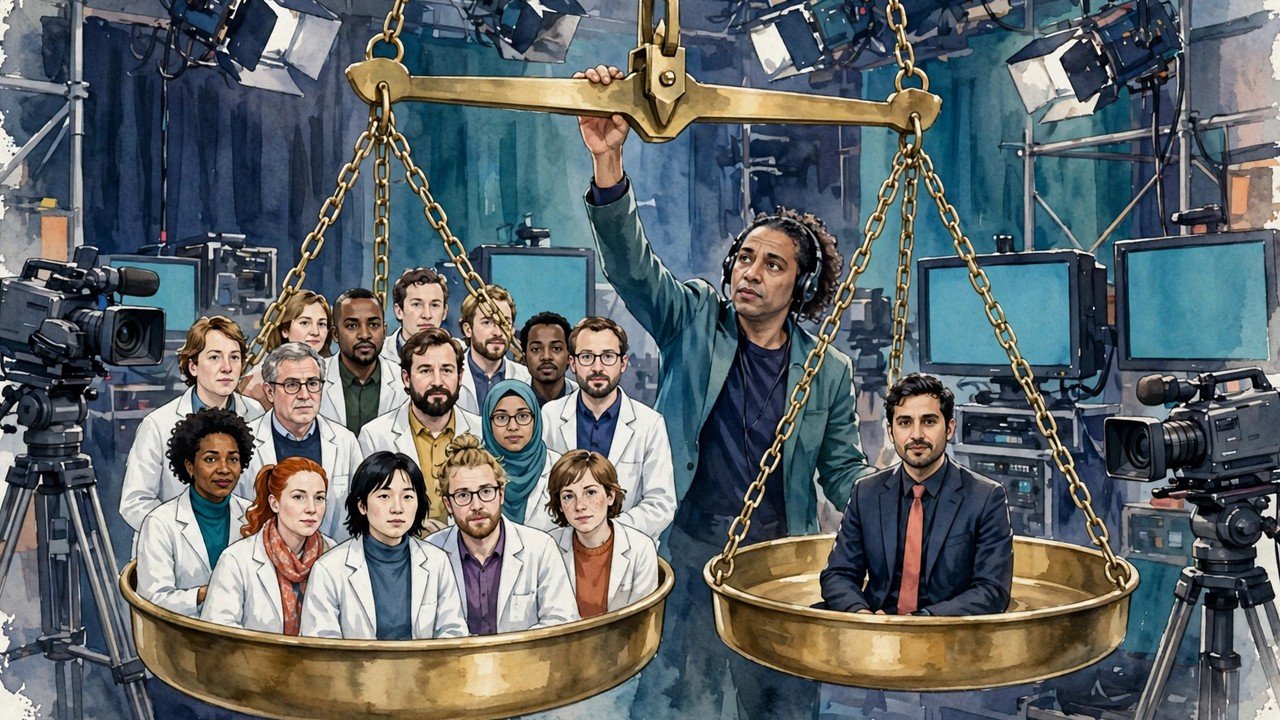
False balance is the presentation of two positions as roughly equal in weight when the evidence behind them is not equal. One scientist speaks for a field, one sceptic against it, each given the same thirty seconds and the same respectful introduction, and the audience goes away believing the question is split down the middle — when the literature may run ninety-seven to three. The site’s glossary lists the habit under bothsidesism: treating every question as though it had two sides of equal standing.
The norm it exploits is a real one. Balanced reporting — hearing the other side, putting the allegation to the accused — is a genuine discipline of journalism, and on contested questions of policy it is indispensable. The distortion enters when balance becomes a substitute for judgement: when the weighing is done by counting voices in the studio rather than by weighing the evidence outside it. What results is a misrepresentation not of any single claim but of the state of the debate itself, and it is the delivery mechanism through which manufactured doubt reaches its audience. The merchants of doubt rarely need to win an argument. They need only to be booked as the other side of one.
How it tends to work
- The paired booking. Two guests, one per side, whatever the numbers behind each — a format decision that manufactures parity before a word is spoken.
- The symmetrical headline. “Scientists divided” where the division is one laboratory against a discipline.
- The unmarked contrarian. The dissenting voice introduced by name and title alone, with no mention of how many share the view or who funds it.
- Balance as pressure. Organised complaints and threats of regulatory trouble demanding equal time — knowing the newsroom’s own norm, once invoked, does the rest.
The documented record — tobacco first, then climate
The pattern is older than the science it is now most associated with. From the early 1950s, as evidence linking smoking to cancer accumulated, the industry organised to keep the question looking open. Working through the Tobacco Industry Research Committee, set up with the public relations firm Hill & Knowlton, its strategists urged scepticism about the statistics and supplied journalists with lists of independent sceptics to consult — in the strategy’s own terms, to ensure balance in their presentations. Demanding balanced reporting was one of the campaign’s stated methods, and it worked for decades: a controversy that must always be reported from both sides never has to be reported as settled. Tobacco in Australia, “Mechanisms of influence — media relations” — the industry’s documented media strategy (opens in a new tab)
The climate version was measured rather than remembered. In a study published in Global Environmental Change in 2004, Maxwell T. Boykoff and Jules M. Boykoff content-analysed global-warming coverage in the four US prestige papers — the New York Times, Washington Post, Los Angeles Times and Wall Street Journal — from 1988 to 2002. Of the articles addressing whether humans contribute to warming, 52.65 per cent gave roughly equal attention to the consensus and to the view that warming was exclusively natural. Their conclusion is in their title — balance as bias: adherence to the norm of balanced reporting had produced informationally biased coverage, a significant divergence between what the public read and what the science said. A handful of contrarians, some veterans of the tobacco campaigns, had been awarded the same prominence as a worldwide assessment process involving thousands of scientists — not because any editor endorsed them, but because the format required a second side and they were available to fill it. Boykoff and Boykoff, “Balance as bias — global warming and the US prestige press”, Global Environmental Change 14 (2004) (opens in a new tab)
Where it sits — balance is not the enemy
None of this makes balance a vice. On a genuinely open question — a choice between policies, a disputed interpretation of events, a science still in its first unsettled years — presenting the strongest competing accounts fairly is the whole of the job, and suppressing a minority view for being a minority would be the opposite failure. The failure specific to false balance is a confusion of categories: applying the etiquette of political controversy, where two parties may legitimately stand near-equal in public support, to empirical questions, where standing is earned by evidence and can be counted. A vote is split by heads; a literature is not.
The corrective developed since the Boykoffs wrote is weight rather than silence. Contrarian voices still appear, but labelled with their standing — how many specialists share the position, who pays for the research — and given space in something like proportion to the evidence behind them. The reader’s corresponding discipline is to ask, of any balanced-looking item, which kind of question is being balanced. If the question is what should be done, parity may be honest. If the question is what is the case, parity is a claim — and it needs evidence of its own.
How to spot it
- Count the voices, then count the evidence. If the coverage runs fifty-fifty, ask what proportion the underlying assessments would give. A gap between the two numbers is the technique, made measurable.
- Check the contrarian’s standing. Relevant expertise, a record in the field, funding from an interested party — the details the format has no slot for decide how much the dissent weighs.
- Listen for the controversy frame. “Still debated” and “critics say”, attached to a finding with no new evidence in the piece, mark a debate being maintained rather than reported.
- Notice the pairing. One-for-one booking, matching quotes, mirrored paragraphs — symmetry of presentation is a production choice, not a measurement of the world.
- Ask who benefits from an open question. A settled question that stays looking open is worth money to somebody: the side that cannot win the argument gains most from it never ending.


