The Media System
Manufacturing Doubt
A third strategy, beside lying and distraction — producing uncertainty about settled evidence so that action is delayed, without the false claim ever having to win. The tobacco industry is its founding case.
Contents ▾0% read
What the technique is
Manufacturing doubt is the deliberate production of uncertainty about evidence that is, in substance, settled — not in order to persuade anyone of a rival claim, but to delay what the evidence would otherwise cause: regulation, litigation, a change in buying habits. It differs from disinformation, which spreads a falsehood and needs people to believe it, and from distraction, which buries a story under other stories. Doubt needs neither. It succeeds while the argument is still going on, because its product is not a conclusion but a postponement: the science is not settled, more research is needed, both sides should be heard.
The asymmetry is the mechanism. Settled evidence has to be defended at the standard of proof; doubt only has to be raised at the standard of a question. A single funded study, a single dissenting expert, a single unresolved detail can be presented as a controversy — and a controversy, reported under the ordinary rules of balance, reads to the public as a coin still spinning. The glossary calls the milder, everyday version FUD — fear, uncertainty and doubt — and the journalistic habit that amplifies it bothsidesism: treating two sides as equally supported when the evidence is not evenly stacked.
How it tends to work
- An apparently independent scientific body. The interested party funds a research committee, institute or council with a neutral name, staffed by credentialed scientists, which then speaks in place of the party itself.
- Sponsored research with a set objective. Studies and reviews are commissioned whose questions are framed in advance, so that the literature appears divided even where working scientists are not.
- The demand for certainty. “No proof” is repeated as though proof, in the absolute sense, were the normal standard for acting on evidence — while the party’s own position is asserted without any standard at all.
- Controversy as the goal. Success is measured not by winning the scientific argument but by establishing that an argument exists, so that journalists, regulators and courts feel obliged to wait.
The founding case — tobacco, 1953–54
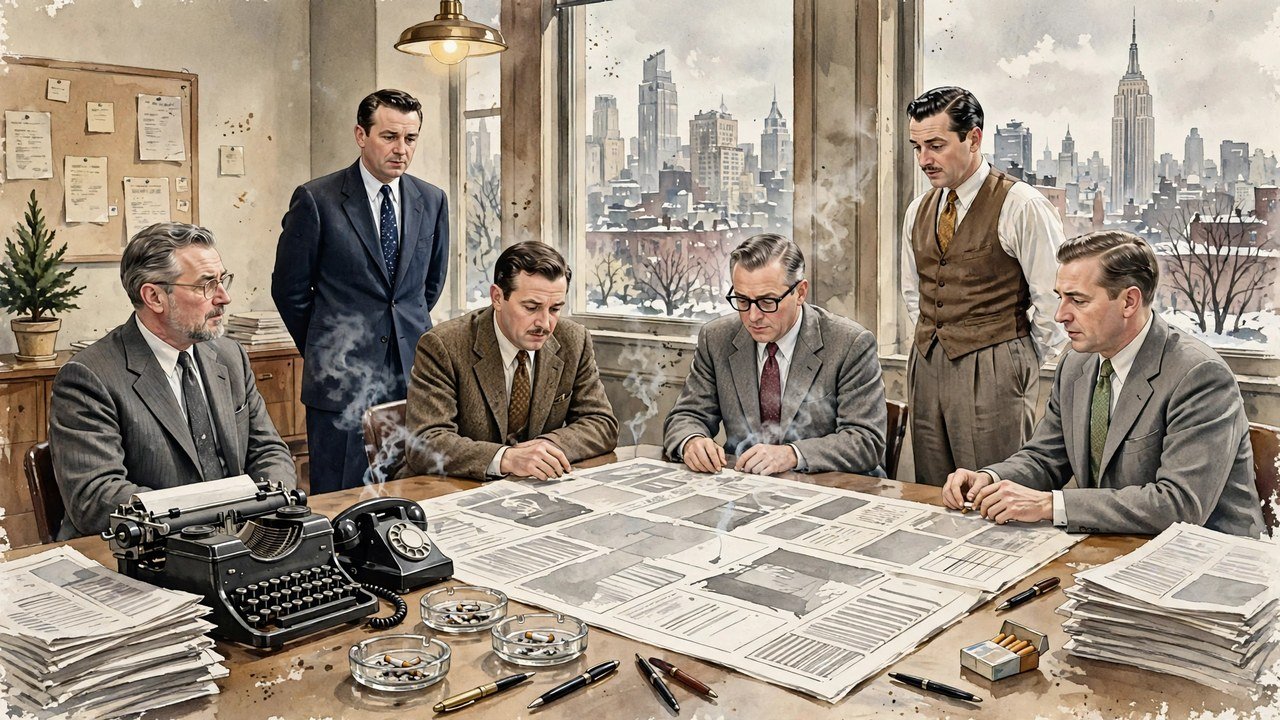
The pattern was built, self-consciously and on advice, in a few weeks at the end of 1953. Epidemiological studies linking cigarette smoking to lung cancer — notably by Richard Doll and Austin Bradford Hill in Britain and by Ernst Wynder and Evarts Graham in the United States — had been published from 1950, and in December 1953 Wynder, Graham and Adele Croninger published the first laboratory production of cancers in mice painted with cigarette tar — a result Graham told Time had proved “beyond any doubt” that something in cigarette smoke could produce cancer, and which drew wide press coverage. The presidents of the major American tobacco companies met at the Plaza Hotel in New York on 14 December 1953 and jointly engaged the public relations firm Hill & Knowlton. The operator’s side of that meeting is told in The big PR and advertising companies; what concerns this page is the technique the firm designed.
Hill & Knowlton’s advice was not to dispute the science head-on. It was to build an apparently independent scientific body — the Tobacco Industry Research Committee — and to announce it as an act of candour. On 4 January 1954 the committee published “A Frank Statement to Cigarette Smokers”, a full-page advertisement carried in 448 newspapers and reaching an estimated 43 million people. Allan M. Brandt, “Inventing Conflicts of Interest: A History of Tobacco Industry Tactics”, American Journal of Public Health (2012) (opens in a new tab) Tobacco Tactics (University of Bath), “Tobacco Industry Research Committee” (opens in a new tab)
Read the statement’s structure, because it became the template. It concedes concern (“we accept an interest in people’s health as a basic responsibility, paramount to every other consideration in our business”). It asserts innocence (“We believe the products we make are not injurious to health”). It lists what “distinguished authorities point out”: that there are many possible causes of lung cancer, that “there is no agreement among the authorities regarding what the cause is”, that “there is no proof that cigarette smoking is one of the causes”, and that the statistics themselves are questioned by numerous scientists. And it promises remedy by research: a joint industry committee, directed by “a scientist of unimpeachable integrity and national repute”, advised by scientists “disinterested in the cigarette industry”. Tobacco Industry Research Committee, “A Frank Statement to Cigarette Smokers” (4 January 1954), text at UCSF Truth Tobacco Industry Documents (opens in a new tab) Every element is present in the first outing: the front body, the credentialed front man, the appeal to disagreement among authorities, and the conversion of a demand for action into a promise of further study.
The committee — later renamed the Council for Tobacco Research — was shaped and run by Hill & Knowlton and housed a floor below the firm’s own offices. The strategy ran, in changing forms, for four decades, through the US Surgeon General’s 1964 report and long after the scientific question it purported to keep open had closed.
The archive becomes evidence
Manufacturing doubt usually leaves no confession. Tobacco left millions of pages of them. Internal industry documents, released through American litigation in the 1990s and through the 1998 Master Settlement Agreement, are held in the UCSF Truth Tobacco Industry Documents library, where anyone can read them. Truth Tobacco Industry Documents, University of California, San Francisco (opens in a new tab)
The best-known single document is an internal Brown & Williamson proposal of 1969, “Smoking and Health Proposal”, which states the strategy as a marketing objective: “Doubt is our product since it is the best means of competing with the ‘body of fact’ that exists in the mind of the general public. It is also the means of establishing a controversy.” The same document is candid about the limit: the company could not claim cigarettes were good for health, because no information supported such a claim — doubt was both the product and the limit of the product. The document, Bates no. 690010951-0959, was an exhibit in the federal government’s case and is quoted in the court’s findings of fact. Tobacco Tactics (University of Bath), “Influencing Science: Creating Doubt about Scientific Evidence” (opens in a new tab)
That case, United States v. Philip Morris, ended in 2006 with Judge Gladys Kessler’s judgment setting out, in some 1,700 pages of findings of fact, how the major American cigarette companies had engaged in a decades-long scheme to defraud the public about the health effects of smoking — including by denying causation they internally accepted, and by maintaining the appearance of an open scientific question. The judgment matters to this page for a practical reason: it is the point at which “manufacturing doubt” stops being a critic’s characterisation and becomes a court’s finding, on documents the industry itself wrote.
The pattern repeats — sugar and Harvard, 1965–67
Tobacco was the founding case, not the only one, and the second-best documented strand involves no front committee at all — only a literature review. In 2016, Cristin Kearns, Laura Schmidt and Stanton Glantz published in JAMA Internal Medicine a reconstruction, from the Sugar Research Foundation’s internal documents, of the foundation’s first coronary heart disease research project. The SRF sponsored the project in 1965: a literature review, published in the New England Journal of Medicine in 1967, which singled out fat and cholesterol as the dietary causes of coronary heart disease and downplayed the evidence that sucrose was also a risk factor. Kearns, Schmidt and Glantz, “Sugar Industry and Coronary Heart Disease Research: A Historical Analysis of Internal Industry Documents”, JAMA Internal Medicine (2016) (opens in a new tab)
The documents show the sponsor’s hand at each stage. The SRF set the review’s objective, contributed articles for inclusion, and received drafts; the review’s Harvard authors — Robert McGandy, D. Mark Hegsted and Fredrick Stare — were paid by the foundation, a fact and a funding source the journal did not disclose, as disclosure was not then required. The payment was about $6,500, roughly $48,000 in 2016 dollars. Scientific American, “Sugar Industry Secretly Paid for Favorable Harvard Research” (2016) (opens in a new tab) Kearns and her co-authors conclude that the industry sponsored a research programme in the 1960s and 1970s that successfully cast doubt on the hazards of sucrose while promoting fat as the dietary culprit — and they note the limit of their own evidence: the principals were dead and could not be interviewed, and there is no evidence the SRF edited the published manuscript directly. The influence was in the commissioning, the framing and the selection, which is precisely how the technique normally works.
The terms for it
Two pieces of vocabulary have stuck. Naomi Oreskes and Erik M. Conway’s Merchants of Doubt (2010) traced how a small number of scientists-for-hire carried the tobacco pattern into later controversies, and gave the trade its enduring name. The historian Robert Proctor coined agnotology for the study of culturally induced ignorance — ignorance not as a simple absence of knowledge, but as something produced, by identifiable actors, for identifiable reasons. The glossary carries the term: agnotology. Both framings make the same point this page’s cases make from documents: doubt of this kind is manufactured, in the ordinary industrial sense — designed, funded, staffed and distributed.
How to spot it
- Ask what the claim of uncertainty is for. “More research is needed” is sometimes true and sometimes a holding position. The tell is whether any imaginable research result would be accepted as settling the question — by the party demanding more of it.
- Follow the body, not the name. A research committee, institute or council with a scientific name may be a front: check who funds it, who appointed its director, and where its offices are. The Tobacco Industry Research Committee was run from its PR firm’s building.
- Compare the standards being applied. Doubt campaigns demand proof from the evidence they oppose and mere plausibility from their own position — in 1954, “no proof” from epidemiology, and an unsupported “not injurious to health” from the industry, in the same advertisement.
- Watch the word “controversy”. Establishing that a controversy exists was the stated objective in the industry’s own 1969 document. Where coverage reports a controversy, ask whether it exists among working scientists or only among funded spokesmen.
- Check whether the dissenting experts are speaking in their field, publishing in its journals, and disclosing who pays them. The sugar review’s authority came from Harvard letterhead; its funding was invisible to its readers for fifty years.
What you can do
- Treat delay itself as a possible objective. When a debate seems designed never to end, ask who benefits from each year it continues.
- Prefer the archive to the argument. In both cases on this page, the decisive evidence was not a better study but the sponsor’s own documents — many of them now in public libraries built from litigation.
- Read consensus statements for what they are: a report that a field has converged is evidence, not a press release, and a lone dissent is not automatically its equal.
- When you cite uncertainty, cite its provenance too — who first raised it, who funds its repetition, and what they said in private, if the record holds it.