
Reader's Defence
The Wisdom of Proverbs
Proverbs is the Hebrew Bible's training manual for the tongue — how speech heals and wounds, how flattery, gossip and bribes bend judgement, and how counsel, timing and rebuke form a reader manipulation cannot easily move.
Contents ▾0% read
- 1. A Book Among the Writings
- 2. How the Sayings Work
- 3. A Book That Trained Readers
- 4. Life and Death in the Tongue
- 5. The Timely Word and the Soft Answer
- 6. Flattery and the Flatterers Net
- 7. The Talebearer and the Whisperer
- 8. Gifts That Blind
- 9. Counsel and the Multitude of Counsellors
- 10. Rebuke and the Ear That Hears It
- 11. The Scoffer the Fool and the Simple
- 12. Hasty Speech and the Unheard Case
- 13. The Kindling of Quarrels
- 14. The Sluggards Self Persuasion
- 15. Pride and the Deceived Heart
- 16. Two Voices at the City Gate
- 17. Speech Before Kings
- 18. A Curriculum Against Manipulation
- References
Most books in the Hebrew Bible tell a story or deliver an oracle. The book of Proverbs does something quieter and, in the long run, harder to escape. It trains the ear. Set in the Writings, the Ketuvim, as the largest surviving collection of Israel’s wisdom teaching, it is built almost entirely out of speech about speech — sayings about tongues, lips, counsel, rebuke, flattery, gossip and gifts, arranged so that a reader who absorbs them has heard every common move of persuasion before he meets it in life. That is the claim this essay examines, and it is why the book belongs on a site about persuasion. Proverbs is not a book about rhetoric in the Greek sense. It has no theory of audiences and no taxonomy of arguments. What it has instead is a complete moral anatomy of the spoken word, built up saying by saying across centuries of collection, and a training method — memorised sentences, absorbed young, tested against experience — designed to form a person whom flattery cannot easily flatter, whom gossip cannot easily recruit, and whom haste cannot easily stampede.
The reading offered here follows the text closely and takes its principles in the order the book itself presses them: first the book’s own history and form, then the tongue and its power, then the great corrupting techniques the sages name — flattery, talebearing, the blinding gift — then the disciplines that resist them, counsel, rebuke and listening, then the inner persuaders, the sluggard’s excuses and the proud heart, and finally the two voices that compete for the young man at the city gate and the strange discipline of speech before kings. The modern commentaries drawn on throughout are those of Michael V. Fox78, Bruce K. Waltke79 and Tremper Longman III80, alongside the text itself in the American Standard Version. Readers who know this site’s companion studies will find the same habits of speech examined from the receiving end in Seven Things God Hates, in Foolish Controversies Breed Quarrels and in the practical discipline of How to Check a Story; what Proverbs adds is the oldest and most systematic account of why those habits work.
A Book Among the Writings
The book called Proverbs in English Bibles takes its Hebrew name from its first word. Mishlei is the construct form of mashal, a saying, comparison or rule of conduct, and the opening superscription attaches those sayings to Solomon son of David, king of Israel. The English title follows a different route. It comes through the Latin proverbia, a rendering of the Greek title Paroimiai used in the Septuagint, and it narrows attention to the short sentence, although the Hebrew book contains much more than sentences. It contains long discourses, a father’s repeated instruction to a son, collections introduced as the words of the wise, sayings ascribed to men otherwise unknown, a confession by Agur, counsel given to a king by his mother, and a closing alphabetic poem. To read it only as a string of detachable quotations is to miss the editorial work that placed those forms side by side and made them interpret one another.
In the Hebrew Bible, the Tanakh, Proverbs belongs to the third division, the Ketuvim, the Writings. The Torah, the five books of Moses, stands first, and the Nevi’im, the Prophets, second. The Ketuvim is the most varied of the three divisions. It gathers psalms and prayers, narrative books such as Ruth, Esther and Daniel, the histories retold in Chronicles, Ezra and Nehemiah, and the books most closely associated with reflection on the order and disorder of lived experience. Within most printed Hebrew Bibles Proverbs follows Psalms and precedes Job, although the order of the Writings was not fixed in every manuscript tradition, and ancient lists differ. That placement matters for reading. Set after Psalms, Proverbs shares vocabulary of righteousness, wickedness, blessing and the fear of Jehovah, yet it speaks less often in direct prayer and more often in observation, warning and counsel. Set before Job in that common order, it presents a world in which conduct ordinarily carries consequences, before Job presses the cases in which the righteous suffer and the expected pattern breaks down.
Scholars group Proverbs with Job and Ecclesiastes as the principal wisdom books of the Hebrew Bible, with the Song of Songs sometimes placed nearby in discussion because of its traditional Solomonic association and its place in the Ketuvim. Wisdom here translates the Hebrew hokmah, a word whose range is wider than intellectual cleverness. In Exodus it describes the skill of craftsmen who made the tabernacle and its furnishings. In the narratives of kings it describes practical judgement in government. In Proverbs it includes moral discernment, self-command, skill in speech, the ability to read people and situations, and reverence towards God. Its opposite is not simply ignorance. Folly in Proverbs is a settled disposition. The fool despises instruction, loves simplicity, speaks before listening, repeats error like a dog returning to its vomit, and treats correction as an insult. The wise person, by contrast, remains teachable after becoming knowledgeable.
The book announces its own purposes at length before it gives a single freestanding proverb. The prologue in chapter 1, verses 2 to 6, is a chain of infinitive clauses, each adding a capacity the collection is meant to form. It is not presented as entertainment, nor as a store of lucky sayings to be consulted at need. It is presented as training in perception and conduct, addressed both to the inexperienced, who need prudence, and to the already wise, who are expected to increase in learning.
To know wisdom and instruction; To discern the words of understanding; To receive instruction in wise dealing, In righteousness and justice and equity; To give prudence to the simple, To the young man knowledge and discretion: That the wise man may hear, and increase in learning; And that the man of understanding may attain unto sound counsels: To understand a proverb, and a figure, The words of the wise, and their dark sayings.1
Proverbs 1:2-6 — American Standard Version
The next verse gives that training a theological foundation rather than a merely prudential one.
The fear of Jehovah is the beginning of knowledge; [But] the foolish despise wisdom and instruction.2
Proverbs 1:7 — American Standard Version
The phrase rendered fear of Jehovah does not mean terror alone, although awe is part of it. In the usage of Proverbs it means a governing reverence that orders every other judgement. It recurs at decisive points, including the close of the opening discourses in chapter 9, where it is called the beginning of wisdom. The repetition is structural. However practical a saying becomes — about surety, sloth, quarrels, drink, weights, bribery or the management of a household — the book refuses to treat practical skill as self-sufficient. A person may be shrewd and still be a fool if that shrewdness serves appetite, pride or injustice. Wisdom begins before technique, in the recognition that human beings live under a moral order they did not invent.
Chapters 1 to 9 form the book’s long front porch, and they differ markedly from what follows. Instead of isolated sentences, the reader meets ten or so discourses, most cast as a father speaking to a son, interspersed with speeches by personified Wisdom and warnings against personified Folly and the strange woman, whose speech is smooth and whose house leads down to death. The exact division of the discourses is debated, because headings are not supplied, but the movement is clear. Chapter 1 warns against joining violent men who promise quick gain. Chapters 2 to 4 set out the search for wisdom as a disciplined pursuit. Chapter 5 warns against adultery, and chapter 6 gathers warnings against surety, sloth and the troublemaker before returning to adultery. In chapter 7 the father tells a story, watched from a window, of a young man lacking sense drawn towards a prepared house. In chapter 8 Wisdom speaks in her own voice at the city gates, claiming a role in creation itself beside God. In chapter 9 Wisdom and Folly each build a house, prepare a feast and issue the same invitation to the simple, and the reader must tell the two voices apart by their ends.
That opening section does interpretative work for the whole book. The sentence collections that follow rarely pause to explain why a proverb should be believed, or what to do when two sayings pull in different directions. Chapters 1 to 9 supply the character who can use them. The son is told to bind instruction on his heart, to trust in Jehovah rather than leaning on his own understanding, and to guard his heart because the issues of life flow from it. The discourses also establish the book’s central contest as a contest of voices. A father speaks. Wisdom cries aloud in the street. Sinners entice. The adulteress flatters. Folly calls from the high places of the city. Long before a modern reader reaches for a vocabulary of influence, Proverbs has already framed life as a competition among speakers for the ear of the inexperienced, and it trains the listener by making him rehearse, in advance, what each voice promises and where each road ends.
At chapter 10 the texture changes abruptly. A new superscription marks the start of the largest collection in the book, running from 10:1 to 22:16. These are predominantly single-verse sayings of two lines each, most of them antithetic, setting the righteous against the wicked, the wise against the foolish, the diligent against the sluggard, the controlled tongue against the babbling one. From there the collection ranges without topical headings. Treasures of wickedness, the blessing of Jehovah, the memory of the just, hatred stirring up strife and love covering transgressions — the subjects arrive in quick succession, and any order they possess is a matter of catchwords, repeated images and small clusters rather than chapters on themes. A saying read beside its neighbours acquires shades it does not carry alone, a point the book’s editors seem to have understood when they left clusters on the tongue, on wealth and on the king standing together in several places.
The superscription at 10:1 names Solomon, as 1:1 does. At 22:17 the voice changes and the reader is told, without a personal name in the heading itself, to bow down the ear and hear the words of the wise. The section that follows, 22:17 to 24:22, is cast as sustained instruction rather than isolated sentences. It addresses a single pupil in the second person, gives reasons for its commands, and contains the prohibition of moving the ancient landmark, the warning against joining those given to wine and gluttony, and the counsel not to rejoice when an enemy falls. An appendix follows at 24:23, introduced as sayings also of the wise, and runs to the end of chapter 24. It includes the warning against false witness and the picture of the sluggard’s field overgrown with thorns. The two wise sections together are shorter than the Solomonic sentences they follow, but their sustained address gives them a different weight. They speak less like a treasury and more like a teacher who knows one pupil’s temptations by name.
Chapter 25 opens with the book’s most historically specific superscription, and it is the only one that describes an act of transmission rather than an act of authorship.
These also are proverbs of Solomon, which the men of Hezekiah king of Judah copied out.3
Proverbs 25:1 — American Standard Version
Hezekiah reigned in Judah in the late eighth and early seventh centuries BC, and the notice presents his men — scribes or court officials — as collectors and copyists who preserved older material. Whether the notice records the moment when chapters 25 to 29 were first assembled, or an older tradition about their editing, it shows that the book’s own makers understood proverb-making as a process across generations. Sayings were composed, gathered, copied and rearranged. The collection in chapters 25 to 29 differs in feel from 10:1 to 22:16. Similes become more frequent. A word fitly spoken, a cloud without rain, a man without self-control like a city broken down and without walls, snow in summer and rain in harvest — the imagery lengthens, and clusters on kingship, on the fool, on the neighbour and on speech run for several verses at a time. Chapter 26 is almost a small treatise on the fool, and chapter 27 contains sustained reflection on friendship, including the image of iron sharpening iron.
Chapter 30 is headed as the words of Agur the son of Jakeh. Nothing secure is known of Agur outside this chapter, and attempts to identify him remain conjectural. The chapter opens with a confession of ignorance more radical than anything elsewhere in the book — Agur describes himself as more brutish than any man — and moves to questions about who has ascended into heaven and come down, who has gathered the wind in his fists, who has bound the waters in his garment. It contains a prayer for two things, removal of falsehood and lying, and neither poverty nor riches, lest fullness lead to denial or poverty to theft. It also contains the book’s best-known numerical sayings, listing things that are never satisfied, things too wonderful to understand, and things that are stately in their going. A voice that begins by disowning wisdom ends by displaying the form at its most artful, and the editors placed it near the close without smoothing the tension.
Chapter 31 begins as the words of Lemuel, a king, described as an oracle that his mother taught him. Lemuel, like Agur, is otherwise unknown, and proposals linking the name to a north Arabian king or treating it as symbolic are not provable from the text. The mother’s counsel is brief and pointed. She warns her son against giving his strength to women and to the ways that destroy kings, and against judging under the influence of wine lest he pervert the justice due to the afflicted, and she commands him to open his mouth for the dumb and plead the cause of the poor and needy. Royal power, in this short instruction, is measured by speech used on behalf of people who cannot command a hearing. It is one of the few places in the book where counsel is explicitly given by a woman in her own authority as teacher, Wisdom’s speeches in chapters 1 to 9 being the great exception that frames the whole.
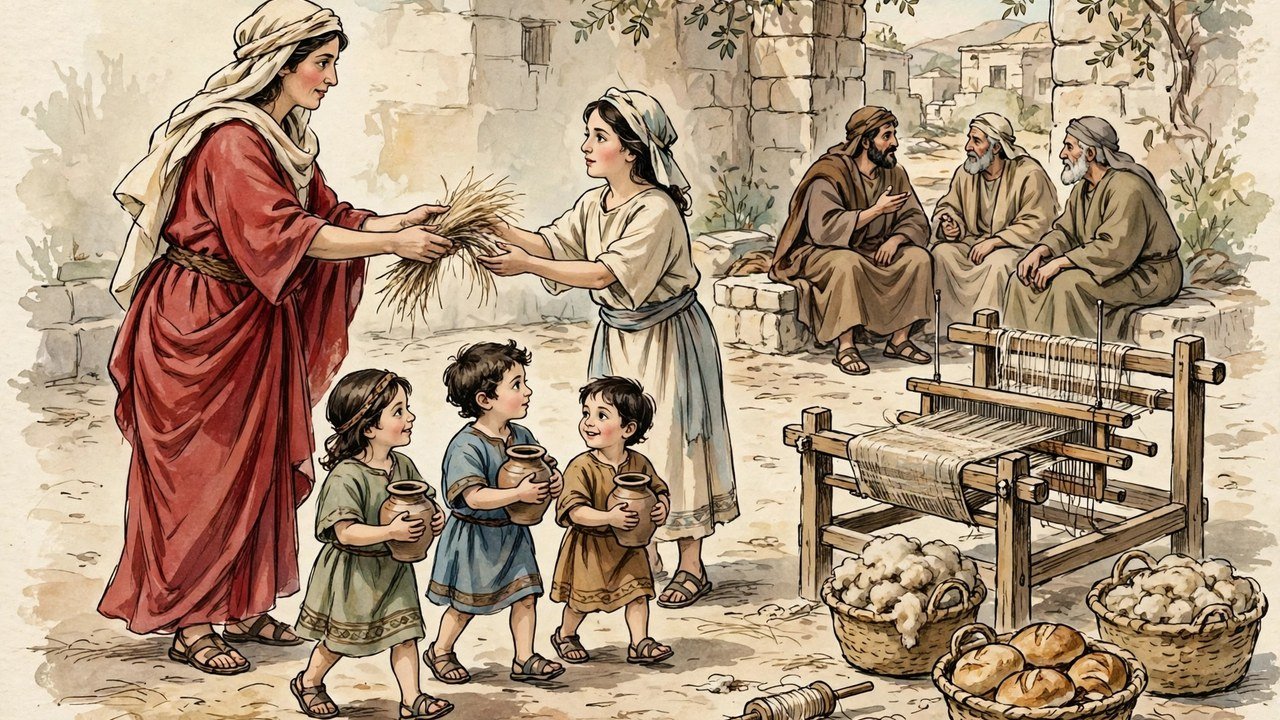
The book then closes, from 31:10 to the end, with a poem of twenty-two verses, one for each letter of the Hebrew alphabet in sequence. Acrostic composition of this kind appears elsewhere in the Ketuvim, in Psalms and in Lamentations, and it serves both as a display of completeness — the subject treated from aleph to tav, from first letter to last — and as an aid to memory. The subject is the woman of valour, the eshet hayil, whose price is said to be far above rubies. The poem describes an economically active household manager. She seeks wool and flax, rises while it is still night, considers a field and buys it, plants a vineyard from her earnings, extends her hand to the poor, and sells garments to the merchant. Her husband is known in the gates, where he sits among the elders of the land. The poem’s praise is not for seclusion or silence. It praises strength, foresight, work, generosity and speech, for she opens her mouth with wisdom and the law of kindness is on her tongue. Set where it is, the poem answers the book’s opening. The father warned his son against the woman whose feet do not abide in her house. The closing poem shows what to recognise and honour instead, and it gives the book’s last word on wisdom to a woman whose whole life embodies it in work rather than in sayings about work.
The superscriptions deserve attention in their own right, because they are the book’s internal account of itself. There are seven principal headings or heading-like notices: the general title in 1:1, the renewed Solomonic heading at 10:1, the invitation to hear the words of the wise at 22:17, the further heading for the wise at 24:23, the Hezekiah notice at 25:1, the words of Agur at 30:1 and the words of Lemuel at 31:1. Together they present the book frankly as an anthology. It does not claim that one man wrote every line in one period. It claims a centre of gravity — Solomon, the king remembered in 1 Kings as speaking three thousand proverbs and as the patron of wisdom at court — surrounded by other named and unnamed teachers whose sayings were judged worthy to stand in the same collection. Ancient attribution often worked in this way. A collection could bear the name of its founder, patron or dominant voice while openly incorporating the work of successors, in the same way that the Psalter bears David’s name across psalms ascribed within it to Asaph, to the sons of Korah and to others.
The Solomonic association itself rests on the portrait in 1 Kings, where Solomon’s wisdom is said to have surpassed the wisdom of the men of the east and of Egypt, where his proverbs and songs are numbered in thousands, and where the Queen of Sheba comes to test him with hard questions. That portrait explains why later collectors would gather wisdom under his name, and why a king’s court is the social setting the book most often assumes. The sayings speak repeatedly of standing before kings, of a ruler’s favour and wrath, and of the danger of hasty speech in a ruler’s presence. Yet the book also addresses farmers, parents, neighbours, borrowers, witnesses, merchants and the poor, and much of its material reads as the distilled observation of village and household life rather than court composition. Both settings can be true of an anthology formed over centuries. Material of varied origin can be gathered, edited and preserved in the scribal circles that a court sustained.
Dating the book, or any part of it, is therefore a matter on which careful writing must refuse false precision. No manuscript of Proverbs survives from anywhere near the period of composition, and the internal evidence points in more than one direction. The Hezekiah notice, taken at face value, implies that a substantial Solomonic collection already existed to be copied in the late eighth century BC, and that chapters 25 to 29 reached their present form no earlier than his reign. Some sayings may be older still; proverbial material is by nature conservative, travelling orally before and alongside writing, and a saying’s age cannot be read off from the age of the collection that preserves it. Other evidence points later. The developed personification of Wisdom in chapter 8, speaking of her presence before and during creation, is widely regarded as a sophisticated theological composition. Aramaic influence on the language of some passages, and features of vocabulary and syntax in chapters 1 to 9 and 30 to 31, have led many scholars to place the final shaping of those sections in the Persian period or later, after the exile. Other scholars defend earlier dates for substantial parts of the discourses. The honest position is a range rather than a year. Core sentence collections are commonly placed in the monarchic period, the book’s editing and framing are commonly placed later, and the completed book existed well before the second century BC, by which time it was being treated as established scripture, and fragments of it were being copied at Qumran.
Two cautions follow from that range. A late editorial date for a section does not make its contents late inventions: editors of proverbs preserve, and the Hezekiah notice boasts of copying rather than composing. And an early origin for a saying does not settle how it reads in its present place. A sentence about the king means one thing spoken in a kingdom and another read in a province ruled from elsewhere, where it becomes instruction in how to behave before any power. Proverbs reached its readers as a layered book — royal in its associations, scribal in its preservation, domestic in much of its address — and its authority did not depend on resolving the layers into a single date. It depended on the claim made in the prologue, tested across thirty-one chapters, that these sayings, heard and practised, form a person who can discern words, weigh counsel and speak at the right time in the right way.
How the Sayings Work
A proverb in Proverbs is not a slogan. It is a compressed act of judgement, built to be carried in the memory and applied to a case its maker never saw. The Hebrew word behind it, mashal, has a wider range than the English word proverb suggests. Its root is associated with likeness and comparison, and the noun is used across the Hebrew Bible for forms that look quite different from one another. Balaam’s oracles in Numbers are called his mashal. Ezekiel tells a mashal about an eagle and a vine and is asked whether hearers will not call it a riddle. Isaiah uses the word for a taunt against the king of Babylon. Job takes up his mashal to begin a long discourse. In Proverbs itself the prologue promises instruction in understanding a mashal and a figure, the words of the wise and their dark sayings. The common thread is not brevity. It is indirection. A mashal says one thing in order to illuminate another, and it requires the hearer to complete the transfer. That requirement is the form’s persuasive engine. A direct command can be obeyed or refused and then forgotten. A comparison lodges, because the mind that works out how the comparison fits has done part of the persuading itself.
The standard unit of the sentence collections is the two-line verse, the bicolon, in which a second line stands in a calculated relation to the first. Hebrew poetry does not rest on end-rhyme, and its metre, if it had one in a strict sense, remains disputed. Its organising device is parallelism, the pairing of lines by sense, grammar and sound. Scholars conventionally distinguish three broad relations, although real verses mix them freely and the labels describe tendencies rather than boxes. In synonymous parallelism the second line restates the first in different words, adding emphasis, a sharper image or a second angle rather than new information. In antithetic parallelism the second line sets the opposite against the first, and the saying teaches by contrast. In synthetic, or complementary, parallelism the second line carries the first forward — completing it, giving its consequence, its reason or its second half — so that the thought is not finished until both lines have been heard together.
Antithetic parallelism dominates chapters 10 to 15, and it is the engine of the book’s moral clarity. A wise son and a foolish son, a righteous mouth and a wicked mouth, diligence and sloth, truthful speech and false witness are set facing each other in line after line until the reader’s eye is trained to sort conduct into the pattern before the mind has formulated a rule. The form does quiet argumentative work. By placing two outcomes in balanced clauses of similar length and shape, it presents the choice between them as symmetrical and therefore as a choice — something for which the chooser is responsible. The world of the antithetic proverb is not a world of forces too large to resist. It is a world in which a soft answer and a grievous word are both available in the same heated moment.
A soft answer turneth away wrath; But a grievous word stirreth up anger.4
Proverbs 15:1 — American Standard Version
Nothing in that verse describes a technique for winning an argument. It describes two speeches and two atmospheres, and it leaves the speaker standing between them. The persuasion lies in the pairing. Read alone, the first line is mild advice. Read against the second, it becomes a claim about causation in human affairs: anger in a room is not only received, it is manufactured, word by word, and it can be unmade by the same means.
Synonymous parallelism works differently, by accumulation. When a saying declares that death and life are in the power of the tongue, the second line does not oppose the first but draws out its consequence for those who love speaking.
Death and life are in the power of the tongue; And they that love it shall eat the fruit thereof.5
Proverbs 18:21 — American Standard Version
The fruit image converts speech from an event into a diet. What a person habitually says becomes what that person must live on. Complementary parallelism can also work by specification, narrowing a general claim until it bites. A saying about many words and transgression finishes by naming the alternative discipline, the restrained lip. The movement from multitude to restraint, within two short lines, enacts the very economy it recommends.
In the multitude of words there wanteth not transgression; But he that refraineth his lips doeth wisely.6
Proverbs 10:19 — American Standard Version
These are aids to memory before they are ornaments. Parallel lines are easier to retain than prose of the same length because each line predicts and confirms the other. A hearer who remembers the first half of an antithetic saying can reconstruct the second, and a hearer who remembers the image can reconstruct the sense. In a culture in which most people encountered texts by hearing them, and in which even the literate carried much of their library in memory, that reconstructability was a technology of transmission. The sayings were built to survive being carried.
Alongside the sentence stands the second great form of the book, the instruction. Sentence literature and instruction literature differ in voice, length and claim. The sentence is anonymous, third-person and descriptive. It states how things generally go: the hand of the diligent makes rich, a false balance is an abomination, pride goes before destruction. It does not address the reader, give a reason or issue a command, and its truth is the truth of a pattern observed often enough to be worth stating. The instruction, concentrated in chapters 1 to 9 and 22 to 24, is second-person, personal and imperative. A father or teacher speaks to a son or pupil, commands attention — hear, incline your ear, do not forget — warns against named dangers, and supports commands with motive clauses, because this will be life to your soul, for her house sinks down to death, lest you give your honour to others. The sentence trusts the reader to draw the application. The instruction draws it in advance and attaches consequences to it. Proverbs needs both forms because persuasion needs both. Observation alone can be admired and ignored. Command alone can be resented and evaded. Set inside a frame of instruction, the sentences acquire a teacher. Set inside a treasury of sentences, the instruction acquires evidence.
The imagery of the sayings is drawn from a small number of densely worked fields, and the repetition is deliberate. Agriculture supplies sowing and reaping, the path and the way, the vineyard neglected and the field of the sluggard, fruit, root and tree. The body supplies the tongue, lips, mouth, ear, eye, heart, hand and foot, so that conduct is always located in organs that can be trained. The household supplies fathers, mothers, sons, servants, neighbours and guests. Commerce supplies scales, weights, surety, debt, wages and merchandise, and the insistence that Jehovah abhors a false balance anchors commercial honesty in worship rather than in custom alone. Warfare and the city supply gates, walls, strongholds and the city broken down without walls as the picture of a man without self-control. Animals supply much of the comedy and much of the sting: the sluggard is sent to the ant, the fool returns to his folly as a dog to its vomit, a golden ring in a swine’s snout becomes the measure of beauty without discretion, and Agur’s stately creatures — the lion, the greyhound or girt-loined creature of the older translations, the he-goat and the king — close the book’s animal register at its most dignified. Because the fields of imagery are limited, images accumulate meaning as they recur. By the time a reader has met the path in fifty sayings, the word alone carries the whole doctrine that lives are journeys with destinations fixed by daily direction rather than by declared intention.
Some sayings work by likeness stated outright, the simile proverbs that become frequent in chapters 25 and 26. As snow in summer and rain in harvest, so honour is not fitting for a fool. As a dog that returns to his vomit, so is a fool who repeats his folly. The simile form is more explicit than the metaphorical sentence and more argumentative. It names the comparison and forces the hearer to grant the first half, which is drawn from common observation, before resisting the second. Nobody disputes that snow in harvest is a disorder in the seasons. The saying borrows that undisputed judgement and spends it on a social case. The most celebrated of these sayings turns the method onto speech itself, praising the right word by picturing it as crafted metalwork.
A word fitly spoken Is [like] apples of gold in network of silver.7
Proverbs 25:11 — American Standard Version
The Hebrew phrase rendered fitly can carry the sense of in its season, or upon its wheels — in either case, aptness and timing rather than eloquence alone. The image joins value to workmanship. A fit word is not found, it is made, and it is made for a setting, as gold fruit is made for a silver filigree that displays it.
Numerical sayings form a distinct and ancient sub-form, concentrated in chapter 30 but present elsewhere, most famously in the list of things Jehovah hates in chapter 6. The pattern gives a number and then a list one longer — six things, yea seven; three things, yea four. The device is not arithmetic decoration. The lower number creates expectation and the higher number satisfies it with a surplus, and the small delay between the announcement and the completion of the list holds attention in a way a plain list cannot. It also gives the list a shape that memory can check. A hearer who knows that four things are coming can tell whether he has retained them all. Agur uses the pattern for things never satisfied, for things too wonderful to be understood — the way of an eagle in the air, of a serpent on a rock, of a ship in the midst of the sea — and for things that move with stateliness. In each case the list teaches by juxtaposition rather than by definition. The items interpret one another, and the category they form — insatiability, mystery, dignity in motion — exists nowhere except in the list itself. The form thus trains a reader to think in gathered instances, which is the basic intellectual movement of the whole book.
No saying in Proverbs, however, was finally left to stand entirely alone, and the clusters matter as much as the units. Editors grouped sayings by catchword, by shared image and by subject, and the groupings create arguments that no single verse makes. Chapter 26 places its sayings about the fool in a dense run, so that the fool is honoured, answered, sent on errands, quoted and compared within a few verses, and the cumulative portrait is of a social problem to be managed rather than a puzzle to be solved. Chapters 16 and 21 gather sayings about the king until a small doctrine of power emerges — the king’s heart as a watercourse in Jehovah’s hand, the king’s wrath as messengers of death, the king who judges the poor faithfully securing his throne. Chapters 11 and 12 return so often to speech, scales and the fate of the righteous that whole stretches can be read as continuous meditation. Clustering also qualifies. A saying about wealth set among sayings about the treachery of riches reads differently from the same saying set among sayings about diligence, and the editors, by their arrangement, became the book’s first commentators.
The sharpest evidence that context governs meaning stands in two adjacent verses of chapter 26, which command opposite actions in nearly identical words.
Answer not a fool according to his folly, Lest thou also be like unto him. Answer a fool according to his folly, Lest he be wise in his own conceit.8
Proverbs 26:4-5 — American Standard Version
Generations of readers have treated the pair as an embarrassment to be explained away. In the logic of the form they are the lesson itself, placed side by side by an editor who cannot have missed the contradiction. A proverb is not a statute. It does not state what must be done in every case; it states what is true in the case it contemplates, and it waits for a reader wise enough to know which case he is in. Some fools must not be answered on their own terms, because answering adopts the terms. Some must be answered precisely on those terms, because silence would leave their folly crowned. The pair therefore performs the book’s central claim about its own genre. The sayings do not replace judgement. They train it, by giving it two true sentences and no rule for choosing between them except the character formed by the rest of the book.
Sound does work that translation can only partly carry. The Hebrew sayings favour short clauses, repeated consonants and wordplay that binds a judgement to its wording. The sluggard, the fool and the scoffer are each named by a cluster of terms that are not interchangeable — the simple, the fool, the hardened fool and the scoffer mark stages of resistance to correction, from inexperience through obstinacy to contempt — and the consistency of that vocabulary across hundreds of sayings builds a cast of recognisable figures. A hearer did not need a definition of the scoffer after meeting him in a dozen scenes, driving out the scoffer to end strife, suffering punishment while the simple watch and learn, loving those who reprove him not at all. Character in Proverbs is taught the way it is taught in life, by repeated encounter, and the form’s economy of types is what allows a two-line saying to invoke a whole history in a single word.
Brevity is what makes all of this portable, and portability is what makes it persuasive across a lifetime. A discourse must be heard in one sitting. A saying can be recalled in a doorway, at a market stall, in the moment before answering a provocation or signing as surety for a stranger. The sayings are short because the situations they govern are short — most failures of speech and temper happen in seconds, faster than an argument can be assembled — and a form meant to intervene in those seconds must arrive whole. Ellipsis helps. The sentences habitually omit connectives, explanations and qualifications, leaving gaps that the hearer’s own experience fills, so that the same saying fits the merchant and the magistrate without alteration. Ambiguity, within limits, does the same work. The book’s sayings about the way, the heart, the tongue and the end of a matter are capacious because their images are capacious. What the form sacrifices is precision about exceptions, and Proverbs knows the cost, which is why it surrounds its sentences with instructions, clusters, counter-sayings and a closing portrait of wisdom embodied. The sentence is the smallest unit of the book’s persuasion, but it was never the whole of it. It was the part designed to be still present, word for word, years after the teacher’s voice had stopped.
A Book That Trained Readers
Proverbs was a book about training before it was a book that was copied, and its transmission preserved the training as well as the text. The Hezekiah notice in chapter 25 is the book’s own earliest account of that process. Sayings attributed to Solomon were, it says, copied out by the men of a king who reigned roughly two and a half centuries after him. Copying in the ancient world was never a mechanical act performed on a finished book. A scribe who copied a collection chose exemplars, resolved damaged passages, sometimes rearranged material and worked within conventions of spelling and layout that changed over time. That Proverbs announces itself as an anthology assembled in stages, and then survived through many further centuries of hand copying, means that its history is written into its form. The clusters, the doublets — sayings that recur in near-identical wording in different collections — and the counter-sayings set side by side are what a living anthology looks like when its custodians value preservation over tidiness.
Doublets deserve a moment of attention, because they are the clearest internal evidence of how the book grew. The saying about a soft tongue breaking a bone and the sayings about the hope deferred, the faithful ambassador, the scoffer and the talebearer recur, in whole or in part, at more than one place in the collections. A modern editor, preparing a book of quotations, would remove duplicates. The editors of Proverbs kept them, and their decision can be read in two ways. A repeated saying may have belonged independently to two source collections, each of which the editors wished to preserve entire. Or a saying may have been deliberately placed twice because it did different work in different company. Either explanation points the same way. The unit of preservation was the collection, not only the individual verse, and the book the reader now holds is a gathering of gatherings, whose seams its makers made no effort to hide.
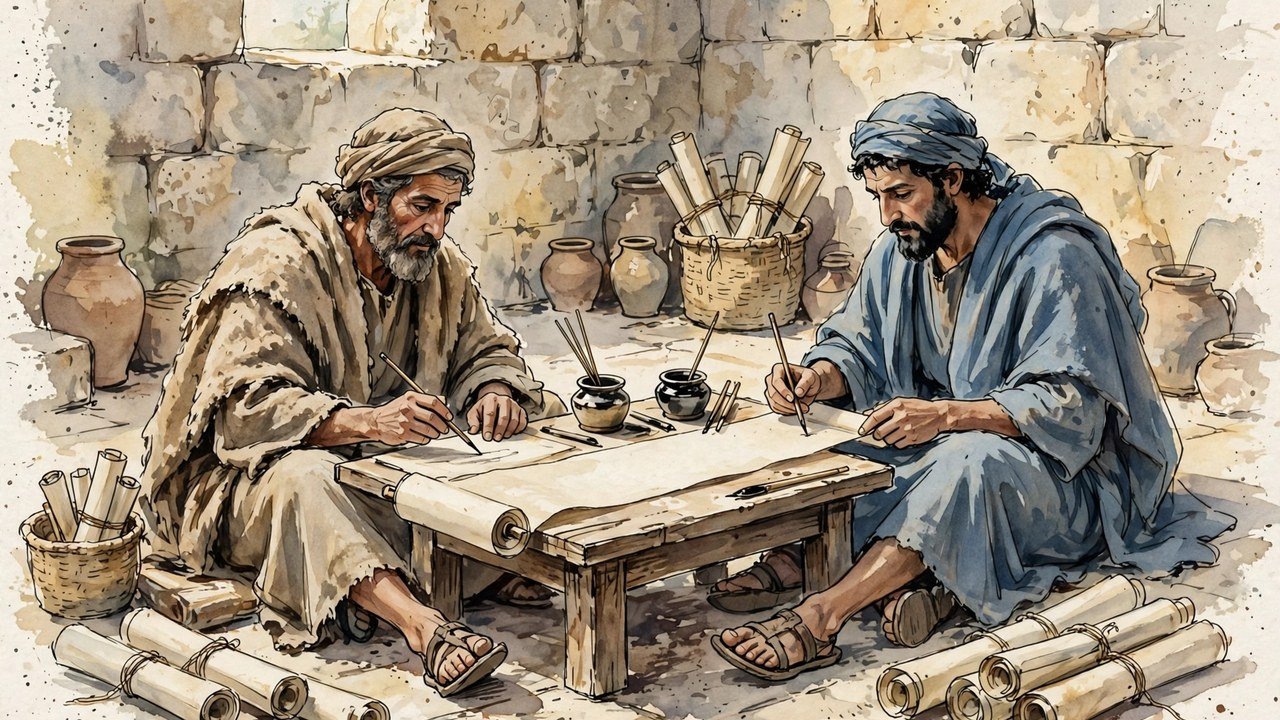
The social setting of that preservation was the scribal profession. In Israel and Judah, as in Egypt and Mesopotamia, literacy was a specialist skill concentrated at court, in temple circles and in administrative families, although the extent of wider literacy remains debated among scholars. Scribes kept accounts, drafted correspondence and treaties, recorded law and chronicle, and were trained, in every neighbouring culture for which curricula survive, by copying model texts — lists, letters, hymns and instructions. Wisdom literature belongs to that classroom world. A young scribe learning his hand on sayings about diligence, restraint of speech, honesty in weights and conduct before superiors was learning his profession’s ethics at the same time as its technique, and the two were not separable. The pupil who copied that the tongue of the wise brings healing, and who was beaten or shamed for careless work in cultures that trained by correction, absorbed the doctrine in his hand. Proverbs never describes its own classroom. It does not need to. Its second-person instructions, its commands to hear and not forget, its promises that instruction will be a chaplet for the head and chains for the neck, are the voice of a teacher addressing a pupil whose formation is the point of the exercise.
The court setting runs alongside the classroom, and the two overlap, because courts were where scribes served. A significant body of sayings concerns the king directly: his favour as a cloud of latter rain, his wrath as the roaring of a lion, the duty of removing the wicked from before him, the danger of eating with a ruler while eyeing his delicacies, the glory of searching a matter out. Other sayings train the courtier rather than the king — in patience that persuades a prince, in gift-giving that makes room for a man, in not exalting oneself in the place of great men but waiting to be called up higher. Read together, these form a curriculum for life conducted near power, where speech is consequential, access is graded and a single careless answer can end a career. That the same book also trains farmers to observe the ant and householders to watch the ways of their households shows the reach the editors claimed for it. The formation that began at court was republished, in the book’s final shape, as formation for Israel at large, with the father of chapters 1 to 9 standing where the court teacher had stood.
The oldest substantial witness to the book’s text is not Hebrew but Greek. The Septuagint, the translation of the Hebrew scriptures produced in stages in the Greek-speaking Jewish world centred on Alexandria, includes a Proverbs that differs from the Masoretic Text — the medieval Hebrew text that stands behind most modern translations — in ways too systematic to be accidents of copying. Whole blocks of chapters 24 to 31 stand in a different order. Sayings appear in the Greek that have no Hebrew counterpart, and Hebrew sayings are absent from the Greek. Individual verses are expanded, abbreviated or rendered so freely that scholars continue to debate, passage by passage, whether the translator worked from a Hebrew text that differed from ours, or exercised a translator’s liberty, or both. The Greek Proverbs is also a more explicitly theological book in places, smoothing difficulties and heightening moral contrasts. None of this makes it a careless witness. It makes it evidence of a stage in the book’s life when its arrangement was still, to some degree, open, and when a translator could also be an editor and teacher of the collection he rendered.
The order difference is the most instructive feature, because it cannot be explained by a slip of the eye. In the Greek arrangement, material from the later chapters is interleaved with the words of Agur and Lemuel in a sequence unlike the Hebrew, which suggests that the closing sections of Proverbs circulated as smaller units that could be assembled in more than one order before the Hebrew arrangement became fixed. Anthologies behave in this way. Their parts have histories of their own. The Dead Sea Scrolls then supply the earliest surviving Hebrew fragments. Two fragmentary manuscripts from Qumran’s Cave 4, conventionally designated 4QProv82a and 4QProvb (4Q102 and 4Q103), preserve small portions of the book, principally from its earlier and middle chapters. The fragments are damaged and cover only a fraction of the whole, so they cannot settle large questions about the book’s early shape. What they do show is that by the late Second Temple period Proverbs was being copied in Hebrew, in the scribal community associated with Qumran, in a text broadly close to the form later preserved in the Masoretic tradition, with the minor variants in wording and spelling that hand copying over centuries produces. Between the Greek translator’s freer Proverbs and the Qumran fragments, the book can be seen at two points of the same long process — still capable of rearrangement in one place, already stable in wording in another.
Canonisation came to Proverbs as it came to the other Writings, gradually and without a single recorded act of adoption. The book is never listed in a surviving decree. Its place is visible instead through use. The prologue written by the grandson of Jesus ben Sira, in the late second century BC, speaks of the Law, the Prophets and the other books of the fathers as an established body of scripture through which his grandfather’s wisdom was formed, and Ben Sira’s own book is saturated with the language and forms of Proverbs. By the first century the book was being copied at Qumran, translated, quoted and argued with as scripture. Rabbinic tradition preserves a memory that its place was not entirely uncomplicated. A discussion in the Babylonian Talmud, in tractate Shabbat, recalls that the sages considered withdrawing Proverbs because its statements seemed to contradict one another, and refrained — the same passage associates the men of Hezekiah with explaining it. Whether or not the memory is historical in detail, it identifies the right difficulty. The adjacent commands to answer a fool and not to answer him are the kind of passage that troubles a community deciding which books teach reliably. That the book was retained, contradictions and all, says something about how its custodians understood it: as a training in judgement whose tensions were part of the training, not as a code whose every sentence must harmonise with every other.
The Egyptian parallel brings the question of training into sharpest focus, because it connects Proverbs to the oldest instructional tradition in its world. Egypt produced instruction literature for well over a thousand years before Proverbs reached its final form. Instructions attributed to viziers and kings — those associated with Ptahhotep, with Kagemni, with Amenemhat — address a son or pupil on speech, silence, conduct at table, dealings with superiors and inferiors, and the virtues of the truly silent man who masters himself. The form of the father’s address in Proverbs, its concern with the disciplined tongue, and its ideal of advancement through restraint rather than self-assertion all belong to this wider instructional culture, which Israel shared with its neighbours and adapted to its own God. Resemblance at that level is general. In one section of Proverbs it becomes specific enough to demand a literary explanation.
The section is the words of the wise, beginning at 22:17, and the Egyptian text is the Instruction of Amenemope81, preserved most completely on a papyrus now in the British Museum and commonly dated, in its composition, to the late second millennium BC, centuries before Proverbs. Amenemope is organised in thirty chapters, each a short unit of instruction to the author’s son. The parallels with Proverbs 22:17 to 23:11 are sequential and verbal, not merely thematic. Both texts open by commanding the pupil to incline the ear and apply the heart. Both forbid robbing the poor and oppressing the afflicted in the gate, in language close enough that the Hebrew appears to render the Egyptian. Both warn against eating bread in the presence of a ruler with an appetite, against friendship with a hot-tempered man, against moving the landmark of a widow’s field, against envying the violent and against exhausting oneself to gain wealth that makes itself wings and flies away — in Amenemope towards the sky, in Proverbs as an eagle towards heaven. The Hebrew passage even contains, at 22:20, a word whose reading is disputed between excellent things and thirty, and if the reading thirty is correct, the pupil is being told that he has been given thirty sayings, matching the thirty chapters of the Egyptian work in a Hebrew collection that does not otherwise count them.
Have not I written unto thee excellent things Of counsels and knowledge, To make thee know the certainty of the words of truth, That thou mayest carry back words of truth to them that send thee?9
Proverbs 22:20-21 — American Standard Version
The scholarly consensus, held with varying confidence since the Egyptian text was published in the 1920s and the parallels were first set out in detail, is that the two works are directly related, and that the direction of dependence runs principally from Amenemope to Proverbs: a Hebrew author or editor knew the Egyptian instruction, in the original or through an intermediary, and reworked a portion of it. The consensus should be stated with its qualifications attached. The extent of the borrowing is debated, verse by verse. Some parallels are closer than others, and some may reflect a common stock of instruction rather than direct copying. A minority of scholars have argued for a shared source, or even for influence in the other direction, although the Egyptian work’s earlier date makes that the harder case. What is not seriously disputed is that the resemblance is too close, over too long a run of text, to be coincidence. Proverbs, at this point, is in conversation with Egypt, and the conversation is conducted by craftsmen who expected the pupil addressed in 22:21 to become a man who carries back words of truth to those who send him — the profile of a trained emissary or official, formed by a book to be trustworthy in speech.
The reworking is as instructive as the borrowing. Amenemope’s warnings are grounded in the order of Egyptian religion and in the judgement of the gods. The Hebrew version grounds its corresponding warnings in Jehovah, who is named as the pleader of the poor man’s cause and the one who will spoil the soul of those who spoil him. Where the Egyptian counsels moderation before the divine, the Hebrew sharpens particular commands and drops others, and the passage on riches that fly away acquires, in its Hebrew setting among the words of the wise, a place in a larger argument about trust that runs through the whole book. Adaptation of this kind was not plagiarism in any sense the ancient world recognised. Instruction was a shared inheritance, passed between courts and scribal schools across languages, and an author’s skill lay in selection, translation and re-grounding. That Israel’s scripture contains, openly, a reworked Egyptian instruction tells the modern reader something the book’s editors evidently felt no need to hide: wisdom, for them, was not diminished by having travelled. It was proved by surviving translation and by being made to speak of Jehovah without losing its practical edge.
Between Qumran and the medieval codices the text passed through the hands of the Masoretes, the Jewish scribal scholars who, in the early medieval centuries, fixed the consonantal text with systems of vowel points, accents and marginal notes recording variant readings and counts of words and letters. Their work is why a modern reader can be confident that the Hebrew Proverbs read today stands in close continuity with the text read a thousand years ago, and their notes preserve, at the edges of the page, the memory of alternatives they chose not to adopt. Copying of that precision was slow, expensive and governed by rules about materials, letter forms and correction. A book that survived that regime survived because communities judged it worth the cost of parchment and of a trained life spent reproducing it accurately, generation after generation.
Later reading extended that travel. In outline, the pattern is one of continuous educational use. Ben Sira, in the early second century BC, imitated Proverbs in form and substance and carried its personified Wisdom further. The Wisdom of Solomon, written in Greek, developed the figure of Wisdom in directions chapter 8 had opened. The New Testament writers quoted the book as scripture: the counsel to feed a hungry enemy is taken up in Romans, the discipline passage of chapter 3 is quoted in Hebrews as an address to sons, and sayings about pride, humility and the covering of sins echo through James and 1 Peter, sometimes as citation and sometimes as absorbed idiom. Rabbinic literature mined the book for exegesis and ethics, allegorised its woman of valour as Torah and its strange woman as heresy or idolatry, and argued, as noted, about its contradictions rather than discarding it. Christian reading followed both paths at once, using the sentences in moral instruction and catechesis, reading Wisdom in chapter 8 in relation to Christ, and copying the book into the Psalters and florilegia through which medieval pupils learned to read. In synagogue practice the book never acquired a fixed liturgical slot comparable to the scrolls read at festivals, which is itself consistent with its character. Its setting was never principally the festival assembly. It was the school, the household and the desk — anywhere a reader was being formed, slowly and by repetition, into someone whose ear had been trained before his tongue was trusted.
Life and Death in the Tongue
Proverbs treats speech as an act, not as a commentary on acts done elsewhere. A word is not a label attached to a deed after the deed is finished. The word itself does something in the world. It wounds or heals, it binds or releases, it sets a quarrel alight or lets it die for want of fuel. That is why the book returns to the tongue more often than to almost any other instrument of human power. Hands can be restrained. Feet can be kept from a path. The tongue works at a distance, in an instant, and often before the speaker has weighed what he has released. The wisdom of Proverbs begins, in this field, with a refusal to call speech harmless.
Death and life are in the power of the tongue; And they that love it shall eat the fruit thereof.5
Proverbs 18:21 — American Standard Version
The saying is deliberately extreme, and its extremity is the teaching. Death and life are the two largest outcomes the book knows, and both are placed in the power of a small, soft, easily moved organ. The claim is not that every sentence kills or saves. It is that speech belongs to the class of things that can kill and can save, and must therefore be governed as carefully as anything else in that class. A man who would never hand a stranger a weapon without thought will hand him a rumour, a taunt or a piece of advice without any thought at all. Proverbs closes that gap. If the fruit is eaten afterwards — if consequences return to the speaker and settle into his life — then speaking is sowing, and the harvest is not optional.
The fruit image matters because it removes the idea of the isolated remark. Fruit grows slowly, from a seed that looked small, and it is eaten later, often by people who have forgotten the planting. A cutting remark in a household is eaten at the table for years. A careless assurance given to a borrower is eaten when the debt falls due. A slander repeated in confidence is eaten by the man who was not present to answer it, in lost work, lost standing and lost trust. Proverbs asks the reader to trace speech forward in time, past the moment of utterance and past the speaker’s intention, to the point where the words are being lived on by somebody. Intention is not the measure. Fruit is.
That forward tracing is what separates wisdom from mere politeness. Politeness governs the surface of speech in the moment — tone, volume, the forms of address. Wisdom governs the trajectory. A polite lie still bears the fruit of a lie. A rough truth, spoken to heal, may bear good fruit despite its surface. Proverbs is not indifferent to tone, as later sayings will show, but it never lets tone settle the question on its own. The first question is always what the words will do once they have left the mouth and begun their work in other people’s minds, where the speaker can no longer qualify, soften or recall them.
There is that speaketh rashly like the piercings of a sword; But the tongue of the wise is health.10
Proverbs 12:18 — American Standard Version
Rash speech is compared to sword thrusts, and the comparison is precise in two ways. First, a thrust is quick. It is over before the victim can guard against it, and rash words share that speed. They are spoken, as the saying implies, without the pause in which judgement works. The speaker has not decided to wound in the way a swordsman decides to strike; he has simply failed to restrain, and the wound follows as if he had decided. Proverbs does not treat that failure as innocence. A thrust delivered carelessly still pierces. Second, a thrust goes deep and narrow. Rash words are rarely long speeches. They are the single sentence that finds the exact weakness — the failure a man is ashamed of, the fear a woman has confessed in confidence, the fault everyone present had agreed not to name. Brevity is no defence. The shortest sentence in a room can be the one that is remembered for a decade.
Against the piercing tongue the saying sets the tongue of the wise as health — not as comfort, not as flattery, but as health, the restoration of soundness. Healing speech is a positive power in Proverbs, not merely the absence of wounding speech. The wise tongue diagnoses before it speaks. It knows that the same words which strengthen one hearer will crush another, that a rebuke which is medicine to a man already turning from his fault is poison to a man still raw from discovering it. Healing is skilled work. It requires knowledge of the hearer, timing, proportion and the discipline to say less than could be said. Anyone can wound; the capacity is universal and needs no training. To heal with words is presented as an attainment, the product of a character formed over time.
A gentle tongue is a tree of life; But perverseness therein is a breaking of the spirit.11
Proverbs 15:4 — American Standard Version
The tree of life is one of the book’s largest images, reaching back to the garden at the beginning of Genesis, and Proverbs applies it to a gentle tongue without embarrassment. A tree gives shade, fruit and shelter repeatedly, season after season, to people who did not plant it. Gentle speech works that way in a household, a workshop or a court. It is a standing resource. Men bring bad news earlier to a gentle hearer, and bad news brought early can still be acted on. They ask advice before a decision hardens. They confess faults while the faults are still small. The gentle tongue therefore changes what its owner gets to know, and knowledge changes what he can do. Harsh speech produces the opposite economy. News is hidden, advice is not sought, faults are concealed until they are too large to hide, and the harsh speaker lives in a world that looks simpler than the real one because nobody dares to complicate it in his hearing.
The second half of the saying names the cost of the opposite tongue — perverseness in speech breaks the spirit. To break a spirit is not to offend or to annoy. It is to damage the inner capacity by which a person acts at all: his willingness to try, to speak, to trust his own judgement. Proverbs recognises that repeated wounding speech can do this, particularly where the hearer cannot easily leave — a child in a house, a servant in a household, a junior man in a trade, a wife or husband bound by covenant and circumstance. The powerful speaker may experience his own words as moments, quickly forgotten. The hearer who cannot answer back experiences them as a climate. Wisdom measures speech from the hearer’s side of that difference, and it holds the speaker answerable for the climate, not only for the moments he remembers.
If speech can wound like a sword and break like a weight, then the sheer quantity of speech becomes a moral question in its own right. Proverbs presses this point with unusual directness.
In the multitude of words there wanteth not transgression; But he that refraineth his lips doeth wisely.6
Proverbs 10:19 — American Standard Version
The logic is almost statistical, and it is meant to be. Every additional sentence is another chance to exaggerate, to promise beyond knowledge, to repeat what was heard in confidence, to speak for another man without his leave, to commit oneself to a position taken only because the conversation seemed to require one. A man who speaks little can keep his few words accurate. A man who speaks constantly is maintaining a large structure of claims, opinions and assurances, and some part of that structure will be false, borrowed or regretted — not because he is unusually wicked, but because no one’s knowledge is large enough to fill that much speech honestly. Proverbs therefore treats restraint of the lips as wisdom in itself, prior to any question of content. The refraining man is not praised for having nothing to say. He is praised for refusing to say more than he has.
This has a direct bearing on influence. The talkative man appears influential because he is always present in the conversation, but Proverbs sees the cost underneath the appearance. His words depreciate. Hearers learn, without ever stating it, that his assurances are cheap because they are plentiful, that his anger is weather rather than judgement, that his agreement today predicts nothing about tomorrow. The restrained man’s words, by contrast, keep their weight. When he finally speaks against a proposal, the room attends, because his opposition is rare enough to mean that something real has provoked it. Scarcity is not a trick in this teaching; it is the natural result of a man spending his speech only where he is prepared to stand behind it. Influence in Proverbs is conserved by the same discipline that spends it carefully.
There is also a defensive side to restraint. Much of the harm speech does falls on the speaker himself, and it usually enters through openings he created voluntarily. He reveals what he knows, and it is used. He reveals what he intends, and it is blocked. He reveals what he thinks of a third party, and it is carried to that party in a sharpened form. He commits himself in anger to a threat he cannot perform, or in generosity to a gift he cannot afford, and then must choose between breaking his word and ruining himself keeping it. The book’s counsel is not cunning silence, the silence of a man hoarding advantage. It is the recognition that the mouth is a gate, and that a gate is judged by what it keeps in as much as by what it lets out.
Whoso keepeth his mouth and his tongue Keepeth his soul from troubles.12
Proverbs 21:23 — American Standard Version
To keep the mouth is to guard it, using the same verb the book uses for keeping a vineyard, a city or a commandment. Guarding implies that threats are expected and that watchfulness is a standing duty, not an emergency measure. The troubles avoided are not named, and the omission is instructive. They are too various to list — quarrels entered by a hasty word, friendships ended by a repeated confidence, employments lost by a contemptuous answer, lawsuits begun by an accusation that could not be proved, households divided by a taunt that named what everyone had been mercifully leaving unspoken. The guarded mouth does not guarantee a quiet life. It removes a whole class of troubles that exist only because somebody spoke.
Guarding the mouth also guards the ear, though the saying does not state it. A man known for restraint is told less poison. Gossip seeks a carrier, and it passes over the man who will not carry it. Slander seeks an audience that will repeat it with relish. The keeper of his mouth gradually finds that less of other men’s folly is deposited with him, and so less of it can leak out of him later in an unguarded hour. His silence purifies his information as well as his expression. By contrast, the man who delights in hearing everything will eventually say most of it, because what fills the mind presses toward the mouth. Proverbs elsewhere observes that the words of a talebearer are swallowed like dainty morsels and go down into the innermost parts. What has gone down that far does not stay down. It returns, in company, at the worst moment, wearing the repeater’s authority.
Between the sword thrust and the tree of life stands the ordinary run of daily speech, and Proverbs refuses to exempt it from judgement on the ground that it was only talk. Most lives contain few dramatic speeches. They contain thousands of small ones — corrections, reports, jokes, answers, instructions, complaints — and it is the accumulated character of the small ones that determines whether a man’s speech is, on balance, a healing or a wounding force in the lives around him. A single rash sentence can be forgiven and its wound can close. A settled habit of rashness produces hearers who flinch before he speaks, who discount his praise because his blame is so ready, who bring him nothing tender or uncertain because they have learned what he does with tender and uncertain things.
The book is equally clear that healing speech is not soft in the sense of weak or evasive. A tongue that is health may have to lance as well as soothe. The difference lies in aim and in knowledge. The surgeon cuts to remove what is killing the patient, having first established where the trouble is and how deep the cut must go. The rash speaker cuts because cutting is what his tongue does under pressure, and he calls the result honesty. Proverbs honours honesty but does not accept it as a complete account of a wound. A true statement can still be a sword thrust if it was delivered rashly, at the wrong hearer, before the wrong audience, in a form chosen for its sting rather than for its usefulness. Truth is necessary to healing speech. It is not sufficient.
Nor does Proverbs allow the speaker to hide behind the hearer’s sensitivity. It knows that some hearers are easily wounded and that a fool will take offence at correction itself; later chapters take up the scorner, who hates reproof however it is given. But the existence of oversensitive hearers does not dissolve the speaker’s duty, any more than the existence of hardy patients licenses careless surgery. The duty is proportion: to know, as far as knowledge is possible, what these words in this mouth at this moment are likely to do, and to accept responsibility for the likely outcome rather than only for the intended one. That standard is demanding, and it is meant to slow the tongue down. Slowness is itself one of the book’s recurring marks of wisdom — the man who is slow to speak has time for judgement to arrive before the words leave.
Speech as Proverbs presents it is therefore a form of action subject to the same moral accounting as any other action, with two aggravating features. It is unusually easy to perform, requiring no tools, no strength and no preparation, and it is unusually hard to undo, because a spoken word passes instantly into memories and reports that the speaker does not control. A deed done in a room stays in the room in a way a sentence spoken in a room does not. The sentence travels. It is quoted, misquoted, summarised and carried into rooms the speaker will never enter, where it acts on people he has never met. To speak is to release an agent. Wisdom consists, in large part, of remembering that before the release rather than after it.
The household is where this doctrine is tested first and most often, because the household is where speech is least guarded and most repeated. A man keeps a measure of discipline before strangers, whose good opinion he needs and whose retaliation he fears. At home the restraints come off, and the true economy of his tongue appears — the habitual contempt in a nickname, the correction always given in front of others, the silence used as a punishment, the confidence of one child retailed to another. Proverbs, which is framed throughout as a father’s instruction within a household, treats the home not as a refuge from the ethics of speech but as its primary school. Children learn what words do by watching what their parents’ words do, and they carry the lesson, unexamined, into every later room. A house where rash speech is normal produces adults who cannot hear correction without hearing the old contempt inside it, and who therefore refuse correction from anyone, however gently it is offered and however badly they need it.
The workplace and the market test the same doctrine in a colder register. A reputation for wounding speech is a commercial fact, whether or not it is ever written down. Men decline partnerships, withhold introductions and route opportunities around the brilliant speaker whose tongue they have seen draw blood for entertainment, because they cannot predict when the entertainment will be at their expense. Conversely, a reputation for healing, guarded speech compounds like interest. It is the reason certain men are told the truth about a failing venture while its promoters are still being congratulated, and being told the truth early is worth more than most capital. Proverbs wrote for a world of courts, gates and marketplaces rather than companies, but the mechanism has not changed with the setting. Speech builds or burns the network of trust through which all other goods travel, and it does so daily, in small transactions that nobody records and everybody remembers.
This is why the book’s teaching on the tongue is foundational for everything it says later about persuasion, counsel and flattery. A man who does not believe his words do anything will not examine how other men’s words work on him. He will treat a flatterer’s praise as weather, a counsellor’s framing as neutral information, a rumour as harmless because repeating it costs nothing. Once speech is understood as action — as fruit-bearing, wound-dealing, spirit-breaking, health-giving action — the words of others come under the same accounting. They too are seeds, thrusts and gates. The chapters that follow assume this accounting throughout. The soft answer, the timely word and the flattering net are all instances of the single principle stated here at the outset — that death and life are in the power of the tongue, and that those who love it, for good or ill, will eat its fruit.
The Timely Word and the Soft Answer
If the tongue carries life and death, the next question is one of delivery. Proverbs does not teach that a true word, spoken truly, has done all that can be asked of it. The same sentence can turn a man aside or drive him forward into the very fault it names, depending on its softness or harshness, its moment, its fitness for the hearer in front of the speaker. Persuasion in this book is not the art of winning an exchange. It is the art of getting a needed word to land — to be heard, weighed and acted on rather than resisted, resented or deflected. Delivery is not decoration added to substance. Delivery decides whether the substance arrives at all.
A soft answer turneth away wrath; But a grievous word stirreth up anger.4
Proverbs 15:1 — American Standard Version
The soft answer is often misread as surrender, and the saying itself corrects the misreading. It does not say that a soft answer concedes the point, withdraws the claim or accepts the blame. It says that a soft answer turns away wrath. The object being acted on is the wrath, not the argument. Wrath is a state in which a man cannot weigh anything, because every new sentence arrives as fresh evidence of attack. So long as wrath governs the exchange, the facts are useless — not because they are weak, but because the hearer has no faculty available with which to receive them. The soft answer works first on the state. It lowers the temperature of the room until hearing becomes possible again. Only then can the substance be discussed, and a speaker who insists on delivering his substance into active wrath is wasting it, however right he is.
The grievous word does the opposite work, and the saying pairs the two so that the mechanism is visible. A grievous word — heavy, wounding, laden with contempt or accusation — stirs up anger as a stick stirs up sediment in water. Nothing has been clarified. Everything has been clouded. The original grievance, which may have been small and specific, is now mixed with the insult of the manner, and the insult is usually remembered longer than the grievance. Men forgive a debt sooner than a sneer. A speaker who adds grievousness to a legitimate complaint has therefore traded a solvable problem for an enduring one, and he has done it for the momentary satisfaction of weight in his own voice. Proverbs calls that trade folly, and it locates the folly precisely — not in holding the complaint, but in the stirring.
Softness, then, is a discipline of strength. It requires the speaker to have his own anger sufficiently governed that it does not choose his words for him. The man who answers softly while wronged is not the weaker party in the exchange; he is the only party still in command of himself. His opponent’s wrath is spending itself against no resistance, and wrath without resistance tires quickly, because it needs opposition to justify its own heat. This is why the soft answer is a principle of influence and not merely of manners. It seizes the initiative that anger thinks it holds. The angry man believes he is setting the terms. In fact the terms are being set by whoever decides whether the exchange will be conducted in wrath or out of it, and the soft answerer has just made that decision unilaterally.
Softness has limits, and Proverbs knows them. It is not prescribed for every hearer. The scorner, who treats gentleness as weakness and correction as sport, is handled elsewhere in the book with a bluntness that would be cruelty toward a teachable man. The principle is fitness — the answer fitted to the state of the hearer — and fitness sometimes requires firmness that the hearer will experience as hard. What the soft answer rules out is grievousness as a habit and as a reflex: the automatic addition of sting, volume and contempt to whatever needs saying. Where a hard word is chosen deliberately, for a hearer who needs it, in a measure proportioned to his condition, it belongs to a different category from the grievous word that anger chose while the speaker was not governing himself.
A man hath joy in the answer of his mouth; And a word in due season, how good is it!13
Proverbs 15:23 — American Standard Version
The word in due season introduces time as a constituent of truth-telling. A season is a window that opens and closes. Seed sown in season germinates; the same seed sown on frozen ground rots or is taken by birds. Counsel has seasons of the same kind. There is a moment when a man has just seen the consequence of his fault and is, for once, ready to hear its name; the word spoken then enters ground that failure has ploughed. There is a moment in the middle of his humiliation when the same word would only add weight to a man already going under, and would be remembered as cruelty rather than counsel. The content has not changed. The season has. Proverbs trains its reader to watch for seasons as a farmer watches weather — not as an excuse for indefinite delay, but as a real condition of whether the work will take.
Season includes the speaker’s own condition. A word spoken when the speaker is fresh, unhurried and in possession of the facts carries a quality that hearers detect without being told. The same word snatched at in haste, in the corridor, in the last minute before a parting, arrives marked as an afterthought, and afterthoughts are discounted accordingly. Men judge the weight a speaker gives his own counsel by the circumstances he chooses for it. To wait for a season is therefore also to honour one’s own word — to refuse to spend it in conditions that announce, before a syllable is heard, that it does not matter very much. The joy the saying promises to the man in his answer is the joy of a word that has landed where it was aimed, in ground prepared to receive it, instead of scattering at random and returning as an argument.
There is a season in public matters as well as private ones. Counsel offered to a ruler, a master or an assembly before the relevant facts are known to them sounds like presumption, even when it is right; the same counsel offered when the facts have begun to trouble them sounds like relief. The adviser who speaks too early spends his credibility proving he was premature, and when his moment genuinely arrives he finds the account empty. The adviser who studies the season — who knows what the hearer already knows, fears and hopes — can place a short word at the joint of events, where a small pressure moves a large structure. Proverbs prizes that placement above fluency. Eloquence spread evenly over every occasion is, by this standard, a form of waste.
A word fitly spoken Is like apples of gold in network of silver.7
Proverbs 25:11 — American Standard Version
The image is of craftsmanship. Apples of gold set in a network — a carved or filigreed setting — of silver: the precious thing held in a framework made to display it, each material honouring the other. A word fitly spoken is a made thing, not a found thing. Fitness covers several judgements at once. The word fits the matter, saying what the case requires and no more. It fits the hearer, using terms he can receive and a measure he can carry. It fits the occasion, neither dragging private reproof into public company nor wasting a public assembly on a private concern. It fits the speaker, coming from a man whose life does not contradict it in the hearing of everyone present. Where any one of these fits fails, the gold is still gold, but it has been thrown rather than set, and thrown gold is easily lost in the dirt of the occasion.
The image also implies rarity and value, and Proverbs means the implication. Fitly spoken words are not the bulk of anyone’s speech. They are the few sentences, in a year of talking, that are still being quoted a decade later because they arrived exactly shaped for their moment. A father says one sentence at a parting that a son carries through every subsequent temptation. A counsellor finds the one comparison that makes a ruler see his own case from outside, and a policy changes. Such words look effortless in retrospect, which conceals the discipline behind them — the discarded versions, the waited-for season, the knowledge of the hearer accumulated over years. The book holds this craftsmanship up as worth the labour. Speech is the cheapest material a man handles, and Proverbs insists it can be worked like the most precious.
Fitness is also a defence for the hearer, and the book trains hearers as well as speakers. A man who has learned what a fit word looks like becomes harder to move with unfit ones. He notices when he is being addressed in terms designed for a crowd rather than for his case, when the timing has been chosen to stampede him — at the height of grief, triumph, fatigue or alarm — and when the speaker’s life contradicts the counsel being pressed on him. Propaganda and high-pressure persuasion depend on unfitness being overlooked: the slogan that fits every occasion because it fits none, the appeal delivered at the moment of maximum emotion precisely because judgement is then at its weakest. The standard of the apples of gold gives the hearer a test. Was this word made for me and for this matter, or was it mass-produced and merely aimed?
By long forbearing is a ruler persuaded, And a soft tongue breaketh the bone.14
Proverbs 25:15 — American Standard Version
This saying extends the soft answer across time and up the scale of power. A ruler is the hardest hearer in the book’s world. He is surrounded by men paid to agree with him, insulated from consequence, and able to end any conversation — or any counsellor — that displeases him. Direct assault on such a man’s settled position fails, not because the position is strong, but because the defences around it are. Long forbearing is the alternative strategy the saying prescribes: sustained, patient, unembittered presence, in which the counsellor does not force the issue at every audience, does not sulk when deferred, and does not make his own wounded pride a second problem the ruler must solve before hearing the first one. Over time, forbearance earns the one thing pressure cannot buy — the ruler’s belief that this adviser wants the matter settled more than he wants to win.
The soft tongue breaking the bone is the book’s most striking image for the strength of gentleness, and it is chosen with care. Bone is the hardest structure in the body, the thing that does not yield to pressure applied briefly. A bone is not broken by a soft tongue through a single soft word. It is broken the way water wears stone — by persistence in a form that never gives the resistance anything to resist. Hard opposition to a hard position produces a contest of hardness, in which the stronger party — usually not the counsellor — wins. Softness refuses the contest and works on the position itself, returning in season, answering objections without heat, supplying facts without triumph, until the structure that seemed monolithic develops a fracture along the line where it was never true. Anyone who has watched a long-held prejudice, a family feud or an institutional policy finally give way has usually seen this mechanism rather than a dramatic refutation. The bone broke quietly, after long forbearing, and often the man whose bone it was believed he had changed his own mind unassisted.
Patience of this kind must be distinguished from mere delay, because delay can be cowardice wearing patience’s clothing. The forbearing counsellor in the saying is persuading throughout — he has a settled aim, a word prepared, and a judgement about seasons. He is not avoiding the matter. He is refusing to destroy the matter’s chances by forcing it at the wrong moment or in the wrong register. The test is direction. Cowardly delay drifts away from the difficult word as time passes; forbearing patience moves steadily toward it, narrowing the distance at each audience, so that when the word is finally spoken in full it arrives as the conclusion of a long preparation rather than as an ambush. Hearers accept conclusions they have been helped to approach. They reject ambushes, even true ones, because the manner tells them the speaker valued victory over their good.
Pleasant words are as a honeycomb, Sweet to the soul, and health to the bones.15
Proverbs 16:24 — American Standard Version
Pleasant words complete the picture by naming the positive attraction of well-made speech. Honey is sweetness that is also food — energy, not merely flavour — and the saying claims both effects for pleasant speech: sweetness to the soul, the immediate experience of being well addressed, and health to the bones, a deeper structural benefit that outlasts the moment. A household, a business or a court in which pleasant words are the ordinary currency is not merely a nicer place to be. Its members carry less accumulated grievance, sleep under fewer unresolved insults, and bring their whole strength to their work instead of spending part of it bracing against the next encounter. Pleasantness, in this accounting, is a form of public health.
The saying must be held apart from flattery, which the next chapter examines, because the two can look identical from outside and are opposites in structure. Pleasant words are fitted to the hearer and true to the matter; their sweetness is the sweetness of accuracy delivered kindly — genuine praise for what is genuinely there, gratitude actually felt, encouragement grounded in a real prospect. Flattery’s sweetness is manufactured by detaching the words from the matter entirely, praising what is not there in order to purchase an effect. The tongue tastes honey in both cases, which is exactly why Proverbs trains discrimination rather than a blunt suspicion of all pleasant speech. A man who rejects every kind word as manipulation has not become wise; he has become unable to receive one of the good things speech can do, and his bones lose the health the saying promises.
Taken together, these sayings form a single doctrine of delivery. The word must be soft enough not to stir the wrath that makes hearing impossible, timely enough to meet the hearer in the season when he can receive it, fit enough to be recognisably made for his case, patient enough to outlast hard resistance without hardening in return, and pleasant enough to nourish rather than merely to inform. None of these qualities alters the truth of what is said. All of them alter whether the truth does its work. Proverbs is unsentimental about this. It does not blame hearers, in the main, for failing to extract truth from grievous, mistimed, ill-fitted delivery, any more than it blames the ground for failing to grow seed sown in frost. The responsibility is placed on the sower.
Audience is the third variable, after softness and season, and Proverbs treats it as part of fitness itself. A word that is right in private can be ruinous in company, not because its content changes but because the hearer’s defences change. A man corrected alone can consider the correction. The same man corrected before his rivals, his servants or his sons must first survive the humiliation, and survival will consume everything the correction was meant to teach. Skilled speakers therefore separate the audiences of their speech as carefully as its occasions — praise given publicly, where it multiplies, and reproof given privately, where it can be heard. The manipulator reverses the arrangement on purpose. He praises in private, where the praise binds the hearer to him alone, and threatens or shames in public, where the audience does his coercive work for him. Noticing which audience a speaker has chosen for which kind of word tells a hearer much of what he needs to know about the speaker’s aim.
The doctrine cuts the other way for anyone learning to resist manipulation, and this is its second use. Skilled persuaders who mean harm use the same instruments — softness, timing, fitness, patience, pleasantness — detached from truth. The alarm, the deadline and the crisis atmosphere are manufactured seasons, designed to make a man decide before judgement arrives. The soft voice and the pleasant words lower the guard that the content would not survive. Recognising the instruments does not require rejecting them; it requires asking the question Proverbs teaches the speaker to ask of himself, now asked of the man addressing you. Is this word fit — for the matter, for me, for this occasion — or is its fitness only a finish, polished over a substance that has not been examined? The timely word is a gift when it serves the hearer’s good. When the timing serves only the speaker’s urgency, the season is a trap, and the man who can name it as such has already half escaped it.
Flattery and the Flatterers Net
Flattery is the counterfeit of the pleasant word, and Proverbs treats it as one of the most dangerous forms of speech precisely because the counterfeit is good. It arrives as kindness. It sounds like encouragement, loyalty, admiration — the very things the previous chapter praised as health to the bones. A man on his guard against insult, slander and open opposition may have no guard at all against praise, because praise asks nothing of him and appears to cost the speaker something. Proverbs dismantles that appearance. Flattery is not a gift. It is an instrument, worked by the speaker for the speaker’s ends, and the book trains its reader to detect it by its structure rather than by its surface, since its surface is designed to defeat detection.
A man that flattereth his neighbor Spreadeth a net for his steps.16
Proverbs 29:5 — American Standard Version
The image is a hunter’s, and it should be taken literally before it is taken morally. A net is spread in advance, in a place the quarry is expected to walk, and it is spread quietly, because a net seen is a net avoided. The flatterer’s praise is laid down ahead of the request it serves. By the time the favour is asked, the obligation is asked for, or the warning should be given and is not, the hearer’s feet are already in the mesh — he has accepted the praiser’s estimate of himself, enjoyed it, perhaps repeated it, and now finds that refusing the flatterer would mean quarrelling with the source of his own good opinion. The net works through vanity, but not only through vanity. It works through gratitude, through the social cost of suspecting a friendly man, and through the simple difficulty of believing that words so pleasant were laid as carefully as a trap.
Steps are what the net takes. Flattery does not usually aim at a man’s beliefs in the abstract; it aims at his next move. The flattered ruler signs, appoints, promotes. The flattered merchant extends the credit, admits the partner, overlooks the account. The flattered friend vouches, lends, guarantees. In each case the praise has done its work before the decision is consciously made, by adjusting the man’s estimate of his own judgement. A man who has just been told, in detail, how shrewd, discerning and seldom deceived he is becomes markedly worse at detecting deception, because suspicion now feels like a betrayal of the portrait he has accepted. This is the deepest mechanism Proverbs exposes. Flattery does not argue for the bad decision. It disables the faculty that would have examined it.
A lying tongue hateth those whom it hath wounded; And a flattering mouth worketh ruin.17
Proverbs 26:28 — American Standard Version
The pairing in this saying is startling and deliberate. The flattering mouth is set beside the lying tongue, and flattery is classified as a species of lying — not as an excess of kindness, not as a social lubricant with unfortunate side effects, but as falsehood. The words are untrue in a specific way. They report an estimate the speaker does not hold, of qualities the hearer does not possess in the measure described, delivered at a warmth the speaker does not feel. Every element of the utterance is manufactured. That is why the outcome named is ruin rather than disappointment. Ruin is what happens when decisions of consequence are built on manufactured information, and a man’s opinion of himself is among the most consequential information he holds. The flatterer falsifies the instrument panel and then leaves the man to fly by it.
The first half of the saying adds a darker observation — that the lying tongue hates those it has wounded. Contempt grows in the flatterer toward his victim, because he knows what the victim does not: that the victim was purchasable, and at what price. Men rarely respect those they have successfully deceived. The relationship that felt, from inside, like admiration and intimacy is, from the flatterer’s side, an arrangement between a worker and his material. This matters for detection. The flattered man believes he has found a friend who sees his worth. In fact he has found a man whose private estimate of him falls with every success of the technique, and who will not be there — or will be there only to exploit the wreckage — when the ruin the saying predicts arrives. Flattery is therefore a wasting asset for both parties. It ruins the hearer’s judgement and the speaker’s character in a single transaction.
Against flattery Proverbs sets an unlikely rival — open rebuke — and asks the reader to compare the two not by how they feel on delivery but by how they stand afterwards.
He that rebuketh a man shall afterward find more favor Than he that flattereth with the tongue.18
Proverbs 28:23 — American Standard Version
The key word is afterward. In the moment, the comparison is not close. The flatterer is thanked, invited back, promoted into confidence. The rebuker is resented, argued with, perhaps excluded. Proverbs concedes all of that by its choice of tense and then directs attention to the later accounting, when the outcomes have separated. The flattered man eventually meets the consequence his flatterer helped him walk into, and in the wreckage he revalues everyone who was present at the decision. The praise that once sounded like loyalty now reads as the sound of a man protecting his position while the ship went down. The rebuke that once sounded like hostility now reads as the only honest signal in the room. Favour migrates, afterward, from the tongue that pleased to the tongue that warned — provided the warned man survives his lesson with enough honesty to conduct the revaluation.
The saying is also a piece of counsel to speakers, and a severe one. It tells the man who wants lasting favour — real standing with real people — that the road to it runs through the willingness to be disliked in the short term. This is a hard doctrine in any court, household or company, because the short term is where livelihoods are decided, and flatterers collect their rewards in the short term with great reliability. Proverbs does not deny their success. It denies its duration. The rebuker’s favour is slower and larger; the flatterer’s is quicker and forfeits itself. A reader trained by this saying learns to ask of any counsellor a simple temporal question — is this man speaking for my afterward, or for his own present standing in my favour? The two speeches sound very different once the question is being asked, because speech aimed at afterward can afford to displease, and speech aimed at present favour cannot afford anything else.
Faithful are the wounds of a friend; But the kisses of an enemy are profuse.19
Proverbs 27:6 — American Standard Version
This is the book’s most compact instrument for telling friend from flatterer, and it works by reversing the obvious test. The obvious test sorts speech by sensation — what wounds is hostile, what pleases is friendly. The saying declares that test worthless and substitutes a test of faithfulness. A friend’s speech is known by its loyalty to the hearer’s good, which will sometimes require it to wound: to name the fault, refuse the excuse, oppose the plan, puncture the self-deception at the moment puncturing hurts most. An enemy’s speech is known by the opposite loyalty — to the hearer’s destruction — which it can serve lavishly with kisses, with profuse, repeated, overflowing expressions of affection and approval, each one confirming the man in the course that is ruining him. Profusion is itself a clue. Genuine affection is usually measured, because it is attached to a real person with real and limited excellences. The enemy’s kisses are profuse because they are not attached to anything; they are manufactured to order, and manufacture has no natural limit.
The wounds of a friend are faithful in a further sense — they can be trusted to be the whole of the friend’s hostility, because he has none. He wounds in the open, to the face, on a specific matter, and then remains present for the aftermath, which is the part the flatterer never stays for. This gives the hearer a practical diagnostic that sensation cannot provide. Ask not how the speech felt, but what the speaker does next, and what he stood to gain. The friend who has wounded you stays to help you dress the wound and gains nothing but your eventual, afterward favour. The kisser withdraws once the effect is achieved, or presses for the decision his kisses were softening you to make. Proverbs expects its reader to keep this ledger calmly, especially when the entries are pleasant, because the pleasant entries are the ones no instinct prompts him to audit.
Flattery has a second theatre besides the court and the counting house, and Proverbs introduces it early in the book, in the portrait of seduction, where smooth speech is the whole engine of the ruin. The full treatment of that passage belongs to a later chapter; here it is enough to mark the cross-reference and the principle it shares with every other case.
With her much fair speech she causeth him to yield; With the flattering of her lips she forceth him away.20
Proverbs 7:21 — American Standard Version
Fair speech, in this portrait, does not persuade by argument. It persuades by accumulation — much fair speech — and by addressing the hearer’s picture of himself: his desirability, his daring, his exemption from the ordinary consequences that govern ordinary men. The verb in the second line is a verb of force. The yielding looks voluntary, and the man would report it as voluntary, but the book classifies the outcome as something done to him, because his judgement was not convinced but circumvented. That classification is the thread connecting the seductress’s lips to the courtier’s net. In every setting, flattery’s method is identical. It does not defeat the judgement in argument. It bribes, flatters and anaesthetises the judgement until the judgement stands aside, and then it walks the man’s steps where it wants them.
It is worth noting who flattery selects. It does not waste itself on the powerless, because the powerless have no steps worth netting — no signatures, credits, appointments or pardons to give. Its presence around a man is therefore itself information: he has something that can be extracted, and someone has calculated that praise is the cheapest extraction tool available. The newly promoted, the newly rich, the newly bereaved and the newly famous are its classic targets, because their judgement of their new position is still unformed and their supply of honest old counsellors has not yet adjusted to it. Proverbs trains a man to treat a sudden rise in the praise around him, coinciding with a rise in his power to grant things, as a single phenomenon with a single explanation, rather than as a pleasant coincidence of recognition finally arriving.
Detection, as Proverbs trains it, therefore rests on a small set of disciplined questions that can be asked even while the pleasure of praise is being felt — indeed, especially then, since that is when the net is being spread. First, proportion. Is this praise fitted to what the speaker can actually know of me, and to what is actually there, or is it gold leaf laid over a surface he has not examined? Praise from a man who barely knows the work is a statement about his purposes, not about the work. Second, specificity. Honest admiration can usually name its object — this decision, that sentence, the handling of a particular difficulty. Flattery deals in large, warm generalities about character, because generalities cannot be checked and because they attach to the man’s identity, where they bind hardest. Third, timing. Does this warmth arrive in advance of a request, a decision or a danger the speaker would prefer I sleep through? Nets are spread before steps, not after them. Fourth, dissent. Has this speaker ever, on any matter, told me I was wrong? A counsellor with no history of disagreement has no history of honesty either; he has only a history of agreement, which is a different and much cheaper thing.
A fifth question concerns the company the praise keeps. Flattery frequently arrives paired with disparagement of a third party — the hearer is praised by contrast with the rivals, colleagues or predecessors whose failures set off his success. The pairing is not accidental. It isolates. A man persuaded that he alone is understood by this one admiring voice, against a world of the envious and the dull, becomes dependent on that voice for his picture of reality, and dependence is the completed form of the net. Proverbs, which prizes a multitude of counsellors, treats any speech that narrows a man’s counsel to a single flattering channel as suspect on that ground alone, whatever its content. Safety lies in breadth of honest input. The flatterer’s whole art lies in quietly reducing that breadth while appearing to add devotion.
Flattery also corrupts the channels through which a powerful man receives the world, and Proverbs’ court sayings return to this damage repeatedly because its consequences are public. A ruler, a master or any man set over others depends on reports. He cannot see every field, ship, account or frontier himself, so he governs through the speech of men who have seen them. Flattery in those men is not a private vice; it is a falsification of the instruments of government. Reports are trimmed to what the hearer rewards. Bad news is delayed until it is undeniable, by which time it is also unfixable. Rivals are described by their faults and favourites by their intentions. Within a few years the flattered ruler is governing a country that does not exist — prosperous, loyal and secure — while the real one moves toward a crisis he will experience as a complete surprise and describe as a betrayal. The betrayal occurred earlier, in instalments, every time a pleasant falsehood was preferred to a wounding truth, and he paid for each instalment with favour.
The same corruption operates at smaller scale wherever one person’s picture of reality is supplied by another. A merchant whose clerks flatter him trades on imaginary stock. A craftsman whose friends flatter him stops improving at the exact point where honest criticism would have carried him further, and spends the rest of his working life defending a standard he reached at thirty. Parents can be flattered about their children, patients about their habits, congregations about their virtue, and in each case the flattery is paid for in the same currency — the loss of the interval in which the truth could still have been acted on cheaply. This is why Proverbs ranks the flattering mouth with instruments of ruin rather than with minor social failings. Most lies deceive a man about a fact. Flattery deceives him about the state of his whole position, and it recruits his own vanity to guard the deception against correction.
There is, finally, the question of what a man is to do when he identifies flattery in himself as its target — for identification without a response leaves the net in place. Proverbs implies the response rather than scripting it, and its elements can be drawn from the sayings themselves. The flattered man should slow the steps the net was spread for; no decision that praise has been hired to accelerate should be taken at the speed the praise demands. He should carry the flattering claim to counsellors who were not present for it and who have a record of disagreement, and watch whether it survives their handling. He should ask the flatterer, on some small matter, for the honest wound instead — and note, carefully, whether the man can produce one. A friend can. A flatterer asked for candour will usually produce a fault so trivial, so charming or so plainly a disguised virtue that the request itself becomes another occasion of praise, and in that failure the whole relationship stands revealed more clearly than any accusation could reveal it.
None of this requires a reader to become sour, suspicious or incapable of receiving a compliment, and Proverbs does not ask it of him. The pleasant words of the previous chapter remain health to the bones, and the fitly spoken word remains apples of gold. The difference the book insists on is structural and learnable. Honest praise can survive questions; it has proportion, specificity and a speaker who has disagreed before and will again. Flattery wilts under the same questions, because its answers were never the point — the steps were. A man who has learned to ask them has not armoured himself against kindness. He has done something better. He has made his judgement harder to bribe at the exact point where every manipulator, in every age of the book’s long readership, has found men easiest to buy — not with money, which they might refuse, but with a portrait of themselves, which they almost never do.
The Talebearer and the Whisperer
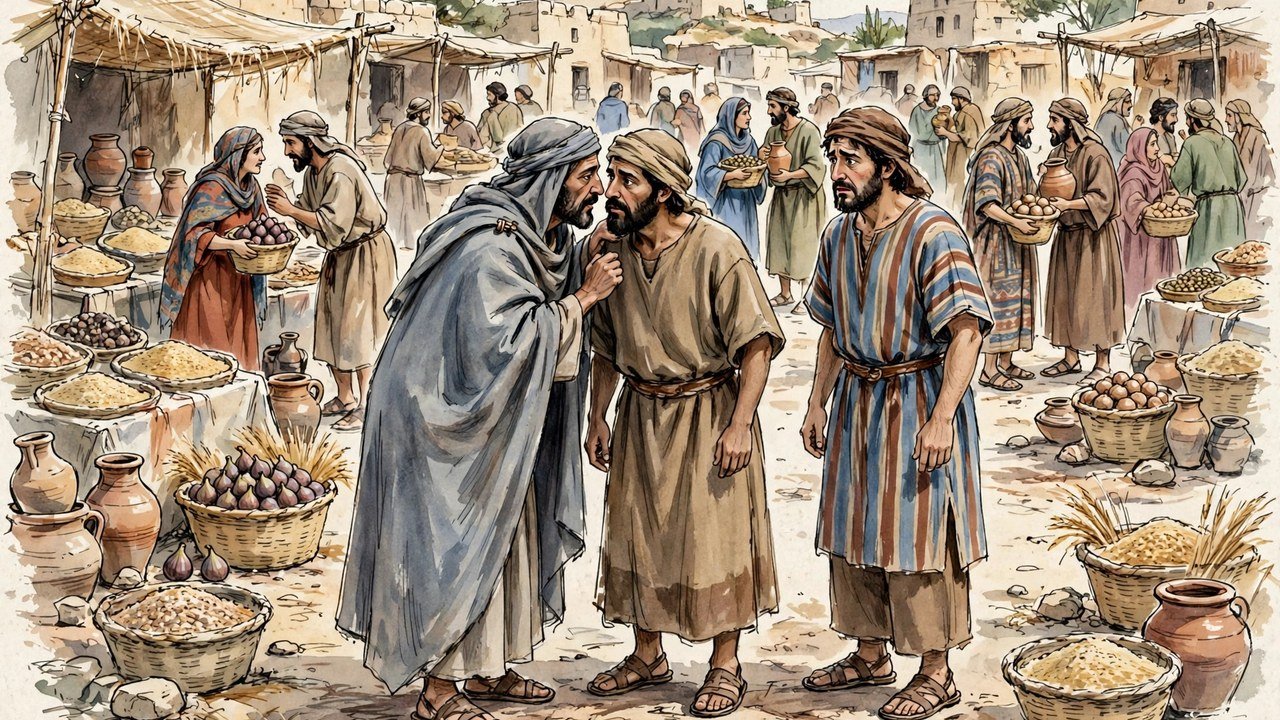
Gossip is the form of persuasion that never announces itself as persuasion. An argument presents its reasons and can be answered. A command declares its authority and can be obeyed or refused. A tale carried from house to house does neither. It arrives as information, offered in confidence, apparently for the hearer’s own protection or amusement, and it changes what the hearer thinks of a third person who is not present to speak. Proverbs returns to this figure repeatedly, under two related names. The talebearer goes about, moving from listener to listener. The whisperer stays close, lowering the voice. One supplies the circulation, the other the intimacy, and between them a reputation can be dismantled in an afternoon by people who would deny, sincerely, that they had done anything at all.
He that goeth about as a talebearer revealeth secrets; But he that is of a faithful spirit concealeth a matter.21
Proverbs 11:13 — American Standard Version
The first charge against the talebearer is not falsehood. It is disclosure. The secret may be perfectly true, and its truth is what makes the telling effective and the breach complete. A confidence is a kind of property. It was entrusted to one person for a purpose — for counsel, for comfort, for safekeeping while a matter was unsettled — and the talebearer spends it elsewhere, on listeners to whom it was never given, for a purpose it was never meant to serve. Against him the proverb sets not a cleverer talker but a faithful spirit, whose mark is concealment: the ability to hold a matter without passing it on. In a book that prizes speech, this is a striking commendation of silence. Some knowledge is carried faithfully only when it is not carried any further.
That distinction matters because gossip habitually disguises itself as honesty. The teller claims to be merely passing on what is true, as though truth settled every question about whether a thing should be said, to whom, and at what moment. Proverbs separates the questions. A report can be accurate and still be a betrayal. It can be accurate and still be theft, because the person it concerns did not choose the audience. It can be accurate and still do the work of a lie, because a single fact, detached from its circumstances and delivered at the wrong hour, produces a false impression more durable than an invention. An invented story can be exposed. A true fragment, suggestively placed, leaves the hearer to construct the false whole himself, and a conclusion a man reaches on his own feels to him like his own judgement.
He that goeth about as a talebearer revealeth secrets; Therefore company not with him that openeth wide his lips.22
Proverbs 20:19 — American Standard Version
The second saying draws the practical consequence, and it is directed at the hearer rather than the teller. Keep no company with the talebearer. The reasoning is unsentimental and requires no inquiry into his motives. A man who brings you the secrets of others will carry your secrets to others; the trade has one stock and it is other people’s confidence. To listen is therefore not a passive act. The hearer supplies the market. Talebearing exists because there is an audience willing to receive what was not intended for it, and the proverb treats receiving as a form of participation. Cutting off the audience is presented as the effective remedy, more effective than correcting any single tale, because it removes the reward that produces the next one.
Why the reward is so reliable is explained by the most quoted image in this group of sayings, which appears twice in the book, once in chapter 18 and again, word for word, in chapter 26. Repetition in a collection of this kind is itself a form of emphasis.
The words of a whisperer are as dainty morsels, And they go down into the innermost parts.23
Proverbs 18:8 — American Standard Version
Gossip is figured as food, and as delicacies rather than staple fare. A dainty morsel is chosen, savoured and eaten for pleasure; nobody is force-fed a delicacy. The image concedes what moral condemnation alone often misses, that whispered talk is enjoyable, and that its enjoyment is the mechanism of its power. The morsel goes down into the innermost parts. It is not merely heard and weighed; it is swallowed and incorporated, taken into the body before reason has had time to inspect it. By the time the hearer thinks to ask whether the report was fair, complete or even verifiable, it has already become part of how he feels about the person concerned, and feelings of that kind are not easily dislodged by later evidence. A correction addresses the mind. The morsel has settled somewhere deeper.
The whisper itself is part of the seasoning. Lowered volume is a signal, understood instinctively, that what follows is not for everyone. It flatters the hearer twice over: first by treating him as trusted, admitted to an inner circle from which others are excluded, and second by implying that the information is valuable precisely because it is restricted. Privileged knowledge need not be important to feel important. A trivial secret, whispered, acquires the weight of significance from its manner of delivery alone. The hearer is also made a partner. Once he has received the confidence he shares, however slightly, in the responsibility for it, and that shared complicity binds teller and hearer together. Gossip is therefore a social cement as well as a solvent. It dissolves the absent person’s standing while cementing the bond between the two who are present, and the pleasure of that bond is a large part of what is being exchanged.
There is a further pleasure, less often admitted. To hear ill of another is to receive, by contrast, a small assurance about oneself. The whispered fault is rarely one the hearer believes he shares, and the telling invites him to occupy the position of judge rather than subject. Proverbs is alert to the appetite this creates. A community in which such morsels circulate freely trains its members to listen for faults as entertainment, and a person trained in that habit eventually listens to his friends in the same way, alert for the detail that might be worth carrying elsewhere. The talebearer’s trade corrupts the hearing of everyone who trades with him, because it teaches them to receive every confidence as potential currency.
For lack of wood the fire goeth out; And where there is no whisperer, contention ceaseth. As coals are to hot embers, and wood to fire, So is a contentious man to inflame strife. The words of a whisperer are as dainty morsels, And they go down into the innermost parts.24
Proverbs 26:20-22 — American Standard Version
The fire image shifts attention from the individual tale to the quarrel it feeds. Fire was a daily practical reality in the ancient world, kindled with effort, fed with gathered fuel, and capable of dying down on its own if left alone. The proverb’s claim is that most contention behaves the same way. Disputes have a natural tendency to cool. The parties tire, the original grievance loses its heat, other business intervenes. What prevents cooling is fuel, and the fuel is talk: the report carried back and forth, the remark repeated to the one person certain to resent it, the old offence described again to a fresh audience. Remove the whisperer and the contention ceases, not because the grievance has been resolved but because it has been starved. Much of what presents itself as a principled, long-running feud is, on this analysis, simply a fire with a reliable wood supply.
This explains why the whisperer so often escapes blame for the quarrels he sustains. He starts nothing, he will say. He only repeated what was said. The proverb answers by assigning him the role of fuel rather than spark, and fuel is not innocent because it did not strike the match. A contentious man inflames strife as wood feeds fire, by being present and combustible at the right moment. The analysis also gives the hearer a test that works in ordinary life. When a quarrel seems incapable of dying, the useful question is not only who began it but who is feeding it: who carries the messages, who reports each side’s worst remark to the other, who would lose a source of interest and importance if peace broke out. That last question is the sharpest. Peace deprives the talebearer of his trade, and a man rarely works hard to end a state of affairs from which his own significance derives.
A perverse man scattereth abroad strife; And a whisperer separateth chief friends.25
Proverbs 16:28 — American Standard Version
The damage is measured, in the end, in separated friends. The phrase is precise: not acquaintances, not allies of convenience, but chief friends, the closest bonds a person has. Whispering is powerful against exactly those bonds because intimacy supplies the material. A stranger’s criticism carries little weight; a report that begins by invoking what a friend said in private carries a great deal. The whisperer works in the space between people who trust each other, repeating to each the fragment most likely to wound, omitting the affection or the qualification that surrounded it, until each friend begins to reinterpret the whole friendship in the light of the fragment. Past kindnesses are reread as calculation. Past confidences become evidence of what might already have been repeated elsewhere. The friendship is not refuted; it is re-lit, and under that light it becomes unrecognisable to the people inside it.
Slander, the darker form of the same trade, adds falsehood or reckless distortion to disclosure, and Proverbs treats the lying tongue elsewhere among the gravest offences of speech. Yet it is worth noticing how much of the harm described in these sayings requires no lying at all. Selection does the work. A true remark, carried to the wrong hearer, stripped of its occasion, delivered with a lowered voice and an air of reluctant concern, will separate friends as reliably as a fabrication, and it has the fabrication’s great disadvantage removed: it cannot be denied. The person traduced finds that there is nothing to correct. The words were his. Only the meaning has been changed, by movement. Gossip is in this sense an art of transport. It persuades not by what it asserts but by where it takes things, and the resistance it requires is therefore not mainly a resistance to false statements. It is a resistance to hearing things out of place.
Against the whole economy of carried tales, Proverbs sets one plain alternative: take the dispute to the person concerned, and to no one else first.
Debate thy cause with thy neighbor himself, And disclose not the secret of another; Lest he that heareth it revile thee, And thine infamy turn not away.26
Proverbs 25:9-10 — American Standard Version
To debate a cause with a neighbour himself is harder than talking about him. It requires the grievance to be stated in a form the other man can answer, at a time when he is present to answer it, with the risk that the answer may be convincing. Talk behind a back has no such risks, which is why it is preferred. The proverb attaches a reputational price to the easier route. The man who discloses another’s secret in the course of pressing his own case acquires an infamy that does not turn away: he becomes known as unsafe. Even those who enjoyed the disclosure draw the conclusion of chapter 20, that a carrier of secrets will carry theirs, and they withdraw the trust on which any lasting influence depends. The talebearer gains a hearing and loses a standing. His information is consumed with pleasure and his character is registered, permanently, in the same transaction.
The setting of these sayings is a world without privacy as a protected legal condition, in which reputation was a working asset and its loss had immediate material consequences. In a small community a man’s credit, his marriage prospects, his welcome at the gate where disputes were heard and bargains witnessed, all rested on what was said of him by people who claimed to know him. There were no records to consult against a rumour and no public means of correction. A tale once in circulation belonged to the circulation. That is why the book treats talebearing as a serious offence against a neighbour rather than a minor fault of manners. To damage a name in such a world was to damage a livelihood, and to do it by whisper, where the injured person might never learn what had been said or who had said it, removed his one remedy, which was to answer.
Secrecy in that world was also a practical necessity of government and of ordinary business. A household deliberating about a marriage, a debt or a dispute, a king’s servants weighing a course of action, a family deciding whether to sell land, all depended on matters being held until the moment chosen for their disclosure. Premature disclosure was not mere embarrassment. It could raise a price, harden an opponent, alert a rival or force a decision before the facts were in. The talebearer therefore threatens more than feelings. He destroys the ability of others to control the timing of their own affairs, and timing, in negotiation as in war, is often the substance of the matter. The faithful spirit who conceals a matter preserves other people’s freedom to act. The talebearer appropriates that freedom and spends it on his own welcome in other people’s houses, where fresh information is his ticket of admission.
That ticket explains the social position of the practised gossip. He is rarely friendless. He is, on the contrary, often welcome everywhere, because he arrives bearing the one commodity every household wants and none will admit to wanting: news of the others. His welcome is the measure of his danger. Each house that receives him for what he brings about its neighbours is teaching him that its own affairs, in due course, will purchase the same welcome elsewhere. Proverbs asks the reader to see the transaction whole. The entertainment is not free. It is paid for in kind, and the payment is extracted later, out of hearing. A community gets the talebearing it rewards, and a hearer who wonders why confidences leak in his circle might begin by examining what his own table rewards with attention and laughter.
The whisperer’s other protection is that his work is deniable at every stage. He did not invent the tale, he only repeated it. He did not repeat it widely, only to one trusted person — who repeated it to one more. He meant no harm; he was concerned, he was warning a friend, he thought the hearer ought to know. Each step is small enough to excuse, and the excuses are not always insincere, which is what makes the pattern durable. Proverbs does not attempt to police the individual steps. It names the role. Talebearer and whisperer are character descriptions, not descriptions of single acts, and the remedy it prescribes is correspondingly a matter of character and company rather than of rebuttal: do not keep company with the man of wide lips, and do not become him. Where rebuttal is attempted, it usually fails on the terms the morsel has set, because a denial repeated is still a repetition, and the tale gains a second circulation from the attempt to kill it.
There is also a discipline for the person who finds a tale already lodged in his own mind, working on his view of a friend or a colleague. The sayings suggest, by their images, what is happening. Something has been swallowed unexamined, and something is being fed that would otherwise go out. The corresponding acts are plain even if they are not comfortable. Withhold the onward telling, which is the wood. Take the substance, if it truly matters, to the person it concerns, which is the direct debate of chapter 25. And treat the interval between hearing and believing as sacred ground. The whisper depends for its effect on speed — on the hearer absorbing the impression before he has asked who carried it, why it was carried to him, and what was left behind on the journey. Slowing that interval is not naivety. It is the precise point at which the morsel can still be refused, before it has gone down into the innermost parts and begun to feel like knowledge.
Trust, in these sayings, is built almost entirely out of restraint. The faithful spirit of chapter 11 is not praised for what he says but for what he conceals. In a household, a court or a village, the person who can be told a matter in its unfinished state — before it is ready for the world, while it is still embarrassing, complicated or liable to be misunderstood — holds a position no flattery can buy. Such trust accumulates slowly, through repeated instances of nothing leaking, and it is destroyed in a single afternoon. Proverbs treats that asymmetry as a fact to be planned around, both by those who confide and by those who would be confided in. The reader who wants to resist manipulation by gossip is given, in effect, three disciplines. Refuse the morsel, or at least notice the pleasure of swallowing it and discount accordingly. Ask what the carrying has removed from the tale. And judge every teller by the simple rule that the secrets he brings are evidence about him, not only about the people they describe.
Gifts That Blind

Every gift creates a relationship, and some gifts are given for exactly that reason. Proverbs speaks about presents with unusual honesty, holding two truths in the same hand without flinching from either. A gift is a normal, often honourable part of human dealings: it expresses gratitude, seals friendship, honours a superior and opens doors that merit alone might leave shut for years. A gift is also the oldest instrument for bending the judgement of another person without uttering a threat or telling a lie. The book refuses to pretend that the second use cancels the first, or that the first excuses the second. Instead it watches the gift at work — in the hand of the giver, in the bosom of the receiver, in the judgement seat — and describes what it does there.
A bribe is as a precious stone in the eyes of him that hath it; Whithersoever it turneth, it prospereth.27
Proverbs 17:8 — American Standard Version
The saying is cool to the point of discomfort. It does not say that a bribe ought to prosper. It says that, in the eyes of the man who has one to give, it is a precious stone, a thing of beauty and reliable power, and that wherever he turns it, it works. The observation is made from the giver’s point of view, and its candour is the point. Bribery persists across centuries and legal systems not because men are ignorant of its wrongness but because it is effective. A stone of this kind opens the audience that a petition could not reach, softens the official whom argument could not move, and shortens the delay that would otherwise exhaust a poorer rival. Any treatment of the subject that begins by denying its effectiveness will fail to explain it, and Proverbs, characteristically, begins with the effectiveness and then asks what the effectiveness costs.
The Hebrew vocabulary behind these sayings already marks the distinction that English translations sometimes blur. One word, commonly rendered gift or present, denotes what is given openly in honour, gratitude or supplication. Another, rendered bribe, denotes what is given to influence a decision, characteristically in a matter of judgement. The same object can pass from one category to the other without changing its shape. Silver is silver. What makes it a bribe is not its substance but its errand: it is sent to do work on a decision that is supposed to be made on other grounds. Proverbs exploits this ambiguity deliberately, because in life the ambiguity is the giver’s chief protection. No bribe arrives labelled. It arrives as generosity, as a token of respect, as a customary courtesy, and the receiver who wishes to accept it is always supplied with an innocent description under which to do so.
A man’s gift maketh room for him, And bringeth him before great men.28
Proverbs 18:16 — American Standard Version
The open gift’s power is stated without censure. In the ancient world, access was not a right but a favour, rationed by gatekeepers, stewards and courtiers, and a present was the recognised means of obtaining a hearing from the great. A petitioner who arrived empty-handed might wait indefinitely; a gift made room, literally creating space for a man in a crowded court and bringing him into the presence where his cause could be spoken. Something of the same economy operates wherever access is scarce and discretion is personal. The gift functions as a credential. It demonstrates seriousness, it honours the dignity of the person approached, and it creates a small obligation to listen, which is all the giver initially asks. To hear a man costs the great man little, and the gift has already paid for the hearing. The difficulty begins at the next step, when the hearing shades into the decision, and the obligation created by the gift is still present in the room while the merits are being weighed.
Obligation is the gift’s real currency, and it operates whether or not any bargain has been spoken. A present accepted creates a debtor. The receiver may owe nothing in law and may sincerely intend to owe nothing in fact, yet he now holds something of the giver’s, given freely, and the human instinct to repay is older and stronger than most rules of procedure. Repayment need not be crude. It can take the form of a warmer hearing, a doubt resolved in the giver’s favour, a delay granted to him and denied to another, a severity relaxed. Each individual act is small enough to be explained on its merits, and that is precisely how gifts bend judgement in practice: rarely by purchasing a decision outright, often by tilting a series of small discretions, each defensible, all in one direction. The giver of experience does not ask for the verdict. He asks, over time, for the tilts, knowing that verdicts are usually the sum of them.
A gift in secret pacifieth anger; And a present in the bosom, strong wrath.29
Proverbs 21:14 — American Standard Version
Secrecy enters the account here, and it cuts both ways, which the proverb allows the reader to feel. A gift in secret can be a work of peace. An offended man who would lose face by accepting a public apology, or whose wrath has become a public position from which he cannot retreat, may be pacified by a present delivered privately, in the bosom, close to the body and out of view. The secrecy protects his dignity and gives the anger a quiet exit. Peacemaking of this kind is a recognised art in a culture of honour, and the saying records its effectiveness with approval of the result, if not of every use. Yet the same secrecy that protects a reconciliation also protects a corruption. What is given in the bosom cannot be examined. No witness can say whether it pacified a wrath or purchased a judgement, and the giver and receiver are the only authorities on the question, both interested in the innocent account. The proverb’s double edge is deliberate. The reader is being taught to ask, of any secret gift, which of the two works it is doing — and to notice that from the outside they look identical.
A wicked man receiveth a bribe out of the bosom, To pervert the ways of justice.30
Proverbs 17:23 — American Standard Version
Here the ambiguity is resolved, and the resolution lies in the purpose clause. The bribe out of the bosom is received in order to pervert the ways of justice. The scene is the judgement seat. In the ancient city, justice was administered at the gate by elders and officials, in public, on the testimony of witnesses and the merits of the cause, and its integrity was the community’s chief protection for those who had nothing else. A poor man, a widow, a stranger — none of them could offer protection, patronage or future advantage in return for a favourable decision. Their whole wealth in court was the expectation that the decision would follow the evidence. A bribe strikes at exactly that expectation. It introduces a second, hidden case running alongside the visible one: the case of the gift, argued silently by its value, which the other party cannot answer because he does not know it is being heard. The perversion is therefore not only in the outcome but in the procedure. One litigant is arguing to the judge. The other is arguing to the judge’s interest, and only one of those arguments is on the record.
The wider law of Israel treated this offence with corresponding severity, naming the bribe as a thing that blinds the eyes of the wise and perverts the words of the righteous, and forbidding it to judges without qualification. The metaphor of blindness is exact. A blinded judge is not a judge who has reasoned badly; he is a judge to whom part of the evidence has become invisible. The gift does not usually persuade a man that black is white. It persuades him not to look too closely at the grey: not to press the witness whose testimony favours the giver, not to notice the document that does not, not to weigh the discrepancy that would require an awkward inquiry. Judgement is bent most often at the level of attention. What a man has been given determines, quietly, what he is willing to see, and he can afterwards defend his decision in complete sincerity, because within the field of vision the gift left him, the decision was honestly made. That sincerity is the bribe’s final refinement. It does not require its receiver to know himself corrupt.
He that is greedy of gain troubleth his own house; But he that hateth bribes shall live.31
Proverbs 15:27 — American Standard Version
The cost is therefore reckoned in two places. The first is the receiver’s own house. Greed of gain, of which the accepted bribe is the purest expression, troubles the household that it was meant to enrich. The mechanism needs no supernatural machinery. A man known to be purchasable attracts purchasers, and with them their quarrels, their expectations and their knowledge of his weakness, which is itself a hold over him. Every bribe accepted is a secret shared with a person who has already demonstrated that he buys men, and such secrets do not retire. The receiver has taken money, and he has also taken on a creditor of a peculiar kind, one who can at any time convert the shared secret into pressure. The house built on such gains is troubled from within its own walls, by obligations that cannot be acknowledged and therefore cannot be discharged.
The second cost falls on the community’s trust in judgement itself, and it falls whether or not any single bribed decision is detected. Courts depend on a belief, held by people who lose cases as well as by people who win them, that the outcome followed the evidence. A system in which gifts are known to circulate around the judgement seat destroys that belief even when a particular decision was honest, because no loser can ever be sure his case was the one that was heard. Suspicion of this kind is corrosive beyond the courtroom. It teaches the poor that justice is a market, teaches the rich that it is a market they can win, and teaches everyone that the forms of fairness are a theatre staged over a negotiation. Proverbs, which grounds social order in the fear of God and the reliability of weights, measures and witnesses, treats the bribed judge as a falsifier of measures: a man who has put his thumb on the scale and called the result a weighing.
For the reader learning to resist manipulation, the gift is the hardest instrument to resist, because it arrives as kindness and its refusal can feel like an insult to generosity itself. The sayings supply a set of distinctions rather than a blanket refusal of all presents, and the distinctions are workable. An open gift, given without a pending decision, honouring the receiver and expecting nothing specific, belongs to the ordinary commerce of friendship and respect. A gift that arrives when its giver has a cause awaiting the receiver’s judgement, that is proportioned to the importance of the favour rather than to the relationship, that is offered in private and would be embarrassing if described in public, has declared its errand by its timing and its secrecy, whatever its giver calls it. Timing is the tell that cannot easily be disguised. Generosity that appears precisely when a decision is pending, and disappears when the decision is made, is not generosity with unfortunate timing. It is a price, quoted in the only currency that allows both parties to deny that a price was ever named.
The giver, too, is altered by his own instrument, and Proverbs’ account of the precious stone contains the warning inside the compliment. A man who has learned that gifts prosper whithersoever they turn acquires a habit of reaching for the stone instead of for the merits of his cause. His arguments weaken from disuse. His causes, in time, become the kind that need a gift, because he has stopped doing the slower work of making them strong, just or presentable in the open. He also becomes dependent on a method that any richer rival can outbid, and the market he entered as a buyer discovers, sooner or later, that he is also for sale in it, since a court accustomed to prices will sell his purchased advantage to the next hand. Bribery is therefore a poor long-term instrument even for the unscrupulous. It trains its user to neglect every durable form of influence — reputation, evidence, alliance, patience — in favour of the one form that evaporates the moment a larger stone is turned against him.
Hospitality and patronage complicate the picture further, and the ancient world knew both intimately. To eat at a great man’s table, to accept his protection, to receive his gift at a festival — these were public bonds, understood by everyone present, and they carried obligations that were honourable precisely because they were open. A client owed his patron loyalty; a guest owed his host respect; the whole city could see the bond and judge both parties by how they kept it. The bribe is the counterfeit of this open system. It seeks the obligation without the publicity, the bond without the witnesses, the debt without the record. That contrast supplies the reader with the most practical test the chapter affords. A gift that can be acknowledged before the whole gate, with its giver named and its occasion stated, may still be unwise, but it belongs to the world of patronage and honour. A gift whose power depends on its never being described in that place has already confessed, by its need for darkness, which of the two categories in Proverbs it inhabits.
The same test of publicity exposes the gift offered to a third party — to the judge’s household, his son, his steward, his favourite cause — in the hope that gratitude will travel the last short distance on its own. Nothing has been given to the judge, his defenders can say, and the statement may be literally true and wholly beside the point. Proverbs judges the transaction by its errand, not by the address on the parcel. A present sent to do the work of a bribe through an intermediary is a bribe with an extra witness, and the intermediary, who now also holds a secret, widens the circle of obligation and of risk in exactly the manner described in the troubled house of chapter 15.
There remains the subtler case, the gift given long before any decision is in view, by a giver patient enough to invest in goodwill rather than to purchase an outcome. Proverbs does not overlook him; the precious stone of chapter 17 turns whithersoever its owner wishes, and a store of obligation laid up in advance turns as reliably as a payment on the day. Against this, no rule about timing suffices, and the book’s answer is directed at the receiver’s character rather than at his diary. The man who hates bribes — the phrase is strong, and deliberate — has settled the question before the gift arrives, at the level of appetite rather than of calculation. He does not weigh each present for its probable intent, a weighing in which his own interest would be the loudest witness. He has acquired a settled distaste for the whole transaction of being obliged in his judgement, and that distaste, formed in advance, is the only defence that works at the moment when a present is already in his bosom and his gratitude is already arguing, persuasively and in his own voice, that this one is surely innocent.
Counsel and the Multitude of Counsellors
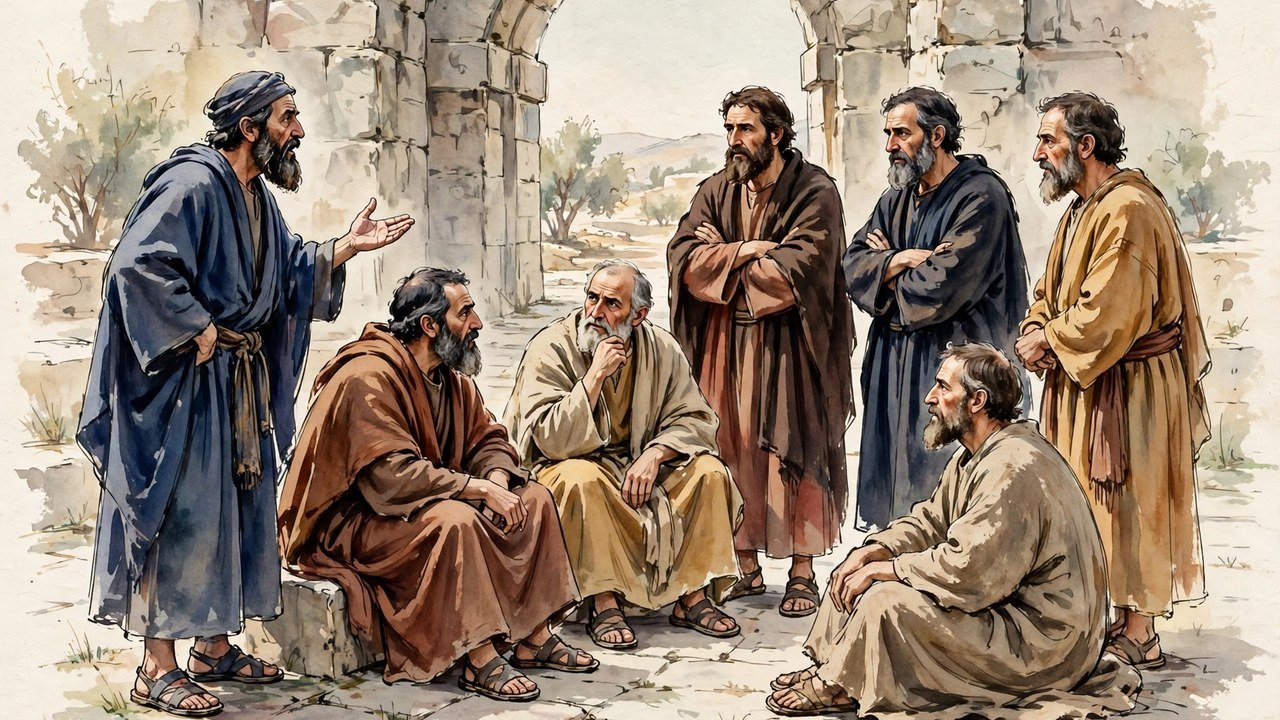
No one sees his own situation whole. A man knows his intentions from the inside, which is the worst vantage point from which to judge them, and he knows his circumstances only in the portion that his hopes and fears have lit for him. Counsel is the institution by which that defect is corrected: other eyes, differently placed, looking at the same matter and reporting what the principal cannot see from where he stands. Proverbs returns to the subject more often, and with more insistence, than to almost any other instrument of influence, because counsel stands at the crossing point of all the others. Flattery corrupts it, gifts buy it, haste skips it, pride refuses it — and a decision made without it carries every one of those failures into action at once.
Where no wise guidance is, the people falleth; But in the multitude of counsellors there is safety.32
Proverbs 11:14 — American Standard Version
The first saying is about a people, not a private person, and its scale should not be reduced too quickly. Wise guidance — the word carries the sense of steering, of ropes and tacking, of a ship worked through difficult water by skill rather than by force — is what stands between a community and a fall. The alternative offered is not a single wise ruler but a multitude of counsellors, and in that multitude there is safety. Safety is a modest word, and deliberately chosen. Counsel does not promise brilliance, victory or glory. It promises that the ship will not be wrecked by the one error that a single steersman, however gifted, could not see himself making. The claim is about error before it is about excellence. A multitude of counsellors is, in the first instance, a system for catching mistakes while they are still words in a room and not yet facts in the world.
Where there is no counsel, purposes are disappointed; But in the multitude of counsellors they are established.33
Proverbs 15:22 — American Standard Version
The second saying brings the principle down from the nation to the individual purpose, and states the failure mode precisely. Purposes without counsel are disappointed — not necessarily defeated by an enemy, but frustrated, unfulfilled, coming to nothing in the execution. Most plans do not die in dramatic reverses. They die of the step nobody examined, the assumption nobody challenged, the resource that was counted twice and the ally who was counted on without being asked. Counsel establishes a purpose in the way foundations establish a building: by testing, before anything is raised, whether the ground will bear the weight. A plan that has survived the objections of several counsellors, each looking from a different side, has already met a portion of the resistance the world will offer it, in a room where meeting resistance costs nothing. A plan that has met no resistance in the room meets all of it outside, at full price.
The way of a fool is right in his own eyes; But he that is wise hearkeneth unto counsel.34
Proverbs 12:15 — American Standard Version
Against counsel stands one obstacle, and it is not ignorance. The fool of this proverb is not a man who lacks information. He is a man whose way is right in his own eyes, which is a description of a closed system: the judgement that would correct the course is generated by the same mind that chose it, and unsurprisingly acquits it. Every person is the easiest audience he will ever address. His motives appear to him in their most charitable form, his risks in their smallest, his opponents in their weakest, because the advocate and the judge in his private court are the same person and they are on excellent terms. Wisdom, in the proverb’s definition, is not superior cleverness in that inner court. It is the decision to take the case outside it — to hearken unto counsel, to submit the way that looks right to eyes in which it may look otherwise. The difference between the fool and the wise man is therefore not intelligence but jurisdiction. One keeps his decisions at home, where they are always approved. The other sends them abroad, where they can be refused.
That is why seeking counsel is an act of character before it is a technique. To ask for advice is to accept, in public, that one’s own view may be defective, and to give another person a standing invitation to say so. Men who cannot bear that admission devise substitutes that preserve the appearance of consultation without its risk. They ask only those certain to agree. They ask after the decision is made, when counsel can only ratify. They present the plan in a form that makes objection feel like disloyalty, or they ask so many people, so casually, that no single answer carries any weight and the one they wanted can be selected from the pile. Proverbs is not deceived by the forms. Its test is whether the counsel was capable of stopping the purpose — whether the counsellors were chosen for their sight rather than their compliance, heard before the commitment hardened, and free to deliver the answer the seeker did not want. Consultation that cannot change the outcome is theatre, and its only real function is to share out the blame in advance.
Every purpose is established by counsel; And by wise guidance make thou war.35
Proverbs 20:18 — American Standard Version
The second half of the saying names the setting in which the ancient world tested counsel most severely. War concentrates every feature that makes advice necessary and difficult. The information is incomplete and partly false, supplied by scouts, deserters and interested allies. The stakes are irreversible; a battle, unlike an argument, cannot be revised. The time is short, the passions are high, and the man deciding is surrounded by others whose honour is engaged in appearing bold. In that setting the proverb does not commend instinct, courage or speed, though the ancient world honoured all three. It commends guidance, the same steering word as chapter 11, and it makes the conduct of war depend on the quality of the deliberation that preceded it. A king who made war by wise guidance was not a king who lacked nerve. He was a king who understood that nerve is spent in a day, while a campaign is a long chain of supply, terrain, season, morale and alliance, no link of which is visible entire from any single position, including the throne.
For by wise guidance thou shalt make thy war; And in the multitude of counsellors there is safety.36
Proverbs 24:6 — American Standard Version
The councils of ancient kings were formal institutions, and their composition reflected hard experience about whose sight a ruler needs. Elders brought memory: they had seen a similar river in flood, a similar ally defect, a similar siege fail in the third month for want of fodder. Men of war brought the arithmetic of forces and ground. Servants who administered revenue brought the unwelcome knowledge of what the treasury could actually bear, which is the fact most likely to be omitted from a glorious plan. Envoys brought the temper of neighbouring powers. No one of these views was the truth; the truth, insofar as a council could reach it, was what survived when the views were laid against each other. A multitude of counsellors is therefore not a crowd. It is a range — a deliberate variety of vantage points, ages, interests and temperaments, assembled so that the blind spot of one is the clear sight of another. Ten counsellors who share the ruler’s outlook, his information and his incentives are, for the proverb’s purpose, one counsellor repeated ten times, and the safety of multitude is not in them.
Diversity of counsel has its own discipline, because counsellors with genuinely different views will disagree, and disagreement in a council is easily mistaken for a failure of the process rather than its working. A ruler who prizes harmony over sight will soon have harmony, of a kind: the counsellors will learn which observations endanger their place and will supply the others, and the council will become a choir. Proverbs has already described the speech that produces that result, in its sayings on flattery and on the wound of a friend being preferable to the kiss of an enemy. The counsellor’s value lies in the friction he provides. A plan rubbed against several unlike minds loses its soft errors the way a blade loses its burr on a stone, and what remains is harder and smaller than the original conception — smaller, usually, in its claims, and harder in the sense that its remaining assertions have each survived an attempt on their lives. The seeker who leaves a council with a slightly reduced plan and a clear view of its weakest point has received exactly what he came for, even when the experience felt like obstruction.
Statecraft in the ancient world also knew the counterfeit of counsel: the packed council, assembled to endorse; the consultation staged after the army had already been ordered to march; the adviser retained because his advice was known in advance. Such arrangements persisted because they served real purposes — they lent a decision the appearance of deliberation, distributed responsibility across many shoulders, and allowed a ruler to say, if the matter failed, that he had taken advice. Proverbs’ sayings cut under all of these uses by attaching the value of counsel to the safety and establishment of the purpose itself, not to the appearance of having sought it. A council that meets to ratify produces no safety. Its members, understanding their function, do not waste their sight on a decision that is not open, and the one man who might have seen the ambush, the empty granary or the faithless ally learns to keep the observation for a setting in which observations matter. The loss is invisible until the day it is total.
There is a corresponding duty on the counsellor’s side, and the book’s wider teaching on speech defines it. Counsel is speech given in trust, for the hearer’s benefit, and it is corrupted by the same instruments that corrupt all speech in these chapters. The counsellor who is fed by the talebearer argues from poisoned information. The counsellor who has received the gift argues, whether he knows it or not, for the giver. The counsellor who fears the ruler’s anger, or loves his own standing at court, argues for his safety. Sound counsel therefore requires a kind of independence that institutions can protect or destroy: the adviser must be able to deliver an unwelcome judgement without paying for it with his place, and he must want the purpose to succeed more than he wants to be thought agreeable. Where either condition fails, the multitude of counsellors becomes a multitude of mirrors, and the ruler who consults them sees only himself, returned with applause — the way of the fool in chapter 12, furnished with a larger room and better furniture.
The court was not the only place where the multitude of counsellors did its work, and the sayings move without strain between the king’s war council and the ordinary decisions of a household because the structure of the problem is the same at both scales. A man contemplating a purchase, a partnership, a marriage alliance for his children or a dispute to be taken to the gate faced the same partial sight, the same interested inner advocate, and the same temptation to consult only the people who shared his enthusiasm. His counsellors were his father and uncles, his neighbours of standing, the elders who had watched similar ventures prosper and fail over decades. Their multitude was smaller than a king’s, but the principle of range applied unchanged: one counsellor who had made the same purchase, one who had lost by it, one who knew the other party, one who owed the seeker nothing and could afford to be blunt. A household that habitually decided in that company built up, over years, a record of purposes established rather than disappointed, and the record itself became a form of wealth, indistinguishable in its effects from good land or a full storehouse.
Time is counsel’s necessary condition, and haste is its most common destroyer. Advice taken after the commitment has been made in the heart is rarely advice at all, because the seeker has already begun to defend the decision and hears every objection as an attack on a possession. The sayings’ repeated counsel to hear, to hearken, to receive, describes a posture that must be adopted before the moment of decision arrives, while the purpose is still genuinely in question. In practice this means consulting earlier than feels necessary, when the plan is still fluid enough to be changed without humiliation. Men delay consultation precisely because they sense that counsel, taken early, might stop them, and they prefer the freedom of the unexamined plan to the safety of the examined one — until the plan meets the world, which examines it without any regard for their feelings at all. The multitude of counsellors is, among other things, a way of scheduling the examination for a time and place of the seeker’s choosing, rather than leaving it to circumstances, which will choose a worse one.
There is also a skill in hearing counsel well, distinct from the humility that seeks it. Counsellors speak from their own positions and with their own interests, and the wise hearer weighs the adviser along with the advice. The elder’s caution may be the memory of a real disaster or merely the conservatism of a man who will not share the reward if the venture succeeds. The young man’s boldness may be clear sight unclouded by old failures, or ignorance of what a failure costs the person who must pay for it. The friend’s agreement may be loyalty; the rival’s objection may be the most disinterested evidence available, since he has no motive to protect the seeker from a mistake that would benefit him. None of this invalidates counsel. It is the ordinary work of sifting it, and it is work the seeker cannot delegate, because the decision, and its consequences, remain his. Counsel informs judgement; it does not replace it, and the man who hides behind his advisers when a purpose fails has misunderstood the arrangement as thoroughly as the man who never consulted them. The multitude provides safety, not an alibi.
A last feature of the multitude deserves notice, because it is the one most easily lost in translation from an ancient court to any later setting. Counsel in Proverbs is personal. The counsellors are known men, with known histories, whose past advice is remembered and whose standing rises and falls with its quality. That memory disciplines the whole system. An adviser who flatters, who guesses, who sells his opinion or who repeats the council’s business in the wrong houses — the talebearer again, undoing at the door what the counsellors built at the table — is found out over time and ceases to be asked, which in a court is a kind of death. A system of counsel therefore depends on the same virtues this whole section of the book has been tracing: tongues that can be trusted, hands that gifts have not bought, ears that can receive a tale without passing it on. Strip those away and the forms of consultation remain, impressive and useless, a multitude of counsellors in whom there is no safety because there is no truth being carried between them.
It follows that the quality of a man’s counsel is one of the most reliable public measures of the man himself. Show the company in which a decision was made — whether it was made among flatterers or among men free to disagree, among the bought or among the independent, among one voice repeated or among a genuine range — and the decision’s likely character is already half known, before its results are in. Rulers and householders alike reveal, in their choice of counsellors, whether they wanted safety or applause, and the choice compounds: good counsellors make a man easier to advise honestly, which attracts better counsel still, while the court of mirrors drives out, one by one, exactly the people whose sight it most needed.
Hear counsel, and receive instruction, That thou mayest be wise in thy latter end.37
Proverbs 19:20 — American Standard Version
The final saying sets the reward of counsel at the far end of a life. Hear counsel now, receive instruction now — the verbs are about receptiveness, about letting the words in past the defences that status, experience and wounded pride construct — in order to be wise in the latter end. The connection is not automatic, and the interval matters. A man becomes wise late by means of corrections accepted early, most of which were, at the time, indistinguishable from insults, delays and the annoyance of being told what he did not wish to hear by people he was tempted to dismiss. His latter end is wise because his record has been edited by other hands throughout. The fool arrives at his latter end with a record edited by no one, every draft approved, and discovers that the world has been keeping its own copy all along, in which the errors were never corrected because the only person who was never permitted to mark them was anyone else.
Rebuke and the Ear That Hears It

Every act of persuasion meets its limit at the ear. A speaker may choose his words with care, order his reasons, time his approach and govern his tone, and still accomplish nothing, because the person addressed will not receive what is said. Proverbs treats that receiving as a moral act in its own right, distinct from the quality of the message. Correction is the sharpest test of it. Praise is easy to hear because it costs nothing; flattery is easier still because it pays a dividend in the moment. A rebuke, by contrast, presents the hearer with a bill. It tells him that something he has done, said or become is wrong, and it asks him to agree with a judgement formed against himself. Whether he can do that — whether the rebuke enters, or strikes the surface and falls away — is, in the book’s account, the truest measure of his character that ordinary life provides. Wisdom and folly are not finally distinguished by what a man knows. They are distinguished by what happens inside him in the few seconds after he is told he is wrong.
The book sets the two responses side by side in a single passage, and the contrast is total. The same reproof, delivered to two different men, produces hatred in one and love in the other.
He that correcteth a scoffer getteth to himself reviling; And he that reproveth a wicked man getteth himself a blot. Reprove not a scoffer, lest he hate thee: Reprove a wise man, and he will love thee. Give instruction to a wise man, and he will be yet wiser: Teach a righteous man, and he will increase in learning.38
Proverbs 9:7-9 — American Standard Version
Nothing in the passage turns on the skill of the corrector. He is not told to soften the rebuke for one man and sharpen it for the other. The variable is the hearer. To the scoffer, correction is an insult to be returned; he answers reproof with reviling, and the man who offered it comes away stained by the encounter, carrying a blot he did not earn. To the wise man, the identical act is a gift to be repaid with affection. He does not merely tolerate the reprover or endure him for the sake of peace. He loves him. And the passage presses the point further: instruction given to such a man compounds. He becomes yet wiser, which means the correction does not simply repair the one fault it named. It enlarges his capacity to be corrected again. Receptivity, in other words, is not a fixed quantity that a man spends. It is a faculty that grows by exercise, exactly as its opposite grows by refusal. Each rebuke accepted makes the next one easier to accept; each rebuke resented makes the next one harder even to deliver.
This is why Proverbs can treat the response to correction as a diagnostic rather than an incident. A man’s opinions may be borrowed, his knowledge second-hand, his manner a performance learned for company. But his reaction to being told he is wrong is difficult to rehearse, because it arrives unannounced and touches him where performance stops. The rebuke finds the place where his account of himself is defended, and what he does in that moment — retaliate, deflect, explain, or listen — discloses whether truth or self-regard governs him. The book’s word for the governing difference is the ear. Again and again its figure for the teachable man is not a capacious mind but an open ear, an organ of reception kept in working order. The unteachable man is correspondingly pictured not as stupid but as stopped up, stiffened, hardened at the point where words should enter.
The ear that hearkeneth to the reproof of life Shall abide among the wise. He that refuseth correction despiseth his own soul; But he that hearkeneth to reproof getteth understanding.39
Proverbs 15:31-32 — American Standard Version
The reproof here carries a remarkable name: it is the reproof of life. Correction is classified not as an attack on the hearer’s life but as an instrument of it, one of the means by which a life is preserved from its own errors. That classification reverses the instinctive one. The man who refuses correction experiences himself as defending his life — his dignity, his standing, his peace — against an intruder. The proverb says he is doing the opposite. He despiseth his own soul. The refusal that feels like self-protection is self-harm, because the error he protects will go on working in him undisturbed, and errors left undisturbed do not stay the size they were. The man who hearkens, meanwhile, is promised company as well as knowledge: he shall abide among the wise. Receptivity is a social position. The teachable are admitted to the society of those who can teach them, because teachers, like everyone else, go where they are received. The unteachable are not usually expelled from that society by decree. They are quietly dropped from its circulation, as correctors learn from experience where correction is wasted and stop bringing it.
The economics of the process are stated with unusual precision in the comparison between a rebuke and a beating.
A rebuke entereth deeper into one that hath understanding Than a hundred stripes into a fool.40
Proverbs 17:10 — American Standard Version
A hundred stripes is not a small force. It is the maximum application of the crudest instrument of persuasion available to the ancient world, pain repeated until resistance breaks. The proverb measures a single sentence against that maximum and finds the sentence, in the right hearer, the deeper penetration. The reason is that stripes and rebukes work on different layers. A stripe reaches the body and stops there unless the mind cooperates; it can compel behaviour while leaving conviction untouched, and behaviour so compelled lasts only while the threat does. A rebuke reaches the judgement. In a man of understanding it enters — the verb is spatial, a thing going in past a boundary — and once inside it continues to work without the corrector’s presence, because the hearer has taken it up as his own thought. He reproves himself thereafter, at no cost to anyone. This is the deepest form persuasion can take: not compliance extracted, but a standard installed. And the proverb’s bleak corollary is that where understanding is absent, escalation does not help. If one rebuke will not enter a fool, a hundred stripes will not enter him either. Force applied to an unreceptive man produces endurance, evasion and resentment, not learning. The failure is not a failure of pressure. It is a failure of the medium.
Because the entry of a rebuke depends on the hearer, the book’s portrait of successful correction is drawn as a matching of two people, a reprover of one kind and an ear of another, and it renders the match as jewellery.
As an ear-ring of gold, and an ornament of fine gold, So is a wise reprover upon an obedient ear.41
Proverbs 25:12 — American Standard Version
The image repays attention. An earring is not a tool or a weapon; it is a thing of value worn at the very organ in question, the ear, and it is beautiful because the ear bears it willingly and displays it. So with the wise reprover on the obedient ear: the correction becomes an ornament to the person corrected, something that improves how he appears to others rather than shaming him. But the proverb assigns wisdom to both parties. The reprover must be wise — in what he says, when he says it, and in his reading of whether this ear will bear it — and the ear must be obedient, a word that in its root sense means hearing that carries through into action. Neither half suffices alone. A wise reprover spent on a stopped ear is gold offered to stone. An obedient ear under an unwise reprover is openness abused, filled with whatever confident error happens to address it. The full art of correction is therefore relational. It asks the corrector to judge receptivity before he speaks, and it asks the hearer to have made himself the kind of person to whom true things can be said.
Within friendship, the book is unambiguous about which failure is worse. Silence that spares a friend’s feelings at the cost of his fault is ranked below the wound of an open word.
Better is open rebuke Than love that is hidden. Faithful are the wounds of a friend; But the kisses of an enemy are profuse.42
Proverbs 27:5-6 — American Standard Version
Hidden love is a strange category, and the proverb intends the strangeness. Love that never risks a painful word is love that cannot be distinguished, from the outside or perhaps from the inside, from indifference. It produces no evidence of itself at the point where evidence would cost something. Open rebuke, whatever its awkwardness, at least proves that the friend valued the man’s good above the smoothness of the relationship. The second line then sets out the book’s test for distinguishing affection from its counterfeit: not by pleasantness but by faithfulness. A friend’s speech may wound, and the wound is faithful — it corresponds to reality, it is delivered in loyalty, and it heals in the direction of the truth. An enemy’s speech may be all embrace, kisses in profusion, and the abundance is itself the warning sign. Flattery costs the flatterer nothing and is therefore issued without limit; rebuke costs the rebuker something and is therefore issued with care. Profusion in praise and scarcity in criticism, coming from the same mouth, mark the mouth as serving itself. The hearer’s task is to read speech by its cost to the speaker, not by its sensation in himself.
Proverbs extends that reading across time, and in doing so it corrects the short-term arithmetic by which rebukers are usually judged.
He that rebuketh a man shall afterward find more favor Than he that flattereth with the tongue.18
Proverbs 28:23 — American Standard Version
The operative word is afterward. In the immediate moment, the flatterer wins every comparison. He leaves the room liked; the rebuker leaves it under a cloud, and may leave it unsure whether he has lost a friend. The proverb does not dispute that ordering of the first hour. It disputes its permanence. Favour, in its account, is settled later, when the hearer has lived with the consequences of both kinds of speech. The flattery that pleased him has meanwhile let his fault run, and when the fault bears its fruit he re-reads the pleasant words that protected it, and they change their character in his memory. The rebuke that stung him has meanwhile done its work, and when he reckons what it saved him he re-reads it too. Time is the auditor of speech. It converts wounds into kindnesses and kisses into betrayals, according to what each actually did for the person addressed. This is also why the wise man of the earlier passage loves his reprover rather than merely forgiving him: he is reading the rebuke by its outcome, and the outcome is that he is wiser than he was. Gratitude for correction is simply accurate bookkeeping, performed by a man willing to keep his accounts over a long enough period.
If receptivity can be built by exercise, refusal can be built the same way, and the book follows that second process to its end. The end is not a man who happens to disagree with his correctors. It is a man whose capacity to be reached has been structurally damaged by repetition.
He that being often reproved hardeneth his neck Shall suddenly be destroyed, and that without remedy.43
Proverbs 29:1 — American Standard Version
The neck is the image of a draught animal refusing the yoke, stiffening against the direction offered to it, and the proverb specifies that the stiffening is a response to frequency: often reproved. Each reproof was an opportunity, and each refusal made the posture more habitual, until what began as a decision became a condition. The neck no longer bends because it has been held stiff too long. Two features of the outcome deserve notice. The destruction is sudden, which is to say it arrives without the long visible decline that might have served as a final warning; a man can appear to be getting away with his refusals for years, because the cost of an uncorrected fault is deferred, and then the whole deferred account falls due at once. And it is without remedy, a phrase that closes the very door the chapter has been discussing. Remedy, for faults of character, arrives through the ear or not at all. A man who has destroyed his ear has destroyed the channel through which every remedy must come, and so his ruin is remediless not because help is withheld but because delivery has become impossible. There is no stronger statement in the book of what receptivity is. It is not a courtesy. It is the load-bearing structure of a corrigible life.
Between the wise man who loves his reprover and the hardened man beyond remedy lies the ordinary territory in which most persuasion actually happens, and Proverbs maps it without illusion. Most hearers are neither. They receive correction unevenly — well from some people and badly from others, well on some subjects and not at all where their pride is invested, well in private and badly before witnesses. The book’s teaching fits that territory because its categories describe directions as much as destinations. A man is becoming wise in the specific respect that his ear is opening, on evidence, subject by subject; he is becoming hardened in the respect that some region of his life has been declared closed to inspection, and the declaration is renewed each time a rebuke is turned away from that door. The practical question the chapters of Proverbs put to a hearer is therefore not the abstract one of whether he is teachable. It is the concrete one of where his neck stiffens. Almost everyone can name, if pressed honestly, the subject on which correction is received as attack regardless of its manner or its source. That subject is the point at which his persuasion by the truth has been suspended, and the book’s judgement is that the suspension, not the fault it protects, is the dangerous thing.
It is worth pausing on the social consequence the book draws from all this, because it explains a pattern of ordinary experience that otherwise looks arbitrary: why some people are told the truth throughout their lives and others are not. Truth-telling flows toward receptive ears as reliably as water flows downhill, and for the same reason — it follows the path where it is not resisted. A man who has punished his correctors, by anger, by coldness, by the subtle withdrawal of favour, trains his whole circle in a lesson they learn quickly and rarely discuss: with him, honesty is expensive and silence is free. They comply. He then lives inside an environment of agreement that he has himself manufactured, and mistakes it for evidence that he is seldom wrong. The flattery that surrounds the powerful, which Proverbs treats at length elsewhere, is in this chapter’s terms partly a supply created by a demand — the demand of an ear that has made rebuke costly and praise cheap. Conversely, the man known to receive correction well becomes a magnet for the honest speech of everyone around him. People bring him their real opinions, their early warnings, their unwelcome news, because experience has taught them that delivery to him succeeds. Over a lifetime the informational advantage compounds in exactly the way the passage on the wise man describes. He increases in learning because the world keeps teaching a man it finds teachable.
None of this requires the corrector to be right every time, and the book does not pretend otherwise. It requires only that the hearer separate two questions that pride habitually fuses: whether this rebuke is accurate, and whether rebuke as such is an affront. The scoffer fuses them, and so must treat every correction as false in order to treat it as insulting. The wise man separates them, and so can find a particular correction mistaken without rancour and the next one true without humiliation. His dignity is not staked on his faultlessness, and that is precisely why faults can be removed from him one at a time without threatening the whole structure. A self that must be defended entire, at every point, cannot be improved at any point. A self that can afford local defeats — this judgement was wrong, this habit is bad, this word should not have been said — can be corrected indefinitely, which is the book’s working definition of a life still in progress. The hardened neck of the final proverb is the opposite architecture: a self so entirely staked on never having been wrong that a single admission would bring it down, defended accordingly, until the destruction it feared arrives from the other direction, suddenly and without remedy.
The Scoffer the Fool and the Simple
Proverbs does not divide mankind into the clever and the stupid. Its divisions are drawn elsewhere, along lines of attitude rather than capacity, and they are drawn because the speaker needs them. Three figures recur throughout the book wherever speech is being planned: the simple, the fool and the scoffer. They are not three grades of intelligence. They are three relations to persuasion — three ways a hearer can stand towards the truth being offered to him — and the book distinguishes them for a practical reason. Each requires a different kind of speech, and one of them requires, for the most part, no speech at all. To address all three in the same manner is the beginner’s error. It wastes instruction on the man who will weaponise it, offers argument where only experience will teach, and abandons the one hearer who might genuinely have been reached. The taxonomy is a diagnostic instrument. Before a word is spoken, it asks the speaker to determine what kind of resistance, if any, he is speaking into.
The Hebrew terms carry the distinctions in their roots. The simple man is the peti, from a root suggesting openness, a door standing ajar. He is not committed against the truth; he is uncommitted in every direction, which is his danger and his hope. He has no settled judgement because he has not yet formed one, and so he believes, as a later proverb puts it in defining him, every word — the last confident voice to reach him becomes, for the moment, his opinion. The fool is the kesil, a word whose associations are with thickness and dullness, a heaviness of the inner man. His folly is not an empty space where judgement should be but a settled condition: he has heard, and hearing has not altered him, and he has made his peace with that. The scoffer is the letz, the mocker, whose defining act is a speech act of his own — derision. He does not merely fail to receive correction. He has built a position out of refusing it, and he defends that position with ridicule, the one weapon that can make truth look contemptible without answering it. Openness, settledness, hostility: the three figures stand at three points on a single scale, which is the scale of how far a man has travelled in closing himself to persuasion.
Wisdom’s opening address in the book names all three together, and its phrasing assigns to each his characteristic act.
How long, ye simple ones, will ye love simplicity? And scoffers delight them in scoffing, And fools hate knowledge?44
Proverbs 1:22 — American Standard Version
The verbs do the classifying. The simple love their simplicity: theirs is an attachment, but to a condition rather than a position, and attachments of that kind can be outgrown when the condition begins to cost more than it pleases. The scoffers delight in scoffing: theirs is a pleasure taken in an activity, which means the activity will be practised for its own sake, on any material that offers, and argument directed at the material misses the man entirely. The fools hate knowledge: theirs is an aversion directed at the thing itself, so that knowledge arrives already classified as an enemy before its content is examined. Love, delight, hatred — the three are affections before they are opinions, and the passage’s question, how long, is addressed to all three as if all three might still answer it. That is the voice of the book’s first chapter, where the invitation is at its widest. The later proverbs, spoken from within the experience of trying, are more discriminating. They record what the wide invitation met, hearer by hearer, and they adjust the speaker’s orders accordingly.
Of the simple, the book’s verdict is fundamentally hopeful, and the hope rests on the definition. A man whose fault is that his door stands open to everything can be reached, because reaching him is precisely what his condition permits. He is endangered by the same openness — the enticement of companions, the confident falsehood, the flattering invitation all enter as easily as instruction does — but the contest for the simple man is a real contest, which is why the book stages it so dramatically in its opening chapters, with two voices calling to the same hearer in the same street. The simple are the persuadable population. They are the reason public teaching exists. Yet their persuadability carries a time limit that the book never lets the reader forget. Simplicity is the condition of youth, in experience if not in years, and it does not persist indefinitely. A man cannot go on believing every word for decades without the habit hardening into something else: either experience teaches him discrimination and he leaves simplicity behind, or the repeated consequences of his credulity teach him nothing and he settles, by slow degrees, into the fool. The simple man is a fool in transit or a wise man in transit, and which of the two he becomes is decided by what he does with the instruction that reaches him while his door is still open.
The fool, the kesil, is the book’s most fully drawn figure, and the drawing is done largely through his speech and his response to the speech of others. He is not silent or slow. He is often fluent, opinionated and entirely at ease, because his folly includes a high estimate of his own judgement. The defining mark is not error but imperviousness: instruction does not accumulate in him. He can be told, shown and made to suffer the outcome, and return to the same course with his confidence undamaged, a return the book compares to a dog’s return to what it has vomited — an image chosen for its refusal of dignity. Where the simple man’s problem is that nothing has yet stuck, the fool’s problem is that nothing does. This is why the book’s counsel regarding him is so often a counsel of withdrawal. The speaker is told to audit the conversation before joining it.
Go into the presence of a foolish man, And thou shalt not perceive in him the lips of knowledge.45
Proverbs 14:7 — American Standard Version
Speak not in the hearing of a fool; For he will despise the wisdom of thy words.46
Proverbs 23:9 — American Standard Version
Note what is being protected. The command is not issued for the speaker’s dignity, though that will suffer, nor because the fool might be harmed by hearing wisdom, which he will not register. It is issued for the words. Wisdom spoken into contempt is damaged goods thereafter; it has been publicly priced at nothing by a man who despised it, and the pricing is witnessed. There is an economy of speech in Proverbs in which true words are a resource, finite in the sense that their credit can be spent down by misuse. To cast a well-formed truth before a hearer certain to trample it is not generosity but waste, and worse than waste, since the trampling teaches onlookers a valuation they might not have reached on their own. The fool’s contempt is contagious in a way his arguments never are. People who would have weighed a saying carefully will weigh it less carefully after watching it mocked by a man who never weighed it at all. Hence the book’s repeated instruction to read the audience before releasing the argument — not from timidity, but from stewardship of the thing being said.
The scoffer stands beyond the fool on the scale, and the book’s language about him hardens accordingly. Folly in the kesil is a condition; scoffing in the letz is a practice, pursued with intent. The scoffer has made derision his instrument, and derision has a property that makes it uniquely resistant to persuasion: it does not engage propositions at all. An argument can be answered, an error corrected, an ignorance instructed, but a sneer operates below the level at which any of those exchanges occur. It addresses the standing of the speaker rather than the content of the speech, and its aim is to make the very act of taking a thing seriously appear naive. Against such an instrument, additional evidence is not merely ineffective; it is raw material. Each new argument offered to a scoffer is a new occasion for the performance that constitutes his position. The book therefore records, from experience, what correction of a scoffer actually purchases for the corrector.
He that correcteth a scoffer getteth to himself reviling; And he that reproveth a wicked man getteth himself a blot. Reprove not a scoffer, lest he hate thee: Reprove a wise man, and he will love thee.47
Proverbs 9:7-8 — American Standard Version
Reviling and a blot: abuse returned, and a stain carried away. The passage is usually read as a warning about the scoffer, and it is, but it is equally a finding about the economics of reproof. Correction is not free. It spends the corrector’s standing, his temper and his future welcome, and where the hearer is a scoffer the expenditure buys nothing at all — worse than nothing, since the corrector leaves the encounter diminished and the scoffer leaves it confirmed in the belief that his derision has won another round. The contrast with the wise man, set in the same breath, completes the diagnostic: identical speech, opposite returns, and the difference located wholly in the hearer. A speaker who ignores that finding and goes on correcting scoffers from a sense of duty has misunderstood the duty. The book never commands the universal delivery of reproof. It commands the fitting of reproof to the ear that can receive it, and it treats the refusal to fit it as a fault in the speaker, not a virtue.
Yet the three figures are not sealed compartments, and the book’s use of them is more subtle than a sorting of mankind into the reachable and the lost. The same man may be simple in one province of his life, where he has formed no judgement and takes his opinions from his company; a fool in a second, where long habit has made him impervious on a subject he believes he understands; and a scoffer in a third, where his pride is so engaged that he can only mock what threatens it. The diagnostic is therefore applied by the wise speaker not to persons in the lump but to the particular hearing in front of him, on the particular subject, at the particular moment. This is also why the categories cannot be read off from surfaces. Fluency is no evidence against folly, since the fool is frequently the most fluent man present. Confidence is no evidence at all, being distributed generously among all three figures and the wise besides. The tests the book supplies are behavioural and retrospective: what has this hearer done with previous correction, previous evidence, previous consequences? The man who has altered course under any of the three is, to that extent, still in transit. The man who has absorbed all three without alteration, over years, has given the speaker the only reliable reading available, and the book directs the speaker to believe it.
It is against this background that the book’s most famous pair of adjacent proverbs must be read, for they are the point at which the diagnostic becomes an instruction in situational judgement, and they appear, deliberately, to contradict each other.
Answer not a fool according to his folly, Lest thou also be like unto him. Answer a fool according to his folly, Lest he be wise in his own conceit.8
Proverbs 26:4-5 — American Standard Version
Two verses, side by side, commanding opposite acts in identical vocabulary. Generations of readers have treated the pair as an embarrassment to be explained away, a scribal accident or a paradox for its own sake. Read within the book’s own method, they are nothing of the kind. They are the method, stated in its purest form. A proverb is not a statute. It is a compressed finding about how things generally go, and the collection places these two findings together precisely to prevent either from being applied as a statute. Each verse carries its reason in its second line, and the reasons point in opposite directions because they identify opposite dangers, both real. To answer a fool according to his folly — on his terms, in his tone, accepting his framing and his standards of what counts as a point scored — is to be recruited into the folly. The answerer descends to the level of the exchange and becomes like him, indistinguishable to any onlooker from a second fool enjoying the same game. But to refuse all answer carries its own cost: the fool’s conceit stands unchallenged in public, he reads silence as victory, and he becomes wise in his own conceit, confirmed in the self-estimate that is the root of his condition. Silence protects the speaker and abandons the audience, including the fool himself. Engagement protects the audience and endangers the speaker. The pair does not resolve this tension. It hands it to the reader, labelled at both ends.
What decides between the verses, in any given case, is everything the surrounding book has been teaching: the reading of the hearer, the presence and character of onlookers, the stakes of the subject, and the speaker’s honest knowledge of his own temper. Where the fool is performing for a crowd that includes the simple — hearers still in transit, whose valuation of the folly is being formed by watching it go unanswered — the second verse governs, and an answer is owed, not for the fool’s sake but for theirs. Where the exchange is private, or the crowd is itself committed, or the speaker knows that his own anger will conduct the answer, the first verse governs, and the folly is left to the slower instruction of its consequences. The manner of the answer, when an answer is given, is fixed by the first verse even while the second is being obeyed: a fool is answered according to his folly in the sense that his folly is exposed on its own terms and shown to collapse under them, not in the sense that his methods are adopted. The distinction is fine and entirely practical. It is the difference between demonstrating that a claim refutes itself and shouting the claimant down, between the brief, level reply that leaves folly with nowhere to stand and the prolonged contest in which folly, being at home, wins on stamina. The book’s ideal answer to a fool is short, because length is the fool’s element; it is calm, because heat is his evidence that the matter is mere contest; and it is addressed, in effect, past him, to everyone listening who can still be persuaded — which is to say, it is not really addressed to him at all.
There remains the question of what persuasion is for, in the cases where the diagnostic returns its bleakest answer. If the fool despises the words and the scoffer converts them into sport, is the speaker’s responsibility discharged by silence? The book’s answer is discriminating. Towards the scoffer, largely yes: the repeated instruction is withdrawal, and the energy saved is redirected to hearers who can receive it. The book shows no interest in the heroic waste of truth on derision. Towards the fool, the answer is more patient. Argument is withdrawn, but the fool is not abandoned to nothing; he is abandoned to the other teacher, consequence, whose lessons he cannot argue with because they do not arrive as propositions. The book is full of that teacher’s curriculum — the sluggard’s field overgrown, the borrower’s servitude, the adulterer’s ruin — narrated in advance so that the simple, watching, may learn from the fool’s tuition without paying it themselves. The fool thus serves the economy of persuasion even in his refusal of it: as a public demonstration, legible to everyone whose door still stands open. It is a hard doctrine, and the book does not soften it, but it explains the otherwise puzzling calm with which Proverbs declines to chase its worst hearers. They are not being pursued because pursuit is not the only instrument, and because the audience for wisdom was never, in the first instance, them.
The diagnostic finally turns back on the speaker, and this is its sharpest use. The three figures are defined by their responses to incoming truth, and every speaker is also, in other rooms and on other subjects, a hearer. A man may discover, applying the book’s tests to himself, that his own door stands open to everything except examination; that on the subject of his money, his temper or his reputation he has absorbed correction, evidence and consequence for years without alteration; that his practised response to a certain class of unwelcome fact is a joke at its expense, delivered before it can be considered. The categories then cease to be a way of dismissing other people and become what the book principally intends: a mirror with three panels, in which the reader is asked to find his own posture towards persuasion, province by province, while the finding can still change it. The simple can be instructed, the fool is warned by his own portrait, and even the scoffer is addressed, once, in the book’s first chapter, with a question about how long he intends to continue — a question that assumes, against all the later evidence, that the man deriding the question might yet be the one to answer it.
Hasty Speech and the Unheard Case
The commonest failure of persuasion in Proverbs is not dishonesty, flattery or folly. It is speed. Again and again the book returns to the man who speaks before the material for speech has arrived — who answers a question he has not finished hearing, judges a case he has heard from one side only, commits himself in words while his thoughts are still forming, and discovers, too late, that the sentence he released cannot be recalled for correction. Hasty speech is treated as a defect of discipline rather than of intelligence. The hasty man is often quick, and his quickness is the problem: his tongue runs on the first portion of the evidence because it can, and it mistakes the sensation of fluency for the possession of a case. Against him the book sets a single, unglamorous discipline, listening — not as politeness, and not as a pause performed while waiting to speak, but as the labour by which a judgement is earned. In the world Proverbs describes, where disputes were settled by speech before elders at a gate and reputations rose and fell on testimony, the order in which words were heard was a matter of justice. The proverbs on haste are the rules of that order, generalised for every conversation in which a verdict, an answer or a commitment is about to be formed.
The foundational rule is stated as a definition of disgrace.
He that giveth answer before he heareth, It is folly and shame unto him.48
Proverbs 18:13 — American Standard Version
Two penalties are named, and they are of different kinds. Folly is the internal verdict: the answer given before the hearing is, as a piece of reasoning, worthless, because it was formed in the absence of the very thing an answer is supposed to answer. A man who replies to the first half of a statement has replied to a statement that was never made, and his reply, however able, is an exercise performed on a phantom. Shame is the external verdict: the performance is visible. Everyone present can see that the answer arrived before the question had finished arriving, and they draw the conclusion the proverb draws. The hasty answerer imagines he is displaying readiness. He is displaying that his responses are not governed by what is said to him — that he carries his conclusions ready-made and fits other people’s words to them as decoration. Nothing a persuader can do destroys his credit faster, because a hearer who has once watched a man answer unheard will discount all his later answers, including the considered ones. He has announced that his speech and the evidence are only loosely connected, and the announcement is believed.
The discipline violated here is more specific than patience. Hearing, in the book’s usage, is an activity with a completion point. A matter is heard when the speaker has finished presenting it — not when the listener has grasped enough to predict the rest, which is the point at which quick minds customarily stop listening and start composing. Prediction is the enemy disguised as comprehension. The listener who predicts correctly nine times in ten has trained himself out of hearing at exactly the rate that matters, because the tenth case, the one where the statement turns at its end into something unexpected, is the case his answer will disgrace him in. Proverbs shows no interest in the efficiency defence — that most answers can safely be begun early, that time is saved, that conversation at full listening speed would be intolerably slow. Its concern is with what the habit does to the man. A listener who habitually answers from the first portion becomes, over years, a man who has in fact heard very little of what has been said to him across his life, while believing he has heard all of it. His information about the world is a first-portion sample, and his confidence, built on fluency, is undisturbed by the sampling error he cannot see.
If answering before hearing is the failure in conversation, its counterpart in judgement is graver, because judgements bind other people. The book states it as a law of advocacy, in the setting of the gate where causes were pleaded.
He that pleadeth his cause first seemeth just; But his neighbor cometh and searcheth him out.49
Proverbs 18:17 — American Standard Version
The first pleader seemeth just. The verb is precise: he does not become just, or prove himself just; he seems so, and the seeming is an artefact of sequence. A cause presented alone, by its own advocate, in its own order, with its own selection of facts and its own characterisation of every motive, is almost irresistibly plausible, because plausibility is what a single unopposed narrative naturally has. Gaps do not show in a story nothing is pressing against. The neighbour’s arrival changes the epistemic situation entirely, and the proverb’s word for what he does is searching: he searcheth him out. Cross-examination, in this ancient form, is not primarily the introduction of a rival story. It is the probing of the first story at its joints — the question about the date, the witness, the sequence, the omitted transaction — by a party with an interest in finding the weakness. What survives that searching may be relied on. What has not yet undergone it has merely been presented, and the proverb’s whole force lies in the distance between those two states. A judge, an elder, a buyer, a friend asked to take a side — anyone who forms his verdict after the first pleading and before the searching has not been persuaded by the merits. He has been persuaded by the order of speaking, which is an accident of procedure dressed as a conclusion.
The setting matters. In the gate of an ancient town, justice was a spoken process conducted in public, without files, transcripts or professional judges insulated from the pleading. Elders sat, parties spoke, witnesses were questioned, and the community watched. In such a setting the temptations the proverb names were structural. The first speaker had the enormous advantage of framing: he chose the terms in which the dispute would be discussed, the point from which its history would be told, the character each party would wear in the listeners’ minds while the second account was heard — if it was fully heard, by men whose impressions had already set. The second speaker laboured against a formed picture. Every hearer of causes therefore had to be trained against his own first impression, to hold it explicitly as provisional, a seeming awaiting the search. Proverbs supplies that training in a single couplet, and its application runs far beyond the gate. Any contested account — a complaint about an absent colleague, a report of a quarrel carried to one party’s friend, a case against a policy or a person presented by an interested advocate — arrives in the first pleader’s position, with the first pleader’s advantage. The discipline the proverb imposes is to notice the advantage as such: to say, this seems just because it is first and unsearched, and to suspend the verdict until the neighbour comes, or, if the neighbour will never come, to discount the seeming by the known size of the advantage it enjoyed.
Cross-examination, so understood, is not a hostile practice but an epistemic one, and the book’s endorsement of it carries an implication for the persuader as well as the judge. A case that cannot survive searching does not deserve to survive at all, and the honest advocate knows his cause is unfinished until it has been exposed to the questions the other side will ask. The wise pleader therefore performs the neighbour’s office on himself in advance: he searches his own presentation for the omitted fact, the strained inference, the witness who will not bear the weight placed on him, and he repairs or abandons those parts before an opponent finds them. Speech prepared this way has a recognisable quality in the hearing — it concedes what must be conceded without being forced, it states the opposing consideration in a form the opponent would accept, and it rests its weight on the points that have already been tested. Speech prepared without it has the opposite quality: a suspicious completeness, an account with no loose ends because the ends have been tucked out of sight, impressive exactly until the first searching question is put. The proverb thus divides persuaders into those who fear cross-examination and those who have already conducted it, and it predicts, correctly, which kind persuades a careful hearer over the length of a whole dispute rather than the length of an opening statement.
Haste in the hearer has its mirror in haste in the speaker, and the book ranks the hasty speaker lower than the reader expects — below the fool himself, who is the book’s usual floor for such comparisons.
Seest thou a man that is hasty in his words? There is more hope of a fool than of him.50
Proverbs 29:20 — American Standard Version
The comparison is startling enough to require explanation, and the explanation lies in what each man’s fault does to his prospects of correction. The fool’s folly is a settled condition, but it is at least a condition — it can be identified, addressed, and on occasion instructed by consequence. The hasty man’s fault is a velocity. His words outrun every process that might correct them: reflection arrives after the commitment, evidence arrives after the verdict, the other party’s case arrives after the answer to it has already been given and defended. He cannot be taught in the ordinary way because teaching requires a pause in which the new material is received, and his defining habit is the abolition of pauses. Worse, each hasty utterance creates the conditions for the next. A man who has pronounced must defend his pronouncement; pride enlists behind words already spoken, so that the first hasty sentence becomes the fixed position to which all later evidence must be accommodated. The fool may be wrong at rest. The hasty man is wrong in motion, acquiring obligations to his errors as he goes. Hope is the book’s measure of corrigibility, and by that measure the man who cannot stop talking long enough to be corrected stands below the man who simply has not yet been.
The same principle is stated, without reference to speech at all, in the economics of planning — a reminder that for Proverbs haste is one fault with many instruments, and the tongue only its fastest.
The thoughts of the diligent tend only to plenteousness; But every one that is hasty hasteth only to want.51
Proverbs 21:5 — American Standard Version
Behind both forms of haste the book identifies a single inner condition, and names its opposite as a form of understanding rather than of temperament.
He that is slow to anger is of great understanding; But he that is hasty of spirit exalteth folly.52
Proverbs 14:29 — American Standard Version
Slowness to anger is classified here as understanding, which relocates it from the virtues of temperament to the operations of the mind. The man slow to anger is not merely a man whose feelings move sluggishly. He is a man whose judgement insists on completing its work before his reactions are issued — who hears the provoking statement to its end, entertains the possibility that it has been misheard or mismeant, and lets the searching process run before the verdict of offence is returned. His slowness is the time understanding takes. The hasty of spirit, by contrast, exalteth folly: he lifts it up, gives it prominence, puts his own worst material on display at the front of his conduct, because his first reaction is invariably the one the world gets to see. In persuasion the connection is direct. Anger is the most common solvent of listening. The moment a hearer takes offence, his hearing changes its function from reception to the collection of material for rebuttal, and the statement that provoked him will be heard, from that point, only in the portions that justify the rebuttal. A speaker who cannot delay anger cannot hear an opposing case; a hearer who cannot delay it cannot be given one. The discipline of slowness is therefore not an adornment of the persuasive character. It is a working part of the mechanism by which opposing material gets inside a mind at all.
Listening, assembled from these proverbs, emerges as a discipline with identifiable parts, and it is worth setting them out as the book implies them, because they are stricter than the courtesy that usually goes by the name. The first part is completion: the matter is heard to its end before any answer is formed, let alone given. The second is sequence: where a matter is contested, the first account is held as a seeming until the second has come and searched it, and the hearer’s verdict is dated from the searching, not from the pleading. The third is self-examination in advance: one’s own case, before it is presented, is subjected to the questions an opponent would put, so that what is finally said has already survived the process it will meet. The fourth is delay of reaction: offence, assent and commitment are all withheld for the interval that understanding requires, an interval the hasty spirit experiences as intolerable and the disciplined hearer experiences as the whole difference between reacting and judging. None of the four is a talent. All four are practices, repeatable at will and therefore blameworthy when omitted, which is why the book attaches shame to their omission rather than sympathy. A man cannot plead that he was born answering before he hears. He can only plead that he has not chosen to stop.
The discipline bears hardest on those whose position makes their haste consequential. An elder at the gate who answers before he hears corrupts a verdict that binds households. A ruler who receives the first pleader and not the searching neighbour governs by sequence, rewarding whoever reaches him earliest and framing every question before its evidence arrives — a court arranged, whether he knows it or not, for the benefit of the quick and the interested. A teacher who answers his pupils’ half-stated questions trains them to stop stating them fully. But the book’s address is not confined to office-holders, because the ordinary commerce of speech gives everyone a small gate of his own: the dispute between neighbours brought to him for an opinion, the accusation repeated in his hearing against someone absent, the family quarrel in which he is asked, by the party who reached him first, to find the other party guilty. In each, the same artefact appears — the first cause, seeming just — and the same neighbour is either awaited or not. The man who has learned to say, in substance, I have heard one side, has learned the central sentence of the discipline. It sounds like indecision to the hasty. It is in fact the only position from which a decision, when it comes, deserves the name.
There is a final refinement, and it concerns the persuader who has himself been given a hearing. The book’s rules cut both ways in a dispute, and the man who pleads first is not condemned for pleading first; someone must begin. He is condemned, by implication, only if he trades on the advantage — if he hurries to be first precisely in order to set the frame before the searching can begin, presses for a verdict in the interval, or treats the neighbour’s arrival as an impertinence rather than as the completion of the process that gives his own cause whatever legitimacy it can have. The honest first pleader wants the neighbour to come. He states his case in a form that invites searching, names the witnesses, fixes the dates, separates what he saw from what he was told, and leaves the joints of his account exposed where a questioner can test them, because a cause that emerges from searching with its shape intact has been given something no opening statement can give itself: it has been found, rather than merely presented, to be just. Persuasion of that order is slow, and the book is untroubled by the slowness. It has already given its verdict on the alternative — that the man in a hurry with his words, whether pleading, judging or answering, hasteth only to want, and arrives, with great efficiency and before everyone else, at the one destination his method was ever fitted to reach.
The Kindling of Quarrels
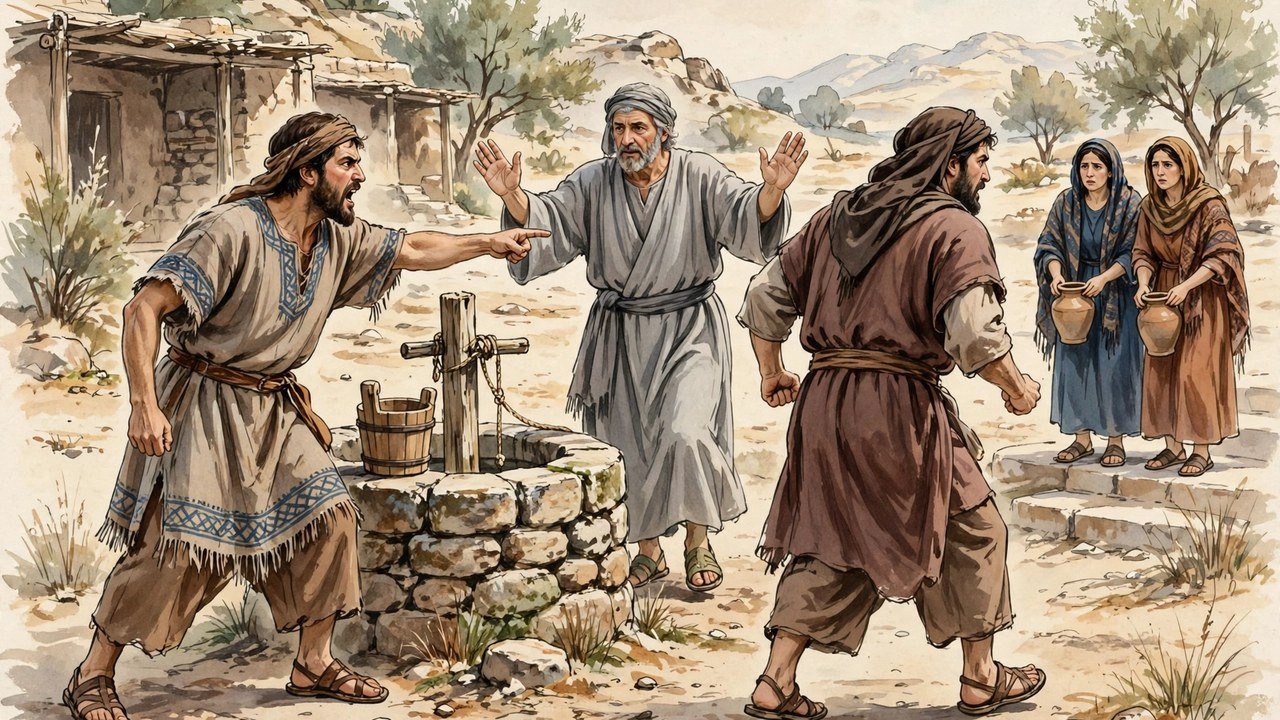
Most quarrels are remembered from their height. They are remembered from the raised voice, the broken friendship, the meeting that ended early, the household divided into camps, the letter that could not be unsent. Proverbs directs attention earlier, to the moment before any of that was inevitable, when strife was still small enough to be left alone. Its interest is not chiefly in who won an argument but in how an argument acquired fuel, recruits and a history. A quarrel, in this account, is rarely a single act. It is a process with a beginning that can be recognised, a middle that can be fed or starved, and a point after which the original question has almost ceased to matter. The persuasion at work is seldom formal. Nobody delivers an oration in favour of discord. Instead, discord is persuaded into existence by hints, repetitions, alliances, wounded pride and the steady suggestion that backing down would be a greater loss than fighting on.
The governing image is hydraulic. Water held back can be managed. Water released cannot be called back into the breach, and it does not ask permission about where it will go next.
The beginning of strife is as when one letteth out water: Therefore leave off contention, before there is quarrelling.53
Proverbs 17:14 — American Standard Version
The comparison is exact about timing. A man who opens a channel has not yet flooded the field, but he has surrendered the one advantage he possessed, which was control over whether the water moved at all. The first sharp remark in a dispute has the same character. It may be small, even deniable. It may be framed as a joke, a correction, a question asked in a particular tone. Yet it changes the conditions for everything that follows, because now the other party must decide not only what was said but what answering it will require. Silence, which a moment earlier cost nothing, can now be represented as admission. A reply, which a moment earlier would have been conversation, becomes retaliation or defence. The proverb therefore gives its instruction at the only point where it is cheap to obey: leave off contention before there is quarrelling. The counsel is not to suppress a grievance for ever, nor to pretend that a real wrong is unreal. It is to refuse the transformation of a grievance into a contest. A matter can be raised, examined and settled without being kindled. Once kindling has taken, the parties are no longer simply discussing the matter. They are defending the positions they have publicly taken about it, and each new sentence must serve two masters, the truth of the case and the honour of the speaker.
That distinction explains why so many disputes feel, to those inside them, strangely disproportionate. The stated issue is often genuine but modest: a boundary, a bill, a rota, a remark at a table, a decision taken without consultation. The heat, however, is generated by what the issue has been made to carry. To concede the boundary is now to concede that one was careless. To pay the bill is now to admit that the accusation of meanness was just. To accept the decision is now to accept a lower place in the household or the firm. Persuasion has done its quiet work in the interval, attaching identities to positions. Skilled peacemaking reverses that attachment before it hardens. It separates the question from the persons, returns the dispute to its actual size, and makes retreat from an exaggerated claim feel like accuracy rather than defeat. Unskilled handling does the opposite. It summarises the other side in its worst form, repeats that summary to third parties, and thereby creates an audience before whom nobody can afford to be reasonable.
Proverbs is blunt about the honour involved. Modern speech often treats willingness to fight as proof of seriousness, as though the man who walks away must not have cared, or must have known he was wrong. The book reverses the valuation entirely.
It is an honor for a man to keep aloof from strife; But every fool will be quarrelling.54
Proverbs 20:3 — American Standard Version
Keeping aloof is not presented as timidity, indifference or a failure of nerve. It is honour, a positive distinction, the mark of a man whose self-command is stronger than his appetite for victory. The fool, by contrast, is not identified by losing arguments but by being unable to leave one unjoined. Every fool will be quarrelling: the universality is the point. Give a fool any subject, any company and any hour, and a quarrel will be found, because the quarrel was never really about the subject. It was about the pleasure and self-importance of contention itself. Such a person experiences a disagreement as an invitation the way others experience a door left open. He cannot pass it. His readiness is mistaken, by himself and sometimes by onlookers, for candour or courage, yet it requires less courage than restraint. Quarrelling asks only that a man surrender to the feeling of the moment. Keeping aloof asks that he govern it, weigh whether the matter warrants a breach, and accept being misjudged by people who equate noise with strength.
There is also a social calculation in the honour. A man known to keep aloof from strife becomes safe to approach with bad news, corrections and unwelcome truths, because his hearers know the message will not be turned into a duel. His counsel carries weight precisely because it is not constantly being spent in skirmishes. The habitual quarreler spends his credibility in advance. Even when he is right, others brace before they listen, and bracing is a poor posture for persuasion. His rightness arrives wrapped in a threat, and people defend themselves against the wrapping before they can consider the contents. Proverbs therefore treats quarrelsomeness not merely as a private defect of temper but as a tax on all future influence. Every unnecessary fight makes the necessary correction harder to deliver and harder to receive.
Some quarrels, however, are not accidents of temper between otherwise willing parties. They are maintained by a particular kind of person whose contribution is not an argument at all but an atmosphere. The scoffer does not need to win a debate. He needs only to make seriousness look foolish, to greet every proposal with the raised eyebrow and the knowing laugh, until nobody wishes to be caught believing in anything in his presence. His weapon is not refutation but ridicule, and ridicule persuades without ever presenting a case that could be answered.
Cast out the scoffer, and contention will go out; Yea, strife and ignominy will cease.55
Proverbs 22:10 — American Standard Version
The remedy is severe and notably impersonal. It does not say to out-argue the scoffer, to shame him in return, or to appoint a committee to reform his tone. It says to remove him, and it predicts the result in terms of departure: contention will go out with him, as though contention had been his luggage. The insight is structural. In any group, a small number of participants can set the emotional price of agreement. Where a scoffer holds a central place, every attempt at settlement must first survive his commentary, and settlements rarely survive being made to look naive. People who might have compromised keep their objections alive because conceding in front of a mocker feels like joining the butt of the joke. Remove that presence and the same people, with the same interests and the same facts, discover that agreement was available all along. The proverb is not a licence to expel anyone whose manner grates, and it should not be stretched into one. The scoffer is defined by a settled posture of contempt, not by a sharp question or an unwelcome objection. Dissent can be answered and often improves a decision. Contempt cannot be answered, because it has asserted nothing. It can only be accommodated, imitated or removed, and the first two choices spread it.
If the scoffer kindles quarrels from inside a group, the meddler imports them from outside. His opportunity is other people’s trouble, and his persuasion is directed first at himself: he convinces himself that proximity is responsibility, that having heard of a dispute makes him a party to it, and that intervention, however uninformed, is a form of kindness.
He that passeth by, and vexeth himself with strife belonging not to him, Is like one that taketh a dog by the ears.56
Proverbs 26:17 — American Standard Version
The picture is deliberately absurd, and its absurdity carries the analysis. A dog seized by the ears cannot be steered, cannot be calmed, and cannot be released safely. Holding on hurts, letting go hurts faster, and the holder acquired the whole predicament by a voluntary act of grasping at something that was never his to hold. So it is with borrowed strife. The meddler enters without the knowledge that the principals possess, without the standing that might let him settle anything, and without the exit that a genuine party can negotiate. Both sides, who agree on little else, can agree in resenting him, and his intervention gives each a fresh grievance to add to the original. He also acquires obligations he did not foresee. Having taken a side in a quarrel he only partly understands, he must defend that side as facts emerge that embarrass it, because withdrawal now looks like betrayal. The dog, once seized, sets the agenda. It is worth distinguishing meddling from the duties of neighbourliness, office or friendship, where a person may be obliged to intervene in harm even at cost to himself. The proverb addresses strife belonging not to him, taken up by a passer-by who vexes himself with it: the appetite, not the obligation, is the target. The test is whether the intervention serves the parties or the intervener’s sense of importance. Meddling flatters the second while claiming the first.
Fuel, however, need not arrive as dramatic intervention. Proverbs returns repeatedly to the ordinary chemistry of combustion, in which small additions, regularly supplied, keep a fire alive long after its original ignition would have died down.
As coals are to hot embers, and wood to fire, So is a contentious man to inflame strife.57
Proverbs 26:21 — American Standard Version
Coals and wood do not create a fire from nothing. They extend one. The contentious man is described in the same terms, as an extender of burn time. His techniques are correspondingly modest: the grievance retold after it had begun to cool, the old phrase quoted again in a new company, the enquiry after a dispute that is really a request for another performance of it, the helpful carrying of messages between parties who would have done better to speak directly or not at all. Each act is defensible in isolation. He was only asking. He was only repeating what was said. He was only trying to help. Yet the cumulative effect is a quarrel that never reaches the natural end of quarrels, which is exhaustion. Left alone, most anger decays. It requires fresh material to maintain its temperature, and the contentious man is a reliable supplier. This is why the same proverbial teaching that warns against starting strife also warns against the economy that sustains it. Gossip, tale-bearing and the strategic reminder are not peripheral to discord. They are its logistics.
The opposite temperament is given equal precision, and it is not mildness of opinion but slowness of reaction that does the work.
A wrathful man stirreth up contention; But he that is slow to anger appeaseth strife.58
Proverbs 15:18 — American Standard Version
Wrath stirs, as a spoon stirs, deliberately keeping in motion what might otherwise settle. The wrathful man does not merely feel anger; he agitates with it, returning to the provocation, rehearsing it aloud, inviting others to share his temperature. The man slow to anger appeases strife that he did not necessarily start, which makes patience an active social gift rather than a private virtue. Slowness creates an interval, and in that interval several things become possible that wrath forecloses. The actual words spoken can be distinguished from the words feared. A question can be asked before an accusation is settled upon. The other party, meeting no immediate counter-blast, is given room to qualify, correct or withdraw without humiliation. Time itself is a negotiator. Many remarks that demand a furious answer at noon require only a brief one by evening, not because the facts have changed but because the first interpretation, which was the most hostile available, has lost its monopoly. The slow man is therefore not a man who feels less. He is a man who refuses to let the first feeling draft the reply.
Escalation, traced across these sayings, follows a recognisable order. First comes release, the small opening through which contention escapes control. Then comes attachment, as positions are bound to honour and retreat is renamed surrender. Then come suppliers, the scoffers, meddlers and contentious men who keep the temperature up for reasons of their own. Then comes audience, because a quarrel performed before witnesses acquires obligations that a private disagreement never had: nobody wishes to be seen yielding, and each side begins speaking past its opponent to the gallery. Finally comes inheritance, in which the quarrel outlives its cause and is handed on as a settled fact about the other party, requiring no fresh evidence to reactivate. At every stage the persuasive work is done less by arguments about the original matter than by framings of what continuing, or stopping, would mean. To continue is framed as loyalty, courage and self-respect. To stop is framed as weakness, guilt and defeat. Proverbs contests precisely those framings, and contests them early. It calls stopping honourable, calls the compulsion to quarrel folly, calls the supplier of fuel contentious rather than candid, and calls the borrowed quarrel a dog seized by the ears. Its counter-persuasion is a renaming of the whole business before the fire has learned to feed itself.
The practical reach of that renaming extends to speech in its smallest units. A question asked in genuine ignorance cools; the same question asked as a verdict heats. A correction delivered privately can be heard as help; delivered before an audience, it must first be survived as an attack on standing. An apology that specifies the fault appeases; an apology that litigates its own wording, conceding everything in general and nothing in particular, supplies fresh fuel by insulting the intelligence of the injured party. Even silence is not neutral once kindling has begun. Silence from a known partisan is read as strategy, silence from a superior as judgement, silence from a friend as desertion, which is why the slow-to-anger man of the proverb does more than refrain. He appeases, an active verb: he speaks the sentence that lowers the price of peace, acknowledges what can be acknowledged without falsehood, and gives the other side a way back that does not pass through humiliation. Where no such way back is offered, parties who privately wish to stop will publicly continue, because the only exit on offer costs more than the fire.
There is, finally, a discipline of refusal that runs through all of these sayings and binds them into a single teaching on influence. The man who cannot be drawn into unnecessary strife retains his influence for the strife that is necessary, and there is such strife: wrongs that must be resisted, falsehoods that must be answered, people who must be defended at real cost. Proverbs is not a manual of universal yielding. Its author commends contention left off early, not truth abandoned cheaply, and the distinction is maintained by the same self-command in both cases. The quarreler cannot make the distinction, because his temper makes every occasion feel like the necessary one. The scoffer cannot make it, because contempt treats every serious stand as a pose. The meddler cannot make it, because appetite treats every quarrel as his own. Only the man who has practised not fighting, who has learned the feel of an opening remark and declined to make it, of fuel offered and declined to carry it, of ears within reach and declined to seize them, can be trusted to know when the water must, in fact, be confronted at the dam and when the wisest act available is to keep his hand off the gate.
The Sluggards Self Persuasion
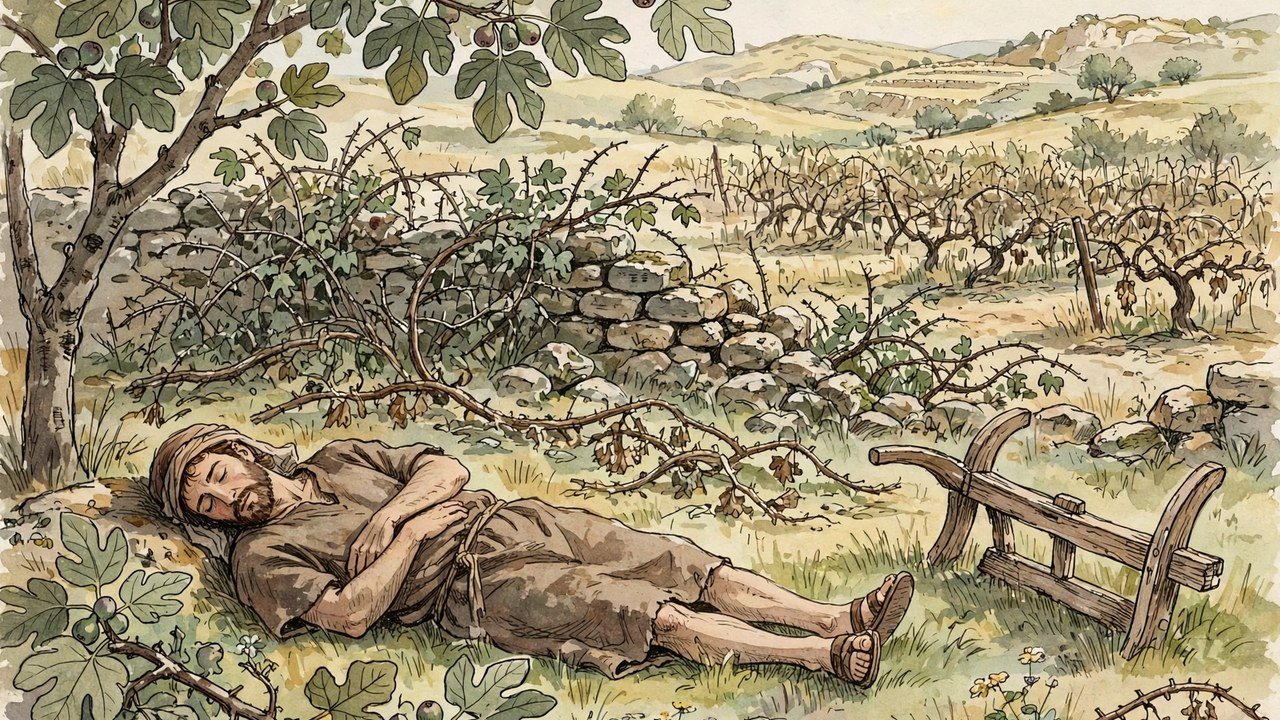
Every persuader in the earlier chapters worked on somebody else. The flatterer worked on the vain, the tale-bearer on the curious, the scoffer on the crowd. The sluggard works on himself, and he is the most successful persuader in the book, because his audience never leaves the room, never checks his facts and never wishes to reach the opposite conclusion. His subject is always the same: that the work in front of him need not be done now, by him, in the manner required. His methods are the classic methods, turned inward. He selects evidence, invents dangers, negotiates definitions, postpones deadlines by agreement with a judge who is also himself, and pronounces the verdict he commissioned. Proverbs treats sloth, accordingly, not as an absence of thought but as a corruption of it. The sluggard is not a man who cannot reason. He is a man whose reasoning has been hired, full time, by his reluctance.
The correction begins, famously, outdoors and downwards, with an insect. The teacher does not send the sluggard to a king, a merchant or a priest for his lesson, because rank would give him something to argue with. He sends him to a creature that cannot argue back and cannot be accused of enjoying advantages he lacks.
Go to the ant, thou sluggard; Consider her ways, and be wise: Which having no chief, Overseer, or ruler, Provideth her bread in the summer, And gathereth her food in the harvest. How long wilt thou sleep, O sluggard? When wilt thou arise out of thy sleep? Yet a little sleep, a little slumber, A little folding of the hands to sleep: So shall thy poverty come as a robber, And thy want as an armed man.59
Proverbs 6:6-11 — American Standard Version
Three features of the ant are held up, and each answers one of the sluggard’s standing arguments. The ant has no chief, overseer or ruler, which answers the claim that work requires external pressure to be real: the ant’s industry is self-supplied, organised without supervision, because the need that drives it is understood rather than imposed. The ant provideth her bread in the summer, which answers the claim that the present moment is the wrong moment: she works in the season when work is possible precisely because she believes in a season when it will not be. And she gathereth her food in the harvest, which answers the claim that effort and result must be simultaneous to be worthwhile: her whole economy is built on the gap between labour and enjoyment, on doing today what only winter will reward. Against this the passage sets the sluggard’s one recorded utterance, and it is not a refusal. He never says no. He says a little: a little sleep, a little slumber, a little folding of the hands. The diminutives are his rhetoric in miniature. Nothing he asks of himself is ever large, and that is the point. A demand for a whole day in bed would alarm even his own conscience, so the request is divided into instalments too small to refuse, each one reasonable, their sum ruinous. Self-persuasion rarely proceeds by grand falsehoods. It proceeds by small quantities.
The consequence is then stated in terms that deny him his favourite consolation, which is gradualism. He imagines his decline, if decline there must be, as a slow slope down which he can stop at any point. The proverb says poverty comes as a robber and want as an armed man: suddenly, from outside the negotiation, and with no interest in the terms he had arranged with himself. The image is chosen with care. A robber does not send notice, does not accept the plea that the householder was resting, and does not leave because the householder had intended, eventually, to lock the door. Intention is the sluggard’s currency, and the passage declares it worthless at the point of settlement. The harvest missed is missed. The debt contracted in small sleeps is collected in one visit. There is a mercy in the severity of the metaphor, since it tells the truth that the man’s own rhetoric exists to conceal: time is not a neutral medium in which postponed work waits patiently. Time is the medium in which consequences travel towards him, at their pace, not his.
The fullest portrait of the inward persuader comes later, in a sequence of four sayings that move steadily from the street to the bed to the table to the mind.
The sluggard saith, There is a lion in the way; A lion is in the streets. As the door turneth upon its hinges, So doth the sluggard upon his bed. The sluggard burieth his hand in the dish; It wearieth him to bring it again to his mouth. The sluggard is wiser in his own conceit Than seven men that can render a reason.60
Proverbs 26:13-16 — American Standard Version
The lion deserves close attention, because it is the sluggard’s masterpiece. There is no lion. The streets of his town are not a game reserve, and he knows, at some level, that the report would not survive inspection. Yet the invention is not random. A lesser excuse would invite a lesser answer: rain can be waited out, tiredness can be rested away, a difficult employer can be approached on a better day. A lion forecloses discussion. It converts a question of willingness into a question of survival, and casts anyone who presses him as a person careless of his life. The excuse is engineered to be unanswerable, and that engineering is the tell. Genuine obstacles are usually stated plainly, because the person facing them wants help in removing them. Fabricated obstacles are stated absolutely, because the person hiding behind them wants the conversation to end. The sluggard does not produce the lion in order to be believed. He produces it in order to be excused from the burden of producing anything better, and since the only examiner present is himself, the lion passes.
Note, too, the direction of travel in his report. The lion begins in the way and is then in the streets, plural and general, as though a single invention, once admitted, breeds. Excuses behave like this in practice. The first falsehood is told to escape a task; the second is required to protect the first from the colleague who went out that morning and saw no lion; a third establishes that lions are a known problem in the district, attested by others; and within a week the man possesses a small body of doctrine about local dangers, complete with supporting instances, all of it constructed to defend an hour in bed. This is rationalisation in its mature form: not a single lie but an edifice, maintained at real cost in memory and consistency, by a man who maintains that effort is what he is trying to avoid. The energy expended on the edifice routinely exceeds the energy the task would have taken. Sloth is not the conservation of effort. It is the misdirection of effort into the service of its own excuse, and the misdirection can be ingenious, tireless and, in its narrow sphere, brilliant.
The door on its hinges is the companion image, and it is about motion without progress. A door turns constantly and arrives nowhere, yet it is not still, and the sluggard on his bed is not still either. He turns, resettles, adjusts, rises in intention and subsides in fact, and the activity of preparation becomes his evidence that the day has begun. Every age supplies its own hinges. There are arrangements to be perfected before work can start, information to be gathered beyond what the task requires, tools to be improved, conditions to be awaited, and a general sense that motion in the vicinity of work is a kind of work. The proverb is unimpressed by vicinity. It measures travel, not turning. A man may be busy all day on his bed of preparations and cover less ground than the ant covers before the dew dries, because the ant’s motion has a direction and a destination outside itself, while his motion is circular, returning each time to the comfort it started from. The hinge, it should be said, is not wicked. It is well made, it swings smoothly, and it is doing exactly what a hinge does. The rebuke is that a man is not a hinge, and a life spent turning on the spot is a misuse of a creature built to go somewhere.
The buried hand carries the analysis one stage further, past beginning to the humiliating territory of not finishing. The sluggard at the table has done the hard part. He has reached the dish. The food is in his hand. What defeats him is the return journey, the few inches between dish and mouth, and the passage is unsparing about the disproportion: it wearieth him. Weariness, here, is not a report from the body but a ruling from the persuader within, who has learned that a claim of exhaustion ends enquiries as reliably as a lion does. Applied beyond the table, this is the anatomy of the abandoned project, the half-built wall, the course dropped in its final term, the letter written and never sent. Starting flatters the sluggard, because a start can be narrated, displayed and counted as evidence of character. Finishing offers no such theatre, only repetition of an unglamorous motion until the thing is done. So his projects accumulate in the state that costs him least and credits him most: begun. The dish of the ancient world was shared, which adds a social edge to the picture. A man who buries his hand in the common dish and leaves it there is not merely failing to feed himself. He is occupying the place of a diner while declining the motions of one, and every household and workplace knows the figure: present at the meal, absent from the labour, hand permanently in the dish.
The sequence ends where it must, in the judgement that protects all the others from correction.
The sluggard is wiser in his own conceit Than seven men that can render a reason.61
Proverbs 26:16 — American Standard Version
Seven is the number of completeness. Set against the sluggard is not a casual opinion but a full bench of counsellors, men able to render a reason, to give an account that survives questioning. He outvotes them in the only court he recognises, which is his own conceit, and the court sits permanently, admits no appeal and finds, with perfect consistency, for the man who appointed it. This is the keystone of the whole structure. The lion could be dispelled by a neighbour who had walked the street. The turning could be named by a friend. The buried hand could be remarked on at the table. What cannot easily be reached is the prior conviction that his own assessment of himself outranks any evidence assembled against it. Self-persuasion, at its most developed, does not merely win arguments. It disqualifies the tribunal. Every external correction is reclassified in advance as misunderstanding, envy, rigidity or ignorance of his particular circumstances, and his circumstances are always particular. He has an answer for the ant as well, if pressed: the ant, he will explain, is differently constituted, differently situated, and in any case obsessed. The seven men leave with their reasons intact and their errand unaccomplished, having discovered that they were never really being answered, only processed.
The last of the sluggard passages replaces argument with evidence, and its method is a walk past a ruin.
I went by the field of the sluggard, And by the vineyard of the man void of understanding; And, lo, it was all grown over with thorns, The face thereof was covered with nettles, And the stone wall thereof was broken down. Then I beheld, and considered well; I saw, and received instruction: Yet a little sleep, a little slumber, A little folding of the hands to sleep; So shall thy poverty come as a robber, And thy want as an armed man.62
Proverbs 24:30-34 — American Standard Version
A vineyard is the most argumentative of properties. It cannot be neglected in secret, because its condition is published to every passer-by, season by season, in a language of thorns and nettles that admits no spin. The owner may have explained his inaction fluently, in terms of weather, markets, health and timing, and his explanations may have satisfied the court of his own conceit for years. The field is unimpressed. It records what was not done, in the order in which it was not done: first the small growth unchecked, then the face of the ground covered, then the wall down, at which point the damage ceases to be a matter of tidiness and becomes a matter of exposure, since a broken wall admits beasts and thieves to whatever the vines might still have borne. Neglect compounds like interest. Each season’s omission raises the cost of the next season’s repair, until the work required to restore the vineyard is many times the work that would have maintained it, and the sluggard, contemplating that enlarged bill, finds in it his freshest excuse. It is too far gone now. It would take more than he has. The ruin he authored becomes the lion that guards him from addressing it.
The observer’s response is the model the passage commends, and it is worth noticing how little of it is speech. He went by, he beheld, he considered well, he received instruction. The field teaches him without a word, because he is willing to let a fact finish its sentence. This is the faculty the sluggard has disabled in himself. Where the observer reads the thorns as a verdict on the folding of hands, the owner read them, at each stage, as a temporary appearance, an unusually wet spring, a problem for next month. The difference between the two men is not intelligence and not information. Both saw the same field. The difference is that one of them permitted evidence to conclude an argument against his comfort, and the other had trained himself, lion by lion and little by little, to ensure that no evidence ever would.
The same liturgy is audible wherever work is shared and its avoidance must be explained to people who are carrying it. In a household, the sluggard’s contribution is a commentary: tasks are discussed, standards are raised, methods are questioned, and the discussion itself is offered as participation, while the washing, mending and carrying proceed around him. In a workshop or an office, his instrument is the memorandum of difficulties, longer than the report the task itself required, establishing at impressive length why the thing cannot be done this week. What unites these performances is that they are addressed, in the first instance, to an audience of one. Colleagues may be unconvinced, and often are. It does not matter, provided the inner court has accepted the plea, because that court’s acceptance is what permits the hands to fold. Other people’s disbelief is registered merely as further evidence that his situation is uniquely misunderstood, and misunderstanding, in his economy, is itself a kind of lion: a hostile condition of the streets that no reasonable man could be expected to walk into unarmed.
Rationalisation, as Proverbs anatomises it, thus has a recognisable liturgy. It begins with diminutives, which shrink the concession being asked. It proceeds to inventions, which raise the cost of the duty until refusal looks like prudence. It maintains itself with circular motion, which supplies the feeling of industry without the fact of it. It abandons tasks at the point where narration ends and repetition begins. And it enthrones the self as the final court, wiser in its own conceit than seven men that can render a reason, so that the whole system is sealed against the only force that could reform it, which is correction from outside. No external persuader could ask for better conditions than the sluggard grants his internal one: a monopoly of the evidence, a veto on witnesses, and an audience whose dearest wish is to be convinced. The book’s remedy is correspondingly plain. It does not argue with the lion. It points to the ant, walks the reader past the vineyard, and lets the harvest, or its absence, deliver the verdict that the sluggard’s court worked so hard, and so ingeniously, to postpone.
Pride and the Deceived Heart
Persuasion ordinarily requires two parties. One speaks, the other is moved. The final subject of this study requires only one, and he performs both offices so smoothly that he never notices the transaction. The proud man is persuaded by himself, of himself, in terms supplied by himself, and the conclusion he reaches is the premise he started with: that his way is right, his judgement sound, his standing secure and his heart a reliable guide to all three. Proverbs returns to this inward persuasion more persistently than to any flatterer at any gate, because it is the persuasion that disables the defences against all the others. A man who has been convinced by an outsider can, in principle, be unconvinced by better evidence. A man who has convinced himself has arranged his evidence in advance, appointed himself the judge of its weight, and taken the further precaution of experiencing every correction as an insult. His deception needs no persuader because he has internalised the office.
The most quoted saying in the whole collection states the sequence as a law of order, not a risk.
Pride goeth before destruction, And a haughty spirit before a fall.63
Proverbs 16:18 — American Standard Version
Before is the operative word. Pride is not punished, in this saying, by an unrelated misfortune arriving from outside to balance the moral books. It precedes destruction the way a cause precedes an effect it has made likely at every step. The proud man walks into his fall through a series of decisions that pride renders rational. He does not take counsel, because counsel implies a gap in his knowledge that he has persuaded himself does not exist. He does not prepare for failure, because preparation would concede that failure is possible for him, and the concession feels like disloyalty to the self he has been describing. He does not hear warnings, because warnings arrive in the voices of people he has already classified as lesser, envious or timid, and classification is pride’s way of answering arguments without the labour of considering them. He takes the larger risk, accepts the thinner margin, dismisses the awkward detail and promotes the agreeable subordinate, and each step is small, defensible and his own. The destruction, when it comes, therefore surprises exactly one person. Everyone around him saw the order of events. He alone experiences the fall as an interruption of his story rather than its conclusion, because the story he had been telling himself had no chapter in which he could be wrong at scale.
A companion saying locates the haughtiness more precisely, in the heart, and sets it in a sequence that runs in both directions.
Before destruction the heart of man is haughty; And before honor goeth humility.64
Proverbs 18:12 — American Standard Version
The symmetry is the teaching. Two processions are described, each with its herald. Haughtiness walks in front of destruction and announces it; humility walks in front of honour and announces that. A man can therefore read his direction of travel from the attitude that precedes him, long before the destination is visible, if he is willing to perform the reading. Pride makes the reading nearly impossible, since haughtiness of heart does not feel like haughtiness from inside. It feels like clarity. It feels like finally seeing one’s own worth accurately, after a period of being underestimated. This is the deceived heart’s most reliable disguise: it presents an inflated estimate as a corrected one, and borrows the emotional satisfaction of justice done. The man is not, in his own account, proud. He is merely no longer willing to pretend to be less than he is. Under that description, every restraint becomes false modesty, every critic becomes a person invested in keeping him small, and every act of self-assertion becomes overdue honesty. The persuasion is complete when the vocabulary of virtue has been conscripted to defend the vice, and humility itself can be dismissed as a performance put on by people who lack his courage to be known.
The earliest of these sayings adds the consequence that pride least expects and most dreads, which is not destruction in the abstract but shame in the eyes of others.
When pride cometh, then cometh shame; But with the lowly is wisdom.65
Proverbs 11:2 — American Standard Version
Shame is the specific undoing of pride because pride is, at root, a claim about standing, and shame is standing reversed in public. The proud man’s whole economy runs on an anticipated audience: he acts for the regard of people whose opinion he has persuaded himself he commands. When the fall comes, the same audience is present, and its verdict is delivered in the currency he chose. The saying sets against him not the successful or the celebrated but the lowly, and it gives them the one possession his system cannot produce, which is wisdom. The reason is mechanical rather than sentimental. The lowly man can afford to be wrong in public, and therefore can afford to learn in public. He can ask the elementary question, admit the missed fact, change his stated position when the evidence changes, and survive all of it, because his standing was never staked on being above correction. Wisdom accumulates in such a man the way capital accumulates where it is not constantly spent. In the proud man it cannot accumulate, because every admission of error is priced as a loss of face, and face is the asset he is managing. He will therefore choose, again and again, the appearance of having been right over the reality of becoming right, until the gap between the two is closed for him, rudely, by events.
All of this rests on a prior act of self-persuasion that Proverbs states as a universal condition, the most quietly devastating sentence in the book on the subject of judgement.
Every way of a man is right in his own eyes; But Jehovah weigheth the hearts.66
Proverbs 21:2 — American Standard Version
Every way, and every man. The saying does not describe a defect of unusually arrogant people. It describes the default setting of human self-assessment, in which one’s own course of action arrives at consciousness pre-approved. The mechanism is familiar to anyone who has examined his own conduct honestly. We judge ourselves by our intentions, which we know intimately and which are generally creditable, and we judge others by their effects, which are all we can see. We know the provocation that preceded our sharp answer, the fatigue behind our omission, the good end our questionable means were serving. That knowledge is real, and it is exactly what corrupts the verdict, because a judge who knows all the mitigating circumstances of one party and none of the other is not impartial merely because he is well informed. He is briefed by the defence, permanently, and calls the briefing conscience. The second half of the proverb introduces the only correction the book offers for this arrangement, which is a different set of scales. Jehovah weigheth the hearts: the weighing is of the heart rather than the way, of motive and mixture rather than presentation, and it is done by a weigher who has not been briefed by either side. The force of the image is that a true weight exists. The man’s own eyes are not the only instrument in the world, and the fact that his way registers as right on his own apparatus settles nothing about what it registers elsewhere.
Weighing is an exact metaphor, and worth dwelling on. A merchant’s scales can be falsified in two ways: by a dishonest weight, placed in the pan as the standard, or by a thumb, applied quietly during the measurement. Self-deception uses both. The dishonest weight is the standard a man selects for himself, lenient where his own faults are concerned and precise where others are measured, so that his temper is directness while another’s is rudeness, his caution is prudence while another’s is cowardice, his ambition is diligence while another’s is grasping. The vocabulary does the weighing before the facts are admitted. The thumb is the pressure applied at the moment of judgement: the decision not to ask the question whose answer might be unwelcome, the haste to conclude an enquiry into one’s own conduct while it is still returning favourable results, the sudden interest in a fresh topic when an old action is mentioned. Neither device requires the man to lie outright. He can pass every test of sincerity, believe every word he says, and still be running false scales, because sincerity measures the honesty of the report, not the accuracy of the instrument. Proverbs is interested in the instrument.
From the universal condition the book moves to the individual folly of acting on it, of taking the heart’s own testimony as a sufficient guide for the road.
He that trusteth in his own heart is a fool; But whoso walketh wisely, he shall be delivered.67
Proverbs 28:26 — American Standard Version
Trust is the precise term. The fool of this saying is not a man who consults his heart, attends to it or takes its reports seriously, all of which are unavoidable and often right. He is a man who trusts it, who rests the weight of a decision on the fact that he feels it to be right, as though the feeling were a credential rather than a claim requiring examination. Feelings about one’s own rightness are the least independent evidence available in any dispute, since they are produced by the party under examination. Yet they arrive with an authority that external evidence rarely matches, because they are experienced from inside, continuously, and in the first person. A report can be doubted. A feeling is simply had, and the having of it masquerades as proof. The deceived heart exploits this confusion relentlessly. It does not argue that a course is wise. It makes the course feel familiar, settled and one’s own, and then invites the man to mistake that settled feeling for a judgement he has reached. The contrast in the second half is with walking wisely, a phrase that points outward: to counsel taken, to precedent weighed, to the fear of the Lord that the book sets at the beginning of knowledge, to all the external reference points by which a private conviction can be checked. Deliverance, in this saying, is not the reward of humility as a temperament. It is the predictable outcome of using instruments other than the one that is broken.
The darkest of the sayings gathers these threads into a single road, and it is the only one of them that follows the persuaded man to the end of his persuasion.
There is a way which seemeth right unto a man; But the end thereof are the ways of death.68
Proverbs 14:12 — American Standard Version
Seemeth is the whole tragedy in one word. The way does not merely tempt the man, or get chosen by him in a moment of weakness he later regrets. It seems right, which means it passes his inspection, satisfies his criteria, agrees with his experience and survives his reflection, and it does all of this while leading to death. The saying is the book’s final refusal of the idea that sincerity is a safeguard. A man may be sincere, reflective, experienced and entirely convinced, and be walking, the whole time, in exactly the wrong direction, because every instrument he used to check the road was supplied by the heart that chose it. Nor is the end described as a single misfortune. The end thereof are the ways of death, plural: the road branches at its terminus into further roads, all of them mortal, so that a man who discovers his error late does not find a simple turning back to the junction where he went wrong. He finds a country. Self-deception, pursued long enough, becomes geography. It builds the relationships, habits, debts and reputations within which the man must now live, and each of them argues, with the force of sunk cost, that the road must have been right, because the alternative is to admit what the road has cost.
That argument from sunk cost is pride’s last and strongest brief, and it explains why the deceived heart so often survives its own exposure. A man shown, plainly, that his way has ended in wreckage does not automatically abandon the persuasion that built it. He has a cheaper option, which is to reinterpret the wreckage. The failure becomes the fault of those who obstructed him, of timing, of a world not ready for what he attempted. His pride, which caused the fall, is retained as the explanation of it, and the same instrument that misweighed the heart at the start misweighs the evidence at the end. This is why Proverbs so often pairs its teaching on pride with teaching on counsel, on reproof and on the friend who wounds faithfully rather than the enemy who kisses. External voices are not an optional refinement of wisdom in this book. They are the only known counterweight to scales that every man carries and every man has tampered with, usually without noticing his own thumb. The lowly man of the earlier saying is wise not because lowliness is a charm but because he has kept his instruments open to calibration. He can still be told. The whole tragedy of the proud is compressed into the loss of that one capacity. He cannot still be told, because being told has been reclassified, by the persuasion he performed on himself, as the one thing a man of his standing must never accept.
Counsel, in this scheme, is not merely advice about a decision. It is a rival weighing. The counsellor brings a second instrument into the room, one that has not been adjusted to flatter the case in hand, and the proud man experiences the mere presence of that instrument as an accusation, which in a sense it is. This is why his resistance to counsel so rarely takes the form of answering it. He questions the counsellor’s standing to offer it, the timing of its arrival, the tone in which it was delivered and the motives that lay behind it, because any of these objections, if sustained, allows the weighing to be postponed without the embarrassment of refusing it outright. A humbler man can separate the message from its delivery and extract what is true from an awkward, even hostile, correction. The deceived heart cannot afford that separation. It must discredit the messenger wholesale, since a partly credible messenger with a partly true message would leave it with work to do, and the work in question is the one labour it was constructed to avoid: the reweighing of itself.
The deceit also has a characteristic effect on memory. A man who has weighed his own heart favourably must maintain the record that supports the verdict, so his recollection of his own conduct is edited as continuously as a chronicle in a court where the king reads every draft. Kind intentions are preserved in full. Harsh words are retained only in their provoked and abbreviated form. Promises are remembered as aspirations, failures as episodes in which he was chiefly a witness, and successes, however communal, are recalled with himself at the centre of the frame. None of this editing feels like editing. It feels like remembering, which is what makes it formidable. By the time an external account of events is presented to him, it is not merely unwelcome. It is unrecognisable, a description of a stranger, and he can reject it with genuine indignation because the man it describes is not the man preserved in his own archive. Pride thus protects itself across time as well as across argument, falsifying the evidence of the past with the same quiet thumb it applies to the judgements of the present.
There is a final refinement, and it concerns the audience for whom this inward persuasion is staged. A man deceiving himself rarely does so in the abstract. He maintains, in imagination, a company of witnesses before whom his conduct is continually being justified: the colleagues who will one day acknowledge that he was right, the family whose respect his sacrifices were purchasing, the rivals whose envy is treated as a form of applause. Pride curates this audience as carefully as it curates its evidence, dismissing real critics as unqualified while promoting imaginary ones whose verdicts can be scripted. The result is a life conducted partly in a theatre that does not exist, for spectators who have never been consulted, while the actual people in the room, whose love and patience are the real stakes, are treated as an interruption of the performance. When the fall comes, its peculiar bitterness is that the theatre empties first. The imagined witnesses, being imaginary, offer no support. The real ones, long unheard, have often learned not to speak. He is left alone with the one voice that persuaded him, which now, characteristically, has nothing to say in his defence that it has not already said, and said, and said, on the road that seemed right all the way to its end.
Two Voices at the City Gate
Proverbs opens its teaching not in a classroom and not in a sanctuary, but in a street, at a gate, in the noise of a city where decisions are made and reputations are settled. Before the book settles into the short, paired sayings for which it is best known, it stages a contest for the ear. Two women speak. Both are personifications, and the book means them to be read as such: one is Wisdom, the other is the foolish, forbidden, strange woman whose speech is the subject of warning after warning in chapters 2, 5, 6 and 7. Both address the same listener, described repeatedly as simple and void of understanding. Both issue an invitation. Both promise a feast, a house, a way of life. The difference between them is not volume, for both are loud, and it is not confidence, for both speak as if they know the listener better than he knows himself. The difference lies in where each voice speaks from, what each voice is willing to have examined, how each handles time, and what each is obliged to conceal in order to be believed. Chapters 1 to 9 are, among other things, a training in telling voices apart before their consequences arrive to do the telling instead.
The setting matters because the gate of an ancient city was not a decorative arch. It was the place of judgement, of trade, of news and of public record, where elders sat, where cases were heard, where agreements were witnessed and where a man’s standing in the community was visible to anyone who cared to look. To speak at the gate was to speak where speech could be checked against a life, a family, a transaction and a past. Proverbs places Wisdom there deliberately, again and again, and it places her rival in telling counterpoint: at a door, on a corner, in the twilight, in streets she has chosen because the light and the hour suit her purpose. The geography is the first criterion the book offers, and it is offered before any argument is heard. A voice that seeks the most public place available is making a claim about itself that a voice which seeks privacy, darkness and a moment when nobody else is present cannot make, whatever words either of them uses.
Wisdom crieth aloud in the street; She uttereth her voice in the broad places; She crieth in the chief place of concourse; At the entrance of the gates, In the city, she uttereth her words:69
Proverbs 1:20-21 — American Standard Version
Chapter 8 repeats the placement with an almost legal precision, as if the location were evidence being entered a second time for the record. Wisdom stands on the top of high places by the way, where the paths meet, beside the gates, at the entry of the city, at the coming in at the doors. Nothing in the description is furtive. She does not wait for a particular passer-by, does not select a victim, does not lower her voice for one listener and raise it for another. Her address is indiscriminate in the strict sense: whoever is passing may hear it, including those who will contradict it, mock it, or repeat it to others. That openness is not a stylistic preference. In the logic of the book, publicity is a form of accountability. Speech delivered where it can be overheard, compared, remembered and tested against events has submitted itself to a discipline that speech delivered in confidence has refused. The first question Proverbs teaches a listener to ask of any persuasive voice is therefore not whether it sounds true, but where it has chosen to stand while saying it.
Wisdom’s second mark is that she states her terms in advance and in full. Chapter 9 gives her a house built, pillars hewn, beasts killed, wine mingled and a table furnished before a single guest is invited. The preparation is described before the invitation is issued, and the invitation itself is plain to the point of bluntness: the simple are told to turn in, to eat of her bread and drink of her wine, to forsake their simplicity and live. There is no suggestion that the price will be revealed later, no hint that the real arrangement differs from the stated one, no second meaning reserved for those who commit themselves first. She sends maidens out to publish the invitation from the highest places of the city, which is to say she multiplies witnesses to her own offer. A host who sends messengers to announce a feast in public has bound herself to the menu she announced. The whole apparatus — house, table, messengers, public cry — is the opposite of a confidence trick, in which the terms must stay vague because precision would end the persuasion.
Hear, for I will speak excellent things; And the opening of my lips shall be right things. For my mouth shall utter truth; And wickedness is an abomination to my lips. All the words of my mouth are in righteousness; There is nothing crooked or perverse in them.70
Proverbs 8:6-8 — American Standard Version
That self-description in chapter 8 is worth reading slowly, because it is a claim about method and not only about content. Wisdom does not merely say that her conclusions are true; she says there is nothing crooked or perverse in her words, nothing twisted in the route by which the listener is brought to them. The distinction is one the rest of the book depends on. A crooked argument can arrive at a true statement and still corrupt the person persuaded by it, because he has been taught, by the manner of his persuading, that twisting is how minds are properly moved. Wisdom refuses the method even where it might succeed. Her speech in chapter 1 is, if anything, severe: she warns that she will laugh at calamity when it comes on those who refused her, that she will not answer when they call in their distress, because they would not answer when she called in the street. It is not flattering speech, and it is not designed to be liked. It offers the listener no compliment about his discernment, no assurance that he is exceptional, no suggestion that the rules have been relaxed in his particular case. The refusal to flatter is itself presented as evidence. A voice that will tell a crowd, in public, that its own past refusals have consequences it cannot now renegotiate is not managing its audience. It is addressing it.
Against this figure the book sets the other woman, and it introduces her first not by her arguments but by her effect on the tongue of anyone who listens. Chapter 2 promises that the father’s instruction will deliver the son from the strange woman, from the foreigner who flattereth with her words. Chapter 6 gives the same protection a sharper edge: the commandment kept in the heart will keep the son from the evil woman, from the flattery of the foreigner’s tongue. Flattery is therefore not an incidental charm in her speech; it is named, twice, as the instrument. In the vocabulary of Proverbs, flattery is speech that works on a person’s estimate of himself rather than on his judgement of the matter in front of him. It does not ask to be believed about the world. It asks to be believed about the listener — that he is desired, that he is discerning, that he is owed an exception, that his case is unlike the cases that ended badly for other men. Once that belief is installed, the conclusion follows without ever having been argued, because a man does not cross-examine a compliment.
For the lips of a strange woman drop honey, And her mouth is smoother than oil: But in the end she is bitter as wormwood, Sharp as a two-edged sword.71
Proverbs 5:3-4 — American Standard Version
Chapter 5 makes the contrast a matter of sequence. Honey and oil describe the first taste and the first texture; wormwood and the sword describe the end. The warning is carefully not that her speech feels false. It feels, by every immediate measure the tongue can apply, better than the truth usually feels. Smoothness is the problem, not the disguise of the problem. Proverbs assumes throughout that destructive persuasion will ordinarily be more pleasant to receive than sound counsel, because sound counsel must include the parts of the truth that the listener would prefer to omit, while destructive persuasion is free to edit. A speaker who wants something from the listener can afford to be agreeable about everything except the one transaction being concealed. A speaker who wants the listener’s good cannot afford that economy, and will sound rougher for it. The book therefore trains its reader to treat unusual smoothness as a question rather than as a credential: what has been left out to make this go down so easily, and who benefits from its having been left out?
Chapter 7 supplies the fullest case study, and it is constructed as a scene watched from a window, which is itself an instruction in method. The father does not merely report a conclusion about the young man void of understanding; he shows the reader how to observe the persuasion as it happens, stage by stage, so that the stages become recognisable when they recur in other dress. The young man is first seen among the simple ones, near her corner, going the way to her house — proximity precedes persuasion, and the chapter is honest that he has already placed himself within reach before a word is exchanged. The hour is twilight, the evening, the black and dark night. She is loud and stubborn, her feet do not abide in her house, and she catches him and kisses him with an impudent face before she speaks. The speech, when it comes, is a masterpiece of the kind the book exists to expose, and every element of it deserves the attention the chapter gives it.
She begins with religious respectability: peace offerings are with her, this day she has paid her vows. The claim does double work. It presents her as a woman of observance rather than of appetite, and it quietly establishes that there is food in the house, a feast prepared, a reason for him to come in that can be described innocently if it ever has to be described at all. She continues with the furnishings — the bed covered with tapestry, with striped cloths and fine linen of Egypt, perfumed with myrrh, aloes and cinnamon — an appeal conducted entirely through the senses, in which luxury stands in for argument. She then removes the one obstacle that might interrupt the scene, and she removes it with information she could only offer in private: her husband is not at home, he has gone on a long journey, he has taken a bag of money with him, he will not return until the full moon. The detail is precise, and its precision is the persuasion. A timetable is offered as a guarantee. Finally she applies the compliment that the whole speech has been arranged to deliver: she came forth to meet him, to seek his face diligently, and she has found him. Of all the men passing through the city, he is the one sought. The chapter then gives its verdict in a single verse that names the mechanism rather than the morality.
With her much fair speech she causeth him to yield; With the flattering of her lips she forceth him along.20
Proverbs 7:21 — American Standard Version
Much fair speech: quantity and quality together. She does not win by one decisive argument but by accumulation, by keeping the channel open until resistance becomes ruder than surrender. The verb in the second half deserves notice, for flattery is described as force. The young man experiences the encounter as his own choice, and in the chapter’s next breath he goes after her as an ox goes to the slaughter, as in fetters to the correction of the fool, until an arrow strikes through his liver, unaware that it is for his life. Proverbs holds both descriptions at once without embarrassment. He chose, and he was forced; the force operated through the choice, by arranging what the choice would feel like from inside. That is the book’s mature account of how smooth speech works on a person, and it is why the book puts so little weight on a listener’s confidence that he would notice manipulation when it happened. From inside, it did not feel like manipulation. It felt like being found, being fed, being told the coast was clear, by someone whose vows were paid.
Chapter 9 closes the contest by placing the two invitations side by side in almost identical words, and the near-identity is the point. The foolish woman is clamorous, simple and knowing nothing, yet she too sits in the high places of the city, she too calls to those who pass by, and she too addresses the simple man in Wisdom’s very formula: whoso is simple, let him turn in hither. A reader taught to judge a voice by its opening line, its confidence or its apparent generosity would have nothing left to judge by, because the imitation covers all of those. What differs is what each host says next. Wisdom offers bread and wine she has prepared in a house she has built, and the outcome named for her guests is life. Folly offers stolen waters and bread eaten in secret, and her pitch is the secrecy itself, presented as sweetness. Then the narrator adds the fact her speech omitted: the dead are there, her guests are in the depths of Sheol. The omitted fact is the whole difference. Both invitations are real. Only one can afford to publish its guest list and its ending.
From these paired portraits the book’s criteria for telling voices apart can be drawn out in order, and they are more practical than a first reading suggests. The first is publicity. Wisdom cries in the street and at the gates, sends out maidens, and repeats her call over years to people who refuse it; her rival works at twilight, at a corner, in a house emptied for the purpose, on information about an absent husband that cannot be repeated. Speech that requires the absence of witnesses should be weighed differently from speech that invites them, and a persuader who insists that a matter be settled between the two of you, now, without reference to anyone else who knows either of you, has already supplied evidence about the kind of claim being made. The second criterion is the treatment of time. Wisdom can wait, and does: she builds a house before she issues an invitation, which is the longest possible admission that her offer does not depend on the mood of an evening. Her rival’s offer expires at the full moon and is void if the husband returns. Urgency in Proverbs is almost never a property of the truth; it is a property of an arrangement that cannot survive delay, consultation or a night’s sleep. A listener trained by this book learns to hear a deadline imposed by a persuader as information about the persuader.
The third criterion is the direction of the compliment. Wisdom’s speech is about the world: about paths, houses, feasts, consequences and the fear of Jehovah, and the listener appears in it mainly as someone who must choose. The other woman’s speech is about the listener: his face was sought, his arrival was prepared for, his presence completes the furnished room. Where a persuasive address spends its energy establishing how the hearer is regarded by the speaker, rather than how the matter stands in itself, Proverbs has already classified it. The fourth criterion is the handling of cost. Chapter 5 is unsparing about the price of the forbidden woman’s company — honour given to others, years to the cruel, wealth in the house of a stranger, and groaning at the end when flesh and body are consumed — and chapter 6 reduces the economics to a loaf of bread and a hunted life. Wisdom states costs as part of her own teaching, including the cost of refusing her. Her rival’s speech contains no cost at all; in seven verses of invitation there is not one noun that admits a consequence. An offer with no stated price is not a free offer in this book’s accounting. It is an offer whose price has been moved to a page the listener will be shown later.
The final criterion is the end of the road, and Proverbs insists on judging speech by destinations rather than by openings because its two voices are most alike at the opening. Her feet, chapter 5 says of the forbidden woman, go down to death and her steps take hold on Sheol, and she does not know the path of life because her ways are unstable — a detail easily missed, that the guide herself does not know where the road goes. Chapter 7’s young man is compared to an ox, to a bird hastening to a snare, creatures whose common trait is not wickedness but an inability to read the scene they are in. Wisdom, by contrast, describes her own path in chapter 8 as the way of righteousness and the paths of justice, and promises that those who love her inherit substance. The book is not embarrassed to argue from outcomes. It regards a voice’s destination as part of its content, and a listener who refuses to ask where a road ends, on the grounds that the first mile is pleasant, as a man who has surrendered the one faculty the whole curriculum exists to build.
There is also a criterion that operates underneath the others, and it concerns the listener rather than the speaker. Both women address the simple, and the book uses that word without contempt and without flattery: the simple man is the one who believes every word, who has not yet installed a test between hearing and assenting. Proverbs never suggests that the simple are safe because they are sincere, or that a good heart will sort true voices from false ones by instinct. Its remedy is not sincerity but training — a stock of comparisons laid up in advance, of which the paired portraits of chapters 1 to 9 are the largest and most deliberate. The reader who has watched the scene at the window in chapter 7, and who has read the two invitations of chapter 9 set out in matching language, has been given a pattern to recognise rather than a rule to recite. When the next voice speaks smoothly, privately, urgently, and chiefly about himself, he will not need to decide from nothing whether it is to be trusted. He will have seen this play before, in a theatre where the ending was shown, and the recognition will arrive in time to be of use — which is the only moment at which discernment is worth anything at all.
Speech Before Kings
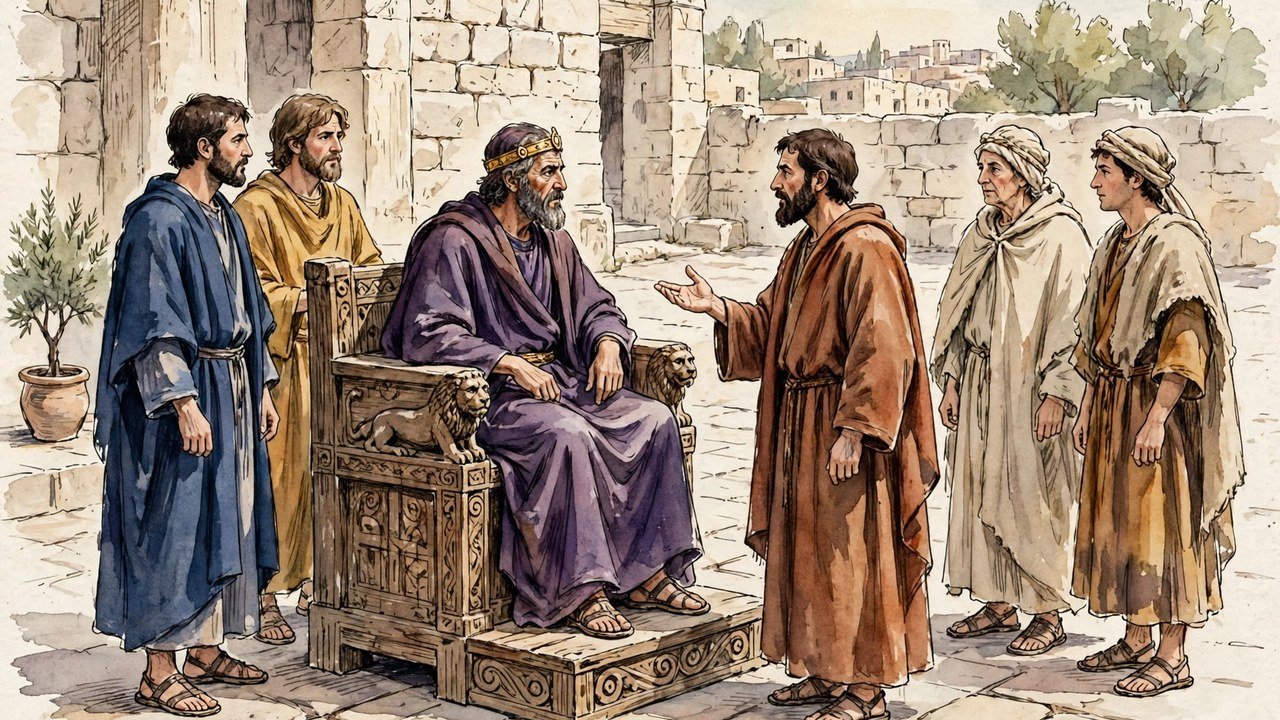
Every court concentrates a problem that exists everywhere in weaker form: speech addressed to power is never only about the matter in hand. It is also about the speaker’s standing with the person who can reward, ruin or dismiss him, and that second subject presses on the first until, in most courts, it displaces it. Proverbs returns to the court more often than its reputation as a book of domestic instruction suggests, and it does so with a clear-eyed account of both sides of the dais. It describes what a king’s favour and wrath are like, what kind of speech each properly calls for, what a ruler owes the people who come before him, and how a man should carry himself in a room where advancement is distributed by a face he must read without being free to trust his reading. The teaching is not a manual for courtiers in the flattering sense. It is closer to the opposite: a set of instructions for remaining truthful, useful and unhurried in the one environment where truthfulness is most expensive and hurry most rewarded.
The king’s wrath is as the roaring of a lion; But his favor is as dew upon the grass.72
Proverbs 19:12 — American Standard Version
The pairing in that saying is exact, and it repays attention because the two images are not symmetrical in the way a courtier would wish. Wrath is a roar: loud, sudden, directional, impossible to mistake and dangerous to be near. Favour is dew: silent, undramatic, arriving without announcement, and valuable precisely because it settles on everything in its field rather than performing for one recipient. A man who governs his speech at court by chasing favour as if it were the counterpart of wrath — something to be provoked, extracted and displayed — has misread both. Dew is not seized. It falls on grass that is simply there, alive and in place, in the morning. The book’s image quietly removes favour from the list of things a speaker can manufacture by technique, and places it among the things that come, or do not come, to a person whose work and character are already what they are when nobody is roaring.
Chapter 16 sets out the stakes in a sequence of sayings about the king’s mouth, his wrath and his messengers of death, and it begins from the ruler’s side with a standard so high that it functions as a judgement on every actual court. A divine sentence is in the lips of the king; his mouth shall not transgress in judgement. That is the office described at its proper weight: the king’s word settles matters that cannot be unsettled by appeal, so his speech carries an obligation no other speaker’s carries. The same chapter that exalts the office also describes its weather without illusion. The wrath of a king is as messengers of death, but a wise man will pacify it. In the light of his countenance is life, and his favour is as a cloud of the latter rain. Nothing here denies the reality of royal temper or instructs a subject to pretend that an angry ruler is a safe one. What the sayings establish is a division of labour. Pacifying wrath is wisdom’s work; manufacturing the appearance that produced the wrath, or feeding it against a rival, is not. The wise man in the saying lowers the temperature of the room. He does not warm his own position at the fire of someone else’s danger.
Righteous lips are the delight of kings; And they love him that speaketh right.73
Proverbs 16:13 — American Standard Version
That saying states the book’s central claim about speech at court, and it states it as a fact about kings rather than as advice to speakers. Righteous lips are the delight of kings, and they love the man who speaks right. The claim is not naive, and the book does not protect it by pretending that all rulers live up to it; the surrounding chapters are full of warnings about power misused. The claim is instead a definition of what a court is for when it is working. A king surrounded by speech he cannot trust is a king who cannot judge, and judgement is his function. Flattery is therefore not a harmless lubricant in the Proverbs account of a court; it is a corruption of the instrument by which the realm is governed, as practical in its damage as a false balance in a market, which this book calls an abomination in commercial settings and would hardly rate more lightly in a throne room. The speaker who tells a ruler what the ruler wishes to hear has not served him. He has disabled him, and taken payment for the disabling.
The counterpart saying concerns the servant rather than the counsellor, and it makes the same point from below. The king’s favour is toward a servant who deals wisely, but his wrath will be against him who causes shame. Competence, in this framing, is not a private virtue that a court happens to reward; it is the substance of what favour is for. A ruler who distributes favour for reasons unconnected with wise dealing teaches his whole household to invest in those other reasons — in access, in display, in the management of his moods — and the court’s real work quietly stops being done by anyone. Proverbs treats that decay as a foreseeable result of how speech and favour are handled at the top, which is why its court sayings are addressed impartially to the man on the throne and the man standing before it. Each is being told what the other’s conduct will do to him.
A king that sitteth on the throne of judgment Scattereth away all evil with his eyes.74
Proverbs 20:8 — American Standard Version
Chapter 20 gives the ruler’s side of the gate its sharpest image. A king seated on the throne of judgement scatters away all evil with his eyes, as grain is winnowed and the chaff blown off. The picture is of discernment as a physical force in a room: the mere fact that cases are being looked at properly changes what people attempt to bring into them. This is the gate justice of the older city carried up to its highest seat. At the gate, elders heard disputes between neighbours, and the integrity of the hearing was the community’s protection against the strong simply taking from the weak with paperwork. At the throne, the same function operates at national scale, and the book’s expectation is identical in both places: the judge’s attention is itself an instrument, evil does not survive being accurately seen, and most corruption therefore depends not on defeating the judge’s verdict but on managing what reaches his eyes. That dependence is exactly why speech before kings matters so much in this book. Whoever controls the description controls the winnowing, because a king can only scatter the evil that is still recognisable as evil when it arrives in front of him.
Hence the weight the book places on a distinction that courts are structurally tempted to blur: the distinction between frankness and flattery, which can sound alike in a transcript and are opposites in effect. Frank speech before a king reports the matter as it stands, including the parts unwelcome to the hearer and inconvenient to the speaker, and it accepts the risk that honesty carries in a room where honesty can be punished. Flattering speech reports the king as he wishes to stand, and transfers all the risk to the matter itself, which will deteriorate unreported until it fails in public. Proverbs has a general doctrine about this exchange, stated most memorably in its teaching on rebuke: a man who rebukes another will find more favour afterward than a man who flatters with the tongue, and he who rebukes a man, rather than flattering him for advantage, is doing the work that friendship and counsel both consist of. Applied at court, the doctrine becomes severe. The flatterer at court is not merely a weak character indulging a ruler’s vanity. He is a man selling the kingdom’s information system for his own tenure, one agreeable audience at a time.
The book is equally clear that frankness is not licence for self-display, and chapter 25 draws the boundary with a precision that suggests long observation of antechambers. It is the glory of God to conceal a thing, but the glory of kings is to search out a matter: concealment and investigation belong to different offices, and the counsellor’s glory lies in the searching, not in performing certainty he has not earned. The sayings that follow in that chapter are the most practical court instructions in the book. Do not put yourself forward in the presence of the king, and do not stand in the place of great men, for it is better to be told to come up higher than to be put lower in the presence of the prince. The advice is sometimes read as mere etiquette, a tip for the ambitious. In context it is a doctrine about speech. A man who has seized a place he was not given must defend the place in everything he subsequently says; his counsel becomes advocacy for his own position, and the king loses a counsellor and gains a tenant. A man who is called up higher has nothing to defend, and can afford to say what the matter requires, including that he does not know.
Put not thyself forward in the presence of the king, And stand not in the place of great men: For better is it that it be said unto thee, Come up hither, Than that thou shouldest be put lower in the presence of the prince, Whom thine eyes have seen.75
Proverbs 25:6-7 — American Standard Version
The same chapter extends the discipline beyond the throne room to the disputes a courtier carries into it. Do not go forth hastily to strive, lest you do not know what to do in the end of it when your neighbour has put you to shame; plead your cause with your neighbour himself, and do not disclose the secret of another. Haste and disclosure are named as court vices because they are the two ways a man converts other people’s business into his own advancement. The hasty litigant uses the court as a weapon before he has established his case in private, where most cases in this book’s world belong. The tale-bearer uses the court’s appetite for information as a market, selling what was told to him in confidence. Both men may win their moment. The sayings are concerned with what they have made of themselves by winning it, and with the court’s resulting knowledge that this man’s speech is governed by opportunity rather than by the matter in hand — knowledge that, once acquired by a ruler who winnows with his eyes, is not easily unacquired.
Against all of this — the roaring wrath, the dew-like favour, the temptation to flatter, the scramble for place — the book sets one unglamorous route into the presence of kings, and states it as a question expecting recognition rather than as a promise requiring faith.
Seest thou a man diligent in his business? he shall stand before kings; He shall not stand before mean men.76
Proverbs 22:29 — American Standard Version
The route is diligence in a trade. The man in the saying has not networked his way into the throne room, has not been discovered for his opinions, and is not standing there because of anything he said about the king. He is standing there because work of his quality is required at that level and cannot be sourced lower down. The saying quietly reorders the ambitions that courts generate. Presence before kings is treated as a consequence, almost a by-product, of being excellent and reliable at something a kingdom actually needs; and the man who arrives by that route arrives with an independence no favourite possesses, because his standing does not depend on continuing to please. He can be frank, since dismissal returns him to a craft that was supporting him before the king noticed it. He need not flatter, since his value in the room is a thing he made rather than a mood he maintains. Proverbs does not romanticise the arrangement — the same book knows that kings’ wrath falls on the competent as well as on the sycophant — but it identifies skill faithfully practised as the only form of court standing that does not have to be paid for in speech.
There remains the question of what a man should actually do with his tongue in the presence he has reached, and the book’s scattered answers compose into a consistent practice. He should speak right, because righteous lips are what a functioning king delights in, and accept that in a dysfunctional court the same speech may cost him the favour that flattery would have bought — the book never promises that the exchange rate will be fair in his lifetime. He should pacify wrath rather than exploit or echo it, because wrath in a ruler is weather that damages bystanders, and the wise man’s work in the saying is done for the room and not only for himself. He should search out matters rather than conceal them, while concealing what was confided to him rather than trading it, holding the two duties apart by the simple test of whose secret it is and whose business the searching serves. He should refuse haste, in litigation and in judgement alike, because a court that decides quickly on partial description has surrendered the winnowing function that justifies its existence. And he should let his place be assigned rather than seized, so that nothing he says in that place needs to be discounted as rent.
Gate justice deserves a word of its own, because the throne in these sayings is not imagined in isolation from the city beneath it. The king who scatters evil with his eyes sits at the top of a system whose lower courts are the gates where the poor, the widow and the stranger bring causes they cannot prosecute by wealth or by arms. Speech before kings therefore includes, in this book’s world, speech on behalf of people who will never be in the room. The counsellor who reports a matter fully — including the part of it that concerns defendants with no access, no gifts and no capacity to reward the reporter — is performing the gate function at the highest level, carrying into the presence of power the cases that power would otherwise never accurately hear. The flatterer’s opposite is not merely the blunt man. It is the man who uses his access as a conduit for those without it, and accepts that such reports earn him nothing in the room where he delivers them. A court where that kind of speech has ceased is a court where the winnowing eyes are being fed a pre-sifted harvest, and the book’s warnings about kings who hearken to lies, and about servants who become worthless under them, describe the end of that process from both directions at once.
Patience belongs in the same account, for a court is a place where waiting is itself a form of speech. The man who must have his matter settled at this audience, who presses a ruler toward a verdict while the ruler’s wrath is still roaring or his favour still untested, has announced that his timetable outranks the truth of the case. Proverbs commends the opposite temperament in its general teaching on anger and haste, and the court sayings assume it throughout: wrath can be pacified, a countenance can change, a matter searched out today can be decided rightly tomorrow, and the servant who deals wisely is distinguished partly by his willingness to let that sequence run. Haste at court is rarely courage. More often it is fear — of losing access, of a rival speaking next, of the moment cooling — dressed as decisiveness, and a ruler trained by this book’s standards learns to discount counsel that arrives in a hurry for the same reason a listener at a city gate discounts an invitation that expires at the full moon.
Read together, the court sayings describe a reciprocal discipline that neither side can perform alone. The king owes his subjects a throne of judgement where evil is scattered by being seen, lips that do not transgress in judgement, and favour distributed toward wise dealing rather than toward agreeable noise. The subject owes his king righteous lips, pacifying wisdom in the presence of wrath, searched-out matters honestly reported, and the refusal to purchase standing with flattery or with other men’s secrets. Where both halves hold, speech before kings becomes what the book assumes it can be: the mechanism by which a ruler with absolute power nevertheless hears the truth about his own realm. Where either half fails, the other becomes dangerous to practise, and Proverbs knows it — which is why its praise of frankness is always paired with its praise of the diligence that gives a frank man somewhere to stand, and its warnings about wrath are always paired with its insistence that favour, like dew, was never the speaker’s to manufacture in the first place.
A Curriculum Against Manipulation

The strongest claim that can be made for Proverbs is not that it contains good advice. Advice is cheap in every century, and most of it is forgotten by the person who asked for it before the situation it addressed has finished developing. The claim the book makes for itself, in its own opening verses, is larger and more exacting: it announces a purpose in producing a kind of person. Its prologue lists the outcomes it intends — to know wisdom and instruction, to discern the words of understanding, to receive instruction in wise dealing and righteousness and judgement and equity, to give prudence to the simple and to the young man knowledge and discretion, to make a wise man wiser and a man of understanding increased in learning. That is the language of a syllabus, not of an anthology. Proverbs presents itself as a curriculum: a deliberately ordered course of training, with a stated entry requirement, a defined method and a graduate in view. Read in that light, the whole book changes character. Its sayings are not pearls to be admired one at a time. They are exercises, set in a sequence, designed to install capacities that will still be working in the graduate long after the wording of any individual exercise has faded.
The fear of Jehovah is the beginning of knowledge; [But] the foolish despise wisdom and instruction.2
Proverbs 1:7 — American Standard Version
Every curriculum has a frame, a proposition that is not itself one of the lessons but the condition under which all the lessons are to be learned, and Proverbs states its frame twice, at the entrance and again near the summit of its opening section. The fear of Jehovah is the beginning of knowledge, and again, the fear of Jehovah is the beginning of wisdom, and the knowledge of the Holy One is understanding. The repetition is structural. Before the student is taught anything about speech, money, sex, anger, trade or kings, he is taught where he stands: under a God who sees, who judges, who cannot be managed, flattered, deceived or outwaited, and to whom the student himself is answerable. The pedagogical function of that frame, for a course whose subject is largely the detection of manipulation, is precise. A man who believes that all reality is negotiation — that every claim is someone’s move, every audience a target, every outcome a product of technique — has no ground left from which to call any technique false. He can only call it unsuccessful. The fear of Jehovah denies the student that sophistication at the outset. There is a truth about things that does not depend on who is persuaded of it, and there is a Judge of the persuaders. Manipulation is therefore not, in this curriculum, a skill that some use well and others badly. It is a wrong against an order the student has been taught to fear before he has been taught anything else, and the frame holds when his technique is failing and flattery is working, which is exactly when a frame is needed.
The delivery system of the curriculum is the household, and its form is an address that recurs so often it becomes the book’s heartbeat: my son. A father speaks, a mother is quoted as co-teacher, and the instruction is framed as something to be bound about the neck, written on the tablet of the heart, kept in the mouth and rehearsed until it is available without deliberation. Modern readers sometimes treat this frame as decoration, the conventional wrapping of ancient wisdom. It is better understood as the book’s theory of how judgement is actually formed. The father does not expect his son to reason his way out of a temptation at the moment of temptation, from first principles, against an opponent who has prepared the scene, the hour and the compliments in advance. He expects the son to have been pre-loaded: to carry a stock of memorised sayings, scenes and comparisons into the encounter, so that recognition can do in a second what argument could not do in an hour. The curriculum is frank about the asymmetry it is correcting. Persuasion in the wild is prepared, timed and practised. A defence that must be improvised on the spot, by an unprepared mind, against a prepared one, will lose on most days of the week — not because the truth is weaker, but because the truth’s advocate arrived without his equipment.
Memorisation, in this design, is not the enemy of judgement but its delivery mechanism. The short saying is engineered for the purpose with an almost technical care. It is brief enough to be held whole in the memory. It is cast in parallel lines, so that the second half locks the first in place and a half-remembered proverb tends to complete itself. It is concrete — a balance, a snare, a roaring lion, dew on grass, honey on lips, an ox at a slaughterhouse — because concrete images survive in the mind under stress in a way that abstract principles do not, and the moments when the sayings are needed are moments of stress, appetite, fear or flattery, in which abstraction is the first casualty. And the saying is comparative, setting two paths, two speakers, two outcomes side by side, because the skill being trained is not recall of rules but discrimination between alternatives that resemble each other. A graduate of this curriculum does not walk about reciting. He walks about noticing, and the noticing feels like instinct only because the training that produced it has been forgotten into fluency, as all thorough training is.
The organs the curriculum trains are named with a consistency that amounts to an anatomy. The heart comes first, as the seat of judgement and intention rather than of feeling alone: the student is told to keep his heart with all diligence, for out of it are the issues of life, and the book treats the heart as the place where a decision is effectively made before the mouth announces it or the feet perform it. The ear comes next, and it is trained as a gate that can be governed: cease, my son, to hear instruction that causes to err, apply thine ear to knowledge, incline it, bow it, let it not depart — the verbs multiply because the ear in this book is not a passive receiver but an instrument with an aim, and most manipulation begins by capturing the aim before the content arrives. The eye is trained alongside it, warned against letting the heart be carried off by what it sees, taught to look at ends rather than openings, at the guest list of a house and not only at its furnished table. Even the feet and the mouth are enrolled: ponder the path of thy feet, put away a perverse mouth, let thy lips speak right. A curriculum that addresses heart, ear, eye, mouth and feet in turn is not delivering information about manipulation. It is rebuilding, organ by organ, the apparatus by which a person is manipulated, so that the apparatus itself begins to resist.
That rebuilding explains a feature of the book that puzzles readers who come to it expecting a treatise: its refusal to stay on one subject for more than a verse or two. A chapter of Proverbs moves from speech to trade to family to anger to kingship within a dozen lines, and the movement is not disorder. It is the method of a training that aims at recognition across domains. Manipulation does not announce its category. The flattery that sells a man a bad bargain at a market stall, the gossip that recruits him into a quarrel that is not his, the smooth voice that hurries him into a commitment he has not examined, the pride that persuades him his case is the exception to every rule he applies to others — these arrive wearing the clothes of commerce, friendship, desire and self-respect respectively, and a student trained in only one department will be defenceless in the other three. By scattering its subjects, the curriculum forces the student to practise the transfer: to notice that the haste condemned in litigation is the haste condemned in speech, that the false balance condemned in trade is the flattering tongue condemned at court, that the same heart is being worked on in every scene. The graduate skill is not knowledge of a list. It is the ability to see one pattern in many costumes, quickly, in real time, while the costume is doing its work.
Real time is the operative phrase, and the curriculum’s realism about timing is among its most valuable properties. Proverbs does not promise its student that he will become a man who cannot be approached, tempted or deceived in a first impression; its own case studies show simple men already inside the furnished house before the lesson begins. What it promises is earlier recognition. The trained ear hears the compliment doing the work of an argument, and hears it while the argument is still missing. The trained eye registers that a matter is being pressed for settlement tonight, in private, without witnesses, and recognises the deadline as a feature of the offer rather than of the world. The trained heart feels pride rising at being singled out, sought out, told that the rules bend for the discerning, and has a name ready for that feeling and a proverb ready for the name. The trained tongue has learned the curriculum’s own counter-techniques: to answer a fool or not answer him, as the paired sayings of chapter 26 teach, according to which failure the moment requires; to let a soft answer turn away wrath rather than matching temperature with temperature; to be slow to speak, not from timidity, but because the book has taught that a word fitly spoken is a crafted object and that a hasty one is usually someone else’s instrument. None of this requires the graduate to be cleverer than the person persuading him. It requires him to have met the moves before, in a text, at leisure, in his father’s house — which is a fairer contest than meeting them first at twilight, at a corner, against a prepared opponent.
The fear of Jehovah is the beginning of wisdom; And the knowledge of the Holy One is understanding.77
Proverbs 9:10 — American Standard Version
The placement of that second statement of the frame is instructive for the curriculum as a whole. It does not stand at the end of the opening section as a conclusion the student reaches; it stands in the middle of chapter 9, between the two feasts, between Wisdom’s invitation and Folly’s imitation of it. The frame is reasserted at the precise point of decision, which is where the book expects it to be needed — not as a doctrine the student once learned, but as the criterion he applies at the door of the house, with both hosts calling and both tables laid. That is the curriculum’s final account of itself. Knowledge begins in the fear of Jehovah, but it is completed, if that word may be used of a training that never quite releases its student, in the moment of discrimination: the graduate standing between two similar invitations, hearing the difference, and choosing the house whose ending can be published. Everything the book has drilled — the memorised comparisons, the governed ear, the pondered path, the suspicion of smoothness, the refusal of haste — converges on moments of that size, which is to say on moments of ordinary size, occurring weekly, in markets and offices and messages and rooms, wherever one voice is competing with another for a person’s assent.
It follows that the value of this book for a later age should be argued on its own ground, as a training and not as a relic. A relic is valued for its age and its associations, and is kept behind glass; a training is valued for what it still produces in the people who submit to it, and is kept in use. The argument from the text is that the human material the curriculum addresses has not been redesigned. The organs are the same: a heart that decides before it admits deciding, an ear that can be captured by aim before content, an eye that mistakes a furnished opening for a destination, a tongue that can be rented by flattery, feet that commit a man while his judgement is still introducing itself. The moves are the same, because they are the moves those organs afford: compliment substituted for evidence, secrecy presented as sweetness, urgency imposed to forbid consultation, gossip offered as intimacy, pride flattered into an exception, wrath provoked or soothed for advantage. Costumes change with every generation’s technology and etiquette, and a curriculum that taught only costumes would expire with them. This one teaches the pattern under the costume, in images — honey, oil, wormwood, snares, balances, dew, lions — drawn from a material world stable enough that a reader millennia later still knows exactly how each of them feels. That stability is not an accident of the book’s antiquity. It is the reason the book has outlasted the courts, markets and city gates it describes, none of which it needed to survive in order to go on training readers who live among their successors.
There is a further argument from the text, and it concerns what the curriculum refuses to do, for its refusals mark the boundary between training against manipulation and merely training in it. The same techniques this book exposes — the reading of faces, the timing of speech, the management of wrath and favour, the knowledge of what flattery does to a hearer — could be assembled, and in every age have been assembled, into a manual for the persuader rather than for the person persuaded. Proverbs consistently declines the assembly. Its court teaching tells a man how to remain truthful before a king, not how to become indispensable to one. Its speech teaching tells a man how to recognise a snare in fair words, not how to set one. Its knowledge of human weakness is placed, without exception, in the service of the person the weakness would otherwise be used against, or of the ruler whose judgement other men’s flattery would corrupt. The frame explains the refusal: a student who fears Jehovah cannot graduate into a manipulator, because the God of the frame sees the twilight scene as plainly as the gate at noon, and the curriculum’s graduate has been taught to conduct himself as a man already overheard. A training that produces people who are harder to deceive and unwilling to deceive is a public good of a rare kind, and the book’s survival as a school text, copied and taught across cultures that shared little else, is evidence that the production was recognised wherever it occurred.
The curriculum also makes a demand that distinguishes it from mere information about persuasion, and the demand should be stated plainly because it is the price of the result. The book asks to be memorised, rehearsed and obeyed in advance of the situations it addresses — to be taken into the heart, in its own image, before the heart is under pressure. A reader who consults Proverbs after the event, looking for a saying that describes what happened to him, will find one; the book is an excellent anatomist of completed folly, and its portraits of the ox, the bird and the young man at the corner have comforted many readers with the accuracy of the diagnosis. But diagnosis after the event is the consolation prize. The curriculum was designed to be carried in, not consulted afterward, and it delivers its full value only to the reader who accepts its method on its own terms: repetition until the sayings are furniture, submission of the ear before the ear is captured, the fear of Jehovah installed as a frame before the frame is tested. That is a considerable demand to make of a modern reader accustomed to extracting insights from books and discarding the husk. The book’s answer, given in its first chapter and never withdrawn, is that the foolish despise instruction as such — not this or that instruction, but the condition of being instructed — and that the beginning of knowledge is a posture toward a teacher, and toward the God behind the teacher, that the proud heart experiences as a humiliation and the trained heart experiences as a relief.
So the case for Proverbs today rests, in the end, on a testable proposition the book itself supplies: that a person can be trained, in advance and by a text, to recognise in real time the voices that will compete for him, and to answer them from a stock of judgement laid up in a quieter season. The curriculum stakes everything on that proposition. It does not stake anything on its readers being unusually gifted, unusually suspicious or unusually strong; its addressee throughout is the simple man, the young man, the son who has not yet been anywhere or done anything, and its promise is addressed to exactly his unremarkable equipment. If the proposition is true, then the oldest curriculum in the tradition is also a standing answer to the newest forms of the oldest trade, and the reader who submits to it is not studying the past. He is rehearsing for the next conversation — the next smooth, private, urgent, flattering approach, in whatever dress his own century provides for it — and he will know it when he hears it, because he has heard it before, at a gate, in a street, from a window, in his father’s house, where the ending was shown and the names were named and the feast that ends in life was set, course by course, against the feast that ends in Sheol. To be able to tell those two tables apart, at sight, under pressure, while hungry, is not a small thing for a book to give a man. It is, by the book’s own opening account of its purposes, the whole thing it was written to give.
References
- Proverbs 1:2-6, American Standard Version, BibleGateway. biblegateway.com *
- Proverbs 1:7, American Standard Version, BibleGateway. biblegateway.com *
- Proverbs 25:1, American Standard Version, BibleGateway. biblegateway.com *
- Proverbs 15:1, American Standard Version, BibleGateway. biblegateway.com *
- Proverbs 18:21, American Standard Version, BibleGateway. biblegateway.com *
- Proverbs 10:19, American Standard Version, BibleGateway. biblegateway.com *
- Proverbs 25:11, American Standard Version, BibleGateway. biblegateway.com *
- Proverbs 26:4-5, American Standard Version, BibleGateway. biblegateway.com *
- Proverbs 22:20-21, American Standard Version, BibleGateway. biblegateway.com *
- Proverbs 12:18, American Standard Version, BibleGateway. biblegateway.com *
- Proverbs 15:4, American Standard Version, BibleGateway. biblegateway.com *
- Proverbs 21:23, American Standard Version, BibleGateway. biblegateway.com *
- Proverbs 15:23, American Standard Version, BibleGateway. biblegateway.com *
- Proverbs 25:15, American Standard Version, BibleGateway. biblegateway.com *
- Proverbs 16:24, American Standard Version, BibleGateway. biblegateway.com *
- Proverbs 29:5, American Standard Version, BibleGateway. biblegateway.com *
- Proverbs 26:28, American Standard Version, BibleGateway. biblegateway.com *
- Proverbs 28:23, American Standard Version, BibleGateway. biblegateway.com *
- Proverbs 27:6, American Standard Version, BibleGateway. biblegateway.com *
- Proverbs 7:21, American Standard Version, BibleGateway. biblegateway.com *
- Proverbs 11:13, American Standard Version, BibleGateway. biblegateway.com *
- Proverbs 20:19, American Standard Version, BibleGateway. biblegateway.com *
- Proverbs 18:8, American Standard Version, BibleGateway. biblegateway.com *
- Proverbs 26:20-22, American Standard Version, BibleGateway. biblegateway.com *
- Proverbs 16:28, American Standard Version, BibleGateway. biblegateway.com *
- Proverbs 25:9-10, American Standard Version, BibleGateway. biblegateway.com *
- Proverbs 17:8, American Standard Version, BibleGateway. biblegateway.com *
- Proverbs 18:16, American Standard Version, BibleGateway. biblegateway.com *
- Proverbs 21:14, American Standard Version, BibleGateway. biblegateway.com *
- Proverbs 17:23, American Standard Version, BibleGateway. biblegateway.com *
- Proverbs 15:27, American Standard Version, BibleGateway. biblegateway.com *
- Proverbs 11:14, American Standard Version, BibleGateway. biblegateway.com *
- Proverbs 15:22, American Standard Version, BibleGateway. biblegateway.com *
- Proverbs 12:15, American Standard Version, BibleGateway. biblegateway.com *
- Proverbs 20:18, American Standard Version, BibleGateway. biblegateway.com *
- Proverbs 24:6, American Standard Version, BibleGateway. biblegateway.com *
- Proverbs 19:20, American Standard Version, BibleGateway. biblegateway.com *
- Proverbs 9:7-9, American Standard Version, BibleGateway. biblegateway.com *
- Proverbs 15:31-32, American Standard Version, BibleGateway. biblegateway.com *
- Proverbs 17:10, American Standard Version, BibleGateway. biblegateway.com *
- Proverbs 25:12, American Standard Version, BibleGateway. biblegateway.com *
- Proverbs 27:5-6, American Standard Version, BibleGateway. biblegateway.com *
- Proverbs 29:1, American Standard Version, BibleGateway. biblegateway.com *
- Proverbs 1:22, American Standard Version, BibleGateway. biblegateway.com *
- Proverbs 14:7, American Standard Version, BibleGateway. biblegateway.com *
- Proverbs 23:9, American Standard Version, BibleGateway. biblegateway.com *
- Proverbs 9:7-8, American Standard Version, BibleGateway. biblegateway.com *
- Proverbs 18:13, American Standard Version, BibleGateway. biblegateway.com *
- Proverbs 18:17, American Standard Version, BibleGateway. biblegateway.com *
- Proverbs 29:20, American Standard Version, BibleGateway. biblegateway.com *
- Proverbs 21:5, American Standard Version, BibleGateway. biblegateway.com *
- Proverbs 14:29, American Standard Version, BibleGateway. biblegateway.com *
- Proverbs 17:14, American Standard Version, BibleGateway. biblegateway.com *
- Proverbs 20:3, American Standard Version, BibleGateway. biblegateway.com *
- Proverbs 22:10, American Standard Version, BibleGateway. biblegateway.com *
- Proverbs 26:17, American Standard Version, BibleGateway. biblegateway.com *
- Proverbs 26:21, American Standard Version, BibleGateway. biblegateway.com *
- Proverbs 15:18, American Standard Version, BibleGateway. biblegateway.com *
- Proverbs 6:6-11, American Standard Version, BibleGateway. biblegateway.com *
- Proverbs 26:13-16, American Standard Version, BibleGateway. biblegateway.com *
- Proverbs 26:16, American Standard Version, BibleGateway. biblegateway.com *
- Proverbs 24:30-34, American Standard Version, BibleGateway. biblegateway.com *
- Proverbs 16:18, American Standard Version, BibleGateway. biblegateway.com *
- Proverbs 18:12, American Standard Version, BibleGateway. biblegateway.com *
- Proverbs 11:2, American Standard Version, BibleGateway. biblegateway.com *
- Proverbs 21:2, American Standard Version, BibleGateway. biblegateway.com *
- Proverbs 28:26, American Standard Version, BibleGateway. biblegateway.com *
- Proverbs 14:12, American Standard Version, BibleGateway. biblegateway.com *
- Proverbs 1:20-21, American Standard Version, BibleGateway. biblegateway.com *
- Proverbs 8:6-8, American Standard Version, BibleGateway. biblegateway.com *
- Proverbs 5:3-4, American Standard Version, BibleGateway. biblegateway.com *
- Proverbs 19:12, American Standard Version, BibleGateway. biblegateway.com *
- Proverbs 16:13, American Standard Version, BibleGateway. biblegateway.com *
- Proverbs 20:8, American Standard Version, BibleGateway. biblegateway.com *
- Proverbs 25:6-7, American Standard Version, BibleGateway. biblegateway.com *
- Proverbs 22:29, American Standard Version, BibleGateway. biblegateway.com *
- Proverbs 9:10, American Standard Version, BibleGateway. biblegateway.com *
- Michael V. Fox, Proverbs 10–31 — A New Translation with Introduction and Commentary (Anchor Yale Bible 18B), Yale University Press, 2009. yalebooks.yale.edu *
- Bruce K. Waltke, The Book of Proverbs — Chapters 1–15 and Chapters 15–31 (New International Commentary on the Old Testament), Eerdmans, 2004–2005. christianbook.com *
- Tremper Longman III, Proverbs (Baker Commentary on the Old Testament Wisdom and Psalms), Baker Academic, 2006. biblia.com *
- Alexandru Mihăilă, “The Teachings of Amenemope and the Book of Proverbs of Solomon (22:17–24:22)”, Roots 10(1), 2023, pp. 69–81. napocaroots.reviste.ubbcluj.ro *
- The Leon Levy Dead Sea Scrolls Digital Library, Israel Antiquities Authority — the archive, including the Proverbs fragments from Qumran Cave 4. deadseascrolls.org.il *


