
Techniques
PSYOP
PSYOP is the military's planned use of information to change what foreign audiences feel, think and do — a disciplined, approved activity whose name now also serves as an all-purpose accusation.
Contents ▾0% read
Military terms for operations that use information and messaging to influence the emotions, motives or behaviour of a target audience. In public debate “psyops” is also used loosely, and often inaccurately, for almost any persuasive communication.
What it is
A definition written in doctrine, not in slang
PSYOP is a staff term before it is a popular one. It shortens psychological operations. In United States joint doctrine — the publications that tell the separate services how to work together — the activity is defined by planning, selection and audience. Joint Publication 3-13.2, in the edition issued on 7 January 2010 and revised with Change 1 on 20 December 2011, defines military information support operations, the name then in force, as “planned operations to convey selected information and indicators to foreign audiences to influence their emotions, motives, objective reasoning, and ultimately the behavior of foreign governments, organizations, groups, and individuals in a manner favorable to the originator’s objectives”.1
Every phrase in that sentence excludes something. Planned excludes the incidental effect of an ordinary military action, however frightening or reassuring that action may be. A bombing raid has psychological effects, but doctrine does not call it PSYOP unless influencing an audience was its primary purpose. Selected information excludes a complete and balanced briefing: the operator chooses material for an effect. Foreign audiences states the legal and policy boundary treated below. Emotions, motives, objective reasoning lists three different routes to the same destination, which is named last: behaviour. Doctrine is not primarily interested in what a target audience privately thinks. It is interested in what that audience does — surrendering, deserting, staying at home, refusing to fire, cooperating, resisting, or ceasing to resist.12
The earlier edition of the same publication, issued under the title Psychological Operations in 2007, used materially the same definition under the older name.2 The Congressional Research Service, in its recurring primer on operations in the information environment, records both the definition and the renaming, and notes that the services later began reverting to the PSYOP label after the replacement caused administrative confusion.2 That churn is not a footnote. It is part of what the term is.
PSYOP is also a name for people and units, not only for an activity. In the United States Army, most active-duty psychological operations soldiers have historically served in units under United States Army Special Operations Command, centred at Fort Bragg, North Carolina — now Fort Liberty — including the groups long known as the 4th and 8th Psychological Operations Groups, later redesignated as Military Information Support Groups during the MISO period and then redesignated back.38 Reserve PSYOP units sit elsewhere in the Army structure. Other services run smaller elements of their own. When a soldier says “I am PSYOP”, she is naming a branch, a qualification and a unit lineage, in the same way an artillery soldier names hers. When a headline says “a psyop”, it is usually naming something quite different: a suspected hidden influence, with no unit, no approval document and often no identified operator at all. Keeping those two uses apart — the occupational and doctrinal use, and the accusatory use — is the first discipline this piece requires.
The vocabulary churn: PSYOP, MISO, PSYOP again
On 3 December 2010 the Secretary of Defense, Robert M. Gates, directed that the Department of Defense would no longer use the term psychological operations to describe the activity.3 His reasoning was stated in the memorandum itself and repeated in the service messages that implemented it, including Marine Corps message MARADMIN 715/11 of December 2011: “Although PSYOP activities rely on truthful information, credibly conveyed, the term PSYOP tends to connote propaganda, brainwashing, manipulation, and deceit.”3 The replacement term, military information support operations — MISO — was said to reflect the nature of the activities more accurately. The memorandum also stated what did not change: all existing policy, legal, organisational and doctrinal guidance that had applied to PSYOP would remain in effect for MISO, and the distinction between public affairs and PSYOP would remain in force.3
There was a second, practical reason, recorded at the time by Rosa Brooks, then a senior adviser in the Office of the Under Secretary of Defense for Policy, in an internal email later obtained by The Atlantic and quoted in reporting on the reversal: the department already used the term Military Information Support Teams for PSYOP personnel deployed to United States embassies in support of State Department public diplomacy, and making the terminology consistent was expected to reduce misunderstandings with other agencies.45 In other words, the new name was partly an act of inter-agency manners. Psychological operations sounded, to diplomats and partner governments, like something done to people in secret. Information support sounded like something done for a commander or an ambassador, in the open.
The force did not take to it. An analysis in Military Review, the Army’s professional journal, published in March 2018 under the title “What’s in a Name?”, examined the change as a case study in organisational change and found that a compelling case for it had never been adequately communicated, that institutional and individual resistance was never properly addressed, and that the change applied to the function while leaving branch, regiment and career-field names untouched — so soldiers lived in both vocabularies at once.4 Paperwork, databases, unit designations and human-resources systems continued to say PSYOP in places the memorandum could not easily reach. Soldiers disliked the new name for reasons that were practical as well as sentimental. MISO was opaque to the commanders PSYOP exists to support: a battalion commander who knew what to ask a PSYOP team for had to learn that he now needed to ask a MISO team for the same thing. It was confusable in speech and in writing with other staff abbreviations. It carried no lineage: no soldier had served in a MISO unit in Korea or Vietnam or the Gulf, and the regiment’s history, honours and identity were written in the older word. And many practitioners held, reasonably, that a euphemism fools nobody for long — an adversary, a journalist or a partner minister who disliked the activity would dislike it under either name, while the renaming cost the force clarity with its own side.45
On 27 October 2017 United States Army Special Operations Command directed a return to PSYOP.4 Army Times, reporting the change on 6 November 2017, quoted Lieutenant Colonel Brad Carr, director of information operations at the command: “Given Russian disinformation, given this new world where the information fight is becoming more complex and nuanced, there’s a level of pride when I can say, I’m a PSYOP soldier in a PSYOP unit that has this lineage.”5 The same report noted the compromise the Army settled on: military information support could describe what the units do, but PSYOP would again name who they are.5 Joint and departmental usage took longer to settle, and documents from the intervening years must be read with the date in mind: a 2013 reference to MISO and a 2019 reference to PSYOP may describe identical work by identical units. The lesson generalises beyond this one term. In this field, renaming is a recurring response to reputational discomfort — compare propaganda giving way to public relations and public diplomacy in the companion entries on this site — and it rarely survives contact with the people who have to do the work.
Older names layer underneath both. Psychological warfare, shortened to psywar, was the standard term of the Second World War and Korea, and survives in the title of the founding text discussed below.6 Political warfare was the British umbrella term, covering propaganda, subversion and related covert activity, and names the Political Warfare Executive treated briefly in section 3. Propaganda itself is the older and wider word, defined in this site’s entry on propaganda. PSYOP is best understood as the deliberately narrower, military-doctrinal descendant of all three: not every act of persuasion in war, but the planned, approved, audience-specific part of it assigned to designated forces.
White, grey and black
Doctrine and practice classify PSYOP products by attribution — by what the audience is told, or allowed to believe, about who is speaking. The scale is the same one used for propaganda generally, and it classifies the source claim, not the truth of the content.1128
White PSYOP is openly and correctly attributed to the sponsoring force or government. A leaflet carrying the coalition’s name and a safe-conduct promise, a radio station that announces itself as a coalition station, a loudspeaker team in uniform broadcasting surrender instructions in front of its own lines: the audience knows who is speaking and can discount accordingly. Most tactical PSYOP in the documented record is white, for a practical reason. A surrender appeal only works if the soldier who acts on it believes the force making the promise is the force that will receive him. Attribution is not a handicap to that message. It is the message.
Grey PSYOP is unattributed or ambiguously attributed. The source is neither confirmed nor convincingly disguised: material placed in local media without a sponsor’s name, a radio programme whose backing is left unstated, a website or pamphlet issued under a neutral title. The audience may suspect a sponsor, but is given nothing it can check. Grey product trades on that uncertainty, and carries a corresponding risk — when sponsorship is later established, as in the Lincoln Group case in section 3, the exposure itself becomes the story and retrospectively colours everything the channel published, including material that was accurate.
Black PSYOP is deliberately misattributed: it purports to come from a source other than its real one, commonly from inside the target’s own side — a dissident officer, a disaffected unit, an opposition station apparently broadcasting from inside the target country. Black product is the smallest part of the modern documented record and the part most tightly controlled, precisely because it involves a false claim about origin that, if exposed, damages the sponsor’s credibility for white product as well. Its classic documented practitioners were not, in the main, the uniformed leaflet units of the post-war American force, but the wartime and intelligence organisations treated in section 3: the Morale Operations Branch of the Office of Strategic Services, and Britain’s Political Warfare Executive.826 Modern American doctrine has generally kept uniformed PSYOP on the white and, with approval, grey parts of the scale, and the distinction between what uniformed forces may do and what intelligence agencies may do under separate authorities is one of the legal boundaries below.
Two cautions apply. First, colour says nothing about truth: a black station can broadcast accurate news — Britain’s did, deliberately, because accuracy built the audience the deception needed — and a white leaflet can select, omit and frame as ruthlessly as any other product.1127 Second, the bands shade into each other in practice. The useful question is always concrete: what was this audience, at the time, given reason to believe about who was speaking?
What it is not
Public affairs is the nearest neighbour and the most important boundary inside the military itself. Public affairs officers inform: they answer journalists, publish statements and release information about their own force, addressed to domestic and international publics alike, under rules requiring accuracy and forbidding deception of the press and public. PSYOP influences: it addresses foreign audiences selected for an effect, in support of a commander’s objectives. The Gates memorandum preserved the distinction expressly when it renamed the activity,3 and doctrine maintains separate publications, separate approval chains and, in principle, a firewall between the two functions, because a public affairs office caught shaping material for effect loses the credibility that is its only asset, and a PSYOP product mistaken for news corrupts both. In practice the boundary is stressed by modern media, in which a product made for a foreign audience is visible worldwide within minutes — a problem the Pentagon’s own Information Operations Roadmap of 2003 recognised, as section 2 describes.24
Public diplomacy is the civilian counterpart: a state’s open engagement with foreign publics, run in the American system principally by the Department of State — exchanges, cultural programmes, embassy information work and international broadcasting. Military Information Support Teams, the embassy-based PSYOP detachments whose name helped inspire the MISO renaming, exist precisely at the seam between the two, supporting a chief of mission’s programme rather than a battlefield commander’s.24 The activities can look similar from the audience’s seat. Their authorities, budgets and approval chains are different, and conflating them is a common source of error in popular writing about “psyops”.
Military deception is a separate doctrinal activity: actions executed to mislead an adversary’s decision-makers about friendly capabilities, intentions and operations — the dummy army, the double agent’s report, the feint. Deception targets an enemy’s assessment of the military situation; PSYOP targets an audience’s emotions, motives, reasoning and behaviour, and its audiences include civilians, friendly and neutral populations, and surrendering soldiers, not only enemy commanders.28 The two can support each other, and historically often did, but they are planned by different staffs under different authorities.
An influence operation, in this site’s usage, is the wider category: any organised attempt, by a state or non-state actor, military or civilian, overt or covert, to shape a target audience’s perceptions and behaviour. PSYOP is the uniformed military’s doctrinal slice of that category. Cognitive warfare, a newer term promoted in NATO-adjacent writing since about 2020, proposes a still wider frame in which the human mind itself is treated as a domain of warfare; the Innovation Hub paper that popularised the concept is a proposal and a warning, not a settled doctrine, and it is treated in this site’s entry on cognitive warfare.31 Active measures is the historical Soviet and Russian term for a repertoire that included disinformation, forgeries and agents of influence alongside overt propaganda; Thomas Rid’s history documents how that repertoire differed from, and overlapped with, Western practice.30 A reader who keeps the scale straight — PSYOP inside influence operations, influence operations inside the longer history of propaganda and active measures — will be misled by fewer headlines than a reader for whom every term means “mind control”.
Finally, PSYOP is not a synonym for lying. Doctrine, from the Gates memorandum onwards, has publicly committed the activity to truthful information credibly conveyed,3 and the operational literature gives a practical reason that has nothing to do with virtue: a tactical audience can check. A leaflet that says a bridge has been destroyed persuades only soldiers who can see the bridge is gone; a safe-conduct pass is a promise that is either honoured at the checkpoint or never believed again. Section 2 returns to this credibility constraint, and section 3 shows both its force — in the Gulf in 1991 — and its breach, in Iraq in 2005.
How it works
The process doctrine prescribes
Joint doctrine describes PSYOP as a deliberate process, not an improvisation, and Joint Publication 3-13.2 sets it out in phases that have remained recognisable across editions and renamings.128 In outline: the commander’s objectives are translated into a psychological operations objective — the change in behaviour the activity is meant to support; target audiences are identified and analysed; a programme, and within it series of related products, is developed to move a specific audience from its current behaviour towards a desired one; products are produced and, where required, tested; dissemination is planned and executed through the media actually available; and effects are assessed through indicators agreed in advance, with the programme adjusted or terminated on the evidence.1
Target audience analysis is the load-bearing step, and the one popular accounts most often omit. The Army’s field manual for the activity, Field Manual 3-05.30, builds its tactical procedures around the same analysis.29 A PSYOP audience is not “the enemy” or “the public”. It is a defined group — the soldiers of a named formation in a named position, the residents of a named town, the drivers using a named road — analysed for its current behaviour, its vulnerabilities and susceptibilities, the conditions acting on it, and its access to media.28 A group that cannot hear a radio broadcast cannot be a radio audience. A group whose behaviour is fixed by immediate coercion — soldiers who will be shot by their own side if they move — may be susceptible to a message about a safe route and insusceptible to a message about the justice of the cause. Doctrine’s insistence on this analysis is why PSYOP planning sits inside the operations staff process alongside intelligence and fires, rather than in a creative studio at a distance from the battle. The product is the last thing made, not the first.
Approval is the second load-bearing step. PSYOP programmes and, in many theatres, individual product series require approval at levels well above the unit that makes them — at combatant command or higher for programmes, with specified categories reserved to the Office of the Secretary of Defense and, for some peacetime programmes, involving the Department of State and the relevant embassy.128 The reasons are practical as much as legal. A leaflet dropped by a tactical team is read, within hours, by the target government’s press office, by allied governments, by journalists and by the sponsor’s own domestic public. A product that contradicts a diplomatic negotiation, promises what a commander cannot deliver, or insults a population the coalition is simultaneously courting can do strategic damage out of all proportion to its tactical intention. The approval chain is therefore also a coordination chain: it exists to make one small printed object consistent with everything else the state is saying and doing in the same theatre at the same time. The cost is speed, and the tension between approval and speed is a constant complaint in the operational literature from Vietnam onwards.1516
Products and dissemination
The classic product set is stable across eighty years, because the constraints that produced it are stable: the audience may be illiterate, may have no electricity, may be forbidden the sponsor’s media, and may be reachable only at moments of danger.
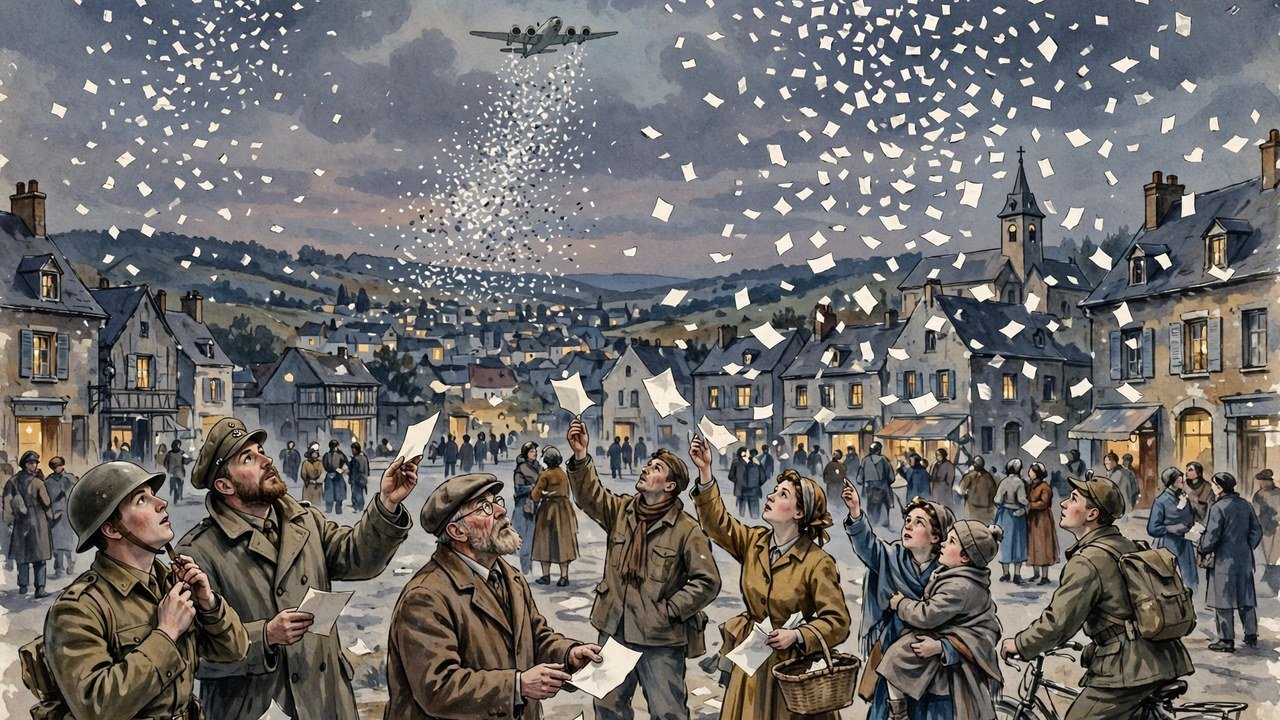
Leaflets remain the emblematic product. A leaflet is cheap, light, persistent and private: it can be dropped by aircraft, fired in artillery shells, delivered by hand or left where it will be found; it can be picked up, read, reread, hidden, shown to a comrade and carried in a pocket for weeks. Its most successful historical form, the safe-conduct pass, gives the reader both an instruction and a physical token to present when acting on it — a script for a frightening act, printed in advance.611 Leaflet design in the documented programmes was a specialist craft: short text in the audience’s language, checked by native speakers; imagery tested against local taboos; a single action requested; and, in mature programmes, a code or series number allowing effects to be traced to a specific drop when surrendering soldiers brought the leaflet in with them.1737
Radio is the second classic channel, in three forms: stations broadcasting from outside the target area under their own or a disguised identity; airborne broadcasting from dedicated aircraft, of which the United States Air Force’s EC-130 Commando Solo, flown by the Pennsylvania Air National Guard’s 193rd Special Operations Wing, is the documented modern example, transmitting radio and television and, in earlier configurations, able to override local broadcasts;1920 and tactical loudspeaker and local stations inside the theatre. Radio reaches the illiterate, crosses front lines, and can respond to events within hours. Its weakness is the receiver: it only reaches audiences who have sets, batteries and the freedom to listen.
Loudspeakers are the most tactical product of all — vehicle-, helicopter- and man-portable systems used by small teams attached to manoeuvre units, broadcasting surrender appeals, instructions to civilians, warnings and directions at ranges from hundreds of metres to a few kilometres.1317 The loudspeaker team is the part of PSYOP that operates within small-arms range of its audience, and its messages are correspondingly concrete: how to approach, what to carry, where to assemble, what will happen next. Its record includes some of the most precisely documented effects in the whole field, because the audience’s response — men standing up with their hands raised — is visible to the team that caused it.
Face-to-face communication, printed newspapers and magazines, posters, handbills, and, in later programmes, television, text messages, websites and social media accounts extend the same logic into new channels.1932 Doctrine treats the channel as a variable and the process as a constant: analyse the audience, state the behaviour sought, make a product the audience can actually receive and act on, and measure what happened. Programmes that reversed that order — making a product first and looking for an audience afterwards — are the recurring failure mode in the case literature.
The credibility constraint
Paul Linebarger, whose Psychological Warfare (1948) is treated in section 3 as the field’s founding text, set out a principle the later doctrine absorbed: propaganda addressed to an audience that can verify it must survive verification, and an operator who is caught in a checkable falsehood spends credibility he will need later.6 The principle divides PSYOP product into two kinds. Claims about the sponsor’s own future behaviour — surrender terms, food, medical care, the time of an attack — must be true, and be seen to be kept, because the audience tests them with its life and reports the result to everyone still deciding. Claims about matters the audience cannot check — the state of a distant front, the intentions of its own leaders — are where selection, framing and, in black product, invention historically concentrated.611
This is why the documented tactical programmes so often read, to a modern eye, as unexpectedly factual. The Gulf War leaflets in section 3 named units, dates and places, warned of specific attacks that then happened, and described surrender procedures in procedural detail.1718 Their persuasion lay not in inventing a world but in arranging true and checkable facts so that one conclusion — resistance is futile, surrender is survivable — became the easiest conclusion for an exhausted soldier to reach. Conversely, the programmes that damaged their sponsors most durably were those that broke the constraint in public: a promise not kept to surrendering men, or a supposedly independent newspaper exposed as a paid channel, teaches the next audience to discount everything, including the true and life-saving parts.2122
The legal boundary: foreign audiences only
United States PSYOP is bounded, in doctrine and in policy, by a rule stated without qualification in the documents: United States PSYOP forces will not target United States citizens, at any time, in any location, or under any circumstances. The formulation is quoted, with its doctrinal sources, in a 2011 letter from the American Civil Liberties Union to the Senate, examining a reported proposal to use information operations techniques on American legislators — a proposal the letter argued the rule already forbade.25 The rule is a rule about targeting, about intent and audience selection. It has never been a guarantee that Americans will not encounter PSYOP material, and in a global media environment they routinely do, when a product made for a foreign audience is rebroadcast, posted online or reported as news. The Pentagon’s Information Operations Roadmap of 30 October 2003, approved by Secretary of Defense Donald Rumsfeld and released in 2006 by the National Security Archive, recognised the problem in terms: information intended for foreign audiences, including PSYOP, increasingly is consumed by domestic audiences, and the distinction between foreign and domestic therefore becomes, in the Roadmap’s phrase, more a question of government intent than of dissemination practice.24 That sentence is descriptive, not a repeal. The legal and policy question remains who the operation was designed to influence.
Behind the doctrine sits a statute with a longer history. The United States Information and Educational Exchange Act of 1948, the Smith–Mundt Act, authorised American information programmes addressed to foreign audiences and, in its original form, directed that material prepared under it for dissemination abroad “shall not be disseminated within the United States, its territories, or possessions”.2324 The Act governed the civilian information agencies — it later underpinned the United States Information Agency and the Voice of America — rather than military PSYOP directly, and its domestic-dissemination provisions were amended over time, notably by the Smith–Mundt Modernization Act enacted as part of the National Defense Authorization Act for 2013, which allowed material produced for foreign audiences to be made available inside the United States on request.23 Popular writing frequently misstates both the original Act and the amendment: the original did not create a general ban on “government propaganda”, and the amendment did not authorise the military to target Americans, a prohibition that rests on the doctrine and policy stated above and on separate appropriations and oversight rules. What Smith–Mundt supplies to this subject is context and a principle that legislators in 1948 stated plainly: a democracy that builds machinery to persuade foreign publics needs a visible line between that machinery and its own citizens, and the line has to be maintained deliberately because technology will not maintain it by itself.2324
Other boundaries are structural. PSYOP in peacetime or in another state’s territory engages that state’s sovereignty and, in the American system, the authority of the ambassador and the Department of State; covert or misattributed activity engages separate legal authorities, principally those governing intelligence activities, which is why black product has historically sat with intelligence organisations rather than with uniformed PSYOP units.828 Within armed conflict, PSYOP product is also constrained by the law of armed conflict in specific, practical ways: a safe-conduct pass must be honoured, surrender appeals must not be a ruse to kill those who respond — perfidy is prohibited — and warnings to civilians, where given, interact with the obligations governing attacks. A PSYOP team is therefore one of the few tactical units whose everyday product is reviewed by lawyers as a matter of routine, a fact that surprises readers who meet the activity first through its popular caricature.
Measuring effects, and the honesty problem
Doctrine requires assessment, and assessment is the weakest part of the documented record.132 Outputs are easy to count: leaflets printed, hours broadcast, accounts posting. Effects are not. A surrendering soldier can be asked why he surrendered, and mature programmes did ask, systematically — prisoner interviews are the main evidence base for the Gulf War claims in section 3.1718 But a prisoner is a selected witness: he is the man the programme reached, interviewed by the force that made the product, with reasons of his own to emphasise the leaflet over fear, hunger, bombing or the collapse of his unit. The men the programme failed to reach are not interviewed at all. Christopher Paul and colleagues, in a RAND study of influence operations assessment, set out the general problem: behavioural indicators can be specified in advance and observed, but attributing an observed change to a communication, among everything else acting on an audience in wartime, is rarely possible with confidence.32
The honest conclusion the case literature supports is therefore modest. PSYOP demonstrably reaches audiences and informs them — of surrender procedures, attack warnings, amnesty terms — and plausibly facilitates behaviour that conditions on the ground have already made attractive. Claims that it independently caused mass outcomes almost always outrun their evidence, because the communication was never the only, or usually the largest, force acting on the audience. A reader of any PSYOP success story should ask: what was counted, who counted it, and what else was happening to that audience at the same time.
Documented cases
The cases below are ordered chronologically. They are chosen because a record exists that a reader can check — an archive, an official history, a declassified report, a congressional or inspector-general investigation, or reporting later tested by investigation — and because together they show the activity changing less than its reputation suggests. The leaflet of 1944, 1951, 1968 and 1991 is recognisably the same object, made by recognisably the same process, for recognisably the same reason.
The Second World War: Morale Operations and the leaflet war
The American wartime organisation divided the work by colour. The Office of War Information ran overt, attributed — white — information from outside enemy territory. The Office of Strategic Services (OSS), the wartime intelligence organisation directed by William J. Donovan, was charged by the Joint Chiefs of Staff with psychological warfare inside and against enemy territory, including black propaganda.89 Its Morale Operations Branch was established by OSS General Order No. 9 on 3 January 1943, and its mission was clarified by Joint Chiefs directive JCS 155/11/D of 27 October 1943: the execution of morale subversion by false rumours, “freedom stations”, false leaflets and false documents, the support of fifth-column activity, and the use of agents — all, in the directive’s words as summarised by the National Archives, for the purpose of creating confusion and division and undermining the morale of the enemy.8
The National Archives’ guide to the branch’s surviving sample books — eleven scrapbooks of leaflets, stickers, newspapers, stamps, postcards, poems, cartoons and booklets produced in 1943–45, preserved as microfilm publication M2108 — is the most direct surviving evidence of what black product actually looked like: small, plausible, deniable objects designed to appear as though they originated inside the target society.8 The Archives’ introduction draws the period’s own distinction: white propaganda “admits its source, and conforms to the policies of the government for which it speaks”, while black propaganda “disguises its source, and is disowned by the government using it”.8 Donovan’s own rationale, quoted there, was that persuasion, penetration and intimidation were the modern counterparts of sapping and mining in siege warfare — an image worth keeping, because it places psychological warfare where its practitioners placed it: as a slow undermining of a defended position, not as a sudden conversion.89
The Army’s special operations history gives concrete operations. In Italy, Operation Sauerkraut, from July 1944, sent German prisoners of war who had volunteered for the task back behind their own lines in German uniform to spread Morale Operations leaflets and false rumours; one leaflet announced, falsely, that Field Marshal Albert Kesselring, the German commander in Italy, was resigning because he believed the war lost, and Kesselring was obliged to deny it formally.9 Operation Cornflakes placed propaganda inside imitation German mailbags, which Allied aircraft dropped during attacks on railway yards in the hope that the scattered bags would be collected and put through the German postal system, delivering the material as though it were ordinary mail.9 Morale Operations radio presented entertainment — including recordings of popular songs in German, among them “Lili Marlene” recorded for the branch by Marlene Dietrich — with propaganda interspersed, from stations presented as clandestine and in fact run from Allied territory.9 The same history repeats an estimate that Morale Operations work in Italy contributed to some 10,000 enemy troops surrendering or deserting; the figure is the organisation’s own tradition rather than an independently tested count, and it should be read with the assessment caution of section 2.9
Alongside the black work ran a white leaflet war of industrial scale. Allied forces dropped leaflets over Europe and, later, over Japan in quantities counted in billions by 1945 — news leaflets reporting Allied advances and German defeats the target’s own media suppressed, warning leaflets naming Japanese cities as forthcoming bombing targets, and safe-conduct passes that became the standard instrument for inducing surrender.1011 Philip Taylor’s history of propaganda, Munitions of the Mind, treats the leaflet as the period’s characteristic weapon for reasons section 2 set out: it reached audiences with no radio, it could be kept and passed hand to hand, and its claims could be tested against events the reader could see, which made the accurate leaflet a cumulative asset and the false one a cumulative liability.11 The British parallel — the Political Warfare Executive, formed in 1941, and Sefton Delmer’s black radio stations purporting to broadcast from inside Germany — is treated in this site’s entry on propaganda and in David Garnett’s internal history of the Executive and Delmer’s own memoir, and is cross-referenced here rather than retold: the American and British organisations studied each other’s methods, divided territory and audiences between them, and between them set the template — attribution as a design choice, accuracy as an audience-building device, and a false source claim as the black product’s whole mechanism — that post-war doctrine inherited.2627
The war also produced the field’s founding text. Paul M. A. Linebarger, an American academic and Army officer who had worked in psychological warfare at levels from Washington planning to preparing spot leaflets for forces in China, published Psychological Warfare in 1948.6 The book is a practitioner’s manual and history combined: definitions, organisation, planning, operations against troops and civilians, and case material drawn from both world wars. Linebarger defined his subject functionally, as the use of propaganda and related informational activity in war against an enemy, and he was frank about its limits — psychological warfare could exploit a deteriorating situation, accelerate desertion and prepare surrender, but it could not substitute for military reality, and product that contradicted what the audience could see happening around it failed.6 Daniel Lerner’s Sykewar: Psychological Warfare Against Germany, D-Day to VE-Day, published in 1949 from his work with the Supreme Headquarters psychological warfare organisation, supplied the complementary campaign study.7 Between them, the two books fixed the post-war field’s vocabulary, its case canon and its central argument — that effects are real, conditional and hard to measure — an argument the field has been having with its own advocates ever since. William Daugherty and Morris Janowitz’s A Psychological Warfare Casebook (1958), assembled at Johns Hopkins’ Operations Research Office from the wartime and Korean experience, carried the same material into the Cold War training system.36
Korea, 1950–53: billions of leaflets, a stalemate to measure them against
The United States entered the Korean War in June 1950 with its psychological warfare capacity largely dismantled after 1945, and rebuilt it in theatre. The 1st Loudspeaker and Leaflet Company arrived in the autumn of 1950; printing was centred on the Far East Command’s facilities in Japan, with tactical production in Korea; and delivery was by bomber and light aircraft to the rear and front respectively, by artillery shell at the front line, and by loudspeaker teams that, in rugged terrain where radios were uncommon among North Korean and Chinese troops, often had to work dangerously close to the positions they addressed.1213
The quantities are documented in the Far East Command’s own reporting, as summarised by the Library of Congress from the Korean scholarship: approximately 120 million leaflets had been printed and scattered by November 1950; production passed one billion in January 1952 and reached more than 2.4 billion by the armistice of July 1953.12 The Eighth Army’s own post-war report, Report on Psychological Warfare Conducted by Eighth Army Units in Korea, 25 June 1950 thru 27 July 1953, prepared in February 1954, records the logistics behind those figures in detail — aircraft loads, artillery leaflet-shell supply, printing capacity and the division between tactical leaflets, delivered within about forty miles of the front, and strategic leaflets delivered beyond it.13 The Library of Congress’s Korean War Propaganda Leaflet Collection, donated in 1994 by a former Army lieutenant, Gordon K. Ellis, preserves the objects themselves, and the Library’s account states the three objectives the programme set itself: to weaken the effectiveness and resistance of North Korean and Chinese forces; to inform the North Korean population, including warning civilians of imminent bombing; and to bolster South Korean morale.12
One Korean operation shows the method at its most specific. Operation Moolah, in April 1953, offered 100,000 dollars to the first Communist pilot who delivered an intact MiG-15 to the United Nations Command, publicised by leaflets and radio in Korean, Chinese and Russian — a single, defined act requested of a tiny, named audience.13 No pilot defected with a MiG during the war in response to it. In September 1953, after the armistice, the North Korean pilot No Kum-sok did fly a MiG-15 to Kimpo airfield and collected the reward, while stating that he had not heard of the offer — the behaviour occurred, the communication existed, and the connection between them was, on the pilot’s own account, absent.13
Korea is the necessary corrective to any simple success story. The leaflet volume exceeded the Second World War’s in a far smaller theatre, the craft was more professional, the audience analysis better resourced — and the war ended in stalemate, without mass surrender of the kind the Gulf would later produce.1213 Prisoner interviews showed leaflets were read, kept and believed on checkable matters, and loudspeaker appeals produced local surrenders throughout the static phase of the war. What the programme could not do was overcome the conditions acting on its audience: political control within Communist units, the absence of a collapsing front, and a military situation in which surrender was neither clearly necessary nor clearly safe. The product was not the limiting factor. The situation was — which is Linebarger’s 1948 conclusion, confirmed at a cost of 2.4 billion leaflets.612
Vietnam: JUSPAO and Chieu Hoi
Vietnam joined the military and civilian efforts in a single organisation. The Joint United States Public Affairs Office — JUSPAO — was created in Saigon in 1965, bringing together personnel and programmes of the United States Information Agency, the Agency for International Development and the Department of Defense, under a single director, Barry Zorthian, with policy direction and substantive supervision of American psychological activity in support of the Government of South Vietnam.14 A progress report from the director of the United States Information Agency to the White House, preserved in the Foreign Relations of the United States series, lists the themes JUSPAO pressed continuously: explaining the American presence; publicising South Vietnamese and American victories to bolster morale; promoting the Chieu Hoi programme; and building support for the Saigon government while denying it to the Viet Cong by exposing their actions.14 The same report gives a sense of scale and of method: of twenty posters and leaflets developed in August 1965, ten were devoted to Chieu Hoi themes, and of some thirteen million copies of psychological warfare product distributed in October 1965, thirty per cent supported that one programme.14
Chieu Hoi — “Open Arms” — was the South Vietnamese government’s defection programme, launched in 1963, offering amnesty, reception, assistance and resettlement to insurgents who “rallied” to the government side.1516 It was, in PSYOP terms, a behaviour programme with a complete supporting apparatus: the promise was made by leaflet, loudspeaker, radio and poster; the act required — coming in, ideally with a safe-conduct leaflet — was specified; reception centres existed to receive the defector; and defectors themselves, called Hoi Chanh, were debriefed for intelligence and, in many cases, recorded or wrote testimonials that became the next round of product, addressed to the comrades they had left.1415 A United States Information Agency assessment prepared with the Pacific command, JUSPAO and the Military Assistance Command and submitted to the White House in January 1970 called the Chieu Hoi inducement campaign “a solid success in 1969, producing over 47,000 defectors” in that year.15 The programme’s administrators, over its life from 1963 to 1971, claimed a total approaching 200,000 returnees; the figure appears in that form — a programme claim — in the scholarly and official summaries, including a RAND study of the programme prepared for the Advanced Research Projects Agency in 1973.16
Both figures need the labelling the brief for any honest account requires, and the documents themselves supply the reasons. The 1966–70 reporting counted “returnees” in categories that could include political cadre, soldiers, porters, tax collectors, dependents and civilians with varying degrees of involvement in the insurgency, so the total is not a count of combatants persuaded to change sides.1516 The same official reporting that celebrated the totals also recorded why individuals said they had rallied — bombing, hardship, illness, family pressure and disillusionment alongside the leaflets that told them how to act on those motives — and recorded the programme’s own weaknesses: overcrowded and understaffed reception centres, poor political education, and returnees who, disappointed, went back to the insurgency and warned others against rallying.1516 Chieu Hoi therefore stands in this piece as the Vietnam counterpart of the Korean lesson, at larger administrative scale. A defection channel demonstrably existed, was heavily used, produced intelligence and testimonials, and removed people from the insurgency. The programme’s claimed totals measure the channel’s traffic. They do not measure the leaflets’ independent persuasive power, and the war’s outcome sets the limit on any claim that they do.
The wider Vietnam effort — leaflets counted in billions over the war, loudspeaker and radio operations in support of manoeuvre units, airborne broadcasting, and product addressed to North Vietnam as well as to the insurgency in the South — operated inside a war whose political premises its audience could test daily against its own experience.1415 Its archive is unusually frank about the gap between output and effect: Vietnam is where the American PSYOP establishment learned, and wrote down, the difference between reaching an audience and moving one.
The Gulf War, 1991: the most-cited success, with its caveat
The campaign against Iraq in 1990–91 is the case PSYOP advocates cite first, and it earns the place — provided the citation includes the conditions. The 4th Psychological Operations Group (Airborne), the Army’s active-duty PSYOP group at Fort Bragg, supported the coalition throughout Operations Desert Shield and Desert Storm. Its own post-war history records the output in detail: over 29 million copies of 38 different leaflets — about 29 tons of paper — researched, developed and disseminated between 30 December 1990 and 28 February 1991, by balloon, by MC-130 and HC-130 aircraft, by F-16 and F/A-18 fighters using leaflet bombs, and by B-52 bombers.1737 The group’s breakdown by theme is the clearest surviving statement of a tactical programme’s intentions: 12.4 million leaflets on the theme of surrender; 6.6 million on the inevitability of defeat; 1.9 million urging Iraqi soldiers to abandon their equipment and flee; 4.7 million blaming Saddam Hussein for the war; and 3.5 million on other themes.1737
Alongside the leaflets ran a radio campaign and a loudspeaker campaign of matching scale. The coalition’s clandestine-format radio network, the Voice of the Gulf, broadcast from ground stations in Saudi Arabia and from EC-130 Volant Solo airborne transmitters on six frequencies, eighteen hours a day for forty days.37 The 4th Group fielded some seventy tactical loudspeaker teams in direct support of ground formations — the group’s history says 71; other summaries of the same record say 66 in direct support of the Army, Marine and special operations components — broadcasting surrender appeals and instructions at the front.1737 Two loudspeaker episodes from the group’s history show the mechanism at its purest. On Faylaka Island, after a helicopter loudspeaker broadcast, the entire Iraqi garrison — approximately 1,400 soldiers, including three generals and ninety officers — surrendered without a shot being fired. At Tallil airfield, over 1,000 Iraqi soldiers, including a division commander, surrendered after a loudspeaker team’s appeals in direct support of the 82nd Airborne Division.17
The outcome figures are the ones that entered the legend. The Department of Defense’s Conduct of the Persian Gulf War: Final Report to Congress (April 1992) recorded the collapse of Iraqi front-line morale under the combined air and ground campaign, and post-war summaries of the PSYOP record, drawing on prisoner debriefings, reported that nearly 87,000 Iraqi soldiers surrendered to coalition forces, a high proportion of them carrying leaflets or with leaflets hidden in their clothing, and that prisoner interviews repeatedly confirmed the leaflets and broadcasts had been received and understood.1718 The Final Report and the group’s history both treat PSYOP as a significant contributor to the low coalition casualties and the speed of the ground victory, and on the narrow claim — that the products reached the audience, were believed on checkable points, told men exactly how to surrender, and were in many men’s pockets when they did it — the evidence is as good as this field produces.1718
The caveat is equally documented, and it is the one this piece is required to keep attached. The Iraqi front-line soldier of February 1991 had been bombed for five weeks by an air campaign of a weight few armies have endured, was short of food, water and sleep, was often a conscript with no commitment to the occupation of Kuwait, faced a ground offensive whose outcome was not in doubt, and knew from the same leaflets — accurately — when and where attacks would fall.18 Under those conditions, a leaflet is not persuading a contented man to change his mind. It is giving a desperate man a procedure: how to leave his weapon, how to approach, what to say, what paper to hold. That is a real and life-saving function, and performing it at scale, accurately and in the audience’s language, is a genuine military achievement. It is not evidence that leaflets, by themselves, dissolve armies — Korea, where comparable craft met different conditions, is the standing disproof.12 The Gulf case shows what PSYOP does at its documented best: it converts a military situation its audience already understands into behaviour, faster and with less killing than the alternative.
Iraq 2003: leaflets and radio again, at larger scale
Twelve years later the same group ran the same playbook against the same country, and the comparison is instructive precisely because the first phase repeated the Gulf pattern and the later phases did not. The Army Center of Military History’s account of psychological operations in Operation Iraqi Freedom records that between 12 December 2002 and 18 March 2003 — before the ground invasion began — United States forces dropped over twenty million leaflets into Iraq, and that by mid-April 2003 the total exceeded forty million.19 The House of Commons Defence Committee, in its 2004 report on lessons of Iraq, recorded a still larger accounting from its sources — over forty million leaflets before the first attack on 20 March and another forty million during the major combat phase — and the difference between the two totals is itself a small lesson in this field’s figures: counts vary with the period covered, the forces included and the definition of a drop, and should be cited with their source attached, as here.20
The pre-invasion leaflets did the classic jobs in sequence: warning Iraqi air-defence crews not to fire on coalition aircraft enforcing the no-fly zones — the first such drop, by an A-10 in October 2002, delivered 120,000 leaflets;20 warning soldiers and civilians away from military targets; publicising the frequencies of coalition radio; and instructing soldiers in surrender and in abandoning equipment. Broadcasting began in December 2002: Information Radio, transmitted around the clock from airborne, ground and naval transmitters, and, from the EC-130E Commando Solo aircraft of the 193rd Special Operations Wing, radio and television services including the coalition television programme Towards Freedom TV, whose content was produced with a contractor, reviewed by the 4th PSYOP Group at Fort Bragg and relayed through Qatar for broadcast.1920 The Army history credits the leaflet programme, combined with the speed of the ground advance, with helping to prevent a repetition of 1991’s environmental destruction — Iraqi forces did not, in the event, set the southern oilfields ablaze as they had in Kuwait — and a Central Command operations briefing of 10 April 2003 publicly cited the “40-some-odd million leaflets” as part of the campaign’s effect.19
What the 2003 record does not show is a Gulf-style mass surrender attributable in the same way, because the conditions differed: the Iraqi army largely dispersed rather than surrendering in formed bodies, and the war’s decisive phase was followed by an occupation and an insurgency, in which the audience for American messaging was no longer a conscript in a trench deciding whether to live, but a population deciding, over years, what to believe about an occupying power. PSYOP units adapted — supporting elections, publicising rewards and wanted-person notices, running local newspapers, radio and, later, digital product in support of counter-insurgency — under the same doctrinal label and through the same approval chains.19 The shift matters for the definition. The machinery of section 2 is built to move a defined audience to a defined behaviour. It performed that task, in both Gulf wars, against soldiers. The Iraq occupation asked it a different question — to manufacture legitimacy — for which its tools, its authorities and its measures of effect were not designed, and the next case shows what happened when part of the effort answered that question by concealing its own source.
The Lincoln Group, 2005: paid placement and the price of exposure
In June 2005 the Pentagon awarded contracts, potentially worth up to 300 million dollars over five years, to three companies to bring commercial creativity to its psychological operations and information work; one of the three was the Lincoln Group, a Washington firm previously known as Iraqex, which also held a multi-million-dollar contract to support public affairs and advertising for the multinational corps in Iraq.21 On 30 November 2005 the Los Angeles Times reported what part of that work had become. Under a programme directed by the Information Operations Task Force at the multinational corps headquarters in Baghdad, American military information operations officers wrote articles presenting the coalition’s view of events in Iraq; the Lincoln Group translated them into Arabic and placed them in Iraqi newspapers and other outlets, paying for publication; and the articles as published did not disclose their military origin.21 The Times reported that Lincoln Group staff or subcontractors sometimes posed as freelance reporters or advertising executives when delivering stories to Baghdad media outlets, and that, as part of the same intensified campaign, the task force had purchased an Iraqi newspaper and taken control of a radio station, using both to carry pro-coalition messages without identifying them as military outlets.21 Of more than a dozen published items the newspaper reviewed, none revealed a connection to the military; one documented example was a piece drafted by military personnel under the title “Children Murdered at the Hands of Terrorists”, recast by the Lincoln Group as an opinion column by an Iraqi citizen and published on 19 July 2005 in Baghdad’s Al Sabah, which was paid more than 1,500 dollars to publish it.2122
The official response moved in stages. Military spokesmen in Iraq first defended the programme as countering insurgent misinformation with factual material, describing publication as buying advertising and opinion space, as was customary in Iraq. Senator John Warner, chairman of the Senate Armed Services Committee, said after a Pentagon briefing on 2 December 2005 that articles were supposed to be identified as paid material, and that planting them favourably without disclosure would be wrong.22 Senator Edward Kennedy asked the Defense Department’s Inspector General to investigate; General George Casey, commanding in Iraq, found in 2006 that the contractor had not violated its contract. The Inspector General’s investigation, completed on 6 October 2006 and released in summary in 2009, concluded that commanders had complied with applicable laws and regulations, while faulting contracting documentation for contracts valued at 37.3 million dollars.22
The case belongs in a glossary of PSYOP for three reasons that survive the legal findings. First, classification: on the scale of section 1, paid placement of unattributed military articles in a target country’s press is grey product at best, and black in its presentation when a staff-written article is recast as a named Iraqi citizen’s opinion. The programme therefore sat at, or beyond, the edge of what uniformed PSYOP doctrine publicly claimed as its normal practice, and it did so through a contractor, at one remove from the approval and attribution disciplines the doctrine describes.2122 Second, exposure: the programme’s value depended entirely on Iraqi readers believing they were reading their own press. Once the Los Angeles Times established the payment chain, every article the programme had placed — including accurate ones — became evidence, for its intended audience, that Iraqi newspapers could be bought by the occupation, a conclusion that damaged the independent Iraqi journalism other American programmes were simultaneously funding and training.21 Third, the domestic echo: because the articles’ sponsor was the American military and the audience was foreign, the programme was defended as lawful PSYOP; because American news organisations reported it worldwide within hours, it became, for the American public, a story about its own government secretly manufacturing news — the exact confusion between foreign targeting and domestic effect that the Smith–Mundt tradition and the 2003 Roadmap had warned the machinery would produce.24 The Lincoln Group case is thus the modern counterpart of the grey-radio exposures of the Cold War treated in the propaganda entry: the technique worked until it was described in public, and being described in public was always a matter of time.
How to spot it
Spot the product, not the vibe
Real PSYOP leaves the artefacts of section 2: a defined audience, a product made for that audience, a dissemination method and an approval chain. A reader who suspects a PSYOP should therefore start with objects, not atmospheres. Is there a physical or digital product — a leaflet, a broadcast, a placed article, an account network — that can be examined, dated and attributed? Who made it, in what language, for whom, and what single behaviour does it ask for? Genuine tactical product is usually unglamorous on inspection: surrender instructions, curfew hours, reward terms, a warning with a date on it. The closer a suspected item comes to that procedural plainness, the more likely it is to be what it appears to be. The further it sits from any identifiable product, audience or request, the more likely the word psyop is being used in its popular, accusatory sense rather than its doctrinal one.
Attribution is the second check, and it follows the white–grey–black scale. White product announces its sponsor; the reader’s job is the ordinary one of discounting an interested source. Grey product withholds its sponsor; the useful questions are who benefits, who paid for placement or production, and whether any disclosure — a contract, a register entry, a funding line, a leaked document — establishes the chain, as the Los Angeles Times reporting established the Lincoln Group chain from task force to contractor to newspaper.21 Black product makes a positive claim about its source that the reader has reason to doubt; the checkable details are the ones black operators historically got wrong or could not sustain — biographical facts about the supposed speaker, technical facts about the supposed station or unit, and the record, in archives and memoirs, that later settled who was actually speaking, as the National Archives and the Political Warfare Executive histories settled the wartime cases.826
The popular misuse: “psyop” as an all-purpose label
Since roughly the late 2010s, and sharply since 2020, psyop and psyops have acquired a second life in social media as a general-purpose explanation for anything prominent, popular or unwelcome: a celebrity’s fame, a news story’s prominence, a protest’s size, a product’s success, an election result. In this usage the word asserts three things at once without evidencing any of them — that a hidden state operator exists, that the visible phenomenon is its product, and that the audience’s response has been manufactured rather than earned. The usage is unfalsifiable in the form in which it is usually offered, because the absence of evidence for the operator is treated as evidence of the operator’s skill. That structure is the opposite of the doctrinal one. A real operation, as sections 2 and 3 show, is a bureaucracy: it has a budget, a contract, an approval signature, a printing bill and, in time, an archive. The historical operations in this piece are known because those records exist and were eventually opened, subpoenaed, leaked or published by their own organisations.81722
The clearest documented illustration is also, deliberately, a non-partisan one, because the mechanism of the misuse does not depend on the politics of the target. In January 2024, claims circulated widely on social media, and were amplified in broadcast commentary, that the American singer Taylor Swift was a Pentagon psychological operation — an “asset” supposedly created or deployed to influence young voters, with her public relationship with the American football player Travis Kelce presented as part of the operation.3335 The broadcast version of the claim, aired on Fox News on 9 January 2024, rested on a clip from a 2019 conference presentation in which a researcher — a Johns Hopkins applied physics engineer, not a Pentagon official — had mentioned Swift’s influence as an example in a discussion of combating online misinformation; the presenter had no Pentagon affiliation and the clip showed no proposal by any PSYOP unit.33 On 10 January 2024 a Pentagon spokesperson, Sabrina Singh, answered the claim on the record in a statement reported by Politico: “As for this conspiracy theory, we are going to shake it off,” adding a request that Congress approve the department’s supplemental budget “as Swift-ly as possible”.35 On 2 February 2024 Singh stated the denial without the wordplay, to the fact-checking organisation PolitiFact: “Taylor Swift is not part of a DOD psychological operation. Period. I’m sure she has other chief priorities, as do we.”33 A Monmouth University poll released in February 2024 found that 18 per cent of American adults said they believed Swift was part of a covert government effort to help re-elect President Biden — a measure of how far the label had travelled from any product, audience analysis or approval document.34
The episode is worth a reader’s attention for what it reveals about the label’s grammar. Nothing in the claim identified a PSYOP product: no leaflet, broadcast, placed article or account network was produced, because the phenomenon to be explained was not a communication but a person’s popularity. Nothing identified an audience in the doctrinal sense, a behaviour the operation sought, or a unit that could have run it — American PSYOP forces are, as section 2 sets out, prohibited from targeting American citizens in any case, which would make the alleged operation not merely undocumented but unlawful on its face, a point the public discussion largely ignored.25 And the claim’s evidence consisted of the phenomenon itself: Swift was very famous and very visible, therefore her fame and visibility must have been manufactured. A reader equipped with the doctrinal definition can dismantle that form of argument in any of its instances, whatever the celebrity, cause or country involved: ask for the product, the audience, the behaviour, the operator and the record. A claim that can supply none of the five is not a discovery about psychological operations. It is the word psyop doing rhetorical work — converting “I dislike or distrust this” into “a secret state machine made this” — and it should be read as rhetoric, not as information.
Signs that point the other way
Some features make a genuine influence operation more likely, and they are the features investigators, rather than commentators, have used in the documented cases. A payment chain is the strongest: contracts, invoices and placement fees, of the kind the Lincoln Group reporting and the subsequent Inspector General review established.2122 A production trail is next: identical drafts in an operator’s files appearing, translated and lightly rewritten, across supposedly independent outlets. Coordination is third: many voices publishing the same unfamiliar claim, in the same wording, at the same time, with no visible common source — a pattern that indicates a briefing or a product series, though it can also indicate ordinary journalism working from one press release, which is why coordination alone proves organisation, not concealment. Fourth, a false source claim that collapses under a checkable detail — the wartime black stations were eventually identified through exactly such details, preserved in the archives.826 A reader who finds one of these has something worth reporting. A reader who finds only prominence, popularity and disagreement has found the ordinary condition of public life.
A final caution runs in both directions. The misuse of the label does not mean real operations do not happen — section 3 is a catalogue of real ones. Nor does their existence license the label’s casual use: each documented case became documented through records, not through the confidence of those asserting it at the time. Demand the record for the claim you dislike, and for the claim you would like to believe.
What you can do
Ask the five doctrinal questions
The fastest counter-measure is the definition. When a message, campaign or celebrity is called a psyop, ask: what is the product, who is its defined audience, what behaviour is it designed to produce, who is the operator, and what record — a document, a contract, a budget, an archive — connects the operator to the product?128 Real operations answer most of the five. Propaganda in the looser sense answers some. The popular accusation answers none, and asking the questions in public, calmly, is often enough to show an audience which kind of claim it is hearing. The same five questions work in reverse on material addressed to you: a message that wants a specific act from a specific group, from a source that will not name itself, deserves the scrutiny its anonymity has earned.
Check attribution before content
Apply the white–grey–black scale as a reading habit. If a source is openly attributed, weigh its interest and read on. If a source is unstated, treat the missing attribution as information in itself and look for the funding and placement trail before repeating the claim: search for the organisation’s registration and funders, for contract and procurement records, and for reporting that establishes who paid, as the Lincoln Group chain was established.2122 If a source claims an identity — a dissident, a local citizen, a spontaneous movement — test the claim’s checkable details before its arguments: biography, history, technical facts, consistency over time. In the documented black cases, the false identity, not the argument, is where the operation was vulnerable.827
Read the primary doctrine and the primary record
This subject is unusually well supplied with primary sources that anyone can read, and reading them is a stronger defence than any summary. The joint publications state what the activity is, whom it may target and how it is approved.128 The Gates memorandum and the service messages implementing it state why the name changed, in the decision-maker’s own words.3 The National Archives’ guide to the Morale Operations sample books shows what wartime black product physically was.8 The Foreign Relations of the United States volumes print the Vietnam programme’s own reporting, including its doubts.1415 The Inspector General’s summary in the Lincoln Group case shows an investigation reaching a narrower conclusion than the headlines on either side suggested.22 A reader who has handled even two or three of these will recognise both real doctrine and its caricature on sight, because the real thing is drier, more procedural and more limited than the caricature allows.
Separate output, reach and effect in every success story
When any operator — military, commercial or political — claims an influence success, divide the claim into three numbers and ask which one is actually being offered. Output: how much was made — leaflets printed, posts published, hours broadcast. Reach: how much of it demonstrably arrived — prisoners carrying leaflets, audience figures, verified exposure.1737 Effect: what behaviour changed, compared with what would have happened anyway — the number that Korea’s 2.4 billion leaflets and Vietnam’s claimed 200,000 returnees show cannot be read off the first two.1216 A claim that supplies only output is an advertisement for the programme, not a finding about the audience. This single habit, applied consistently, removes most of the exaggeration from the literature of influence, including the exaggeration in official histories.
Slow down at the moment of maximum feeling
PSYOP doctrine targets emotions and motives before reasoning, by design and by definition.1 The practical implication for a reader is not to suppress feeling but to notice its timing. Material that arrives with urgency, outrage or elation attached, that asks for an immediate act — share this, condemn this, join this, surrender now — is working on the doctrinal sequence in the doctrinal order, whoever made it. The counter-move is procedural: pause, find the same event reported by a source with a different interest, look for the original document or recording behind any quotation, and check whether the act being requested would still seem wise in the morning. Lateral reading of this kind — leaving the page to check the source, rather than reading more of the page — is the method professional fact-checkers use and the method this site’s entries on misinformation and propaganda recommend in detail. It is slower than the feeling. That is the point.
Keep the vocabulary precise, and lend it to others
The last counter-measure is linguistic. A public vocabulary in which psyop means “anything that influenced anyone” cannot describe the real activity, identify its abuses or acquit the innocent. Use the precise terms where they exist — this site’s entries on propaganda, influence operations, cognitive warfare and active measures each cover part of the ground the loose word blurs3031 — and correct the loose use, including in material you agree with, by substituting the accurate description: a popular singer with a large audience, a government advertising campaign, a newspaper editorial line, an unattributed website whose funder is unknown. Each substitution states what is actually known. A reader who does that habitually has done the one thing no operation in this piece, white, grey or black, can easily survive: insisted on knowing who is speaking, to whom, and to what end.
References
- United States Joint Chiefs of Staff, Joint Publication 3-13.2, Military Information Support Operations, Joint Chiefs of Staff, 2010 (incorporating Change 1, 20 December 2011) *
- Congressional Research Service, Defense Primer: Operations in the Information Environment (IF10771), Congressional Research Service, 2022, https://www.congress.gov/crs_external_products/IF/PDF/IF10771/IF10771.9.pdf *
- United States Marine Corps, MARADMIN 715/11: Changing the Term Psychological Operations to Military Information Support Operations, United States Marine Corps, 2011, https://www.marines.mil/News/Messages/Messages-Display/Article/887791/changing-the-term-psychological-operations-to-military-information-support-oper/ *
- What’s in a Name? Psychological Operations versus Military Information Support Operations and an Analysis of Organizational Change, Military Review, United States Army University Press, 2018, https://www.armyupress.army.mil/Journals/Military-Review/Online-Exclusive/2018-OLE/Mar/PSYOP/Journals/Military-Review/MR-War-Poetry-Submission-Guide/Journals/Military-Review/MR-War-Poetry-Submission-Guide/Journals/Military-Review/MR-War-Poetry-Submission-Guide/ *
- Meghann Myers, The Army’s Psychological Operations Community Is Getting Its Name Back, Army Times, 2017, https://www.armytimes.com/news/your-army/2017/11/06/the-armys-psychological-operations-community-is-getting-its-name-back/?contentQuery=%7B%22includeSections%22%3A%22%2Fhome%22%2C%22excludeSections%22%3A%22%22%2C%22feedSize%22%3A10%2C%22feedOffset%22%3A105%7D&contentFeatureId=f0fmoahPVC2AbfL-2-1-8 *
- Paul M. A. Linebarger, Psychological Warfare, Infantry Journal Press, 1948 *
- Daniel Lerner, Sykewar: Psychological Warfare Against Germany, D-Day to VE-Day, George W. Stewart, 1949 *
- United States National Archives and Records Administration, OSS Morale Operations Branch Propaganda Sample Books, 1943–1945 (Microfilm Publication M2108), National Archives and Records Administration, 2006, https://www.archives.gov/files/research/microfilm/m2108.pdf *
- United States Army Special Operations Command History Office, The Office of Strategic Services (OSS): A Primer on the Special Operations Branches and Detachments of the Office of Strategic Services, Veritas, vol. 3, no. 4, 2007, https://arsof-history.org/articles/v3n4_oss_primer_page_1.html *
- Alfred H. Paddock Jr., U.S. Army Special Warfare: Its Origins, Praeger, 2002 *
- Philip M. Taylor, Munitions of the Mind: A History of Propaganda from the Ancient World to the Present Day, Manchester University Press, 2003 *
- Library of Congress, Korean War Propaganda Leaflet Collection at the Library of Congress, Library of Congress Blogs, 2017, https://blogs.loc.gov/international-collections/2017/09/korean-war-propaganda-leaflet-collection-at-the-library-of-congress *
- Eighth United States Army, Report on Psychological Warfare Conducted by Eighth Army Units in Korea, 25 June 1950 thru 27 July 1953, Eighth United States Army, 1954 *
- United States Department of State, Foreign Relations of the United States, 1964–1968, Public Diplomacy volume: Memorandum from the Director of the United States Information Agency (Marks) to the President’s Special Assistant (Komer) — Progress Report on JUSPAO Support to Pacification, United States Government Printing Office, https://history.state.gov/historicaldocuments/frus1917-72PubDipv07/d91 *
- United States Department of State, Foreign Relations of the United States: Memorandum from the Acting Director of the United States Information Agency (Loomis) to the President’s Assistant for National Security Affairs (Kissinger), with USIA Assessment of PsyWar Operations Against Vietnamese Communists, January 1970, United States Government Printing Office, https://history.state.gov/historicaldocuments/frus1917-72PubDipv08/d66 *
- J. A. Koch, The Chieu Hoi Program in South Vietnam, 1963–1971 (RAND Report R-1172-ARPA), RAND Corporation, 1973 *
- 4th Psychological Operations Group (Airborne), Significant Activities during Operations Desert Shield and Desert Storm, 4th Psychological Operations Group, 1991, https://www.psywarrior.com/4thgulf.html *
- United States Department of Defense, Conduct of the Persian Gulf War: Final Report to Congress, United States Department of Defense, 1992 *
- United States Army Special Operations Command History Office, Reaching Out: Psychological Operations in Operation Iraqi Freedom, Veritas (ARSOF History), https://arsof-history.org/articles/v1n1_reaching_out_page_1.html *
- House of Commons Defence Committee, Lessons of Iraq: Third Report of Session 2003–04, House of Commons, 2004, https://publications.parliament.uk/pa/cm200304/cmselect/cmdfence/57/5718.htm *
- Mark Mazzetti and Borzou Daragahi, U.S. Military Covertly Pays to Run Stories in Iraqi Press, Los Angeles Times, 30 November 2005 *
- United States Department of Defense Inspector General, Report on Contracts for Media and Public Relations Services in Iraq (executive summary released 2009; investigation completed 6 October 2006), Department of Defense Inspector General, 2009 *
- United States Information and Educational Exchange Act of 1948 (Smith–Mundt Act), 22 U.S.C. § 1461, United States Congress, 1948 (as amended, including by the Smith–Mundt Modernization Act of 2012) *
- National Security Archive, Rumsfeld’s Roadmap to Propaganda (Electronic Briefing Book No. 177, including the Information Operations Roadmap of 30 October 2003), George Washington University, 2006, https://nsarchive2.gwu.edu/NSAEBB/NSAEBB177/index.htm *
- American Civil Liberties Union, Letter to the United States Senate Re: U.S. Intelligence Operations Targeting Members of Congress, American Civil Liberties Union, 2011, https://www.aclu.org/sites/default/files/field_document/ACLU_Letter_to_Senate_Re_U_S__Intelligence_Operations_Targeting_Members_of_Congress.pdf *
- David Garnett, The Secret History of PWE: The Political Warfare Executive, 1939–1945, St Ermin’s Press, 2002 *
- Sefton Delmer, Black Boomerang, Secker & Warburg, 1962 *
- United States Joint Chiefs of Staff, Joint Publication 3-53, Doctrine for Joint Psychological Operations, Joint Chiefs of Staff, 2003 *
- United States Department of the Army, Field Manual 3-05.30: Psychological Operations, Department of the Army, 2005 *
- Thomas Rid, Active Measures: The Secret History of Disinformation and Political Warfare, Farrar, Straus and Giroux, 2020 *
- François du Cluzel, Cognitive Warfare, NATO Innovation Hub, 2020 *
- Christopher Paul, Colin P. Clarke, Beth E. Grill and Molly Dunigan, Paths to Victory: Detailed Methods for the Practice of Influence Operations — and Christopher Paul et al., Assessing and Evaluating Department of Defense Efforts to Inform, Influence, and Persuade, RAND Corporation, 2009–2018 *
- PolitiFact (Poynter Institute), Taylor Swift: Singer, Songwriter … Psyop? How Conservative Pundits Spread a Wild Theory, Poynter Institute, 2024, https://www.poynter.org/fact-checking/2024/taylor-swift-singer-songwriter-psyop-how-conservative-pundits-spread-a-wild-theory/ *
- Monmouth University Polling Institute, Swift Conspiracy Theory Has Hold on 1 in 5 Americans, Monmouth University, February 2024 *
- Politico, Pentagon statement on Taylor Swift conspiracy theory (spokesperson Sabrina Singh: “we are going to shake it off”), reported January 2024; see also NME, The Pentagon Denies Fox News’ Theory That Taylor Swift Is a Political “Asset”, NME, 2024, https://www.nme.com/news/music/the-pentagon-denies-fox-news-theory-that-taylor-swift-is-a-political-asset-3569853 *
- William E. Daugherty and Morris Janowitz (eds.), A Psychological Warfare Casebook, Johns Hopkins University Operations Research Office / Johns Hopkins Press, 1958 *
- Herbert A. Friedman, Leaflets of Operation Desert Shield and Desert Storm (4th PSYOP Group records archive), PsyWarrior, https://www.psywarrior.com/HerbDStorm.html *
- United States Army, 4th Military Information Support Group / Psychological Operations Group — unit history and lineage, United States Army Special Operations Command, Fort Liberty *


