
History & Thinkers
The Anglo-Bengalee Disinterested Loan and Life Assurance Company
A company with a magnificent name, grand offices and no capital at all - Dickens invented the Anglo-Bengalee in 1843, and in doing so wrote the working manual of every respectable fraud since.
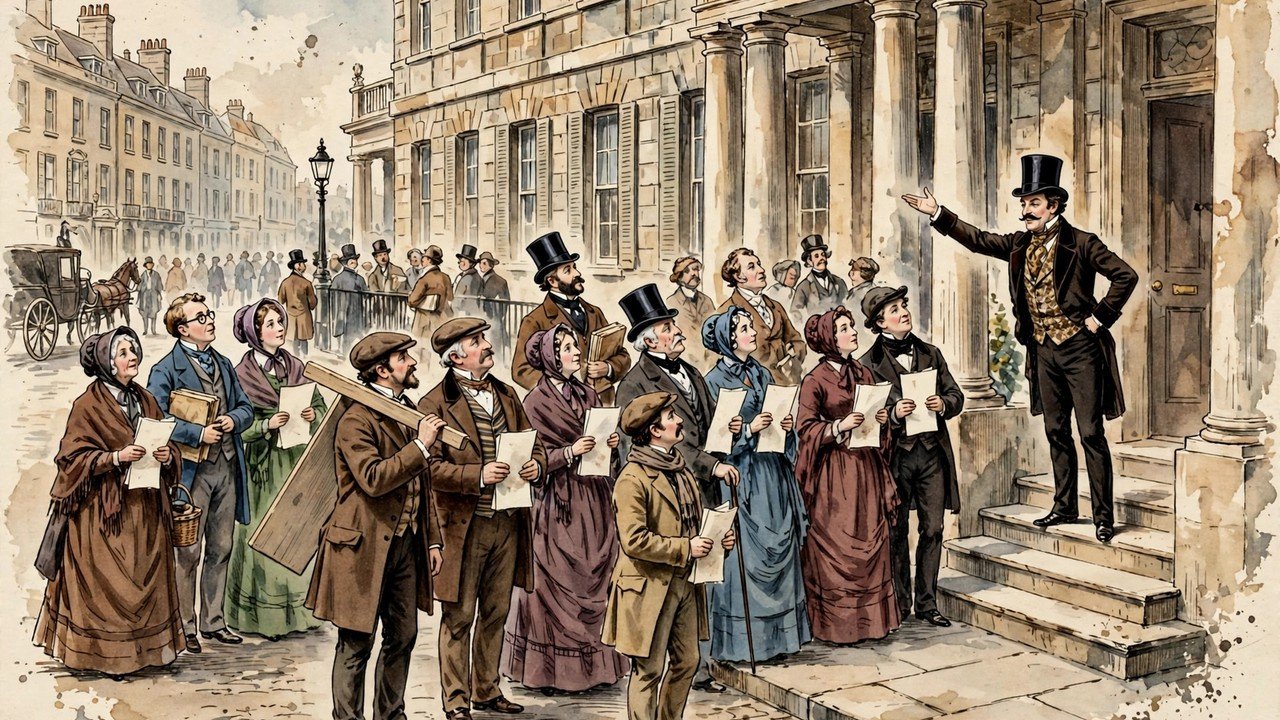
Contents ▾0% read
- 1. A name that does the work of proof
- 2. The novel and its moment
- 3. Montague Tigg – the man who renamed himself
- 4. Jonas Chuzzlewit – greed educated at home
- 5. Inside the Anglo-Bengalee – offices, clerks, dinners and forms
- 6. Disinterested – the lie in the title
- 7. No capital – paying out of what comes in
- 8. Life assurance perverted – betting on lives
- 9. Nadgett – inquiry against theatre
- 10. Murder and exposure
- 11. Dickens’s London – a market learning to be fooled
- 12. The Independent West Middlesex – the fraud that was not fiction
- 13. The law arrives late – registration without scrutiny
- 14. The persuasion machine – how the Anglo-Bengalee worked on people
- 15. The victim’s side – why sensible people signed
- 16. How to spot it – a reader’s defence
- 17. Why fiction saw it first
- References
The Anglo-Bengalee Disinterested Loan and Life Assurance Company never existed. It had no office a policyholder could visit outside the pages of a novel, no shareholders a creditor could pursue, no capital a court could seize. Charles Dickens invented it in the winter and spring of 1843-44, in the middle numbers of Martin Chuzzlewit, and he invented it complete – the name, the brass plate, the clerks, the dinners, the printed forms, the chairman’s waistcoat, and the hole where the money should have been.1
It is the most fully worked fraud in English fiction before the age of the fraud squad, and it deserves to be read as something more than a comic subplot. Dickens did not sketch a swindle. He documented a system. The Anglo-Bengalee works, in the novel, exactly as its real counterparts worked in the London of his own decade – and the counterparts were real. Life assurance offices were multiplying in the capital, at least 140 companies sold life assurance in London in the first half of the nineteenth century, and some of them were built on the same plan as Dickens’s invention – real policies, real claims paid while the money lasted, and nothing behind either.23 One of them, the Independent West Middlesex Fire and Life Assurance Company, had collapsed in scandal three years before Dickens began his novel, and a modern historian of the case has shown in detail how it ran on character, print and confidence rather than on funds.4
This essay follows the company through the novel and out of it. It begins with the name, because the name is where the fraud begins. It follows the two men who embody its two halves – Montague Tigg, who manufactures the appearance of a company out of nothing, and Jonas Chuzzlewit, who supplies the greed that the appearance is designed to catch. It goes inside the offices to watch the theatre being performed, takes the word ‘Disinterested’ apart, and follows the money – or rather, follows the place where the money should have been, as claim is paid out of premium and premium is hunted to pay the next claim. It examines what happens when life assurance is turned inside out and becomes a bet on other men’s deaths, and it gives the book’s one honest professional his due – Mr Nadgett, the private inquiry agent, whose employer hired him not to expose the fraud but to weaponise what he found.
The essay then leaves the novel for the record. Dickens wrote before there was a Companies Act worth the name, before limited liability, before any solvency regime for the offices that took the public’s premiums. Parliament spent the decade after Martin Chuzzlewit discovering, committee by committee, the world the novel had already described. The last chapters draw the lessons out as principles – how a grand name does the work of proof, how respectability is staged, how sensible people sign, and what questions would have stopped the Anglo-Bengalee at the door – because those principles, and not the frock coats, are the part of the story that has not dated.
A name that does the work of proof
The fraud begins before any money changes hands, before any prospectus is opened, before any clerk lifts a pen. It begins with a name long enough to sound like a history.
Anglo-Bengalee Disinterested Loan and Life Assurance Company. Every element in that sequence is doing a separate piece of work, and the work is done on the person hearing it, not on any register, ledger or bank account. By the time the name has been read off a brass plate, printed on a circular or spoken across a board-room table, it has already supplied the answers to questions the hearer has not yet thought to ask: Is this firm substantial? Is it established? Is it respectable? Is it safe? The name answers yes to all four, at no cost beyond paint, print and brass.
Consider the parts in order. “Anglo-” comes first, and it comes first for a reason. It places the company at home. It claims Englishness, familiarity, the known world of London streets, London law and London commerce. A customer in the City in 1844 did not need to be told what “Anglo-” was meant to make him feel. It was the prefix of belonging. Whatever followed it, however distant or strange, was to be understood as anchored here, governed here, answerable here. The foreign element in the name is therefore introduced only after the domestic guarantee has been fixed in place. The order matters. Reversed, the name would sound like a foreign speculation seeking English money. In Dickens’s order, it sounds like an English institution with foreign reach.
“-Bengalee” then supplies the reach. Bengal was not, in the imagination of a London policyholder of the 1840s, a street he could walk to and inspect. That was the point. It was a name associated with India, with trade on a scale that dwarfed a single shop or counting-house, with fortunes made at a distance and with an empire whose commerce was routinely described in terms of vastness. A firm that could plausibly present itself as at home in Bengal as well as in London was a firm that appeared to operate above the level at which ordinary failure happens. Small firms fail. Firms with a geography do not, or so the name invites the hearer to assume. The distance also performs a second, quieter service. Capital that is said to lie in Bengal cannot be looked at. Property on the other side of the world cannot be visited between breakfast and dinner. The further away the supposed assets are, the less unreasonable it seems that the customer has never seen them, and the less awkward it becomes to accept a printed statement in place of an inspection.
Fumie Tamai, writing on Martin Chuzzlewit and globalisation, argues that Dickens planted the warning in the name itself: turning a home assurance name into “Anglo-Bengalee” signals, in her reading, “the greater risks and fraudulent dealings involved in colonial business”, and the name becomes Dickens’s way of warning against abuses of freedom in global business 5. That reading is worth taking seriously precisely because it reverses the intended effect. What the founders of the company want the name to prove — scale, reach, safety — is, to a reader alerted by Dickens, exactly what the name should make him question. The grandeur is not a distraction from the risk. The grandeur is the risk, dressed in its most persuasive form. A business that needs Bengal in its title to sell a loan in London is asking to be judged by its geography rather than by its accounts.
The insiders know this. Mary Pat Campbell, an actuary writing for the Society of Actuaries on Dickens and business fraud, quotes the secretary himself laughing at the name — “‘The Anglo-Bengalee,’ tittered the secretary” — because inside the firm the name is understood as an invention, a joke shared between the men who coined it 3. Outside the firm, the same name is the firm’s principal asset. The joke and the asset are the same words. That doubleness is the mechanism in miniature: a name costs its inventors nothing but breath, and it is received by the public as if it were a deposit lodged at a bank. The men who made it up can laugh at it in private because they know what it is made of. The men and women who insure their lives under it cannot laugh, because they have mistaken the sound of the name for the substance it imitates.
After the geography comes the moral claim, and it is the boldest word in the whole title: “Disinterested”.
In its precise sense, disinterested does not mean uninterested, bored or indifferent. It means having no stake in the outcome. A disinterested adviser is one who does not profit from the advice he gives. A disinterested company, if such a thing could exist in commerce, would be one that did not gain from the customer’s decision to borrow, to insure, to sign. To place that word in the name of a loan and life assurance company is to ask the customer to grant, in advance and without evidence, the one quality that a customer most needs to test for himself. It is not argued. It is presupposed. The word sits in the title the way a crest sits on a carriage door: not as a claim to be examined, but as an identity to be recognised.
Dickens makes the falseness of the word plain by letting the reader hear how the company talks when no customer is present. In Chapter 27, Montague Tigg, now chairman, and David Crimple, his secretary, joke openly in the cab about the concern they run, about salaries, shares, the capital that will appear in the next prospectus and the property in Bengal that is supposed to answer for claims upon the company 1. The chairman’s own description of the firm is delivered as a piece of proprietorial pride: “The Anglo-Bengalee Disinterested Loan and Life Assurance Company is rather a capital concern, I hope, David.” 1 The sentence is comic because the speaker knows exactly how interested the concern is. Its business, as he will explain at length to Jonas Chuzzlewit later in the same chapter, is to take from a borrower at every stage of the borrower’s need: interest on the loan, premiums on the borrower’s own life, premiums on the lives of friends the borrower is required to bring in, and charges attached to the machinery of the transaction itself 1. Campbell’s summary of that explanation sets out the accumulation plainly: the borrower is charged for the bond, for inquiries whether he is accepted or not, and for the small services of the office, so that interestedness is not an occasional lapse in the company’s practice but its system 3.
The word “Disinterested” therefore does more than decorate. It disarms a specific question. The natural question to put to any loan company is a hard one: what do you charge, what do you take if I cannot pay, and whose interest do you serve when my interest and yours conflict? A company that has already called itself disinterested has placed that question under a kind of social embarrassment. To ask it is to imply that the title might be untrue, and most customers, in most offices, in front of most clerks and porters and polished furniture, would rather not begin a transaction by accusing the firm of lying in its own name. The virtue word raises the cost of scepticism. It makes doubt feel like bad manners. That is a real service to a fraud, and it is performed before a single figure has been discussed.
Then come the plain, heavy, institutional words: “Loan and Life Assurance Company”. After the geography and the virtue, Dickens ends the name with the vocabulary of business as usual. Loans are familiar. Life assurance, by the 1840s, was familiar and spreading fast. “Company” is the most settling word of all. It implies a plurality of responsible men, a structure, a continuity beyond any single adventurer. A company has officers. A company has premises. A company survives the illness, absence or death of any one person connected with it. To a customer who might hesitate to hand money to a man, the word “Company” offers a different and safer object for his trust. He is not trusting Tigg. He is trusting an institution. The fraud’s central trick — that the institution is a few men, a hired room and a stock of printed paper — depends on that substitution being made in the customer’s mind without his noticing that he has made it.
The length of the name is itself part of the persuasion. Short names can be weighed. Long names are recited. The Anglo-Bengalee’s full title has the rhythm of a legal instrument; it takes time to say, it fills a line, it looks well in large letters, and it resists abbreviation in formal use because every shortening loses some part of its effect. Dickens understood the value the company placed on repetition. The name was not used once and then allowed to rest on its dignity. It was multiplied across every surface the company controlled. In Chapter 27 the name appears on the brass plate at the door, in the wire blinds at the windows, on the letter paper, on the seal, and, in one of Dickens’s most exact details, painted on the very coal-scuttles 1. The secretary’s circulars repeat the invitation until the name becomes the message. Dickens notes of the concern’s public notices that “It is repeated twenty times in every circular and public notice wherein one David Crimple, Esquire, Secretary and resident Director, takes the liberty of inviting your attention.” 1
Twenty times in a single circular is not information. Nobody learns anything from the twentieth repetition that he did not learn from the first. Repetition of that kind has a different purpose. It produces familiarity, and familiarity, in commercial life, is easily mistaken for establishment. A name seen once is a claim. A name seen on the door, the window, the paper, the seal, the porter’s buttons and the coal-scuttle in a single visit begins to feel like a fact of the world, something that was there before the visitor arrived and will be there after he has gone. The company had in fact started into existence, as Dickens puts it with deliberate abruptness, “one morning”: “The Anglo-Bengalee Disinterested Loan and Life Assurance Company started into existence one morning, not an Infant Institution, but a Grown-up Company.” 1 That sentence deserves to be read slowly. Real institutions grow. They begin small, they make mistakes in proportion to their size, they accumulate reserves, reputation and premises over years. The Anglo-Bengalee skips the growing. It is born adult. The name is the means by which the skipping is concealed, because a name gives no indication of age. Painted in fresh letters, a company of one morning can present exactly the same face as a company of fifty years. The customer has no instrument for telling the difference except inquiry, and the whole arrangement of the office, as later chapters of this post will show, is designed to make inquiry feel unnecessary.
There is a further point about the name that belongs to the principles Persuasion Atlas exists to examine, and it can be stated without reference to any later fraud or any modern firm. A name is not evidence. It is not a balance sheet, not a reserve fund, not a record of claims paid, not an audit. It is a cost to its inventor of almost nothing, and it can be chosen in an afternoon by the very men who will profit from its being believed. Yet names are treated, in ordinary commercial judgement, as if they carried evidential weight. A confident, long, geographically grand name colours everything attached to it: the office looks more solid because the name above the door is grand, the clerk looks more responsible because he serves a grand name, the prospectus looks more credible because the grand name is printed at its head. Psychologists describe the general transfer of a favourable impression from one feature of a thing to unrelated features of the same thing as the halo effect, and the literature of persuasion treats titles, credentials and authoritative language as a shortcut by which people agree more readily and check less. The Anglo-Bengalee is a fictional construction, but Dickens built it out of that real shortcut, and he built it so completely that the shortcut can be watched working on character after character inside the novel.
The test the name cannot pass is a simple one, and Dickens arranges for the reader to apply it even though the customers do not. Strip the name away. Call the concern by a plain description of what can actually be verified about it on the morning it opens: a loan and life assurance office, recently established, with such capital as its chairman and secretary can describe in a cab, such property in Bengal as its chairman can joke about to his secretary, and such a board as can be seated in one room. Nothing in that description is improved by the words “Anglo-Bengalee” or “Disinterested”, and nothing in it is worsened. The description is the company. The name is an addition to the company, made by the company, for the company’s purposes. Everything the name adds is added in the customer’s mind, at the customer’s expense.
Dickens also gives the name a history inside the fiction that sharpens the point. The man at the head of the Anglo-Bengalee has himself been renamed, and by his own hand, in the same movement that created the company. Montague Tigg becomes Tigg Montague. The chairman and the company are christened together, in the same spirit, by the same person, for the same reason: because in the world Dickens is anatomising, a name is not a label attached to a thing that already exists. It is a tool for bringing a belief into existence, after which the belief does the work that capital, reserves and character were supposed to do. The transformation of the man is the subject of the third chapter of this part. The transformation of the words above the door comes first, in the novel and in the fraud, because the words are what the public meets. No customer of the Anglo-Bengalee ever met Montague Tigg first and formed a judgement of him. They met the name first. They met it twenty times in a circular, in brass, in glass, on paper, on a porter’s buttons. By the time they met the man, the meeting had already been decided by the meeting with the name.
That is why Dickens gives the company so long a title, and why the length should not be read as mere comic exuberance. The comedy is there — the name is funny, and it is meant to be funny, and the men inside the firm find it funny themselves. But the joke has a victim, and the victim is everyone who reads the title as a description instead of as an advertisement. A name that does the work of proof has relieved its owner of the expense of providing proof. In the Anglo-Bengalee’s case, as Chapter 27 sets out in detail, there was very little proof to provide. There was a tailor’s shop below the branch office, stucco and plate glass at the City offices, green ledgers, iron safes and marble chimney-pieces, and behind the chairman, when the board sat, the secretary and the porter 1. The name had to be large because what stood behind it was small. Dickens put the proportion on the page in a single sentence about the board itself, and it is the proportion that the whole magnificent title exists to hide: “This was the board: everything else being a light-hearted little fiction.” 1
The novel and its moment
The Life and Adventures of Martin Chuzzlewit reached its first readers slowly, in monthly parts, between January 1843 and July 1844, and appeared in book form in 1844 1. That manner of publication matters to the kind of book it is. A novel issued in monthly numbers over nineteen months is not written, or read, as a single sealed statement. It grows in public. Its characters are lived with, argued about and waited for; its author can watch which figures take hold and can deepen what the story is discovering about itself as it goes. The Anglo-Bengalee Disinterested Loan and Life Assurance Company belongs to the later reaches of that process. The chapters in which the company is founded, staffed and set to work — above all Chapter 27, in which Tigg Montague appears in his transformed state and explains his trade to Jonas Chuzzlewit — belong to the February 1844 part of the serial, more than a year after the first number had introduced the Chuzzlewit family in a Wiltshire village 6. By the time the fraud opens its offices, the reader has already spent many months inside the world that produced it. Dickens does not present the company as an invasion from outside ordinary life. He presents it as a growth from soil the reader has been walking over, part by part, for over a year.
The book announces its subject plainly, and Dickens took care that the announcement should not be missed. The novel is about selfishness: not selfishness as one vice among others in a few bad characters, but selfishness as the organising principle of a whole society, working at every level from the family parlour to the City office. Old Martin Chuzzlewit, the rich, suspicious patriarch whose money hangs over every member of his family, is given the summing-up in Chapter 52, near the close of the book, where the old man reckons with what the pursuit of his fortune has made of the people around him — and, by implication, of himself, since his own lifelong distrust and manipulation have helped to train the expectants who circle him. The family gathering with which the novel’s action effectively begins is a gathering of people waiting for a rich man to die. Their courtesy is a form of bidding. Their affection is an investment, made in hope of a return, and the longer the return is delayed the thinner the courtesy wears. Dickens’s subject, announced in that final reckoning, is a world in which nearly every human relation has been quietly converted into a speculation on somebody else’s money.
The Preface makes the same point in the form of a defence. Dickens there explains Jonas Chuzzlewit — the novel’s darkest figure, the son who is bred by his father Anthony in cunning, avarice and suspicion, and who grows into brutality, fraud and murder — as a product of his upbringing: a man so born and so bred, the legitimate issue of the father upon whom those same vices are in the end seen to recoil 1. The argument is worth dwelling on, because it is the argument of the whole novel in miniature. Dickens is not interested in Jonas as a monster who happens, inexplicably, to exist. He is interested in Jonas as a manufacture. A father who treats every transaction as a contest to be won, who values sharpness above honesty and teaches his son that other people exist to be got the better of, will in due course be succeeded by a son who applies the lessons without the father’s remaining restraints. Selfishness, in this account, is not merely felt. It is taught, inherited, rewarded and handed down, like a business. Anthony Chuzzlewit and Son is the name of a Manchester firm in the novel, and the phrase does double duty: the son is the firm’s truest product.
That is the moral architecture into which the Anglo-Bengalee fits, and it explains why the company, for all its comic extravagance, is not a detachable episode. The fraud is selfishness incorporated. What the Chuzzlewit relations practise on one another in private — the flattery of a rich man in hope of his money, the conversion of kinship into a claim, the patience that is really a form of siege — the Anglo-Bengalee practises on the public, with a brass plate, a prospectus and a staff. Old Martin’s money draws the family to a sickroom the way the company’s circulars draw borrowers and policyholders to an office: in both cases the attraction is wealth that exists, or is said to exist, somewhere just out of sight, and in both cases the people drawn in begin at once to calculate what they can extract. The difference between the parlour and the office is a difference of scale and of costume, not of motive.
The clearest proof of that continuity is Mr Pecksniff. Seth Pecksniff, the architect of Salisbury, is the novel’s great study in hypocrisy: a man whose every utterance is a small sermon, whose professional life is built on taking credit for the work of pupils he exploits, and whose language of virtue, duty and benevolence is maintained, without interruption, over a career of appropriation. Pecksniff never runs a fraudulent assurance company. He does something more instructive for the reader of this post: he demonstrates, in domestic and professional life, the exact technique on which the Anglo-Bengalee depends. He understands that a reputation for virtue is an asset that can be spent, that elevated language costs nothing to produce, and that most people will take the language as evidence of the thing it describes. When Pecksniff calls himself humble, disinterested and devoted to the good of others, he is doing with his own character what Tigg Montague does with a company name. The word “Disinterested” over the office door in the City is Pecksniff’s manner, translated into commerce. It is no accident, and no mere plot convenience, that Pecksniff is in the end drawn into the Anglo-Bengalee and loses his money in it. The hypocrite who has lived by appearances is ruined by an appearance larger and better mounted than his own. Dickens arranges the nemesis with precision: the man who manufactured respectability for a living meets the firm that manufactures it wholesale, and cannot tell the difference between his own product and theirs — or, more exactly, can tell it, and invests anyway, because the performance is pitched exactly at the faculty he has spent his life training in others and has therefore left untrained in himself.
Around these central figures the novel arranges its counterweights, and they too are defined by their relation to the same vice. Tom Pinch, Pecksniff’s exploited clerk, is the book’s study in a goodness so unselfconscious that it cannot at first even recognise selfishness in others, because it has no corresponding appetite in itself by which to measure it. Young Martin, the hero, begins the story as a young man of considerable self-regard, expecting the world and his grandfather’s money to arrange themselves around him, and the course of the novel is in part the course of his education out of that expectation. The canvas is wide — the story ranges well beyond England, and the grasping it anatomises is shown to flourish in more than one society and more than one setting — but the diagnosis does not change with the scenery. Wherever the book goes, it finds people converting one another into instruments, and it measures them by the completeness of the conversion. The Anglo-Bengalee is the purest case because it is the most honest about its dishonesty, at least among its own partners: a machine for conversion, with premises.
The moment at which Dickens wrote was unusually favourable to the subject — favourable, that is, to the frauds, and therefore to the novelist who wished to expose them. Life assurance had expanded at extraordinary speed within living memory: from roughly ten companies in 1800 to more than 150 by 1850, in a trade marked by fierce competition and by practices that respectable opinion already regarded as dubious, including the poaching of customers and the undercutting of rates 1. A Londoner of 1843 who wished to insure a life was not facing a small, settled profession with fixed customs and a shared memory. He was facing a crowd of competing offices, many of them new, some of them ephemeral, all of them soliciting his custom, and few of them subject to anything that a later age would recognise as substantive regulation of life insurance. Mary Pat Campbell, the actuary who has written on Dickens and business fraud for the Society of Actuaries, puts the regulatory point flatly: these were the days before the regulation of insurance, and the first substantive regulation of life insurance in the United Kingdom did not arrive until the Life Assurance Companies Act of 1870 — the year of Dickens’s own death 3. The Anglo-Bengalee’s thin capitalisation and absence of reserves, she notes, would have been far harder to pass off after that Act. In 1843 they could be passed off with furniture.
The wider company world was in a corresponding state of formation. The 1840s were a decade in which the joint-stock company was becoming a normal instrument of business and speculation, in which promotion was easier than verification, and in which the investing public — a public widening beyond the old circles of merchants and landowners to include clerks, tradesmen, professional men and small savers of exactly the kinds Dickens lists among the Anglo-Bengalee’s prey — was learning, expensively and in instalments, the difference between a company and the appearance of one. The great railway promotions of the decade belong to the same climate: a new appetite for shares, a new machinery of prospectuses, provisional committees and newspaper advertisement, and a new class of promoter whose skill lay in presentation rather than in the underlying enterprise. Dickens did not need to import this climate into his novel. It was the weather outside his window, and his readers were breathing it as they read. When the Anglo-Bengalee’s secretary jokes that the paid-up capital in the next prospectus will be a figure of two followed by as many noughts as the printer can fit into the line, the joke lands because the reader of February 1844 has himself received prospectuses, and has himself been invited to mistake print for money 1.
It is often said that novelists of the period worked from particular scandals, and scholars have proposed particular originals for the Anglo-Bengalee: an assurance company exposed shortly before Dickens wrote has been named in the scholarship as a model for Tigg’s concern, and Tamai’s reading connects the firm to the risks of undercapitalised assurance promotion 5. Those attributions should be handled with care — they rest on individual scholarly arguments rather than on any admission by Dickens, and this post does not need them. The more useful point is the one made by the scholar John Butt and quoted in Tamara Wagner’s study of financial speculation in Victorian fiction: Dickens did not need specific financial scandals to create his fictional speculators, because he had already taken imaginative stock of the situation before fresh events arrived to confirm his diagnosis and supply an illustrative example 7. Wagner places the Anglo-Bengalee early in a line of fictional frauds running through the Victorian novel — a line in which later and larger promoters would be drawn by other hands — and treats these fictions not as decorations on financial history but as part of the means by which the culture learned to think about credit, paper instruments and the moral character of the men who issued them 7. The novel, on this account, is not a roman à clef waiting for the right name to be fitted to Tigg. It is a diagnosis of a type, published while the type was still setting up its offices.
That distinction — type, not portrait — is what gives the Anglo-Bengalee chapters their lasting use, and it is the reason a post on Persuasion Atlas can treat a fictional company of 1844 as evidence about persuasion rather than merely as a curiosity of literary history. A prosecution, a newspaper exposure or a parliamentary inquiry must fasten on a particular firm, particular accounts and particular acts, and must stop where proof stops. A novelist labouring under no such restraint can do the one thing the record of a real fraud almost never permits: he can put the reader inside the cab with the promoters on the way to the office, and let him hear how the prospectus is composed. The Anglo-Bengalee’s inner conversations — the chairman and secretary laughing over the capital, the Bengal property and the name itself — are inventions, but they are inventions of a kind that documentary sources structurally exclude, because real promoters do not minute their own fraudulence. Dickens’s claim on the reader is not that these words were spoken by these men. It is that this is how such an enterprise must talk to itself if it is to exist at all: that somewhere behind every such prospectus there is a room, or a cab, in which the figures are known to be printer’s figures. Campbell, writing as a practitioner rather than a literary critic, endorses the detection from the professional side: Dickens’s great business frauds ring true against events that occurred in Victorian times and against frauds that still occur, and the Anglo-Bengalee in particular stands mainly as an indictment of the questionableness of the insurance companies of his time 3.
Dickens brought equipment to the task that few novelists have possessed. He was thirty-one years old when the serial began, and before he was a novelist he had been a shorthand reporter — a young man paid to sit in rooms where other men talked for a living, and to take down, exactly and at speed, what they said. The training shows everywhere in the Anglo-Bengalee chapters, which are built less on description than on pitch: on the cadence of a salesman who has learned that confidence is a rhythm before it is an argument, on the vocabulary of the office and the board-room reproduced with a reporter’s ear for the phrase that reveals more than its speaker intends. Tigg does not merely deceive people. He talks them into a world, at length, in their own idiom, improving it slightly as he goes. A writer who had spent his youth recording the talk of law courts, of Parliament and of the City understood that institutional language is itself an instrument — that a man who can sound like a going concern for long enough, in the right rooms, with the right printed forms in his hand, has acquired the greater part of what a going concern is for practical purposes. The novel’s ear is its evidence. Again and again in these chapters, the fraud is not in what is done but in what is said while nothing is being done: in the interview that becomes an induction, the lunch that becomes an appointment, the joke between partners that contains, for the reader alone, the whole balance sheet of the firm.
There is one more feature of the moment that the modern reader needs to hold in mind, because it conditions everything the company does. In 1843 there was, for a defrauded policyholder or a ruined borrower, very little machinery of redress that moved faster than the fraud. Inquiry existed, but it was private, purchasable and slow — as the novel’s own inquiry agent, Mr Nadgett, embodies, working at a pound a week, in secret, for whoever paid him, and producing knowledge that his employer used as a weapon rather than as a remedy 6. Exposure, when it came to firms of this kind, tended to come by collapse rather than by detection: the money ran out, the principals ran away, and the public learned the truth from the wreckage. Dickens builds exactly that ending for the Anglo-Bengalee, which is exposed off-stage and reaches the reader, in Chapter 51, as a fait accompli of flight and ruin: “The exposure of the Assurance office; the flight of Crimple and Bullamy with the plunder.” 1 The sentence is worth pausing over for its order. Exposure and flight arrive together, in the same breath, because in the world Dickens is describing they were the same event. Nobody closed the Anglo-Bengalee down. It stopped, the way a fire stops, when there was nothing left to burn.
Montague Tigg – the man who renamed himself
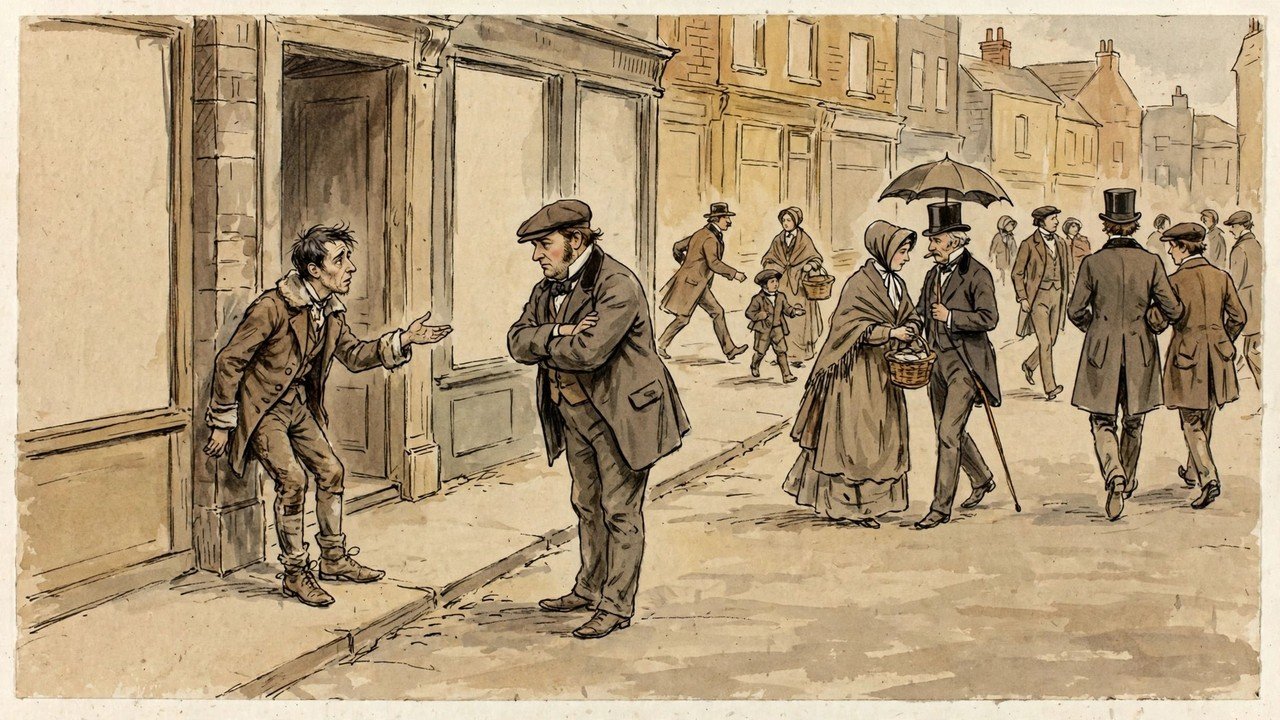
Every fraud of the Anglo-Bengalee’s kind needs a founder, and the founder Dickens gives it is a man whose entire capital, from first to last, is presentational. Montague Tigg enters the novel with nothing: no money, no profession, no establishment, no prospects that any other character can identify. What he has is a manner. He has the bearing of a gentleman down on his luck rather than a beggar, the vocabulary of a man of the world, a readiness to be amusing about his own necessities, and an instinct — the one genuine talent Dickens allows him, and allows him in abundance — for the impression a scene makes on the person watching it. The Anglo-Bengalee is that instinct given offices. To understand the company, it is necessary to begin where Dickens begins, with Tigg before the company existed, because the pre-history is the audit the customers never performed. Everything that will later be hidden behind stucco, plate glass and a brass plate is visible, in the early chapters, in the open.
Tigg first appears in Chapter 4, in the train of Mr Chevy Slyme 1. Slyme is a Chuzzlewit cousin, a dissolute and self-pitying young gentleman who lives, in the manner of several of the family, on the expectation of old Martin Chuzzlewit’s money: he has no income but the hope of one, and he conducts himself, on the strength of that hope, as a man of injured merit whom the world has conspired to keep waiting. The family gathering at Pecksniff’s house, at which the relations assemble to pay their court to old Martin and to Anthony Chuzzlewit and his son Jonas, includes, in Dickens’s dry presentation, Mr Chevy Slyme and his friend Tigg. The pairing is exact. Slyme has the expectations and no abilities; Tigg has the abilities and no expectations. Slyme is a gentleman by birth who can do nothing; Tigg is a nobody who can do one thing supremely well, which is to attach himself to a prospect and live off its warmth. He is, at this stage, a hanger-on of a hanger-on — a parasite at one remove from the fortune, feeding on the man who hopes to feed on it. The Anglo-Bengalee will later perfect this arrangement and give it a prospectus. In Chapter 4 it is still being practised in a parlour, for drinks and dinners.
Chapter 8 develops the arrangement into a small, complete system of imposture, and Dickens gives the chapter a title that advertises Slyme’s assertion of the independence of his spirit 1. The independence is asserted, characteristically, by deputy. Tigg appears as Slyme’s accredited agent and ambassador — the envoy of a court that consists of one unemployed gentleman — and conducts, in that capacity, the delicate business of cadging on Slyme’s supposed expectations among the Chuzzlewit connection. The comedy is precise about the economics. A direct beggar can be refused. An ambassador must be received. By interposing a representative between himself and his necessities, Slyme converts want into diplomacy, and Tigg, who performs the conversion, takes his commission in keep. The roles are the roles of the later company in embryo: a figurehead whose name and expectations constitute the supposed substance, and an active partner whose business is presentation — who writes the letters, makes the calls, keeps the story in circulation and sees that the figurehead’s credit is never tested by anything so crude as a demand for cash. It is worth noting which of the two men Dickens shows to have the operative gift. Slyme can sulk, posture and expect. Tigg can talk. When, years of story-time later, the two are separated, it is the talker who rises and the expecter who is left behind, and the novel thereby states one of its colder principles: in a market for belief, the man who manufactures the belief is worth more than the man who merely owns the name it is manufactured about — a principle Slyme learns too late, and Jonas Chuzzlewit, who also has a name and money and expects them to command the concern he joins, will learn later still.
The shabby gentility of this early Tigg is a studied thing, and Dickens studies it. Tigg is seedy — Jonas, meeting him again in his glory, will recall the earlier figure with contempt as a precious seedy companion of Slyme’s — but the seediness is worn in a particular way 1. It is the seediness of a man who insists, by every remaining resource of dress, address and self-caricature, that his condition is temporary and accidental, a fall from a level that is properly his. This is not vanity alone; it is a commercial position. The shabby-genteel man asks the world for credit on a specific representation: that he is a gentleman in eclipse, that his real station is higher than his present one, and that assistance given to him now is not alms but an early subscription to his restoration. Sponging, conducted in this style, is a prospectus issued by a single person. It promises a return — gratitude, connection, reflected gentility, the pleasure of patronising a man who might one day patronise you — on an underlying asset, the sponge’s supposed prospects, which the subscriber is never in a position to inspect. Tigg in Chapters 4 and 8 is already doing, on a scale of dinners and small loans, what Tigg Montague will do on a scale of policies and premiums. The instrument is the same. Only the printing is better.
He disappears from the novel for a long stretch after these early chapters, and the disappearance is itself part of the design. When he returns, in Chapter 27, he returns transformed — and Dickens’s chapter title announces transformation as its subject, promising to show that old friends may appear not only with new faces but in false colours, and that people are prone to bite, and biters may sometimes be bitten 1. The scene of the return is managed like a conjuring trick whose method the reader is immediately shown. Young Bailey, the sharp London boy who has attached himself as cab-boy and tiger to a rich governor in Pall Mall, is driving his master through the City when the master is recognised — by the narrator first, and then, in the chapter’s great interview, by Jonas — as Tigg. The recognition is written as a problem in identity. The hair is jet black, the waistcoat flowered, the person laden with chains, jewels and rings; the equipage, the servant, the whole turnout announce a man of established wealth. And yet the metal underneath the burnish and lacquer is, Dickens insists, the true Tigg metal, newly stamped. The sentence the novel gives the transformation deserves its place at the head of any account of the man: “though no longer Montague Tigg, but Tigg Montague; still it was Tigg; the same Satanic, gallant, military Tigg.” 1
The reversal of the name is the smallest complete fraud in the book, and Dickens places it where the reader cannot miss its significance. Montague Tigg becomes Tigg Montague. Nothing has been added. No new person has come into existence, no fortune has been inherited, no business has been built. The same elements have been rearranged, and the rearrangement is presented — by Tigg himself, who understands exactly what he has done — as a rise in the world. A name that sounded like a Christian name followed by a surname of no account now sounds like a surname of consequence preceded by a family name; “Montague”, promoted to the front, does the work of ancestry, and “Tigg”, demoted to the rear, is disguised by its new position, the way a familiar face is disguised by a uniform. The trick is the company’s trick at the scale of two words. The Anglo-Bengalee likewise adds nothing to the world but an arrangement: Anglo before Bengalee, Disinterested before Loan, a chairman before a secretary before a porter, in an order calculated to make the whole read as substance. Tigg has simply applied to himself, first, the treatment he was preparing for the public. He is his own first prospectus, his own first policyholder, and — the reader should note the completeness of it — his own first believer, for there is no sign in Chapter 27 that the performance is undermined by any private embarrassment. He enjoys it. The enjoyment is part of the equipment. A presenter who visibly doubted his own presentation would be a tradesman with a secret; Tigg, doubting nothing in public and laughing only in the right company, is a chairman.
His own account of his gift, given to Crimple in the cab, is the most economical piece of self-knowledge in the novel: “I rise with circumstances, David. That’s a point of genius in itself.” 1 The claim is modest in form and total in content. Tigg does not claim to make circumstances, to command capital, to understand assurance, to keep books or to judge lives. He claims to rise with circumstances — to detect, faster than other men, what a new situation will reward, and to be already dressed for it when it arrives. It is the talent of the weathercock raised to a philosophy, and Dickens, who rarely lets a villain define himself without the definition cutting both ways, lets the sentence stand as both boast and indictment. A man who rises with circumstances has no weight of his own to resist them. He will be a sponger’s ambassador when sponging is the opportunity, a chairman when promotion is the opportunity, and — when the circumstances turn, as Chapter 42 shows him privately resolving — a fugitive across the water with the gains, leaving his partners and policyholders to the wreck. The genius is real. So is the vacancy at its centre. The company he founds is the institutional form of the same quality: it too rises with circumstances, expands with every inflow, puts on whatever face the moment requires, and has no reserves — financial or moral — with which to meet a change in the weather.
Dickens summarises the rise in a single piece of narration that strips it of the last pretence of industry: in peculating on a grander scale, Tigg had become a grander man altogether 1. The order of cause and effect is the point. Tigg did not become grand and then, in consequence, handle larger sums. He handled larger sums — other people’s, obtained by peculation — and the handling made him grand. Grandeur, in this economy, is not the reward of substance but the by-product of circulation: money passing through a man’s hands leaves a residue of importance on the hands. The observation generalises far beyond Tigg, and Dickens plainly intends it to. It is the reason the Anglo-Bengalee must keep money moving, must have premiums arriving and loans issuing and dinners being given, whether or not any of it corresponds to a sound transaction. A concern of this kind cannot afford stillness, because stillness would reveal that the grandeur is the motion. The moment the flow stops, the chairman is a seedy gentleman in a hired room again. Tigg, who began as a man living on the expectation of another man’s inheritance, ends by building an institution that lives on exactly the same thing: an expected future — of premiums, of new borrowers, of fresh directors with fresh capital — perpetually consumed in advance.
The transformation required a staff, and the staff Dickens gives him is a small masterpiece of casting, each member a different department of the single art of appearance. First, and nearest, is David Crimple, the secretary. Crimple’s own past is given in a detail that pairs him with his master: his name, Dickens notes, had originally been Crimp, and had been altered because the original was susceptible of an awkward construction 1. Even the secretary has been renamed. The firm is a company of edited names — Tigg reversed, Crimp softened — as if the personnel, like the prospectus, had been through a process of revision in which everything suggestive of the truth was struck out. Crimple’s history before the edit is as humble as Tigg’s: he had been David the tapster, a drawer of beer, with associations in the pawnbroking world. In the company he is Secretary and resident Director, at a salary of £800 a year with house-rent, coals and candles free, and a holding of twenty-five shares 1. The division of labour between the two men is stated by Dickens with the clarity of an organisation chart: Crimple does the plain work of the concern — the figures, the books, the circulars, the advertisements — while Tigg attends to the ornamental department. The sentence should be read as the firm’s true memorandum of association. There is a plain department, which manufactures paper, and an ornamental department, which manufactures belief, and the ornamental department is the senior one, draws the chairman’s portrait for the board-room wall, and is occupied by the founder in person.
It is Crimple, accordingly, who speaks the firm’s founding truths in the cab in Chapter 27, because the plain department cannot help knowing them. The chairman opens the exchange with a proprietor’s complacency — “The Anglo-Bengalee Disinterested Loan and Life Assurance Company is rather a capital concern, I hope, David.” — and the secretary’s reply, and the chairman’s question after it, expose in three lines the entire financial structure: “What will be the paid up capital, according to the next prospectus?” / “A figure of two, and as many oughts after it as the printer can get into the same line.” 1 Campbell draws from scenes like this the practical lesson that fraud on this scale needs capital to perpetrate it in the first place — not capital in the bank, but capital in the theatrical sense: the money for shiny appearances to bolster reputations, and for hooking in other unethical and questionable people 3. The prospectus figure is the purest instance. It is not a lie of the ordinary kind, a false number substituted for a true one. It is a number whose magnitude is determined by typography. The printer’s line, not the banker’s ledger, is the binding constraint on the company’s capital, and Dickens makes the secretary say so, laughing, in the hearing of the reader, before a single customer has been shown into the office. The public will receive the figure as a statement about money. The men who set the type know it is a statement about space.
The invented capital required an invented geography to hold it, and here the founder’s presentational talent works at its largest scale. The company, Jonas is given to understand and the public is invited to believe, has property in Bengal answerable for claims upon it — Tigg’s own joking version, exchanged with Crimple, locates a mint of money in a preserve of tigers 1. The jest is instructive about the function of distance in the design. Bengal is far enough away to be unverifiable by any customer standing in a City office, and grand enough, in the commercial imagination of the 1840s, to make large figures sound moderate. A reserve held in a strong-room in London could in principle be asked after, counted, audited. A reserve held in Bengal can only be believed. Tigg’s genius is to see that unverifiability, properly dressed, is not a weakness in a balance sheet but an improvement on one: the distant asset never disappoints, never has to be produced, and grows, in the minds of believers, at exactly the rate their hopes require. Tamai’s argument that the colonial element in the name signals the greater risks and fraudulent dealings of business conducted at a distance from scrutiny applies with equal force to the colonial element in the balance sheet 5. The tigers are the perfect custodians of the capital. Nobody demands an interview with them.
Then come the offices, and with them the transformation passes from the man’s person to his premises — the point at which a performance becomes an institution in the eyes of everyone who visits it. Dickens’s narration of the founding is a single sentence of controlled absurdity: “The Anglo-Bengalee Disinterested Loan and Life Assurance Company started into existence one morning, not an Infant Institution, but a Grown-up Company.” 1 The company has a branch in the West End, over a tailor’s shop, and its chief offices in the City are fitted in stucco and plate glass, with wire blinds worked with the company’s name, a brass plate on the door, green ledgers, iron safes and marble chimney-pieces, and the name repeated into the smallest furnishing — painted on the very coal-scuttles, printed on the letter paper, struck on the seal, worn on the porter’s buttons 1. Each item deserves a moment’s attention, because each is a small argument addressed to a visitor’s doubt. Green ledgers argue that accounts are kept. Iron safes argue that valuables are held. Marble chimney-pieces argue that the firm is housed as permanence is housed. The brass plate argues that the firm expects to be found at this address by people who will come back. None of these arguments is stated, and that is why they succeed: a visitor does not feel argued with, he feels surrounded, and the conclusion — that a concern so furnished must be a concern of substance — presents itself to him as his own observation rather than as the company’s claim. Criminologists of corporate financial crime have a name for the general device, ostensible legitimacy: the use of otherwise ordinary corporate structures and premises to make offending appear common, routine and concealed within normal occupational practice 3. Dickens had no such term. He had the coal-scuttles, which make the same point better.
The board-room completes the set. It has a Turkey carpet. It has an ivory hammer and a hand-bell, the instruments of chaired procedure. It has, presiding in effigy, a portrait of the chairman, Tigg Montague, so that the founder’s image attends even the meetings his person might miss. And when the board sits, the board consists of the chairman, the secretary Crimple, and the porter Bullamy ranged behind the chair — upon which Dickens delivers the verdict that the whole establishment exists to prevent any customer from reaching: “This was the board: everything else being a light-hearted little fiction.” 1 The plural forms of company governance — directors, meetings, resolutions, a board — are preserved with ceremonial completeness and filled with three men, one of whom is the porter. Governance, in the Anglo-Bengalee, is a theatrical genre: it has props, costumes and a stage, and its performances are given for an audience of visitors who will report, to the next visitors, that they have seen the board-room of a great company. What they have seen is a room. The company’s deepest insight, which is Tigg’s insight, is that for most commercial purposes a room correctly furnished is indistinguishable from the thing it represents, because the thing it represents — capital, reserves, continuity, oversight — is invisible in any case, and can only ever be inferred from rooms, papers and persons. Tigg does not forge the invisible things. He forges the inferences.
Bullamy the porter is the inference made flesh, and Dickens gives him the most quietly devastating testimonial in the chapter. Bullamy is a large man in a vast red waistcoat, with a pepper-and-salt coat and a glazed hat, whose duties are to cry room for the chairman, to clear a passage with cries of “By your leave there!”, to serve the board-room lunch, and in general to be beheld. Of the waistcoat Dickens writes: “Respectability, competence, property in Bengal or anywhere else, responsibility to any amount on the part of the company that employed him, were all expressed in that one garment.” 1 The sentence is a complete theory of the fraud in a single item of clothing. The waistcoat expresses — asserts, communicates, testifies to — every quality the customer needs the company to have, and it does so without the risk of a specific claim that could be checked. And it works, measurably, inside the fiction: visitors who came intending to insure a life for a thousand pounds are recorded doubling the sum to two thousand on the strength of looking at Bullamy 1. No argument was put to them. No figure was shown to them. A large, calm, well-fed man in a red waistcoat stood in the hall of a stucco office, and the market moved. Tigg’s talent is visible here in its purest form, because Bullamy is not a deception practised on the visitor’s reason. He is an environment. He alters what it feels reasonable to do in that hall, and men insure for double inside environments that feel like permanence. That Bullamy, in the collapse, flees with Crimple and the plunder 1 is the final gloss on the garment: the respectability was never a character trait of the company’s servants. It was a uniform, and uniforms are taken off — or, in this case, taken away, with the cash inside them.
The last appointment completes the establishment, and it is the one that connects the theatre to the trade. Mr Jobling is the company’s medical officer: the professional man whose function, in an honest assurance office, is to examine proposed lives and protect the fund against bad risks. Jobling had followed Anthony Chuzzlewit to the grave in his medical capacity, a connection Dickens notes at the moment of his introduction to the company, and he now attends the Anglo-Bengalee’s board-room lunches, takes a commission on policies he steers to the office from among his own patients, professes to know nothing of the company’s capital, and conducts examinations that are theatre of a kindred sort to Bullamy’s waistcoat — since, as Dickens puts it, “whatever kind of lives they were, the Anglo-Bengalee would accept them readily.” 1 A medical officer who accepts every life is not a safeguard with a defect. He is a safeguard inverted: his professional title is retained precisely because it reassures, while his professional function — refusal — is abolished, because refusal would interrupt the inflow of premiums. Jobling’s presence on the establishment also performs the subtler service of borrowed credibility. He is a man with a practice, a position, patients, a history of attending respectable families to their graves. All of that accumulated trust is, by his attendance at the lunches and his name on the company’s arrangements, quietly transferred to a firm that has earned none of it. Tigg collects such transfers the way other men collect capital. A porter’s waistcoat, a doctor’s title, a secretary’s printed circulars, a director recruited from among the customers themselves: the Anglo-Bengalee’s real balance sheet, if it could be drawn, would be a list of other people’s respectability, held on loan.
It remains to ask what, beneath the presentation, Tigg actually is as a man of business — and Dickens answers the question by giving him, in his interview with Jonas, a candour that functions as the most sophisticated presentation of all. Tigg does not pitch Jonas with the prospectus. He pitches him with the truth, or with enough of it to serve: “We companies are all birds of prey; mere birds of prey.” 1 And then the invitation that reverses Jonas’s errand — Jonas has come to buy a policy on his wife’s life, cheaply and without her knowledge, having been questioned and resisted by one or two of the old companies — into a recruitment: “Why don’t you take premiums, instead of paying ’em? That’s what a man like you should do. Join us!” 1 The method deserves the closest attention of any reader interested in persuasion, because it inverts the ordinary logic of the confidence trick. The ordinary swindler hides his dishonesty from the victim. Tigg displays his — to the right victim. He has read Jonas exactly: a man bred to cunning, who despises being duped, who prides himself on seeing through humbug, and who can therefore be captured by being admitted, apparently, to the inside of the machine. The confession of predation is the credential. Jonas trusts the company because its chairman has told him it is a company of birds of prey; the admission flatters his self-image as a fellow predator, and a man who believes he has been made a partner in the preying does not ask to see the reserves. Even Tigg’s honesty is presentational. It is the one costume in his wardrobe reserved for customers too knowing for the waistcoat.
And Slyme? The discarded ambassador’s master makes no appearance in the company’s story, and his absence is the founder’s first audited result. In the Chapter 27 interview, Jonas is at first put off the concern by Tigg’s old association with Chevy Slyme, and Tigg must satisfy him that the partnership is dissolved — that he has parted ways with Slyme 1. The detail is small and complete. The man whose expectations were Tigg’s first stock-in-trade has been written off, because expectations unbacked by any performance are, in the new and larger market Tigg has entered, a liability: they remind the customer of the parlour when he is meant to be contemplating Bengal. Tigg’s rise can be measured by his disposals. He disposed of his name’s order, of his secretary’s name’s ending, of his shabby clothes, of his old associate, and in due course he intended to dispose of Jonas, of the company, and of England. Each disposal is the same act — the removal of whatever in the presentation might prompt a question — performed at a larger scale. What he never acquires, at any stage, is the thing all the presentations represent. He begins with no capital but a manner, and he ends, in the wood on the footpath from Pecksniff’s house, with no capital but a manner, walking home from a dinner at which the manner has just extracted another investor’s money. The manner was genuine. It was the only genuine article the Anglo-Bengalee ever had in stock, and Dickens, who gave it to a sponger’s hanger-on in a Wiltshire parlour and watched it incorporate itself in the City, knew precisely what he was showing his monthly readers: that the distance between the ambassador of Chevy Slyme and the chairman of the Anglo-Bengalee is not a distance of kind, of capital or of character. It is a distance of staging — and staging, unlike capital, can be acquired on credit.
The embassy at Pecksniff’s: a letter that was money
The fullest single performance of the early Tigg is not a dinner cadged or a loan raised. It is an errand, staged in Chapter 8, in the workroom at Pecksniff’s, where young Martin and Tom Pinch are at their drawing-boards. Tigg announces himself before he is properly in the room — head first, surveying the two young men from the doorway “in a manner that was at once waggish, conciliatory, and expressive of approbation” — and opens not with a request but with a compliment. Industry, he tells them, is next to genius one of the charmingest qualities of the human mind. They remind him of Whittington, thrice Lord Mayor of London. They are, he says, “a pair of Whittingtons, gents, without the cat.” Only when the room has been warmed does the embassy declare itself: “I am the accredited agent of Chevy Slyme; that I am the ambassador from the court of Chiv” — the sentence breaks off into a laugh in the text, the title of the court left unfinished, as if the grandeur of the mission were too large for the word that had to carry it 1.
The business of the embassy, when it is finally stated, is conducted in a whisper. Tigg shields his lips with the palm of his hand, applies them close to Tom Pinch’s ear, and confides: “I have come for the letter.” Tom, who has no letter, says so aloud. Tigg corrects him, still whispering: the letter “which my friend Pecksniff addressed to Chevy Slyme, Esquire, and left with you.” Tom repeats that no letter was left with him. “Hush!” cries Tigg. “It’s all the same thing, though not so delicately done by my friend Pecksniff as I could have wished. The money.” 1
That exchange, which lasts less than a page, contains the whole method in its street form. A demand for cash is an ugly thing; it can be refused bluntly, without social cost to the refuser. A demand for a letter is a piece of business between gentlemen. Tigg’s first move is therefore always translational: he converts the transaction he wants into a transaction of a more elevated kind, and conducts the conversion in the hearing of the victim, so that the victim is made a collaborator in the euphemism. The whisper does the rest. By lowering his voice and shielding his mouth, Tigg creates a zone of shared discretion around the demand, inside which Tom is no longer a young man being dunned but a trusted intermediary in a delicate affair. To break out of it would require Tom to violate a confidence that Tigg has manufactured on the spot and presented to him as already existing. Tom does break out of it, because Tom Pinch is constitutionally incapable of intrigue, but the attempt deserves attention: it is the Anglo-Bengalee’s office manner reduced to one man and one palm. The board-room and the porter’s waistcoat will later do by architecture what the whisper does here by gesture — make directness feel like a breach of the occasion’s rules.
When the euphemism fails, Tigg does not retreat. He escalates. Sitting himself down, he informs the room that there is at that moment, at the Blue Dragon inn, “a perfect constellation of talent and genius” detained for his bill: “my friend Chevy Slyme being held in pawn for a bill, beats any amount of cockfighting with which I am acquainted.” The phrase “held in pawn” is exact — Slyme is, in the innkeeper’s arithmetic, a pledged article retained against a score. Tigg’s rhetoric performs the opposite conversion: a bill is “a thing in itself essentially mean; a low performance on a slate, or possibly chalked upon the back of a door”, and when a man like Slyme is detained for such a thing, “the very first principles of things can no longer be trusted” 1. The debt, the only hard fact in the room, is talked down into chalk; the debtor is talked up into a constellation. Nothing is paid, or even promised. What is produced is indignation — the currency in which Tigg deals when he has no other, because a listener made indignant on Slyme’s behalf has been moved from creditor’s ally to partisan, and partisans reach for their pockets more readily than judges do.
The scene also records, in Mark Tapley’s evidence, the material substrate under the rhetoric, described by the one man present who is immune to the performance. Mark has been set to watch Tigg — to follow him to the house and see him home again — because Tigg, like his friend, is effectively under inn-arrest for the score. Tigg threatens him with operatic violence. Mark’s reply is a tradesman’s audit of the whole person: “It’s no use. If you knock ever so much in that quarter, you’ll get no answer. I know better. There’s nothing there but padding; and a greasy sort it is.” 1 Mark then gives the history in plain terms. Tigg and Slyme “goes and stops at the Moon and Stars till they’ve run a bill there; and then comes and stops with us and does the same.” The running of bills, Mark allows, is common enough. The objection is the manner: “Nothing’s good enough for him; all the women is dying for him he thinks… and all the men was made to be ordered about by him.” 1
Two features of that testimony matter. The first is seriality. The bill at the Blue Dragon is not a misfortune; it is the second iteration of a procedure — consume on credit at one house until the credit stops, remove to another house, repeat. The procedure requires no capital beyond the performer’s confidence that a new audience can always be found which has not yet seen the act end. The second feature is that the consumption is itself part of the advertisement. Tigg does not hide his pennilessness by economy. He orders as a man of consequence orders, and lets the bill grow, because a large bill run up in a lordly style is evidence — to the next inn, to the next parlour — that somebody has thought this man worth trusting to that amount. The debt is the testimonial. When the Anglo-Bengalee’s chairman later gives dinners in Pall Mall and explains that one member of a company must spend to hold the connection together, he is stating as corporate policy what the Blue Dragon already knew as practice.
Two-and-six at the pawnbroker’s: the price of a performance
The pawnbroker’s shop is the one place in the novel where Tigg’s art meets a professional who is paid to be unimpressed, and the scene there — Martin, back in London and destitute, pawning his watch in one of the little private boxes, and recognising the voice in the next box — is the closest the book comes to a laboratory test of the method. The voice is haggling over a shirt. “Make it two-and-six, my dear friend, positively for this occasion only. Half-a-crown is a delightful coin. Two-and-six. Going at two-and-six! For the last time at two-and-six!” The shopman is unmoved: the article has grown yellow in the service. “Its master has grown yellow in the service, if you mean that, my friend,” says Tigg, “in the patriotic service of an ungrateful country.” The advance stays where it was: “what it always has been — two shillings.” 1
The haggle is a negotiation between two theories of value. The pawnbroker’s theory is material and repeatable: a worn shirt is worth two shillings today because it was worth two shillings last time, and the customer’s conversation does not enter into the price. Tigg’s theory is that price is a social event, adjustable by warmth, by humour, by the auctioneer’s cadence — “Going at two-and-six!” — borrowed from a sale-room in which he is simultaneously auctioneer, lot and bidder. He loses. The sixpence is not conceded. But the manner of the losing is the point: Tigg conducts a failed negotiation as if it were a successful entertainment, and extracts a familiarity that will be worth money on the next visit. A pawnbroker who likes a customer does not ask the questions he asks of strangers. Tigg is investing the only thing he has, his manner, in the only bank that will take it.
The particulars he gives the shopman are a small, complete prospectus of himself. Asked whether the name is the same as usual, he replies: “Still the same name; my claim to the dormant peerage not being yet established by the House of Lords.” Asked for the address: “I have removed my town establishment from thirty-eight Mayfair, to number fifteen-hundred-and-forty-two Park Lane” — the lease, he explains, taken for “seven, fourteen, or twenty-one years, renewable at the option of the tenant”, because the apartments for the under-butler and the fifth footman at the old place were of a most confounded low and vulgar kind 1. Every element of the later company’s technique is present in these two answers, at the scale of a shirt: the claim deferred to an authoritative body that has not yet ruled (the House of Lords here; the next prospectus there); the address inflated past the point of checkability — Park Lane has no fifteen-hundred-and-forty-second house, and the impossibility is itself a protection, since a listener laughing at the number does not proceed to verify the street; and the domestic staff, invented in the same breath as the mansion, because a great house is believed in proportion to the servants it is said to inconvenience. The Anglo-Bengalee will have its Bullamy. At the pawnbroker’s, Tigg already has a fifth footman.
Then Martin is recognised, and the scene changes key. Tigg pours himself through the partition — “his head was as much in Martin’s little cell as Martin’s own head was” — and, the moment Martin’s watch is produced, constitutes himself Martin’s agent on the spot. “David, pay particular attention to this gentleman immediately, as a friend of mine, I beg.” The recommendation that follows is a parody of a reference, delivered at full volume: “A gold hunting-watch, David, engine-turned, capped and jewelled in four holes, escape movement, horizontal lever, and warranted to perform correctly, upon my personal reputation, who have observed it narrowly for many years, under the most trying circumstances” — here he winks at Martin, to let him understand the effect this will have. The shopman offers three pounds, and not a penny of it is attributable to the oration: “It is very old-fashioned. I couldn’t say more.” Tigg instantly re-describes the unmoved price as a triumph of his advocacy: “And devilish handsome, too. Two-twelve-six for the watch, and seven-and-six for personal regard. I am gratified; it may be weakness, but I am. Three pounds will do. We take it.” He then supplies Martin with a false name and address for the ticket — “The name of my friend is Smivey: Chicken Smivey, of Holborn” — winking again, Dickens notes, to apprise him that all the forms and ceremonies prescribed by law were now complied with 1.
Three operations are performed in under a minute, and each is a rehearsal. First, an unsolicited agency: Tigg inserts himself into a transaction to which he is not a party, and makes himself its broker by speaking first and loudest. Second, the re-description of an outcome: a price fixed entirely by the pawnbroker’s valuation is announced as a price improved by Tigg’s personal regard, so that a result he did not cause becomes a debt Martin owes him. Third, the casual falsification of the record: the name on the ticket is invented as a formality, and Martin — who needs the money — is made complicit in it before he has agreed to anything. The company’s later paperwork will work identically: forms filled with names that serve the occasion, outcomes announced as the chairman’s doing, and customers converted into accomplices by the small falsifications they witnessed and did not protest.
The bill for the performance arrives in the street. Martin is reminded that he has reduced the proceedings “to a cold and distant matter of business” when Tigg was disposed to place them on a friendly footing; business it shall be: “I expect a trifle (which I shall bestow in charity) as commission upon the pecuniary advance in which I have rendered you my humble services. After the terms in which you have addressed me, sir, you will not insult me, if you please, by offering more than half-a-crown.” Martin tosses him the coin. Tigg catches it, tests it, “spun it in the air after the manner of a pieman, and buttoned it up”, raises his hat with a military air, and swaggeres round the corner 1. Half-a-crown: two shillings and sixpence — precisely the sum he had failed to extract from the pawnbroker for his shirt. What the professional counter refused the performance, the amateur’s embarrassment pays it. Tigg’s income, at this stage, is the difference between what people will give his necessities (two shillings on a shirt) and what they will give his feelings (half-a-crown, to end a scene). He has learned to invoice the feelings.
The second employer: begging messages and bought intelligence
There is a coda to the early career which Dickens withholds until Chapter 52, and it changes the valuation of everything in the scenes above. Old Martin, unmasking himself, explains how he came to know what his grandson had been doing in London. “The wretched man who has been murdered,” he says — “then passing by the name of —” “Tigg,” suggests Mark — “of Tigg — brought begging messages to me on behalf of a friend of his, and an unworthy relative of mine; and finding him a man well enough suited to my purpose, I employed him to glean some news of you, Martin, for me.” It was Tigg who watched Martin to his lodging after the pawnbroker’s, and Tigg whose intelligence “enabled me to send you a banknote” 1.
The revelation matters because it is the only occasion in the novel on which Tigg’s persuasion is bought by a man who sees through it completely. Old Martin is not deceived for a moment. He calls him “the wretched man”; he employs him precisely because a begging-message carrier is already inside the rooms, inns and pawnshops where news of a ruined grandson circulates, and because a man of that trade can be trusted to perform the one service his life has trained — to observe a mark, to carry a story between parties who do not meet, and to be paid by whichever side is buying. The begging messages on behalf of Slyme had been Tigg’s stock approach to the rich man: the rich man’s door was the terminus of the cadging circuit, where Slyme’s expectations were supposed to be convertible into cash. Finding the conversion refused, Tigg sold the only other commodity the visit generated — information about the family, gathered in the course of the cadging — to the very man the cadging was aimed at. The embassy, it turns out, had two customers.
This is the street-level origin of a figure who will recur in the company’s story in a more expensive coat. The Anglo-Bengalee keeps Mr Nadgett at a pound a week to make inquiries, and Nadgett’s product — knowledge of Jonas that can be held over him — becomes the company’s most valuable asset, worth more than its fictitious Bengal property because it can actually be produced. Tigg’s apprenticeship anticipates the arrangement exactly. Before he ever hired an inquiry agent he had been one, and he had learned the trade’s first principle in his own person: that the go-between’s loyalty is to the errand, not to the party. Wagner’s study of financial speculation in Victorian fiction treats novels like this one as part of the machinery by which the culture learned to think about credit and the men who intermediated it 7. Yesterday’s cadger is today’s intelligencer and tomorrow’s chairman, without any change in the underlying business, which is the brokerage of belief.
Read with Chapter 52 in hand, the early scenes stop looking like improvisation. They are a training in the three skills the Anglo-Bengalee will monetise at scale: the management of an interview so that refusal becomes socially expensive; the conversion of other people’s transactions into commissions for the man who merely attended them; and the gathering of knowledge about the parties — their lodgings, their embarrassments, their pawned watches — bankable with third parties who were never in the room. The young Martin pawning his watch supposes he has had a humiliating private encounter. He has in fact been processed: his circumstances were observed, reported and acted on by a man he paid half-a-crown for the privilege of being observed by. The chairman’s later habit of studying his man was not acquired in Pall Mall. It was acquired in a pawnbroker’s box, at two-and-six a lesson.
Pecksniff’s school: premiums pocketed, nothing built
Seth Pecksniff’s establishment at Salisbury is introduced in Chapter 2 with a precision the Anglo-Bengalee chapters never need, because Pecksniff’s fraud has been running for years and has a settled method Dickens can state as a formula. “Of his architectural doings, nothing was clearly known, except that he had never designed or built anything; but it was generally understood that his knowledge of the science was almost awful in its profundity.” His professional engagements “were almost, if not entirely, confined to the reception of pupils”. Then the formula, in one sentence: “His genius lay in ensnaring parents and guardians, and pocketing premiums.” 1
Every word of that sentence is load-bearing. The genius is not architectural. It is commercial, and its objects are not the pupils but the parents and guardians — the parties who pay and who do not attend. A pupil, once installed, might in time discover what the establishment contains; a parent in another county receives only the establishment’s account of itself, conveyed in Pecksniff’s letters, his cards (“Mr Pecksniff, Architect”, with “and Land Surveyor” added), and the great man’s manner when the families meet. The premium is paid at the start, for a term of years — the young gentlemen are articled “for three or five years, according to his articles” — and for a thing testable only at the end of the term, when the pupil emerges and either can or cannot design a building. By then the money is long spent. The structure is the assurance structure in miniature: a present payment against a future performance, sold to a buyer who cannot inspect the reserve — here, the reserve of knowledge in the master’s own head — on which the performance depends. Dickens gives Pecksniff a capital of reputation consisting of a profundity that is “generally understood”. In both establishments the asset is an understanding among people who have not examined it, maintained by the interested party’s continuous performance of the quality in question.
What the premium buys, once paid, Dickens itemises with an auditor’s malice. “A young gentleman’s premium being paid, and the young gentleman come to Mr Pecksniff’s house, Mr Pecksniff borrowed his case of mathematical instruments (if silver-mounted or otherwise valuable); entreated him, from that moment, to consider himself one of the family; complimented him highly on his parents or guardians, as the case might be; and turned him loose in a spacious room on the two-pair front.” The room contains drawing-boards, parallel rulers, stiff-legged compasses and two or three other young gentlemen. There the pupil “improved himself, for three or five years… in making elevations of Salisbury Cathedral from every possible point of sight; and in constructing in the air a vast quantity of Castles, Houses of Parliament, and other Public Buildings.” “Perhaps in no place in the world were so many gorgeous edifices of this class erected as under Mr Pecksniff’s auspices” — erected, Dickens specifies, in that front room, in the air 1.
The itemisation is a schedule of what a confidence operation delivers once the money is in. First, a small extraction beyond the price: the instruments, borrowed if valuable — the customer’s property passing, by the house’s etiquette, into the proprietor’s use. Second, a substitution of belonging for instruction: the pupil is to consider himself one of the family — Pecksniff’s equivalent of the Anglo-Bengalee’s directorship, the non-cash consideration that reconciles the payer to the absence of the cash consideration. A pupil who is one of the family cannot present an account for teaching not received. Third, flattery directed up the line of payment: the parents are complimented highly, in the pupil’s hearing, so that the report carried home is of the master’s regard for the family. Fourth, occupation without production: elevations of a cathedral that already exists, and public buildings constructed in the air. The work fills three or five years and can be shown to visitors; it is simply not the work the premium was paid for. The curriculum is the prospectus, continued by other means: activity arranged so that its products can never be tested against a client’s brief, a builder’s estimate or a standing wall.
The parallel with the assurance office is structural, not decorative, and Dickens plants the verbal link himself: Pecksniff’s income, like the company’s, is premiums. But the deeper identity lies in the direction of the work. In an honest school, value flows from the master to the pupil, and the premium is the price of the transfer. In Pecksniff’s school the flow runs the other way — for the pupils are not merely neglected. They are used.
The finishing touches: how a pupil’s work became the master’s
Pecksniff explains his pedagogy to Martin with the candour of a man describing a conjuring trick to a fellow professional he has mistaken for an admirer. The pupil is to attempt the grammar-school design — a real commission, open to competition. Who knows, says Pecksniff, “but a young man of your taste might hit upon something, impracticable and unlikely in itself, but which I could put into shape? For it really is, my dear Martin, it really is in the finishing touches alone, that great experience and long study in these matters tell.” Dickens’s narration then supplies the case law, attributed to Pecksniff’s old enemies: “there were cases on record in which the masterly introduction of an additional back window, or a kitchen door, or half-a-dozen steps, or even a water spout, had made the design of a pupil Mr Pecksniff’s own work, and had brought substantial rewards into that gentleman’s pocket. But such is the magic of genius, which changes all it handles into gold!” 1
The additional back window is the smallest unit of appropriation in the novel. Nothing of substance is added — alterations a competent clerk could make in an afternoon. But the alteration is not valued for its effect on the building. It is valued for its effect on the authorship. Once the master’s hand has touched the design, the design is the master’s in the only sense the market will ever examine: it goes forward under his name, from his office, as the product of his practice. The pupil’s premium-paid labour is thereby converted, by a finishing touch, into the master’s capital — his portfolio, his reputation, his next premium from the next set of parents. In both establishments, the customer’s contribution is the substance and the house’s contribution is the signature, and the rewards are allocated according to the signature.
The grammar school runs the full course of the method, and Dickens gives it a public ending: the fraud is performed before witnesses and is still, at the moment of performance, unanswerable. Martin’s design, made in the two-pair front room, is the design Pecksniff submits. Martin, returned to England, hears an inn landlord announce that “the great Mr Pecksniff, the celebrated architect”, has come down “to help to lay the first stone of a new and splendid public building”, having “carried off the First Premium, and will erect the building”. Martin looks over Pecksniff’s shoulder at the unrolled plans at the ceremony, and comes back to Mark Tapley “boiling with rage”: “Matter! This is my building… My grammar school.” 1 The stone is laid, with the member of Parliament in attendance — the full civic theatre of a legitimate triumph — over a design whose author is standing in the crowd, unrecognised. Martin’s remedy, when it comes much later, is the remedy of the whole period: a letter, written on John Westlock’s advice, “to the trustees of the famous Grammar School, boldly claiming the successful design as his, and charging Mr Pecksniff with the fraud he had committed” 1. A letter, against a laid foundation stone and a name in the newspapers — exactly as the Anglo-Bengalee’s victims will be left with claims against a firm whose secretary and porter have fled with the plunder.
Tom Pinch’s terms complete the picture of the school’s internal economy, because Pinch is the establishment’s longest-held asset. His first ground for gratitude to Pecksniff, recited to John Westlock, is this: “he took me as his pupil for much less than he asked.” 1 The discount is presented, and received, as benevolence. Its function is the opposite. A pupil taken at a reduced premium is placed under a permanent obligation, whose subsequent services — Pinch is by now assistant, organist, general drudge and the house’s institutional memory — can be remunerated below their value for ever, because the original concession is always on the books against him. Westlock’s cross-examination exposes the rest of the ledger: a salary that is to improve when the business improves, and a dead grandmother who “died happy to think that she had put me with such an excellent man” — the family’s gratitude itself enlisted as a retaining fee 1. Pecksniff has arranged that Pinch experiences the underpayment as a debt of honour owed in the other direction. It is the same inversion the pawnbroker scene taught in miniature — a result the house did not cause re-described as the house’s generosity, and invoiced to the victim’s feelings — practised not for half-a-crown but for a working life.
The moralising, finally, is not an ornament on this system but its protective coating, applied continuously and at no cost. At the breakfast table, the master takes the very items of the meal — “even cream, sugar, tea, toast, ham — and eggs — even they have their moral. See how they come and go!” — and draws the lesson before the household has finished eating 1. A man who can extract a sermon from toast can extract one from any transaction, including a premium or a pupil’s design; and a household trained to receive every act of the master’s as an improving reflection is a household trained out of the habit of auditing him. The sermons are Pecksniff’s circulars: they repeat the invitation — attend to the master’s virtue — until the repetition stands in for evidence, and they raise the social cost of the one question that would dissolve the establishment, which is not “is he good?” but “what, exactly, has he built?” Dickens answers it himself, in the second chapter: he had never designed or built anything 1. The school, the sermons, the premiums and the profundity all stand on one side of the ledger. On the other side there is not a wall in England. When such a man is later shown the Anglo-Bengalee’s prospectus, the reader who has done this arithmetic already knows what he will look for in it, and what he will not think to ask.
Jonas Chuzzlewit – greed educated at home

Jonas Chuzzlewit did not learn greed at the Anglo-Bengalee. He arrived there already educated. The company did not have to teach him to want money at other people’s cost, to regard secrecy as ordinary prudence, or to treat another man’s life chiefly as a sum that might fall due. Anthony Chuzzlewit had taught him all of that at home, over years, in the counting-house and at the table, by precept and by example. What Tigg Montague offered Jonas in Chapter 27 was not a new character. It was a larger room in which the character he already had could operate, a board-room instead of a family parlour, printed forms instead of private bargains, and other men’s money on a scale his father’s Manchester firm had never put within his reach.1
Dickens states the principle in his Preface without leaving it to inference. Jonas, in that account, is a man so born and so bred that he comes to regard himself as justified from his cradle in cunning, treachery and avarice, and Dickens presents him as the legitimate issue of the father upon whom those same vices are finally seen to recoil.1 The phrasing matters because it removes the comfortable explanation that Jonas is simply an aberration, a bad son born to a respectable house. In Dickens’s construction Anthony is not betrayed by a stranger who happens to share his name. He is answered by his own teaching, carried further than he intended it to go and turned back upon its author. The son learns the lesson too well. He applies to his father the valuation his father taught him to apply to everyone else.
Anthony Chuzzlewit, head of Anthony Chuzzlewit and Son of Manchester, was old Martin Chuzzlewit’s brother, a hard man in a family in which hardness about money had become a kind of inheritance more reliable than any will.1 The firm name itself placed the son inside the business before Jonas had any choice in the matter: Anthony and Son, father and heir, principal and successor. Jonas’s expectations, his employment, his standing and his future portion all ran through one narrow channel, and that channel was his father’s life and death. While Anthony lived, Jonas waited. When Anthony died, Jonas inherited. Dickens builds the whole moral danger of Jonas’s upbringing into that simple commercial fact, and then makes Anthony sharpen the danger by the way he trains the waiting man. A son taught to see the world as a contest in which the sharpest takes the most will not exempt his own father from the contest merely because the older man is the source of the teaching.
Chapter 13 belongs to that schooling. Jonas is shown in his father’s world not as a young man softened by domestic affection or restrained by filial gratitude, but as a pupil who has absorbed the atmosphere of suspicion, bargaining and self-protection in which Anthony conducts his affairs.1 The education is not formal. No single speech contains it. It is in the habit of reckoning every relationship by what can be got from it, in the pleasure taken in getting the better of a bargain, in the assumption that other men are trying to do the same and that the only disgrace lies in being the one who is beaten. Jonas grows up fluent in that language before he ever hears Tigg Montague speak. It is why Tigg’s candour, later, does not repel him. It sounds familiar. It sounds, in a coarser and grander form, like home.
That fluency explains a feature of Jonas’s conduct that might otherwise look contradictory. He is at once secretive and boastful, suspicious of everyone and yet remarkably easy for Montague to recruit. The contradiction dissolves once his training is understood. Jonas has been taught to suspect men who profess honesty, because in Anthony’s world a profession of honesty is usually the opening move in a negotiation. He has not been taught to suspect a man who cheerfully admits that he is a predator, because that admission flatters his own self-image: it treats him as one of the knowing, one of the few who understand how business is really done and are not to be fooled by the forms respectable firms keep for the public. Tigg understands this instinctively. When he tells Jonas, “We companies are all birds of prey; mere birds of prey,” he is not making a confession that endangers his enterprise.1 He is issuing a password. Jonas hears it and recognises his own creed spoken aloud by a chairman in Pall Mall.
Jonas’s marriage belongs to the same education. He married Mercy Pecksniff, the younger Pecksniff daughter, after the elder, Charity, had had reason to expect him, and he carried into marriage the same habits of domination and calculation that governed his dealings outside it.1 Mercy, called Merry for the gaiety that marriage to Jonas steadily destroys, becomes in his house another possession to be managed, threatened and kept in ignorance of his affairs. The tyranny is not incidental colour. A man who has learned at home that affection is a weakness to be exploited and that the person nearest to him is also the person most conveniently controlled will keep secrets from his wife as a matter of course, conduct business she is not to understand, and regard her ignorance not as a protection but as part of his power over the household. When Jonas begins to move in and out of the Anglo-Bengalee’s offices on business he does not explain at home, he is continuing a domestic method, not inventing a new one for the occasion.
His first approach to the company was secret, and the secrecy is the point. Jonas, newly married to Mercy, came to the Anglo-Bengalee wanting to insure his wife’s life cheaply, easily and without her knowledge, and he came to this new and accommodating office after one or two of the old companies had asked the questions and raised the difficulties that such business ought to raise.13 A reputable office, confronted with a client who wants a transaction concerning a life to proceed quietly and without fuss, has reasons to pause. The pause is not mere officiousness. It is the point at which inquiry protects both the insurer and the person whose life is in question. Jonas resented the pause. He went looking for an office that would not make it. In the Anglo-Bengalee he found one whose medical officer, Mr Jobling, conducted examinations that were theatre, because, in Dickens’s summary, “whatever kind of lives they were, the Anglo-Bengalee would accept them readily.”1
Jobling is the bridge between Anthony’s grave and Jonas’s directorship, and Dickens makes the connection pointed. Jobling, the company’s medical officer, is identified in Chapter 27 as the same medical man who had followed Anthony Chuzzlewit to the grave.1 He therefore knows the family, knows the death, knows the son, and is precisely the man whose professional position ought to make him careful. Instead he brings Jonas in. He takes commission on business he steers to the company, professes ignorance of the capital on which the whole concern rests, and lends the proceedings the one credential Jonas’s secret business most needs: a medical man’s presence, implying that a life has been examined, a risk assessed, a professional judgement formed. None of that substance is present. The form is present in full. Jonas, bred to value the sharp bargain over the sound one, does not ask for the substance. The form is what he has come to buy, because the form is what will let the business proceed without questions.
It is worth pausing on what Jonas wanted from that first interview, because it determines everything that follows. He did not want advice. He did not want a fair price openly arrived at, a risk honestly stated, or a second opinion. He wanted facility: a transaction done cheaply, easily and quietly, by people who would not embarrass him by treating his errand as the sort of errand that requires scrutiny. That want is itself a product of his education. Anthony’s pupil has learned that scrutiny is something the weak submit to and the sharp evade, that a question asked by an official is an obstacle to be got round rather than a safeguard that might also protect him. So when the old companies question him, he does not hear prudence. He hears an insult to his cleverness and a delay to his profit. He shops for a less scrupulous office exactly as a dishonest trader shops for a less scrupulous auditor, and for the same reason: the scrutiny he evades at the door will be the ruin that enters, unexamined, with him.
Montague sees all of this within minutes. The interview in Chapter 27 is often read as Tigg recruiting Jonas, but the direction of discovery runs both ways, and Tigg’s is the quicker eye. He reminds Jonas of their earlier meeting, in Pecksniff’s parlour, at the family party at which Jonas and his respected father had both been present.1 The reminder does delicate work. It establishes that Tigg is not a stranger imposing on a respectable family from outside; he is, however distantly, a man from within Jonas’s own social scenery, someone who was there, in the room, when the Chuzzlewits and Pecksniffs were assembled together. It also establishes, without Tigg needing to say so, that Tigg remembers Jonas from before Jonas was a director, a bridegroom and an heir in possession — from when he was still Anthony’s son, waiting. Tigg has watched the family market for years. He knows what Jonas has inherited, what Jonas has married, and what Jonas is likely to want next.
Then Tigg performs the inversion on which the whole recruitment turns. He does not press Jonas to complete the transaction he came for. He proposes that Jonas abandon the customer’s side of the counter altogether. “Why don’t you take premiums, instead of paying ’em? That’s what a man like you should do. Join us!”1 The sentence is perfectly pitched to the pupil of Anthony Chuzzlewit. It appeals first to arithmetic: taking is better than paying. It appeals second, and more powerfully, to rank: paying premiums is what ordinary, anxious men do, men who fear loss and buy protection from their betters; taking premiums is what the betters do. Jonas is offered promotion from the class of the fleeced to the class of the fleecers, and the offer is made to sound like simple recognition of what he already is. A man like you. Tigg does not argue that Jonas should become someone else. He congratulates Jonas on already being the sort of man the company needs.
Dickens, in Chapter 28, anatomises the motives with a plainness that leaves nothing to romanticise. “Firstly, there was money to be made by it. Secondly, the money had the peculiar charm of being sagaciously obtained at other people’s cost.”1 The second motive is the educated one. Any labourer wants money to be made; it takes Anthony’s schooling to give money its peculiar charm specifically when it is obtained sagaciously, at other people’s cost — when the getting of it proves the getter cleverer than the loser. Jonas does not merely want to be richer. He wants the enrichment to certify his sharpness. A wage would not do that. An inheritance, by itself, does not do it either, since an inheritance arrives by another man’s death and timetable. A share in a scheme that takes money from borrowers, policyholders and their friends, by fees and premiums and charges they barely understand, certifies it daily. Every pound the Anglo-Bengalee extracts from a stranger is, to Jonas, a fresh proof that his father’s lessons were true and that he has learned them better than the stranger has.
To those two motives Chapter 28 adds a third: the homage and power of a directorship.1 Jonas is to be a Director. The word carries a chair in a board-room, a name associated with a chairman in Pall Mall, the deference of clerks and porters, the right to walk into a City office as one of its proprietors rather than as a customer with an embarrassing errand. For a man whose standing had always been derivative — Anthony’s son, then Anthony’s heir, then Pecksniff’s son-in-law — the directorship offers a standing that appears to be his own. It is, of course, the most derivative standing of all, since Montague confers it, Montague’s by-laws will later be used to show Jonas that his votes count for nothing against the chairman’s, and Montague will keep the real control of the money entirely out of his reach.1 But Jonas does not know that yet, and the part of the offer that dazzles him is precisely the part that costs Montague nothing to give. A title is the cheapest capital a fraudulent company can issue. It requires no reserve, no deposit, no audit. It is paid for by the recipient, who brings money, name and usefulness in exchange for being allowed to use it.
The commitment Jonas entered into was large enough to bind him and small enough, in power, to leave him helpless. Withdrawal would mean a real loss, a public admission and a quarrel with men who by then were learning his secrets; membership bought him no control whatsoever over the direction of the company whose name he now bore. He is, in the strictest commercial sense, exposed without being in charge: liable, as the collapse will later remind him, as a partner in the broken firm, while the cash, the books and the decisions remain with Montague and with David Crimple, the secretary.1 That asymmetry is not an accident of Jonas’s bargain. It is the bargain, as Montague designed it. The recruit is to bring in money and other recruits; he is not to touch the money once it is in.
The dinner in Pall Mall, in Chapter 28, completes what the office interview began, and it completes it by social rather than financial means. Montague’s splendid lodgings, the wine, the company — Jobling, Crimple, and the two decorative men of the world, Mr Wolf the literary man and Mr Pip the theatrical man, dropping the names of lords and dukes into the conversation as part of the furnishing — all of it tells Jonas that he has entered a circle above the one his father’s money alone could buy him.1 Montague explains that this magnificence is his common style, and that one member of a company must spend in this way to hold the connection together. The explanation is itself a lesson Jonas is pleased to learn: expenditure that in Anthony’s house would have been waste is here reclassified as business method, the necessary cost of keeping up the appearance that attracts more money. Tigg and Crimple study their man throughout, letting Jonas talk himself further in over the wine than any argument of theirs could have pushed him.1 By the end of the chapter he is committed to the concern, and by Chapter 38 he is, in the words Dickens gives to Nadgett’s surveillance of him, “formally installed as a Director” of the office he had first entered as a secret customer.1
There is a principle here that can be named without importing any modern example. Greed, in Jonas’s case, is not a sudden appetite that overwhelms an otherwise sound judgement. It is a trained judgement. He assesses the Anglo-Bengalee by the criteria he was taught at home — Is there money in it? Is the money got cleverly, at others’ cost? Does it raise me? — and by those criteria the company passes every test. The tests it fails — Is there capital? Are there reserves? Who holds the cash? What exactly has the medical officer examined? Why will this office do quietly what reputable offices refused to do at all? — are tests his education never taught him to apply, because applying them would have required him to direct suspicion at the kind of man he aspired to be. Fraud does not usually need to defeat a victim’s critical faculties. In Jonas it needs only to present itself in the shape those faculties were trained, from the cradle, to admire.8
That is also why Jonas’s later terror has the quality it does. When Montague whispers Nadgett’s discovery into his ear in the board-room, Jonas’s face runs through red and white and yellow to a cold, dull, awful, sweat-bedabbled blue, and he claps a bloodless hand over Montague’s mouth.1 A man who has been taught that every other man is a bird of prey has no refuge when he discovers that the largest bird of prey in the room has been quietly taking notes on him. He cannot appeal to the honesty of the concern, because he joined it for its dishonesty. He cannot appeal to the law, because the secret being held over him concerns his own father’s death. He can only pay, obey, decoy his own father-in-law into the same office, and finally kill the man who holds the secret. Each of those acts follows the schooling: keep the secret, resent the question, take the money, refuse to be the one who is beaten — now with fear doing the teaching that Anthony began.
Inside the Anglo-Bengalee – offices, clerks, dinners and forms
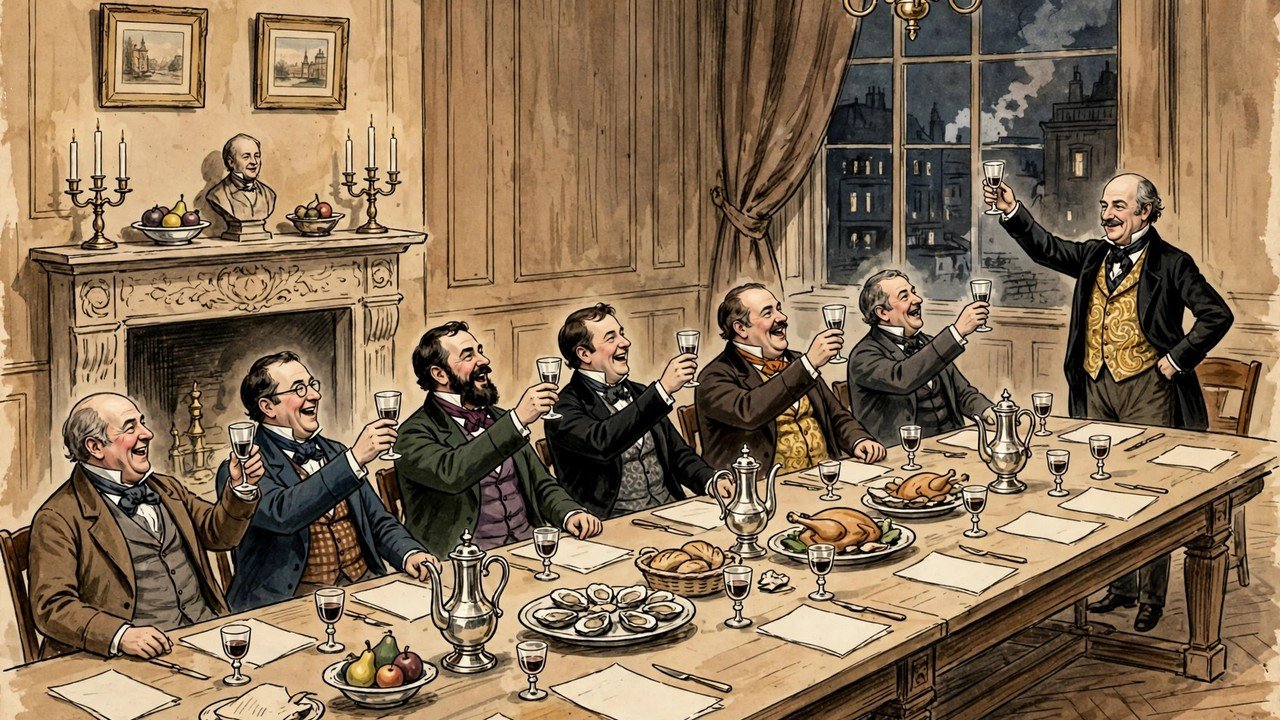
The Anglo-Bengalee did not begin, in Dickens’s account in Chapter 27, as a small concern that grew. It presented itself as already grown. Dickens’s sentence is exact: “The Anglo-Bengalee Disinterested Loan and Life Assurance Company started into existence one morning, not an Infant Institution, but a Grown-up Company.”1 The distinction matters because of what a customer is allowed to ask. An infant institution may reasonably be questioned about its capital, its reserves and its prospects, because it admits to being at the beginning of its life. A grown-up company, arriving complete with offices, staff, printed circulars and a chairman in Pall Mall, invites a different response. Its completeness is offered as the answer to questions that have not yet been asked. A fraud has a particular reason to purchase that appearance at the outset, because it has no past with which to replace it.
The company’s past, insofar as it had one, was kept in the cab in which Montague and his secretary drove through London at the opening of Chapter 27, laughing about it. The chairman was the former Montague Tigg, companion of Chevy Slyme, now reversed in name and rebuilt in dress: jet-black hair, a flowered waistcoat, chains, jewels and rings. Dickens’s verdict on the transformation runs: “though no longer Montague Tigg, but Tigg Montague; still it was Tigg; the same Satanic, gallant, military Tigg.”1 Beside him sat David Crimple, the secretary and resident director, formerly David the tapster, a man associated in his earlier life with pawnbroking and the sign of the golden balls. Dickens notes, of Crimple’s name itself, that it had required alteration: “This gentleman’s name, by the way, had been originally Crimp.”1 Crimp carried an awkward construction; Crimple sounded like a secretary. The renaming of the men and the founding of the company are the same operation at different scales. Tigg becomes Montague by reversal, Crimp becomes Crimple by softening, and a concern with no capital becomes the Anglo-Bengalee by proclamation. In each case the surface is adjusted until it produces the required impression, and in each case the material underneath is unchanged. Montague’s own account of his gift, given in the same chapter, is a rise without substance underneath it: “I rise with circumstances, David. That’s a point of genius in itself.”1 Dickens’s narrator puts the same ascent in colder language: “peculating on a grander scale, he had become a grander man altogether.”1
The conversation in the cab establishes what the material underneath consisted of. Crimple’s salary as secretary was eight hundred pounds a year, with house-rent, coals and candles free, and he held twenty-five shares in the concern.1 Those are substantial terms for the officer of a company whose capital, when the two men turn to it, dissolves into a joke about typography. Dickens gives the exchange in Chapter 27: “What will be the paid up capital, according to the next prospectus?” / “A figure of two, and as many oughts after it as the printer can get into the same line.”1 The joke is precise about the mechanism it exposes. The capital of the Anglo-Bengalee was not a sum of money held somewhere and available to meet claims. It was a figure to be printed, and its size was limited not by assets but by the width of a line. A prospectus, in such hands, is not a report on a financial position. It is a piece of scenery with numbers on it. The men who wrote it knew that most readers would treat a printed figure as a verified figure, because print carries an authority that speech does not, and because a reader who doubts a printed figure must undertake the labour of finding the real one, which in 1844, before substantive regulation of life assurance companies, there was often no ready means of doing.
The Bengal property performed the same function at a greater distance. In the cab, Montague and Crimple joke about the chairman’s fictitious property in Bengal, held out as amenable to all claims upon the company, and about a preserve of tigers alone being worth a mint of money.1 Bengal was far enough away to be uncheckable by a London customer in the course of an afternoon’s business, and grand enough, as part of the British imperial world, to suggest estates, revenues and connections on a scale that a City office alone could not imply. The company’s name made the same claim in compressed form every time it was spoken or printed. A customer dealing with the Anglo-Bengalee was invited to feel that behind the office stood not merely the men in the office, but a geography: property overseas, interests in India, a field of operations too large for a swindle of the ordinary kind. Nothing in that invitation required the property to exist. It required only that the customer could not conveniently establish that it did not.
The offices themselves were arranged to close the remaining distance between claim and belief. Dickens’s Chapter 27 inventory is detailed because the detail is the argument. There was a branch establishment over a tailor’s shop in the West End, placing the company within reach of fashionable custom. The main City offices were finished in stucco and plate glass. Wire blinds carried the name Anglo-Bengalee worked into them, so that even the means of softening the light in the rooms advertised the concern. A brass plate at the entrance gave the name the permanence of metal. Inside were green ledgers, iron safes, marble chimney-pieces and Turkey carpet. The company name was painted on the very coal-scuttles. It appeared on the letter paper, on the seal, and on the buttons of the porter’s uniform.1 Each item in the inventory does a particular piece of work. Stucco and plate glass place the firm in the architecture of established commerce. Green ledgers suggest accounts kept over years. Iron safes suggest valuables held and guarded. Marble suggests money spent by people who expect to remain. A seal suggests legal personality. Letter paper suggests correspondence with a world of other substantial firms. Even the coal-scuttles are enlisted, because a concern that paints its name on a coal-scuttle is presenting itself as a concern so completely established that its identity extends to the least of its furnishings.
Criminologists who study corporate financial crime have a term for this arrangement: ostensible legitimacy. In the account given by Nicholas Lord and his co-authors, otherwise legitimate corporate structures, offices and professional arrangements create an appearance of legitimacy that does real work for offenders, giving them spatial separation from their victims, making criminal behaviour appear common and routine within ordinary occupational practice, and providing concealment under a superficial appearance of straightforward dealing.9 The Anglo-Bengalee is a literary demonstration of the principle long before the term was coined. The offices separate the taking of money from any visible act of taking. Premiums are received across a counter, entered in a ledger, acknowledged on printed paper and placed, in imagination if not in fact, in an iron safe. Nothing in the customer’s experience resembles theft. The routine of the office – the porter at the door, the clerk at the desk, the secretary in his room, the chairman in the board-room – converts each transaction into an ordinary piece of business, indistinguishable in form from the transactions of a sound company down the street. That indistinguishability is the product being manufactured. The policies and loans are what the company sells. Respectability is what it makes.
At the door of that manufacture stood Mr Bullamy, the porter, and Dickens gives him an importance that a merely comic reading of the novel can miss. Bullamy was a large man in a vast red waistcoat, a pepper-and-salt coat and a glazed hat, whose duties included crying out to clear a way for the chairman – room for the chairman, by your leave there – and serving in the board-room. His waistcoat is the subject of one of the most exact sentences in the chapter: “Respectability, competence, property in Bengal or anywhere else, responsibility to any amount on the part of the company that employed him, were all expressed in that one garment.”1 Dickens then records the commercial effect. Clients who came intending to insure for a thousand pounds doubled the sum to two thousand after looking at Bullamy.1 The doubling is the whole theory of the office in a single transaction. No new information about the company’s capital, reserves or claims record had been supplied between the customer’s arrival and his decision to double his policy. What had been supplied was an impression, carried by a porter’s chest, and the impression was sufficient to double the money committed. The Financial Conduct Authority’s catalogue of investment-fraud tactics includes the use of convincing literature and an authoritative presentation as a means of establishing false authority, distinct from any real authorisation or substance behind it.10 Bullamy’s waistcoat is false authority made textile. It is also, in the strictest sense, the most productive asset the company possessed, since unlike the Bengal property it demonstrably produced income.
Bullamy’s other characteristic completes the design. He believed in the company, or seemed to, and he had, in Dickens’s account, nothing whatever to do and something less to take care of.1 A porter who knows nothing cannot betray anything, and a porter who believes what his waistcoat proclaims is a better advertisement than one who merely wears it. The arrangement recurs throughout the firm’s staffing. The people placed where customers could see them were chosen for the impression they made, not for any check they might exercise on the concern. When the company collapsed, as Chapter 51 records, it was Crimple and Bullamy who fled together: “The exposure of the Assurance office; the flight of Crimple and Bullamy with the plunder.”1 The waistcoat, in the end, left with the money. Whether Bullamy had been a dupe who took his opportunity at the collapse or a confederate throughout, Dickens does not pause to settle, and the uncertainty is itself instructive. A front-of-house figure in such a concern is valuable precisely because his knowledge cannot be determined from his manner. Belief and performance look identical from the customer’s side of the door.
The board-room, at the top of the office, was furnished to the same standard and staffed to a smaller one. It had a Turkey carpet and a portrait of Tigg Montague as chairman, presiding in paint over the deliberations beneath it. It had an ivory hammer and a hand-bell, the instruments by which a chairman calls a board to order and gives its decisions the sound of procedure. The board itself, when Dickens assembles it, consists of Montague, Crimple and Bullamy behind the chairman. Dickens’s sentence is flat: “This was the board: everything else being a light-hearted little fiction.”1 The fiction was light-hearted only inside the room. Outside it, the existence of a board performed serious work. A board implies deliberation, oversight and the mutual checking of one substantial man by others. It implies that decisions about other people’s money are taken by a body that can be held to account as a body. Customers and prospective directors who heard of the board of the Anglo-Bengalee were entitled to imagine a table surrounded by men of property. What they would have found, had the door been opened to them at the wrong moment, was the chairman, his secretary and his porter, with lunch being brought in.
Crimple’s part in the firm explains how the fiction was maintained from day to day. Montague, in his own division of labour, took the ornamental department: the dinners, the interviews, the chairman’s presence, the performance of magnificence. Crimple did the plain work – the figures, the books, the circulars and the advertisements.1 That plain work was the company’s continuous output. The circulars, drafted by the secretary, invited the public’s attention to the concern not once but repeatedly: “It is repeated twenty times in every circular and public notice wherein one David Crimple, Esquire, Secretary and resident Director, takes the liberty of inviting your attention.”1 The substance of the invitation, as Crimple framed it, was an offer no solvent company could make in earnest: a perpetual Christmas box and a constantly increasing bonus, from a concern which in its great liberality was pretty sure to lose.1 The wording deserves attention because it inverts the normal logic of assurance advertising. A sound office promises prudence, reserves and careful selection of lives, because its ability to pay claims in thirty years depends on those qualities now. The Anglo-Bengalee promised liberality to the point of loss, because its ability to collect premiums now depended on customers believing that money would flow towards them without the usual conditions. A promise that a company will lose money on its customers’ behalf is, examined coldly, a promise that it will either break its word or break itself. Unexamined, in a circular, under a brass plate, beside an iron safe, it reads as generosity.
Mr Jobling, the medical officer, occupied the one position in the office that ought to have interrupted this flow, and his conduct shows how a professional check is converted into a sales channel. Jobling had a medical practice of his own and a connection, already noted, with the Chuzzlewit family, having followed Anthony to the grave. For the Anglo-Bengalee he examined the lives proposed for assurance. He also steered his own patients towards the company and took commission on the policies that resulted, while professing ignorance of the company’s capital.1 The combination of functions destroys each of them. A medical officer who profits from the acceptance of a life cannot be trusted to report adversely on it. A medical officer who disclaims knowledge of the company’s finances cannot reassure an applicant about the company’s ability to pay. And an examination conducted for a company that will accept lives of whatever kind they are – Dickens’s phrase for the Anglo-Bengalee’s practice in Chapter 27 is that “whatever kind of lives they were, the Anglo-Bengalee would accept them readily”1 – is not an examination at all. It is a ceremony performed so that the file can show that a ceremony took place. The customer who had been examined could feel that a professional standard had been applied to him. The company, which intended to apply none, obtained the benefit of his feeling at the cost of Jobling’s commission.
Lunch in the board-room, at which Jobling joined Montague and Crimple on the day Jonas was brought in, belongs to the same system as the examinations. Business in the Anglo-Bengalee was transacted in an atmosphere of feeding. Men who have eaten and drunk together at a company’s table are less inclined to treat the company as an object of suspicion, and the company’s officers understood the management of that inclination as part of their work. The fullest demonstration came away from the office, in Chapter 28, at the dinner in Montague’s Pall Mall lodgings to which Jonas was invited the day after his first interview. The lodgings were splendid. The dinner was splendid. Present, besides Montague, Crimple and Jobling, were two men whose function Dickens identifies by their professions and their conversation: Mr Wolf, a literary man, and Mr Pip, a theatrical man, men of the world whose name-dropping of lords and dukes formed part of the set-dressing.1 Wolf and Pip were not there to discuss assurance. They were there to establish, by casual reference, the altitude of the company Jonas was being invited to keep. A chairman whose dinner guests drop the names of dukes is a chairman connected at a level where failure seems socially impossible. Social proof, in the persuasion literature, is the tendency to treat the conduct and apparent choices of others as evidence for one’s own decision, and it operates with particular force when the others are presented as people of standing whose judgement one would wish to share.8 Wolf and Pip supplied social proof as a dinner service. Their conversation was the evidence, and it cost the company the price of two dinners.
Montague’s explanation of his own magnificence, given to Jonas at that dinner, is the most candid statement of the theatre’s economics in the novel. The splendour, he told Jonas, was his common style, and one member of a company had to spend in that manner in order to hold the connection together.1 The connection – the network of introductions, dinners, patients, borrowers and prospective directors through which new money reached the office – did not maintain itself. It had to be fed, clothed and entertained, and the chairman’s establishment was the instrument by which it was held. Expenditure that would be evidence of recklessness in the manager of a sound company was, in Montague’s account, an investment in the only asset his company truly cultivated: the continued belief of the people who supplied its income. The account is candid because Jonas was by then being treated as an insider, and because Montague judged, correctly, that candour about the theatre would not break its spell on a man who hoped to profit from the performances. The dinner was therefore an examination as real as any Jobling conducted, though of the opposite kind. Jobling’s examinations pretended to test lives and passed them all. The Pall Mall dinner genuinely tested Jonas – his appetite for flattery, his tolerance for candour about fraud, his desire for the title that was coming – and he passed it on every count.
The forms completed what the offices, the porter and the dinners began. When Montague explained the loan business to Jonas in Chapter 27, he did so with printed forms snatched from the table, acting out the progress of the borrower B through the company’s machinery: the proposal, the two securities, the bond, the insurances, the charges.3 The performance shows paperwork in its double character. To the borrower, each form was a step in a process that appeared to have rules, stages and officers responsible for each stage. A process with forms looks governed. A charge with a printed name looks authorised. An inquiry with a fee attached looks thorough. Yet every form in Montague’s hands described a transfer of money or risk from B to the company, and none of them described any corresponding accumulation of reserves by the company against the promises it was issuing. Campbell’s summary of the company’s position is that it essentially had no reserves.3 The paperwork was complete and the reserves were absent, and the completeness of the paperwork was one of the means by which the absence of the reserves went unnoticed. A customer shown a bond, a policy, a receipt and a prospectus has been shown four documents. He has not been shown any money, but the documents occupy the place in his mind where evidence of money would go.
The inquiry system, which might appear to be the company’s safeguard against bad lives and bad borrowers, was staffed by Mr Nadgett, and Nadgett’s employment shows the office’s final inversion. He was, in Chapter 27’s introduction of him, the man at a pound a week who made the inquiries.6 The Victorian Web’s page on the Eytinge illustration of Nadgett quotes Dickens’s description of him – “He was born to be a secret. He was a short, dried-up, withered old man, who seemed to have secreted his very blood.”1 – and identifies him as one of Dickens’s first detectives, employed by Montague.6 Inquiries, in the Anglo-Bengalee’s practice, were charged to the borrower whether he was accepted or not, so that even a refusal produced income.3 And the most consequential inquiries Nadgett ever made for the company were not into a borrower’s securities or a life’s health. They were into Jonas Chuzzlewit, a director of the company itself, and their product was not a report to the board but a set of numbered memoranda delivered privately to the chairman in Chapter 38, as the basis for blackmail.11 The office thus contained, behind its green ledgers and iron safes, a complete apparatus for appearing to investigate while actually extracting: Jobling’s examinations that accepted every life, Crimple’s circulars that promised liberality to the point of loss, Montague’s forms that multiplied charges at every stage, and Nadgett’s inquiries that charged the inquired-after and armed the chairman. Every department performed the outward shape of a safeguard. Every department, examined by its incentives, was a toll point.
That interior is a sequence, and the sequence is the reason the Anglo-Bengalee remains recognisable long after the furniture of a Victorian assurance office has become antique. A visitor’s doubt was met at the door by Bullamy, in the office by the ledgers and safes, in the board-room by the portrait and the bell, in the examination room by Jobling’s professional manner, and at dinner by the names of dukes. By the time a visitor reached the point of signing, he had not investigated the company. He had been conducted through it, and the conducting was the investigation he mistook for his own.
The founding, as Dickens stages it in the cab in Chapter 27, was an argument about credit for the idea — the closest thing the company ever had to a minute of its first board meeting. Crimple’s claim was modest: he had saved a few pounds, Montague had come into a few pounds, and it was Crimple who said that if they put the money together they could furnish an office and make a show. Montague did not dispute the pounds; he disputed the idea. His contribution was the scale: provided they did it on a sufficiently large scale, they could furnish an office and make a show without any money at all. Crimple conceded, and accepted a departmental settlement. The plain work — “figures, books, circulars, advertisements, pen, ink, and paper, sealing-wax and wafers” — was Crimple’s, a first-rate groveller’s. The ornamental department, “the inventive and poetical department”, was Montague’s entirely. The two had been made acquainted across the counter of their common uncle, the pawnbroker. The company that would invite the public to trust it with lives and loans was thus, by its founders’ own account, a partnership formed over a pawnbroker’s counter, capitalised by two small sums, and then re-founded on the discovery that at a sufficiently large scale the sums were unnecessary.1
The offices were fitted to conceal exactly that. Everything was new — newly plastered, painted, papered, countered, floor-clothed, tabled, chaired, fitted up in every way, with goods substantial and expensive and designed, like the company, to last. A real institution’s rooms accumulate furniture across years of trading; these had to suggest the years without having had them, so the suggestion was bought in bulk: green ledgers with red backs, likened to strong cricket-balls beaten flat; court guides, directories, day-books, almanacks, letter-boxes, weighing-machines for letters; rows of fire-buckets for saving the immense wealth in notes and bonds belonging to the company — wealth that existed chiefly as a reason for owning fire-buckets; a clock; the office seal, in its capacious self security for anything; and a brass plate kept very bright, as courting inquiry, looking bolder than the Bank. Lest any visitor still doubt Tigg Montague of Pall Mall and Bengal, or any other name in what Dickens calls, in passing, the imaginative List of Directors, there was the porter.1 The adjective deserves stopping on: the List of Directors was not trimmed or padded but imaginative, a work of the inventive department itself.
Bullamy’s engagement followed the same principle as the capital: nothing was verified, because verification was not the point of him. No confidences existed between him and the directorship; nobody knew where he had served last; no character or explanation had been given or required, and no questions asked on either side. Relying solely on his figure, he had applied and been instantly engaged on his own terms, which were high — he knew no man could carry such an extent of waistcoat as himself. Rival offices had tried to lure him away; Lombard Street itself had beckoned. In the office he sat in a corner on a seat erected for him, his glazed hat on a peg above his head, grave with imaginary cares. Behind him the board-room table was set at intervals with blotting-paper, foolscap, clean pens and inkstands. And the theatre had its audience built in: at both openings of the board-room door, the simple clients in the public office stretched their necks and stood on tiptoe, thirsting to catch the slightest glimpse of that mysterious chamber. A customer who has stood on tiptoe to see into a board-room has already accepted that what happens inside it is above him; he does not afterwards ask for its minutes.1
Dickens then gives, at length, the form of words in which that saying was done — the company’s most effective selling scene, set nowhere near its offices. His information about the Anglo-Bengalee, the patient is told, is limited, very limited; he is medical officer for a certain monthly payment — the labourer is worthy of his hire, bis dat qui cito dat — receives it regularly, and is bound, so far as his knowledge goes, to speak well of the establishment. Any question touching the responsibility or capital of the company finds him at fault: no head for figures, and, not being a shareholder, delicate of showing curiosity — delicacy, the patient’s amiable lady will agree, being a first characteristic of a medical man. Then, disclaimers complete, the payload, delivered as personal knowledge rather than advice: the patient doesn’t know Mr Montague — Jobling is sorry for it — a remarkably handsome man, quite the gentleman; property, he is told, in India; house and furniture beautiful, costly, lavish. And should the patient ever think of doing anything with the company, Jobling will pass him, he may depend upon it; he can conscientiously report him a healthy subject. The capital question declined on grounds of delicacy, the Bengal property repeated as hearsay that sounds like testimony, the chairman’s furniture offered as evidence, and a medical pass promised in advance of any examination — carried into a sick-room by the one professional the patient already trusts, at no cost to the company beyond a monthly payment and a commission its recipient protests he has no right to draw.1
The selling of Jonas, in the interview after lunch, is a sequence of small tests, failed in an order Dickens preserves. Jonas begins uncommitted: a question or two and a document or two to consider of bind him to nothing. He will not take wine over business — “All very well for you, but it wouldn’t do for me” — and Montague, leering through half-shut eyes, compliments him as an old hand, which Jonas receives as his due. Twice Montague polices his vocabulary. “The truth is—” is interrupted: don’t say the truth, it’s so like humbug. Reaching for the word again over security, Jonas is stopped by the jewelled hand: don’t use that Sunday School expression, please. A recruit who has agreed, as a matter of style between men of the world, not to use the word truth in the chairman’s room has surrendered the only vocabulary in which the interview could have gone the other way. What he has come for then emerges: he has got married, rather green, especially as she is young; one never knows what may happen to these women; he is thinking of insuring her life, as a consolation in case of such a loss; and here he could do it cheap, and easy, without bothering her about it. He has been, besides, not very well used by one or two of the old companies, which started objections they had no right to start and put questions they had no right to put. The old companies had asked questions about a secret insurance on a young wife’s life. The Anglo-Bengalee’s competitive advantage, stated by its prospective customer in its own board-room, was that it would not.1
The question of security is raised once, and Dickens shows how it dies. “The long and the short of it is, what’s the security?” Montague refers to papers on the table — the paid-up capital, at this present moment, is — and Jonas stops him: oh, he understands all about paid-up capitals. “You do?” cries Montague, and turns the papers down again. The prospectus figure, a joke about a printer’s line in the cab, is withdrawn altogether, because the customer has announced he is too knowing to need it. In its place, the window. Jonas is beckoned to it and told that Montague can tell how many of the crowd below will come in here merely because they find this office here, knowing no more about it than they do of the Pyramids; will buy annuities, effect insurances, bring their money in a hundred shapes, force it upon the company, trust it as if it were the Mint, yet know no more about it than Jonas does of the crossing-sweeper at the corner — not so much. That is the only statement of security Jonas ever receives, and on inspection it states that there is none: the security for the concern’s going on is the continued arrival of people who know nothing about it. Jonas gradually breaks into a smile.1
The performance with the printed forms follows — B, the little tradesman, clerk, parson, artist or author, proposing himself and two securities, insuring his own life for double the loan and bringing two friends’ lives also, just to patronise the office. The company also grants annuities on the lowest terms known; the old ladies and gentlemen down in the country buy them; it pays them too — perhaps. Jonas raises the one actuarial objection in the chapter: all very well while the office is young, but when the policies begin to fall in, when they begin to die? Montague answers with the company’s only recorded encounter with its liabilities. A couple of unlucky deaths at the first start brought them down to a grand piano: he raised money on every other piece of property and was left alone with a grand piano — an upright-grand too, so he couldn’t even sit upon it. They got over it by granting a great many new policies that week, with a liberal allowance to solicitors. And when policies should fall in heavily, one of these days, then — the sentence finished in so low a whisper that only one word is audible, imperfectly: it sounds like “Bolt”. Jonas’s verdict is admiration: “Why, you’re as bold as brass!” He leaves carrying the documents, shown out by Bullamy crying “Gentleman from the board-room, by your leave!” He has asked for the security and been shown a street; he has raised the dying policyholders and been told, in a whisper, the company’s terminal policy. He dines with the chairman next day.1 Campbell’s itemisation of what the forms did to B, and her summary that the concern essentially had no reserves, describe the machine;3 the interview shows the prior fact — the absence was disclosed in substance to the man who joined anyway, and disclosure was not an obstacle to the sale but the substance of it.
The Pall Mall dinner completes the induction by the opposite method: where the interview flattered Jonas’s depth, the dinner flatters his consequence. He arrives determined to observe the gentility of the establishment keenly — it not occurring to him that Montague wanted him to, or would not have invited him while his decision was in abeyance. Bailey answers the door and recognises him: “the hold name, I suppose?” — from Mrs Todgers’s, where Bailey took his name up to the young ladies when he came a-courting; a reg’lar scaly old shop, times are changed, and how he’s growed. The recognition stands, with a private wink, because it does the evening’s first work: the guest’s shabby recent past is known in this house, treated as a pleasantry, and priced at nothing. At table, seated between host and doctor, Jonas is in the midst of calculating the value of the plate alone when Montague disturbs him with wine. The two men of the world perform their repertoire in rotation: Wolf’s Lord Nobley, who would, strike him blind, have made a parson of Wolf had Wolf been brought up at the University, there being a living to bestow; Pip’s Duke, appealing to Pip — “Here’s Pip. Ask Pip. Pip’s our mutual friend” — on whether she is bandy or not bandy, and Pip pronouncing “Bandy, your Grace, by the Lord Harry!”; later, Pip’s Viscount denouncing Shakespeare as an infernal humbug, a lot of feet in his verse but no legs in his plays. Jobling, whispering behind his hand, supplies the captions: Wolf, literary character, remarkably clever weekly paper; Pip, theatrical man, capital man to know; men of the world — to a professional person quite refreshing, philosophically improving, character. Dickens’s summary of the material is exact: the least of their stories had a colonel in it, lords were as plentiful as oaths, and even the Blood Royal ran in the muddy channel of their personal recollections.1
Against that accompaniment the host conducts the real business in asides. Does Jonas do this every day? — no: Montague does, every day of his life when he dines at home; this is the common style; Crimple had proposed a party, and Montague refused — he shall take us in the rough. Then the proposition in final form: when Jonas joins them he needn’t spend his share of the profits so; one of a company must do it to hold the connection together, and since Montague takes pleasure in it, that is his department; Jonas doesn’t mind dining expensively at another man’s expense? Not a bit. The flattery is then made public: Montague announces a splendid little trait of his friend Chuzzlewit, the deepest dog he knows — his sacred word of honour, the deepest dog he knows — and the anecdote is received with loud applause as incontestable proof of Jonas’s greatness. Jonas responds by exhibiting himself, displaying the depth he has been complimented on at his entertainer’s expense, ridiculing, while he drinks the wines, the extravagance that set the fare before him. Dickens’s sentence is the dinner’s verdict: Tigg and Crimple, studying to understand their man thoroughly, gave him what licence he chose, knowing the more he took the better for their purpose; while the blundering cheat — gull that he was, for all his cunning — thought himself rolled up hedgehog fashion, sharpest points towards them, he was betraying all his vulnerable parts to their unwinking watchfulness. After coffee Jonas appraises the furniture aloud — whether such an article was paid for, what it originally cost — considering himself desperately hard on Montague. Champagne punch ends in the unsteady departure of the gentlemen of the world and the slumber of Mr Jonas on a sofa; it is almost three in the morning before Bailey is ordered to take him home. Over the sleeping guest the partners hold the company’s shortest board meeting. “Is he hooked, do you think?” whispers Crimple. “Aye!” says Tigg. “With a strong iron, perhaps.” The chairman then asks, in the same breath, whether Nadgett has been there that night. He has; hearing there was company, he went away, and will return early, before Montague is out of bed. “Tell them to be sure and send him up to my bedside.” The dinner that recruited the director and the inquiry that would be set on him are transacted over the same sofa, and the second is arranged before the first has been cleared away.1
Disinterested – the lie in the title
The first thing the Anglo-Bengalee sold was its name. Before a customer had seen a prospectus, met the porter, been examined by the medical officer or been conducted into the board-room, the name had already done work on him. It stood on the brass plate at the entrance. It was worked into the wire blinds. It was painted on the coal-scuttles, printed on the letter paper, stamped on the seal and repeated, as Dickens notes in Chapter 27, in the company’s own publicity: “It is repeated twenty times in every circular and public notice wherein one David Crimple, Esquire, Secretary and resident Director, takes the liberty of inviting your attention.”1 Repetition of that kind is not identification. A name needs to appear once on a door to identify the firm behind it. It appears twenty times in a circular, and on objects as unlikely as a coal-scuttle, to make the firm seem established by the sheer accumulation of its own lettering, as if a concern that could afford to put its name everywhere must have something behind the name. The name was the cheapest part of the establishment to produce. It cost no capital, required no reserves and could be enlarged without limit. It was also, for most people who encountered the company, the only part of it they ever examined.
Dickens gives the full name its full weight whenever the joke requires it. In Chapter 27 the chairman introduces his own creation to his secretary in the form in which the public was meant to receive it: “The Anglo-Bengalee Disinterested Loan and Life Assurance Company is rather a capital concern, I hope, David.”1 The sentence is spoken in a cab, between the two men who know that there is no capital behind it, and the comedy depends on the distance between the length of the name and the emptiness of the thing named. A few pages later Dickens uses the full form again for the company’s birth: “The Anglo-Bengalee Disinterested Loan and Life Assurance Company started into existence one morning, not an Infant Institution, but a Grown-up Company.”1 The name arrives complete, like the company, with no period of growth behind it. Taken word by word, it is not a description of a business. It is a sequence of claims, each of which asks to be granted before it is tested, and each of which covers a weakness in the part that follows it.
Anglo-Bengalee comes first, and it claims geography. Anglo places the firm at home: English, domestic, governed by the expectations an English customer brought to an English office in the City of London. Bengalee places it abroad: in Bengal, in India, in the imperial world from which fortunes, appointments, remittances and returns were understood to flow. Yoked together with a hyphen, the two words claim that the firm is at home in both places at once. It is not a London office hoping for Indian business, nor an Indian speculation looking for London money. In the name, the connection is already made, the distance already bridged, the empire already turned into a field of operations over which this one company ranges. That is a market and a mystique in two words. The market is literal enough. Bengal suggested trade, land, revenue, military and civil employment, and the movement of money between Britain and India that passed through agents, insurers and lenders in London. The mystique is larger and less checkable. Bengal suggested scale. A firm whose name reached to Bengal could not, the name implied, be a petty swindle conducted from a single room, because a petty swindle would not need, or dare, so large a geography.
The implication was useful precisely because a London customer could not test it. He could visit the City office and look at the ledgers, the safes and the marble chimney-pieces. He could not visit Bengal, inspect the chairman’s property there, examine its title or ask its tenants what rent they paid. In the cab in Chapter 27, Montague and Crimple joke between themselves about that property, held out as answerable for claims upon the company, and about a preserve of tigers alone being worth a mint of money. The joke is private because the property is fictitious. Distance converts an assertion into something that feels like knowledge. A property in the next street can be looked at. A property in Bengal must be believed, and the company arranged matters so that believing it felt reasonable, because the name, the office and the chairman’s manner all pointed in the same direction. Borrowed geography does the work of borrowed capital. The empire lends the firm its size, and the firm repays the loan in nothing but lettering.
Anglo-Bengalee also normalises risk by dressing it as reach. Business connected with India carried hazards a domestic office did not carry in the same form: distance, delay, imperfect information and the difficulty of checking a representation across an ocean. A name that put Bengal in the title did not warn the customer about those hazards. It converted them into evidence of enterprise, and ambition could be mistaken for competence. Dickens plants the warning in the name itself: a home assurance concern renamed for a colony is advertising that it deals in the kind of business where representations are hardest to verify. Inside the firm, the name was a joke about invention. Campbell, the actuary who has written on Dickens and business fraud for the Society of Actuaries, records the insiders tittering over the name itself.3 The men who invented Anglo-Bengalee knew it was a coinage. The men who read it on a blind were invited to treat it as a fact of commercial geography.
Disinterested comes next, in the middle of the name, where it governs everything on either side of it. Anglo-Bengalee tells the customer where the company supposedly operates. Disinterested tells him how it supposedly operates: without a stake of its own, without favour, without an interest that could bend its dealing with him. Of the words in the title, it is the only one that describes a moral quality rather than a place or a trade, and it is placed where a reader cannot reach the trades named after it without passing through the virtue first. By the time the eye arrives at Loan and Life Assurance, it has already been instructed to trust the lender and the insurer. The instruction has not been argued. It has been inserted into the name of the party it describes, by that party itself, at that party’s expense, for that party’s benefit. That circularity is the lie in its simplest form. A claim to have no interest, made by the person who will profit if the claim is believed, is itself an interested claim.
To hear the word as Dickens’s first readers heard it, it has to be rescued from its modern looseness. Disinterested in 1844 did not mean uninterested. It did not mean bored, indifferent or paying no attention. It meant the opposite of interested in the legal and commercial sense: not having an interest in the matter, standing to gain nothing from one outcome rather than another, and therefore able to judge or deal impartially. An interested witness was a witness with something at stake in the case. An interested party to a contract was a party who stood to benefit from it. A disinterested person was valuable precisely because his advice, his valuation or his judgement could be taken as unbiased by profit. The distinction survives in careful modern usage, but in the commercial world of the 1840s it carried a sharper, almost technical edge, because so much of business depended on knowing whose interest lay behind a recommendation. To call a man disinterested was to say that the usual question – what does he get out of this? – had, in his case, an empty answer.
Set in the title of a loan and life assurance company, the word therefore makes a specific and extravagant promise. A lender is interested by definition. He charges interest, takes security, and profits when the borrower pays and when, on default, the security can be called in. An assurance office is interested by definition. It collects premiums, sets the terms on which it will pay, and retains what it does not pay out. Neither trade can be carried on by a party with no stake in the outcome, and no customer who thought for a moment about how either trade earned its money could suppose otherwise. Dickens does not, however, put a merely impossible word in the title. He puts an impossible word that points in the opposite direction from the truth. The Anglo-Bengalee was not simply a company with the ordinary, declared interests of a lender and an insurer, openly set out in its rates and its policy conditions so that a customer could price them. It was a company whose whole business, as its chairman explained it to an insider, consisted in multiplying its interests at every stage of a transaction while presenting each multiplication as a separate, necessary charge. Campbell’s summary of that explanation gives the borrower, B, paying interest on his loan, the premium on his own life, the premiums on the lives of two friends he was required to bring in, a charge for the bond, a charge for inquiries whether he was accepted or not, and a further small charge for the secretary.3 That is not a failure to be disinterested in some abstract, saintly sense. It is interestedness systematised, itemised and charged for, under a title that denies that any interest exists.
The private motto of the firm, as Campbell quotes its chairman and secretary agreeing between themselves, was care for number one.3 Dickens’s own version of the same admission, made by Montague to Jonas in Chapter 27 when Jonas is being drawn inside, is blunter and more general: “We companies are all birds of prey; mere birds of prey.”1 The two statements belong together. Number one is the interest. Birds of prey is the method. Disinterested is the word placed on the door to prevent the customer from applying either statement to the firm he is entering. It matters that Montague makes the admission only to a man he is recruiting, and that he makes it as a form of flattery, as an invitation to stand on the preying side of the counter: “Why don’t you take premiums, instead of paying ’em? That’s what a man like you should do. Join us!”1 To the public, the company is disinterested. To the initiate, it is a bird of prey offering him a share of the taking. The virtue word and the predatory admission are not two descriptions that happen to conflict. They are two instruments aimed at two audiences, and the success of each depends on the other audience not hearing it. A customer who had heard the birds-of-prey speech would have read Disinterested on the brass plate as a warning. A customer who had only read the brass plate arrived at the office already disposed to hear everything that followed – the porter’s bulk, the secretary’s circulars, the medical officer’s manner, the chairman’s dinner – as the conduct of a firm that had declared itself to have no axe to grind.
That advance disposal is why Dickens put the virtue word in the title rather than in a speech, a circular or a prospectus alone. A claim made in a speech can be answered. A claim made in a prospectus can be compared, at least in principle, with accounts. A claim made in a name is not presented as a claim at all. It is presented as the identity of the claimant, and it is repeated every time the firm is referred to, written to, written about or written on an envelope, by customers and clerks and newspapers as well as by the firm itself. Every repetition reasserts the virtue without re-arguing it, and every repetition by a third party lends the assertion a borrowed neutrality, as if the word were a fact other people had established rather than a description the firm had awarded itself. Persuasion research describes part of this mechanism under the heading of authority: titles, credentials and expert-sounding language operate as a shortcut, inclining people to defer and to check less than they would check an unsupported claim from an unnamed source.8 A virtue word in a company name works as a credential of character. It does not say that the firm is large, or old, or authorised. It says something more useful to a fraud and harder to falsify in a single question: that the firm’s motives are clean. Once that shortcut has been taken, the burden of proof quietly reverses. The customer who doubts the firm no longer feels that he is asking it to prove an ordinary commercial claim. He feels that he is impugning a quality the firm has already been granted, in its very name, as a settled attribute.
The research on ostensible legitimacy explains why that reversal is so difficult to undo with the evidence available inside the transaction. Lord and his co-authors, writing on the organisation of corporate financial crime, argue that otherwise legitimate corporate structures and arrangements create an appearance of legitimacy that does substantive work: it separates offenders from victims in space, makes offending behaviour appear common and routine within ordinary occupational practice, and provides concealment under a superficial appearance of straightforward dealing.9 The name belongs at the head of that apparatus, before the structures themselves. An office can be inspected and found, on inspection, to be only an office. A board can be counted and found to be three men. A name cannot be inspected at all. It can only be believed or disbelieved, and a firm that has chosen a virtue for its name has chosen the one part of its presentation against which no ledger, safe or Turkey carpet is needed as corroboration, because the name is the lens through which the ledger, safe and carpet will be seen. Ostensible legitimacy usually describes the staging that surrounds a fraud. Disinterested is the staging compressed into a single word and carried, at no further cost, into every room the customer enters afterwards.
A virtue claimed in a name is therefore a claim that has not been tested, and the louder the virtue in the title, the more reason there is to suspect that it is substituting for evidence rather than summarising it. A firm that is impartial in a particular dealing can usually show the arrangement that makes it impartial: a fee paid by one side only and disclosed to both, a decision taken by a person with no share in the outcome, a valuation made under a rule the valuer cannot alter to suit himself. Those are tests. They can be passed or failed. Disinterested, standing alone in a title, offers none of them. It asks to be taken as a character reference that the firm has written for itself, and its position in the name – before Loan, before Life Assurance, before any term, rate or condition is mentioned – ensures that it is taken, if it is taken at all, before any evidence that could test it has been offered. The principle is general and it is severe. When a seller puts a moral quality in the brand rather than in a verifiable term of the contract, the quality should be treated as advertising copy, not as a fact about the seller. The question is never what the title calls the firm. The question is what the fee schedule, the security, the commission and the small print pay the firm to do.
Loan and Life Assurance, the last three words of the name, look at first like the honest part of it. They name two trades, and the company did, after its fashion, carry on both. The dishonesty lies in the yoking. Set side by side in a title, lending and life assurance present themselves as two services a single substantial house can offer a customer in the course of a connected financial life: money advanced when he needs it, protection provided for his family against his death. Each trade borrows respectability from the other. The loan side suggests funds in hand, capital available to be lent, a house with money to dispose of. The assurance side suggests prudence, long views, obligations soberly undertaken and met over decades. A firm that only lent money at high rates to desperate men might be looked at narrowly. A firm that only sold life policies with no visible reserves might be looked at narrowly. A firm that did both, under one roof, behind one brass plate, could present each activity as evidence for the soundness of the other, and could move a customer from one side of the business to the other without his ever leaving the building or encountering a stranger.
In the Anglo-Bengalee’s practice, the movement from one side to the other was not a convenience offered to the customer. It was a condition imposed on him. Montague’s explanation of the loan business, as Campbell summarises it, has the borrower giving a bond with two securities, insuring his own life for double the amount of the loan, and bringing in two friends to insure their lives as well, with interest at the highest lawful rate and charges laid on top of the whole arrangement.3 Follow the money through that sequence and the yoking in the title becomes a mechanism. A man comes in needing fifty or a hundred pounds. He leaves owing interest on the loan, premiums on his own policy, and the consequences of having drawn two friends into policies of their own, while the company holds his bond, his security and a set of premium obligations that will go on presenting themselves for payment after the borrowed money has been spent. The loan is the bait and the hook. The assurance is the line by which the catch is held and hauled further in. What was advertised as two trades is in operation one trade, conducted upon a borrower whose need for the first service is used to compel his purchase of the second, and to compel him to recruit, from among his own acquaintance, further purchasers for it.
Seen from the assurance side, the inversion is just as complete. Life assurance, honestly conducted, begins with a life that someone has a reason to protect and proceeds by careful selection, medical examination and the accumulation of reserves against a claim that may not fall due for many years. The Anglo-Bengalee began with a loan that someone had a reason to need and proceeded by requiring lives to be attached to it. Lives, in that arrangement, are not being protected. They are being harvested. The borrower supplies his own life as a condition of borrowing. His friends supply theirs as a condition of his borrowing succeeding. The office collects premiums on all three, not because three households have separately judged that they need cover, but because one man’s distress has been used as a lever to move three names onto the premium book. Dickens marks the corresponding laxity on the selection side in Chapter 27, in the account of the medical officer’s examinations: “whatever kind of lives they were, the Anglo-Bengalee would accept them readily.”1 A company that accepts every life is not selecting risks. It is collecting premiums, and a company that requires extra lives to be attached to every loan is not responding to a demand for protection. It is manufacturing premium income out of other people’s obligations.
The assurance also performed a service for the loan that had nothing to do with protecting a family. A policy on the borrower’s life for double the sum lent gave the transaction an air of security that the borrower’s own circumstances could not give it. On paper, the lender was covered: if the borrower died, the policy answered. In the customer’s mind, and in the mind of anyone shown the arrangement, the presence of a life policy made the loan look considered, safeguarded, almost institutional, as if a second, prudent business had examined the first and underwritten it. But the second business was the same business, in the same office, under the same chairman, taking its own premiums on its own form. No outside judgement had been applied to the loan at all. The company had insured its own risk with itself, charged the borrower for the insurance, and obtained, from the mere existence of the policy, an appearance of prudence to set against the reality of a borrower who needed fifty pounds and had been loaded with charges until the transaction bore no proportion to the sum he received. Paper security of that kind is a form of the same ostensible legitimacy that furnished the offices: a legitimate instrument, recognisable from honest practice, reproduced inside a dishonest one so that the routine looks common, supervised and safe.9
There is a moral consequence in the yoking that Dickens keeps in view and that the word Assurance works to hide. A loan secured on a life gives the lender an interest in questions that a lender on ordinary security does not face in the same form. The security improves, from the office’s point of view, if the life is a good one, and the office’s entitlement is triggered by the life ending. Honest assurance law and practice had spent generations building fences around exactly that interest, requiring that a policy rest on a genuine interest in the life insured and treating a policy without one as a wager. The Anglo-Bengalee’s model weakened the fences as a matter of routine. Lives were attached to loans because the model required lives, in numbers, as premium-bearing units. Friends were drawn in, in Montague’s phrase as reported in the research on the chapter, just to patronise the office – that is, as a favour extracted by the borrower’s need, not as customers exercising an independent judgement about their own protection.3 Once lives become units in a lending system, the distance between assurance and betting narrows to the width of the form on which the policy is written, and the word Assurance in the title is doing the work of keeping that distance invisible.
Read in order, then, the full name performs the whole fraud in miniature, before a single premium has been collected. Anglo-Bengalee supplies a geography too large to check and too grand to doubt. Disinterested supplies a character too virtuous to question and too vaguely defined to test. Loan and Life Assurance supply two trades, each lending the other an appearance of substance, and yoked together so that a customer entering by one door can be processed by both departments and made to bring his friends in behind him. None of the four elements costs the firm the thing it claims. Geography costs no property. Virtue costs no impartiality. Lending costs no capital of the firm’s own worth naming – when Montague asks his secretary, in Chapter 27, “What will be the paid up capital, according to the next prospectus?”, the answer is a joke about printing: “A figure of two, and as many oughts after it as the printer can get into the same line.”1 Assurance costs no reserves. The name is complete where the company is empty, and it is complete first, in advance of every other part of the persuasion, so that the offices can be read as the premises of the Anglo-Bengalee rather than as rooms hired by Montague Tigg, the dinners as the hospitality of a disinterested house rather than as bait laid by birds of prey, and the forms as the instruments of a loan and life assurance company rather than as a schedule of charges imposed on a man who came in because he was hard up and would do anything. Strip the name away and call the concern by the names of the men who ran it and the capital they actually held, and every later stage of the persuasion would have had to work harder, against questions the title had already answered. That is what a name of this kind is for. It is not the label on the fraud. It is the first transaction in it, and the only one the customer completes without signing anything.
No capital – paying out of what comes in
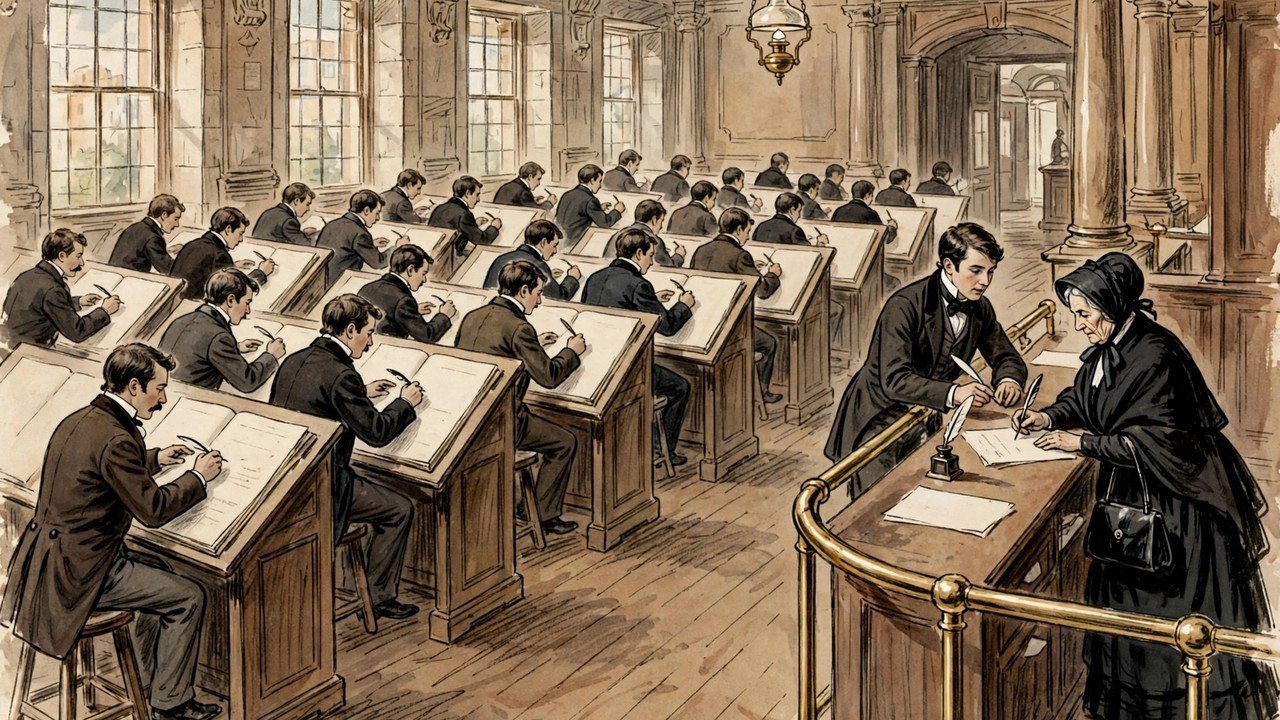
The Anglo-Bengalee Disinterested Loan and Life Assurance Company had a board-room before it had anything else. In Chapter 27 Dickens takes the reader inside it at the moment when the room is supposed to do its work. There is a Turkey carpet. There is a portrait of the chairman, Tigg Montague, on the wall. There is an ivory hammer and a hand-bell for the conduct of business. There are the men who belong in such a room, in the places such men occupy. Then Dickens removes the room’s authority in a single sentence: “This was the board: everything else being a light-hearted little fiction.”1
The board, as a governing body distinct from the chairman, his secretary and his porter, did not exist. Montague, Crimple and Bullamy constituted the whole of it. Everything beyond those three — the implication of other minds watching the money and questioning the chairman — was invented for the visitor to supply from the furniture. A board in a sound company is a control: it can ask where the capital is, refuse a risk, overrule a chairman and require accounts. In the Anglo-Bengalee the word named a stage set with three men in it, two of whom owed their places to the third. Crimple was secretary on a salary Montague had set. Bullamy was the porter. Neither was placed to restrain the man who had placed them there.
That absence matters more than any single false statement in a prospectus, because a prospectus can be checked only if there is someone inside the concern whose business it is to check it. Dickens makes the point by showing what the company’s insiders talk about when no customer is present. Montague and Crimple, alone in the cab on the way to the office, joke about the concern in the language of men who know there is nobody to overhear them who matters. Montague asks, in the tone of a man reciting a familiar catchphrase, “The Anglo-Bengalee Disinterested Loan and Life Assurance Company is rather a capital concern, I hope, David.”1 The pun on “capital” is the confession. A life assurance company lives or dies by its capital and its reserves: money held against promises that may not fall due for decades, calculated against the probability that assured lives will die sooner or later than expected. Without that fund, every promise the company makes is a promise that somebody else, later, will pay for it.
Crimple’s answer, when Montague asks him directly what the paid-up capital will be, gives the figure’s true origin. “What will be the paid up capital, according to the next prospectus?” / “A figure of two, and as many oughts after it as the printer can get into the same line.”1 The capital is not counted. It is typeset. Its limit is not a bank balance but the width of a printed line. Add another nought and the company is ten times richer on paper at no cost except ink. Remove one and it is ten times poorer, though nothing in any strong-room has changed, because there was never anything in a strong-room corresponding to the figure in the first place.
Dickens returns to the same invention when he describes Montague’s supposed property in Bengal, offered to Jonas and to the public as the substance behind the company’s engagements. The tiger preserve, the Indian estate, the distant wealth “amenable to all claims upon the company” — in the cab, between the two men who invented it, it is a joke about tigers. At the office, on paper, it is security. The distance is part of the mechanism. A London customer could in principle walk to a London bank and ask whether a deposit existed. He could not walk to Bengal. Property placed far enough away, in a place the customer knows only from maps and imperial rhetoric, cannot be inspected, valued or seized by him, and that uninspectability is presented as if it were magnitude. The grander and more remote the asset, the less it can be tested, and the more completely the test is replaced by the name.
This is why Dickens insists that the company “started into existence one morning, not an Infant Institution, but a Grown-up Company.”1 A real institution begins small because it must accumulate the thing it trades in: capital subscribed, premiums received and invested, reserves built year by year as policies are written. Its youth is visible in its accounts. The Anglo-Bengalee skips youth altogether. It opens with a West End branch over a tailor’s shop and main City offices in stucco and plate glass, with wire blinds worked with the company name, a brass plate, green ledgers, iron safes, marble chimney-pieces, the name painted on the coal-scuttles, printed on the letter paper, cut into the seal and sewn, in effect, onto the porter’s buttons. Crimple’s circulars repeat the name, in Dickens’s phrase, “twenty times in every circular and public notice wherein one David Crimple, Esquire, Secretary and resident Director, takes the liberty of inviting your attention.”1
The repetition is not vanity. It is a substitute balance sheet. A customer who has seen a name twenty times in one circular, and then on a door, a seal, a ledger and a waistcoat, has received twenty impressions and no information. The impressions accumulate into a feeling of solidity that feels like knowledge and is not. An iron safe in an office implies that something valuable is kept in it. A green ledger implies entries. A marble chimney-piece implies permanence, a firm that expects to warm the same room for years. None of these objects costs anything like the sum their presence helps to collect. They are bought once, or rented with the rooms, and then they go on persuading every visitor who enters, without wages.
Bullamy’s waistcoat is the purest form of the device, and Dickens says so outright. Of that vast red garment he writes: “Respectability, competence, property in Bengal or anywhere else, responsibility to any amount on the part of the company that employed him, were all expressed in that one garment.”1 Clients, the narrative records, doubled the sum they had come in to assure — from one thousand pounds to two thousand — after looking at the porter. Nothing about the company’s ability to pay a claim of two thousand pounds had changed between the door and the desk. Only the customer’s confidence had changed, and confidence, in this office, was manufactured by upholstery.
A company with no capital can still trade, for a time, so long as money comes in faster than it must go out. That interval — between the first premium and the first heavy claim, between the first loan charge and the first default — is the whole life of such a concern, and everything Montague does is designed to widen it at the front and narrow the customer’s view of the back. The income of the Anglo-Bengalee, as Montague himself explains it to Jonas in Chapter 27, does not come from investing a fund at a profit. It comes from the customer, at the moment of his greatest need, in as many separate charges as can be made to sound like separate services.
The customer in the explanation is reduced to a letter. “B” is a small tradesman, a clerk, a parson, an artist, an author — in Montague’s words, any common thing you like — who is hard up and will do anything. B wants to borrow fifty or a hundred pounds. For that accommodation he must give a bond, find two securities, pay the highest lawful interest, insure his own life for double the amount of the loan, and bring in two friends to insure their lives as well. He pays for the bond. He pays for the inquiries made into him, whether he is accepted or not. He pays a charge for the secretary. Premium follows premium, and each premium is money in on the day it is paid against a promise that falls due, if it falls due at all, on some later day that Montague does not intend to be present for.
Strip the Victorian dress from that arrangement and the mechanism is recognisable in the plain definition used by regulators for a Ponzi scheme: an investment fraud that pays existing investors with funds collected from new investors, in which the operators do not in fact invest the money as promised, use it instead to pay those who came in earlier and keep some for themselves, and which, having little or no legitimate earnings, requires a constant flow of new money to survive.12 When it becomes hard to recruit new entrants, or when large numbers of existing entrants demand their money back, such a scheme tends to collapse, because the payments that looked like earnings were never earnings at all.12
Dickens published Martin Chuzzlewit in 1843–44. The scheme-type that carries that later name belongs to the twentieth century. The label is therefore retrospective, and it should be used in this post for the dynamic rather than as a claim that Dickens described a modern securities fraud in every particular. The Anglo-Bengalee was a loan and life assurance company, not an investment fund, and its takings included fees, interest and premiums extracted under colour of ordinary business as well as money subscribed by men like Jonas and Pecksniff. An actuary writing for the Society of Actuaries makes the identification with that qualification in view, calling the concern “just a fancy Ponzi”, with Montague and his partners skimming a percentage for themselves, and noting that the fraud ran deeper than the small policies — that Montague needed larger catches to keep the show running.3 The shared core is exact: no real earnings underneath, early obligations met out of new money coming in, and collapse built into the arithmetic from the first day.
The actuary’s account of the company’s early history gives that arithmetic a concrete shape. Early on, the Anglo-Bengalee had some claims. Claims are the moment a life office discovers whether it is an office or a fiction, because a claim must be paid in cash, at once, to a widow or an executor who will not accept a circular in settlement. Paying those early claims reduced the company, in the actuary’s summary of the novel, to a grand piano — the show nearly stripped to a single piece of furniture — and the concern then built the pyramid up again to the grand edifice Jonas sees when he is brought in.3 Read as finance rather than as comedy, that sentence describes the only way such a firm can survive its first honest moment. It paid, because not paying at the start would have ended it at the start. It paid out of what it had taken in. Then it took in more, on the strength of having paid, and rebuilt the appearance that the payments had created.
A payment, in such a system, is the most persuasive advertisement the operator can buy, and he buys it with the next customer’s money. The widow who is paid tells her neighbours the company is sound. Each satisfied early recipient becomes evidence, offered in good faith by a person who has no idea what he is evidencing, that the fund exists. Regulators make the same point in general terms: paying earlier participants with new money creates the false illusion that an enterprise is successful, drawing in further participants and lulling existing ones into believing their money is safe.13 The illusion is not a side-effect of the mechanism. It is the mechanism’s product, arriving in the voice of a satisfied customer rather than in the voice of the firm.
Crimple’s circulars promised a perpetual Christmas box and a constantly increasing bonus, from a concern which in its great liberality was pretty sure to lose. A bonus in a genuine office is a share of a surplus that has actually arisen. In a company with no capital and no reserves, a constantly increasing bonus can only be a promise to distribute other people’s payments, under the language of liberality.
The loan side runs the same flow in reverse. A lender with real capital parts with his money and waits, at risk, for repayment. The Anglo-Bengalee parts with very little. Before B receives his fifty pounds he has begun paying: charges, premiums on three lives, fees for inquiries. His securities are bound for his debt. His own life is assured for double the loan, so that if he dies the company is repaid out of the policy. The lender’s risk has been transferred, item by item, to the borrower and his friends, while the lender’s profit is retained and multiplied. Montague’s candour to Jonas is complete. “We companies are all birds of prey; mere birds of prey.”1 And his recruiting question follows: “Why don’t you take premiums, instead of paying ’em? That’s what a man like you should do. Join us!”1
Jonas understands the proposal at once because it appeals to the exact quality Dickens anatomises in Chapter 28. “Firstly, there was money to be made by it. Secondly, the money had the peculiar charm of being sagaciously obtained at other people’s cost.”1 The second reason is the operative one. A legitimate return on capital is available to any man with capital; it carries no distinction. A return obtained at other people’s cost, by being inside a concern that extracts it from people outside, flatters the recipient’s opinion of his own sharpness. Jonas is not offered interest. He is offered a seat on the taking side of the table, and the offer works because the table has only two sides and he has spent his life determined not to be on the paying one.
A directorship in such a company is worth more to the fraud than the director’s subscription. Jonas’s money is new money in. Jonas installed as a director is useful again every day, to every subsequent visitor, in the same way Bullamy’s waistcoat is useful: a Chuzzlewit, a man of a known firm and of property, whose name tells the next man that a man like that has looked into the concern and joined it. The next man does not know Jonas looked into nothing, or that his directorship carries no control over the money — the grievance Jonas raises in Chapter 38, when he finds Montague’s by-laws and multiple votes drown his own. The board that does not exist as a control exists effectively as a lure, each new name spent as evidence to obtain the name after it.
Underneath all of this sits a test none of the company’s visitors applies. Ask of any payment: from what earnings was it paid? Ask of any bonus: out of what surplus? Ask of any claim settled promptly: whose premium, deposited last month, settled it? A sound office can answer from its valuation, reserves and investment returns. The Anglo-Bengalee can answer only with a larger prospectus figure, a grander office and a more splendid dinner — it can answer a question about money only by increasing the theatre. When inflow stops, the distinction arrives all at once and for everybody at the same time.
Montague knows this, which is why his plan, heard in Chapter 42, is not to run the company but to leave it: to use Jonas up, strip Pecksniff through him, and decamp across the water with the gains. Its value lies entirely in the interval before the inflow stops. Crimple’s salary — eight hundred pounds a year, house-rent, coals and candles free, and twenty-five shares — belongs to the same calculation. In a company without capital a share is a claim on nothing; a salary is cash out of the inflow while the inflow lasts. The insiders take salaries, dinners, carriages and lodgings. The outsiders take promises.
Dickens gives Montague a sentence for his own gift. “I rise with circumstances, David. That’s a point of genius in itself.”1 The circumstances are other people’s money arriving. Montague rises with them — better rooms, better dinners, a portrait, a cab — and the rising is exhibited as proof that the company is rising, which brings in the next circumstances. It is a circle with no external support. The narrative voice puts the same transformation in the language of scale: “peculating on a grander scale, he had become a grander man altogether.”1 Peculation — embezzlement of funds entrusted to one — is named as the activity. Grandeur is named as its product. Between those two words the entire capital of the Anglo-Bengalee is accounted for.
Life assurance perverted – betting on lives
Life assurance, in its legitimate form, is a contract against a loss. A man whose earnings keep a household alive insures his own life so that, if he dies, the household does not lose both the man and the income in the same week. A creditor who has advanced money on the strength of a debtor’s continued work insures that debtor’s life so that death does not extinguish the debt unpaid. In each case the person who will receive the money is the person who will suffer by the death, and the sum payable answers, however roughly, to a loss that can be stated. The policy does not create an interest in the death. It compensates an interest in the life.
Remove that loss and the same document changes its nature. A policy taken by a man who loses nothing if another man dies, and gains a stated sum if he dies within the term, is not protection. It is a bet that the death will happen, dressed in the forms of an office, a premium receipt and a seal. The bettor does not need to wish the death into being for the corruption to be complete. The contract has already separated profit from loss, and placed the profit on the side of the grave. If the bettor is also in a position to influence the event — to be near the life insured, to prepare his food, to nurse him, to hasten or neglect him — the wager carries a second danger inside the first. It gives a financial reason, where none existed before, for the event insured against to occur.
Parliament had named both dangers long before Dickens wrote. The Life Assurance Act 1774 opens with a recital that the making of insurances on lives, or other events, wherein the assured shall have no interest, had introduced a mischievous kind of gaming. Its remedy was not to regulate the price of such policies or to license the offices selling them. It was to strike at the interest itself. No insurance was to be made on the life of any person, or on any other event whatsoever, where the person for whose use, benefit or account the policy was made had no interest, or where it was made by way of gaming or wagering. A policy made in those circumstances was void. The Act required the names of the persons interested in, or entitled to the benefit of, the policy to be inserted in it, and it capped what could be recovered at the amount or value of the interest the assured actually had in the life or event insured.14
Three features of that settlement matter for the Anglo-Bengalee. The first is that the test is interest, not intention. The Act does not ask whether a particular policyholder meant harm to the life insured. It asks whether he had an interest that the policy could lawfully protect. Without that interest, the policy fails as a wager before any question of harm arises. The second is naming. The persons interested must appear in the policy itself, so that the interest is not a private understanding between a customer and a clerk but a statement on the face of the contract, open to challenge. The third is measure. Recovery is limited to the value of the interest. A creditor owed a hundred pounds has an interest measured by that debt, not an open licence to insure the debtor for any sum an office will accept and to profit by the excess if the man dies. Later legal writing on insurable interest keeps the two original rationales together in exactly this way: the doctrine exists to prevent wagering on lives and to prevent the moral hazard that follows when a man stands to gain by a death.15 A review of Geoffrey Clark’s history of the culture of life insurance in England puts the Act’s effect in a single sentence: it banned the purchase of insurance on lives in which the policyholder did not have a real and documented financial interest, and it ended insurance that was no more than a bet on whether someone would live or die.16
That was the law of 1774. The practice Dickens describes in 1843 and 1844 is a market working around, beneath and in ignorance of it. Life offices had multiplied, competition for premiums was fierce, and an office that asked the questions the Act implied — whose life is this, what is your interest in it, who is to benefit, will the person whose life is offered consent to be examined and to have his life made the subject of your contract — risked losing the customer to an office that asked fewer. The Anglo-Bengalee’s position in that market is stated by Dickens without elaboration: “whatever kind of lives they were, the Anglo-Bengalee would accept them readily.”1 Readiness, in this context, is not liberality. It is the removal of the gate. A medical officer, Mr Jobling, is attached to the company, and examinations take place, but an examination that never refuses a life is not underwriting. It is a ceremony performed over a decision already taken, which is to accept the premium. The life is not being assessed. It is being harvested.
Montague’s loan business shows the harvesting in its systematic form. The borrower he calls B must insure his own life for double the amount of the loan, and must bring in two friends to insure their lives as well, as a condition of an advance of fifty or a hundred pounds. None of those three policies arises from the friends’ wish to protect their own households. They arise because a hard-up man needs money and the office has made other men’s mortality part of the price of lending its own. The friends’ lives become instruments in a transaction they may barely understand: security theatre for the lender, premium income for the office, and a contingent claim, held by the office, on the event of their deaths. An actuary examining the novel for the Society of Actuaries draws the transaction out in its full list of charges — interest, the borrower’s own premium, his friends’ premiums, a charge for the bond, a charge for inquiries whether the proposal is accepted or not, and a further trifle for the secretary — and treats the multiplication of lives and charges, not any single policy, as the working model of the firm.3 Life assurance has been turned inside out. Instead of a family buying protection against a death it dreads, an office manufactures occasions to collect on the possibility of deaths it has no natural reason to dread or to welcome, because either way it has arranged to be paid first.
Jonas Chuzzlewit enters that market from the customer’s side carrying the same perversion in a private form. He is a newly married man who wants a policy on his wife’s life, cheaply, easily and without her knowledge, having already been questioned and put off by one or two of the older companies. The older companies’ questions are the point. A wife’s knowledge and signature are not bureaucratic ornaments on such a proposal. They are evidence that the life to be insured is a party to the arrangement, that the interest claimed for it can be stated openly to the person most concerned, and that the husband is not quietly acquiring a financial interest in his wife’s early death which she herself has never seen. A customer who shops from office to office until he finds one that will dispense with those questions is not merely impatient. He is selecting for the absence of the safeguard, and an office that advertises, by its conduct, that it will not ask is selecting customers of exactly his kind in return. Montague understands him at once, because Montague’s whole trade depends on men who prefer the office that does not ask to the office that does.
It is against that background that Jonas’s dealings over his own father’s life have to be read, because Anthony Chuzzlewit’s life was not an abstraction in the insurance market of the novel. It was an insured life, placed not with the Anglo-Bengalee but with another office — a separate concern, distinct from Montague’s, with which Jonas fell into a quarrel after Anthony’s death. The full revelation of that quarrel is withheld by Dickens until Chapter 51, when Nadgett explains, in the room where Jonas is arrested, how his suspicions of Jonas first took shape. They began there: in Jonas’s dispute with the other office where Anthony’s life had been insured, and in the settlement Jonas accepted from it. Jonas compounded with them, and took half the money, and was glad to do it.
A compromise of that kind needs to be understood in the terms of the office that offered it and the claimant who accepted it. To compound a claim is to settle it for less than its face, each side surrendering part of its position to end a dispute it might lose. An office that believed a claim was straightforwardly payable on a valid policy, on a life in which the claimant had a clear interest, had no need to offer half. A claimant who believed his title was unanswerable, his father’s death natural beyond argument and his own conduct in the matter clean, had every reason to refuse half and sue for the whole. That both sides settled at half is the fact Nadgett fastened on. It told him that the office had a reason to resist which it did not wish to test in public, and that Jonas had a reason to take less, quickly and quietly, which outweighed the considerable sum he was abandoning. Half the money, taken gladly, is not proof of a crime. Nadgett never treats it as proof. It is a beginning — the first indication that around Anthony’s death there was a smell that both the insurer and the insured’s heir preferred to pay, in their different currencies, to disperse rather than to examine.
Dickens gives the reader no scene of Jonas proposing his father’s life, no interview at the other office, no policy document to inspect. The transaction reaches the novel backwards, through an investigator’s reconstruction years afterwards, and that order is itself instructive. Betting on a life rarely presents itself at the time as betting. It presents as a form completed, a premium paid, a family arrangement, a prudent provision. Its character becomes visible only when the death has happened and the money is claimed, when the questions that should have been asked at the proposal are asked at last, under pressure, by people whose interest is now to avoid answering them. The quarrel and the compromise are what an insurable-interest failure looks like from the outside: not a confession, but a settlement pitched at exactly the price of not inquiring further.
Behind the settlement lay a fact that neither the other office, settling for half, nor Montague, when he later acquired Nadgett’s dossier, understood correctly — and that Jonas himself did not understand until the night of his arrest. Jonas had intended to poison his father. He had bought the poison through Lewsome, a young medical man in his circle whose name recurs in Nadgett’s inquiries and whose talk in a fever later supplied one of the threads Nadgett gathered. He brought the stuff home. He mixed it, with a sweetmeat in a jar, in a form resembling his father’s cough medicine, so that the preparation would pass, when placed where Anthony would take it, as a familiar remedy rather than as a strange draught requiring explanation. He locked the jar away in a desk drawer. Then, at the point where preparation had to become administration, he stopped. His courage failed, or his heart was touched — Chuffey, Anthony’s old clerk, who tells the story in Chapter 51 and who is the source for almost everything known about it, allows both possibilities and settles neither. Jonas never put the jar where his father would take it. The poison he had bought, mixed and hidden was never administered by him to Anthony at all.
What Jonas did not know was that the desk drawer had been opened by other hands. Anthony and Chuffey found the mixture. They had a key made to the drawer in which it was locked, they took the jar out, and they burnt its contents. The act is worth dwelling on in its particulars, because Dickens gives it none of the apparatus of a public accusation. There is no magistrate, no dismissal, no confrontation in which a father charges a son with attempted murder and a son answers. There is a key, quietly procured, a jar, quietly emptied into a fire, and a knowledge that the two older men then carry between them and act upon in opposite ways. Chuffey carries it as a promise of silence, extracted from him and kept, in Dickens’s account, as a dying-bed undertaking — the promise Anthony’s last words renew. Anthony carries it as a wound he attributes, before he attributes it to his son, to himself.
On the night of the discovery Anthony came to Chuffey’s bedside weeping. His account of the crime, as Chuffey reports it, did not begin with the poison. It began with the education that had made the poison thinkable: this crime began with him, he said; it began when he taught his son to be too covetous of what he had to leave. “I have sown, and I must reap.” The sentence is not an acquittal of Jonas. Jonas bought the poison, mixed it and hid it, and no teaching compelled his hand to any of those acts. It is a father’s recognition that the moral hazard in this house did not start with a policy or a jar. It started with a lifetime in which a son was trained, by example and by instruction, to regard his father’s property as the object of his life and his father’s continued existence as the obstacle standing between him and it. A policy on a life creates a financial interest in a death by contract. Anthony, on his own confession, had created the same interest by upbringing, over thirty years, without any contract at all.
His settled intention, after the discovery, was the reverse of exposure. He planned to give Jonas his inheritance at once, in his own lifetime, to let him marry, and to forgive him when he saw remorse in him — to remove the obstacle, as it were, by surrendering the property whose postponement had bred the crime, and to reclaim the son by generosity rather than to destroy him by prosecution. The plan was never carried out. Anthony did not recover from the knowledge of what he had found in the drawer. He sank and altered, in Chuffey’s phrase, and died within days — not of the poison in the jar, which had been burnt, and not by any act of Jonas’s hand after the mixing, but of a broken heart: of grief at discovering that his son had prepared his murder, and of the self-accusation that accompanied the grief. His last words, as Chuffey preserves them and as the household remembers them, were an injunction to protect the son who had meant to kill him: “Spare him, Chuff!”1
The distinction between the death Anthony died and the death Jonas believed he had caused is the hinge on which the rest of the plot, and the whole of Montague’s power, turns. In fact, Jonas was an attempted murderer whose attempt had been discovered, intercepted and destroyed before it reached its victim, and whose victim then died of the discovery. In Jonas’s own belief, he was a successful murderer. He lived, from his father’s funeral onwards, under the conviction that he had poisoned Anthony — that the stuff he bought and mixed had done its work, that his inheritance had come to him through his own act, and that any inquiry pressing close enough to the circumstances of Anthony’s death would end at his door with a capital charge. Dickens does not give Jonas a scene of private confession in which that belief is stated in so many words. He gives something more convincing: Jonas’s conduct, over years, in the presence of every person who might speak. He fears Chuffey, the half-broken old clerk in his own house, with a fear out of all proportion to anything Chuffey, in his wanderings, appears to say. He quarrels with an insurance office over his father’s life and takes half the money gladly rather than press a claim that would invite examination. He is, long before Montague knows anything, a man already governed by a secret he believes to be murder.
That governability is what Nadgett’s inquiries eventually deliver to Montague, and Montague converts it, in Chapters 38 and 41, into the most efficient instrument in the novel. Blackmail is often described as the sale of silence, but Montague’s version is more precise than that. He does not, at first, name a price and threaten a disclosure in the same breath. In Chapter 38, in his own dressing-room, with Nadgett kept in the room by the stove as if he were a piece of furniture, Montague beckons Jonas close and whispers Nadgett’s discovery in his ear. Dickens does not print the whisper. He prints Jonas’s body instead: a face cycling through red, white, red and yellow to a cold, sweat-covered blue, and a bloodless hand clapped over Montague’s mouth to stop the words being spoken aloud where anyone might hear them. The one fragment of that scene Dickens allows into direct speech beforehand is a pun that tells Jonas, if he had been calm enough to hear it, exactly what has been found: “It’s my belief that you are Poison to him.”1 Jonas capitulates in that room. He undertakes to venture further in the company he had come to complain about, and to bring in his father-in-law Pecksniff, who has money, as the next contributor to it.
Chapter 41 strips the arrangement of its whisper. Montague charges Jonas with the flight he has just attempted — Jonas, intercepted on the steamboat wharf as he tried to leave the country with his wife, admits he meant to make better terms from a distance — and states the alternative in the board-room in plain words. Jonas must put in more money, keep quiet, and act as decoy to draw Pecksniff into the concern. If he refuses, the secret ceases to be an asset worth keeping: “If you don’t, my secret is worthless to me: and being so, it may as well become the public property as mine.”1 Then the formula that gives the whole transaction its shape: “It must come to a friendly agreement, or an unfriendly crash.”1 The friendliness is Jonas’s submission, continued investment and active assistance in recruiting the next victim. The crash is disclosure. Montague adds a false assurance that completes Jonas’s isolation — that the discovery is known to nobody else, that its value depends on Montague alone having the keeping of it. Jonas accepts that assurance. He does not know that the man who assembled the discovery, Nadgett, is alive, active, and still watching him, and that a secret held by an investigator who writes everything down is not held by one man at all.
The falsity underneath the blackmail deserves to be stated exactly, because it is double. Montague believed, on Nadgett’s evidence, that Jonas had poisoned his father. Jonas believed it too. Both men were wrong about the central fact, and the blackmail worked not despite that error but because the error was shared. Had Jonas known that the jar had been found and burnt, that Anthony had died forgiving him and enjoining silence for his sake, he would still have been guilty of an attempt, still exposed to ruin and prosecution if the attempt became known, but he would not have carried the specific terror of the gallows for a completed murder that Montague was trading on. Had Montague known it, he would have held a lesser secret and known it was lesser. The leverage depended on a life-assurance logic applied to guilt itself: a risk that both parties valued at its maximum because neither had examined the underlying event. Nadgett had assembled circumstances — a purchase of poison, a quarrel over a policy, a settlement at half, a clerk’s behaviour at a funeral — and circumstances, assembled tightly enough, had produced in two different minds the same false certainty that a murder had been committed and completed. The perversion that began with a policy on a life without a proper interest ends, in this part of the novel, with a price put on a death that did not happen in the manner priced. In both transactions the document, or the dossier, is treated as the event. In both, the man who profits is the man who prevents the underlying facts from being looked at directly.
Insurable interest in depth – the wager before the Act, and the loopholes after it
Public lives attracted this money for a precise reason: information about them circulated. A private man’s health was known to his family, his physician and his neighbours. A statesman, a general, a condemned prisoner or a celebrated invalid had a health that was reported, rumoured and argued over in print and in conversation. That circulation created what every wagering market needs, differing opinions that can be matched at a price. One man read a bulletin and thought the patient recovering; another heard a rumour from a servant or a surgeon and thought him sinking. Each could express his opinion, not by finding the other and laying a private bet, though that also happened, but by going to an office and taking or writing a policy. The office stood in the middle, took its premium or its commission, and gave both opinions the same contractual dress. Clark’s reviewer notes that the 1774 Act ended insurance that was no more than a bet on whether someone would live or die, a formulation that only makes sense if, before the Act, a substantial amount of what was called insurance was exactly that and was understood to be that by the people buying it.16
The Life Assurance Act 1774 – 14 Geo. 3 c. 48, in full “An Act for regulating Insurances upon Lives, and for prohibiting all such Insurances except in cases where the Persons insuring shall have an Interest in the Life or Death of the Persons insured” – attacked the practice at three points, and each point was aimed at a different part of the wagering machinery.14 The first was existence: was there an interest at all? Section 1 provided that no insurance should be made on the life of any person, or on any other event whatsoever, where the person for whose use, benefit or on whose account the policy was made had no interest, or where the insurance was made by way of gaming or wagering, and that every assurance made contrary to the Act should be null and void.14 Voidness mattered. Parliament did not merely impose a fine on the office or a penalty on the bettor, leaving the winner to collect. It removed the prize. A gaming policy could not be enforced, because in law it did not exist.
The second point was identification. Section 2 required that where an insurance was made on a life or lives, the name or names of the person or persons interested in, or for whose benefit, profit or use the policy was made should be inserted in the policy itself.14 A wager depends on the bettor being able to stand behind a nominee, an agent or a vague description of beneficiaries to be named later. Section 2 closed the policy’s face against that anonymity. The interest had to have a name, and the name had to be in the instrument, where an office, a court or the life insured could read it. The requirement also changed the evidential position after a death. A claimant could no longer arrive with a private story about an arrangement nobody had recorded. He had to point to himself, named at the outset, in a document made before the event.
The third point was measure. Section 3 provided that where money became recoverable under such a policy, no greater sum should be recovered, or allowed in the claim, than the amount or value of the interest of the insured in the life or other event.14 This is the provision that separates indemnity from profit most sharply, and it is the one most often missed in popular accounts of the Act, which tend to stop at the ban on gaming. A creditor with a genuine interest was not given a general licence over his debtor’s mortality. If he was owed £100, his interest was valued by that exposure, by the advances still outstanding and by the loss the death would actually inflict, not by whatever multiple of the debt an office could be persuaded to write. A policy for £1,000 on a life in which the assured’s interest was £100 was not, to the extent of the excess, protection bought in good faith. It was a £900 wager stitched to a £100 indemnity, and section 3 refused recovery beyond the interest. Later British Insurance Law Association writing on the doctrine keeps precisely these two purposes together – the suppression of wagering and the suppression of the moral hazard that arises when a death becomes a source of net gain – because the statute itself keeps them together: a man with no interest is a gambler, and a man with a small interest insured far beyond its value is a gambler for the excess.15
The loopholes followed from that design. The first was valuation. Interest in a life is not always a debt with a figure in a ledger. A wife’s interest in a husband whose earnings support the household, a father’s interest in a son apprenticed to a trade, a partner’s interest in the partner whose skill brings in the firm’s business, a creditor’s interest where further advances are contemplated – all are real, and none has a value that can be read off a single document at the proposal stage. That necessary elasticity gave a dishonest proposer room to state an interest in inflated terms and gave a careless office room not to test the statement. Section 3 capped recovery at the true value, but the true value would only be established, if it was established at all, in a dispute after death, when the person best able to explain the household or the business was dead.
The third loophole was consent, or rather its absence from the Act. The statute required an interest in the proposer and names in the policy. It did not, in terms, require that the person whose life was insured should know of the policy, consent to it, attend a medical examination or sign the proposal. In a household policy taken by a husband on his own life for his widow, that silence did no harm, because the life and the proposer were the same person. In a policy taken by one person on the life of another – a husband on a wife, a creditor on a debtor, an employer on a clerk, a speculator using a genuine but slender connection as his cover – the silence left the life insured as the one party to the transaction who might never see the document that made his or her early death profitable to somebody else. Offices could and did impose signature and examination requirements as a matter of their own practice, and the older offices’ insistence on them is part of the background Dickens uses. But that insistence was practice, not statute. An office competing for premiums could relax it, and a proposer refused elsewhere for want of it could shop until he found the office that had relaxed it.
Tontines – the pool that paid for other men’s deaths
The tontine was not a fraud. It was a lawful, widely used and, for governments, highly effective financial device, and that is why its presence in the mental world of Dickens’s first readers matters. A reader of 1844 did not need the perversity of profiting from other people’s deaths explained to him as a novel idea. He could have bought it, in an orthodox form, from the state.
Moshe Milevsky and Thomas Salisbury, in their study of tontines for retirement income, define the mechanism by its division rule: subscribers contribute to a common pool, the pool pays a dividend or income, and that income is divided among the members who are still living, so that as other members of the pool die, each survivor’s share rises.18 The arithmetic can be stated without any apparatus. If a hundred subscribers create a fund whose annual income is divided equally among them, each receives one hundredth part. When fifty have died, each survivor receives one fiftieth part of an income that has not itself needed to grow. When ten remain, each receives one tenth. When one remains, he receives the whole. No investment brilliance is required to make the survivor’s income increase. Mortality does the work. The last survivors of a long-running tontine could receive sums grotesquely disproportionate to their original subscription, not because the fund had performed prodigies, but because almost everybody else who had paid for it was dead.
Milevsky traces the name to Lorenzo de Tonti, the Neapolitan banker who proposed such a scheme to the French government in the 1650s, and the device’s early career through Holland and France before its most famous English adoption.18 In 1693 William III’s government, needing money for war with France, issued a tontine loan to raise £1 million. The terms Milevsky records repay attention because they show how completely the state was prepared to separate the investor from the life on which his return depended. A share cost £100. Dividends were £10 a year to 1700 and £7 thereafter, and a subscriber had an option to convert to a 14 per cent life annuity. Crucially, the life – the nominee – whose survival determined the subscriber’s place in the division could be any person of any age chosen by the investor.18 A subscriber did not have to nominate himself. He could nominate a healthy child he had never met, a robust stranger whose age and constitution he had studied as a trainer studies a horse, because the younger and healthier the nominee, the longer the income might be expected to run and the better the chance that this subscription, among all the subscriptions in the pool, would be one of the last still drawing.
Governments used tontines because the same feature that made them attractive to subscribers made them cheap and convenient for borrowers. Milevsky quotes Adam Smith’s explanation in The Wealth of Nations (1776): by means of tontines a government could raise more money than it could by granting annuities on separate lives, because of “the confidence which every man naturally has in his own good fortune, the principle upon which is founded the success of all lotteries.”18 Smith’s sentence identifies the subsidy the state was collecting. Each subscriber overvalued his own nominee’s chance of being among the long-lived, just as each buyer of a lottery ticket overvalues his chance of the prize, and that collective overvaluation allowed the borrower to obtain money on terms better than the actuarial value of the promises, taken one by one, would have justified. The tontine was, in Milevsky and Salisbury’s compact phrase, part annuity, part lottery and part hedge fund, and it appealed to the gambling instinct as well as to prudence.18 A finance minister did not have to choose between appealing to investors’ caution and appealing to their hope of an outsized gain. The tontine appealed to both in the same instrument.
The perverse incentives were therefore not a corruption of the tontine. They were its selling points, and a contemporary reader recognised them without instruction. First, the tontine gave every member a direct financial interest in the deaths of every other member of his pool. Not a vague interest in mortality in general, but a calculable one: each death in the pool raised, by a fraction that grew as the pool shrank, the income of everyone left. A member reading an obituary list was reading his own accounts. Second, it rewarded the detachment of the investment from the investor’s own life and needs. The best nominee was not the subscriber, with his known ailments and his advancing age, but a stranger selected for durability. Third, it made extreme longevity, in a handful of cases, produce returns out of all proportion to contributions, and it was those cases – the nonagenarian drawing the income of a whole vanished cohort – that fixed themselves in the public imagination and sold the next scheme. Milevsky’s modern argument for reviving tontine elements in retirement provision rests on exactly this mortality credit: survivors gain from the released shares of the dead, efficiently and without an insurer’s guarantee in between.18 What a modern actuary can present as efficiency, a Victorian reader could also see as the pool’s members waiting, with money at stake, for one another to die.
Friendly societies and burial clubs – the honest contrast, and its own failures
Set against the Anglo-Bengalee in the same decades stood an institution that began from the opposite end of the same fear. The friendly society existed because a working man who fell sick stopped earning, and a working family that had to bury its breadwinner, or its child, faced a bill for the funeral at exactly the moment its income had collapsed. Members contributed small sums at regular intervals – weekly or monthly payments collected at a public house, a chapel or a society’s box kept by a steward – and in return drew a stated allowance during sickness, a sum at death for funeral expenses, and in many societies a provision for widows and orphans.32 The scale was local and the administration was by the members themselves: rules were read aloud, officers were elected, fines were imposed for misconduct at meetings, and the box, with its several locks and its keys held by different officers, was opened in the presence of the society.33 Nothing in the form required Bengal, a chairman’s portrait or a prospectus figure set by a printer. The society’s capital was in the box, and every member knew the public house where the box was kept.
The contrast in purpose is exact, and it is worth stating in actuarial rather than sentimental terms. A friendly society member insured, in substance, his own life and his own health, for the benefit of his own household, in an amount related to the actual costs of sickness and burial. His interest was the paradigm case the 1774 Act had been designed to protect: he lost wages when he was ill, his family lost support when he died, and the benefit answered that loss and no more.1415 He did not nominate strangers. He did not gain when another member died, except in the indirect sense that every mutual fund is relieved when a claim is not made; his benefit did not rise because his fellow members had died before him, as a tontine survivor’s did. If anything the incentives ran the other way. Members visited one another in sickness, and the visit was both a kindness and an inspection: the society’s visitor confirmed that the man on the box was genuinely unable to work, that he was not working elsewhere while drawing sick pay, and that he was not prolonging a claim by drink or by neglecting treatment.33 Surveillance that in an assurance office would have been an underwriting cost was in a friendly society supplied free, by neighbours, as part of the institution’s ordinary sociability.
Those failures were extensive, and honesty about them is necessary if the contrast with the Anglo-Bengalee is to mean anything. The commonest failure was not embezzlement. It was arithmetic. Many societies charged the same weekly contribution to a man joining at twenty and to a man joining at forty-five, although the older man’s expected sickness and his nearness to death were far greater, and promised the same benefits to both.32 A young society with young members could run for years in apparent prosperity on such terms, because claims were few, the box filled, and the annual feast could be paid for out of a surplus that was not a surplus at all but the reserve against the members’ old age being spent in their youth. As the membership aged together, sickness claims lengthened – the decisive discovery of nineteenth-century friendly society statistics was that sickness does not merely become more frequent with age, it becomes more prolonged, rising sharply after sixty – and a society that had made no age-graduated charge and set aside no reserve discovered that its level contribution, adequate at thirty, was hopeless at sixty-five.33 Societies divided their funds periodically among members, a practice attractive to men who wanted to see a return, and each division destroyed exactly the accumulation that old-age claims would require. Valuations, when registrars and reformers finally pressed them on the sector, revealed widespread deficiency: societies that had met every claim for forty years were insolvent on any honest projection of the claims still to come.32
Burial clubs carried the friendly society principle into its narrowest and most troubling form. A burial club, or collecting society in its developed commercial form, took very small weekly sums – pennies collected door to door by an agent – in return for a fixed sum at death, usually for funeral expenses.34 The market was overwhelmingly working-class and the sums were small by the standards of a life office, but the number of policies was enormous, and children were insured as a matter of routine, because a child’s funeral cost money a poor family did not have and because a pauper funeral, burial at the parish’s expense in a common grave, was dreaded with an intensity that middle-class commentators repeatedly recorded and repeatedly underestimated.34 Here the insurable interest doctrine met its hardest case. A parent’s interest in a child’s life is not a debt and cannot be valued as one. What the parent insures is a funeral cost – a real, statable expense – but the policy is written on the child’s death, the parent controls the child’s food, care and medical attention, and the sum payable, though small, could exceed the cost of the cheapest burial and could be taken on the same child in several clubs at once.15 Contemporary anxiety fixed on exactly that disproportion: that a child insured for more than the funeral would cost was a child whose death had been made profitable to the adults around it, and allegations that children were neglected, starved or murdered for burial money became a recurring feature of inquests, newspaper reporting and parliamentary discussion of the sector.34 Proven cases were a small fraction of the policies in force, and historians of working-class saving warn against taking the panic as a measure of the practice, but the structural point does not depend on the frequency of the crime.34 It is the 1774 point, reproduced at the smallest economic scale in the kingdom: wherever the sum recoverable exceeds the loss that can be stated, the excess is a wager, and a wager on a life that cannot consent, cannot sign and cannot complain is the wager in its purest form.1415
Legitimate actuarial practice by the 1840s – what a sound office actually did
By the 1840s a sound life office was not a mystery, and its methods were not awaiting invention in some later, more scientific age. They existed, they were published, they were practised by named offices with decades of experience behind them, and the profession that guarded them was in the act of organising itself: Walford identifies the founding of the Institute of Actuaries in 1847 as the really important event of that year for life assurance interests, a formal association of the men who calculated premiums, valued liabilities and advised offices on their surplus.24 Mary Pat Campbell, writing for the Society of Actuaries, makes the matching negative point about the period of the novel: the first substantive regulation of life insurance in the United Kingdom did not arrive until the Life Assurance Companies Act 1870, so that in 1843 the difference between a sound office and a bogus one was not a licence or a supervisor.3 It was whether the office actually did the work. The work had four parts, and the Anglo-Bengalee did none of them.
The first part was a mortality table: a statement, derived from recorded deaths, of how many of a group of lives born or taken at a given age would still be living at each later age, and therefore how many deaths an office should expect in each future year among lives of the ages it had insured. The Equitable Society, founded in 1762, had been the first office to grant whole-life policies at premiums graduated according to age, computed from the mortality expected at the different ages of the lives insured – the founding act of modern life assurance practice, from which the rest of the apparatus descends.17 By the 1840s an office could choose among tables built from different bodies of experience: the Northampton Table, constructed by Richard Price from the burial registers of a single parish and long used despite its known defects; the Carlisle Table, published by Joshua Milne in 1815 from the population and deaths of Carlisle, and widely regarded as a substantial improvement; and, increasingly, tables built from the offices’ own combined experience of assured lives, who were not average members of the general population but selected lives, medically examined and drawn from the classes that bought policies.35 The choice mattered in money. A table that overstated mortality produced premiums higher than necessary and a fund that accumulated fast; a table that understated it produced attractive, competitive premiums and a slow-motion deficiency that would not declare itself for twenty years. Walford’s history is, in large part, a record of offices learning that difference from experience, and of the 1840s as the decade in which the volume of new offices – 92 assurance companies projected in 1845 alone, 47 of them contemplating life business, of which, writing in 1887, he records that not one was still existing – made the lesson lethal to learn slowly.24
The second part was the premium calculation built on the table. A whole-life premium is not a price guessed from what competitors charge, though the competitive pressure to treat it as one was constant: Sam Woods, in his Bank of England lecture on the history of insurance supervision, records that after the repeal of the Bubble Act in 1825 more than four hundred insurers were established over the next four decades, and that of the 219 insurers established between 1843 and 1870, 170 had been discontinued by 1870 – a failure rate of more than three in four, in a market where undercutting on price was one of the recognised routes to a quick premium income and a deferred reckoning.20 In a sound office the calculation ran the other way. From the table the actuary took the probability that a life aged, say, thirty would die in each future year. He discounted each year’s expected claim by interest, because premiums received now would be invested and would earn before the claim fell due, using an assumed rate – commonly a cautious 3 or 3½ per cent – below what the office hoped actually to earn. He added a loading for expenses and for contingencies. The result, spread as a level annual premium over the policy’s expected life, was the price at which the office could expect, if its mortality and interest assumptions held, to pay every claim in full as it arose. Every element of that sentence is a place where a bad office could cheat without the customer seeing the cheat. Assume interest too high and the premium falls. Assume mortality too light and the premium falls. Omit the loading and the premium falls. The customer sees only the fallen premium, and congratulates himself, until the year the assumptions come home.
The third part, and the one whose absence defines the Anglo-Bengalee most completely, was the reserve. A level premium is deliberately more than the cost of the risk in the policy’s early years, when the life is young and death unlikely, and deliberately less than the cost in the later years, when the life is old and death approaches certainty. The excess of the early premiums over the early claims is therefore not profit and not available income. It is a liability in the course of being built: money held against the years in which premiums will no longer cover claims. A sound office calculated, policy by policy and then in aggregate, the present value of its future claims less the present value of its future premiums – its net liability – and held funds at least equal to that figure, invested, identified and reported in its accounts as the assurance fund. That calculation, the valuation, was performed periodically, and only a surplus shown by a valuation – assets exceeding the net liability, with a margin – could properly be divided as bonus among policyholders or as profit among shareholders. A bonus declared without a valuation is not a bonus. It is a distribution of the reserve, which is to say of future widows’ claims, to present customers as an inducement to become customers. Campbell’s account of the Anglo-Bengalee notes that its thin capitalisation and absence of reserves would have been far harder to pass off after 1870, when valuation and deposit requirements began to be imposed by law; in 1843 an office had to be judged by whether it valued at all, and most customers had never heard the word used in this sense.3
Now set the Anglo-Bengalee against the four parts, point by point, in the order a valuing actuary would have taken them. Mortality table: none is named, none is used, and no character in the novel ever asks on what table the company’s premiums are computed. The premiums in Montague’s explanation to Jonas are not derived from the probability of B’s death at his age; they are derived from B’s need, set at double the loan for B’s own life because the loan, not the mortality, is the figure the office cares about, and extended to two friends’ lives because each additional life is an additional premium, not because any calculation of the friends’ ages, health or expectation of life has been performed.3 Premium calculation: inverted. In a sound office the premium is the output of the calculation and the claim is the obligation it must meet. In the Anglo-Bengalee the premium is the product and the claim is the contingency the office intends, by flight if necessary, not to be present for. Interest assumption, expense loading, contingency margin: none appears, because no calculation appears in which such assumptions could take their place. Reserves and valuation: none. The company’s assets, as the existing chapters establish, are furniture, premises, a porter’s waistcoat and a fictional property in Bengal; there is no assurance fund, no invested accumulation of early premiums against late claims, no periodic valuation, and the bonuses Crimple’s circulars promise – a perpetual Christmas box, a constantly increasing bonus – are promised by a concern that has never struck a surplus and could not state its net liability if a court had ordered it to.3 An actuary asked to value the Anglo-Bengalee would not have returned a deficiency. He would have returned the prior finding that there was nothing to value: no table, no fund, no liability calculation, only a flow.
Nadgett – inquiry against theatre
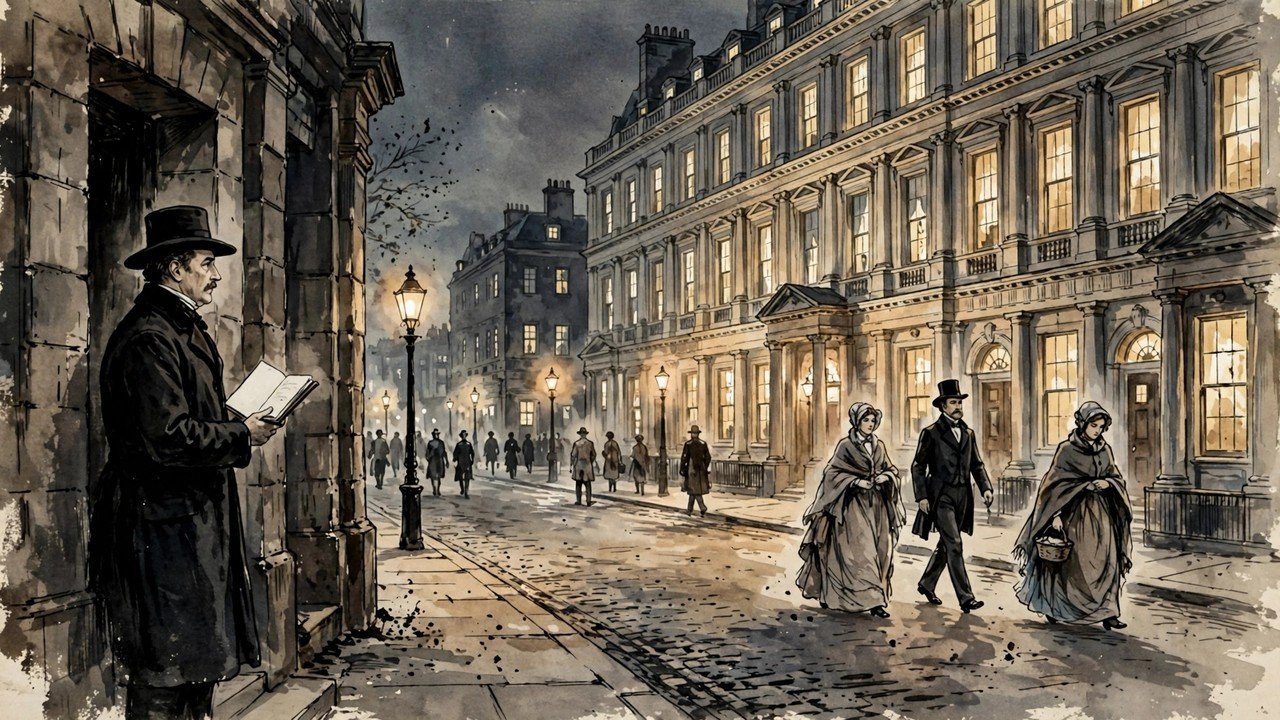
Every other figure in the Anglo-Bengalee Disinterested Loan and Life Assurance Company is performing. Montague Tigg performs the chairman, in jet-black hair, flowered waistcoat, chains, jewels and rings. David Crimple performs the secretary, writing the circulars and keeping the books of a concern that has no capital to keep books about. Mr Bullamy performs respectability in a vast red waistcoat, and clients double the sums they had come in to assure after looking at him. Mr Jobling performs the medical officer, examining lives the company will accept whatever their condition. Even Jonas Chuzzlewit, once he is installed, performs the director — a name on the concern, exhibited to the next visitor as proof that a man of property has looked into it and joined it. The offices themselves perform: stucco and plate glass, wire blinds worked with the company name, green ledgers, iron safes, marble chimney-pieces, a portrait on the board-room wall. Nothing in the establishment is what it appears to be, and appearing is the whole of its business.
One man in the company is not performing. He is the only man in it whose work consists of finding out what is actually true, and he is introduced, in Chapter 27, in the closing movement of the foundation chapter, almost as an afterthought to the splendour — the man at a pound a week who made the inquiries.1 His name is Nadgett. Dickens’s description of him is the opposite of the description of everything else in the office: “He was born to be a secret. He was a short, dried-up, withered old man, who seemed to have secreted his very blood.”1 The Victorian Web’s page on the Eytinge illustration of Nadgett quotes that description and identifies him as one of Dickens’s first detectives, employed by Tigg Montague — a private inquiry agent before the private detective had settled into a recognised figure in English fiction.6 Where the company expands, Nadgett contracts. Where it displays, he conceals. Where its circulars repeat the company name twenty times in a single notice, he will not say a consequential sentence aloud if he can write it down instead.
The contrast is not decoration. It is the structure of the fraud seen from inside. A concern built on theatre needs, at exactly one point, to deal in fact, because its profits depend at that point on knowing things that other people do not know. An ordinary assurance office employs inquiry to protect itself: it asks questions about a life before it accepts the life, checks a borrower’s securities before it lends, investigates a claim before it pays. Inquiry, in an honest office, is the enemy of theatre — it is the process by which appearance is tested against evidence and refused when the evidence fails. The Anglo-Bengalee inverts that use completely. It asks no questions about the lives it accepts, because questions would slow the taking of premiums. It makes its inquiries, instead, about one of its own directors — secretly, at a pound a week — not in order to protect the company from him, not in order to expose him to anyone outside it, but in order to own him. Nadgett’s evidence is gathered so that it can be withheld. The most accurate information in the building is produced for the one purpose that requires it never to be published.
Dickens places Nadgett’s introduction carefully. He belongs to Chapter 27’s office milieu, the same chapter that builds the board-room, the waistcoat, the portrait and the fiction of the board. The reader who has just been shown that everything else in the establishment is a “light-hearted little fiction” is then shown the inquiry agent, and the inquiry agent is real. His pocket-book is real. His watching is real. The facts he assembles will prove, in the event, to be substantially accurate as far as they go — accurate about what Jonas bought, whom he dealt with, how he behaved at a funeral, how he settled a claim. The fraud, which can manufacture capital out of a printer’s line of noughts, cannot manufacture the one commodity it needs for blackmail. For that it has to hire honesty, at a pound a week, and set it to work in the dark.
Chapter 38, titled “Secret Service”, opens on him in his other life. He is “Mr Nadgett, man of mystery to the Anglo-Bengalee Disinterested Loan and Life Assurance Company.”1 He is also, by this point in the novel, the landlord of Tom and Ruth Pinch in Islington, in Kingsgate Street, a man who gets shaved at Poll Sweedlepipe’s barber’s shop and who appears in the Pinches’ chapters as a quiet, secretive householder of no apparent consequence. Tom and Ruth do not know his employer. They do not know what his work is. The double existence is itself a piece of tradecraft rendered as domestic detail: the inquiry agent lives among people who have no idea that inquiry is his trade, in a street where nothing about him advertises it, while the company that employs him advertises everything about itself except the truth. The theatre is all in Pall Mall and the City. The inquiry is in Islington, unmarked.
The work Dickens shows him doing, in Chapter 38, is surveillance of a particular and patient kind. Montague has set him on Jonas — on the company’s own director, the man Montague himself recruited over dinner in Chapter 28, the man whose name and money the company has taken in. “He watched him in and out of the Assurance Office, where he was now formally installed as a Director; he dogged his footsteps in the streets.”1 The sentence deserves its weight. Jonas walks in and out of the office as a director of it, with the standing that the office confers, while the office’s own agent walks behind him in the street, recording where he goes. The directorship and the surveillance are simultaneous, and both are the company’s doing. Jonas has been given a place inside the concern and, without his knowledge, a file inside it as well.
Dickens extends the picture beyond the street-following. Nadgett listens. He fills his great pocket-book. He writes letters to himself about Jonas, and burns them — correspondence with no correspondent, a record made and destroyed by the same hand, so that the act of writing fixes the matter in his own ordered memory while leaving no paper for another reader to find. He cultivates the circle of Mould, the undertaker, whose trade brings him close to funerals, families and the talk that surrounds a death. He becomes a patient of Jobling, the company’s own medical officer, presenting a pretended complaint of the liver, so that he can move inside the office’s world under a medical pretext, sitting in the rooms where lives are discussed by a man who has an interest in discussing them carelessly. Each of these approaches is aimed at the same buried subject: the death of Anthony Chuzzlewit, Jonas’s father, and the part Jonas was believed to have played in it. The nurse, the doctor, the undertaker and the undertaker’s man, the talk of a man named Lewsome in a fever, the behaviour of old Chuffey at the funeral — these are the materials Nadgett assembled, as he lays them out at the end of the novel, and they were assembled here, in this chapter’s quiet movements, while Jonas was still dining as a director and complaining that he did not control enough of the money.1
The starting point of the whole inquiry, as Nadgett eventually reveals it, was not a corpse and not a confession. It was an insurance dispute. His suspicions began in Jonas’s quarrel with another office, an office where Anthony’s life had been insured. After Anthony’s death Jonas had fought that office over the money, and had then compounded with them — settled, compromised — and taken half the money, and been glad to do it. To most observers a compromised claim is a dull commercial event. To an inquiry agent it is a behavioural fact of the first order: a man entitled, on his own account of the matter, to the whole of a sum, who accepts half of it and is glad of the bargain, is a man who has reasons for not wanting the claim examined to the end. Nadgett began there, with money, and worked backward to poison. The route is worth noticing because it is the route honest inquiry into fraud still takes. The paperwork irregularity comes first. The crime is inferred from the settlement that was made to avoid scrutiny of it.
The report scene, when it comes, is staged by Dickens as a direct collision between the two kinds of knowledge the company contains. Nadgett attends Montague in his Pall Mall dressing-room — the private interior behind the public splendour, the room where the chairman is prepared for display. He will not deliver his findings by speaking them. “I don’t like word of mouth. We never know who’s listening.”1 The sentence is verified, and it is the professional creed of the man in five words and a reason. Speech evaporates and can be denied, misheard, repeated by whoever overheard it. Writing persists, can be numbered, can be handed over, can be taken back. So Nadgett produces his report as numbered written memoranda, taken one by one from the great pocket-book that he lays on a second chair beside him, and hands each memorandum across to Montague in sequence, saying nothing that the paper does not say. The Fred Barnard illustration of the scene, captioned “Mr Nadgett produces the result of his private inquiries”, fixes exactly this moment — the inquiry agent delivering, in writing, what he will not say aloud — and the Victorian Web’s commentary on the Barnard plate treats the report for what it is: Nadgett’s findings on Jonas, produced for Montague.11
Montague reads the memoranda with mounting alarm and wonder, and his response is admiration of the workmanship: “You are a wonderful man, Mr Nadgett!” The admiration is genuine, and it is also the whole tragedy of the arrangement in miniature. The chairman of a fraudulent company is holding, in his hands, a piece of first-rate investigative work — patient, sourced, written, numbered, accurate in its materials — and the use he is about to make of it is not to lay it before a magistrate, a coroner, a newspaper or the family of the dead man. The use he is about to make of it is to frighten its subject into obedience, in the same room, within the hour, with the investigator still present and saying nothing.
For Jonas arrives while Nadgett is still there. He has come to complain, and his complaints are those of a man who has discovered the difference between the directorship he was sold and the directorship he holds. He has no real control over the money. Montague’s by-laws and Montague’s multiple votes drown his own vote whenever they differ. He threatens, in his blustering way, to play old Gooseberry with the office — to wreck the concern, to make trouble for it — unless he is bought out at a high price. It is a negotiation between two thieves about the division of authority in a theft, and Jonas conducts it in the belief that he holds a threat. Montague, who has just read the memoranda, knows that he holds the larger one. He keeps Nadgett in the room, by the stove, during the interview — keeps him there deliberately, as a piece of the room’s furniture, a dried-up old man in the corner whom Jonas does not know and does not regard. Then, at the chosen moment, he drops the nearest thing to a naming of the secret that Dickens allows into the chapter, telling Jonas, of the unregarded man by the stove: “It’s my belief that you are Poison to him.”1 The pun does its work as a signal. Jonas is being told that the silent man knows, and that what he knows concerns poison.
Then Montague beckons Jonas close, and whispers the discovery in his ear.
Dickens does not print the whisper. He does not print the memoranda either. The two central documents of the chapter — the numbered written report and the spoken sentence that conveys its substance — are both withheld from the reader, and the withholding is exact and deliberate, because it reproduces, in the reader’s own experience, the economy in which this information circulates. Nadgett will not speak because someone may be listening. Montague whispers because the value of what he knows depends on nobody else knowing it. Dickens makes the reader into the person outside the door: aware that a discovery has been made, able to measure its effect, denied its content. What is printed is the effect, and the effect is rendered in the body. Jonas’s face cycles through red, white, red again, yellow, and at last a cold, dull, awful, sweat-bedabbled blue. He claps a bloodless hand over Montague’s mouth — the gesture of a man trying, too late and by physical force, to put the words back into the speaker. The chapter’s information has been delivered in full, and not one word of it has been written down for us. That is what a secret is, in this company’s handling of it: not an absence of knowledge, but knowledge so carefully channelled that it can pass from a pocket-book to a whisper to a terrified face without ever becoming public property.
Jonas capitulates on the spot. He will venture further — put more money in. He will undertake to bring in his father-in-law, Pecksniff, who has money. The investigation has achieved its object, and its object was never justice for Anthony Chuzzlewit. Anthony is as dead at the end of Chapter 38 as he was at the beginning, and no authority in England is one fact better informed about his death. What has changed is a balance of power inside a fraudulent assurance office. The inquiry agent’s dossier has been converted, at the moment of its delivery, from evidence into leverage.
That conversion is the paradox at the centre of Nadgett’s employment, and it should be stated plainly. The Anglo-Bengalee employs the only honest investigator in the book. Nadgett does not fabricate. He does not exaggerate for effect, does not perform, does not take the customer’s word or the chairman’s word for anything. He watches, he listens, he writes, he numbers, he burns his drafts, he keeps his own counsel, and when the case is finally opened at the end of the novel his account of his watching holds: “I have not been watching him so long for nothing,” he says in Chapter 51. “I never watched a man so close as I have watched him.”1 The Victorian Web’s Nadgett page treats him, accordingly, as a serious early instance of the fictional detective — a man whose method is observation and record rather than inspiration.6 And this man’s honest work, honestly done, is commissioned by a fraud, paid for at a pound a week by a fraud, and used by the fraud for the most dishonest purpose to which evidence can be put: not to publish a crime, but to suppress one at a price. The better Nadgett is at his work, the worse the outcome his work produces, because the value of his dossier to Montague rises with its credibility. A flimsy case would have frightened Jonas for a week. A sound case owns him for the rest of the plot.
There is a further turn inside the paradox. Nadgett himself appears to be indifferent to the use made of him, and Dickens gives him a line that states the indifference as a philosophy: “Oh! nothing has an interest to me that’s not a secret.”1 The sentence is usually read as a comic eccentricity, the professional deformation of a man who has made secrecy into a temperament. Read against his employment, it is more exact than that. A secret, to Nadgett, is interesting in itself — in its acquisition, its ordering, its keeping. Whether the keeping serves a prosecution or a blackmail is a question that belongs to the man who pays the pound a week. Nadgett’s honesty is real, but it is an honesty of method, not of allegiance. He will not invent a fact for Montague. He will not withhold a fact from Montague either. He serves the inquiry, and the inquiry serves whoever commissioned it. Dickens, writing in 1843-44, before the detective had become a stock figure of public virtue in fiction, had already seen the type whole: the investigator as an instrument, whose integrity guarantees the quality of the information and says nothing at all about the morality of its use.
Set Nadgett beside the rest of the establishment and the company’s design becomes fully visible. The theatre exists to bring money in from people who know nothing. The inquiry exists to keep control over a man who knows too much — or rather, over a man who is believed, by himself most of all, to have done something that must not be known. Between the theatre and the inquiry, there is no third function. There is no department of the Anglo-Bengalee that asks whether a life is a good risk, whether a loan is sound, whether a claim should be paid, whether the capital exists. The two real activities of the firm are persuasion outward and coercion inward, and both are, in their different registers, forms of the same trade: the management of what other people believe. The customers must believe the company is rich. Jonas must believe the company knows. Both beliefs are manufactured, one with a waistcoat and a brass plate, the other with a pocket-book and a whisper, and both are worth money for exactly as long as they are not tested against the facts — the facts being, in the first case, that there is no capital, and in the second, as the end of the novel reveals, that the murder at the heart of the dossier never in fact took place.
Murder and exposure
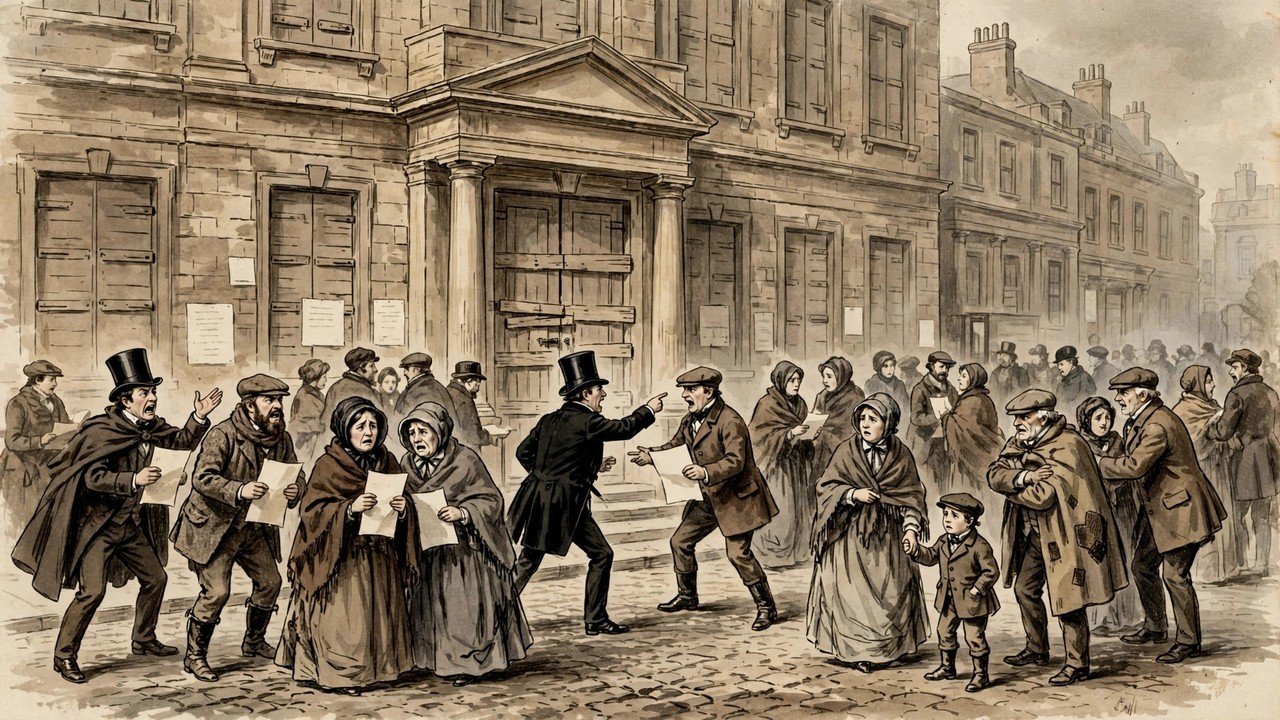
The enterprise of Mr Jonas and his friend, as Dickens titles the sequence that begins with the blackmail, ends with a stake torn from a fence. By Chapter 47 Jonas has done everything Montague priced for him. He has ventured further money and kept quiet. He has travelled to Salisbury through the thunderstorm of Chapter 42, gripping a bottle by the neck, singing a gallows song, and — by lightning-flash, as Montague thought — raising the bottle like a hammer at the chairman’s head. He has primed Pecksniff at the Blue Dragon and at Pecksniff’s own table, letting the dazzling prospects of the Anglo-Bengalee escape him inch by inch, so that Pecksniff begged to be initiated, and has watched Montague’s suavity take the old man in. Pecksniff’s money has gone where Jonas’s went. The friendly agreement has been performed in full.
It has bought Jonas nothing except a closer captivity, and he knows the arithmetic of his position as well as Montague does. The secret has not been discharged by his payments; it has been refinanced. Each performance gives Montague more to hold — Jonas is now not merely a man who believes he poisoned his father, but a director who has decoyed his own father-in-law into a fraudulent office, with documents, in state. Montague, for his part, has already resolved on his own exit: to use Jonas up, decamp across the water, and keep the gains and the laugh. Chapter 42 gives his private estimate of the instrument he is using: “If he could kill me with a wish, I should not live long.”1 The sentence is Montague’s, about Jonas, and it is the most accurate risk assessment anyone in the company ever makes. The chairman who employed a medical officer who examined nothing, and an inquiry agent who reported only to himself, assessed the mortal risk standing next to him correctly — and continued to stand next to him, because the profits of the enterprise required the journey, the dinner and the decoy work to be completed first.
Jonas travels disguised, by night coach, to intercept Montague’s return on foot from dining with Pecksniff. In a copse beside the route he fashions the weapon from what the place provides: he tears a thick, hard, knotted stake from a fence and shapes its jagged head with his knife. The detail of the manufacture matters to Dickens’s purpose. This is not a gentleman’s weapon, bought and traceable. It is a piece of the landscape, altered by a penknife, that will look after use like a piece of the landscape again. Montague parts from Pecksniff at a stile and takes the footpath through the little wood alone. Dickens then withdraws the narration from the act itself, exactly as he withdrew the contents of Nadgett’s memoranda and the words of the whisper in Chapter 38. The reader is given the before and the after, and nothing between. “Never more beheld by mortal eye or heard by mortal ear; one man excepted.”1 Jonas leaps out of the wood leaving behind him, among last year’s oak and beech leaves, “the body of a murdered man”,1 and walks back toward London.
The murder is the blackmail’s final invoice, presented to the blackmailer. Every other element of the Anglo-Bengalee plot is a transaction in paper, confidence or money; this one is the point at which the paper structure produces a corpse, and Dickens’s reticence about the blow keeps the emphasis where the novel has kept it throughout — not on the mechanics of violence, but on the chain of priced silences that made a wood at night seem to Jonas like a commercial solution. He kills Montague to close the account. The account, as Chapter 51 shows, does not close. It multiplies.
Chapter 51 opens the exposure by inventory, in a passage that lists Jonas’s simultaneous terrors as a man might list debts coming due on the same day: “The exposure of the Assurance office; the flight of Crimple and Bullamy with the plunder.”1 The company has collapsed off-stage, in the manner of such companies, not by a dramatic confrontation in the board-room but by the simple cessation of the inflow and the departure of the men who kept the books. And the plunder, Dickens specifies, included Pecksniff’s money — remitted, as Jonas fears, to one or other of those trusty friends for safe deposit at the banker’s — and it included something Jonas wanted far more than money: his own bill, the paper evidence of his financial entanglement, which he had searched for in the murdered man’s pocket-book on the night of the murder and had not found. He killed Montague in part to recover control of his own paper. The paper was not on the body. It was already in the hands of the secretary and the porter, and it left the country, or at least the reach of Jonas, in their luggage.
Crimple is the man who did the plain work — figures, books, circulars, advertisements — while Montague did the ornamental department: David, né Crimp, renamed because the original was susceptible of an awkward construction, formerly a tapster, drawing eight hundred a year and holding twenty-five shares, and the only person besides Montague who spoke of the capital as what it was. Bullamy is the porter in the red waistcoat, the walking expression of respectability, competence and property in Bengal, who cried “Room for the chairman!” and served the board-room lunch. When the end comes, these two — the clerk who knew the figures were invented and the front-of-house man whose garment was the company’s credit — leave together, with the cash. The chairman is dead in a wood. The director is left in London, liable to be called to account “as a partner in the broken firm”, facing immense losses and the discovery of the body. The theatre’s two employees walk out with the takings; the men whose names and faces guaranteed the performance are left holding its liabilities.
That distribution follows the same rule as the salaries and dinners of the prosperous phase. Inside a fraud, reward flows to whoever can convert the inflow into portable property before it stops, and liability settles on whoever’s name is most publicly attached to the promises. Jonas’s directorship, accepted as flattery and used as bait, returns at the collapse in its legal form. Pecksniff, never granted even a title, loses his money as a simple investor. The customers B, multiplied across the books — the tradesmen, clerks, parsons, artists and authors who paid premiums on three lives for every small loan — do not appear in the exposure at all. The exposure that reaches the courts is the exposure of the principals. The small policyholders and borrowers, whose money constituted the inflow, are dispersed, individually owed sums too small to organise around, and largely invisible in the sequel.
Against that collapse Dickens sets the second exposure of Chapter 51, the one Nadgett has been preparing since he first watched Jonas in and out of the Assurance Office. His client is now dead; Montague cannot receive the last memoranda. The knowledge accumulated at a pound a week — the nurse, the doctor, the undertaker and his man, Lewsome’s fever talk, Chuffey’s behaviour at the funeral, the quarrel with the other office and the half-settlement Jonas was glad to accept — passes, with Chuffey’s revelation, into the hands of old Martin’s party, and from there to officers of the law. The captured inquiry is captured no longer, because the captor is in a wood, and Nadgett’s habit of watching completes itself by watching the murderer commit the second crime while fleeing the consequences of the first, imaginary one.
The watching, in the final phase, was physical and close. Nadgett had taken a position at a garret window opposite Jonas’s house. He saw Jonas return alone from the journey undertaken with Montague — a return that itself told a story, since the two men had travelled down together and only one came back. He followed the disguised figure of Jonas, dressed as a countryman, out and back on the night’s work around the murder. He followed him, at the end, to the steps at London Bridge, and watched him sink a bundle in the river. The bundle was fished up by the police. It contained the dress Jonas had worn near the place of the murder, stained with clay and spotted with blood. Nadgett’s own summary of his work, delivered in Chapter 51, has the flat pride of a man whose whole life has been a single method finally vindicated: “I have not been watching him so long for nothing. I never watched a man so close as I have watched him.”1
The arrest follows in the same chapter, and Dickens staffs it with a figure whose presence closes one of the novel’s longest arcs. Among the officers who take Jonas is Chevy Slyme — the dissolute, self-pitying cousin on whose expectations the shabby Montague Tigg once lived as ambassador and hanger-on, now a police officer. The man Tigg discarded on his rise, the man whose company Tigg disowned to Jonas as a credential of his own ascent, stands in the room in the King’s name while Tigg’s murderer is taken. Nadgett identifies the prisoner in the words Dickens gives him: “That is the man,” said Nadgett. “By the window!”1 The inquiry agent points, the officers act, and the knowledge that for so long existed only in a pocket-book and in numbered extracts handed across a chairman’s dressing-room becomes, at last, a public act with public consequences.
Chuffey’s revelation and Nadgett’s evidence arrive together, and their conjunction is the novel’s final statement about the company. Chuffey establishes that the founding crime of the blackmail — the poisoning of Anthony Chuzzlewit — was prepared and never committed: the jar mixed, the courage failed, the mixture found and burnt by the father and the clerk together, the father dead within days of a broken heart, forgiving, with his last words “Spare him, Chuff!”1 on his lips. Nadgett establishes that the second crime, the one committed to escape the first, was real, witnessed in its movements and proved by a bundle pulled out of the Thames. Between those two findings sits Montague’s whole enterprise. He built a company with no capital that paid out of what came in. He perverted life assurance into a trade in lives and then refined it further, into a trade in one man’s belief about a life he thought he had taken. He employed inquiry as a private weapon and was killed by the man the weapon was used on. And the exposure, when it came, came from none of the directions the company’s theatre was designed to impress — not from the board, which did not exist; not from the medical officer, who examined nothing; not from the prospectus, which printed noughts; but from an old clerk keeping a deathbed promise until he could keep it no longer, and from a dried-up inquiry agent at a garret window, doing for the law at the end what he had spent the novel doing for the chairman.
Chapter 52 opens by confirming, in a subordinate clause of old Martin’s correspondence, the receipt of “the narratives of Chuffey and Nadgett, and the forging of that chain of circumstances ending in the death of Jonas”. Jonas died shortly after his arrest. Dickens, in the material verified for this post, is allowed to say no more than that here, and this account says no more: not the manner, not the place, not the words. The chain of circumstances is the subject, and it is complete without them. A son taught to be covetous prepared a poison he could not use. A father burnt it and died of the knowledge. A fraudulent office, watching the son through its inquiry agent, converted his guilty belief into an asset and priced his silence by the meeting. A father-in-law’s fortune was taken in on the strength of that silence. A chairman was beaten to death in a wood by the man he was blackmailing, with a stake torn from a fence. A secretary and a porter left with the plunder, a director was left with the liability, and the bundle that proved the murder was fished, dripping, out of the river at London Bridge by men acting on the word of the company’s own watcher — the pound-a-week inquiry that had served the fraud in its life, and buried it, with its founder and its most famous director, in its death.
Nadgett’s dossier, when finally opened in Chapter 51, is opened by its author in a speech — the only full statement of method Dickens allows him, since in Chapter 38 he would deliver nothing except in numbered writing. He speaks in Jonas’s own house, the officers waiting, his prisoner manacled on the floor, regretting even then the approaching publicity of what he knew. The method was accumulation from named human sources, each producible: “I found the nurse — here she is to confirm me; I found the doctor, I found the undertaker, I found the undertaker’s man. I found out how the old gentleman there, Mr Chuffey, had behaved at the funeral; and I found out what this man” — touching Lewsome on the arm — “had talked about in his fever. I found out how he conducted himself before his father’s death, and how since and how at the time; and writing it all down, and putting it carefully together, made case enough for Mr Montague to tax him with the crime, which (as he himself believed until to-night) he had committed. I was by when this was done.” Three features are new to the record. The dossier was corroborated in person: the nurse stands in the room, produced as a witness is produced in court. Its raw material included a sick man’s fever talk — Lewsome, who had supplied the poison, had raved of it in a fever, and the net caught what a delirious man said to whoever nursed him. And the dossier was, by its author’s word, a construction: the writing and the putting together made the case. The Victorian Web’s Barnard plate, “Mr Nadgett produces the result of his private inquiries”, fixes the same man producing that construction to its purchaser;11 in Chapter 51 it is produced to its subject, aloud, before the nurse — the difference between a weapon and an accusation.1
What no inquiry could have found is supplied in the same hour by Chuffey, in detail that reverses every fact the dossier assembled. Anthony’s discovery of the poisoned jar in the locked desk drawer ended not in confrontation but in a plan, made by the intended victim, for his son’s rescue, recited in his own words. Coming to the clerk’s bedside in the night, weeping, Anthony had said Jonas should not weary for his death: he should have it now, the inheritance at once; should marry where he had a fancy, although it didn’t please his father; and the two old men would go away and live upon a little. “I always loved him; perhaps he’ll love me then. It’s a dreadful thing to have my own child thirsting for my death. But I might have known it. I have sown, and I must reap.” Jonas was to believe his father was taking the mixture; when Anthony saw he was sorry, and had all he wanted, he would tell him he had found it out, and forgive him. Next day the discovery was staged as accident: Anthony made believe he had opened the drawer by mistake with a key from the bunch that happened to fit — they had had a key made and hung upon the bunch — and professed surprise at finding his cough medicine there. They burnt the mixture. But the son believed his father was taking it, and once, to try him, Anthony said it had a strange taste, and Jonas got up directly and went out. Anthony wrote to Pecksniff to hasten the marriage. Then his mind went a little wrong through grief, his heart broke, he sank and altered from that night, and died within days, his only speakable words the instruction that governed the next two years: “Spare him, Chuff!” — which the clerk had promised, and tried, to obey.1
The return is a second plan, executed under a fear that had changed its object: Jonas was frightened when he thought of the deed, but not sorry, and out of the wood his fears diverted, strangely, from the wood to the dark room left shut up at home — his hideous secret, to his thinking, was shut up in the room, not in the wood. He walked ten miles, then stopped at an ale-house for a coach he knew would pass toward London and knew was not the coach he had travelled down by, coming from another place. A knocking within — an ordinary, unexplained sound — set him constructing the whole sequence of discovery in an instant: a knocking at his own door, no answer, the door burst open, the room empty, himself unable to enter without showing himself in the garb he wore — rumour, detection, death. He paid and walked on. The coach brought him to London by five in the morning; he slipped down without troubling the driver to stop, and approached his dwelling street by street, halting to survey each before entering it. He stole on tiptoe to the door, turned the key with a trembling hand and pushed it open with his knee — beset by the monstrous fear: what if the murdered man were there before him? Nothing was there. He drew the key through the dust and damp in the fireplace to sully it again, and hung it up as of old: a forged patina, to make it appear never to have been used that night. He tied his disguise into a bundle, ready for sinking in the river, locked it in a cupboard, and went to bed in the room that was his alibi, hearing his heart beat “Murder, Murder, Murder” in the bed. At nine his wife told him Mr Nadgett had wanted to see him the day before, had been told he was not to be disturbed, had said it was of little consequence — and that she had seen Nadgett passing through the street that morning, very early. Jonas trembled at having nearly seen even him, who kept his own secrets and, as Jonas thought, saw nothing. It is the novel’s most complete misreading of a watcher by the watched. Nadgett had seen everything.1
The arrest, when the chosen time arrives, is staged inside the acquittal. Nadgett stands foremost in the doorway; Mark, outside, beckons to the man at the window — Jonas himself — to open the door, which he does with a deal of pleasure, admitting his own capture in the belief he is admitting allies. “That is the man,” said Nadgett. “By the window!” Three others lay hands on him so quickly that he has not lost sight of the informer’s face when his wrists are manacled. “Murder,” said Nadgett. “Let no one interfere.” Confronted with the dossier speech, Jonas tries to stop his ears with his fettered arms, and the company draws away from him as if a pestilence were in his breath — even those keeping him shun him, with one exception: Chevy Slyme, sitting lazily across a chair, eating nuts and throwing the shells out of the window as he cracks them, continuing to do so while he speaks. Slyme’s presence is a family transaction in uniform: he took up the trade, he tells old Martin, on purpose to shame him; he always expected he and Tigg would be brought together again in the course of business, but thought Tigg would be wanted for some swindling job — it never entered his head he should hold a warrant for the apprehension of his murderer. “His murderer!” cries Martin. “His or Mr Montague’s,” Nadgett corrects. “They are the same, I am told. I accuse him yonder of the murder of Mr Montague, who was found last night, killed, in a wood.” The warrant, it should be noticed, is for the murder. No warrant in the chapter names the Anglo-Bengalee, its policies, its premiums or its missing capital.1
Jonas’s death follows within the hour, staged with the same transactional closeness as the dinner and the interview — in form, another negotiation with a Chuzzlewit connection, priced in cash. Left with Slyme while the other officer waits for the coach, Jonas, wrists tight together, directs him: put your hand in my pocket — the breast pocket, on the left. Slyme draws out a purse: a hundred pound in it. Escape is impossible, Jonas says; he knows it. One hundred pound for only five minutes in the next room. What to do, Slyme asks, and Jonas whispers in his ear, his face making the officer recoil: he has it about him, hands at his throat, as though what he referred to were hidden in his neckerchief. Slyme, trembling, observes it would be more creditable to the family, and puts two questions and a condition: “Are you guilty?” — “Yes!” — “Are the proofs as they were told just now?” — “Yes!” — and will he engage to say a prayer, now, or something of that sort? Jonas breaks from him without replying and closes the glass partition door. Slyme listens at the keyhole, creeps away on tiptoe, and, when the coach arrives, tells the men below the prisoner is getting a few things together. The five minutes run out, and more, before Slyme flings the door wide and enters. Jonas stands in an angle of the wall, neckerchief off, face ashy pale. “You’re too soon,” he says, with an abject whimper. “I’ve not had time. I have not been able to do it. I — five minutes more — two minutes more! — only one!” The man who fashioned a stake beneath a hayrick and waited a day for his victim could not, alone with the poison already on his person, perform the same office for himself inside five purchased minutes. Slyme thrusts the purse back into his pocket and calls up his men. Jonas is got away — whining, crying, cursing and struggling in one breath, with no power to stand — put on a coach seat, and soon falls moaning among the straw at the bottom. Passing a fruiterer’s, one of the men remarks how faint the peaches smell. The other stoops in quick alarm: “Stop the coach! He has poisoned himself! The smell comes from this bottle in his hand!” The hand had shut upon it tight, with a rigidity no living man in full strength can match. They drag him into the dark street, but jury, judge and hangman could have done no more, and could do nothing now. Dead, dead, dead. The poison carried in his neckerchief — carried through the arrest, the dossier and the acquittal, as a director of a life assurance company might carry a policy on his own life — was used not in the room he bought but in the coach taking him to a cell, and identified not by a doctor or an inquest, but by an officer’s nose, mistaking prussic acid for peaches from a shut fruiterer’s.1
What “exposure” consisted of can now be stated by its instruments, because the novel supplies a complete list and a regulator is not on it. The company’s exposure consisted of a cessation and a flight: the inflow stopped, Crimple and Bullamy left with the plunder, and the fact became public as a stopped clock becomes public, by no longer working. No official enters the Anglo-Bengalee’s offices in the final numbers; no inspector examines its books, no magistrate questions its secretary, no claim by any policyholder or borrower B is heard anywhere. The murder’s exposure consisted of a private dossier, a dying clerk’s conscience, a family council in the murderer’s own parlour and a warrant for murder — in that order, set in motion not by any authority’s suspicion of the company but by old Martin’s party arriving to confront Jonas about his father’s death, the police admitted at the last moment, on Nadgett’s communication, to fish a bundle from the Thames and hold a warrant his watching had filled. Even the police presence is familial before it is institutional: the chief officer is a cousin there to shame his uncle, who eats nuts through the accusation and sells the prisoner five minutes’ privacy for a hundred pounds. Campbell dates the first substantive regulation of life insurance in the United Kingdom to the Life Assurance Companies Act of 1870;3 Dickens’s ending shows what stood in its place in 1844. A fraud could be ended by its own arithmetic and its clerks’ departure. A murderer inside it could be ended by the fraud’s own inquiry agent, changing employers by the employer’s death, and by an old clerk breaking a deathbed promise because the confronting party had already found out so much that silence had stopped protecting anyone. Between those endings there is no institution at all — only a pound-a-week watcher, a pocket-book, a garret window opposite, and a smell of peaches in a dark street.16
Dickens’s London – a market learning to be fooled
In 1800 there were about ten companies offering life assurance in Britain. By 1850 there were over 150.2 That growth, in half a century, is the background against which the Anglo-Bengalee Disinterested Loan and Life Assurance Company has to be read. Dickens did not place his imaginary office in a settled, well-policed trade. He placed it in a trade that was expanding fast, competing fiercely, and still inventing the rules by which it might be trusted. The London Museum, describing a legitimate new office of the period, the Economic Life Assurance Society, established in 1823 at 34 Bridge Street, Blackfriars, notes why such offices clustered near the City: location itself was used “to enhance the financial credibility of companies involved in the fledgling and, perceived risky life assurance business.” Growth, the same account adds, reflected “the rise of the middle class and their desire for family security,” while “competition was fierce and resulted in some dubious practices including poaching customers and under-cutting rates.”2
Every phrase in that short description matters for the novel. A fledgling business. A perceived risky business. Credibility that had to be enhanced, by an address, by premises, by proximity to older and larger institutions. Customers who were not speculators in any grand sense but householders seeking security for a widow and children. Competitors who poached and undercut. A market, in short, in which the product being sold was a promise about a distant future, the buyer could not inspect the promise, and the seller’s present appearance had to do the work that evidence could not.
Life assurance was not new in 1843. What was new was its scale, its reach, and the number of people being asked to trust it.
The oldest precedent the actuaries themselves cited reached back to the beginning of the previous century. The Amicable Society, chartered in 1706, was a corporation of up to 2,000 persons raising a joint stock “for the use and relief of widows and orphans,” dividing £10,000 a year among the claimants of members who died.17 It is tempting, from a distance, to treat such a body as an early version of a modern life office. The actuarial historian Frederick Hendriks warned against exactly that error. The Amicable, he pointed out, “was not invested with the power of granting insurances at rates of premium calculated according to age, until after 30th October, 1807.” For its first century it was a contribution and benefit society dividing a common purse among those entitled to claim, not an office pricing each life according to the risk that life presented.17
The break came in 1762. The Equitable Society, founded that year, was, in Hendriks’s words, “the first Society that granted policies, and for the whole term of life, at rates of premium graduated according to the varying mortality computed as in expectation at the different ages of the lives insured. Thus the principles which guide modern plans of insurance were established.”17 Age, expectation of life, a premium calculated from a table rather than divided from a purse: here, at last, was a method. A man of thirty and a man of sixty did not present the same risk, and a serious office charged them differently.
That method is what gave legitimate assurance its claim to be a science rather than a scheme. It is also what made imitation so easy. A bogus office did not need the tables, the calculations or the reserves behind them. It needed the vocabulary. It needed the printed forms, the medical officer, the talk of premiums and policies and bonuses, the suggestion that somewhere behind the counter a body of mathematical knowledge was being applied on the customer’s behalf. The customer could not check the arithmetic. He could only check the office, the clerks, the porter, the chairman’s portrait, the dinner to which a prospective director was invited. Dickens understood that substitution exactly, and built the Anglo-Bengalee out of it: an office in which, as the Society of Actuaries’ Mary Pat Campbell puts it, success rested on “the need for capital to perpetrate the fraud to begin with, the need for shiny appearances to bolster reputations, the hooking in of other unethical and questionable people.”3
Before assurance could be perverted in that way, however, it had already had to be rescued once from a different perversion. Life policies had been taken out as bets.
The Life Assurance Act 1774, 14 Geo. 3 c. 48, states its purpose in its long title: “An Act for regulating Insurances upon Lives, and for prohibiting all such Insurances except in cases where the Persons insuring shall have an Interest in the Life or Death of the Persons insured.”14 Section 1 then provides that “no insurance shall be made… on the life or lives of any person… wherein the person or persons for whose use, benefit, or on whose account such policy or policies shall be made, shall have no interest, or by way of gaming or wagering,” and that every assurance made contrary to that intention “shall be null and void to all intents and purposes whatsoever.”14 Section 2 required the policy itself to insert the names of the persons interested in it, or for whose benefit it was made. Section 3 capped recovery at “the amount of value of the interest of the insured” in the life concerned. Section 4 expressly left bona fide insurance on ships, goods or merchandise outside the Act.14
Three requirements, each of them aimed at a single abuse. You must have an interest in the life. Your name and interest must appear on the policy. You may recover no more than that interest is worth. Strip any one of them away and a life policy stops being protection and becomes a wager on a stranger’s death, placed with an office instead of a bookmaker.
The tontine showed how strong the gambling appetite inside ostensibly respectable finance could be. In a tontine pool, as Moshe Milevsky and Thomas Salisbury of York University describe it, a fixed dividend was divided among surviving members, so that as other members died off, each survivor’s income rose: “part annuity, part lottery and part hedge fund,” an arrangement which “appealed to the gambling instinct.”18 The scheme took its name from Lorenzo de Tonti, an Italian banker who proposed it in the 1650s. In 1693 William III’s government issued the first English government tontine to raise £1 million for the war against France: £100 a share, £10 dividends to 1700 and then £7, with an option to convert to a 14 per cent life annuity. The nominee whose life measured the investment could be any person of any age chosen by the investor.18 Adam Smith, in The Wealth of Nations in 1776, saw why governments liked the device: they could raise more by tontines than by separate-life annuities because of “the confidence which every man naturally has in his own good fortune, the principle upon which is founded the success of all lotteries.”18
A reader of Martin Chuzzlewit in 1844 did not need that history explained to him. He lived among its descendants. He knew that a contract written around a human life could be a father’s provision for his family, a creditor’s security for a loan, or a bet. He knew that the same office, the same printed policy, the same premium receipt might stand for any of the three. And he knew, if he had followed Jonas Chuzzlewit’s errand to the Anglo-Bengalee, what it meant when a man went looking for an office that would ask fewer questions than the respectable ones. Jonas, newly married, wanted to insure his wife’s life cheaply, easily and without her knowledge, having been questioned and rebuffed by, in the novel’s phrase, “one or two of the old companies.”1 The 1774 Act had required the names of interested persons to be inserted in the policy for seventy years. Jonas’s shopping around was a search for somewhere that requirement, and the inquiries behind it, would be treated as a formality. Dickens does not cite the statute. He dramatises the evasion it was written to prevent.
If the product was difficult to judge, the company selling it was, before 1844, difficult even to place in law.
A promoter who wanted to create a large joint-stock undertaking at the beginning of the nineteenth century had, in the summary given by Ranald C. Michie of Durham University in his review of James Taylor’s Creating Capitalism: Joint-Stock Enterprise in British Politics and Culture, 1800–1870, two routes only: “obtain a private act of parliament, which was a long and costly process, or form companies lacking any legal standing.”19 The consequence followed directly. “Consequently, many joint-stock companies operated in limbo during the 1820s and 1830s. Unless an act of Parliament had been obtained, the company had no legal status.” By the 1840s the difficulty was, in Michie’s words, “particularly acute,” as companies providing urban and transport services each needed a separate Act.19
Consider what that limbo meant for a member of the public standing in an office in 1842, policy in hand. A chartered corporation had a charter. A company created by its own Act of Parliament had an Act he could, in principle, look up. A great unincorporated association of subscribers, bound together by its own deed and its own rules, had neither. It could have directors, a secretary, a seal, a bank account, printed policies and a brass plate. It could look, in every outward particular, more solid than a small chartered body. Yet its legal personality, its capacity to sue and be sued as one body, the liability of the men whose names appeared on its deed, and the standing of the fund from which claims were supposedly to be paid, all rested on private arrangements the customer never saw. The distinction between a real company and the performance of one was not a distinction the eye could make.
The older prohibition that had once kept such associations in check had gone a generation earlier. The first step in the rehabilitation of the joint-stock form, as Michie puts it, was “the repeal in 1825 of the ‘Bubble Act’ passed in 1720,” followed in 1826 by the ending of the prohibition on joint-stock banking outside London.19 The Bank of England’s own history of insurance makes the same point from the industry’s side: “It wasn’t until the Bubble Act was repealed in 1825 that insurers were able to organise freely as regular joint stock companies.”20 Repeal removed a ban. It did not put a system of scrutiny in its place. For nearly twenty years after 1825, therefore, joint-stock enterprise in Britain occupied a widening space between permission and supervision: freer to form, easier to promote, and still, unless Parliament had intervened in the individual case, without a general legal constitution.
Nor did the repeal produce a settled public confidence in the form. The mid-1820s themselves saw, in Michie’s summary, “a speculative boom and collapse, during which many ephemeral joint-stock companies were promoted,” and the episode kept public perception of joint-stock enterprise hostile long afterwards.19 The hostility had a literature of its own. Joint-stock companies, the same review notes, were long associated in novels, plays and cartoons with speculative outbursts. “Company promoters were seen either as evil people who defrauded and duped innocent investors or pandered to human greed by encouraging speculation in shares,” and nineteenth-century literature kept invoking the South Sea Bubble of 1720 as its standing warning.19
Dickens, in other words, was not inventing a type when he invented Tigg Montague. He was taking up a figure his readers already recognised from the stage, the cartoon and the cautionary tale, and giving him a new trade, a new address and a reversed name. The originality of the Anglo-Bengalee lies not in the promoter but in the precision of the setting: not a mine in a distant country, not a canal that would never be dug, but a life office in the City, selling the most domestic and respectable of products to clerks, tradesmen, clergymen and widows, and taking its profit at the counter in premiums, fees and charges before any question of a claim arose.
That precision had a biography behind it.
Charles Dickens knew Parliament, the law courts and the newspaper office from the inside, and he knew them young, as a working reporter rather than as a literary observer admitted on sufferance. In 1828 he had been a freelance reporter in the London law courts, and he read at the British Museum. In his twentieth year he became a parliamentary reporter for the Mirror of Parliament, founded by his uncle John Henry Barrow, working there from 1832 to 1834. A contemporary, James Grant of the Morning Advertiser, said he “occupied the very highest rank, not merely for accuracy in reporting, but for marvelous quickness in transcript.” His observation of Parliament during and after the Reform Bill debates, the Poetry Foundation’s biography concludes, “constituted the liberal education neither he nor his parents could afford to finance.” He then joined the reorganised Morning Chronicle as a regular staff reporter.21
Shorthand was his trade before fiction was. A parliamentary reporter in the early 1830s learned a particular set of skills, and they are the skills on display in Chapter 27 of Martin Chuzzlewit: how a committee talks, how a prospectus phrase is constructed to sound like a fact, how a title is inflated, how men who have nothing to sell sell the manner of men who have everything. He learned, too, what an inquiry looked like when it was meant, and what it looked like when it was theatre. The Anglo-Bengalee keeps a man at a pound a week to make inquiries. Its medical officer examines lives it intends to accept whatever he finds. Its board consists, behind the chairman’s portrait and the ivory hammer, of Montague, his secretary Crimple and his porter Bullamy: “This was the board: everything else being a light-hearted little fiction.”1 A novelist who had never sat through public business might have imagined a fraud as a strong-room and a forged ledger. Dickens, who had taken down public business word by word, imagined it as procedure: minutes, circulars, examinations, inquiries, a board-room, a lunch.
The habit did not leave him when the fiction succeeded. He “continued to submit articles and letters to newspapers for the remainder of his life,” became founding editor of the Daily News in January 1846, though for only seventeen issues, and edited Bentley’s Miscellany from January 1837.21 Campbell, writing for the Society of Actuaries, makes the connecting point directly: Dickens, even before he became prominent, when he was a parliamentary recorder, “became more familiar with the lifeblood of the city,” and “one issue Dickens knew well was fraud of all types.”3 Later, from March 1850 to May 1859, he conducted and edited Household Words, an unillustrated weekly published by Bradbury and Evans in which most articles were unsigned and many were edited or written by Dickens himself or by his co-editor William Henry Wills, before the quarrel with his publishers ended the journal and it was folded into All the Year Round.22
The novel he wrote in 1843 and 1844 carries that double formation in its very chronology. Much of its England is deliberately old-fashioned. The Victorian Web’s study of the novel’s setting, drawing on Nancy Metz’s Companion to Martin Chuzzlewit, notes that the English scenes carry many pre-1840 markers, coaching among them, and postage charged by distance, from before the Penny Post of 1839. Then, by Chapter 27, the Anglo-Bengalee chapters relocate England firmly in the 1840s, because the company was modelled on a real and recent debacle. The effect, in that study’s conclusion, is that “Martin Chuzzlewit’s England is ultimately exposed as being as fundamentally greedy as America.”23 The American chapters, written after Charles and Catherine Dickens’s visit to the eastern United States from January to June 1842, show a country figured as “brash, demagogic, money-centred.”23 Dickens had gone to America and come back angry, not least about the pirating of his work by American publishers and the treatment of his arguments for international copyright. The invented American newspapers of Chapter 16, the Family Spy, the Keyhole Reporter, the New York Rowdy Journal and the rest, are revenge as comedy.23 But the revenge would have been incomplete, and the book merely a traveller’s complaint, if England had been allowed to stand as the honest contrast. The Anglo-Bengalee prevents that. The fraud at home is quieter, better dressed and conducted in a board-room rather than a newspaper office, and it is worse.
It is often said that the novel sold disappointingly in its early numbers beside Dickens’s earlier successes, and that the American journey was introduced to revive it. The qualitative claim rests, in the scholarship, on Michael Slater’s biography, which judges that a desire to increase the disappointing sales of the monthly parts had much to do with the decision to send Martin to America. The precise circulation figures commonly repeated for the early parts were not established from an academic source for this account, and they are not asserted here. What can be said without them is enough: this was not, on its first appearance, the triumphant popular success that The Pickwick Papers had been, and its author knew he was writing a harder, colder book about a harder, colder subject.
He said what the subject was in his preface. Selfishness is the theme the preface names, and the treatment of Jonas carries it into the company plot. Jonas, Dickens wrote, was “the legitimate issue of the father upon whom those vices are seen to recoil”: a son bred by Anthony Chuzzlewit in avarice and cunning, whose vices return upon the house that bred them.1 Pecksniff, the architect of unctuous professions whose every sentence advertises a virtue he is in the act of betraying, belongs to the same design. Neither man was drawn as a monster from outside ordinary life. Each was drawn as a recognisable product of it: the hypocrite whom a neighbourhood trusts because his professions are so fluent, and the heir whom a counting-house education has taught to regard every human relation, his father’s life and his wife’s included, as an account to be settled in his own favour. That is why the Anglo-Bengalee can recruit both of them without difficulty. Pecksniff is taken in at a dinner, by suavity, by the pleasure of being initiated into a great speculator’s confidence. Jonas is taken in by candour, by Montague’s open confession that “we companies are all birds of prey; mere birds of prey,” and by the invitation that follows it: “Why don’t you take premiums, instead of paying ’em? That’s what a man like you should do. Join us!”1
A market learning to be fooled, then, is not a market of fools. It is a market of householders who want security and cannot test the security they buy, of investors who trust a director’s character because no better test is offered to them, of borrowers so pressed that they will insure their own lives for twice a loan and bring two friends’ lives in as well, and of promoters who have discovered that the cheapest capital a company can raise is the appearance of capital. Dickens gives that discovery its perfect sentence in the cab in Chapter 27, when Montague asks his secretary what the paid-up capital will be, according to the next prospectus, and Crimple answers: “A figure of two, and as many oughts after it as the printer can get into the same line.”1 The London Museum quotes the same line when it uses the Anglo-Bengalee to illustrate the malpractices of the real trade.2 The joke works because every reader of 1844 had seen such a prospectus. He had seen the figure of two. He had counted the oughts. He had no means of knowing whether anything stood behind them except the printer.
The Independent West Middlesex – the fraud that was not fiction
The Anglo-Bengalee Disinterested Loan and Life Assurance Company did not need to be invented out of nothing. When Dickens brought Tigg Montague’s company into Martin Chuzzlewit, English readers had very recently watched a real assurance office, grand in name and confident in print, collapse and leave its policyholders and creditors to discover how little had stood behind the front it presented to the world. The office was the Independent West Middlesex Fire and Life Assurance Company. Its history is the subject of a chapter by the historian James Taylor, “Numbers, character and trust in early Victorian Britain: the Independent West Middlesex Fire and Life Assurance Company fraud”, published in Statistics and the Public Sphere in 2011. Taylor’s chapter, as recorded in Lancaster University’s research directory, is the modern academic account on which any careful retelling of the case has to rest: it sets out both the fraud itself and the larger argument about how trust was made, and misplaced, in the new joint-stock economy of the 1830s and early 1840s.4
The first point about the West Middlesex is that it was not a mere name painted on a door by men who never troubled the law at all. The company was incorporated by its own Act of Parliament in 1837. That fact, recorded as part of Taylor’s account of the company, matters because of what incorporation by a private Act then meant.4 Before 1844 there was no general road by which a body of promoters could register themselves into a corporation. A promoter who wanted legal personality for his company had, in practice, two choices: obtain a private Act of Parliament, a long and costly process, or form a company lacking any legal standing at all. Many joint-stock companies of the 1820s and 1830s consequently operated in limbo. Unless an Act had been obtained, the company had no legal status, and by the 1840s the difficulty had become acute as companies providing urban and transport services each required a separate Act.24 The West Middlesex took the expensive, respectable road. It carried the form of a company that Parliament itself had brought into being. Whatever its promoters were, they were not operating from outside the recognised machinery of company creation. They were operating from inside it, and the Act that created their company was itself part of the persuasion, whether or not any individual policyholder ever read a line of it.
The second point is that the company did business. It issued real policies. It paid real claims. A fraudulent assurance office that never paid anything would have advertised itself at once, because assurance is a trade in promises whose value is tested, publicly and repeatedly, at the moments when families are bereaved and property is burnt. The West Middlesex understood, or stumbled upon, the elementary rule of the long confidence trick in this particular trade: early promises must be kept, visibly and promptly, if later promises are to be believed. Premiums came in from new policyholders; claims arising in the company’s early life were met; and each claim met became evidence, in the mouths of agents, in the talk of policyholders and in the ordinary reputation of the office, that the company was what it claimed to be. The money that paid the early claimant was not proof of a fund set aside and actuarially maintained for him. It was proof only that, on that day, money was available. In a young company growing fast, money is usually available, because this month’s premiums are in the till. The distinction between a reserve and a flow of new money is the whole science of life assurance, and it is a distinction a policyholder cannot draw from the fact that his neighbour’s widow was paid.
That is why the parallel with Dickens’s fiction is exact rather than loose. The Anglo-Bengalee, in the summary given by Mary Pat Campbell in the Society of Actuaries’ journal The Stepping Stone, is a fancy pyramid arrangement in modern dress: Montague and his partners skim a percentage for themselves, early claims reduce the company almost to its furniture, and the pyramid is then built up again on fresh intake. Campbell’s word for the mechanism belongs to a later century, and Dickens did not use it, but the mechanism itself is the one the West Middlesex case puts on the historical record: receipts mistaken for capital, payments mistaken for solvency, growth mistaken for soundness.3 A life office can look strongest precisely when it is weakest, because a rapidly expanding book of new premiums produces cash, offices, clerks and confidence long before it produces the mature claims that will test whether the premiums were ever adequate. Fire assurance shortens the interval between promise and test, since fires happen in the present; life assurance lengthens it, since the great weight of claims lies years or decades ahead. A company calling itself a fire and life office, as the West Middlesex did in Taylor’s title for it, stood across both timescales at once.4
The collapse, when it came, came in 1840 and 1841, within three or four years of the company’s incorporation. The Victorian Web’s account of the setting of Martin Chuzzlewit, drawing on Nancy Metz’s Companion to the novel, dates the debacle to December 1840 and states the literary consequence plainly: the Anglo-Bengalee swindle was based on a very real, contemporary confidence scheme of grand proportions, and the modelling of Tigg’s fraudulent company on the Independent and West Middlesex affair brings the English action of the novel up into the 1840s.3 The dating matters for the novel’s whole construction. Much of the England Dickens draws in the earlier chapters is deliberately old-fashioned: coaching inns, postage charged by distance, a world that predates the Penny Post of 1839. The Anglo-Bengalee chapters break that pattern. By the time the reader reaches Montague’s offices, the novel has moved into the reader’s own present, and the fraud on the page is not a picturesque relic of the age of the South Sea Bubble but a report, lightly disguised, on the reader’s own decade.
Campbell, writing for actuaries rather than for literary scholars, makes the connection with the same caution that the evidence allows. Dickens, she records, may have been influenced by the West Middlesex collapse. The phrase should be kept exactly as hedged as that. It is a suggestion offered by a modern professional writer looking back at the resemblance between a documented fraud of 1840-41 and a fictional fraud serialised from 1843; it is not a letter from Dickens saying where he took the company from, and no such direct statement is offered in Campbell’s article.3 The suggestion is nevertheless a strong one, because the resemblance is not confined to the single fact that both companies sold assurance they could not honour. It extends to the method. Campbell’s account of the Anglo-Bengalee identifies the elements Montague needed: capital, or the appearance of it, to perpetrate the fraud to begin with; shiny appearances to bolster reputation; and the hooking in of other unethical and questionable people, whose own compromised respectability then becomes part of the company’s stock in trade.3 Each of those elements has its counterpart in a real office that held an Act of Parliament, transacted real business and paid real claims before it fell.
Taylor’s argument, as the Lancaster record summarises his chapter, is about the kind of evidence on which strangers in the early Victorian economy were being asked to rely. The joint-stock company had created a new problem of trust. A policyholder dealing with a local tradesman could judge the man: his shop, his family, his standing in the parish, the length of time he had been known. A policyholder dealing with an incorporated assurance company was dealing with an abstraction, an entity that existed in an Act, in a deed, in an office and in print, and whose promises would fall due long after the men who signed them might have disappeared. In that new impersonal economy, Taylor argues, investors tended to rely on the perceived character of the directors. Character was the inherited technology of trust, carried over from a face-to-face world into a world of shares, policies and prospectuses where it no longer fitted the object it was asked to judge.4
The fraud’s exposure of that reliance is, in Taylor’s account, what gives the case its historical weight. The West Middlesex did not merely take money; it demonstrated that the test the public was actually applying – are these respectable men? does the office look established? is the company’s literature handsome, regular and assured? – could be passed in full by a company that was rotten underneath. Character, as perceived from outside, is a performance before it is a fact. It consists of names, addresses, forms of words, clerks, ledgers, seals, dinners, advertisements and the confident repetition of figures. Every one of those components can be bought with the first premiums received, and bought more cheaply than the reserves whose absence they conceal. Exposing the unreliability of that traditional way of forming trust, Taylor argues, prompted the state to attempt to improve access to objective data on companies: to substitute, or at least to supplement, the judgement of character with numbers that could in principle be checked.4
The word “attempt” carries the argument forward into the next chapter of this history, because the numbers supplied under the system that followed were themselves seldom checked. But Taylor’s framing also explains why print mattered so much in the fraud itself. A prospectus is not simply information about a company; in a market where the company cannot be inspected, the prospectus is the company, in the only form most policyholders will ever meet it. Dickens understood this and built the Anglo-Bengalee’s most famous joke out of it. Asked what the paid-up capital of the company will be, according to the next prospectus, Montague’s secretary answers that it will be a figure of two, and as many noughts after it as the printer can get into the same line.3 The joke works because the capital exists only in the prospectus. It is a typographical quantity. It can be enlarged at no cost beyond the printer’s patience, and it will be believed in proportion to the magnificence of the page on which it appears. The West Middlesex’s real history gives the joke its documentary foundation: here was a company whose standing rested on an Act, on offices, on policies handsomely issued and claims handsomely paid, and whose collapse showed that none of those printed and performed assurances amounted to verification of the one thing that mattered, which was whether the money to meet future claims existed and was being kept.
Numbers, in Taylor’s title, stand alongside character and trust for a reason. The early Victorian assurance market was already a market that spoke in figures: tables of mortality, rates of premium graduated by age, bonuses, annuities, sums assured. The legitimate science was real, and it was comparatively new. The Equitable Society, founded in 1762, had been the first society to grant whole-life policies at premiums graduated according to the varying mortality expected at different ages, and in doing so had established the principles that guide modern insurance.17 By the early nineteenth century that science had multiplied into a crowded trade: Sam Woods of the Bank of England records that more than four hundred insurers were established in the four decades after the Bubble Act’s repeal in 1825, ranging from small and often fraudulent companies upward.20 In such a market, figures were the language of legitimacy. They were also, for the same reason, the easiest language to counterfeit. A fraudulent office did not need to refuse the language of actuarial science; it needed only to speak it fluently, print its tables, quote its rates – rates that could be made attractive precisely because the office did not intend, or was not able, to hold the reserves those rates required – and let the customer’s respect for numbers do the rest.
Verification, by contrast, was nearly impossible for the ordinary buyer. To verify a life office, a policyholder would have needed to know the value of its assets, the adequacy of its premium rates against a mortality table honestly applied, the amount of its expenses, the quality of the lives it had accepted and the honesty of the men keeping its books. He could inspect none of these. He could not even easily discover whether other policyholders existed in the numbers claimed. What he could do, and what the market trained him to do, was to read the company’s printed face and judge the character of the men whose names stood at the head of it. Taylor’s point is that this was not foolishness on the policyholder’s part. It was the rational use of the only instruments available, in a transitional economy that had created impersonal institutions faster than it had created any means of seeing inside them.4
The one institution that was beginning to see inside them was the press. Sam Woods of the Bank of England, lecturing on the history of insurance supervision in 2016, described a burgeoning insurance press emerging in the 1840s: newspapers at first funded by revenue from insurance advertisements, which quickly became guides for the consumer and grew increasingly critical as new companies began to go bust.20 The sequence is worth dwelling on. The press that might expose a bogus office was paid for, in part, by the advertisements of offices, bogus and genuine alike; criticism sharpened only as failures accumulated and made silence untenable. Journalism, like Parliament, arrived after the losses. Dickens, who had been a parliamentary reporter in 1832-34 and a reporter in the London law courts before that, knew both institutions from inside, and the Society of Actuaries’ account notes that even in his years as a parliamentary recorder he became familiar with the lifeblood of the City, and that fraud of all types was a subject he knew well.3
There was also an older legal memory behind the trade, which the respectable offices invoked and the bogus ones traded upon. Parliament had intervened in life assurance once before, in 1774, when the Life Assurance Act laid down that no insurance should be made on a life in which the person for whose benefit the policy was made had no interest, or by way of gaming or wagering, and that any assurance made contrary to that rule should be null and void; the policy was to name the persons interested, and recovery was capped at the value of the interest insured.14 The Act of 1774 had been aimed at a different corruption of the same instrument: the policy as a bet on a stranger’s death. By the 1830s the corruption had changed its direction. The danger was no longer only that a man might insure a life he had no business insuring; it was that an office might sell insurance it had no means of honouring, to thousands of people who had every legitimate interest in their own lives and their families’ security, and who were ruined not by wagering but by trusting. The law of 1774 policed the policyholder’s motive. Nothing yet policed the office’s solvency.
That is the world the West Middlesex collapse exposed, and it is recognisably the world of the Anglo-Bengalee chapter by chapter: the grand name doing the work of capital, the printed prospectus doing the work of a balance sheet, the director’s character doing the work of an audit, and real money paid out in the early stages doing the work of proof. Dickens did not need to exaggerate the machinery. He needed only to compress it into one office, one founder with a changed name and a smarter coat, and one set of rooms in the City, and to let the machinery run at fictional speed. The West Middlesex had taken roughly four years from incorporation to collapse. Fiction could do it in a handful of monthly parts, and could show, as no parliamentary paper yet had, what the inside of such an office felt like to the men who were drawn into it – the investor who came looking for a policy he should not have been sold, and stayed to become a director; the clerk who believed in the office because belief was his employment; the inquiry agent watching, patiently, from outside. The fraud that was not fiction supplied the facts. What the law did with those facts, when it finally moved, is a slower and less satisfying story.
The West Middlesex was the case that could be named and remembered. Around it stood a landscape harder to recover name by name, and the difficulty is itself part of the history. Walford recorded that the First Report of the Committee on Joint Stock Companies detailed the proceedings it had unravelled regarding seven insurance, annuity and loan companies and three mining and general companies, then declined to follow the narration: it was “not necessary to our present history.”24 The committee had warned that much of its information affecting persons was “in the nature of ex parte statements,” that caution was required in promulgating it, and that much of the evidence would therefore be stated summarily.24 The official record thus preserves categories rather than biographies: seven companies in the Anglo-Bengalee’s own combined trades, three more in mining and general business, their promoters largely shielded. What can be established on a strict standard is the scale of the trade, the machinery by which offices were promoted, the terms on which they competed, and the way the press that advertised them turned into the press that exposed them.
Scale first, because scale made individual inspection impossible. A paper in the Journal of the Institute of Actuaries on the progress of life assurance over fifty years, omitting “the speculative and evanescent schemes” altogether and counting only properly constituted life offices, found that up to 1 January 1837 a total of 94 such offices had been established, of which 20 had already ceased to exist, leaving 74 in operation; the average age of those 74 was only 17¾ years, not more than 18 had existed for 25 years, and the remaining 56 had attained an average age of just seven years.36 Most offices competing for a premium in the late 1830s had not existed long enough for a generation of policies to mature or for deaths among the lives they had accepted to test their tables. The same paper noted that only 20 offices out of 102 had succumbed in the 131 years since the Amicable was founded in 1706, and supplied the explanation: by 1837 the great majority “had not attained an age sufficient to test their stability.”36 Youth was being read as soundness because the test that distinguishes the two — time — had not yet been applied to most of the market.
The Government Actuary’s Department’s own historian, reviewing the origins of insurance supervision in the actuaries’ journal, put the 1840s in one sentence: a large number of life insurance companies came into being in the 1840s and 1850s, few survived for very long, and some were involved in “appalling swindles,” of which the West Middlesex was the celebrated example.37 The plural matters: the profession remembered it as the named instance of a class. The class’s business shape can be reconstructed from the documents. The committee’s seven were insurance, annuity and loan companies.24 That combination was not Dickens’s invention, nor confined to fraudulent offices. The Protestant Dissenters and General Life and Fire Insurance Company obtained its own Act on 3 April 1840 — not an incorporating Act, but the lesser, cheaper instrument allowing it to sue and be sued in the name of its chairman, deputy chairman, a director or its secretary — and its preamble recites a business effecting assurances on lives and survivorships and against fire, granting annuities immediate, deferred and contingent, purchasing and selling reversionary interests, and making loans.38 Life assurance, annuities, reversions and lending under a name advertising a religious constituency was an ordinary legal shape in 1840. The Anglo-Bengalee’s title parodied a form the statute book was already accommodating, one constituency name at a time.
Promotion ran in a fixed order, documented outside assurance altogether. In June 1836 a provisional committee began meeting to establish a new joint-stock bank in Birmingham, provisionally named the Birmingham Exchange Bank. Its surviving minutes, June to August 1836, preserved in the HSBC archives, record the committee dealing in sequence with its own membership, the issue of a prospectus, the number of directors, the execution of a deed of settlement, the appointment of a manager — Charles Geach — and the renaming of the business as the Birmingham and Midland Bank.39 Committee first, prospectus second, directors and deed following, a manager appointed, a better name adopted at the end: that is the anatomy of a promotion, preserved because this one succeeded and its papers entered a great bank’s archive. The bogus offices ran the same sequence and left no archive. What survives of them is the prospectus, the advertisement and the complaint — the documents a promotion addressed to the public, rather than to itself.
A provisional committee was provisional in the strict sense that the company did not yet exist: the men named on it were lending their names to an intention, in advance of capital, deed or legal personality. For the promoter it solved the problem of beginning — a committee of local merchants, professional men and, where obtainable, a peer, a baronet or a member of Parliament converted his intention into a collective undertaking before a shilling had been paid. For the committeeman the commitment was correspondingly light: he had not necessarily subscribed capital, and he could withdraw before the deed was executed with no more consequence than a letter. The prospectus therefore displayed men whose legal exposure was close to nil in type indistinguishable from a formed company’s directors. The reader could not tell which names were directors, which provisional, which had subscribed, and which had merely not yet objected to being printed.
The same machinery, at its largest, can be measured in the railway promotions that drew on the same investing public. Gareth Campbell and John D. Turner of Queen’s University Belfast, working from subscription lists of projected railways and shareholder lists of established companies, record 63 applications to Parliament for new railways in 1843, 199 in 1844, and a further 562 by the end of 1845; more than a thousand railway companies were established in 1844–46.40 Against the picture of a mania carried by naive outsiders, they found experienced investors supplied a large proportion of the capital, and that provisional committee members — their category of insiders, alongside directors of established railways — were themselves active in providing it.40 A committeeman’s name told his neighbours that a man they knew had attached himself to the scheme. That is why the device was dangerous in assurance. The inference was reasonable. What it could not reach was whether the committeeman had examined anything — a mortality table, a reserve, a bank balance — or had merely been dined.
Allotment completed the sequence, and allotment was where the prospectus’s figures met money. The standard pattern was application, allotment and deposit: the subscriber applied, the committee or directors allotted, and a deposit — a fraction of the share’s nominal amount — was paid, the balance left to future calls. The capital printed at a prospectus’s head and the money in the company’s hands were therefore different quantities by design, in honest promotions as well as fraudulent ones. A company could be projected at £1,000,000 and begin on the first allottees’ deposits, a sum bearing no fixed proportion to the million in type. In a life office the gap was bridged, if at all, by premium income — money belonging in economic substance to the future claims of the policyholders who paid it. An office spending its first premiums on rooms, advertisements, commissions and directors was not yet distinguishable from an honest new office, which also had to furnish rooms and print forms before its fund accumulated. The distinction lay in whether a reserve was being built behind the expenditure. No document the customer was shown answered that question, and the allotment system ensured the shareholders’ paid-up stake — the one fund unambiguously the company’s — was usually the smallest money in the building.
Competition set the terms on which offices met the public, visible in the advertisements. The London Museum records fierce competition issuing in poaching of customers and undercutting of rates.2 A premium cut below the rate the mortality table requires does not produce a cheaper policy; it produces an identical-looking policy with a smaller fund behind it, undiscoverable for twenty or thirty years. The first issue of Post Magazine, dated Saturday 25 July 1840, carried an advertisement for the Independent West Middlesex offering “immediate benefits,” life and fire rates “reduced to 30 per cent. per annum lower than any other office,” and — the clause addressed to the distribution network, not the policyholder — “a liberal commission allowed to solicitors and agents.”41 Rates a third below every competitor are either a discovery in the science of mortality, which the office did not claim, or an unfunded promise. A liberal commission meant the men professionally placed to advise the customer — his own solicitor among them — were paid by the office to send him to it.
Post Magazine itself is the clearest instance of the press’s double position. It was founded by John Hooper Hartnoll, editor of the Kentish Mercury, produced from 3½ Wine Office Court, off Fleet Street, and launched on 25 July 1840 as the first publication anywhere to be sent by post, seven months after the Penny Post had cut the cost of sending a letter from London to Birmingham from 8d to 1d.41 From its first eight pages it was dedicated to the insurance market, and its revenue was the market’s advertising; the West Middlesex was among its first advertisers. By December 1840, on the account in the paper’s own published history, the office had taken almost £250,000 in premiums, a quarter of it had gone back out in agents’ commissions, and the four directors had divided the rest and fled.41 Those figures come from the trade paper’s retrospective history rather than an academic source, and should be read as its own account of the affair that defined it; the sequel, however, is corroborated by Walford. He identified the letter Hartnoll, by then proprietor and editor of the Post Magazine, addressed to Edward Cardwell, President of the Board of Trade, on “the inoperative character of the Joint-Stock Companies Registration Act as a means of preventing the formation of Bubble Assurance Companies,” containing “a most trenchant narration of certain insurance projects; of the character of the men; of their antecedents; of the amounts and nature of their depredations — time, place and circumstances all stated,” as the document after which enquiry could no longer be withheld.24 The editor who had taken the West Middlesex’s advertisement money in 1840 became, by 1853, the witness whose dossier forced a select committee. The insurance press did not begin as a watchdog. It became one by having been, at the outset, a noticeboard.
The earlier exposure had come from outside London and from a different kind of paper. Peter Mackenzie, born in Dumbarton in 1799, had founded the Loyal Reformers’ Gazette in 1831, renamed the Reformers’ Gazette in 1832; his papers, catalogued by East Dunbartonshire Archives, credit his work with the exposure both of the Glasgow spy Alexander Richmond and of the Independent West Middlesex fraud.42 James Taylor’s research, as reported in coverage of his work on the financial press, adds the operational detail: the Scotch Reformers’ Gazette hired detectives to investigate the company and ran a series of articles in 1839 on what they found; the company offered bribes for silence, which were refused, and began libel proceedings against some papers; and the end was discovered not by a regulator or an auditor but by a clerk — The Times sent a clerk to collect payment of an advertising bill and found the office empty, in early 1841, after which the London papers wrote extensively about the demise.43 The investigation was commissioned journalism: a provincial editor spent money on detectives because no public body existed whose business it was to spend it. The company’s defences were a respectable advertiser’s defences — the bribe and the libel writ — available to it precisely because, in law and appearance, it was a company like any other, incorporated by Act of Parliament in 1837.4 And the discovery was accidental and commercial: an unpaid advertising account, a clerk sent to collect it, an empty room.
Between the Glasgow exposure of 1839 and the empty office of 1841, the company continued to take money. A warning in a Scottish reforming paper did not reach, in any form he could act on, the solicitor in an English county town earning the liberal commission, or the annuitant who had already paid his purchase money and could not withdraw it without forfeiting the bargain. There was no register to consult, no official list of offices under suspicion, no obligation to publish a balance sheet in a form another office’s actuary could test. What existed was print against print: the Gazette‘s articles against the company’s advertisements, prospectuses and writs. Taylor’s larger argument is that investors, faced with that contest, relied on the perceived character of the directors, and that the scandal prompted the state to attempt to improve access to objective data on companies.4
The law arrives late – registration without scrutiny
The Joint Stock Companies Act 1844 received royal assent on 5 September 1844. The date fixes the Act’s place in this story, and it is not the place a reader might assume. Martin Chuzzlewit had been serialised from January 1843 to July 1844. The last monthly number was already in readers’ hands, and the book edition was appearing in the same year, when the statute reached the statute book. The Act therefore cannot explain the world Dickens wrote in. No provision of it governed the promotion of the Independent West Middlesex, whose debacle of December 1840 had supplied his model. No registrar stood behind the prospectuses a reader of the early numbers would have seen in his newspaper. No general Act had yet given an assurance association a common legal constitution, or required it to file the particulars of its existence anywhere a sceptical man could consult them. The Act belongs instead to the world that answered Dickens: a world that had read the same scandals he had read, had appointed a committee to unravel them, and had produced, as its remedy, a system of registration that recorded what promoters chose to declare without testing whether any of it was true.2524
Parliament had not been idle while the novel was being written. A Select Committee on Joint Stock Companies had been appointed in 1841, three years before the Act, and its First Report was presented to Parliament at the beginning of 1844, while the later numbers of Martin Chuzzlewit were still appearing. Cornelius Walford, the Victorian historian of assurance whose account of the period drew directly on the parliamentary report, recorded where the committee’s attention had first been directed, in its own words: “The Bubble Companies which were the immediate occasion of this enquiry, being concerned in effecting assurances and granting annuities, the attention of your Committee was naturally directed to Companies and Societies engaged in that most important class of undertakings.”24 The committee detailed in its report the proceedings it had unravelled regarding seven insurance, annuity and loan companies, and three mining and general companies. That classification is worth pausing on. Insurance, annuities and loans, taken together, was the Anglo-Bengalee’s own combination of trades, the combination in its full name – the Anglo-Bengalee Disinterested Loan and Life Assurance Company. Parliament was not inquiring into company fraud in the abstract while a novelist happened to invent an example of it. Committee and novelist were working, in the same months, on the same small and suspect corner of the City.24
The committee also made a discrimination that shaped everything that followed. Reputable offices, it said, generally deserved “the highest credit,” but “instances of abuse which have occurred justify and demand enquiry.”24 That sentence contains the whole difficulty of the legislation of 1844. The object was double, and its two halves pulled against each other. Fraud was to be checked – the bubble companies unravelled, their practices described, their recurrence prevented – without discouraging the legitimate enterprise of offices that deserved the highest credit and on which, increasingly, the provision of ordinary families for widowhood and old age depended. The balance the reformers of 1844 sought, in the form in which the inquiry and the Act together express it, was a law that would make promotion open without making it hard: bring companies into the light, require them to declare themselves, and trust that publicity would do the work that prohibition and inspection were not to be asked to do. Gladstone’s committee – the inquiry is conventionally attached to his name as the minister at the Board of Trade under whom the reform was carried – left that balance embedded in the statute itself. What Parliament enacted was disclosure. What it did not enact, at any point, was permission: no official was empowered to refuse a company the right to exist because its capital was imaginary, its directors were men of straw, or its rates could not possibly be met.2425
The Act itself – cited in the legislation lists as “An Act for the Registration, Incorporation, and Regulation of Joint Stock Companies,” 1844 c. 110, or 7 & 8 Vict. c. 110 – was accompanied by a companion measure, c. 111, for facilitating the winding up of joint stock companies unable to meet their pecuniary engagements.25 The pairing is a small, telling detail. In the same session Parliament made it easier to bring a company into legal existence and made provision for companies that collapsed. Its preamble, as Walford quoted it, recited the expediency of providing “for the due Registration of Joint-Stock Companies, and after complete Registration, to invest such Companies with the qualities and incidents of incorporation, with some modifications; and to prevent the establishment of any Companies which should not be constituted and regulated according to the provisions of this Act.”24 Registration first, incorporation as its reward: that was the mechanism. A company that complied acquired a legal personality it could previously have obtained only by charter or by its own private Act. A company that did not comply was not to be established at all.
Its scope was deliberately wide. The definition expressly swept in assurance business: “Every Assurance Company or Association for the purpose of assurance or insurance of lives against any contingency involving the duration of human life, or against the risk of loss or damage to ships at sea… or for granting or purchasing Annuities on lives.” It also reached partnerships of more than twenty-five members and friendly societies assuring more than £200 on a single life.24 Assurance was therefore inside the Act from the start. It was not, however, singled out by it. A life office was registered by the same machinery, on the same terms, as a mining company or a general trading association. No separate test was devised for a trade whose liabilities might not fall due for forty years, whose solvency depended on mortality tables and reserves no customer could examine, and whose failure would be discovered, in the ordinary course, only when a widow presented a claim on a fund that had been spent a generation earlier. The Act treated the promise to pay on a death in 1884 exactly as it treated a promise to deliver goods next quarter: as a matter for registration.
The registration it required was in two stages, and the stages show both the intention and its limit.24 The first was provisional registration. Before a company could advertise a prospectus, a handbill or any advertisement of the intended undertaking, prescribed particulars had to be returned to the new Registry Office. The names and particulars of the undertaking and of the men presenting it as its officers were thus to be on public record before the public was invited to subscribe. The second stage was complete registration. No company was actually to commence business until that second process had been attained, and the requirement was backed, in Walford’s words, by “severe penalties.” A copy of every balance sheet had to be registered, and the scheme as later described in Parliament required an annual balance-sheet return to the Registrar of Joint Stock Companies, a document shareholders and inquirers could inspect rather than a private paper locked in the company’s own strong-room.2426 In place of the perceived character of the directors – the test that had failed so completely in the West Middlesex case – the Act proposed to substitute a file: names, particulars, a prospectus on record, a balance sheet returned year by year. Anyone minded to distrust a chairman’s waistcoat could, in principle, go and look at the figures instead.
That substitution was a real change, and it should not be understated. Before 1844 a promoter’s two routes had been a private Act, long and costly, or a company with no legal standing at all, and many joint-stock companies had operated in limbo through the 1820s and 1830s for want of any general constitution. After 1844 there was a register, an office, a form and a file. The state had accepted, for the first time in general legislation, that the formation of companies was its business. But the file recorded declarations, not findings. The Registrar received particulars; he did not verify them. He received a balance sheet; no standard prescribed how it was to be drawn, what a life office’s liabilities were to be valued at, or whether the assets entered against them existed. Provisional registration preceded the prospectus, but nothing in the process required an official to read the prospectus and judge whether the capital it announced – a figure of two, and as many oughts after it as the printer could get into the same line – bore any relation to money subscribed, money paid up, or money in a bank. The Act policed the order in which paper was filed. It did not police the truth of what the paper said.
The limits can be listed plainly, because each of them mattered. The Act gave incorporation by registration; it did not give limited liability. A shareholder in a company registered in 1844 remained exposed beyond the amount of his shares, and the general privilege of limited liability arrived only in 1855-56, more than a decade after the novel and the Act alike.25 Promoters who wanted some protection in the meantime had to manufacture it by contract. Walford recorded the device used in assurance: a proviso inserted into policies to the effect “that the property and effects of the Company for the time being should alone be liable for any moneys payable under that contract.”24 The law had not limited liability; a form of words in a policy attempted to do so instead, and a policyholder who read his policy closely – few can have done – would have found that the fund he was trusting was also the limit of what he could claim against.
Nor did the Act impose any audit standard by which a returned balance sheet was to be tested, or any solvency test by which a company was to be judged fit to trade. There was no capital threshold that had to be proved rather than announced, no reserve that had to be shown, no valuation of life liabilities that had to be made on a prescribed basis, and no officer charged with refusing complete registration to an office whose figures did not add up. Assurance, as noted, was not singled out for any such treatment either: the Act that first gave insurance associations a common legal constitution gave them nothing else that was specific to insurance. It neither authorised them, in the sense of granting a permission that could be withheld from the unfit, nor supervised them, in the sense of returning to examine them once registration was complete. It registered them. That was the beginning and, in substance, the end of the state’s attention until something went wrong, at which point the companion Act of the same session, c. 111, offered machinery for winding the wreck up.2524
Walford’s verdict on the result is the most important sentence written about the Act by a contemporary historian of the trade, and it is not a comfortable one. “This was the first general Act under which Insurance Associations could gain a common legal constitution. Under its provisions many hundreds of Insurance Companies were founded… Under its supposed sanction, too – that is, after compliance with all its requirements – many fraudulent insurance projects were launched upon the world; and mischiefs far greater in extent, because more numerous, followed than had preceded it. The measure therefore constitutes an epoch in Insurance History.”24 Supposed sanction: those two words identify the Act’s unintended product. Registration was meant to be a record. To a public that had no other test, it read as an endorsement. A company that had filed its particulars, completed its registration and returned its balance sheet had done everything the state asked of it, and the state had asked for nothing that a fraudulent company could not supply as easily as an honest one – more easily, since the fraudulent company was untroubled by the figures being true. The Anglo-Bengalee’s methods were, in this respect, perfectly adapted to the new regime before the regime existed. Montague’s company was all filing and no fund: prospectus, circulars, officers, a secretary, a board. Under the Act of 1844 it would have had one more piece of paper, its certificate of registration, and that paper would have made it harder, not easier, for a customer to believe that there was nothing behind the rest.
The figures for the years immediately following show how fast the new machinery was used. At the end of 1844 there were about eighty life assurance associations in existence, including some that were little more than friendly societies. In 1845 alone, ninety-two assurance companies were projected; thirty-nine were completely registered and fifty-three provisionally registered, and forty-seven of the ninety-two contemplated life business. Walford, writing in 1887, added the outcome in a single flat sentence: “Of these Companies not one is existing at the moment of writing!” In 1846 a further fifty-two insurance associations were registered, thirty-two completely and twenty provisionally, twenty-four of them contemplating life business. The first series of balance sheets rendered under the Act was not printed by order of Parliament until 1848, four years after the Act that required them.24 The profession’s own response came sooner than the state’s printed evidence: Walford identified “the really important event of the year 1847, as affecting Life Assurance interests,” as the founding of the Institute of Actuaries – the trade beginning, three years after registration, to construct for itself the professional standard the statute had not supplied.24
While assurance companies were being projected and registered at that rate, the same machinery of promotion was running, at far larger scale, in railways. The chronology is exact, and it is the strongest evidence that the lesson of the Anglo-Bengalee chapters had not been learned, because it had barely had time to be read. The price run-up of the Railway Mania ran from early 1844 to August 1845; it turned to slump in the autumn of 1845, and the slump was followed by a modest recovery and then by a long and deep deflation.27 Dickens’s satire on company promotion – the imaginary capital, the prospectus as literature, the trust placed in the character and appearance of directors – was therefore complete in print before the largest promotion boom of the century reached its peak. The research of Atta-Darkua, Bruner and Miller, published in the Journal of Applied Corporate Finance in 2024, associates the 1844-45 run-up significantly with a policy shock: Peel’s 1844 liberalisation programme, which included the reform of the constraints on company formation and constrained governance in the burgeoning railway industry.27 In November 1845 The Times printed a tally of the capital required for proposed railway expansion of £590 million – more than Britain’s gross domestic product for 1845 and more than twice its monetary base. The Bank of England raised its rate to 3 per cent, from 2.5 per cent, on 16 October 1845, and to 3.5 per cent the following month.27
Railway companies, it should be noted, did not for the most part come into existence under the 1844 Act at all. A railway needed rights of way and powers over land, and its promoters proceeded, as companies of that kind had always proceeded, by individual Acts of Parliament, while other new companies were formed under the new general legislation.27 That distinction makes the mania a fairer test, not a weaker one, of what registration had changed. The mania was not caused by the 1844 Act, and it was not conducted under it. What it shared with the assurance promotions of the same years was the method and the public: prospectuses announcing capital in figures no subscriber could verify, schemes multiplied far beyond any capital the country possessed to build them, and investors asked to judge an undertaking by the names attached to it and the confidence of its printed paper. Parliament could subject each railway scheme to its own Act and still authorise, in aggregate, demands exceeding the national product. Scrutiny applied scheme by scheme was no more equal to the mania than registration applied company by company had been to the bogus life offices. Dickens himself turned to the railways in his next novel: the University of London’s Senate House Library notes that he “introduced trains into his books with Dombey and Son (1846-8),” sometimes seen as Britain’s canonical railway novel, with the railway’s building through Staggs’s Gardens in Camden Town bringing devastation and disruption on one side and, on the other, the realisation of the possibility of related business enterprise, and with Carker, the novel’s villain, killed by a train in Chapter 55.28 The novelist who had anatomised the promotion in 1844 was writing, by 1846, in a country living through its consequences.
Nine years after the Act, Parliament was told, in terms, what registration had amounted to in practice. On 8 March 1853 the House of Commons debated a motion for a Select Committee on Assurance Associations. The mover, Mr Wilson, put the scale of the trade first: the accumulated capital of the assurance companies in question was “150,000,000l. sterling, at the smallest estimate,” with an annual premium income in England and Scotland of £5,000,000, “a sum almost equal in amount to the whole revenue derived from the income tax”; in Scotland alone, fifteen offices carried liabilities of £33,000,000. Against that scale he set the churn: “hundreds of associations were springing into existence one day, and falling like an autumn leaf the next.”26
He then turned to the Act of 1844, citing it as 7 & 8 Vict. c. 110, and to its two supposed securities – registration, and the annual balance-sheet return to the Registrar. Both, he told the House, “had been grossly violated and abused.” Registration “had in many cases been effected more in name than in reality,” with deeds signed by subscribers “of whom, upon inquiry, no trace could be found… they had subscribed nothing whatever, and were men of no responsibility whatever.”26 The file, in other words, could be fictitious in exactly the way the company was. Names had been returned, as the Act required; the men behind the names did not exist, or existed without property, credit or any intention of paying anything. No one at the Registry had traced them, because tracing them was no part of the system the Act had built. The debate also stated, with a precision the legislators of 1844 had not matched, why the failure bore hardest in life assurance. A bank customer or a fire policyholder who lost confidence could withdraw; a life policyholder could not. He paid premiums year after year for a benefit falling due at an indefinite future date, and to abandon the policy was to sacrifice what he had already paid, which made the office, in the mover’s words, “much more as a sacred trust for the future, than as the means of mercantile operations for the present.” His conclusion was that investigation would show “that in too many cases the establishment of these companies had been made a cover for frauds of a most gross and extensive description.”26 It was in the same speech that the House heard the Assistant Registrar’s account of the half-dozen adventurers, the announced capital of £1,000,000 and the upwards of £200,000 taken from the public – “nothing of a company but the name – no capital but the contributions of the dupes themselves.”26
The committee followed, and Frederick Hendriks, reviewing its work for the actuaries’ journal, recorded an outcome that stayed inside the philosophy of 1844.17 The remedy pressed for and obtained was more of what the 1844 Act had already attempted: publicity and returns – fuller disclosure by assurance associations, figures laid before Parliament and before policyholders, the record made more complete and more open to inspection. What the 1853 inquiry did not produce was a different kind of regime. There was still no system of authorisation under which an assurance association had to satisfy the state of its fitness before it took a premium, no official examination of its reserves, and no solvency standard against which its continuance in business could be judged and, if it failed the standard, stopped. The state would know more about the companies on its register. It would still not decide which of them deserved to be there.1726
That absence lasted far longer than the Victorians who debated it can have expected. Sam Woods, the Bank of England’s Executive Director of Insurance Supervision, surveying the history in his Insurance Institute of London lecture of 27 January 2016, “Embarking on a new voyage? Solvency II in context,” placed the long delay at the centre of the story.20 On the long view he set out, recognisable insurance solvency regulation – rules that prescribe the capital an insurer must hold against its liabilities, test it against them and intervene when it falls short – is a construction of the late twentieth century, not of the nineteenth. The lecture’s intervening record makes the gap concrete: more than four hundred insurers were established in the four decades after the Bubble Act’s repeal in 1825, ranging from small, often fraudulent companies upward, and of the 219 insurers established between 1843 and 1870, 170 had been discontinued by 1870 – over three out of every four new companies gone.20 When the Albert Life Assurance Company finally failed in 1869, after years in which it was suspected of insolvency, there had been no legal means of stopping it trading earlier; it failed when it ran out of liquid assets, and it is therefore often cited as the catalyst for the Life Assurance Companies Act 1870.20 Between the Anglo-Bengalee’s paper capital in 1844 and that first substantive statute lay twenty-six years, a railway mania, an 1853 committee and a register full of names that, on inquiry, could not be traced.
The committee whose report produced the Act had a chairman, and his identity explains its character. Appointed in 1841, its decisive phase belonged to William Ewart Gladstone, who became President of the Board of Trade in 1843 and chaired the committee in that capacity; its First Report was ordered to be printed on 15 March 1844.4445 Gladstone’s committee stated its remedy in a sentence a chairman of the United States Securities and Exchange Commission, Hamer Budge, was still quoting in 1969 as a founding text of disclosure regulation: “Periodical accounts, if honestly made and fairly audited, cannot fail to excite attention to the real state of a company; and by means of improved remedies parties to mismanagement may be made more amenable for acts of fraud and illegality.” The report likewise expected that “the early publication, resulting from registration, of prospectuses and circulars, will doubtless be useful in controlling undertakings at their outset.”44 Accounts were to excite attention — the attention of shareholders, not of an inspector. Prospectuses were to be published early — published, not approved. The committee’s instrument was the reader; its dominant concern, as an accounting-history summary of the report puts it, was to protect the subscriber against the fraudulent promoter by legal obligation and publicity.46
The Act was passed on 5 September 1844, but by its first section it came into operation at two times: immediately, as to the registration officers and the new Registry Office, and on 1 November 1844 as to the companies and all other provisions.47 The Board of Trade’s regulations, in the London Gazette of 29 October 1844, named the Registrar — Frederic Rogers, of No. 15 Duke Street, Westminster — and announced that forms for the prescribed returns could be had at Mr Smith’s, 49 Long Acre.48 Registration at birth was administration, not investigation.
What a promoter had to file can be set out exactly. By section 4, before advertising an intention to form a company — by prospectus, handbill or advertisement — promoters had to file a return of the proposed name, its business or purpose, and the names, addresses and occupations of the promoters.47 The prescribed form elaborated this into columns: for each promoter, name, occupation, rank or usual place of business, place of residence down to street, square and house number, and signature; with a separate return of the company’s place of business or meeting.48 On registration the promoters received a Certificate of Provisional Registration.47 Provisional registration did not incorporate the company. What it licensed was promotion itself: the promoters could assume the intended name with the words “Registered Provisionally,” open subscription lists, allot shares and receive deposits on them, and do other acts necessary to constitute the company or to obtain letters patent, a charter or an Act of Parliament.47 The statute took the provisional committee of the old practice and gave it a certificate, a lawful style and express power to take deposits, while the company it advertised still had no legal existence and its promoters remained, in the Act’s own definition, every person acting in forming the company before complete registration.47
The second filing was heavier. As further matters were decided, there had to be registered the situation of the place of business, the names and particulars of the formation committee, officers and subscribers, and, before circulation, a copy of every prospectus or advertisement relating to the formation.47 Complete registration could not be obtained until the company had been formed by a deed of settlement containing provisions similar to those later found in a memorandum and articles of association.47 On complete registration, by section 25, the company and its present and succeeding shareholders became incorporated from the date of the certificate, under the name in the deed, with power to use the registered name with “Registered” added, to have a common seal, to sue and be sued in the registered name, to hold land as a place of business — though not, without licence, generally — to issue share certificates and to borrow money.47 The Act ran to eighty sections, many containing provisions on management and auditing comparable, the Columbia Law Review’s history judged, to stringent modern companies legislation.47 On paper it was a complete procedural code. What it nowhere contained was a power, in any official, to say no.
What nobody checked can be stated as precisely as what was filed. Justice Ashley Black of the Supreme Court of New South Wales, in a 2024 judicial history of the modern company, summarises the process in a clause: registration was with the Board of Trade, “which did not undertake a merits assessment of the application for registration.”49 The Registrar received returns in the prescribed form. He was not directed to verify that a promoter’s address was real, a subscriber existed, or the capital named in a prospectus had been subscribed. The contrast enacted the same day exposes the choice: Parliament knew how to require capital when it wished. Hendriks set the two Acts of 5 September 1844 side by side. By the Joint Stock Banks Act passed that day, no banking company could commence business until at least £100,000 had been subscribed in £100 shares, the deed fully executed, and £50,000 — half the capital, or of any larger capital — really paid up, and rendered permanent by a prohibition on repaying any part without the Board of Trade’s leave.17 “But on the selfsame day that this cautious enactment took effect,” Hendriks wrote, “an Act deserving a diametrically opposite character was passed, containing no effectual regulations either as to the amount of capital and its permanency, or as to the guarantees to be afforded of the general bona fides of the members” of companies for purposes other than banking.17 A bank’s customers were protected by paid-up, permanent capital as a condition of opening. A life office’s customers were protected by a form.
Hendriks’s calculation shows why the omission mattered most in assurance. A whole-life policy at a level premium does not buy one year of cover with one year of premium: because the premium is equated while the risk rises with age, each early payment contains a portion of the premium for every future year, “received in hand and in advance, for reservation, accumulation, and permanent trusteeship during periods of time which, in the case of young lives insured, may last fourscore years or more.”17 The 1844 Act, he concluded, “leaves individuals to take care of themselves, while it affects to watch over their interests.”17 A system designed for ordinary trade was applied without adjustment to a contract whose performance might fall due in 1924.
Incorporation was what the Act withheld until the second stage, and the older routes stood beside the new one: a charter or a private Act at the old cost, while companies executing works requiring parliamentary authority — bridges, canals, reservoirs, railways, harbours — were outside the Act’s ordinary application, filing instead the documents required by the Standing Orders of the two Houses.2547 Nor did registration carry limited liability. By section 66, judgment against a completely registered company could be enforced against the property of any shareholder who had not ceased to be one for three years, that shareholder having his remedy over against the company.47 When limited liability did arrive, assurance was left out: the Limited Liability Act 1855, 18 & 19 Vict. c. 133, enabled companies under the 1844 Act to register “with Limited Liability,” but, as Walford records, “Insurance Companies were excluded from its operation.”2447 The Joint Stock Companies Act 1856 repealed the 1844 Act and rebuilt registration on a memorandum signed by seven or more persons, stating name, registered office, objects, limited or unlimited liability, nominal capital and its shares — and by its second section it did not apply to banking or insurance at all.47 Between 1844 and 1856 the general law thus passed assurance by twice. A life office in 1856 stood substantially where one in 1843 had stood, except that it had a file at Duke Street.
The profession built the institution the statute had not. Walford dated the founding of the Institute of Actuaries to 1847 and called it “the really important event of the year 1847, as affecting Life Assurance interests,” quoting its first article: an association “for the purpose of elevating the attainments and status, and promoting the general efficiency, of all who are engaged in occupations connected with the pursuits of an Actuary; and for the extension and improvement of the data and methods of the science, which has its origin in the application of the doctrine of probabilities to the affairs of life.”24 The Institute’s own anniversary history fixes the formal act a year later: it was founded at a meeting on 8 July 1848, when the original constitution was accepted, and John Finlaison, the government actuary, was elected its first President.50 The Government Actuary’s historian supplies the contested weeks behind that date. Early in 1848 William Thomas Thomson, an Edinburgh actuary, suggested such an association in London; a preliminary meeting of actuaries and chief officials of the London life offices followed on 15 April 1848; a committee of ten recommended merely occasional meetings rather than a society; and on 10 June 1848 a general meeting of all the London offices rejected that recommendation and resolved to establish “a scientific and practical association amongst the Actuaries, Secretaries, and Managers of the Life Assurance Societies of Great Britain.” The minority withdrew and formed the private Actuaries’ Club. The Institute first met on 14 October 1848, Finlaison in the chair, to regulate the practice of the profession, promote knowledge and research, and promote its status; it obtained no Royal Charter until 1884.37 A Commons committee of the 1840s had already advocated a society of actuaries to issue certificates to persons qualified to practise, while recognising considerable difference of opinion among actuaries themselves.51 The organised profession was a recommendation of the reform era, carried out in 1848 by a vote overruling the senior men’s committee.
By 1853 the Institute was behaving as the Act’s unofficial inspectorate. Walford printed the Registrar’s return: up to 30 April 1853, 311 insurance associations had been registered under the Act in nine and a half years; only 140 had become completely registered and commenced work; and of those, only 96 still existed.24 The 1853 committee’s report, presented in mid-August, drew the inference: “considerable traffic has been carried on in the mere creation of companies which never had any real prospect of a bona fide existence,” and the law did “either too much or too little; too much, inasmuch as any legislative enactments professing to protect the public in such matters, have a certain tendency to weaken and impair that individual vigilance which would be more surely exercised if no such attempt were made; and too little, inasmuch as the securities which the law provides are ill calculated to affect the object at which they aim.” It recommended assurance be taken out of the Joint Stock Act altogether and dealt with “in a separate Act.”24
The Institute’s resolutions, passed on 19 April 1853 with Finlaison and 66 other members present and laid before the committee, map onto the three things the Act had declined to do.24 First, the Act had created “an invidious distinction” between offices established before and since 1844, and ought to be repealed so all stood on an equal footing. Second, competition was to remain unrestrained, but every new company should be required, before commencing business, “to prove the possession of an investment in Government securities of a Capital of at least £10,000,” under conditions similar to those imposed on joint stock banks, “as some guarantee to the public of its ability, under present circumstances, to carry out the contracts which it may enter into.” Third, “no legislation in Life Assurance Associations can be permanently effective that does not exact tests as to the respectability and acquirements of persons allowed to practice as Actuaries.”24 Proof of capital before trading; a professional test for the men certifying the figures; one rule for old offices and new. Each resolution negates a feature of 1844.
The committee adopted the second in form and emptied it of scale, recommending that no new company be admitted to complete registration until at least £10,000 had been subscribed and actually paid up and invested in the public funds, as “a test of bona fide intentions on the part of the promoters, and of a security for the liabilities of the Company at the early stage of existence.”17 Hendriks dismantled the figure: pre-1844 proprietary offices averaged upwards of £100,000 paid-up guaranteeing capital each, while offices established since 1844 averaged below £10,000 — in several cases a sum that had ceased to exist in fact once a proper reserve for liabilities already incurred was deducted.17 The committee fixed no amount to be paid up on each share, so £10,000 might be spread over ten thousand £1 shares or two hundred £50 shares; imposed no sliding scale as sums assured grew, so a proprietary might insure £100,000 or £10,000,000 on the same guarantee; and required the whole in public funds, where Consols bought at 92 might be sold at 55 in wartime, turning £10,000 into £6,000 when called on.17 Beside it Hendriks set New York: under the Acts of 1849 and 1851 no life company could transact business in that state without $100,000 (£25,000) paid up, invested in funded securities or mortgages on unencumbered improved real estate worth half as much again, and a company for life, fire or marine insurance in New York city or King’s County needed $150,000 (£37,500).17 Parliament took no immediate action. In 1854, 37 new insurance companies were completely registered and 29 provisionally, 24 of the completely registered devoted to life assurance alone or with other branches; in 1855 and 1856 new projects were again large.24
The persuasion machine – how the Anglo-Bengalee worked on people
The Anglo-Bengalee did not persuade people with an argument. It persuaded them with an arrangement. Name, offices, porter, board-room, dinner, printed forms and a chairman’s portrait were placed in a particular order, so that a visitor met each piece of evidence for the company’s solidity before he was allowed to meet anything that could be checked. By the time a question about money could be asked, the questioner had already walked through the answer the company wanted him to give himself: a concern this large, this furnished, this staffed and this calm cannot be empty. Dickens shows the machine working in Chapter 27 before he shows it taking money in any quantity, and the order matters. The reader is first taken into the cab, where Tigg Montague and David Crimple are laughing about the concern, and only then into the offices, where the laughter stops and the performance begins. The fraud is the difference between those two rooms.
Begin with the name, because a visitor met the name before he met a man. The Anglo-Bengalee Disinterested Loan and Life Assurance Company1 makes three claims in a single breath, and none of them is a claim it has to prove at the door. “Anglo-Bengalee” claims geography: home and empire at once, a firm rooted in England and extended to Bengal, too widely planted to be a back-room contrivance. “Loan and Life Assurance” claims two trades, lending and insuring, as if competence in either had been established for the other. “Disinterested” claims a motive. Tamai’s reading of the name is that Dickens plants the warning inside the compliment: the leap from a home assurance name to an Anglo-Bengalee one signals the greater risks and the fraudulent dealings made possible when business is conducted at imperial distance, where a London customer cannot inspect what he is told exists5. Inside the firm, the name was not even believed. Campbell, an actuary writing for the Society of Actuaries, quotes the insiders tittering over it — “‘The Anglo-Bengalee,’ tittered the secretary” — because the men who invented the reach knew there was no reach to inspect3. Tigg’s Bengal property, produced in the cab patter as security “amenable to all claims upon the company,” dissolves in the same breath into a joke about a preserve of tigers being worth a mint of money1. The asset that answered for the name was a punchline.
That is the first mechanism, and it is worth stating plainly because it is so cheap to operate. A name costs the price of painting it. The Anglo-Bengalee had its name worked into the wire blinds of the City offices, on a brass plate, on letter paper and the company seal, and painted, Dickens notes, on the very coal-scuttles1. Repetition did the work that verification should have done. A name seen twenty times in a building feels more established than a name seen once in an advertisement, although the evidential value is identical: in both cases the company is reporting its own existence in its own words. Crimple’s circulars, Dickens says, repeated the invitation twenty times over, in the name of “one David Crimple, Esquire, Secretary and resident Director”1. The persuasion literature gives this transfer a structure. A favourable impression formed from one feature — a grand title, a confident style, an expert manner — colours judgement of unrelated features, and titles and credentials operate as an authority shortcut: people comply more readily, and check less, when what faces them sounds like an authority829. The Financial Conduct Authority, listing the tactics of investment fraud in 2019, separated “false authority” from actual authorisation for exactly this reason: convincing literature, an authoritative manner and a claim to be regulated are tactics, and a tactic is not a credential10. The Anglo-Bengalee’s name was false authority before false authority had a regulator to name it. It asked to be treated as the conclusion of an inquiry nobody had made.
“Disinterested” deserves its own attention, because it is the boldest item in the title and the easiest to walk past. In its strict sense the word means having no stake in the outcome: impartial, not profiting from the advice given or the transaction proposed. A loan company lives by having a stake. It charges interest; it charges for the risk it takes; if the borrower fails, it calls on his securities. To put “Disinterested” in the name is therefore not to describe the business but to pre-answer the customer’s most necessary question — what do you get out of this? — before he thinks to ask it. The answer supplied by the title is: nothing, we are above interest. The answer supplied by Montague in private is the reverse. Campbell quotes the exchange about capital in which the chairman corrects the secretary’s conventional meaning: capital, in the only important sense, is “number one”3. The company called Disinterested existed to look after number one, and Montague’s own exposition of the loan trade, given to Jonas in Chapter 27, is a catalogue of interestedness itemised. The borrower, “B,” pays interest at the highest lawful rate. He pays his own life premium, because he must insure his life for double the loan. He brings two friends, whose lives are also insured, and pays in connection with them. He gives a bond, with two securities. He pays a charge for the bond, a charge for inquiries whether he is accepted or not, and, in Campbell’s summary of Montague’s account, “a trifle for the secretary” — “we stick it into B, up hill and down dale”3. Every stage of a transaction advertised as disinterested generated a payment to the office. The word in the title did not merely fail to describe this. It made the description harder to reach, because a customer who has accepted the frame has to accuse the name itself of lying before he can start counting the charges. Persuasion research calls the underlying pressure commitment and consistency: once an initial favourable frame is accepted, people prefer to act as if it were true rather than reopen it, because reopening it means admitting the first judgement was theirs829. The Anglo-Bengalee sold the frame first and the loan second.
The offices were the frame built in three dimensions. Dickens is precise about the company’s birth: it “started into existence one morning, not an Infant Institution, but a Grown-up Company”1. A real institution grows, and its growth leaves awkward evidence — early small premises, a thin staff, a short record. The Anglo-Bengalee skipped infancy because infancy is exactly what a sceptic looks for. It appeared with a branch over a tailor’s shop in the West End and main offices in the City in stucco and plate glass, with green ledgers, iron safes and marble chimney-pieces1. Each object answered a fear without addressing it. Plate glass answered the fear of dinginess. Iron safes answered the fear that money might not be kept safely, by displaying the furniture for keeping it — empty or full, a safe looks the same from the visitor’s side of the counter. Green ledgers answered the fear that no records were kept, by displaying the covers of records. None of these objects was evidence about capital, reserves or claims paid. All of them were evidence that money had been spent on looking like a company that had capital, reserves and claims paid, which is a different expenditure, and a much smaller one.
Scholarship on corporate financial crime has a term for this that fits Dickens’s board-room exactly: ostensible legitimacy. Legitimate organisational structures, offices and professional arrangements, Lord and his co-authors argue, create an appearance of legitimacy that does practical work for offenders — it separates them spatially from their victims, makes offending behaviour appear common and routine within ordinary occupational practice, and provides both a superficial appearance of legitimacy and straightforward concealment9. The Anglo-Bengalee is ostensible legitimacy rendered as interior decoration. The crime did not happen in an alley, where a victim would be on his guard. It happened at a counter, across a desk, in a board-room, in the middle of the working day, surrounded by the routines of clerks and porters and luncheon. Routine is anaesthetic. A man does not expect to be robbed by a form he has to fill in, and the more forms there are, the more the robbery resembles administration.
At the centre of the offices stood a man who was not, strictly, an argument at all. Mr Bullamy, the porter, wore a vast red waistcoat, and Dickens gives that waistcoat a paragraph of commercial analysis that should be read as the novel’s shortest treatise on persuasion: “Respectability, competence, property in Bengal or anywhere else, responsibility to any amount on the part of the company that employed him, were all expressed in that one garment”1. Bullamy did nothing probative. He cried “Room for the chairman” and “By your leave there!”, he served the board-room lunch, he had, in the primary account, nothing whatever to do and something less to take care of. Yet clients, Dickens records, doubled their proposed insurance from £1,000 to £2,000 by looking at him1. The waistcoat worked because it converted an abstraction — is this company responsible? — into a perception: this company employs a man who looks like responsibility itself. A perception does not invite cross-examination. Nobody asks a waistcoat for its accounts. Campbell draws the general lesson from Montague’s operation in almost these terms: fraud of this kind needs capital to begin with, not to trade but to stage — “the need for shiny appearances to bolster reputations” is listed alongside the hooking in of other questionable people as one of the concern’s working requirements3. The staging was not waste. It was the highest-yielding investment the company ever made, and unlike its Bengal property, it existed.
The board-room completed the interior. Turkey carpet on the floor, a portrait of Tigg Montague as chairman on the wall, an ivory hammer and a hand-bell for the conduct of business — and behind the chairman, Montague himself, Crimple and Bullamy, who, Dickens writes, constituted the whole board: “This was the board: everything else being a light-hearted little fiction”1. The sentence is the key to the whole apparatus. A board, in a customer’s mind, is a control: several independent men, watching each other, none able to commit the company alone. The Anglo-Bengalee’s board was a chairman, his secretary and his porter. The forms of collective governance were present — the hammer, the bell, the portrait, the room — and the substance, independent judgement, was absent by design, because the three men in the room were the fraud. This is why the theatre cannot be dismissed as mere vanity on Montague’s part. Each element of it disabled a specific check. The portrait disabled the question of who was in charge by making the answer look settled and permanent. The hammer and bell disabled the question of whether decisions were properly taken by making decision-taking audible. The board disabled the question of oversight by providing men with the titles of overseers. A visitor who heard the bell and saw the portrait had experienced governance. He had not witnessed any.
Montague himself was part of the set, and Dickens insists the reader notice the join. The chairman of the Anglo-Bengalee was Montague Tigg reversed — “no longer Montague Tigg, but Tigg Montague; still it was Tigg; the same Satanic, gallant, military Tigg”1 — the shabby hanger-on of Chevy Slyme, who in the early chapters cadged as Slyme’s self-styled ambassador and was remembered by Jonas as “precious seedy.” In Chapter 27 he appears with jet-black hair, a flowered waistcoat, chains, jewels and rings, and Dickens’s metaphor is metallurgical: the brass was burnished, lacquered and newly stamped, but it was the true Tigg metal underneath1. Even the secretary had been re-stamped. David Crimple had been born Crimp, a name altered, Dickens notes, because the original “was susceptible of an awkward construction,” and before the secretaryship he had been David the tapster1. Names in this company are not labels but costumes, changed when the old one gives the wearer away. Montague understood his own method and named it, in the cab, as genius: “I rise with circumstances, David. That’s a point of genius in itself”1. Rising with circumstances meant that the man changed at exactly the speed his audience required. To Jonas he would shortly present the same talent as candour. To the public he presented it as a chairman.
The dinner in Chapter 28 extended the offices into private life, and it did work the offices could not do. Jonas was taken to Montague’s splendid Pall Mall lodgings, given wine and a good table, and seated with Mr Jobling, the medical officer, with Crimple, and with two decorative men of the world — Mr Wolf, literary, and Mr Pip, theatrical — whose conversation dropped the names of lords and dukes as part of the furnishing1. Nothing at that table was an argument for the company’s solvency. Everything at it was an argument about the company Jonas would be keeping if he joined. This is the persuasion principle of liking, in Cialdini’s framework, working together with social proof: people say yes more readily to those they like and wish to resemble, and they take the behaviour of people around them — especially people who appear to be their peers or their betters — as evidence of what a good choice looks like829. Wolf and Pip were not there to invest or to be invested in. They were there to make the room feel like the inside of something, so that Jonas would experience refusal not as prudence but as exclusion from a table at which literary and theatrical London apparently already sat. Montague, explaining why one member of a company must live in this style, told Jonas the magnificence was his “common style” and that the spending held “the connection” together1. It was the one wholly truthful account of the expenditure he ever gave. The dinner was not overhead. It was the connection, held together, course by course.
Hospitality also creates a debt that is not written down. Reciprocity — the pressure to return what one has received — does not require the gift to be large, only to be given first and personally829. A prospectus can be refused without embarrassment. A dinner at the chairman’s own lodgings is harder to refuse, because the refusal now has a host — and Dickens shows Montague and Crimple “studying to understand their man” across that table1, the hospitality doubling as reconnaissance.
The last piece of the machine was paperwork, and it was the piece that did the most work with the least scrutiny, because paperwork is the one part of a fraud that the victim is expected to admire rather than read. Montague’s exposition to Jonas was performed with documents in his hands — snatching printed forms from the table as he explained how “B” was processed3. The prospectus carried the machine’s largest single claim, and Dickens lets Crimple state it as a joke in the cab: asked what the paid-up capital would be “according to the next prospectus,” he answers, “A figure of two, and as many oughts after it as the printer can get into the same line”1. The capital of the Anglo-Bengalee was a typographical quantity. It was limited by the width of a page, not by money in a bank. Yet once printed, a figure acquires a life that a spoken figure does not: it can be pointed to, filed, shown to a wife or a partner, and quoted back as if the printing were an audit. The forms multiplied the effect. Bonds, securities, inquiries, premiums, charges for inquiries whether the applicant was accepted or not — every stage of B’s processing generated a document, and the pile of documents stood in the customer’s mind where the reserves should have stood. Campbell notes, flatly, that the company essentially had no reserves3. It had paper instead, and paper is much cheaper to accumulate.
Complexity was not a by-product of this paperwork. It was one of its functions. A simple fraud — give me your money, I will keep it — invites a simple question. The Anglo-Bengalee’s transactions were never simple: a loan required a bond, the bond required two securities, the loan required a life policy for double the amount, the policy required two more lives, and each requirement generated itemised fees that made extraction sound like procedure. Investor.gov’s red-flag list names the pattern in modern regulatory language: “secretive, complex strategies” are to be avoided where the investor cannot get complete information12. The Anglo-Bengalee inverted the companion warning about paperwork: its paperwork was not irregular but immaculate, abundant and produced on demand, and the abundance was the irregularity. A customer drowning in forms does not notice that none of them is the one document that matters — a statement, verified by somebody outside the firm, of what the firm owns.
Authority – the answer worn as a title
Authority, in the persuasion literature, is not the same thing as knowledge, and the distinction is where the Anglo-Bengalee lived. The American Psychological Association’s summary of Cialdini’s programme describes the principle in terms of cues: titles, credentials and the trappings of expertise raise compliance because the person facing them treats the cue as a substitute for the slower work of judging the claim itself8. The open-textbook treatment of the same principles notes that such cues work because no one can verify everything firsthand29. Both accounts summarise a research tradition rather than a single experiment. What it establishes is not that people obey any figure in a costume, but that compliance rises and scrutiny falls when a request arrives dressed in the forms of a role normally entitled to be believed — hardest where verification is hardest, and the customer must decide how much of the inspection the costume has already done for him.
Montague’s costume was tailored to that gap. A customer could not inspect Bengal, nor the reserves, because there were none, nor the capital, because the capital was a figure arranged for a printer’s line. What he could inspect, in a single visit, was a chairman: a portrait on the board-room wall, a secretary and resident director whose name appeared on the circulars, a medical officer attached to the concern, a porter trained to announce him. Every item is an authority cue, and every one was cheaper to produce than the thing it signified — permanence, accountable administration, professionally examined lives, routine mastery of bonds and inquiries. None of it signified that a single claim could be paid. The Financial Conduct Authority’s 2019 warning, issued alongside more than £197 million in reported losses for 2018, refuses the merger the Anglo-Bengalee worked to achieve: it lists “false authority” — convincing literature, an authoritative presentation, an implication of official standing — among the tactics used on customers, a thing done to a person, not a property of the firm doing it10. Authority as a cue is a performance directed outward; authorisation, capital and claims paid are facts that exist or fail to exist whether or not anyone performs them. The firm’s achievement was to make the performance so complete that the absence of the facts stopped looking like an absence. A visitor who might have asked a shabby man in a lodging house for his accounts did not ask a chairman beneath his own portrait. The question had not been answered; it had been made to feel impertinent, and impertinence is a social cost most customers will pay a financial premium to avoid. The effect also ran inward: Jonas, installed as a director, was placed inside the cue-system that had persuaded him, his name becoming an authority signal for the next visitor, the cue travelling at each step further from the room where anyone might have noticed that the board was a chairman, his secretary and his porter.
Social proof – other men’s names doing the work of evidence
Social proof is the principle that uncertainty is resolved socially: unsure what to think of a proposition, a person looks at what people like himself appear to think of it, and treats their behaviour as information8. The textbook account stresses the two conditions under which the shortcut grips hardest — uncertainty, and similarity: the more unsure the decision, and the more those already committed resemble the person deciding, the more their commitment reads as evidence rather than as mere company29. Both were present at the Anglo-Bengalee’s counter by design. Few tradesmen or clerks could price a premium, judge a reserve or test a prospectus figure, and the firm’s complexity kept them uncertain; and the borrower Montague described — a little tradesman, a clerk, a parson, an artist, an author — was a man the next tradesman, clerk or parson could recognise as his own kind, already inside, already signing.
The regulatory evidence shows the same shortcut at population scale, and shows it being fabricated where it does not exist. In the Financial Conduct Authority’s 2017 research, 45 per cent of those over 55 surveyed agreed that an opportunity was more attractive if they knew others had made similar investments, and the Authority recorded that fraudsters exploited the tendency directly, claiming that others had invested or wished to invest whether or not the claim was true31. The claim “others are in” therefore does not need to be true to work. Montague’s version was stronger than a claim: he could produce the others — a board-room with directors in it, a dinner table with guests at it, a medical officer with patients to steer. To doubt the concern, a visitor had to believe not merely that one plausible man was lying, but that an entire populated establishment was a coordinated fiction; most people will doubt their own judgement first. That asymmetry is the mechanism. The fraud does not have to convince each customer. It has to convince each customer that the others are already convinced. Dickens builds the purest version into the firm’s smallest transaction: the borrower had to bring two friends, whose lives were insured and who stood as his securities. On the surface, underwriting; underneath, a social-proof engine fuelled by the customer’s own acquaintance. A man who has persuaded two friends to support his loan has testified for the firm in the most credible forum there is, his own friendship — and his friends met the company pre-endorsed, carried in by a man whose judgement they had no social reason to insult by refusing. The crowd thus assembled was real, and that is what made the proof false: nobody in it had examined the company and found it sound; they had been placed in it, one relationship at a time, by people who had not examined it either. A chain of trust in which no link has performed the verification is strengthened, in appearance, by every link added — which is why its length is precisely what a sceptic should refuse to count.
Commitment and consistency – the staircase built out of small signatures
Commitment and consistency is the mechanism the Anglo-Bengalee built into its paperwork rather than its décor. The principle, as the APA’s summary states it, is that people who have taken a position — especially publicly, especially in writing, especially at some cost — feel pressure to behave consistently with it, and can be led from a small initial agreement to larger ones they would have refused if asked for outright8. The experimental tradition behind the summaries is older and more specific: small, apparently trivial first requests measurably raise agreement to a much larger second request — the effect discussed as the foot in the door — and later reviews caution that the effect, while real, is modest, and works best where the first act is freely chosen and engages how the person thinks of himself5253. The caution suits the novel: Montague’s staircase was not one small request but a flight of them, each freely signed, each engaging the signer’s idea of himself as a man whose word, once given to friends and securities, would be kept.
Read the borrower’s progress as the staircase it was. He began by proposing himself — an application, easily reversed in imagination. Acceptance converted his posture: no longer a supplicant who might be refused, he was a client whose business the great company had taken. He gave a bond, brought two securities, insured his own life for double the loan, and his friends insured theirs. At each stage a fee attached — for the bond, for the inquiries whether he was accepted or not, a trifle for the secretary — and at each stage the fee was easier to pay than the alternative: to stop, and explain to his securities and friends why the business they had joined at his request was one he now distrusted. The charges were individually small enough to be swallowed as procedure; their sum was the fraud’s income. Jonas climbed the same staircase in grander dress: a conversation in which the chairman treated him as a fellow insider, the invitation to take premiums instead of paying them, money ventured, the directorship. No step required him to endorse the company as honest; each required only that he act, once more, as the man the previous step had made him. When he later found the by-laws arranged so that his votes counted for little, he did not denounce the company or warn its customers. He demanded to be bought out at a high price — a director negotiating his exit is still a director, and the firm’s secrets remained an asset to be sold back to the firm rather than a warning given away free. The staircase had no downward flight that did not pass through his own disgrace, and Montague could rely on him to keep climbing rather than climb down.
Liking – candour, dinner and the wish to be of the company
Liking is the least respected of the principles and, in this fraud, among the hardest at work. The APA’s summary gives its ordinary levers: people say yes more readily to those they find attractive, familiar and similar to themselves, to those who praise them, and to those with whom they feel themselves cooperating on a shared enterprise8. The textbook account adds the association effect — a proposition encountered in agreeable company, over food, in pleasant surroundings, borrows some of the agreeableness of the occasion29. None of this requires the target to be foolish — only that judgement of a proposition and feeling about its presenter are not kept in separate accounts. The dinner in Pall Mall was therefore not hospitality surrounding the business but a persuasion instrument with courses. Jonas was fed at the chairman’s own table, in splendid lodgings, with a medical officer for company and two decorative men of the world — one literary, one theatrical — dropping the names of lords and dukes as other hosts might drop the names of wines. He was given no new fact about the company’s capital, only an experience of what membership felt like from the inside, at the exact moment membership was being proposed. Refusal after such an evening would not have been a commercial judgement but a social act — a slight against a host — and Montague could count on the slight costing Jonas more, in feeling, than the venture cost him in calculation.
Scarcity and status competition – the prize that had to be begged for
Scarcity, in Cialdini’s framework, is the tendency to value what appears limited, exclusive or contested, and to value it more sharply when the limitation seems caused by other people’s demand829. The Anglo-Bengalee did not sell admission the way it sold loans. Loans were procedure; admission was privilege. Dickens shows the technique in its most refined form in Jonas’s handling of his own father-in-law, where the opportunity was never offered at all: it was allowed to escape, inch by inch, in boasts about the share Jonas had been sharp enough to obtain and the money he had made, until the older man begged to be initiated. An opportunity that must be begged for arrives pre-valued: the applicant has competed for it, in imagination, against unnamed others, and a man who has competed for a thing does not examine it as coolly as a man who has been sold it. The FCA’s research records the commercial version of the same pressure — offers presented as time-limited, as available only to the person addressed, as chances that will pass to someone else — pressure designed, the Authority notes, to prevent the pause in which checking happens31. The Anglo-Bengalee’s version was slower and better bred than a deadline: a seat near the chairman presented as a scarce social good, allotted to the discerning, hesitation readable not as prudence but as failure to recognise what had been dangled.
Underneath the scarcity sat the stronger engine, and the status research earns its place with its limits stated. Hopkins’s work on conspicuous consumption and cardinal status is a theoretical treatment in economics, not an experiment on fraud victims; it is an account of the motive, not proof of the fraud’s effect. Its central claims are that people care about their position relative to others, that unfavourable comparisons — the gap between oneself and those above — weigh more heavily than favourable ones, and that striving is therefore driven less by absolute want than by the size and visibility of the distance to the level above30. Translated into the novel’s street, the claim is concrete. A directorship was not, for Jonas, primarily an income; it was a reduction of distance — between himself and the men whose names were dropped at dinner, between the shabby Tigg he remembered and the chairman he now sat beside. The homage of the board-room, which Dickens lists among the directorship’s charms as a motive in its own right, is status in its purest saleable form: deference delivered on schedule, by porters and clerks, in a room built for the purpose. A fraud that sells income must compete with other incomes; a fraud that sells a smaller gap between the customer and his betters competes with nothing, because the gap is felt daily and the remedy offered once, by invitation, to him alone. That is also why victims so often became recruiters: the buyer of a status good advertises it himself, because the good consists largely in others knowing he has it — Jonas boasting at the fireside was enjoying the distinction before he was ever compelled to recruit.
Ostensible legitimacy – the organisation itself as the front
The criminological account of ostensible legitimacy gives the machine its most exact modern name, and it deserves a fuller statement than a label. Lord and his co-authors, examining how the monies of corporate financial crime are organised, argue that ordinary organisational structures — companies, offices, professional intermediaries, the routines of legitimate business — do three kinds of work for offenders at once. They create an appearance of legitimacy that is not a by-product of the offending but one of its instruments. They provide effective anonymity and insulation, separating those who design a scheme from those who meet its victims, so that responsibility can always be located one desk away. And they enlist third-party facilitation: the respectable services of others — clerks, agents, professionals, introducers — whose ordinary work lends the structure credibility and whose contribution can be entirely genuine at the level of the task each performs9. Legitimacy of this kind is not a mask worn over an organisation; it is a property the organisation generates simply by being organised, no single pair of hands appearing to do the whole deed.
The Anglo-Bengalee reads, against that account, less like an exaggeration of the type than like its diagram. Spatial separation: the chairman received in the board-room, the secretary administered, the porter embodied, the inquiry agent watched from the street — and the victim, dealing always with a part, never met the whole, which existed nowhere except in the cab conversation Dickens allows his reader and no customer ever heard. Routine as concealment: the fraud’s daily business consisted of acts indistinguishable from honest business — applications taken, forms completed, premiums receipted — so that a clerk could work a full week inside the concern and handle nothing that announced itself as crime9. Third-party facilitation: the medical officer examined lives and took his commission, the securities stood for their friend’s bond, the friends insured their lives, the directors lent their names, each contribution a normal professional or friendly service at the level of the contributor’s own act. The structure distributed innocence as efficiently as it distributed work; ask any participant what he had done, and the answer was a task. The fraud was the arrangement of the tasks, and the arrangement had no office a visitor could be shown into. The framework also clarifies the paperwork: in an ostensibly legitimate structure, documents are not evidence about an underlying reality but a large part of the reality the victim is permitted to encounter9. A sound company produces records because it transacts; the Anglo-Bengalee transacted, in considerable part, in order to produce records — to be shown to the next customer and pointed to in any dispute as proof that ordinary business had been done in the ordinary way. Even the internal discipline served the front: by-laws under which directors voted, a chairman whose multiple votes decided. Governance theatre is usually described as decoration on power; here it was a technology of power, the appearance of being governed by rules being what allowed one man to govern without appearing to. Jonas, discovering that his directorship decided nothing, was discovering the front from inside. And the insulation outlasted belief: when the concern collapsed, the secretary and the porter fled with what could be carried, while the director recruited from the customers remained, formally a partner, answerable for a concern he had never controlled9.
The victim’s side – why sensible people signed
It is tempting, reading Chapter 27 from the safety of the cab, to ask how anyone signed. The reader has heard Tigg Montague and David Crimple laughing. The reader knows the paid-up capital is a figure of two with as many oughts after it as the printer can get into the same line1. The reader knows the Bengal property is a joke about tigers. Nobody who signed knew any of that, and the difference between the reader’s position and the customer’s position is the first thing to understand about the victims. Dickens does not show stupid people being fooled by a clever man. He shows people being met, one by one, at the exact point where their own circumstances had already done half of Montague’s work for him. The Anglo-Bengalee did not create its customers’ motives. It found them, named them more flatteringly than the customers would have named them themselves, and charged for the naming.
Take the customer Montague himself describes, because his description is the company’s own market research, delivered to Jonas as a boast. “B” is, in Montague’s words as Campbell summarises them, a little tradesman, a clerk, a parson, an artist, an author — any common thing you like — who is hard up, and will do anything3. The list is worth pausing over. These are not gamblers and they are not fools. A tradesman, a clerk and a parson are, by the standards of their own streets, sensible people: men with reputations to keep, with regular habits, with a horror of disgrace. What they share is not credulity. It is pressure. A tradesman whose credit is questioned, a clerk whose salary does not reach his family’s expectations, a parson whose living does not match his cloth, an author or artist whose income arrives irregularly if it arrives at all — each of them needs a sum of money now, in the region of fifty to a hundred pounds on Montague’s account, and needs it without the need becoming public knowledge3. A loan obtained quietly solves two problems at once: the debt, and the appearance of having a debt. That second problem is not vanity. For a tradesman or a clerk, the appearance of distress could itself cause the distress to become real, because credit, employment and custom all depended on being thought sound. B came to the Anglo-Bengalee already needing discretion as much as money, and a man who needs discretion has surrendered his best protection before the interview begins. He cannot shop around loudly. He cannot consult widely. He cannot make a scene at the counter if the terms multiply, because a scene advertises why he was there.
The terms did multiply, and the multiplication is itself part of why sensible people signed rather than walked away. B did not agree to the whole extraction in one moment. He agreed to it in stages, each stage small enough to seem reasonable and each stage making the next harder to refuse. He proposed himself and two securities. He was accepted — acceptance itself being a relief to a man who feared refusal — and the securities gave a bond. He insured his own life for double the amount of the loan, and brought in two friends whose lives were also insured, in Montague’s phrase, just to patronise the office3. He paid interest at the highest lawful rate, a charge for the bond, a charge for inquiries whether he was accepted or not, and a trifle for the secretary3. By the time the full cost was visible, B had signed, his friends had been brought in, his securities had committed themselves, and withdrawal would have meant explaining the whole affair to the very people he had involved. Persuasion research gives this staircase a name: commitment and consistency. A small initial commitment changes how a person sees the next request, because refusing it now means admitting that the earlier step was a mistake, and most people prefer to remain consistent with what they have already done than to reopen it829. The Anglo-Bengalee’s staircase was built into its paperwork. Every form B completed was a tread. The fraud did not need him to say yes to the fraud. It needed him to say yes, repeatedly, to procedure.
There is a further pressure in B’s position that the word “greed” does not describe at all. B was not trying to get rich. He was trying not to fall. The distinction matters, because advice aimed only at greed — do not chase unrealistic returns, be content with less — misses the customer who would have been perfectly content and still signed. Behavioural work on status and relative position shows that people measure their standing against those around and above them, that unfavourable comparisons weigh more heavily than favourable ones, and that a widening gap above can drive striving and spending at every level below it30. Put in the language of B’s street: a clerk does not compare himself with a pauper and feel safe. He compares himself with the clerk who has been promoted, the tradesman whose shopfront has been repainted, the parson whose parish is larger. Falling behind is visible, and it is feared as a social fact before it is calculated as a financial one. A discreet loan that keeps the shop stocked, the rent paid and the family’s appearance intact is not bought as an investment. It is bought as a defence against being seen to sink. Montague understood that his customers were buying time and appearance, and he priced both. The interest was the least of what B paid for them.
At the other end of the company’s intake stood a different kind of customer, and Dickens is careful to show that the machine adjusted itself to him just as precisely. Jonas Chuzzlewit did not come to the Anglo-Bengalee hard up. He came, newly married, wanting to insure his wife’s life cheaply, easily and without her knowledge, having already been questioned and resisted by one or two of the old companies13. That prior refusal is the detail to hold on to. Jonas had met honest friction. Reputable offices had asked for the signature and the knowledge of the person whose life was to be insured — the questions that exist, and had existed in law since the previous century, precisely because a policy on a life in which the holder has no proper interest is a wager on a death. Jonas experienced those questions not as protection but as obstruction, and he went looking for an office that would not ask them. Campbell’s description of the resulting match is exact: a disreputable customer for a fraudulent company3. Neither party was deceived about the other’s willingness to cut corners. What Jonas was deceived about was who was cutting whom.
Montague’s handling of Jonas is the novel’s masterclass in the victim’s side, because he does not sell Jonas a policy at all. He sells him admission. First comes candour, offered as proof of honesty: “We companies are all birds of prey; mere birds of prey”1. A confession of that kind disarms in a way no protestation of virtue can, because it appears to give away the secret of the trade, and a man who believes he has been told the secret stops looking for a deeper one. Then comes the inversion of the whole transaction: “Why don’t you take premiums, instead of paying ’em? That’s what a man like you should do. Join us!”1 Jonas came as a customer and was reclassified as a colleague. The narrator, opening Chapter 28, anatomises what the reclassification appealed to, and the anatomy has three parts. First, there was money to be made. Second, the money had the peculiar charm of being sagaciously obtained at other people’s cost. Third — and Dickens places it as a motive in its own right, not as decoration — there was the homage and power of a directorship1. Jonas wanted profit, he wanted the profit to certify his cleverness, and he wanted a title and a seat that other men would defer to. Only the first of those is greed in the simple sense. The second is self-regard. The third is status, naked and unembarrassed.
Status is not a soft motive that operates only on the weak. It operates most reliably on people who believe they have been denied the standing they deserve, and Jonas, bred by his father Anthony in a household where money was worshipped and trust was treated as a defect, had been trained from childhood to read every transaction as a contest he must not lose. A directorship at the Anglo-Bengalee told him he had won one. It also did practical work for the company, because a director recruited from among the customers becomes evidence for the next customer: if a Chuzzlewit, a man of a known moneyed family, sits on the board, the concern must be worth sitting on. That is social proof operating through a title. Cialdini’s framework treats social proof and authority as separate shortcuts — we follow what similar others are doing, and we defer to those who appear to be in charge829 — but a customer-director fuses them in one person. He is at once the authority at the top of the letterhead and the fellow-customer whose example can be followed. The Financial Conduct Authority found, in its 2017 research on investment fraud, that 45 per cent of those over 55 surveyed agreed an opportunity became more attractive if they knew others had made similar investments, and that fraudsters exploited exactly this by claiming that others had invested or wanted to invest31. Montague did not need to claim it. He could point to the board-room.
Once installed, Jonas discovered what the directorship was, and his discovery shows why leaving is harder than joining even for a man who knows he has been used. By Chapter 38 he was formally installed as a Director, watched in and out of the Assurance Office by Nadgett1, yet he complained that he had no real control over the money, that Montague’s by-laws and multiple votes drowned his own, and he threatened to make trouble for the office unless he was bought out high1. Note the form of the complaint. Jonas did not go to any authority. He did not warn the customers. He demanded a better price for his silence and his share. The directorship that had flattered him into the company now implicated him in it: he was, in law and in appearance, a partner in the concern, and exposure of the concern would expose him. When the collapse came in Chapter 51, that is exactly where Dickens leaves him — liable to be called to account as a partner in the broken firm, while Crimple and Bullamy had fled with the plunder, including his own bill1. A victim who has been given a title has been given something to lose in the telling. Silence, which the fraud needs, is purchased not only with money but with complicity, and complicity is the more durable currency because it appreciates with every month the victim says nothing.
Pecksniff completes the gallery, and he is the clearest proof that being taken in required neither poverty nor stupidity. Pecksniff was a man of property, a professional man, an architect and teacher of architecture, whose whole public character was built on the performance of morality. He did not approach the Anglo-Bengalee directly. He was approached through Jonas, his son-in-law, in Chapter 44, and the method of the approach is a study in itself. Jonas did not parade the opportunity. He let the dazzling prospects of the Anglo-Bengalee establishment escape him inch by inch, boasting of the share he had been sharp enough to get and of the money he had made, until Pecksniff begged to be initiated1. Scarcity and exclusivity do the work here without a single false statement needing to be made about the company’s accounts. An opportunity that must be begged for does not get examined like an opportunity that is being sold. The customer who has pleaded for admission feels he has won something, and a man examining a prize he has won is in a different frame of mind from a man examining a product he has been offered. Cialdini’s account of scarcity is that things which appear limited or difficult to obtain are valued more highly, and the pressure intensifies when the limitation seems to arise from demand by others829. Jonas, boasting and withholding in the same breath, manufactured both conditions at his father-in-law’s fireside.
Pecksniff also demonstrates the group mechanism that regulators now describe under affinity fraud. The Securities and Exchange Commission warns that fraudsters who target a group often enlist respected figures from within that group to spread the word, that those figures may themselves be unwitting victims, and that members then tend to handle doubts inside the group rather than take them to an outside authority13. A family is the smallest such group, and a son-in-law is its most trusted conduit: the recommendation arrives not as marketing but as kinship, and to doubt it openly is to accuse a relation. Jonas was not unwitting — he was acting under Montague’s blackmail, under instruction to entice Pecksniff, who had money1 — but from Pecksniff’s side of the table the structure was identical to the unwitting case. The word came from inside the family, from a man whose directorship appeared to prove the word true, at a dinner, in an atmosphere of suavity supplied by Montague himself. Chapter 51 records the result without comment: Pecksniff’s money went into the concern and was carried off in the collapse1. Dickens does not present him as a fool. He presents him as a man whose vanity — his belief that his judgement of character was a professional instrument — was the door, and whose family connection was the corridor.
Between B at the counter and Pecksniff at the dinner table stand the smaller figures who believed, or half-believed, and whose belief helped the machine run. Mr Jobling, the medical officer, took commission on policies he steered from his own patients while professing to know nothing of the company’s capital, and conducted examinations that were theatre because the company would accept any life, whatever kind of life it was13. Jobling is not presented as a mastermind. He is presented as a professional man who had arranged not to know the one thing his profession entitled him to ask. His ignorance was not passive; it was maintained, because knowing would have cost him the commission. Bullamy, at the other end of the hierarchy, believed in the company, or seemed to, and served it with nothing whatever to do and something less to take care of1 — until he fled with Crimple and the plunder, which suggests the belief, if it existed, had limits the customers never saw. Even the clients who merely doubled their policies at the sight of Bullamy’s waistcoat, raising a proposed £1,000 to £2,000 without a single new fact about the company having reached them1, belong in this account. They were not signing for a fraud. They were responding, in the only way available to them in that room, to a perception of responsibility — and a perception, unlike a balance sheet, cannot be argued with on the spot.
Set against all of them is the one man in the novel who is offered the hook and does not take it. Campbell notes that old Martin Chuzzlewit will not be hooked, that he is an honest man and cannot be caught the way Jonas was3. The contrast is sometimes read as a moral compliment, and it is, but it is also a precise piece of mechanism. The hook required a barb already in the victim: in B, desperation that needed concealment; in Jonas, avarice joined to a hunger for homage; in Pecksniff, vanity about his own discernment; in Jobling, a commission he preferred not to examine. Old Martin, whatever his faults — and the novel gives him pride, suspicion and a long habit of manipulating his relations — did not want the particular thing the Anglo-Bengalee was selling. He did not need a discreet loan, he did not crave a directorship, and he did not believe himself too clever to be cheated. The company’s whole apparatus was therefore wasted on him, because the apparatus was never an argument. It was a set of surfaces arranged to meet a desire. Where the desire was absent, the surfaces were only furniture.
That is the uncomfortable conclusion of the victim’s side, and it is more useful than the comforting one. The comforting version says that sensible people sign because the deception was very good. The deception was good — the offices, the waistcoat, the board-room and the dinner were all well judged — but Dickens shows it succeeding at different doors for different reasons, and in every case the reason was supplied by the victim’s own situation before Montague spoke. The practical consequence is that a defence built only on spotting bad companies will fail the people who most need it, because at the moment of signing they are not evaluating a company. B is evaluating his disgrace. Jonas is evaluating his cleverness. Pecksniff is evaluating his son-in-law’s respect. Jobling is evaluating his commission. A defence has to interrupt the evaluation they are actually making, and ask the questions none of those evaluations contains.
Trust arrived before the company did
The victims of the Anglo-Bengalee rarely met the company first. They met a person first — a friend who needed securities for his bond, a patient relationship with a medical man, a son-in-law at the fireside — and the company arrived afterwards, travelling on credit the person had already earned in some other part of life. The United States Securities and Exchange Commission’s investor alert on affinity fraud describes this structure in its modern form, and its details map onto Dickens’s intake with uncomfortable completeness. Fraudsters who work through a group, the alert warns, often enlist respected figures from within the group to spread the word about the scheme; those figures may themselves be victims who believe the investment legitimate; the pitch succeeds because it relies on the trust and friendship that already exist inside the group; and the fraud is correspondingly harder to detect, because the ordinary channels through which a stranger’s claims would be tested — scepticism, outside advice, comparison — are exactly the channels a close group does not use on its own members13. Trust, in this arrangement, is not merely exploited. It is transferred. The introducer lends the firm a credential he accumulated over years — as a relation, a professional man, a fellow worshipper of the same respectabilities — and the firm spends it in an afternoon, on a transaction the introducer himself has usually not examined.
Dickens grades his introducers by how much they knew, and the grading shows that knowledge was not the variable that mattered. Jobling, the medical officer, steered his own patients toward policies and took commission on them while professing ignorance of the company’s capital: his patients received the recommendation as medical-adjacent trust, the confidence of the consulting room carried into a premium book. Jonas, recruiting Pecksniff, knew a great deal more and recruited under blackmail, yet from Pecksniff’s side of the fireside the experience was identical to the innocent case — the word came from inside the family, from a director, from a man whose prosperity in the concern appeared to be the concern’s own testimonial. B’s two friends stand at the far end of the scale: they were not recruited by the firm at all, but by B, whose need they understood and whose signature they matched with their own as an act of friendship before it was ever an act of finance. In each case the victim’s first act of belief was not in Montague, whom he might barely have met, but in the intermediary, whom he had believed for years. A fraud distributed through trust networks therefore inherits the network’s immune system as well as its reach. Doubt, when it arises, is not directed at the firm. It is directed, uncomfortably, at the friend — and most people will postpone doubting a friend considerably longer than they would postpone doubting a company.
Why checking felt like an accusation
Verification is usually described as a technical act: ask for the accounts, consult the register, take independent advice. For the Anglo-Bengalee’s customers it was a social act, and its price was set socially. To ask Pecksniff’s question — show me the capital, show me who has audited it — was, in the setting in which the opportunity had reached him, to tell his son-in-law that he suspected him of lying or of folly, at his own fireside, in the middle of the younger man’s triumph. To ask it of Jobling was to accuse a professional man of selling his patients. To ask it as one of B’s friends was to refuse a friend in difficulty the small, defined help he had requested, on the stated ground that his judgement could not be trusted — a refusal that would be remembered long after the loan was forgotten. The Financial Conduct Authority’s 2017 research found the same cost operating as a standing attitude among older investors: a third of those over 55 surveyed thought it best not to discuss investment decisions with others, and fraudsters seized on the disposition, urging their targets to keep the opportunity secret precisely so that no outsider would dissuade them31. The SEC’s affinity alert records the complementary instruction from the fraudster’s side — suspicion is due to any opportunity that must be kept confidential, that cannot be taken away and examined in daylight13. Between the victim’s reluctance to discuss and the fraudster’s insistence that he not, a sealed room forms, and inside the sealed room the only voice assessing the company belongs to the company.
The early money that taught people to believe
Nothing the Anglo-Bengalee said about itself persuaded as efficiently as what it paid. In its early days the company met claims, and the meeting of them was genuine: money arrived, in the right amount, at the moment of bereavement or need, and a family that has been paid does not experience itself as the victim of a fraud. It experiences itself as the beneficiary of a sound institution, and says so, in the streets and chapels and counting-houses where the next customers are made. The actuary’s reading of the novel preserves the sequence that gives the game away — early claims reduced the company to a grand piano, after which the pyramid was built up again to the grand edifice Jonas saw — but the sequence was visible only from inside. From outside, each payment was a completed proof. The mechanism is the one Investor.gov sets out in its plainest regulatory language: in a Ponzi-type fraud, existing investors are paid with funds collected from new investors; the money is often not invested at all; with little or no legitimate earnings the scheme requires a constant flow of new money to survive, and collapses when recruitment slows or when many investors try to withdraw at once12. The SEC’s affinity alert adds the psychological dividend, which is the part that matters here: paying earlier participants out of new money creates the false illusion that the investment is successful, and the illusion does double work — it brings new people in, and it lulls those already in into believing their own position safe13.
The lulling is the deeper effect. A customer who has received money from a firm has a new reason, beyond consistency, not to examine it: examination now threatens not merely his judgement but his gratitude, and, if the payment is looked at steadily, his title to the money itself — for a claim paid out of a friend’s premium is a claim paid out of a friend, and most people would rather believe in the company’s investments than in that arithmetic. Early payment also reverses the direction of testimony. Before payment, the firm must vouch for itself, with waistcoats and prospectuses; after payment, the customer vouches for the firm, with the unanswerable authority of a man reporting what happened to him personally. Jonas’s boasts at Pecksniff’s fireside were of exactly this kind — not prospectus claims but money made, presented as already in hand. The fraud’s scarcest resource was never capital, which it did not have. It was time: time for inflow to outrun claims, time for each payment to recruit the payers of the next. Early generosity bought that time at a price the victims themselves supplied — until the day the inflow faltered, when every payment they had witnessed turned out to be evidence only that, on that day, somebody newer had paid.
Shame, the last thing the firm collected
The collapse of a fraud like the Anglo-Bengalee’s is usually told as the moment the victims stop paying. In the novel it is nearer the truth to say it is the moment they start paying in a different currency. The SEC’s affinity alert identifies the behaviour that protects such schemes after they fail as reliably as trust protected them while they ran: victims of a group fraud are often reluctant to notify the authorities, from embarrassment and from loyalty, and try instead to work things out within the group — a delay the fraudster, who needs time above all things, could not buy more cheaply if he ordered it13. The FCA’s research supplies the surrounding climate: the same reluctance to discuss money decisions that fraudsters exploited at the point of sale persists at the point of loss, when discussion has become confession31. Shame is the hinge between the two. To report the Anglo-Bengalee, a customer had to narrate, to officials and family, the whole staircase of his own participation — the signatures, the friends introduced, the premiums paid, the boasts repeated — and to narrate it as folly. Men who had signed to protect their standing discovered that reporting the loss would damage the standing further, and more certainly, than silence. So the loss stayed private, and privacy, multiplied across a whole intake of tradesmen, clerks, parsons and professional men, kept the firm’s reputation technically intact in the very streets where its victims lived.
Jonas’s silence was shame’s harder alloy, complicity. He could not report the company without reporting himself — as a director, as a recruiter of his own father-in-law, as a man who had tried to sell his silence back to the chairman at a price. His exposure, when the concern broke, was not that of a customer who had lost money but of a partner liable to be called to account, while the men who had arranged his usefulness had fled with the plunder. Pecksniff’s wound was of the other kind: not liability but ridicule, the collapse of a public character built on discernment, undone by the discovery that his vanity had been operated like a handle. Between the complicit man who cannot speak and the vain man who will not, between the tradesman protecting his credit and the widow protecting her husband’s memory of prudence, a defrauded public produces almost no witnesses — and a fraud with no witnesses has a half-life far beyond its solvency. The Anglo-Bengalee’s last asset, after the grand piano, was the certainty that the people best placed to describe it would pay, in standing, for every word of the description. Their silence was the only one of Montague’s takings that cost him nothing to arrange, because the victims, each alone with his own account of himself, arranged it for him.
How to spot it – a reader’s defence
The Anglo-Bengalee left no handbook for its victims, but it left something nearly as useful: a complete working model of itself, described from the inside, by the men running it, at the moments when they thought no customer was listening. A defence built from that model does not depend on being cleverer than Jonas Chuzzlewit, less vain than Seth Pecksniff or less pressed for money than the anonymous borrower Montague called B. It cannot depend on any of those things, because character is exactly what the fraud works on. It has to be procedural instead: a short list of questions asked in a fixed order, asked of every firm however respectable it looks, and asked before money, signatures or introductions to friends have made the asking embarrassing. What follows is that list. Every item on it is drawn first from the novel — from something the Anglo-Bengalee did, said or displayed — and only then stated as a general rule, because the general rule is easy to forget and the scene is not. A reader who remembers the scene will remember to ask the question.
*First, ask where the capital is, and who has seen it.* In Chapter 27, in the cab, away from customers, David Crimple is asked what the company’s paid-up capital will be, and he answers with the firm’s whole financial system in one joke: it will be, “according to the next prospectus,” a figure of two, and as many oughts after it as the printer can get into the same line1. The capital of the Anglo-Bengalee was a typographical quantity. It expanded to fill the width of a printed page and contracted, on inspection, to nothing at all. The company essentially had no reserves3, and its one supposed substantial asset, Tigg Montague’s property in Bengal, offered in conversation as security amenable to all claims upon the company, dissolved in the same conversation into a joke about a preserve of tigers being worth a mint of money1. Nobody outside the firm had seen the capital, because there was no capital to see. The prospectus was not a report of the figure. The prospectus was the figure.
The general rule is the cab question, asked in the office, out loud, and not deflected by print. Where is the capital? Not what is it called, not what does the prospectus say it will be, but where is it held, in what form, and who — outside the firm, with no salary, commission or directorship from the firm — has verified that it is there? A printed number is a claim, not a sighting. A firm’s own documents reporting the firm’s own strength are the firm talking about itself, and the Anglo-Bengalee’s documents were fluent, abundant and worthless. The Financial Conduct Authority’s warnings about investment fraud return repeatedly to this gap between what a firm says about itself and what has been independently established: convincing literature and an authoritative manner are listed among the fraudster’s standard tactics, distinct from any actual authorisation or substance behind them10. If the answer to the capital question is another document produced by the same people who produced the prospectus, the question has not been answered. It has been reprinted.
*Second, read the name backwards.* Every word in a firm’s title that names a virtue is a claim the firm has made about itself and has not yet been required to prove. The Anglo-Bengalee put the largest such claim where it could not be missed: Disinterested. In its strict sense, disinterested means having no stake in the outcome — impartial, not profiting from the transaction proposed. A loan and life assurance company lives entirely by its stake. It charges interest, it charges premiums, it charges for bonds and for inquiries, and its chairman, correcting his secretary in private, defined the company’s capital in “the only important” sense as “number one”3. The disinterested company existed to look after number one, and its loan business, as Montague expounded it to Jonas, was interestedness itemised to the last trifle for the secretary: interest at the highest lawful rate, the borrower’s own premium, his friends’ premiums, a charge for the bond, a charge for inquiries whether the application succeeded or not — “we stick it into B, up hill and down dale”3. The word in the title did not describe any of this. It did the opposite work. It answered, in advance, the customer’s most necessary question — what do you get out of this? — with a reassurance printed on the door, so that the question felt settled before it was asked.
So read a name as a list of unexamined assertions, starting with the virtue words. Disinterested, independent, honest, caring, safe, guaranteed, on your side: each of these, in a title or a brand, is a promise the seller has awarded to himself. None of them is evidence. The test of disinterestedness is not the word but the fee schedule and the answer to the plain question of how the firm is paid, by whom, and what it earns if the customer loses. The test of independence is what the firm is paid by the other side. The test of safety is the capital question above. A firm that is genuinely disinterested can survive having its charges read aloud one by one; the Anglo-Bengalee could not, which is why its charges were only ever read aloud in a cab, in a board-room after the doors were shut, or to a recruit who was being invited to share them rather than pay them. Where a virtue is asserted in the name, require it in the contract. If it is not in the contract, it is in the advertising, and it should be weighed as advertising is weighed.
*Third, separate the theatre from the accounts.* The Anglo-Bengalee “started into existence one morning, not an Infant Institution, but a Grown-up Company”1, complete with City offices in stucco and plate glass, wire blinds worked with the company’s name, a brass plate, green ledgers, iron safes, marble chimney-pieces and the name painted on the very coal-scuttles1. In the board-room there were a Turkey carpet, a portrait of the chairman, an ivory hammer and a hand-bell. At the door stood Mr Bullamy, the porter, in a vast red waistcoat of which Dickens writes that “Respectability, competence, property in Bengal or anywhere else, responsibility to any amount on the part of the company that employed him, were all expressed in that one garment”1. Clients doubled their proposed insurance from £1,000 to £2,000 by looking at him1. In Chapter 28 the theatre moved into private life: a dinner at the chairman’s splendid Pall Mall lodgings, wine, a medical officer, and decorative men of the world dropping the names of lords and dukes across the table1. Every item in that inventory was real. The offices existed. The waistcoat existed. The dinners were eaten. What did not exist was the thing all of it was taken to signify.
The distinction to hold is between costs and assets. Offices, brass plates, dinners, uniforms, printed forms, portraits and hospitality are costs. They are what a firm spends, not what it owns, and they are entirely compatible with owning nothing else. Indeed, in a fraud they are not merely compatible with emptiness; they are a substitute for substance, bought precisely because they are cheaper than substance and produce the same impression. Scholarship on corporate financial crime calls the effect ostensible legitimacy: legitimate structures, offices and professional arrangements create an appearance of legitimacy that does real work for offenders, making their behaviour look common and routine and providing superficial legitimacy and straightforward concealment at once9. The actuary’s summary of Montague’s operation reaches the same conclusion from the professional side: the fraud needed capital to begin with, not to trade, but for “shiny appearances to bolster reputations”3. So when a firm’s splendour is offered — or, more subtly, simply displayed — as a reason to trust it, translate the splendour back into what it actually proves. It proves the firm could pay a tailor, a landlord, a caterer and a printer. A safe in the office proves a safe was bought; it says nothing about what, if anything, is inside it. Ledgers prove ledgers were bound. The accounts are a different set of objects from the furniture, and the defence is to refuse, politely and completely, to let the furniture be entered in evidence for the accounts.
*Fourth, notice who is not allowed to ask questions — and what happens to people who do.* This item runs against the usual picture of a fraudster dodging scrutiny, because the Anglo-Bengalee’s most instructive customer arrived already equipped with the right questions, and asked them in the wrong place. Jonas wanted a policy on his wife’s life without her knowledge. The established offices rebuffed or questioned him: they insisted on the signature and the formalities whose entire purpose is to stop a life policy becoming a private bet on a death3. Those refusals were the sound of the system working. Jonas heard them as obstruction, and went shopping for a firm that would not make a fuss — and found one. The Anglo-Bengalee’s willingness to accept any life, whatever kind of life it was, was not customer service. It was the product. Jobling’s medical examinations were theatre because the conclusion was fixed in advance: the company accepted lives readily, and the examination existed to reassure the examined, not to inform the examiner1.
The general rule follows directly. The questions are the service. Signatures, evidence of interest, medical examination, proof of identity, enquiries about source of funds — the friction of a legitimate transaction is not a defect in it but a large part of what the customer is paying for, because that friction is applied to everyone else in the pool as well, including the people whose claims will one day compete with his. A firm that waives the questions its competitors insist on is not being modern, flexible or friendly. It is telling you that it does not intend to perform the checking on which its promises depend, or that it needs your money too urgently to risk frightening you away. The FCA’s research into the tactics used on older investors found the complementary pressure applied from the other side: fraudsters urge their targets to keep the opportunity secret, and a substantial minority of investors already believe investment decisions are best not discussed with others — an attitude the fraudster seizes on, because a question asked outside the room is the one thing the room cannot answer31. So notice both directions. Notice whether the firm discourages your questions, discourages you from repeating its claims to an adviser, a spouse or a friend, or treats delay for checking as disloyalty or stupidity. And notice, equally, whether the firm asks you any hard questions of its own. A firm that asks you nothing intends to verify nothing.
*Fifth, ask what the payments to earlier customers depend on.* The Anglo-Bengalee did pay, in its early days. It had claims, and it met them, and meeting them nearly emptied it: the actuary’s reading of the novel records that early claims reduced the company to a grand piano, after which it built the pyramid up again to the grand edifice Jonas saw3. That sequence — payment, near-exhaustion, rebuilding by new inflow — is the mechanism to recognise, because the payments were genuine and proved nothing. The firm’s income was not investment profit. On Montague’s own exposition, its income was extraction from each new entrant: B’s interest, B’s premiums, his two friends’ premiums, the bond charges, the inquiry charges, the secretary’s trifle3. New people arriving with new money funded everything, including the appearance that earlier obligations could be honoured, and the concern accordingly needed ever larger catches — a Jonas, with capital to venture and a Pecksniff to bring in behind him — to keep the show running3.
Stated generally, this is the dynamic the United States Securities and Exchange Commission’s investor education service describes in its plainest form: in a Ponzi-type fraud, existing investors are paid with funds collected from new investors, the money is often not invested at all, there are little or no legitimate earnings, and the scheme therefore requires a constant flow of new money to survive, collapsing when recruitment slows or when many investors try to cash out at once12. The same source lists the accompanying signs: returns that are high and oddly steady, strategies that are secretive or too complex to explain, difficulties with paperwork, and — the sign that matters most for this item — difficulty actually receiving payments12. The Anglo-Bengalee is not a textbook modern securities scheme, and the label should not be forced; it was a fraudulent loan and life assurance company that skimmed and charged as well as circulated new money. But the shared core is exact, and it is the part a customer can test. A payment received proves only that the payer could find that sum on that day. It does not prove that any profit was earned. So ask the question the early claimants of the Anglo-Bengalee never asked: from what earnings was this paid? If the honest answer requires new entrants to keep arriving — if the prestige of the firm, the bonuses, the returns and the ability to meet claims all rise and fall with recruitment — then an early payment is not reassurance. It is bait that has already been swallowed by somebody else, with your money, shortly, to be the bait for the next arrival. Prestige works the same way as the payments. Jonas’s directorship, and Pecksniff’s money after it, were not only takings; they were advertisements, proof to the next man that men of substance were already inside. Where joining is itself the evidence offered for joining, the evidence is circular, and the circle is the scheme.
*Sixth, remember that registration is not scrutiny.* The Anglo-Bengalee was not a hole-in-the-corner operation conducted in whispers. It had a prospectus. It had printed forms, circulars, a seal, a secretary and resident director whose name appeared on its public notices, by-laws under which its directors voted, and all the paperwork of a properly constituted company1. It existed, formally, in a world that had just begun to make such formal existence easier to obtain and easier to display. None of that paper constituted an examination of the concern by anybody outside it. The prospectus did not report an inspection. It reported the company’s own claims, including a capital figure limited only by the printer’s line. Filing, printing and registering are acts performed by the firm. Scrutiny is an act performed on the firm, by someone else, with the power to publish an unwelcome answer.
The modern form of the same confusion is a standard item in the regulators’ warnings. The FCA separates the tactic of false authority — claiming to be regulated, producing convincing literature, speaking with authority — from actual authorisation, precisely because the two are so readily mistaken for each other10. A firm can be registered, incorporated, listed in a directory and possessed of beautifully filed documents, and none of those facts establishes that anyone has verified its capital, its reserves, its accounts or its fitness to hold the public’s money. Registration records that forms were submitted. It does not record that the contents of the forms were true. So treat every formal credential as the beginning of a question rather than the end of one: registered by whom, authorised for what exactly, examined when, by whom, and with what published result? A number on a register can be checked against the register — that much is worth doing, since false claims to registration are themselves a warning — but a genuine entry still proves only the entry. The Anglo-Bengalee would have passed a test that asked merely whether it existed on paper. On paper, it was magnificent. That was the line of country in which it was strongest, and a defence that stays on paper stays on the fraud’s home ground.
Why fiction saw it first
The Anglo-Bengalee was exposed, in the novel, by a murder. Jonas killed Montague in a wood with a stake torn from a fence, and the company’s collapse followed in the wreckage of that crime — exposure, the flight of Crimple and Bullamy with the plunder, Pecksniff’s money and Jonas’s own bill gone with them, Jonas left liable as a partner in the broken firm1. No auditor exposed it. No regulator closed it, no actuary published its reserves, no committee of policyholders demanded its books. Dickens, who understood the company’s mechanics well enough to have its chairman explain them in Chapter 27, could not imagine, in 1844, an institution that would do the exposing. That absence is not a gap in his plotting. It is his evidence. The fraud was legible to a novelist years before it was actionable by anyone else, and the reasons it was legible to him are the reasons fiction, and satire in particular, remains an early-warning system for fraud long after the products have changed.
The first reason is licence. A regulator, a journalist or a prosecutor who wishes to act against a real company must prove a specific case against a specific firm: this capital does not exist, these claims were paid from those deposits, this prospectus deceived these investors. Proof of that order takes time, powers and documents the fraud exists to withhold. A novelist needs none of it. He needs to recognise a type — the recurring arrangement of grand name, staged offices, recruited directors, printed capital and insider patter — and recognition can run years ahead of proof, because the type announces itself in surfaces that are public property. Anyone could walk into the Anglo-Bengalee’s offices and see Bullamy’s waistcoat. What no outsider could do was compel the production of the reserves. Dickens simply declined to wait for the reserves. He invented the insider, put the reader in the cab with him, and let him laugh. Satire’s licence is the licence to publish the pattern before the case can be brought, and to name the pattern by showing it whole, at the moment when showing a real instance, piece by piece, would still look like a collection of unremarkable business practices: a porter, a dinner, a form, a fee.
Dickens was accused, in his own time and on the appearance of his work, of the charge that always attends this licence: exaggeration. His prefaces return to the defence, and the defence matters to the Anglo-Bengalee because the company is the kind of invention a reader is tempted to dismiss as laid on too thick — the name too grand, the board too thin, the chairman too open about the swindle. Dickens’s position, argued in the preface material, is that the exaggeration lies in the eye of the beholder rather than in the portrait: what looks heightened to a reader who has not attended to the original looks like transcription to one who has, and the apparently improbable figure is defended as a legitimate product of the conditions that bred him. The point is made most sharply around Jonas, whom the preface presents as the natural issue of his father — a son formed, vice by vice, by the household and the counting-house that raised him, so that the extremity of the son is evidence about the ordinariness of the father rather than about the novelist’s invention. Paraphrased, the argument runs: do not call the fruit exaggerated until you have examined the tree, which is growing in plain sight in every generation. Applied to the company, the defence is the same. If the Anglo-Bengalee reads as caricature, Dickens’s answer is that the reader should compare it, feature by feature, with the assurance offices actually soliciting his premiums — the tittering over the name, the printer’s capital, the board of three — and decide which side of the comparison is doing the exaggerating.
Scholarship on Dickens’s financial fiction supports the stronger claim behind the defence: that he was not copying scandals but anticipating them. Wagner quotes John Butt’s judgement on Dickens and the speculator of a later novel — that Dickens did not need specific financial scandals to create his fictional speculators, because he had already taken imaginative stock of the situation when a fresh event arrived to confirm the diagnosis and supply an illustrative example7. The order of events in that sentence is the whole argument of this chapter. Diagnosis first, event second. Wagner’s broader account places the Anglo-Bengalee, in 1844, near the head of a line of Victorian fraud fictions and treats the genre as building a new cultural understanding of creditworthiness, probity and paper instruments — fiction teaching a society how to think about promises on paper at exactly the moment when such promises were multiplying beyond the reach of older, personal forms of trust7. Tamai’s reading adds the geographical dimension Dickens built into the company’s very name: the Anglo-Bengalee was a warning, issued in 1843–44, about the abuse of freedom in global business — about what could be claimed on behalf of distant places a London customer would never see — before events had made that danger obvious to everyone5. A warning that arrives before the danger is obvious is indistinguishable, at the time, from exaggeration. That is why the preface defence had to be written.
The second reason fiction saw it first is that fiction can go inside, and a prospectus cannot. Every document the Anglo-Bengalee produced was designed to show nothing: the circulars showed liberality, the prospectus showed capital, the forms showed procedure. What none of them could show was motive — what Montague wanted, what Jonas wanted, what B feared — and motive is where fraud actually lives, because the same policy is protection in one man’s hands and a wager in another’s, and the same directorship is governance in one company and bait in another. Dickens’s method throughout the company chapters is to alternate the surfaces with the interiors. The reader sees the board-room and then hears that the board is three men. The reader sits at the Pall Mall dinner and is told, in the narrator’s anatomy, that Jonas’s pleasure in the scheme is the pleasure of money “sagaciously obtained at other people’s cost”1. The reader watches Nadgett hand over his numbered memoranda in silence and is admitted to the terror they produce in a man whose face changes colour through red, white and yellow to a sweat-bedabbled blue1. No inquiry agent’s report, then or now, contains that sequence, because reports are confined to acts. The novel is not. It can show greed from inside, as a sensation a man enjoys; status anxiety from inside, as the smart of a parlour party years before; desperation from inside, as B’s willingness to pay any charge because the alternative is stopping. A reader who has inhabited those interiors has learned something no red-flag list can teach: what the approach of a fraud feels like to the person it is working on, at the moment when it still feels like opportunity, flattery or relief.
The third reason is the insider’s voice. The single most valuable document in the whole Anglo-Bengalee case is a speech that could never exist outside fiction: Montague, at ease, explaining the trade to a recruit. “B is a little tradesman, clerk, parson, artist, author, any common thing you like… B proposes self and two securities. B is accepted”3. In life, that speech is the one thing a fraudster never gives on the record. He gives the prospectus version, the dinner version, the version with Wolf and Pip talking over it. The explanation of the machine, in the machine’s own slang, with the victim reduced to a letter and the charges itemised as sport, is available only when the door is shut — and fiction is the art of shutting the reader inside the room where the door is shut. Campbell, reading the novel as a modern actuary, testifies to the accuracy of what that room contains: Dickens’s great business frauds, she writes, ring true against events in his own century and against frauds that still occur, and the Anglo-Bengalee in particular was mainly an indictment of the questionableness of the insurance companies of his time3. The professional, arriving a century and three-quarters later with regulation, actuarial standards and a literature of fraud behind her, recognises the chairman’s exposition as a true account of a trade. The novelist, arriving first with nothing but attention, had already written it down.
There is a fourth reason, quieter than the others. Institutions notice what they are built to notice: a registrar notices filings, an actuary notices mortality tables, and a policeman in 1844 noticed very little about companies, because the category of the fraudulent assurance office — a crime committed by paperwork, at a counter, in business hours — had not yet been built into law. Campbell’s chronology makes the lag concrete: the Anglo-Bengalee appeared in 1844, before the regulation of insurance, and the first substantive British regulation of life assurance arrived in 18703. Dickens noticed the waistcoat: that persuasion in this trade was conducted by garments, rooms, dinners and typefaces, and that a man could be ruined by a sequence of experiences none of which was a false statement a court could seize on. Bullamy never lied to anyone. He stood in a doorway in a red waistcoat, and clients doubled their money. A legal system organised around false statements has nothing to say to a waistcoat. A novel, organised around what people actually respond to, has everything to say to it.
None of this makes fiction a substitute for the machinery that eventually arrived — the registers, the reserve requirements, the regulator’s red-flag lists used throughout this part, in the FCA’s and the SEC’s institutional language, to translate Dickens’s scenes into questions a modern reader can ask1012. The machinery is better at stopping a named firm than a novel can ever be, but it is by construction retrospective: built from cases, and cases from victims, and the first victims of a new arrangement arrive before the rule that would have described it. Fiction’s advantage is that it preserves not the name but the shape — and a reader who has met the shape once carries it into every office he subsequently enters, where the recognition arrives at the only moment it can still do its work: before he signs.
References
- Charles Dickens, The Life and Adventures of Martin Chuzzlewit (serialised 1843-44; book form 1844), Project Gutenberg eBook #968, full text. https://www.gutenberg.org/files/968/968-h/968-h.htm *
- London Museum, “The Economic Life Assurance Society” (collection object). https://www.londonmuseum.org.uk/collections/v/object-431159/the-economic-life-assurance-society/ *
- Mary Pat Campbell, “Business Classics – Dickens and Business Fraud”, The Stepping Stone (Society of Actuaries), Issue 53, February 2014. https://www.soa.org/globalassets/assets/library/newsletters/stepping-stone/2014/february/stp-2014-iss53-campbell.pdf *
- Lancaster University research directory – James Taylor, “Numbers, character and trust in early Victorian Britain – the Independent West Middlesex Fire and Life Assurance Company fraud” (Routledge, 2011). https://research.lancaster-university.uk/en/publications/numbers-character-and-trust-in-early-victorian-britain-the-indepe/ *
- Fumie Tamai, “Globalisation and the Ideal of Home (1) – Martin Chuzzlewit”, Doshisha Studies in Language and Culture 5(2), 2002, pp. 275-298. https://doshisha.repo.nii.ac.jp/record/11598/files/g00106.pdf *
- The Victorian Web, “‘Mr Nadgett’ – ninth illustration for Martin Chuzzlewit by Sol Eytinge, Jr.” https://www.victorianweb.org/art/illustration/eytinge/151.html *
- Tamara S. Wagner, Financial Speculation in Victorian Fiction – Plotting Money and the Novel Genre, 1815-1901 (Ohio State University Press, 2010), via Ohio State Knowledge Bank. https://kb.osu.edu/server/api/core/bitstreams/6dac29c4-205d-5b58-99cc-820b9177c252/content *
- American Psychological Association, “Tapping our powers of persuasion”, Monitor on Psychology, February 2011. https://www.apa.org/monitor/2011/02/persuasion *
- Levi Lord et al., “Organising the Monies of Corporate Financial Crimes via Organisational Structures – Ostensible Legitimacy, Effective Anonymity, and Third-Party Facilitation”, Administrative Sciences, 19 May 2018. https://www.mdpi.com/2076-3387/8/2/17 *
- Financial Conduct Authority, “FCA warns public of investment scams as over £197 million reported losses in 2018”, 6 February 2019. https://www.fca.org.uk/news/press-releases/fca-warns-public-investment-scams-over-197-million-reported-losses-2018 *
- The Victorian Web, Fred Barnard illustration page, “Mr Nadgett produces the result of his private inquiries” (Ch 38). https://www.victorianweb.org/victorian/art/illustration/barnard/mc44.html *
- Investor.gov (U.S. SEC), “Ponzi Scheme” – definition and red flags. https://www.investor.gov/protect-your-investments/fraud/types-fraud/ponzi-scheme *
- U.S. Securities and Exchange Commission, “Investor Alert – Affinity Fraud”. https://www.sec.gov/files/investor/pubs/affinity.htm *
- Life Assurance Act 1774 (14 Geo. 3 c. 48), legislation.gov.uk. https://www.legislation.gov.uk/apgb/Geo3/14/48/2014-06-02 *
- Jay Gajjar, “The Doctrine of Insurable Interest in Life Insurance”, British Insurance Law Association journal, Issue 127. https://bila.org.uk/wp-content/uploads/2019/04/Issue-127-Gajjar.pdf *
- Reviews in History (Institute of Historical Research), review of Geoffrey Clark, Betting on Lives – The Culture of Life Insurance in England, 1695-1775. https://reviews.history.ac.uk/review/131/ *
- Frederick Hendriks, “On the First Parliamentary Committee on Insurance” / review of the 1853 Select Committee, Assurance Magazine and Journal of the Institute of Actuaries, via actuaries.org.uk. https://www.actuaries.org.uk/system/files/documents/pdf/0300-0359.pdf *
- Moshe A. Milevsky and Thomas S. Salisbury (York University), “Optimal Retirement Tontines for the 21st Century”, arXiv. https://arxiv.org/html/1307.2824v1 *
- Ranald C. Michie (Durham University), review of James Taylor, Creating Capitalism (2006), EH.net (Economic History Association). https://eh.net/book_reviews/creating-capitalism-joint-stock-enterprise-in-british-politics-and-culture-1800-1870/ *
- Sam Woods (Bank of England), “Embarking on a new voyage? Solvency II in context”, Insurance Institute of London Lecture, 27 January 2016. https://www.bankofengland.co.uk/-/media/boe/files/speech/2016/embarking-on-a-new-voyage-solvency-2-in-context.pdf *
- Poetry Foundation, “Charles Dickens” (biography). https://www.poetryfoundation.org/poets/charles-dickens *
- Smith College Libraries, “Charles Dickens at 200” – Household Words. https://www.smith.edu/libraries/libs/rarebook/exhibitions/dickens/8-household-words.htm *
- The Victorian Web, “The Dualistic Chronological Setting of Dickens’s Martin Chuzzlewit”. http://www.victorianweb.org/authors/dickens/chuzzlewit/setting1.html *
- Cornelius Walford, “History of Life Assurance in the United Kingdom”, Journal of the Institute of Actuaries (1887), via actuaries.org.uk. https://www.actuaries.org.uk/system/files/documents/pdf/0436-0465.pdf *
- legislation.gov.uk, UK Public General Acts 1844 (including the Joint Stock Companies Act 1844, c. 110). https://www.legislation.gov.uk/ukpga/1844?sort=title *
- Hansard, House of Commons, 8 March 1853, “Assurance Associations” (motion for a Select Committee), Parliamentary Archives historic Hansard. https://api.parliament.uk/historic-hansard/commons/1853/mar/08/assurance-associations *
- “Causes and dynamics of equity market run-ups and ‘bubbles’ – Lessons from the boom and bust of Britain’s railway mania of the 1840s”, Journal of Applied Corporate Finance (Wiley). https://onlinelibrary.wiley.com/doi/10.1111/jacf.12673 *
- Senate House Library, University of London, “On the Right Track – Some railways in literature”. https://www.london.ac.uk/senate-house-library/blogs/right-track-some-railways-literature *
- eCampusOntario Pressbooks, “Cialdini’s 6 Principles of Persuasion”, Rhetoric and Persuasion (open textbook). https://ecampusontario.pressbooks.pub/persuasion/chapter/cialdini/ *
- Ed Hopkins (University of Edinburgh), “Cardinal Sins? Conspicuous Consumption, Cardinal Status and Inequality”, working paper, 9 February 2023. https://homepages.econ.ed.ac.uk/~hopkinse/cardinal.pdf *
- Financial Conduct Authority, “Inside the mind of a scammer – FCA reveals the tactics investment fraudsters use to deceive over 55s”, 1 March 2017. https://www.fca.org.uk/news/press-releases/inside-mind-scammer-tactics-investment-fraudsters *
- Simon Cordery, British Friendly Societies, 1793-1997 (Palgrave Macmillan, 2003). https://link.springer.com/book/10.1057/9780230598041 *
- P. H. J. H. Gosden, The Friendly Societies in England, 1815-1875 (Manchester University Press, 1961). https://manchesteruniversitypress.co.uk/9780719009321/the-friendly-societies-in-england-18151875/ *
- Paul Johnson, Saving and Spending – The Working-Class Economy in Britain, 1870-1939 (Oxford University Press, 1985). https://global.oup.com/academic/product/saving-and-spending-9780198763244 *
- Joshua Milne, A Treatise on the Valuation of Annuities and Assurances on Lives and Survivorships (London, 1815) – the work in which the Carlisle Table was published; Institute and Faculty of Actuaries historical collections. https://www.actuaries.org.uk/learn-and-develop/research-and-knowledge/library-services *
- David Deuchar, “The Progress of Life Assurance Business in the United Kingdom during the last Fifty Years”, Journal of the Institute of Actuaries 28 (1890), via Cambridge Core. https://core-varnish-new.prod.aop.cambridge.org/core/journals/journal-of-the-institute-of-actuaries/article/abs/progress-of-life-assurance-business-in-the-united-kingdom-during-the-last-fifty-years/6154937D82DC3242BCC46BF4BD747A1B *
- C. D. Daykin, “The Developing Role of the Government Actuary’s Department in the Supervision of Insurance”, Journal of the Institute of Actuaries 119, via actuaries.org.uk. https://www.actuaries.org.uk/system/files/documents/pdf/0313-0343.pdf *
- Protestant Dissenters and General Life and Fire Insurance Company Act 1840 (1840 c. xx), as enacted, via vLex. https://vlex.co.uk/vid/808291365 *
- HSBC Archives, “Proceedings of the provisional committee of the ‘Birmingham Exchange Bank’, later renamed Birmingham and Midland Bank” (minutes, June-August 1836), HSBC History collections. https://history.hsbc.com/collections/global-archives/hsbc-uk-midland-bank/records-relating-to-bank-formation-and-governance-2/proceedings-of-the-provisional-committee-of-the-birmingham-exchange-bank-later-renamed-birmingham-and-midland-bank/1946805-proceedings-of-the-provisional-committee-of-the-birmingham-exchange-bank-later-renamed-birmingham-and-midland-bank-03 *
- Gareth Campbell and John D. Turner, “Dispelling the Myth of the Naive Investor during the British Railway Mania, 1845-46”, Business History Review 86(1) (2012), pp. 3-41, via Queen’s University Belfast Research Portal. https://pureadmin.qub.ac.uk/ws/portalfiles/portal/13426282/RailwayInvestors.pdf *
- David Worsfold, “A publishing milestone – 180 years of innovation” (history of Post Magazine, first issued 25 July 1840), Worsfold Media, 25 July 2020. https://worsfoldmedia.co.uk/2020/07/25/a-publishing-milestone-180-years-of-innovation/ *
- East Dunbartonshire Leisure & Culture, collections catalogue entry, “Peter Mackenzie, Editor of the Glasgow Gazette” (East Dunbartonshire Archives). https://collections.edlc.co.uk/details/archive/110020467 *
- “Watchdog financial journalism is nearly 200 years old”, Talking Biz News, reporting James Taylor’s Institute of Historical Research research on the Scotch Reformers’ Gazette and the West Middlesex. https://talkingbiznews.com/they-talk-biz-news/watchdog-financial-journalism-is-nearly-200-years-old/ *
- Hamer H. Budge, Chairman, U.S. Securities and Exchange Commission, “Remarks Before the National Security Traders Association”, 19 October 1969, via sec.gov. https://www.sec.gov/files/news/speech/1969/101969budge.pdf *
- CiNii Research catalogue record, First report of the Select Committee on Joint Stock Companies – together with the minutes of evidence, taken in 1841 and 1843, appendix and index (ordered to be printed 15 March 1844). https://cir.nii.ac.jp/crid/1970304959817948037 *
- Association for Accountancy & Business Affairs, The BCCI Cover-Up (2001), section “Early Audits and Fraud Reporting/Detection”, quoting the 1844 Select Committee report. https://aabaglobal.org.uk/BCCICOVERUP.pdf *
- “The Evolution of the English Joint-Stock Limited Trading Company. VII. Trading Companies Incorporated under General Act of Parliament”, Columbia Law Review (Early Journal Content, JSTOR), via archive.org. https://archive.org/stream/jstor-1109981/1109981_djvu.txt *
- The London Gazette, issue 20398, 29 October 1844, “Registration of Joint Stock Companies under 7 & 8 Victoria, c. 110” (Board of Trade regulations and prescribed provisional-registration forms). https://www.thegazette.co.uk/London/issue/20398 *
- Justice Ashley Black, Supreme Court of New South Wales, “Comment on Professor Watson’s presentation – The Significant Origins of the Modern Company”, 9 October 2024. https://supremecourt.nsw.gov.au/documents/Publications/Speeches/2024-speeches/BlackJ_20241009.pdf *
- Institute and Faculty of Actuaries, “IFoA celebrates its 175th anniversary”, 7 July 2023, actuaries.org.uk. https://actuaries.org.uk/news-and-media-releases/news-articles/2023/july/7-jul-23-ifoa-celebrates-its-175th-anniversary/ *
- D. F. Renn, “The Road to Windsor – Centenary of the Royal Charter of 1884”, Journal of the Institute of Actuaries, via actuaries.org.uk. https://www.actuaries.org.uk/system/files/documents/pdf/0223-0227_0.pdf *
- Jonathan L. Freedman and Scott C. Fraser, “Compliance Without Pressure – The Foot-in-the-Door Technique”, Journal of Personality and Social Psychology 4(2) (1966), pp. 195-202. https://doi.org/10.1037/h0023555 *
- Jerry M. Burger, “The Foot-in-the-Door Compliance Procedure – A Multiple-Process Analysis and Review”, Personality and Social Psychology Review 3(4) (1999), pp. 303-325. https://doi.org/10.1207/s15327957pspr0304_2 *


