
AI & Algorithms
The Spending That Cannot Stop
The AI build-out spends sums no profit can justify, and the spending has become the argument: belief, borrowed money and circular deals holding each other up, with nobody inside the machine able to stop.

Contents ▾0% read
- 1. Part One – The Race
- 2. The size of the spend
- 3. Belief in scaling
- 4. The race nobody can leave
- 5. What a gigawatt buys
- 6. Part Two – The Money Goes Round
- 7. Money that goes round in a circle
- 8. Microsoft and OpenAI
- 9. Two patrons for one laboratory
- 10. Nvidia invests in its customers
- 11. Stargate and Oracle
- 12. Inside the family
- 13. Meta spends like a state
- 14. SoftBank, the leveraged link
- 15. Part Three – The Debt
- 16. Debt arrives
- 17. Off the balance sheet
- 18. The guarantee layer
- 19. The neocloud borrowers
- 20. Part Four – The People
- 21. The talent auction
- 22. Why people cost that much
- 23. Reverse acquihires
- 24. The drain from universities and rivals abroad
- 25. Part Five – The Chips
- 26. Nvidia’s toll
- 27. Building their own chips
- 28. AMD and the warrant deals
- 29. The memory dash
- 30. Taiwan, packaging and the China workaround
- 31. Part Six – Land, Rivals and the State
- 32. Land, power and water
- 33. The electrical bottleneck
- 34. China spends differently
- 35. China’s enormous effort and the open-weights weapon
- 36. Too big to fail
- 37. Mistral, the little challenger
- 38. Part Seven – The Reckoning
- 39. Never profitable, so far
- 40. The token price war
- 41. What the customers got
- 42. The quiet funders
- 43. Earlier build-outs
- 44. If the music stops
- 45. The case for the spend, stated fairly
- 46. What would have to be true
- Timeline
- References
Part One – The Race
1. The size of the spend

The first thing to grasp about the money now moving through artificial intelligence is that the familiar units stop working. A billion dollars, the sum that once bought a company a decade of research, became in the space of three years the price of a single training cluster, then of a single hiring round, then of a few months of electricity contracts. By the end of 2025 the five largest American technology companies — Amazon, Alphabet, Meta, Microsoft and Oracle — were spending on capital projects at a combined rate that analysts put between $376 billion and $416 billion for that year alone, the range depending on whose perimeter is used and which leases are counted as spending.1 That is not a research budget. It is the construction budget of a small industrial state, repeated annually, and it was still rising: Amazon guided its investors to roughly $200 billion of capital spending in 2026, predominantly for its cloud division,2 Alphabet guided to $175 billion to $185 billion,3 and Meta, which spent $72.22 billion in 2025, told the market to expect far more again.4
Set the figures side by side and the escalation is stark. Microsoft’s capital spending in its 2025 financial year was about $88.7 billion, derived from its filings, against revenue of $281.7 billion.5 Alphabet raised its 2025 guidance during the year to $91 billion to $93 billion, and its third-quarter filing showed why it felt able to: revenue of $102.35 billion in a single quarter, its first $100 billion quarter, with Google Cloud up 34 per cent to $15.16 billion and a cloud backlog of $155 billion.6 Meta’s $72.22 billion of 2025 capital spending came out of a business whose Family of Apps segment produced $102.469 billion of operating income in the same year — the advertising machine was, in effect, printing the money that the AI build-out burned.4 Amazon’s cloud business produced $45.6 billion of operating income in 2025 on sales of $128.7 billion, and its management responded not by banking the profit but by guiding the whole company to that $200 billion figure for 2026.2
Those are the surge years. The baseline they surged from is now exact, because the four parents’ cash purchases of property and equipment can be read year by year from their own 10-K cash-flow statements, and the series is more dramatic than any summary of it. In 2019, the last pre-pandemic, pre-AI year, Alphabet spent $23.5 billion in cash on property and equipment, Amazon $16.9 billion, Meta $15.1 billion and Microsoft $13.9 billion — $69.4 billion between them, which is less than Alphabet alone spent in 2025.7 The combined figure rose through the pandemic years to $93.0 billion in 2020, $125.0 billion in 2021 and $150.2 billion in 2022 — and then, in 2023, the first full year after ChatGPT’s launch, it fell, to $140.1 billion.7 Amazon cut after its pandemic logistics overbuild and Meta cut in its “year of efficiency”, so the AI surge is not a smooth continuation of cloud growth: it is a reversal of a retrenchment that was already under way. The explosion is a 2024–25 event — about $217 billion of cash purchases in 2024 on the same basis, and $357.5 billion in 2025: Alphabet $91.4 billion, Amazon $131.8 billion, Meta $69.7 billion in cash and Microsoft $64.6 billion in its financial year.7 Add the years up and the shape of the thing is unmistakable. The four companies spent about $578 billion in cash on property and equipment across the whole of 2019 to 2023, and about $575 billion in 2024 and 2025 alone. Five years of spending, repeated in two.8 Alphabet, the cleanest series of the four, spent more in 2023 to 2025 — $176.2 billion — than in the whole of 2015 to 2022 combined.9
The table needs its warnings attached, because each company’s headline “capex” is a different animal, and any account that mixes the definitions is wrong. Amazon’s 10-K contains three numbers that all answer to the name: gross purchases of property and equipment, $131.8 billion in 2025; “cash capital expenditures”, the management figure net of asset-sale proceeds and vendor incentives, $128.3 billion; and property and equipment acquired under finance leases, disclosed separately and sitting in neither cash figure.10 That lease column is the sleeper fact of the whole series: Amazon acquired $13.7 billion of equipment under finance leases in 2019, nearly as much as it bought for cash, and then essentially stopped — under a billion dollars a year from 2022 — shifting to outright purchase just before the AI build-out, so any long Amazon series that ignores the leases understates the early years.10 Amazon’s pandemic spike, the $40 billion to $64 billion a year of 2020 to 2022, was mostly fulfilment and logistics, not AI, and the company’s own filing language dates the turn precisely. In the 2020 10-K, cash capex “primarily reflect investments in additional capacity to support our fulfillment operations and in support of continued business growth in technology infrastructure (the majority of which is to support AWS)”. By the 2024 10-K the sentence has flipped its order: “investments in technology infrastructure (the majority of which is to support AWS business growth) and in additional capacity to support our fulfillment network”. The reordering of one sentence inside a filing is as good a marker as exists for the moment the AI era starts.10
Meta has two numbers, and the difference is a definition Meta chose. Its earnings releases define capital expenditures as cash purchases of property and equipment plus principal payments on finance leases; the pure cash line in the 10-K is lower every year — $69.69 billion in 2025 against the $72.22 billion company-defined figure used elsewhere in this chapter.11 Both are filing-sourced; they are not interchangeable. Meta is also the only parent whose series visibly rose, fell and then tripled: about $31 billion to $32 billion in 2022, in the metaverse-era build, cut to about $27 billion to $28 billion in 2023, then $69.7 billion in cash in 2025.11 Microsoft has two numbers as well, and they do not reconcile. Its filed cash additions to property and equipment were $64.55 billion in the year to June 2025, and its 10-K separately records $20.5 billion of right-of-use assets obtained through finance leases that year — the mechanism it uses for large third-party data-centre shells — which sums to about $85.1 billion.12 The roughly $88.7 billion figure given above for Microsoft’s 2025 spending is the measure the company itself used on its quarterly calls for “capital expenditures including finance leases”, built quarter by quarter on a slightly different basis; the gap of about $3.6 billion is definitional, and the two figures should be carried as both versions, never averaged.12 What is not in dispute is the direction: Microsoft’s capital spending ran at 10 to 12 per cent of revenue every year from 2016 to 2022, reached 22.9 per cent in 2025 and 34.9 per cent in its 2026 financial year, when its cash purchases alone were $115.95 billion.12 Every parent’s series, read properly, contains the same event: a cut, or at best a plateau, immediately before the surge. The build-out overrode a retrenchment. It was not the path of least resistance inside these companies.8
These are the parents. The laboratories they fund spend at a rate that would bankrupt any ordinary company of their size. OpenAI booked $13.07 billion of revenue in 2025 and recorded an operating loss of $20.92 billion, on total costs of $34.0 billion, according to audited figures reported in June 2026 from documents verified by the Financial Times.13 Anthropic booked nearly $4.6 billion of revenue in 2025 and an operating loss of $8.06 billion, with $7.33 billion spent on compute and infrastructure alone — nearly three times its compute bill of the year before — and it carried $518 billion of future cloud, compute and infrastructure commitments into its draft flotation prospectus.14 Elon Musk’s xAI was reported by Bloomberg in June 2025 to be burning about $1 billion a month, with roughly $13 billion of levered cash burn expected across 2025 against expected standalone revenue of about $500 million; Musk publicly disputed that reporting as “nonsense”, and the dispute has never been resolved by a filing, because xAI publishes none.15 The reader should hold all three cases in mind at once, because they are the same fact in three forms: the frontier of the technology is held by organisations whose costs are a multiple of their income, funded by someone else’s profit, someone else’s balance sheet, or someone else’s debt.
The commitments dwarf the annual figures. When OpenAI, Oracle and SoftBank announced Stargate in January 2025, the headline was $500 billion of intended investment; when the Oracle contract behind it was reported that September, it was about $300 billion of computing power over roughly five years, some 4.5 gigawatts of capacity, with purchases beginning in 2027 — a figure OpenAI’s own Stargate expansion announcement later described as exceeding $300 billion over five years.16 Nvidia’s letter of intent of 22 September 2025 proposed investing up to $100 billion in OpenAI, progressively, as each gigawatt of at least ten gigawatts was deployed.17 Microsoft’s total commitment to OpenAI, visible only in its securities filings rather than in any press release, stood at $13 billion, of which $11.9 billion had been funded by 30 June 2026.18 Anthropic’s $518 billion of commitments, noted above, were entered into by a company holding $20.28 billion of cash and short-term investments at the end of 2025.14 The Bank of England, surveying the whole structure in its December 2025 Financial Stability Report and again in 2026, recorded that the five largest hyperscalers’ lease commitments and the wider web of AI obligations had grown to a scale where the Bank treated the build-out as a financial-stability question, not a technology story.19 Moody’s put a number on the least visible part of it: at the end of 2025 the five largest American hyperscalers owed $969 billion in undiscounted future lease commitments, of which $662 billion was for leases that had not yet commenced — a sum equal to 113 per cent of those companies’ adjusted debt, and up from $71 billion of uncommenced leases at the end of 2022.20
The system-level estimates agree on the order of magnitude even where they disagree on everything else. Morgan Stanley calculated in July 2025 that global data-centre investment from 2025 to 2028 would reach about $2.9 trillion, that the hyperscalers’ operating cash flow would cover roughly $1.4 trillion of it, and that an external financing gap of about $1.5 trillion would have to be filled by private credit, bonds, securitisation and joint-venture capital.20 Bain & Company, in its Global Technology Report of 23 September 2025, approached from the revenue side and reached the bleaker version of the same conclusion: by 2030 the industry would need $2 trillion of annual revenue to fund its compute profitably, would fall about $800 billion short even after counting AI-related savings, and would be building roughly $500 billion a year of new capacity and 200 gigawatts of incremental compute to get there.21 The International Monetary Fund, in October 2026, counted fourteen deals among the largest firms over three years totalling $300 billion of equity investment and $650 billion of debt exchanged for $1.4 trillion of future revenue commitments — a quantification the Fund published alongside a warning that stress at key recipient companies could weaken the value of the accumulated debt written against those commitments.22
None of these totals can simply be added together, and this article will not add them. The Stargate intention, the Oracle contract, Nvidia’s ten gigawatts and Microsoft’s Azure commitments overlap substantially in the same physical capacity: the same data halls, the same chips, the same megawatts appear in several announcements at once, because each party to a deal announces the whole of it as its own.23 A dollar committed by an investor who is also the supplier may be counted as investment by the giver, as revenue by the receiver, and as capital spending by the company that finally pours the concrete. The honest statement is not a single trillion-dollar figure but a range and a direction: several hundred billion dollars a year of cash spending by the parents, commitments in the trillions when leases and purchase obligations are counted, and every serious estimator — bank, consultancy or central bank — expecting the rate to rise into 2027 before it can fall.320
The bond market shows the moment the spending outgrew even these companies’ cash generation. For years the hyperscalers funded themselves from operations and issued debt opportunistically; in 2025 the five named above issued about $121 billion of American corporate bonds on Bank of America’s tally — against an average of roughly $28 billion a year in 2020 to 2024 — while a Reuters-cited tally put the same five companies’ 2025 issuance at about $93 billion, the difference being one of perimeter, American-only against global tranches.3 The named deals were individually enormous: Oracle raised $18 billion in September 2025, Meta $30 billion in October, Alphabet $17.5 billion in November and Amazon $15 billion in November.3 In February 2026 Alphabet returned for $31.51 billion across dollars, sterling and Swiss francs, including a £1 billion hundred-year bond at 6.125 per cent — the first technology century bond since Motorola’s in 1997 — and its $20 billion dollar tranche drew more than $100 billion of orders.3 Investors were, at that point, queueing to lend to the build-out at almost any maturity. By October 2026 the picture had begun to price risk as well as enthusiasm: Oracle’s five-year credit default swaps had widened from 141 to 308 basis points during the year, CoreWeave’s stood near 855 basis points, and the bonds of Meta’s Hyperion vehicle traded at about 91.6 cents on the dollar.20
What is being bought with all of this is, in the end, a physical thing, and the physical thing has a price list. Nvidia, which supplies the default accelerator, reported revenue of $57.0 billion in the single quarter to 26 October 2025, of which $51.2 billion was data-centre revenue, at a gross margin of 73.4 per cent; its chief executive told investors on the same release that Blackwell sales were “off the charts” and cloud GPUs were sold out.24 Nvidia publishes no list price, but analyst estimates put a single Blackwell B200 chip at roughly $40,000, a complete eight-GPU server at $400,000 to $500,000, and a full GB200 NVL72 rack — seventy-two GPUs with their companion processors — at about $3 million.25 On Nvidia’s own framing to analysts, each generation carries more Nvidia content per gigawatt of data centre than the last: roughly $20 billion to $25 billion of Nvidia content per gigawatt in the Hopper generation, about $30 billion in Blackwell, and more in the Rubin generation that follows.26 Multiply that content figure by the gigawatts announced in a single year and the size of the spend stops being mysterious. It is what the hardware costs, at the quantities the doctrine described in the next chapter demands.
There is one more component of the spend, easy to miss because it does not appear in capital budgets at all: people. The research assembled for this article records OpenAI’s payments to Microsoft alone at $17.2 billion in 2025, $10.59 billion of it classified as research and development.13 It records a talent market in which a single researcher’s package was reported at about $250 million over four years, and in which Meta’s formation of its Superintelligence Labs in June 2025 triggered counter-offers, retention awards and garden-leave payments across four rival companies.2728 Those chapters come later. The point for now is the shape of the whole: the spend is not one decision but a stack of them — chips, buildings, power, debt and people — each layer entered into because the layer beneath it had already been committed, and each large enough, on its own, to have been the largest technology programme of an earlier decade.
It is also, deliberately, a spend without a published profit figure at its centre. No parent company discloses a standalone profit and loss account for its frontier laboratory. Alphabet reports Google DeepMind inside unallocated corporate costs; Meta reports Superintelligence Labs inside Family of Apps; Microsoft and Amazon publish AI revenue run-rates with no cost or margin attached.6452 The one partial exception proves the rule: DeepMind Technologies Ltd, the British subsidiary, files accounts at Companies House showing turnover of about £1.33 billion and pre-tax profit of about £174 million in 2024 — but that turnover is almost entirely research fees charged to other Alphabet companies, a measure of what the parent pays the laboratory, not of anything the laboratory sells.6 A reader who wants to know what superintelligence costs, company by company, cannot be told from the filings. The filings were not designed to hide the number; the organisations were designed in a way that makes the number not exist. That design is itself one of the reasons the spending can continue, and it is examined in Part Two. First, though, the belief that makes the spending seem necessary to the people signing for it.
The laboratories’ own borrowing shows the spend reaching firms with no parent to absorb it. OpenAI took its first disclosed bank debt in October 2024, a $4 billion revolving facility from nine banks, undrawn at closing, arranged the day after a $6.6 billion equity round at a $157 billion valuation.29 Anthropic’s revolving facility grew from $2.5 billion in May 2025 to $3.25 billion by November 2025, and then, in September 2026, to $15 billion from a syndicate of more than fourteen banks — six times the original facility in about sixteen months, still undrawn at signing, with the four lead banks the same four leading its flotation.29 Its draft prospectus, when it became public in October 2026, named compute commitments totalling $637 billion on one analyst’s summing of the commitments table: at least $114.5 billion to Google to 2033, at least $110 billion to Amazon to 2036, at least $44.9 billion to Microsoft, up to $120.5 billion to SpaceX AI, $161.2 billion of rent to Broadcom — against cash of $131.7 billion at 30 June 2026 and quarterly revenue that annualised to roughly a fourteenth of the commitments.29 OpenAI’s chief executive, Sam Altman, stated the equivalent figure for his own company in November 2025: commitments of about $1.4 trillion over the next eight years, against an annualised revenue run-rate he put at above $20 billion; the Financial Times later reported the company’s internal plan showing $278 billion of negative free cash flow across 2026 to 2030.29 A law-firm compilation cited in the research for this article put the whole industry’s 2025 product revenue at about $60 billion against about $400 billion of build-out spending in the same year.30
Morgan Stanley’s August 2026 tally of the contingent layer is larger than any of the cash figures: more than $3.1 trillion of off-balance-sheet commitments across the hyperscalers, Nvidia and Broadcom — $1.1 trillion of leases not yet commenced and $1.7 trillion of procurement commitments — roughly four times the same companies’ $770 billion of on-balance-sheet debt and lease liabilities.20 The same analysis recorded hyperscaler bonds rising from 2 per cent of American non-financial investment-grade supply in 2025 to 19 per cent in the first part of 2026, which is what it looks like when one industry’s building programme becomes a measurable share of a continent’s credit market.20 Goldman Sachs credit strategists, by October 2026, counted about $500 billion of AI-linked debt issued across the ecosystem in that year alone, tracking to $750 billion by its end and about $1.2 trillion in 2027 — a wider perimeter than the five-company bond tally above, and not to be quoted beside it without saying so.3 The spending, in short, has three layers that must never be merged: cash capital spending in the hundreds of billions a year, contracted commitments in the low trillions, and contingent guarantees and uncommenced leases of a similar order again. Every alarming headline number in this field is one of those three layers wearing the clothes of another, and the chapters that follow will keep them separate even where the companies’ own announcements do not.
The securitisation figures show the spend escaping the technology sector’s own balance sheets altogether. Debt backed by data centres — asset-backed securities whose payments depend on the rent from buildings full of other people’s computers — grew from about $4 billion outstanding in 2020 to about $61 billion by 2026, roughly 12 per cent of the esoteric asset-backed market, with about $50 billion of issuance forecast for 2026 alone.20 The Bank for International Settlements recorded the parallel growth in private credit: lending to AI-related sectors rose from near zero to over $200 billion outstanding by January 2026, from under 1 per cent to almost 8 per cent of private credit volumes, with an average AI loan of $169 million against $90 million for private credit generally, and a projection of $300 billion to $600 billion by 2030.22 In January 2026 four Democratic senators on the Senate Banking Committee wrote to the Financial Stability Oversight Council pressing for a formal investigation into AI debt, naming the Hyperion structure directly and arguing that such vehicles “conceal the company’s true financial condition, allowing it to appear healthier and less leveraged than it actually is”; no source in the research assembled for this article reports that the Council confirmed an investigation, and this article does not claim one opened.22 Bank of America, meanwhile, raised its forecast for 2026 hyperscaler debt issuance to $175 billion in March 2026 after Amazon’s near-record $54 billion sale, having suggested in January that the year’s total could exceed $300 billion on a wider perimeter.3 A spending programme that requires the attention of the Senate Banking Committee, the Bank for International Settlements and the world’s largest bond investors, in the same quarter, has passed the point at which “technology investment” describes it. It is a credit phenomenon with computers attached, and it will be treated as one, by the regulators quoted throughout this article, from here on.
One independent audit among the sources gathered for this article offers a necessary correction to every total in this chapter, and it concerns the difference between announcing, signing and paying. Outlier Technology’s running tally of Nvidia’s announcements from September 2025 onwards counted $384 billion announced, $277 billion signed, and $61.5 billion confirmed paid — roughly one dollar in six of the announced sum — including the $100 billion OpenAI letter of intent, which was never contracted and which Nvidia’s chief executive said in March 2026 was “probably not in the cards”.31 The same tally recorded items that appear in no headline total at all, among them a $105 billion lease guarantee for OpenAI’s Ohio campus, under which Nvidia pays only if OpenAI defaults, and $36 billion of AI-cloud capacity commitments in Nvidia’s own filing language.31 The audit is one analyst firm’s methodology, visible on its page and open to challenge, and the guarantee figure in particular should be checked against Nvidia’s 10-Q before it carries any headline.31 But the taxonomy it enforces — announced, signed, paid, and guaranteed, as four different numbers — is the single most useful discipline a reader can bring to this subject, and it is applied to every deal in the rest of this article. The size of the spend is real. It is also, in every public telling of it, larger than the amount that has actually changed hands, and the gap between the two is not an error: the announcement is itself an instrument, used to raise money, frighten rivals and move share prices, as Chapter 3 now shows.
2. Belief in scaling

Every spending programme has a theory underneath it, and the theory underneath this one can be stated in a single sentence: bigger models, trained on more data with more compute, get predictably better, and the improvement does not stop at any size yet tried. In January 2020 a team at OpenAI led by Jared Kaplan published “Scaling Laws for Neural Language Models”, reporting that a language model’s test loss — its measured error in predicting text — fell as a smooth power law as model size, dataset size or compute was increased, each relationship holding across many orders of magnitude.32 The practical consequence the authors drew was that, for a fixed compute budget, most of the budget should be spent on a larger model. Two years later, in March 2022, DeepMind’s Chinchilla study by Jordan Hoffmann and colleagues trained more than four hundred models and corrected the recipe: parameters and training data should grow in roughly equal proportion, which meant the celebrated models of the day, including GPT-3 and DeepMind’s own Gopher, had been trained on far too little data for their size; the study’s demonstration model, Chinchilla, with 70 billion parameters trained on 1.4 trillion tokens, outperformed the 280 billion parameter Gopher trained on a fraction of that data per parameter.32 The correction mattered commercially as much as scientifically, because it said the efficient frontier required not just bigger models but vastly more training — more compute, spent for longer, on more machines.
The two papers disagree in numbers that can be written down exactly, and the disagreement is the industry’s founding argument. Kaplan’s fitted allocation was steeply model-heavy: for each increase in the compute budget, the optimal model size grew with an exponent of roughly 0.73 while the optimal dataset grew with an exponent of only 0.27 — spend the budget on parameters.32 Followed literally, that recipe produced GPT-3: 175 billion parameters trained on about 300 billion tokens, roughly 1.7 tokens per parameter.32 Chinchilla’s three estimation approaches all put the two exponents near equality — 0.50 and 0.50 on the first, 0.49 and 0.51 on the second, 0.46 and 0.54 on the third — which works out at about twenty to twenty-two tokens per parameter at the optimum, and its fitted loss surface, with its constants published, turned scaling from an observation into an engineering formula a finance department could price.33 Chinchilla itself, at the same compute budget as Gopher, reached 67.5 per cent on the MMLU benchmark that the 280 billion parameter model had been built to impress.33 The doctrine has also survived an audit of its own scripture. In 2024 researchers at Epoch AI reconstructed the data behind Chinchilla’s third approach from the paper’s own figures and found that the published fit matched its data poorly and implied about seventy tokens per parameter — inconsistent with the twenty actually used; their corrected refit agreed with the first two approaches.33 The precise constants of the third method did not survive. The qualitative conclusion — scale data with parameters — did, and it is worth recording why the two famous papers disagreed at all: Hoffmann’s team diagnosed Kaplan’s runs as using learning-rate schedules not matched to run length, which systematically understated how much smaller models improve when trained longer. The founding dispute of the spending era was an experimental-design artefact, found and fixed by the field’s own methods.33
What turned a pair of research papers into a capital programme was the record that followed them. Epoch AI, the research institute that maintains the most complete public database of training runs, concluded that the compute used to train frontier models grew by a factor of roughly four to five times per year from 2010 to 2024, a rate faster than the peak growth of mobile telephone adoption or solar installation, and that the trend showed no robust sign of breaking into either acceleration or collapse.34 Epoch’s later work, examining whether that growth could continue to 2030, identified power availability, chip manufacturing capacity, data scarcity and the latency limits of computation itself as the binding constraints — a list notable for containing no entry that says the models stop improving.34 Inside the companies, the same arithmetic was stated as strategy. OpenAI’s chief financial officer, Sarah Friar, set out in January 2026 that the company’s compute had grown from 0.2 gigawatts in 2023 to 0.6 gigawatts in 2024 to 1.9 gigawatts in 2025, and that its annualised revenue had grown in step, from $2 billion to $6 billion to over $20 billion on the same three-year view.13 That pairing — compute up by a factor of ten, revenue up by a factor of ten — is the doctrine in its most persuasive form, and it was offered by the company itself as the reason to keep going.
Epoch’s numbers also explain, mechanically, why the doctrine expresses itself as construction spending rather than as engineering. Its measured growth rate for notable models’ training compute is 4.1 times a year from 2010 to May 2024, and when Epoch decomposed the frontier’s growth since 2018 it split into three factors: the size of the training cluster rising about 1.7 times a year, the duration of training runs about 1.5 times a year, and the speed of each chip about 1.4 times a year.34 The largest of the three factors is the number of chips. A doctrine whose fastest-growing input is a count of physical machines is a doctrine that bills its believers in factories, packaging lines and power stations, which is the subject of the rest of this article. The supercomputer record underneath the trend, assembled by Epoch AI and Georgetown researchers across five hundred systems from 2019 to 2025, shows the same compulsion in hardware: leading systems’ performance doubled every nine months while their hardware cost and power consumption doubled every year, and the leader in March 2025, xAI’s Colossus, used 200,000 AI chips, about $7 billion of hardware and about 300 megawatts.34 Extrapolated on the same trends to 2030, the leading system would hold two million chips, about $200 billion of hardware and nine gigawatts — a forecast, not a plan, but a forecast drawn from the industry’s own measured behaviour.34 The anchor points of the climb are worth fixing in place: GPT-3 in 2020 was trained on about 3.1 × 10²³ floating-point operations, GPT-4 in 2023 on about 2.1 × 10²⁵, and Google’s Gemini 1.0 Ultra in the same year on about 5 × 10²⁵, on Epoch’s estimates.34 Epoch labels its own figures by confidence — “Confident” within a factor of three, “Likely” within ten, “Speculative” within thirty — and every FLOP figure in this article inherits that caveat, stated once here rather than repeated at every use.34
The doctrine has a second, harder edge, which is where the money actually goes. Epoch AI’s analysis of OpenAI’s investor documents, published in October 2025, found that of roughly $5 billion of research and development compute in 2024, most went not on the final training runs of models that were released, but on experimental and unreleased runs — the failures, ablations and rehearsals from which a frontier model is selected.13 The Information’s reporting put the same year’s figures differently, at about $7 billion “on training” plus $1.5 billion on staffing, a discrepancy the research for this article attributes to definitions: the $7 billion appears to be total compute, mislabelled as training in secondary coverage.13 Both versions describe the same industrial reality. A frontier training run is not a single act of manufacture. It is the surviving member of a large family of runs, most of which are discarded, and the cost of the family rises with the size of the survivor. A laboratory that wants next year’s model to be trained on ten times the compute must therefore budget not for one run at ten times the price, but for a research programme at ten times the price, running continuously, on hardware that must be bought before the experiments that justify it have been run.
Anthropic’s accounts show the doctrine operating on a smaller company. Its compute and infrastructure spending rose from about $2.5 billion in 2024 to $7.33 billion in 2025, nearly trebling in a year in which its booked revenue rose roughly twelvefold to nearly $4.6 billion; its gross margin, according to The Information’s reporting of its internal forecasts, had been about minus 94 per cent in 2024 — about two dollars of compute for every dollar of revenue — with a 2025 forecast later cut to about 40 per cent as reasoning models consumed more compute than planned.14 A company losing money on every unit it sells, whose costs treble when its sales rise twelvefold, is not in a position where restraint is available as a strategy. If the doctrine is right, the competitor who spends is the competitor whose model is better next year; if the doctrine is wrong, everyone who believed it has spent together. Either way, no individual laboratory can test the doctrine by stopping, because stopping is indistinguishable, from the inside, from losing.
The suppliers understand this and price accordingly. The reason Nvidia can sustain a gross margin of 73.4 per cent — reported for the quarter to October 2025, and guided higher — is that its customers are not buying chips against a calculation of this quarter’s return; they are buying position on a curve they believe continues.24 Anthropic’s behaviour is the clearest evidence: rather than committing to one supplier’s roadmap, it assembled access to Google’s TPUs (up to a million chips, bringing well over a gigawatt online in 2026, in a deal the companies valued only as “tens of billions of dollars”), Amazon’s Trainium clusters, Nvidia’s GPUs and, later, AMD’s accelerators and Broadcom-built custom silicon — by late 2026 it was committed across five silicon suppliers at once.3536 A laboratory that believed compute was about to stop mattering would consolidate on the cheapest supplier. A laboratory that believes compute is destiny buys from everyone, at everyone’s price, because the binding constraint is supply, not money.
There is a respectable case against the doctrine, and the spenders have heard it. The power laws describe the prediction of text; the step from lower loss to the capabilities that customers will pay for is an inference, not a law, and the history of the field contains long plateaus in which a dominant method stopped improving and was displaced. The research for this article also records the doctrine’s costs being understated by its own accounting: The Information reported in February 2026 that OpenAI’s adjusted gross margin fell to 33 per cent in 2025 from 40 per cent in 2024, against an internal forecast of 46 per cent, as inference costs rose roughly fourfold to about $8.4 billion, with about $14.1 billion expected in 2026.13 Inference — serving the model to users — was supposed to be the cheap part, the harvest after the training investment. Instead the harvest itself began consuming compute at training-like rates, because the reasoning models that customers valued most worked by spending compute on every answer. The doctrine, followed faithfully, thus commits its believers twice: once to train the model, and again, indefinitely, to run it.
None of this has slowed the commitments, because the doctrine is held not as a hypothesis but as an institutional fact, embedded in hiring plans, property leases and bond covenants that will outlast any single model generation. When Mark Zuckerberg said in July 2025 that Meta would spend “hundreds of billions” on multi-gigawatt clusters named Prometheus and Hyperion, he was not announcing a purchase; he was announcing that Meta accepted the doctrine at the largest scale it could finance.4 When Anthropic signed, in the weeks before its May 2026 funding round, for up to five gigawatts from Amazon, five gigawatts of next-generation TPU capacity from Google and Broadcom, and access to SpaceX’s Colossus GPU cluster, it was converting belief into contracted capacity across three rival suppliers simultaneously.14 Belief, at this level of commitment, is no longer the right word for what is being expressed. The companies have built organisations that can only operate if scaling continues — research programmes sized to next year’s cluster, valuations priced on next year’s capability, debt serviced from next year’s revenue. The next chapter is about the second force that holds them there even on the days when private doubts are strongest: each other.
The doctrine also survived its first serious public contradiction, which came from inside the tent. DeepSeek, the Chinese laboratory funded by the quant fund High-Flyer, released models in 2024 and 2025 whose performance approached the American frontier at stated training costs far below American budgets — its V3 training cost was given as $5.576 million in its own technical report, a figure that carried, in the same document, an exclusion of all prior research, experimentation and failed runs, and which SemiAnalysis countered with an estimate of about $1.6 billion of server spending behind the laboratory’s work.37 Both versions matter for this chapter, because the doctrine’s believers absorbed the shock in a specific way: not by concluding that compute mattered less, but by concluding that efficiency gains would be spent on more compute rather than banked — that a cheaper token means more tokens, a cheaper run means more runs. The market’s verdict on the episode was a one-day fall of about $589 billion in Nvidia’s value on 27 January 2025, followed by recovery as the hyperscalers raised, rather than cut, their capital guidance in the weeks that followed.37 A doctrine that interprets its own refutation as a reason to spend more is not being held as a scientific claim any longer. It is being held as the operating assumption of an industry, and operating assumptions are changed by bankruptcy or by law, not by papers.
There is a final, quieter reason the belief persists, and it is visible in the accounts rather than the laboratories. A training run’s cost is capitalised, in large part, into hardware that is then depreciated over years — Microsoft, Alphabet and Meta all extended the stated lives of their servers, to six, six and five and a half years respectively, with Meta’s extension alone reducing its 2025 depreciation charge by $2.92 billion, while Amazon moved the other way, shortening from six years to five and citing the pace of AI change.1 The short seller Michael Burry attacked those extensions as understating the true cost of the hardware — an opinion from an investor holding positions against the companies, and recorded here as such.38 But whatever the correct life of a GPU is, the accounting treatment means the doctrine’s cost arrives in the accounts slowly, in instalments, while its promised benefits are narrated immediately. A belief whose price is deferred and whose rewards are announced is a belief with a long life in any boardroom. The spenders are not fools, and they are not, in the main, lying. They are men and women who have read the same two papers, watched the same curve hold for fourteen years, and built companies whose finances, hiring and credit all assume it holds for fourteen more.
Epoch’s forward work deserves a paragraph of its own, because it is the closest thing the doctrine has to an engineering audit. Its study of whether training compute growth of about four times a year could continue through 2030 examined the four candidate constraints in turn — power, chip manufacturing, data and latency — and concluded that training runs of 2×10²⁹ floating-point operations would likely be feasible by the end of the decade: in its own comparison, a step from GPT-4 as large as the step from GPT-2 to GPT-4.34 The same work put a price on the continuation: the largest models of 2030 would require investments of hundreds of billions of dollars and a thousand times the compute of the largest models of the mid-2020s.34 Bain & Company’s demand-side version of the same calculation has already appeared in Chapter 1: $500 billion a year of capital spending and 200 gigawatts of new compute by 2030, against a revenue requirement the industry is $800 billion short of meeting.21 Read together, the two studies describe a doctrine that is technically feasible and financially unproven at exactly the same time — feasible in the sense that the power, chips and data can probably be assembled, unproven in the sense that nobody has shown where the revenue to pay for the assembly comes from. The companies have chosen, collectively, to run the experiment at full scale and find out. It is not the least interesting fact about the spend that the experiment cannot be run at any smaller scale: a half-size test of a scaling law is just a smaller model, and the doctrine predicts, correctly, that it will be worse.
One of Epoch’s four constraints, though, is not like the others, because it can be counted. Villalobos and colleagues at Epoch, in work first posted in 2022 and revised for the International Conference on Machine Learning in 2024, estimated the effective stock of public human-generated text — quality-filtered, and adjusted for the value of reading the same text twice — at about 300 trillion tokens, within a wide interval running from about 100 trillion to about a quadrillion.39 Dataset sizes have grown about 2.4 times a year against training compute’s four to five times a year, and the gap between those two rates is the wall: if dataset growth continues on trend, the stock is fully used at some point between 2026 and 2032, with a median around 2028, and under heavy overtraining it is exhausted around 2027.39 The paper is a conditional projection, not an observation — nothing in it says improvement stops, only that this particular input runs out on this particular trend — but it is the projection the spenders’ own favourite research institute published, and the spending continued through it.39 The data-constrained literature then priced the slope on the far side of the wall. Muennighoff and colleagues, across more than four hundred training runs, found that training on up to four epochs of repeated data yields negligible loss change against unique data, that returns decay beyond that, and that by about forty epochs repetition is worthless — repetition buys at most a few multiples of the unique stock before compute spent re-reading is compute wasted.40
The laboratories’ own answer to the doctrine arrived, characteristically, as a decision to break it. Chinchilla minimises training compute for a given loss, but a deployed model pays roughly twice its parameter count in operations for every token it ever serves, so a smaller model trained far past the supposed optimum is cheaper over its working life. Meta’s Llama 3 herd paper records the arbitrage in the open: Llama 3.1 405B was pre-trained on 15.6 trillion tokens — about 38 tokens per parameter, roughly double the Chinchilla ratio — using 3.8 × 10²⁵ operations on up to 16,000 H100 chips, and the 8 billion parameter model was trained on over 15 trillion tokens too, roughly 1,900 tokens per parameter.41 The industry’s response to the scaling laws was therefore not obedience but arbitrage — train small, train long, serve cheap — and the token counts in the exhaustion forecast above already assume that overtraining, which is why the wall arrives sooner in the overtrained scenario.41 Compute-optimal turned out to be a property of the training run. Deployment economics rule the company, and deployment economics spend more, not less.
The doctrine’s second front is inference, and it explains why the spend did not level off once the great training runs were funded. Stanford’s AI Index measured the cost of querying a model at GPT-3.5-level performance falling from $20 per million tokens in late 2022 to $0.07 by late 2024 — a 280-fold fall — while the a16z “LLMflation” series measured a roughly thousandfold fall in the price of a fixed level of capability between 2021 and 2024, and Epoch put the median rate at about fiftyfold a year.42 Cheaper inference was supposed to be the industry’s harvest. Instead, the frontier laboratories moved their products up the price curve as fast as it fell: the flagship models’ prices never followed the commodity curve down, with the top tier anchored at $60 per million tokens and peaking at $150, because the newest capability — long chains of reasoning, in which a model spends compute thinking before it answers — consumed the efficiency gains as fast as engineering produced them.42 This is the doctrine applied to serving: if spending compute on an answer makes the answer better, then the rational laboratory spends, per answer, whatever the customer relationship will bear, forever. Training built the factory; reasoning turned every customer interaction into a small manufacturing run of its own. A spending programme with that structure has no natural plateau, because its second engine is throttled only by the number of questions the world asks.
The second engine acquired its own scaling law in September 2024, and with it the doctrine escaped the data wall altogether. Launching its o1 reasoning model on 12 September 2024, OpenAI stated the finding in one sentence: “We have found that the performance of o1 consistently improves with more reinforcement learning (train-time compute) and with more time spent thinking (test-time compute)” — adding that this approach’s constraints “differ substantially” from those of LLM pretraining.43 The published results were not marginal: on the AIME 2024 mathematics examination o1 scored 74.4 per cent single-sample against about 12 to 13 per cent for GPT-4o, reached 83 per cent on an International Mathematical Olympiad qualifying exam using consensus among 64 samples, and placed at the 89th percentile on Codeforces programming contests.43 The formal result followed from Berkeley’s Snell and colleagues: allocating a test-time budget compute-optimally, according to the difficulty of the prompt, is up to four times more efficient than best-of-N sampling, and a smaller model given test-time compute can outperform a model about fourteen times its size on suitable problems.43 Capability, in other words, can be bought at inference, per query, indefinitely — which converts what looked like a one-off training cost into a permanent, usage-scaled operating cost, and means the constraint that was supposed to bind, the stock of human text, is no longer the only frontier input.43
The open replication arrived from the laboratory the doctrine’s believers least expected to supply it. DeepSeek’s R1 paper, posted in January 2025 and published in peer-reviewed form in Nature in September 2025, showed pure reinforcement learning — no supervised fine-tuning first — raising its base model’s AIME 2024 score over training from 15.6 per cent to an endpoint the two versions of the paper do not state identically: 71.0 per cent in the arXiv version, 77.9 per cent in Nature’s Figure 1, with both versions agreeing on 86.7 per cent under majority voting.43 The full R1 reached 79.8 per cent, on a par with OpenAI’s o1-1217, with response lengths growing into thousands of tokens over the training and the now-famous “aha moment” — spontaneous self-verification and reflection — emerging around step 8,000.43 Both versions of the discrepancy are carried here because both are in the primary record, and the point for this article does not depend on which endpoint is right. Reinforcement-learning compute and inference compute are manufactured from the same chips as pretraining compute. Faced with the exhaustion of its first input, the doctrine changed what the money is spent on. It did not spend less of it.43
3. The race nobody can leave

The Bank for International Settlements, in a study published alongside its June 2026 Annual Economic Report, modelled the AI build-out as a contest and reached the conclusion that explains more of the spending than any belief about the technology: each player rationally over-commits, because being left behind costs more than over-building.22 That is the second engine of the spend. The first, described in the last chapter, is a doctrine about models. This one requires no doctrine at all. It requires only that there be several players, that the prize for winning be very large, that the penalty for losing be exclusion from the next decade of computing, and that nobody can verify, in advance, how much spending is enough. Under those conditions the rational move is always to match the largest credible spender and then add something, and the result is an equilibrium in which everyone spends more than any of them would choose if they could agree to stop — and no mechanism exists by which they could agree.
The market enforces the equilibrium quarterly. On 9 September 2025 Oracle published first-quarter results whose headline was not profit but remaining performance obligations — contracted work not yet delivered — of $455 billion, up 359 per cent in a year, which its chief executive attributed to four multi-billion-dollar contracts with three customers; the release did not name OpenAI, though reporting at the time put OpenAI’s share at about $300 billion over five years.44 The underlying quarter was mixed, with revenue and earnings missing expectations in the same coverage. The shares rose 36 per cent the next day, Oracle’s best day since 1992, adding roughly $240 billion of market value in one session and briefly making Larry Ellison the richest man in the world.44 The lesson every board in the industry drew was precise: the market does not pay for AI profit, of which there is none to inspect — no parent publishes a laboratory profit and loss account — it pays for position in the build-out, measured in contracted gigawatts and backlog.45 A company that announced restraint in that market would not be rewarded for prudence. It would be marked as a company leaving the race.
The punishment side of the asymmetry is real but narrower than the reward side, and the research for this article is careful about it. Meta’s shares fell about 11 per cent on 29 and 30 October 2025, its steepest fall since October 2022, after a quarter in which revenue beat expectations, rising 26 per cent to $51.242 billion; the fall combined a tax-distorted earnings miss with a raised capital-spending signal, and it cannot honestly be attributed to the spending alone.45 The pattern the analysts cited in the research for this article describe is more exact: through 2025, capital-spending increases accompanied by backlog or cloud-growth claims were typically rewarded, Oracle being the extreme case, while increases announced without a revenue story were punished.45 In other words the market was not buying spending. It was buying spending that looked like winning. That distinction keeps every chief executive in the same posture: spend, and attach the spend to demand, in the same announcement, every quarter, without exception.
Behind the active investors stands a larger, silent buyer that never has to be persuaded at all. By late 2025 the Magnificent Seven accounted for over a third of the S&P 500 on the Bank of England’s measure, the IMF put the seven at about 33 per cent of the index with the information technology sector at 35 per cent, and the Bank for International Settlements put the top ten American stocks at about 40 per cent of the index’s capitalisation, the highest share in five decades.19 The three largest S&P 500 exchange-traded funds alone held about $2.6 trillion of assets, and every passive inflow into them buys the largest companies in proportion to their market value, so that a rising weight mechanically produces more buying of the same shares.19 The counterweight is genuine and must be stated: the top ten also produce roughly 40 per cent of the index’s earnings, so the concentration is earnings-backed in a way the dot-com peak, at forward multiples near 50 times against roughly 30 times for technology now, was not.19 But for the race the counterweight cuts the wrong way. The spenders do not need to convince a sceptical investor each quarter, because the default flow of the world’s retirement savings arrives regardless of anyone’s view of AI, in proportion to size, and the largest spenders are by definition the largest recipients. Pension money funds the build-out automatically. The race is financed by people who have never heard the names of the clusters being built.
The race is also run inside the companies, between divisions and patrons, and there the matching is literal. Microsoft built its position through OpenAI, committing $13 billion and taking Azure exclusivity; when the relationship was restructured in October 2025 it simultaneously stood up its own superintelligence team under Mustafa Suleyman, announced on 6 November 2025, with no budget disclosed — a hedge that is also a competitor to its own investee.1846 Amazon invested $8 billion in Anthropic and built Project Rainier for it, a Trainium2 cluster that reached nearly half a million chips within a year of its December 2024 announcement, with over a million chips expected by the end of 2025 and no total project cost disclosed.47 Google, Anthropic’s other patron, sold it up to a million TPUs in October 2025 while developing Gemini in direct competition with Anthropic’s Claude.48 Anthropic, for its part, took money and capacity from both of its patrons’ rivals as well, because a laboratory courted by everyone can play the race off against itself; its May 2026 funding round raised $65 billion at a $965 billion valuation, of which $15 billion was previously committed hyperscaler money — the patrons paying, in part, to remain patrons.14 Nobody in this structure can reduce their commitment without handing position to a named rival whose name they know.
States then entered the race and removed the remaining exits. In July 2025 the United States Department of Defense awarded contracts with ceilings of $200 million each to OpenAI, Anthropic, Google and xAI — $800 million of headline ceiling in total, a small sum beside the capital budgets, but one that converted four commercial laboratories into defence contractors.49 Export controls, in place since October 2022, made the most advanced chips a licensed strategic asset: Blackwell-class processors have never been licensed for China, and in November 2025 the Commerce Department approved up to 35,000 Blackwell GB300 chips each for the Gulf champions G42 and HUMAIN, under strict security and reporting conditions.50 When a chip requires a government licence, allocation of chips becomes foreign policy, and the companies that make and buy them become instruments of state whether they wish to or not. China answered with the opposing financial model: a National AI Industry Investment Fund of ¥60.06 billion established in January 2025, days after American controls tightened, sitting inside a government guidance-fund system whose accumulated capital was estimated at about ¥13 trillion by 2024, and a semiconductor Big Fund whose third phase alone registered ¥344 billion in 2024.51 An American chief executive contemplating restraint in 2026 was therefore not contemplating a quieter market. He was contemplating unilateral disarmament in a contest his own government had declared strategic and his principal geopolitical rival was funding from the state balance sheet.
The human layer of the race shows the same logic in miniature, and it is where the matching became personal. When Meta formed Superintelligence Labs on 30 June 2025 and began hiring named researchers from OpenAI, Google DeepMind, Apple and Anthropic at packages reported — in the largest cases — at about $200 million and $250 million over several years, OpenAI’s chief research officer Mark Chen wrote to his own staff comparing the feeling to a home invasion, and OpenAI responded with retention awards reported at more than $1.5 billion across about a thousand staff and a fivefold rise in stock compensation to $4.4 billion.52275354 Google DeepMind defended its British researchers with non-compete clauses and paid garden leave of up to twelve months; Safe Superintelligence, a laboratory of about ten people when it raised its first billion, defended itself with reported packages of $2 million in salary and $20 million in stock for individual hires.5556 None of these payments can be justified by the current output of the person being paid for. All of them are justified, internally, by the cost of the person working for the other side. That is the race in its purest form: the price of everything — chips, power, buildings, people — is set not by its value in use but by the identity of the alternative buyer.
It would be wrong to end the chapter on the impression that the racers are merely trapped. The same structure that compels the spending also protects the spenders, because a company whose failure would damage pension funds, defence programmes and the national position in a strategic technology is a company that governments and markets have strong reasons to keep standing — the subject of the too-big-to-fail chapter in Part Six. And the BIS modellers’ conclusion carries its own cold comfort for the participants: if over-commitment is rational for each player, then no player need apologise for it individually, whatever happens to the collective result.22 The apologies, if they come, will be owed by the system. Systems, however, do not sign bond prospectuses. Named companies do, and named executives chose the guidance figures, the cluster names and the hiring lists. The chapters that follow keep both halves of that sentence in view.
Sovereign money then widened the race beyond the companies altogether. Abu Dhabi’s MGX, launched in 2024 with a target of about $100 billion under management, was an initial equity funder of Stargate — reported, not announced, at about $7 billion of $52 billion of committed equity — co-founded a $30 billion infrastructure partnership with BlackRock and Microsoft, invested in xAI’s $20 billion Series E in January 2026, and closed its first fund at a reported $49 billion in July 2026.57 Saudi Arabia’s HUMAIN, launched by the Crown Prince in May 2025, signed launch-week partnerships with Nvidia, AMD, Amazon and others measured in hundreds of megawatts and tens of billions of dollars, with a reported target of 1.9 gigawatts by 2030; Qatar’s sovereign fund announced a $20 billion AI infrastructure joint venture with Brookfield; the combined Gulf mobilisation was claimed at over $130 billion — a figure this article records as announced and planned, not spent.57 Sovereign buyers are price-insensitive in a way even pension funds are not: they are buying post-oil diversification, alliance value and chip access, and they will keep funding through a private-market downturn that stops commercial buyers.57 Europe and Britain entered the same race at lower prices — the European Union’s InvestAI initiative of February 2025 aimed to mobilise €200 billion, of which €150 billion was a private-sector pledge and €50 billion public money, a mobilisation target rather than an appropriation, while Britain’s Sovereign AI Unit was funded at up to £500 million.58 Sovereignty, it turns out, is sold at three price points, and every government that has announced a price has thereby told its domestic champions that slowing down is a national act, not a commercial one.
The defence entanglement, examined closely, is smaller in money and larger in meaning than its headlines. The July 2025 Pentagon awards carried ceilings of $200 million per company, but a West Point Modern War Journal analysis found only about $8 million actually funded at the time of writing, each contract funded to its $2 million floor.49 The escalation came in May 2026, when the Pentagon reached agreements with seven companies — SpaceX and xAI, OpenAI, Google, Nvidia, Reflection, Microsoft and Amazon — for deployment on classified networks, and excluded Anthropic, designating it a supply-chain risk after a dispute over use guardrails, a designation Anthropic contested in court.49 The episode teaches both halves of the entanglement: a laboratory embedded in classified systems acquires a state interest in its survival, and a laboratory that argues with the state can be marked as a risk by the same machinery. Neither half encourages restraint. A company that might one day need its government’s protection, its export licences or its contracts does not volunteer to shrink itself out of strategic relevance.
Even the great reward episode of Chapter 3’s opening contains the race’s discipline in reverse. Oracle’s shares, up 36 per cent in a day in September 2025, stood about 64 per cent below that peak by the middle of 2026; in July 2026 S&P downgraded the company to one notch above junk, attributing roughly half of its $638 billion of contracted but undelivered work to OpenAI and naming that concentration a credit risk; by November 2026 its credit default swaps stood at record widths, and the shares rose 12 to 13 per cent in a day merely on the company’s statement that the OpenAI contract was “fully funded” after a $20 billion raise.4430 The market had not changed its mind about the race. It had repriced one runner’s ability to stay in it. That is the environment in which every spending decision in this article is taken: the penalty for spending is a possibility, priced in basis points; the penalty for being seen to fall behind is a certainty, priced immediately.
Consolidation is the race’s other exit, and it leads back into the race. In February 2026 SpaceX acquired xAI, which had itself absorbed the social network X the previous March; SpaceX’s $20 billion bridge loan that March repaid xAI’s 12.5 per cent notes and term loans at $739 million of combined prepayment penalties, and its balance sheet absorbed the Colossus 2 vehicle’s leases as failed sale-leasebacks, about $13.3 billion of debt by June 2026.59 By May 2026 SpaceX was leasing Colossus 1 — over 300 megawatts and more than 220,000 Nvidia GPUs — to Anthropic, xAI’s rival, after xAI moved its training to Colossus 2: a laboratory renting its competitor’s debt-financed capacity, because in a supply famine even your rival’s spare gigawatts are worth taking and worth renting out.59 The episode belongs in this chapter because it shows the race metabolising its own casualties. A runner who cannot sustain his pace does not leave the track; he is bought by a richer runner, his debts are refinanced by a stronger balance sheet, and his buildings are let to the field. The capacity, and the spending that created it, survive every change of ownership — which is precisely why the totals in Chapter 1 keep rising regardless of which individual companies falter.
The official world noticed the race in a dated sequence that is worth setting down, because the escalation of the warnings tracks the escalation of the spending almost quarter for quarter. In October 2025 the Bank of England’s Financial Policy Committee warned of stretched valuations, particularly in AI-focused technology companies, with the American market’s cyclically adjusted price-earnings measure close to its lowest earnings yield in twenty-five years, “comparable to the peak of the dot-com bubble”, and the top five S&P 500 companies at about 30 per cent of the index, the highest share in fifty years — but its subject was valuations and concentration, not yet debt.22 The IMF’s October 2025 stability report carried the counterweight in the same vintage: the surge had not then been fuelled by heavy leverage, and American AI investment since 2022 amounted to under 0.4 per cent of GDP against about 1.2 per cent for the dot-com build-out.22 Federal Reserve Chair Jerome Powell, on 29 October 2025, supplied the official bull case in a sentence: unlike the dot-com companies, the highly valued companies of this cycle “actually have earnings”.22 By January 2026 the BIS was recording the shift from cash flow to debt as a fact rather than a risk; by March 2026 it had a name for the off-balance-sheet structures, “shadow borrowing”; by September 2026 the Bank of England was writing of “opacity and, at times, ‘circular arrangements’”; and by October 2026 the IMF was naming circular financing among the amplifiers of its first-listed salient risk.22 No regulator in the record assembled for this article calls the build-out a bubble, and none alleges wrongdoing. What the sequence shows is the referees learning, in public, at about the speed the race was run — and a warning that arrives after the debt is issued is a description, not a restraint.
4. What a gigawatt buys

The industry stopped counting its ambitions in dollars and started counting them in gigawatts, and the change of unit is itself information. A gigawatt is a measure of electrical power — the rate at which a site can draw energy, continuously, day and night. When Nvidia’s September 2025 letter of intent spoke of at least ten gigawatts, when OpenAI and Broadcom announced ten gigawatts of custom accelerators in October 2025, when AMD agreed to supply six gigawatts to OpenAI and then six more to Meta, and when Anthropic contracted for well over one gigawatt of TPU capacity for 2026 and later for up to five gigawatts each from Amazon and from Google and Broadcom, all of them were describing the same underlying purchase: not computers, but the right to run computers at a stated scale, in stated buildings, on a stated date.60176162633514 The gigawatt became the unit because it is the scarcest input. Chips can be ordered, and in 2025 they were ordered faster than they could be made; money can be raised, and was; but a gigawatt of firm power, connected, permitted and cooled, exists in few places, takes years to create, and cannot be downloaded.
What a gigawatt contains, at current prices, can be itemised. On Nvidia’s own framing to analysts, a gigawatt of Blackwell-generation capacity carries roughly $30 billion of Nvidia content — the accelerators, the networking that joins them, the systems around them — with the figure rising in the Rubin generation.26 The content is delivered in racks: a GB200 NVL72 rack holds seventy-two GPUs and thirty-six Grace processors, draws its power as a single unit, and costs about $3 million on analyst estimates, Nvidia publishing no list price.25 Around the racks sits everything the chip price does not include: the building, the electrical switchgear, the backup generation, the cooling plant, the land, the substation, and the grid connection itself. The Stargate campus at Abilene, Texas — 1.2 gigawatts, eight buildings, built by a Crusoe and Blue Owl joint venture, leased to Oracle and used by OpenAI — required a $15 billion joint venture, including a $7.1 billion construction loan led by JPMorgan for its second phase, and the Financial Times reported Oracle’s chip purchase for the site at about $40 billion of Nvidia GB200s.64 Add the venture’s $15 billion to the reported $40 billion of chips and a single 1.2-gigawatt campus accounts for sums in the region of $55 billion before a model has been trained on it — arithmetic the reader can check against the gigawatt deals above, and the reason a ten-gigawatt programme is a half-trillion-dollar sentence even when nobody in the announcement says the number.
A gigawatt also buys a position in queues that money alone cannot shorten. Wood Mackenzie’s survey series, the reference dataset for the electrical industry, put average lead times for power transformers at 128 weeks in the second quarter of 2025, against a pre-pandemic norm of twelve to sixteen weeks; generator step-up transformers averaged 143 to 144 weeks, rising past 160 weeks by early 2026, and the largest transformers carried official American estimates of thirty-six months, up to sixty at the maximum.65 Transformer prices had risen 77 per cent since 2019, and Wood Mackenzie estimated a supply shortfall of about 30 per cent against 2025 demand, with no meaningful relief projected before 2028.65 Gas turbines, the other route to firm power, were in the same condition: about 110 gigawatts of heavy-duty turbine orders by the end of 2025 against industry build capacity of sixty to seventy gigawatts a year, prices up 195 per cent on 2019, and a turbine ordered in 2026 delivering around 2031.65 GE Vernova told its investor day on 10 December 2025 that every gas-turbine production slot was sold out through 2028; Siemens Energy carried a record order backlog of €136 billion at the end of June 2025, and its chief executive said about 60 per cent of the fourteen gigawatts of turbine orders taken that financial year were linked to American data centres.66 JLL’s figures add the construction reality: 57 per cent of data-centre projects had a construction delay of three months or more in 2025, a typical fifty-megawatt facility took about eighteen months to build, and some materials were being ordered twenty-four months ahead.65 A gigawatt announced for 2027 is therefore not a plan but a claim on equipment ordered, in the main, in 2025 — or a hope.
The grid itself is the third queue. In Britain, the transmission connection queue for generation reached 738 to 739 gigawatts at its peak — roughly three times the 200 to 225 gigawatts of clean generation the country needs by 2030 — before reform cut it by nearly two-thirds in December 2025; the binding constraint then moved to the other side of the meter, as British data-centre demand-connection applications surged from about 41 gigawatts to about 125 gigawatts in roughly a year, on Ofgem’s figures.67 In the United States, Lawrence Berkeley National Laboratory’s Queued Up series recorded about 2,600 gigawatts actively seeking interconnection at the end of 2023 — against about 1,300 gigawatts of installed national capacity — with a median wait of sixty-one months for projects built in 2025 and only about 13 per cent of the capacity that queued between 2000 and 2020 ever reaching operation.67 Those are generation queues, not data-centre load queues, and the two must not be conflated; but together they describe the world the gigawatt announcements land in. The International Energy Agency projected global data-centre electricity use rising from about 485 terawatt-hours in 2025 to about 950 terawatt-hours in 2030, and judged about a fifth of planned data-centre projects at risk of delay from grid constraints.67 Every gigawatt in every press release in this article is competing, ultimately, for a place in those queues.
Inside the fence, a gigawatt buys compute in quantities that have their own internal logic. Google’s Ironwood TPU, its seventh generation, packs 4,614 teraflops of FP8 performance and 192 gigabytes of high-bandwidth memory into a single chip, and joins 9,216 of them into a superpod rated at 42.5 exaflops with 1.77 petabytes of shared memory.68 Anthropic’s million-TPU arrangement with Google was described by the companies as bringing well over a gigawatt online in 2026 — which is to say, roughly a million accelerators stand behind a single one of the gigawatt figures in this chapter.35 Amazon’s Project Rainier, built for Anthropic, reached nearly half a million Trainium2 chips within a year, at sites including St Joseph County, Indiana, where one site was reported at about 2.2 gigawatts; Amazon disclosed no total cost for Rainier, and this article puts no figure on it.47 OpenAI, the largest single buyer, ended 2025 operating 1.9 gigawatts of compute in total, on its chief financial officer’s account — less than the capacity of the single Abilene campus once complete, and a tenth of what its Nvidia letter of intent alone proposed to deploy.1317 The gap between operating gigawatts and announced gigawatts is the truest measure of the build-out’s stage: the announcements describe 2028, the meters describe the present, and the debt described in Part Three is raised against the announcements.
Finally, a gigawatt buys time, and time is the one input the race prices above all others. Capacity that exists in 2026 can train the model that competes in 2027; capacity that exists in 2029 competes in 2030, against whatever the earlier capacity produced. That is why buyers pay premiums that look irrational against the hardware’s cost — why a laboratory signs with five silicon suppliers at once, why a hyperscaler guarantees a landlord’s borrowing, why turbine slots and transformer positions are traded like the scarce assets they have become.366966 It is also why the gigawatt figures must be read with the legal strength of each commitment attached: the research for this article assesses them deal by deal, from AMD’s definitive agreement with OpenAI, through Broadcom’s signed term sheet, to Nvidia’s letter of intent, which by March 2026 its own chief executive was describing as probably not proceeding in its announced form.706131 A gigawatt promised in a letter of intent buys a headline and an option. A gigawatt under construction buys a building full of the most expensive equipment ever assembled, a thirty-year claim on a power network, and a bill that arrives whether or not the doctrine of Chapter 2 turns out to be true. Part Two now follows the money that pays those bills, and shows how much of it travels in a circle.
Behind the accelerators stands a second, less celebrated bill, and a gigawatt buys a share of two of the tightest supply chains on earth. An accelerator is useless without its high-bandwidth memory: Micron’s chief executive has explained that making a hundred bits of HBM3E consumes as much wafer capacity as about three hundred bits of ordinary DRAM, a trade ratio rising toward four to one in the next generation, which is why every wafer given to AI memory is a wafer taken from telephones and personal computers.71 By late 2025 all three HBM makers were, in effect, spoken for: SK hynix told its October 2025 earnings call that its entire 2026 output of DRAM, NAND and HBM was sold out, Micron completed price and volume agreements for its entire calendar-2026 HBM supply by December 2025, and Samsung’s finance chief said its 2026 HBM4 volume was completely sold out; SK hynix later said its DRAM and HBM volumes for the three years to 2029 were effectively sold out.72 TrendForce’s contract-price series shows what that scarcity did to everyone else: conventional DRAM prices rose 45 to 50 per cent in the fourth quarter of 2025, then 93 to 98 per cent in a single quarter at the start of 2026, then a further 58 to 63 per cent — roughly a trebling in six months for the memory the rest of the economy uses.73 And before memory can be fitted, the chip itself must be packaged: TSMC’s CoWoS process, which mounts the processor and its memory on a silicon interposer, is the only route to a working frontier accelerator, its capacity estimated by analysts — TSMC does not disclose it — at about 35,000 wafers a month in late 2024, rising toward 120,000 to 130,000 by the end of 2026, with reported lead times of fifty-two to seventy-eight weeks and Nvidia alone estimated to hold about 60 per cent of it.26 TSMC’s chief executive, C.C. Wei, said on the company’s July 2026 earnings call that packaging capacity was “so tight that now it’s limiting my customers’ growth” — the careful formulation of the man who owns the bottleneck, with the trade press’s stronger word, “sold out”, being theirs rather than his.26
The makers of the electrical equipment have become, in consequence, some of the build-out’s clearest winners, and their order books are the hardest evidence of what announced gigawatts are worth. GE Vernova required about 20 per cent of a turbine’s contract price as a deposit before it would grant a slot reservation at all — buyers paying a fifth of the price simply to stand in line.66 Hitachi Energy broke ground in June 2026 on a $457 million large-transformer plant in Virginia, part of more than $1 billion of American grid investment, with volume output ramping toward 2028; the five largest publicly reporting grid and switchgear suppliers disclosed more than $130 billion of combined unfilled electrical backlogs in late 2026, though the figures are not strictly comparable between makers.66 The pattern repeats the chapter’s lesson at one remove: the factories that would relieve the queues are themselves on multi-year queues, with new transformer capacity arriving mainly between 2028 and 2032.66 A gigawatt, bought today, is therefore partly a physical asset and partly an option on other people’s future factories — and the premium embedded in every figure in this chapter is, in the end, the price of that option.
Three current projects show the range of what the word “gigawatt” now covers in practice. In El Paso, Texas, a one-gigawatt campus — reported at 960 megawatts — was financed in July 2026 with $12.5 billion of notes issued by a vehicle owned 80 per cent by BlackRock-managed funds and 20 per cent by Meta, the notes serviced not by the value of the buildings but by twenty years of Meta rent payments from 2028, with Meta’s residual-value guarantee exposure on the venture reported at about $13 billion.74 In New Mexico, banks assembled an $18 billion loan package for “Project Jupiter”, a 2.5-gigawatt campus leased to Oracle — and in September 2026 Oracle reportedly sent a force majeure notice to its developer, Blue Owl, a stress marker the research for this article records from a single secondary source and which is flagged here accordingly.75 And in Texas, a Morgan Stanley-led syndicate was reported in 2026 to be assembling about $15 billion — a $14 billion bridge loan and a revolver — for a Nexus Data Centers campus with a 1.6-gigawatt gas plant, built for Anthropic and backstopped by Google: a laboratory’s landlord borrowing against a patron’s guarantee to build a power station and a data centre as a single asset.29 One gigawatt of rent, two and a half gigawatts of disputed construction, one point six gigawatts of private power: the unit is the same, the assets are not, and any total that treats them as interchangeable — as most announcement-day coverage does — is measuring the race’s publicity, not its plant.
Abroad, the gigawatt has become a diplomatic unit as well. Stargate UAE, announced on 22 May 2025 by G42, OpenAI, Oracle, Nvidia, SoftBank and Cisco, is a one-gigawatt cluster — its first 200 megawatts due in 2026 — inside a five-gigawatt UAE–US AI campus in Abu Dhabi covering ten square miles, described by its builders as the largest such deployment outside the United States, built by G42 and operated by OpenAI and Oracle, with the Emirates investing in American Stargate infrastructure in parallel.76 Saudi Arabia’s HUMAIN opened its account in May 2025 with an initial Nvidia order of 18,000 GB300 systems and a programme of several hundred thousand GPUs over five years, up to 500 megawatts, alongside a $10 billion AMD collaboration for a further 500 megawatts.57 These are not commercial purchases in any simple sense: the chips involved are export-controlled, the approvals are granted by the American Commerce Department — up to 35,000 Blackwell GB300s each for G42 and HUMAIN in November 2025, under security and reporting conditions — and the gigawatts are, in effect, allocated by treaty.50 A unit of account that began as an engineer’s measure of a building’s power draw now appears in state visits, export licences and sovereign fund prospectuses. That, as much as any price, is what a gigawatt buys in 2026: a seat at a table where the other diners are governments.
Part Two – The Money Goes Round
5. Money that goes round in a circle

Read the announcements in the order they were made and a pattern shows itself, deal after deal, company after company. A large technology firm announces an investment in an artificial intelligence laboratory. The sum is enormous and the language is generous: partnership, collaboration, a shared mission. Then read what the laboratory does with the position it has just been given. It commits to buy computing power, chips or cloud services — from the firm that has just invested in it. The money leaves one building as investment and comes back through another door as revenue. The investor books an appreciating stake in the laboratory and a growing order book for its own products. The laboratory books the capital it needs to keep training. Both sides can describe the transaction truthfully, and both descriptions leave out the shape of the whole.
That shape is the subject of this part of the article, and it needs stating plainly at the start, because everything that follows is evidence for it or evidence about its limits. In almost every major financing of the frontier AI race between 2024 and 2026, the investor was also the supplier.18 Money announced as an investment in a lab flowed back, in whole or in part, as purchases of the investor’s own cloud capacity, chips or services.18 This was not a secret kept in a drawer. It was printed in the announcements themselves, in the paragraphs after the headline figure, where the purchase commitments sat. What was not printed, in any primary announcement examined for this article, was the split that would let an outsider judge the transaction: how much of the investment arrived as cash the laboratory could spend anywhere, and how much arrived as credits redeemable only with the investor.18 That single missing number is the difference between an investment and a sales channel, and no company in this story has volunteered it.
The pattern is older than artificial intelligence, and the comparison was made within hours of the largest deal in this part being announced. When Nvidia said in September 2025 that it intended to invest up to $100 billion in OpenAI as OpenAI deployed Nvidia systems, the arrangement was characterised immediately by critics as vendor financing, with comparisons drawn to the telecoms boom of 1999 to 2001, when equipment makers such as Lucent and Nortel lent money to carriers that used the loans to buy the lenders’ equipment.17 Vendor financing is not illegal and it is not new. It is a way for a supplier with a strong balance sheet to make sure its products keep moving when its customers’ own cash runs short. Its danger is equally well understood from that earlier episode: the supplier’s reported revenue comes to depend on the supplier’s own willingness to keep financing the purchases, and if the customer fails, the supplier loses the sale, the loan and the stake at the same time. The risks do not sit in separate boxes. They stack.
It is important to be exact about what is documented and what is alleged, because this subject attracts loose talk. Some of the circular structures in the chapters that follow are documented in filings: a backstop obligation written into an order form filed with the Securities and Exchange Commission, a warrant filed in an 8-K, an investment total that appears only in a 10-Q because the press releases never stated it. Some are company-announced in terms — an investment of “up to” a figure, a commitment to purchase a stated value of services — where the ceiling is real but the amount actually paid is not disclosed. And some of the most repeated claims in this area, including the internal profit-sharing terms of the Microsoft–OpenAI relationship, have never appeared in any filing at all and rest entirely on reporting attributed to unnamed sources.18 Each chapter below keeps those grades separate. Where the sources disagree, both versions are given. A reader who wants to check any figure can follow the marker to the research note behind it.
Start with the simplest form of the circle, the one with only two parties. A cloud owner invests in a laboratory. The laboratory trains and runs its models on that cloud owner’s machines, increasingly on that cloud owner’s own chips. The cloud owner reports the laboratory’s consumption as cloud revenue and growth. The laboratory’s rising valuation raises the value of the cloud owner’s stake. Microsoft and OpenAI built the template, and it is examined in full in the next chapter, but the template’s terms are worth fixing here because later deals copied it: a commitment of $13 billion that appeared not in any press release but in Microsoft’s SEC filings, funded in stages — $11.6 billion of it by 30 September 2025 and $11.9 billion by 30 June 2026 — and a partner that, by its own leaked accounts, paid Microsoft $17.2 billion in a single year, 2025, across research and cost-of-revenue lines.18 Set those two figures side by side and the circle stops being a metaphor. Over the life of the partnership the customer’s payments to the investor came to exceed the investor’s celebrated investment. That does not make the investment fake. It makes it something more precise: capital supplied by a vendor to its own best customer, on terms neither party has fully disclosed.
Amazon and Google ran the same play with Anthropic, and Anthropic, alone among the laboratories, had two patrons at once — the subject of chapter 7. Amazon invested $8 billion in total and received in return Anthropic’s commitment to train on Amazon’s Trainium chips, with Anthropic’s engineers working alongside Amazon’s Annapurna Labs on the design of future generations of those chips.77 Read that again, because it is the circle at its most complete: the customer does not merely buy the supplier’s product, it helps improve the supplier’s product, using money the supplier invested in it. Google invested a sum the timelines put at over $3 billion, and in October 2025 Anthropic agreed to expand its use of Google’s TPUs to as many as a million chips in a deal the companies valued only as “tens of billions of dollars”.48 Anthropic was careful to keep three suppliers — Google’s TPUs, Amazon’s Trainium and Nvidia’s GPUs — and to keep Amazon as its primary training partner.48 A laboratory with two patrons and three chip suppliers is harder to strangle than a laboratory with one of each. The patrons, for their part, each bought a share of the same future, and each knew the other was buying too.
The second form of the circle runs through the chip maker, and it is the form that grew fastest in 2026. Nvidia did not only sell the processors every laboratory needed; it invested in the laboratories and in the companies that buy its processors to rent to the laboratories. It took a stake of roughly 6 to 7 per cent in CoreWeave before and around that company’s flotation, bought a further $2 billion of CoreWeave shares in January 2026, and — the documented centre of the whole structure — obliged itself in an order form filed with the SEC in September 2025 to buy any of CoreWeave’s data-centre capacity that CoreWeave’s own customers did not use, up to an initial value of $6.3 billion, through April 2032.7879 Supplier, shareholder and guaranteed customer of last resort, in one company, in one filing. CoreWeave’s business is to borrow against graphics processors and customer contracts, buy more processors, and rent the capacity on. Its largest supplier guarantees the demand that makes the borrowing safe, owns a slice of the borrower, and sells the borrower the collateral. Chapter 8 takes that structure apart company by company; chapter 16 returns to the debt it carries, which reached $35.1 billion in carrying value by 30 June 2026, up 64 per cent in six months.80
The third form appeared in October 2025 and February 2026, and it is cruder: the supplier pays the customer in the supplier’s own shares for buying. AMD issued OpenAI a warrant over up to 160 million AMD shares — about a tenth of the company — at one cent a share, vesting as OpenAI takes delivery of AMD processors and as AMD’s share price climbs through targets rising to $600.62 Four months later AMD issued Meta a second warrant on identical terms over another 160 million shares.63 Together the two warrants promise up to about 19.5 per cent of AMD to two customers, conditional on those customers buying AMD’s products.63 In November 2026 AMD recorded a $1.07 billion non-cash charge for the two warrants, accounted for as consideration payable to a customer — which is, in the dry language of accounting standards, a discount on the sales.62 A discount paid in equity, whose value rises when the deals are announced, to customers whose purchases then justify the rise. Nobody in this chain has to write a false number. The circle does the work.
The fourth form is the purchase commitment so large it functions as financing whether or not any money changes hands at the start. OpenAI’s agreement to buy about $300 billion of computing power from Oracle over about five years — first reported by the Wall Street Journal in September 2025, then described in OpenAI’s own Stargate expansion announcement as exceeding $300 billion — turned Oracle, in a single quarter, into a company whose remaining performance obligations stood at $455 billion, up 359 per cent in a year.16 Oracle’s own results release did not name OpenAI; the link between the $300 billion and the $455 billion is an inference from timing and from the roughly $317 billion quarter-on-quarter increase in obligations, and it is stated as an inference wherever this article uses it.16 But an inference the whole market traded on. The commitment let Oracle borrow, let its suppliers plan, and let OpenAI present itself as a customer too large to be refused capacity. Chapter 9 follows that transaction and the debt that gathered behind it, including the construction loans of about $38 billion raised against two campuses leased to Oracle, and the lawsuit later brought by Oracle’s own bondholders alleging that the scale of the borrowing the OpenAI build-out would need was not visible when they bought Oracle’s bonds in September 2025.75
There is a fifth form, quieter than the rest, and it may matter most in the end: the guarantee. When Meta built its Hyperion campus in Louisiana, it did so through a joint venture owned 80 per cent by funds managed by Blue Owl Capital, kept the venture off its own consolidated balance sheet, leased the finished campus back, and supported the whole structure with a residual value guarantee that press and filing summaries put at a threshold of about $28 billion over the first sixteen years.69 The venture’s vehicle issued $27.3 billion of notes at 6.581 per cent, rated one notch below Meta itself, and bondholders are repaid from Meta’s rent.69 Meta recorded no liability for the guarantee, because payment under it was judged not probable.69 Nothing in that sentence is improper; it is accounting applied as written. But it means the number that matters in a failure — what Meta would actually have to pay — sits in footnotes and guarantees rather than in the debt figure a casual reader sees. By late 2025 the Financial Times counted more than $120 billion of data-centre spending moved off technology-company balance sheets through such vehicles.74 Chapter 14 is devoted to that layer, and chapter 15 to the guarantees behind it, because the guarantees are where the circle closes when business is bad rather than good.
None of this, on its own, proves the spending is wasted or the revenue invented. Companies have financed their customers since there have been companies; General Electric and General Motors built finance arms for exactly this purpose, and aircraft and railway equipment have been sold on vendor credit for a century. The laboratories are real, their products are used by hundreds of millions of people, and the patrons are among the most profitable businesses ever recorded. The official warnings, when they came, were careful in the same way: the Bank of England’s Financial Policy Committee warned in October 2025 that valuations looked stretched and markets were “particularly exposed should expectations around the impact of AI become less optimistic”, but it did not use the language of circularity.22 The International Monetary Fund, in the same month, noted that the AI surge had not then been fuelled by heavy leverage.22 Only later did the official vocabulary harden — the Bank of England naming “circular arrangements” in September 2026, the IMF naming “circular financing arrangements” the following month and counting fourteen deals among the largest firms at $300 billion of equity and $650 billion of debt exchanged for $1.4 trillion of future revenue commitments.22 Those figures are the Fund’s own, set out in Chapter 1 of its October 2026 Global Financial Stability Report (p. 4), and are cited here from the Fund’s text directly. The escalation in the language is itself part of the record, and this article presents it in date order rather than reading the end of the story back into its beginning.
What the circular structures do change is the meaning of the headline numbers — and the headline numbers are what the spending race runs on. An investment announcement is no longer only an investment; it is also a sales announcement for the investor. A revenue figure at a cloud division is no longer only demand; some part of it is the investor’s own money completing its round trip. A backlog figure is no longer only orders; some part of it is a commitment from a company whose ability to pay depends on raising the next round. Each figure can be accurate and the total picture still mislead, because the same dollar is counted at several points on its journey and no announcement nets it off. The chapters that follow go through the main circuits one at a time — Microsoft and OpenAI, the two patrons of Anthropic, Nvidia’s investments in its customers, and the Stargate structure that binds OpenAI, Oracle and SoftBank together — with the amounts, the dates, the form each payment took, and the points where the record runs out and reporting takes over.
The deals did not slow as the criticism grew; they formalised. On 18 November 2025 Microsoft and Nvidia announced investments in Anthropic — Nvidia committing up to $10 billion and Microsoft up to $5 billion, on the companies’ own announcement, though some secondary coverage reversed the two figures — while Anthropic committed to purchase $30 billion of Azure computing capacity and to contract for up to a gigawatt more.81 Do the arithmetic the announcement invites and then the arithmetic it does not. The customer’s committed purchases, at $30 billion and rising, are at least double the combined ceiling of the two investors’ equity, at $15 billion.81 Both investors are suppliers: Microsoft sells the cloud capacity, Nvidia sells the systems the capacity runs on, and the partnership also has Anthropic helping to optimise future Nvidia architectures for its own workloads.81 Three months later, in February 2026, OpenAI raised $110 billion in a single round at a $730 billion pre-money valuation, from Amazon ($50 billion), Nvidia ($30 billion) and SoftBank ($30 billion).82 Amazon’s money came in tranches, $15 billion at first and $35 billion when conditions were met — conditions reported as an initial public offering or the achievement of artificial general intelligence — and alongside it OpenAI expanded its existing agreement with Amazon’s cloud by $100 billion over eight years, with at least two gigawatts of Amazon’s Trainium capacity in the arrangement.82 A funding round in which the largest investor is repaid, by contract, roughly twice its investment in purchases of its own services over the following eight years is not a donation and was never presented as one. It is the template from 2023, scaled by an order of magnitude and signed by three patrons at once.
Inside one corporate family the circle needs no announcement at all. In February 2026 SpaceX acquired xAI, which had already absorbed the social network X the previous March, and SpaceX’s balance sheet took on the leases of the vehicle that had bought Nvidia processors for xAI’s Colossus 2 site — recorded as failed sale-leasebacks, with about $13.3 billion of the vehicle’s debt sitting on SpaceX’s books by 30 June 2026.59 SpaceX raised a $20 billion bridge loan in March 2026 and used it in part to repay xAI’s earlier subsidiary debt, including notes carrying 12.5 per cent interest, at combined prepayment penalties of $739 million.59 Then, in May 2026, SpaceX leased Colossus 1 — more than 300 megawatts and over 220,000 Nvidia processors — to Anthropic, after xAI moved its training to the newer site.59 A laboratory ended up renting, from a rocket company that had absorbed its rival, capacity that had been bought with borrowed money by a vehicle part-owned by the chip maker. Every party in that sentence can produce documents showing its own leg of the transaction was rational. The sentence as a whole describes an industry financing itself.
There is a limit case, and honesty requires putting it in. In October 2025 OpenAI and Broadcom announced ten gigawatts of custom accelerators designed by OpenAI and developed and deployed by Broadcom, with no equity in either direction and no financial terms disclosed by either company.61 It is the largest commitment in this part of the article that is not, on its face, circular at all — a customer ordering from a supplier. Yet a year later the Wall Street Journal and Bloomberg reported that Broadcom was working to arrange more than $50 billion of financing to help OpenAI pay for the chips the two companies had co-developed; the talks were early and unconfirmed, and they are reported here as talks.61 Even the clean purchase, in other words, was drifting toward vendor-arranged finance, because the customer’s commitments — put by one analyst at the time of the Broadcom announcement at “approaching $1 trillion” against revenue of about $15 billion — had outgrown what its cash flow could carry.61 That analyst, Gil Luria of D.A. Davidson, is an interested professional voice and his figure is an estimate, not an audit. But the direction of travel it describes is visible in the filings themselves: revolvers drawn, warrants issued, vehicles formed, guarantees given.
One more distinction runs through everything that follows and is worth fixing before the detail starts. A commitment is not a payment. An investment announced as “up to” a figure is a ceiling. A letter of intent is an intention. A purchase commitment spread over eight years is a promise whose value depends on the promiser surviving to keep it, and on prices not yet set for products not yet built. The companies in this story are fluent in all four instruments and their announcements move between them without changing tone, so that a $100 billion intention, a $30 billion commitment and a $13 billion funded investment can appear in three headlines in the same typeface. The chapters below slow each deal down to the speed of its documents. Where a figure is a ceiling it is called a ceiling. Where an agreement was never signed, that is said. Where the only source is reporting, that is said too. The circle is damning enough at the speed of the documents; it does not need help.
To see the circle from the inside, follow one company’s year. Take the laboratories’ own borrowing, which grew up alongside the patrons’ investments and is easily missed because it carries no famous name. OpenAI, the recipient of the largest equity cheques in the industry, arranged a $4 billion revolving credit facility in October 2024 with nine banks and left it undrawn — a laboratory with no profits arranging bank debt against its valuation, in case the next round was slow.29 Anthropic’s revolver tells the story in three dates: $2.5 billion, then $3.25 billion, then, in September 2026, $15 billion — a sixfold increase in the industry’s quietest instrument, arranged with the banks that would compete to run its eventual flotation.29 A revolver is not spending. It is the option to spend, bought in advance, and its growth measures something the announcements do not: how much short-term money the laboratories’ bankers were prepared to stand behind by 2026, against businesses whose booked revenues were a fraction of their commitments. When the patrons’ equity, the suppliers’ warrants, the customers’ commitments and the banks’ revolvers are all pointed at the same few companies, the failure of one company is no longer one company’s failure. It is a queue of creditors discovering each other.
Follow, finally, the auditors of the circle — the people whose job is to price it from outside. The rating agencies split. S&P rated the Hyperion vehicle’s notes A+, one notch below Meta, and allowed Meta to keep the campus off its balance sheet with no direct hit to its credit profile despite the guarantees — the blessing that made the template usable by everyone else.30 Moody’s, looking at the same family of structures in February 2026, counted $969 billion of future lease commitments across the five largest hyperscalers, of which $662 billion were for leases not yet commenced — 113 per cent of the five companies’ adjusted debt — and warned of “reporting deferral”, while its analyst David Gonzales was careful to add that the $662 billion was “yet to be on the balance sheet”, not hidden: the service had not yet been received.2030 Both agencies were describing the same contracts. One priced the guarantee; the other priced the gap between the guarantee and the accounts. A law firm’s compilation put the industry’s 2025 product revenue at about $60 billion against about $400 billion of build-out spending, and the external financing still required across the ecosystem at about $1.5 trillion by 2028 — a compilation, not audited data, but a sourced version of the gap every chapter of this part keeps meeting.30 The circle’s defenders and its critics agree on the shape. They disagree about whether the thing in the middle of it — demand for the models — will grow fast enough to fill it. That is an argument about the future, and it belongs to Part Seven. The shape itself is a matter of documents, and the documents are what the next four chapters are made of.
The official world took three years to find its vocabulary for all this, and the sequence of dates is worth setting down because it mirrors the deals. In October 2025 the Bank of England’s Financial Policy Committee spoke of stretched valuations and a capitalisation-weighted index whose top five companies held about 30 per cent of its value, the highest share in fifty years; it did not speak of circles.22 The IMF that month drew the dot-com parallel on valuations while recording, as a counterweight, that the surge had not been fuelled by heavy leverage and that American AI investment since 2022 amounted to less than 0.4 per cent of GDP, against about 1.2 per cent for the dot-com build-out.22 In January 2026 the Bank for International Settlements recorded the turn: private credit lending to AI-related sectors had risen from near zero to over $200 billion outstanding, and the boom’s scale “will require firms to shift the source of financing from operating cash flows to debt”.22 The same month, four senators wrote to the Financial Stability Oversight Council pressing for a formal investigation into AI debt, naming the Hyperion vehicle and warning that such structures “conceal the company’s true financial condition”; no source found for this article reports that the Council confirmed an investigation, and the letter is a legislative intervention, not a regulator’s finding.22 In March 2026 the BIS gave the SPV structure its name — “shadow borrowing” — obligations economically equivalent to debt residing largely outside corporate balance sheets.22 By September 2026 the Bank of England was writing of “circular arrangements” in its own record, and by October 2026 the IMF had put the phrase “circular financing arrangements” in its Global Financial Stability Report, with the count of fourteen deals, $300 billion of equity, $650 billion of debt and $1.4 trillion of commitments already cited.22 No regulator in this record calls the structure a bubble, and none alleges wrongdoing; every warning travels with its counterweight — profitable core firms, an orderly sell-off in July 2026, bank stress tests broadly passed, and a Federal Reserve chairman remarking in October 2025 that unlike the dot-com companies, these companies “actually have earnings”.22 Both halves of that record are evidence. An article that printed only the warnings would be as misleading as the announcements that print only the ceilings.
The system-level arithmetic underneath the official language is supplied by the banks that arrange the deals. Morgan Stanley estimated in July 2025 that global data-centre investment from 2025 to 2028 would reach about $2.9 trillion, that the hyperscalers’ operating cash flow would cover about $1.4 trillion of it, and that the remaining gap of about $1.5 trillion would be filled by roughly $800 billion of private credit, $200 billion of corporate bonds, $150 billion of securitised products and the balance in equity and joint-venture capital.20 By August 2026 the same bank put the five largest hyperscalers’ off-balance-sheet commitments — uncommenced leases and procurement promises — at over $3.1 trillion, about four times the same companies’ on-balance-sheet debt and lease liabilities of $770 billion.20 The five companies’ bond issuance tells the same story in a single series: about $121 billion in 2025 on Bank of America’s count, against an average of about $28 billion a year from 2020 to 2024 — with a rival tally of about $93 billion for the same five issuers in the same year, the difference being the perimeter counted, and both figures recorded here because the disagreement itself shows how hard the total is to fix.3 These are analysts’ estimates, not filings, and the chapters that follow prefer filings wherever a filing exists. But the estimates frame the question the filings then answer company by company: when the richest firms in history cannot fund an investment programme from the largest cash flows in history, the difference has to be borrowed, guaranteed or promised — and each of those verbs leaves a different kind of paper trail.
The copycats arrived within a year, because a structure that moves $27 billion off one balance sheet will not stay one company’s property. In July 2026 funds managed by BlackRock took the 80 per cent role in a second Meta vehicle — a campus of about a gigawatt at El Paso, Texas — issuing $12.5 billion of notes at a yield of 7.534 per cent, this time secured on twenty years of Meta rent rather than on the physical assets, with Meta’s guarantee exposure on the El Paso venture reported at about $13 billion.74 An Oracle vehicle with Blue Owl and JPMorgan was reported at about $13 billion, $10 billion of it debt, serviced by Oracle’s lease payments — a single-source report at this stage, recorded as such.74 Later filings analysis put Meta’s maximum exposure across its two ventures at $68.40 billion, up 49 per cent in nine months, and Alphabet’s data-centre backstops and power guarantees at $91.9 billion by September 2026 — secondary analysis of the companies’ quarterly filings, flagged for verification before publication, but consistent in direction with everything the primary documents show.69 The guarantee, in other words, was scaling faster than the campuses. Each new vehicle was presented as a financing innovation. Cumulatively they describe something simpler: the largest companies in the world deciding, one after another, that the build-out had grown too big to sit honestly on a single balance sheet, and arranging for it to sit, instead, on several — theirs in the footnotes, and other people’s in the funds.
It remains to say what the circle is not, because the strongest counter-argument deserves its place in the chapter that states the pattern. The circle is not a claim that the revenue is fabricated. CoreWeave’s data centres exist and are full; Oracle’s campuses are being built; Anthropic’s and OpenAI’s products are used, at a scale no previous software category reached in three years, by people who pay for some of it. The patrons’ investments have, so far, risen in marked value. The Federal Reserve’s chairman made the point in October 2025: unlike the dot-com companies, these companies have earnings — the patrons’ earnings, at least, are among the largest ever recorded.22 Nor is the circle hidden in the manner of a fraud: the backstop is in a filed exhibit, the warrants are in 8-Ks, the lease commitments are in footnotes Moody’s could total, the letters of intent announce themselves as letters of intent to anyone who reads past the headline. The failure, where there is one, is a failure of aggregation. No single document adds the loops together, nets the investment against the purchases, or states what share of a supplier’s celebrated growth is the supplier’s own money on its way home. The companies report their legs of the circle, accurately, in the places the rules require. The circle itself — the shape that decides how much of this economy is demand and how much is momentum — has to be assembled by the reader, from exhibits, footnotes and the occasional leaked account, which is what the rest of this part attempts.
The last stage of the pattern is the one that carries the circle out of the technology industry altogether: securitisation, the packaging of data-centre debt into bonds sold to the ordinary machinery of the bond market. Asset-backed securities secured on data centres grew from about $4 billion outstanding in 2020 to about $61 billion by 2026, roughly 12 per cent of the market for esoteric asset-backed paper, with issuance in 2026 forecast at about $50 billion.20 Behind those securities sit the same leases and capacity contracts described above, sliced into tranches and rated. The hyperscalers’ own borrowing reached the same market in plainer form and at a new scale: Alphabet’s February 2026 raise of $31.51 billion across dollars, sterling and Swiss francs included a £1 billion hundred-year bond at 6.125 per cent — the first century bond from a technology company since Motorola’s in 1997 — sold while the company guided its 2026 capital expenditure to $175–185 billion, and Reuters noted the bonds carried weak or no protective covenants for the people buying them.3 A hundred-year bond is a promise that outlives everyone who signed it, everyone who bought it and, on the industry’s own depreciation schedules, about twenty generations of the processors the money buys. Investors queued for it: the dollar tranche alone drew over $100 billion of orders.3 Whatever else the circle is, by 2026 it was no longer a private arrangement among technology companies. It was an asset class, held in pension funds and insurance portfolios, and its performance now depends on the same assumptions as the announcements that began this chapter — that the demand arrives, that the commitments are honoured, and that the money coming back round is new money and not the same money, arriving again.
6. Microsoft and OpenAI

Every circular structure in this article descends from one partnership, and the partnership began modestly, in a form that would be unrecognisable beside what it became. In July 2019 Microsoft announced an investment of $1 billion in OpenAI, then a research organisation with no consumer product and no revenue worth the name, and became its exclusive cloud provider.18 A further investment followed in 2021 on undisclosed terms, and on 23 January 2023, two months after ChatGPT had made OpenAI the most discussed technology company in the world, Microsoft announced the “third phase” of the partnership: a multiyear, multibillion-dollar investment, with Azure confirmed as OpenAI’s exclusive cloud provider for all workloads.18 That is all Microsoft’s own announcement said. It did not give a figure. Bloomberg reported the 2023 tranche as $10 billion over multiple years, citing a person familiar with the matter, and Microsoft never confirmed it.18 The figure that can be checked appeared later and somewhere else: Microsoft’s SEC filings put the total commitment at $13 billion, and it is only in those filings that the commitment exists as a number at all.18
The filings also show what kind of number it was. The $13 billion was a commitment, not a payment — funded in stages, $11.6 billion of it by 30 September 2025 and $11.9 billion by 30 June 2026.18 And they are silent on the question that decides how the deal should be read: how much of the money was cash and how much was computing credits. Semafor reported in November 2023 that only part of the commitment arrived as cash and the rest as compute, and TechCrunch noted that roughly half of the original 2019 billion was Azure credits; neither company has ever confirmed a split.18 Consider what each possibility means. If the investment was mostly cash, Microsoft bought a stake in a laboratory that then chose, freely, to spend much of the money back on Azure. If it was mostly credits, Microsoft in effect paid OpenAI in vouchers for Microsoft products, booked the arrangement as an investment in the future of AI, and then booked OpenAI’s redemption of the vouchers as cloud revenue. The truth is somewhere between those poles, in proportions known to two finance departments and to no one else. Every outside account of this partnership, including this one, is built around that hole.
What can be measured is the flow in the other direction, and it is larger than the famous figure. OpenAI’s accounts for 2025, leaked and reported in detail the following year, show $17.2 billion of that year’s expenses going to Microsoft — $10.59 billion of it classified as research and development and $6.047 billion as cost of revenue — with a further $3.64 billion owed to Microsoft at the year’s end.13 In one year, then, the laboratory paid its investor more than the investor’s entire multi-year commitment, and still ended the year in Microsoft’s debt. Microsoft, for its part, told its own shareholders what the relationship earned: its fiscal 2026 accounts recorded $24.1 billion of revenue from OpenAI including revenue share, a $6.0 billion receivable, and net gains of $6.5 billion in that year from its holding, with about $11.9 billion of the $13 billion commitment funded and a stake of roughly 25 per cent on an as-converted basis.18 None of these numbers contradicts any other. Together they describe a vendor that financed its customer, supplied its customer at a scale no rival was offered, took a quarter of the customer’s equity, and by 2026 was receiving more from the customer each year than the financing that started the relationship. Whether that is the best investment in the history of the software industry or the most elegant sales programme ever constructed depends on the value of the equity at the end, which depends on OpenAI, which depends in part on Microsoft. That is what a circle means in practice.
Around the documented core grew a thicket of reported terms that no filing supports, and they matter because they shaped how the partnership was understood for two years. It was widely reported, from the Wall Street Journal through a chain of secondary summaries, that Microsoft would take 75 per cent of OpenAI’s profits until its $13 billion was recouped and 49 per cent thereafter up to a cap.18 The Information reported a revenue share of 20 per cent running to 2030.18 Neither figure has appeared in a Microsoft filing.18 When the partnership was restructured in October 2025, Microsoft’s own account confirmed only that a revenue share “remains until the expert panel verifies AGI”, payable over a longer period than before, and gave no percentage.18 The honest summary is that the most-quoted economics of the most important partnership in AI are unverified. This article uses them nowhere as fact, and readers who meet them elsewhere should ask which document they came from. There isn’t one that has been made public.
The restructuring of October 2025 is the best-documented moment in the whole relationship, because for once both parties set out the new terms in public, on 28 October 2025.18 OpenAI’s for-profit arm was recapitalised as a public benefit corporation, OpenAI Group PBC, controlled by the non-profit — renamed the OpenAI Foundation — which held about 26 per cent of it at closing, a stake worth roughly $130 billion, plus a warrant for more.18 Microsoft’s investment was valued at about $135 billion, roughly 27 per cent of the recapitalised company on an as-converted diluted basis, down from the 32.5 per cent it had held of the old for-profit excluding recent funding rounds.18 And in the same document, the circle was renewed and enlarged: OpenAI contracted to purchase an incremental $250 billion of Azure services.18 A purchase commitment, not an investment — money flowing from the laboratory to the investor, agreed on the same day the investor’s stake was crystallised at $135 billion. Anyone adding the day’s figures into a single headline total of “investment” would be counting the relationship twice, in opposite directions.
The rest of the October terms show two companies loosening a bond that had become too tight for both of them. Microsoft’s intellectual property rights in OpenAI’s models and products were extended through 2032, including models built after any declaration of artificial general intelligence; its research IP rights run until AGI is verified by an independent expert panel or through 2030, whichever comes first.18 Any declaration of AGI by OpenAI must now be verified by that independent panel — a clause that exists because the old contract made AGI a trigger with enormous financial consequences, defined by the party that would benefit from declaring it.18 Azure’s exclusivity narrowed: API products remain exclusive to Azure until AGI, but non-API products may be served from any cloud, and Microsoft’s right of first refusal over OpenAI’s computing business — itself a softening, agreed in January 2025 alongside Stargate, of the original exclusivity — came to an end.18 Microsoft may now pursue AGI on its own, and within days it announced its own superintelligence team under Mustafa Suleyman, the executive it had hired from Inflection the year before; no budget for that team has been disclosed.47 The investor was building a rival to its own investment, in the open, and the investment’s response was to diversify its suppliers — Oracle, CoreWeave, Amazon, Google — as the following chapters describe. The circle did not break. It multiplied.
It is worth pausing on why Microsoft signed the original deal at all, because the spending in this article is usually explained by belief in the technology, and belief was only part of it. In 2019 Microsoft was losing the cloud contest for the workloads that mattered most to its rival Google’s prestige, and it had no frontier language model of its own. For $1 billion, much of it in credits for machines it already owned, it bought exclusive supply to the laboratory most likely to matter, and the right to fold that laboratory’s models into Office, Windows, Bing and its developer tools. By January 2023 the price had risen tenfold, but so had the evidence: ChatGPT was the fastest-growing consumer product ever measured, and the alternative to paying was watching Google or Amazon pay instead. Each later step follows the same logic. The question the October 2025 restructuring poses is not whether Microsoft overpaid — its stake was marked at $135 billion against $13 billion committed — but what that mark rests on. It rests on a private valuation of a company whose largest cost is its payments to Microsoft and whose largest single purchase commitment, $250 billion, is payable to Microsoft. If OpenAI thrives, Microsoft wins as shareholder, as supplier and as creditor of the receivable. If OpenAI fails, all three positions fail together, and the $135 billion was never cash that could have been banked. Concentration of that kind, inside a single counterparty, is exactly what the circularity critics mean, and it is visible not in leaked documents but in the parties’ own announcements.
Microsoft’s shareholders, it should be recorded, were given more than most. The commitment appeared in filings; the funded amounts can be tracked quarter by quarter; the revenue from OpenAI was separately stated in the fiscal 2026 accounts; the restructuring terms were published in full by both companies on the same day.18 Compare that record with what follows in the next three chapters — a stake whose percentage has never been announced, an investment whose headline figure was a letter of intent that its own finance chief later said had not become a definitive agreement, and a $300 billion purchase whose existence rests on reporting and a partner’s carefully worded expansion release — and the Microsoft deal, for all the money that moves in a circle inside it, is the transparent end of this market. That is the most useful thing to understand about it. The template was not hidden. It was published, praised and copied, and each copy disclosed a little less than the original.
One further figure belongs in this chapter because it shows how the relationship was presented to the market while the money went round. In January 2025 Microsoft told investors that its “AI business” had passed an annual revenue run rate of $13 billion, up 175 per cent on the year before; the figure was not updated in an earnings release until April 2026, when it was given as $37 billion, up 123 per cent.5 The “AI business” is a basket — Azure AI services, the Copilots, GitHub Copilot and more — and Microsoft has never defined its contents, nor published the booked revenue, cost or margin of any part of it.5 Azure’s growth rates were attributed in part to AI — 16 points of Azure’s 33 per cent growth in the third quarter of fiscal 2025 — and over 100 trillion tokens were said to have been processed in that quarter.5 A run rate is a month’s or a quarter’s revenue multiplied up; it is not a year’s booked revenue, and a basket that cannot be inspected cannot be checked against the payments described above. How much of the $37 billion run rate is OpenAI’s consumption of Azure, bought with money Microsoft and others invested in OpenAI, is a question the published figures do not answer. It may be a modest share. The point is that no shareholder can tell, and that the company setting the question is also the company on both sides of the transactions that would answer it.
The partnership also rewired Microsoft itself, in ways its shareholders could watch in real time. Azure, which had grown for a decade on ordinary enterprise workloads, became a business whose growth rate was quoted with an AI component carved out — 12 points, then 13, then 16 points of Azure’s growth attributed to AI services across successive quarters of fiscal 2025 — until the attribution itself became the story investors traded.5 Microsoft’s total revenue for fiscal 2025 was $281.7 billion with operating income of $128.5 billion, and Azure passed $75 billion of annual revenue, disclosed as a dollar figure for the first time.5 Against numbers of that size, even $17.2 billion of payments from one customer is a few per cent — which is the strongest version of Microsoft’s defence, and it deserves to be put in Microsoft’s own terms: this is a company that could fund the entire OpenAI commitment from a single quarter’s operating income, that disclosed the commitment in its filings, and whose exposure, however circular, is small against its balance sheet. The circle at Microsoft is a strategy. The same circle at Oracle, in chapter 9, is a bet the size of the company; at CoreWeave, in chapter 8, it is the company. The structure is identical. The capacity to survive its failure is not, and the chapters are arranged so the reader watches the same pattern move down the scale of balance sheets until it reaches firms for whom the circle is not one strategy among many but the whole of the business.
There is a last document in this chapter, and it is the one that shows the partners planning for the relationship’s most dangerous moment. The original contracts made the arrival of artificial general intelligence a financial event: rights would lapse, exclusivity would end, shares of profit would change — on a declaration that OpenAI itself would have made. The October 2025 terms replaced that trigger with verification by an independent expert panel.18 Two of the richest organisations on earth thus agreed, in writing, that neither of them could be trusted to say when the central event of their industry had occurred — because each had billions riding on the answer in opposite directions. It is the most honest clause in any of these agreements, and the most revealing. The money had grown so large, and moved in such a complete circle, that even the definition of success had to be outsourced to strangers.
The loosening did not begin in October 2025; it began the day Stargate was announced. Until January 2025 OpenAI’s computing came from Microsoft alone, first by exclusive right and then by a right of first refusal agreed that month as Stargate took shape with Oracle and SoftBank.1816 Each concession since has followed the same direction: OpenAI buying capacity from CoreWeave in March 2025, from Oracle at a scale reported in September, from Amazon under the November 2025 agreement expanded by $100 billion the following February.7882 Microsoft’s response was not to fight the diversification but to price it — the $250 billion Azure purchase commitment extracted in the October restructuring is, in substance, the fee for releasing the exclusivity.18 A supplier that can no longer be the only supplier settles for being the largest, on a contract long enough to outlast several generations of the technology. Whether $250 billion of purchases over the coming years is a realistic obligation for a company whose booked revenue in 2025 was $13.07 billion is a question the commitment’s own timescale answers only by assuming the growth continues.13 The commitment is denominated in a future that both parties need to happen. That is not a criticism unique to this contract; it is, by this point in the article, a description of the industry’s standard instrument.
Nor should the partnership’s benefits be understated, because they are the reason the structure survived its own renegotiation. Microsoft obtained, and still holds, intellectual property rights through 2032 in the models of the laboratory that defined the field, rights that cover its entire product line from Office to its developer tools.18 Its cloud took the largest and most prestigious workload in the industry at the moment that workload became the industry’s measure of seriousness. Its stake, whatever its foundations, was marked at about ten times its committed cost within six years.18 OpenAI obtained what no venture fund could have given it: effectively unlimited computing capacity on demand, a distribution channel into nearly every large company on earth, and a patron whose own $281.7 billion of annual revenue made the laboratory’s credit good before it had any.5 The circle was not a conspiracy against shareholders or customers. It was two companies each supplying the thing the other could not obtain elsewhere — capacity and credibility in one direction, models and growth in the other — and being paid, on both sides, in each other’s paper. The risk is not that the arrangement was foolish. The risk is that it was so sensible, for so long, that by the time the amounts reached hundreds of billions, neither party could afford to test what the arrangement was worth without the other standing behind it.
OpenAI’s own accounts, where they have surfaced, show what the partnership looked like from inside the laboratory’s cost base — and why the laboratory needed a patron at all. On the leaked audited figures for 2025, OpenAI booked revenue of $13.07 billion against total costs of $34.0 billion: $7.5 billion of cost of revenue, $19.18 billion of research and development, and an operating loss of $20.92 billion.13 The $17.2 billion paid to Microsoft sits inside those lines, the largest single destination of the laboratory’s spending.13 A company losing $21 billion a year at the operating level, on $13 billion of revenue, does not have suppliers in the ordinary sense. It has funders who also supply it, because no ordinary supplier extends that much implicit credit to that much loss. The 2024 figures make the trajectory plain: revenue of $3.7 billion, total costs of $12.48 billion, an operating loss of $8.78 billion — the press figure of a roughly $5 billion loss that circulated at the time was the smaller net number, after items the operating line does not forgive.13 In two years the laboratory’s costs nearly trebled while its revenue rose three and a half times, and at every point on that curve the gap was filled by the same small group of patrons and suppliers, Microsoft first among them. Growth of that kind is either the early shape of the largest business in the world or the most expensive bonfire in commercial history, and the documents in this chapter cannot tell the reader which. They can only show who is standing around it, holding both the matches and the insurance.
There is one more party to the partnership whose position changed completely in October 2025, and it is the party that started everything: the non-profit. The recapitalisation left the OpenAI Foundation in control of the public benefit corporation and holding about 26 per cent of it, worth roughly $130 billion, plus a warrant.18 A charitable foundation set up to ensure that artificial general intelligence benefits all humanity thereby became, on paper, one of the largest shareholders in the commercial race to build it, its endowment denominated entirely in the equity of the company it exists to oversee. If the equity holds its value, the foundation is rich beyond the dreams of any charity in history. If it does not, the oversight body and the overseen company fall together. Even the governance of the industry, at its most idealistic point of origin, was pulled into the circle — not by anyone’s corruption, but by the simple mechanics of a structure in which every asset is the same asset, wearing different legal clothes.
Microsoft’s own spending belongs in this chapter too, because the patron was building as fast as the laboratory. Its capital expenditure for fiscal 2025 came to about $88.7 billion, against guidance given during the year of about $80 billion for AI-enabled data centres alone, and its total revenue of $281.7 billion and operating income of $128.5 billion made it, even in a year of record investment, one of the most profitable companies that has ever existed.5 That profitability is the partnership’s foundation and its best defence. Microsoft was not a dot-com vendor lending to insolvent carriers; it was a company generating more than $100 billion a year of operating profit, choosing to route a tenth of its commitment capacity through the laboratory whose models its products now run on. The critics’ answer is not that Microsoft cannot afford the circle, but that affordability has never been the question: the question is what the reported growth means when the grower finances the customer, and on that question Microsoft’s own disclosures — the undefined AI basket, the run rates in place of booked figures, the revenue share with no percentage — are the least forthcoming part of an otherwise well-documented deal.518 A company can be entirely solvent and its numbers still require the reader to know which dollars have been counted twice. Both things are true of this partnership, and the chapters on the reckoning will need both.
The October mark of $135 billion did not stand still, and its movement shows how the circle prices itself. Four months after the restructuring, OpenAI’s February 2026 round was struck at a $730 billion pre-money valuation — $840 billion post-money on the derived figure — and the round was later reported closed at $122 billion committed and an $852 billion post-money valuation, on secondary trackers that the research flags for verification.82 Microsoft did not lead that round and its percentage will have diluted, but the direction of the mark is the point: the value of the patron’s stake is set, round by round, by the prices patrons and suppliers are willing to pay for new stakes, in transactions accompanied — in the February round explicitly — by purchase commitments from the company being valued.82 Amazon’s $50 billion arrived with a $100 billion expansion of OpenAI’s Amazon cloud agreement attached.82 A valuation formed in transactions of that shape is not a fraud and not a market price; no public market has ever priced OpenAI. It is a negotiated number inside the circle, which then appears in the patrons’ accounts as evidence that the circle is working. Microsoft’s fiscal 2026 accounts recorded $6.5 billion of net gains on the holding in a single year.18 Gains of that kind are real in the only sense accounting requires — they follow the rules for measuring them. Whether they would survive an open market’s pricing of a company with $20.92 billion of operating losses is a question that only a flotation can answer, and a flotation, when it comes, will be the first time anyone outside the circle has been asked to pay for a seat inside it.
It is fitting to end this chapter where the partnership’s public record is strongest, because the contrast disciplines everything after it. Microsoft disclosed its commitment in filings when its press releases would not. It stated its revenue from OpenAI as a line item. It published the restructuring in full, on the day, beside its partner. The undisclosed remainder — the cash and credits split, the revenue-share percentage — is a remainder, not the whole cloth.18 The deals in the next three chapters disclose progressively less: a stake with no percentage, a commitment with no exact figure, an investment that was never signed, a contract whose customer is an inference. The reader should keep the Microsoft standard in mind as the disclosure thins, because the thinning is not an accident of drafting. Each company in this market learned from the last one how little it needed to say, and said it.
The coda to the Microsoft chapter arrived within days of the restructuring, and it confirms the direction of travel. On 6 November 2025 Mustafa Suleyman announced Microsoft’s own superintelligence team — the MAI Superintelligence Team, with Karén Simonyan as chief scientist — aimed at AI companions, medical superintelligence and clean energy, and explicitly rejecting “a directionless race to AGI” in favour of what Suleyman called humanist superintelligence.47 Suleyman had joined Microsoft in March 2024 from Inflection, the company he co-founded, whose intellectual property Microsoft licensed in the same transaction that brought him and most of his staff to Redmond.47 No budget, headcount, model or timetable for the new team was disclosed.47 The sequence is the story in miniature: a patron pays $13 billion for a stake in the leading laboratory, discovers the stake buys influence but not control, renegotiates for a $250 billion purchase commitment and an IP licence to 2032 — and then, in the same fortnight, founds its own laboratory under a man it bought from another laboratory, to build the thing itself. Microsoft now funds the race twice, once as OpenAI’s patron and once as its competitor, and discloses the cost of neither effort as a line in its accounts. If the patron’s own team wins, the stake was a bridge. If OpenAI wins, the team was a hedge. Either way the spending was presented as necessary, and either way it was the same shareholders’ money, spent twice on the same future, because standing still had become the one position no board in this industry could defend.
A detail of the October terms that passed with little notice deserves a line, because it shows the partners dividing the future between them like cartographers. Microsoft’s extended intellectual property rights cover OpenAI’s models and products through 2032 — with one exclusion: consumer hardware.18 The patron that sells the world’s business software kept the models and let the devices go. OpenAI, for its part, kept the right to build whatever it puts in consumers’ hands, and to serve its non-API products from any cloud it chooses.18 Read alongside the end of the compute right of first refusal, the settlement has a clear shape: Microsoft converted a fading exclusivity over a dependent laboratory into a long licence, a vast purchase contract and a crystallised stake, while OpenAI converted a patron into a customer — its largest, on a $250 billion contract, but a customer, whose rights end at a licence boundary like any other’s.18 It is the most successful renegotiation any laboratory has achieved in this market, and OpenAI achieved it because, by 2025, it was too important to refuse. Anthropic never had to renegotiate, because it never signed the original kind of deal. That difference — between the laboratory that escaped the template and the laboratory that was born outside it — is the difference between chapters 6 and 7, and it was worth, on the evidence of the terms, several hundred billion dollars of commitments.
7. Two patrons for one laboratory

Anthropic was founded by people who left OpenAI, and it learned from OpenAI’s captivity as carefully as from its success. Where OpenAI took one patron and gave it exclusivity, Anthropic took two patrons who compete with each other in cloud computing, chip design and foundation models, gave neither of them exclusivity, and kept a third supplier in reserve. The result is the most instructive structure in this article, because it shows what the circular deals look like when the laboratory, rather than the patron, holds the stronger hand. Anthropic still runs on its patrons’ money and its patrons’ machines. But it arranged the circle so that the money can arrive from two directions and the machines from three, and it has used that arrangement, repeatedly, to improve its terms.
Amazon moved first and largest. In September 2023 it agreed to invest up to $4 billion in Anthropic — $1.25 billion of it paid at once, the balance completed by March 2024 — and on 22 November 2024 it added a further $4 billion, taking the total to $8 billion.77 Amazon remains a minority investor, and no equity percentage has been disclosed.77 What flows back was set out by Amazon itself. Anthropic named Amazon Web Services its primary training partner as well as its primary cloud provider, and committed to train and deploy its models on Amazon’s own silicon — Trainium for training, Inferentia for inference — rather than only on the Nvidia processors every laboratory was queuing for.77 Anthropic’s engineers work with Annapurna Labs, Amazon’s chip division, on future generations of Trainium, down to the level of kernels and the Neuron software stack.77 Amazon’s customers, in turn, received a period of exclusive early access to fine-tuning new Claude models in Bedrock, Amazon’s model service.77 Amazon did not state what part of its $8 billion was cash and what part credits.77
Consider what Amazon bought, beyond a minority stake in a company then valued in the tens of billions. Its Trainium chips were the weakest leg of its AI offer: designed in-house, cheaper than Nvidia’s, and short of the one thing that makes a chip platform real, which is a frontier laboratory training its flagship models on them in public. Anthropic’s commitment supplied exactly that. Every Claude model trained on Trainium is a demonstration, to every other potential customer, that Amazon silicon can do the hardest work in the industry — and the demonstration was performed by a company Amazon part-owned, on machines Amazon sold it, with engineers from both firms improving the product together. Project Rainier, the Trainium2 cluster Amazon built for Anthropic and named after the mountain, was fully operational within a year of its announcement with nearly half a million Trainium2 chips — more than five times the compute Anthropic had used for its previous models — and over a million chips were expected by the end of 2025.47 Amazon has disclosed no total cost for Rainier.47 Its return arrives as AWS and Trainium consumption by a company it invested $8 billion in, which is to say the return and the investment are the same money at different points in its journey, and the accounts are not arranged so that an outsider can separate them.
Anthropic’s own flotation filing, when Reuters reported from it in September 2026, gave that sentence a number — and the number is the missing half of this chapter’s circle. Sales through the Amazon and Google cloud marketplaces came to about $2.16 billion in 2025, which was 47 per cent of Anthropic’s revenue; the share had climbed every year, from 11 per cent in 2023 to 32 per cent in 2024 to nearly half of everything the laboratory sold.83 Against those sales Anthropic paid about $351 million back to the platforms in distribution fees — roughly sixteen cents of every marketplace dollar, on Reuters’ analysis of the filing.83 The tithe does not appear in any gross-margin line, because Anthropic records the full contract value as its revenue — it sets the price and delivers the service — and books the platforms’ cut inside its sales, marketing and partnerships expenses, where no reader of the accounts would think to look for a landlord’s commission.83 The dependence runs through the cash cycle as well as the price: the two platforms were responsible for collecting 60 per cent of the $909 million of customer bills outstanding at the end of 2025, up from 42 per cent a year earlier.83 And of the roughly $4.6 billion of revenue itself, about $3.8 billion was consumption-based and $789 million subscriptions — nearly all of it metered, billed and collected through machines the patrons own.83 Amazon’s return on Anthropic is therefore not only the Trainium consumption described above. On nearly half of the laboratory’s sales, Amazon and Google are also the shop, the till and the debt collector, and they keep about a sixth of the takings for standing at all three posts.
What the largest of those shops earns in total, neither patron will say. Analysts at SemiAnalysis estimated in May 2026 that Bedrock, Amazon’s model service, was running at a revenue rate of about $5.5 billion, that between 80 and 90 per cent or more of its volume ran on Anthropic’s models, that it supplied 37 per cent of AWS’s AI revenue in the first quarter of 2026 — up from 9 per cent a year earlier — and an estimated 53 per cent in the second, that it contributed about 30 per cent of AWS’s year-on-year growth in gross profit dollars on about 4 per cent of its revenue, at implied operating margins around 55 per cent, and that Trainium processors powered more than half of Bedrock’s token usage.84 Every one of those figures is an analyst’s estimate, and they are recorded here as estimates. Against them stands the patron’s own disclosure, which is silence of a specific kind: Amazon has never reported a Bedrock revenue line in any filing, and the most it has said in its own words is that Bedrock runs at a “multibillion-dollar annualised run rate” with customer spending up 60 per cent quarter on quarter, on its February 2026 results call.84 The distance between the estimate and the formulation is not an accident of drafting. It is the measure of what the patron chooses not to separate — the same inseparability, now visible from the other side of the accounts.
Google’s position is older, smaller and murkier. A Reuters timeline records a participation of about $300 million in February 2023, an agreement in October 2023 to invest up to $2 billion — $500 million upfront and $1.5 billion over time — and a further sum of about $1 billion that different timelines date to January 2025 or March 2025; the total is over $3 billion on any of those versions, and this article gives the range rather than a false precision.48 A stake of about 14 per cent, carrying no voting, board or observer rights and capped at 15 per cent, was reported from court filings in the antitrust proceedings in March 2025; neither company has announced a percentage.48 Google, unlike Amazon, also competes with Anthropic directly through its own laboratory, Google DeepMind, whose models Anthropic’s Claude family is measured against in every benchmark table. One of Anthropic’s two patrons is therefore also its most capable rival. That is not a comfortable arrangement, and it is precisely the arrangement Anthropic chose, because a patron who is a rival cannot afford to be seen strangling the laboratory, and because Google’s chips — its tensor processing units, built for a decade while the rest of the industry rented Nvidia’s — were the strongest alternative silicon in existence.
The Google relationship produced, in October 2025, the largest single chip commitment any laboratory had made to a non-Nvidia supplier. On 23 October 2025 Anthropic announced a major expansion of its use of Google Cloud: access to up to one million TPUs, including the seventh-generation Ironwood chip, and additional Google Cloud services, in a deal the companies valued only as worth “tens of billions of dollars”, bringing well over a gigawatt of capacity online during 2026.48 No exact figure was given by either company, and anything more precise in circulation is unconfirmed.48 Anthropic used the same announcement to stress the structure that protects it: a three-platform strategy across Google’s TPUs, Amazon’s Trainium and Nvidia’s GPUs, with Amazon remaining its primary training partner.48 A million chips from one patron, flagship training with the other, and the industry’s standard processor held in reserve. If any one supplier raises prices, rations capacity or fails to deliver a generation on time, the laboratory can shift work. No other frontier laboratory built itself that much room. OpenAI reached the same destination later and by a harder road, unwinding exclusivity clause by clause; Anthropic started there.
Then, in November 2025, the structure acquired a third ring. On 18 November Microsoft and Nvidia announced their own investments in Anthropic — up to $10 billion from Nvidia and up to $5 billion from Microsoft, on the companies’ announcement, a pairing some secondary coverage reversed — with Anthropic committing to buy $30 billion of Azure capacity, to contract for up to a gigawatt more, and to work with Nvidia on designing and engineering future architectures optimised for Claude.81 Microsoft’s chief executive could thus present Anthropic’s models inside Microsoft’s Foundry and Copilot products while Microsoft remained OpenAI’s largest backer; Nvidia could deepen its hold on a laboratory that had been building its future on rival silicon. The implied valuation in the reporting was about $350 billion, against $183 billion at Anthropic’s Series F two months earlier.81 The laboratory that had set out to avoid dependence ended 2025 with four of the five largest technology companies in America as investors or committed suppliers, each of them also selling to its rivals. Dependence had not been avoided. It had been diversified until no single patron could call in the loan — which, in a market where the loans are denominated in computing capacity, may be the most that independence can mean.
The commitments Anthropic accumulated along the way are the other side of the patrons’ generosity, and they are very large. Its draft prospectus, reported by Reuters in September 2026 from the document itself, put the company’s future cloud, compute and infrastructure commitments at $518 billion, against cash and short-term investments of $20.28 billion at the end of 2025.59 The prospectus figures are press-reported from a leaked draft, not a public filing, and are used here on that footing. The filed prospectus itself, checked directly against the document, names commitments that sum higher still — some $637 billion across the named arrangements, including a Broadcom arrangement for TPU capacity valued at about $161.2 billion; the filing prints no single total, so that sum is assembled here from its components, and the amendments filed in November 2026 later filled in an aggregate of roughly $895–901 billion.29 Even the lower, Reuters-reported figure is twenty-five times the cash on hand. Anthropic’s booked revenue in 2025 was about $4.6 billion.14 A company does not sign half a trillion dollars of commitments against $4.6 billion of revenue because it expects next year to resemble last year. It signs them because its patrons have made capacity the currency of the race, because the commitments themselves raise its valuation and its credit, and because in this market the firm that has reserved the most compute is treated — by investors, by customers and by the next patron deciding where to place a stake — as the firm most likely to win. The commitments are the strategy, not a by-product of it.
There is a human fact underneath the structure, and it explains why the patrons accept terms they would refuse elsewhere. Anthropic’s models were, for much of 2025 and 2026, the ones programmers actually used: its coding tools built the enterprise business that carried its revenue from a run rate of about $1 billion at the start of 2025 to over $5 billion by August of that year, on the company’s own Series F announcement.14 A patron investing in Anthropic was not buying a promise; it was buying proximity to the laboratory whose products its own customers were demanding inside its cloud. That is the strongest defence of every deal in this chapter, and it is a real one. Amazon and Google did not invent Anthropic’s demand. They paid to stand next to it, and to make sure that when the demand was served, it was served on their machines, in their data centres, against their silicon roadmap. The circle, in this case, encloses something genuine. Whether it encloses enough to justify $518 billion of commitments is the question the reckoning in Part Seven takes up.
Anthropic’s own expansion shows the same discipline applied to geography and power. The million-TPU commitment to Google was not only a chip order; it was well over a gigawatt of capacity arriving during 2026, on top of Rainier’s million-plus Amazon chips expected by the end of 2025 and the Nvidia systems every laboratory runs somewhere in its stack.4847 Three patrons’ data centres, three silicon roadmaps, three sets of engineers with a commercial interest in Anthropic’s survival. When Anthropic later told prospective flotation investors its figures, the revenue was real and growing at a speed none of its rivals matched in percentage terms — booked revenue of about $4.6 billion in 2025, roughly twelve times the year before, with an operating loss of $8.06 billion.14 The patrons were not rescuing a failing laboratory; they were competing to fund a succeeding one, and paying for the privilege in the only currency the laboratory needed, which was capacity. If the circle is a trap, Anthropic is the company that walked into it with its eyes open and negotiated the widest door. What it could not negotiate away is the arithmetic on its own prospectus: commitments in the hundreds of billions, against cash of $20.28 billion, are a promise that the growth of 2025 repeats itself many times over.59 The patrons have bet that it will. Anthropic has bet that if it does not, the patrons cannot afford to let it fail. Both bets cannot be described as safe, but they can both be described as rational — and that, more than any single deal, is the engine of the spending this article exists to explain.
The patrons’ own accounts complete the picture, because neither Amazon nor Google gives its shareholders a number for what the Anthropic relationship earns. Alphabet reports three segments — Google Services, Google Cloud and Other Bets — and since 2023 its laboratory has sat inside unallocated corporate costs, its income booked wherever the models are sold.6 Amazon reports North America, International and AWS, and its AGI organisation has no segment, no revenue line and no cost line; its chief executive’s formulation, repeated through 2024 and 2025, is that AWS’s AI business is a “multibillion-dollar revenue run rate” growing at triple-digit percentages — a phrase with no figure in it that an auditor could test.2 Amazon’s group results for 2025 were net sales of $716.9 billion and operating income of $80.0 billion, with AWS contributing $128.7 billion of sales and $45.6 billion of operating income.2 Anthropic’s $8 billion sits inside numbers of that scale as Microsoft’s $13 billion sits inside Microsoft’s: material to the laboratory, a rounding decision to the patron. That asymmetry is the deepest reason the circle turns. The patron risks a sum it can lose; the laboratory receives the sum it needs to exist. Both therefore sign, and keep signing, and the laboratory’s dependence — the thing the two-patron structure was built to avoid — reconstitutes itself one level up: not dependence on a company, but dependence on the continued willingness of four or five companies, whose interests are aligned only while the race lasts, to keep the capacity coming.
The depth of Anthropic’s commitments, as its prospectus was read by those who saw it, repays one closer look, because it is the laboratory-side mirror of the hyperscalers’ lease overhang in chapter 15. The named commitments in the filed document were put at $637 billion by analysts who worked through it — including about $161.2 billion for Broadcom-arranged TPU capacity, under an arrangement giving Broadcom the right to issue up to $42 billion of convertible notes at 9 per cent, rising to 13 per cent if growth targets were missed, and Amazon holding the laboratory’s only reported debt, $6.2 billion of non-interest-bearing notes.29 Those figures come from secondary readings of the filing and are flagged, in the research behind this article, for direct verification before publication; the Reuters-reported total of $518 billion from the earlier draft is the floor this article stands on.59 Either way, the structure rhymes with everything around it. The laboratory’s largest single commitment is to rent a patron’s rival’s chips through a third company that may pay itself in the laboratory’s own convertible paper at penalty rates. There is no villain in that sentence. There is also no point in it at which new money enters from outside the system of companies building, supplying and financing one another. The money enters from the public markets at the edges — the patrons’ shareholders, the bond buyers, the eventual flotation investors — and the prospectus exists precisely to widen that edge. Chapter 35 returns to the question of what those outside investors are being asked to believe. Here it is enough to register that by the autumn of 2026, the laboratory with the best reputation for caution in the industry had signed commitments somewhere between twenty-five and thirty times its cash, and described the position, accurately, as leadership.
Anthropic’s internal economics, as reported from its own forecasts and draft documents, show why the patrons’ capacity was worth more to it than their cash. In 2024 the company’s gross margin was reported at minus 94 per cent — about two dollars of computing cost for every dollar of revenue — as it bought capacity at market prices to build its position.14 Its 2025 gross margin forecast was cut to about 40 per cent as the cost of its reasoning models ran 23 per cent above plan, and its projected cash burn for the year was reported in a range around $3 to $5.2 billion depending on the compilation.14 A laboratory in that position does not experience a patron’s chip commitment as a subsidy; it experiences it as survival at a survivable price. The patrons, for their part, were buying the one asset that could not be manufactured: a frontier laboratory whose usage was compounding — run-rate revenue from about $1 billion at the start of 2025 to over $5 billion by August, about $9 billion by the year’s end, and reported figures of about $30 billion by April 2026 and over $47 billion by May 2026, the later numbers carried here as company and press reports of run rates, not booked revenue.14 Anthropic also reports some cloud revenue gross where peers report net, which flatters its top line against theirs — a caveat the research records and the reckoning will use.14 Even discounted, the trajectory explains the patrons’ conduct better than any theory of mania. They were not bidding for a mirage. They were bidding, against each other, for the right to supply the fastest-growing cost base in the industry — and paying for the right in equity, because equity was what the laboratory would accept and capacity was what it needed.
Behind the patrons’ rivalry sits a technical fact that decided its terms: the two patrons own the only two mature alternatives to Nvidia’s processors, and Anthropic’s commitments made both of them real. Google’s seventh-generation TPU, Ironwood, carries 192 gigabytes of high-bandwidth memory per chip and is designed to be wired into pods of up to 9,216 chips; Anthropic’s million-chip commitment is the largest external validation the TPU has ever received, and Broadcom — which manufactures Google’s designs — told its own investors of $10 billion and then a further $11 billion of orders for Ironwood rack systems destined for Anthropic, with a further commitment of about 3.5 gigawatts reported in April 2026.85 Amazon’s Trainium line followed the same path from internal experiment to patron’s weapon: the Rainier cluster’s half-million Trainium2 chips training Anthropic’s models in production, a third generation announced with claims of further large gains in performance per dollar, and Anthropic’s engineers inside the design loop for the generations after that.8677 Before Anthropic, both chip programmes had exactly one serious customer: their own parent. After Anthropic, both could point to the laboratory the whole industry watched. The patrons were not merely renting the laboratory its tools. They were using the laboratory to prove their tools belonged in the same conversation as Nvidia’s — a proof worth more, in a market deciding its next decade of standards, than the interest on $11 billion. Chapter 22 examines the silicon itself. Here the point is the exchange: Anthropic paid for its independence in the only coin that bought it, which was the credibility of its name on other companies’ chips.
One figure from the draft prospectus reporting belongs in this chapter because it qualifies the patrons’ triumph. Nearly a quarter of Anthropic’s 2025 revenue came from two customers.14 The prospectus reporting does not name them in the material gathered for this article, and they are not named here. But a laboratory whose revenue is that concentrated, whose commitments run to $518 billion or more, and whose capacity arrives from four patrons who also supply its rivals, has exchanged one kind of fragility for another: it cannot be switched off by a single patron, and it cannot survive the simultaneous disappointment of its customer base and its patrons, because those are substantially the same event. The patrons know this, which is why they keep paying. Anthropic knows it, which is why it keeps signing. The arrangement is stable in exactly the way a circle is stable — while it keeps turning. The chapters on debt and on the reckoning exist to ask what happens, in documents rather than metaphors, if it slows.
Google’s conduct inside this structure is the strangest of any patron’s, and the most revealing about what the money is really buying. Google owns the laboratory — DeepMind — against which Anthropic is most directly compared, funds that laboratory entirely from its own cash flow with no external round and no disclosed budget, and simultaneously holds a reported stake of about 14 per cent in Anthropic, with no voting rights, no board seat and no observer, capped at 15 per cent on the court-filing account.4847 It sells Anthropic the chips its own models also run on, in quantities — up to a million TPUs — that commit Google’s silicon roadmap to a rival’s timetable.48 A company does not arm a competitor from sentiment. It does so because the alternative is worse: if Anthropic’s capacity came only from Amazon and Nvidia, Google’s chips would be an internal technology with no external market, its cloud would lose the industry’s second laboratory as a tenant, and the standard-setting conversation would happen in other companies’ data centres. The $3 billion and the million chips are the price of remaining a platform rather than becoming a spectator. Every patron in this chapter reached the same conclusion by a different road, which is why the laboratory they surround has been able to set its own terms. The patrons are not competing to own Anthropic. They are competing not to be excluded from it — and exclusion, in a market consolidating around two laboratories and three clouds, is the one outcome none of them can price.
8. Nvidia invests in its customers

Nvidia’s position in the AI economy has no precedent in the history of computing hardware. It sells the processors without which no frontier model can be trained, at margins its own filings put above seventy per cent, to customers who queue for allocation.21 A company in that position does not need to finance its customers. Its order book was, by its own account, sold out. Yet from 2023 onwards Nvidia did finance its customers — laboratories, cloud companies and the vehicles that buy its chips — systematically, in amounts that grew from millions to tens of billions, until by 2026 an independent audit of its announced investments could count $384 billion announced, $277 billion signed and $61.5 billion actually paid.31 Those three numbers, from an analyst’s audit rather than a filing, are the right way to hold the subject: the announcements are the largest figure, the signatures smaller, the cash smaller still, and the distance between the first and the third is where the story lives. This chapter follows Nvidia’s money into three places: the laboratories, above all OpenAI; the rental companies, above all CoreWeave; and the wider web of stakes, guarantees and funds that by 2026 made the chip maker something closer to the industry’s central bank.
The OpenAI transaction came first in size and last in certainty. On 22 September 2025 the two companies announced what their joint release called a strategic partnership: Nvidia “intends to invest up to $100 billion in OpenAI progressively as each gigawatt is deployed”, across at least ten gigawatts of Nvidia systems, the first gigawatt targeted for the second half of 2026 on the Vera Rubin platform, with Nvidia as a preferred — not exclusive — compute and networking partner and the details “to be finalised in the coming weeks”.17 It was, in the companies’ own words, a letter of intent.17 Not a definitive agreement, not a signed purchase contract, not money moved. The form the investment would take — cash, chips or credits — was not specified.17 Reporting by Bloomberg and Reuters described two intertwined transactions underneath it: OpenAI paying Nvidia cash for chips, and Nvidia investing for non-controlling shares, the first $10 billion on signature of a definitive purchase agreement; none of that structure is in the joint release.17
The weeks passed. On 2 December 2025 Nvidia’s finance chief, Colette Kress, told a UBS conference the position in one sentence: “We still haven’t completed a definitive agreement.”17 Nvidia’s own quarterly filing said there was “no assurance that any investment will be completed on expected terms, if at all”, and the company excluded the potential demand from the roughly $500 billion of Blackwell and Rubin bookings it cited as visibility.17 In January 2026 the Wall Street Journal reported that the plan had stalled and that Jensen Huang had privately described the $100 billion as non-binding; Huang publicly denied any dissatisfaction the next day in Taipei and promised a “huge investment” in OpenAI.17 Then, on 27 February 2026, OpenAI announced its $110 billion funding round, and Nvidia’s concrete participation in it was $30 billion — real money on announced terms, alongside Amazon’s $50 billion and SoftBank’s $30 billion, attached to three gigawatts of dedicated inference capacity and two gigawatts of training capacity on Vera Rubin systems.82 Reuters noted at the time that it was “not immediately clear whether Nvidia’s $30 billion investment replaced its earlier commitment”.82 That remains the correct state of the record: the $100 billion letter of intent should be treated as superseded or unresolved unless a filing says otherwise, and any account that adds the $100 billion to the $30 billion, or presents the $100 billion as invested, is counting an intention as a transaction.82 The largest “investment” of the AI boom may yet be completed. On the documents available, it has not been.
The reaction to the September announcement is part of the evidence, because it shows the structure was visible to everyone at the time. The deal was characterised immediately as circular and as vendor financing, with explicit comparisons to Lucent and Nortel at the end of the 1990s, lending to the carriers that bought their equipment until the carriers’ debts and the vendors’ revenues collapsed together.17 Nvidia took the charge seriously enough to answer it at length: in a seven-page memorandum to analysts in November 2025 it raised the Lucent comparison itself and rejected it, arguing that its investments are in companies with independent demand and that the useful lives of its processors are real.30 The memorandum’s arguments about depreciation belong to chapter 30. What belongs here is the fact of it. The world’s most valuable company devoted a formal rebuttal to the proposition that it was financing its own sales. Companies do not rebut propositions nobody believes.
If the OpenAI deal is the uncertain end of Nvidia’s investing, CoreWeave is the documented end, and the documentation is unusually complete because CoreWeave is a public company that files. Nvidia first invested in CoreWeave’s Series B in 2023, alongside the master services agreement under which CoreWeave buys its processors.78 By the prospectus for CoreWeave’s flotation in March 2025, Nvidia’s stake was about 5.96 per cent; its May 2025 disclosure put it at about 7 per cent; in January 2026 it bought a further $2 billion of Class A shares at $87.20, which secondary tallies put at roughly 9 per cent in total, making it CoreWeave’s second-largest shareholder — the $2 billion and the price are agreed, the exact percentage depends on the share count used, and both versions are given here as the research gives them.7879 Then there is the backstop. In an order form dated 9 September 2025 under the 2023 agreement, filed as an exhibit to a CoreWeave 8-K on 15 September 2025, Nvidia obliged itself, where CoreWeave’s data-centre capacity is not fully used by CoreWeave’s own customers, to purchase the residual unsold capacity itself, up to an initial value of $6.3 billion, through 13 April 2032.78 One secondary report has mislabelled that obligation as a $6.3 billion Nvidia “investment” in CoreWeave; it is not equity, it is a purchase obligation, and the distinction is the whole point.79 Nvidia is CoreWeave’s supplier. Nvidia is a leading shareholder in CoreWeave. And Nvidia has contractually guaranteed to be CoreWeave’s customer if nobody else is. Every leg of CoreWeave’s business — its supply, its capital and its demand — has Nvidia standing in it.
CoreWeave’s other great customer completes the figure. In March 2025 OpenAI agreed to buy up to $11.9 billion of CoreWeave’s services; in May it added up to $4 billion; on 25 September 2025 a further expansion of up to $6.5 billion took the total contract value to about $22.4 billion, on CoreWeave’s own release.78 Reporting in March 2025 added that OpenAI would receive $350 million of CoreWeave stock at the flotation price — the customer taking equity in its supplier — though that element is not in CoreWeave’s September release and is cited here to the March reporting.78 So the processors travel from Nvidia to CoreWeave on the strength of a guarantee from Nvidia; the capacity travels from CoreWeave to OpenAI under contracts worth $22.4 billion; OpenAI holds CoreWeave shares; Nvidia holds CoreWeave shares; and Nvidia’s largest announced investment intention is in OpenAI. Money and risk move around the triangle in both directions, and no participant’s accounts show the triangle. Each shows its own two sides of it, described in the language of ordinary commerce: product revenue, equity investments, cloud services, backlog.
The triangle sits on borrowed money, which is why it matters beyond the three companies. CoreWeave’s model is to borrow against its processors and its take-or-pay contracts, and its debt grew from $21.4 billion at the end of 2025 to a carrying value of $35.1 billion by 30 June 2026 — $35.6 billion in principal on another measure, the two figures being carrying value and principal respectively and not to be merged — while its contracted backlog rose over the same period from $60.7 billion to $103.7 billion.80 Interest consumed 24.9 per cent of its revenue in the second quarter of 2026.80 The price of its borrowing is set by the credit of the customer on the other side of the contract: facilities backed by an investment-grade customer priced at 2.25 points over the benchmark rate, facilities backed by a weaker customer at 4.50 points.80 The guarantee from Nvidia and the contracts from OpenAI are therefore not ornaments on the structure; they are what the lenders lent against. Remove the circle and the borrowing costs more, or does not happen, and the processors are not bought, and Nvidia’s revenue — the revenue that made it the world’s most valuable company — is smaller by that amount. Nobody has published the amount. That is the honest end of this chapter’s arithmetic: the dependence is documented, contractual and dated; its size is not disclosed, by anyone, anywhere.
Beyond the triangle, the web widens past easy mapping. Nvidia took a $5 billion stake in Intel, recorded in a filing.31 It joined the partnership of BlackRock, Microsoft and xAI interests that bought Aligned Data Centers for $40 billion.31 Its investment portfolio was put at $99 billion in analysis of its quarterly filing — a secondary reading, flagged as such.31 It put up to $2 billion of equity into the vehicle that bought its own processors to lease to xAI for Colossus 2, a vehicle carrying up to $12.5 billion of debt arranged by Apollo and Diameter, whose rent services the borrowing.87 And it guaranteed rent for the British neocloud Nscale to the extent of $860.3 million, on the figures gathered in chapter 15.88 Each item is explicable alone: a strategic stake, a consortium purchase, a customer’s project finance. Together they describe a supplier that has concluded its market is safest when it personally underwrites its customers’ ability to keep buying. There is a word for an institution that lends to an industry, holds equity across it, guarantees its rents and stands behind its unsold output, and the word is not “vendor”. The industry has not yet had to find out whether Nvidia would also perform the last function of such an institution, which is rescuing the borrowers when the cycle turns. The guarantees it has already signed mean the question is not hypothetical; it is merely unanswered.
The web has a filed spine, and it is worth following in the documents rather than the announcements, because the two records tell different stories. Nvidia’s first-ever 13F disclosure, filed on 14 February 2024 for positions held at the end of 2023, totalled roughly $230 million: Arm at $147.3 million — the largest holding, in the company Nvidia had tried to buy outright for $40 billion — Recursion Pharmaceuticals at about $76 million, SoundHound at $3.67 million, a remnant of a 2017 investment, Nano-X Imaging at under $0.4 million, and TuSimple.89 The disclosure alone moved the small stocks; SoundHound rose more than 60 per cent the following day, because at that scale Nvidia’s filing was itself the investment event.89 A year later the book was already rotating: the 13F filed in February 2025 showed Nvidia out of SoundHound, Serve Robotics and Nano-X entirely, its Arm holding cut by about 44 per cent, a new position of 1.7 million shares in WeRide, and holdings in Applied Digital and Nebius, acquired late in 2024 — the novelties sold, the infrastructure names kept.89 By the 13F filed on 16 November 2026, the portfolio held eight positions worth $48.3 billion: SpaceX at $19.7 billion and Intel at $19.4 billion, the latter after a trim of a quarter, then CoreWeave at $4.1 billion, Coherent at $2.2 billion, Synopsys at $1.9 billion, Nokia at $739 million after a cut of more than half, Nebius at $281 million, and Generate Biomedicines at about $14 million.89 In under three years a $230 million portfolio of small AI bets had become a $48 billion book dominated by two positions — and these are holdings on a date, filed and dated, not intentions. The $100 billion letter of intent to OpenAI appears in no such document, and the distinction between the announced and the filed is the distinction this chapter exists to keep.
Behind the 13F, the balance sheet is larger still, and the two never reconcile — which is itself information. Nvidia’s quarterly filing for the period ended 26 July 2026 carried $42.8 billion of marketable equity securities and $47.9 billion of non-marketable, private equity — $90.7 billion of other companies’ stock — and the private book had stood at $3.8 billion only a year earlier.90 A further $25 billion of equity commitments was unfunded; $5 billion of public stock sat locked up until December 2027 in other assets; and $10.8 billion of unregistered warrants and convertible preferred shares sat inside the public total, which is why the filed holdings and the balance sheet cannot be made to match and each must be cited for what it is.90 By the supplemental disclosures for the quarter ended 25 October 2026, non-marketable securities had reached $65.5 billion, up from $22.3 billion the previous January, with marketable securities at $44.2 billion — about $109.7 billion combined — and $1.8 billion of impairments and unrealised losses booked in that single quarter.90 Nvidia does not name its private investees in its filings. Itemised from filing reviews, the customer stakes at cost include CoreWeave at $2.0 billion of shares bought in January 2026, Nebius at $2.0 billion of pre-funded warrants taken in March 2026 — invisible in the 13F’s $281 million common-stock line — Nscale at $1.2 billion of preferred shares, Nokia at $1.0 billion, and, on the supplier side, Intel at $5.0 billion, bought at $23.28 a share and closed in December 2025 for roughly 4 per cent of the company.90 The announcements describe a partner. The filings describe a portfolio — assembled, position by position, inside the customer list.
CoreWeave was not the only rental company inside Nvidia’s web, and the pattern repeated at smaller scale wherever a young cloud needed processors its balance sheet could not command. Nebius, the Amsterdam-listed company built from the international remains of Yandex, funded its build-out with a ladder of convertible notes whose true cost hides in accretion — a 2 per cent coupon that is really 7.06 per cent by maturity — reaching $10.04 billion of convertible principal by June 2026, with quarterly capital expenditure of about $5.7 billion against quarterly revenue of $582 million.87 xAI’s Colossus 2 was financed through a vehicle of about $20 billion, up to $7.5 billion of equity and $12.5 billion of debt, which buys Nvidia processors and leases them to xAI over five years; Nvidia took up to $2 billion of the equity in the vehicle that exists to purchase its own products.87 The structure’s “off balance sheet” quality partly collapsed when SpaceX absorbed xAI and recorded the leases as failed sale-leasebacks, leaving about $13.3 billion of the vehicle’s debt on SpaceX’s books.87 Even the escape routes from Nvidia lead back to it: the laboratories’ custom-silicon programmes, examined in chapter 22, are years from volume, and in the interval every alternative cloud, every sovereign programme and every rival laboratory queues for the same allocation meetings in Santa Clara. Allocation — who is allowed to buy, and how much, and when — is the quiet power underneath the investments, and Nvidia’s stakes and guarantees can be read, most charitably, as the price of keeping that queue orderly and its own customers alive inside it. Read less charitably, they are the queue’s owner buying shares in the people standing in it. The documents support both readings, which is why this article keeps returning to them: they are the best evidence available, and they do not speak with one voice.
The borrowing ladder underneath CoreWeave shows how completely the circle has been financialised — turned, that is, into instruments that can be priced, rated and sold to people who have never seen a data centre. In May 2024 CoreWeave raised a $7.5 billion secured facility led by Blackstone and Magnetar. In July 2025 it raised $2.6 billion, arranged by Morgan Stanley and MUFG, explicitly to accelerate delivery for OpenAI. In December 2025 it sold $2.7 billion of convertible notes at 1.75 per cent. In the spring of 2026 came an $8.5 billion non-recourse facility rated A3 by Moody’s — an investment-grade rating, earned not by CoreWeave’s own credit but by the investment-grade customer whose contract stood behind the loan — and a further $3.5 billion of convertibles and a $3.1 billion syndicated term loan; across March to September 2026 the company priced at least $22.8 billion of dollar debt plus a €2 billion bond.80 Its earliest facilities were priced like a speculation, at effective rates up to 15 per cent; its newest price like a utility.80 The transformation was not achieved by CoreWeave becoming safer. It was achieved by the contracts behind it becoming grander — $103.7 billion of backlog by June 2026 — and by the guarantee from its supplier standing behind the whole edifice.8078 A credit analyst quoted in the research put the two sides in one headline: “CoreWeave Books $104 Billion. It Also Owes $35 Billion” — an opinionated framing from a credit-strategy writer with a position in the argument, recorded here as such.80 Between those two numbers, the $104 billion of other people’s promises and the $35 billion of its own debts, sits the entire business model of the neoclouds, and chapter 16 returns to it with the rest of the sector’s balance sheets.
Nvidia’s investing did not stop at its customers’ equity; it reached into the funds and consortia that finance the industry’s property. The $40 billion purchase of Aligned Data Centers was made by a partnership joining BlackRock’s infrastructure funds, Microsoft, Nvidia and xAI interests — a chip maker, its largest customer’s patron, its own customer and the world’s largest asset manager, buying a data-centre landlord together.31 Nvidia also appears as a strategic investor in xAI’s $20 billion Series E of January 2026, alongside Cisco, Fidelity, the Qatar Investment Authority and MGX — the same round in which Tesla invested about $2 billion, and in which xAI disclosed no equity and debt split, leaving Bloomberg’s reported structure of $7.5 billion of equity and up to $12.5 billion of SPV debt as reported, not confirmed.91 Add the pattern of the smaller positions to the two giants — the $5 billion Intel stake, the $99 billion portfolio on secondary analysis, the guarantees for Nscale’s rent — and a map emerges that no single filing draws.3188 At the centre of the map sits a company with quarterly revenue larger than most nations’ budgets, distributing capital to every layer of the structure that consumes its product: the laboratories that design the demand, the clouds that house it, the landlords that shelter it, the rival chip maker whose survival keeps regulators calm, and the funds that lend to all of them. Economists have a term for the institution at the centre of such a map in a banking system. The technology industry has not yet decided whether it wants one, or whether it already has one and simply prefers the word “partner”.
The scale of the machine doing the investing is worth fixing in this chapter from Nvidia’s own filings, because the investments are sometimes discussed as if they were a marketing expense. In the third quarter of its fiscal 2026, Nvidia reported revenue of $57.0 billion, of which $51.2 billion was data-centre revenue, at a gross margin of 73.4 per cent, and told investors its cloud processors were sold out; it cited visibility over about $500 billion of Blackwell and Rubin demand.92 A company earning at that rate generates the cash for a $30 billion OpenAI participation in a matter of weeks. The investments are not a strain on Nvidia; they are a deployment of surplus into the only place that guarantees the surplus continues — the demand side of its own market. That is also why the usual discipline of investment does not bite. A venture fund that finances its portfolio’s purchases of one product would be asked hard questions about concentration. Nvidia’s shareholders have, so far, asked the opposite question — whether it is investing enough — because every dollar placed with a customer has returned as orders at a 73 per cent gross margin, and the stock has priced the arrangement as genius. The arrangement’s weakness is the same as its strength, and it is structural: if the end demand falters, the investments, the guarantees and the product revenue are exposed to the same event, and there is no diversified remainder. Nvidia’s November 2025 memorandum to analysts argued its customers have independent demand.30 Its own investment map — stakes in the laboratories, the clouds, the landlords and the funds — is the best available evidence of how independent that demand is, and readers can weigh the memorandum against the map.
The guarantee layer behind Nvidia’s named deals is larger than the deals themselves, and one item in it shows how far the web now extends. Nvidia’s own filing records a residual value guaranty connected to OpenAI in Ohio put at $105 billion — verified against the company’s 10-Q, where the guaranty runs to the lessor, SB Energy, is payable only on a shortfall, and sits within $108.5 billion of guarantees in total.88 If it stands, the chip maker has not merely promised to invest in its largest customer and to buy its other customer’s unsold capacity; it has stood behind its largest customer’s rent on a single site to a figure exceeding the annual revenue of most of the companies in this article. The same table of backstops records Alphabet’s guarantees at $91.9 billion, Meta’s residual value guarantees at about $28 billion on Hyperion and about $13 billion on El Paso, and Nvidia’s rent guarantee for Nscale at $860.3 million.88 Guarantees cost nothing while business is good, which is why they are given so freely, and everything at once when it turns, which is why chapter 15 counts them separately from debt. A guarantee is a loan that has not happened yet, extended by the party with the most to lose from the borrower’s failure. By that definition the AI industry is already its own largest lender; the formal loans in Part Three are merely the part of the lending that carries interest.
The January 2026 purchase came with a job description that shows how far the relationship now reaches into the physical world. Announcing the $2 billion investment, the parties set a target of more than five gigawatts of “AI factories” by 2030 built on Nvidia technology, and Nvidia undertook to help CoreWeave procure the land, power and shell for them.79 The chip maker is thus assisting its customer to find the three things the chip maker does not sell — land, electricity and buildings — because without them the chips cannot be installed and the revenue cannot be booked. Against that ambition stand the balance-sheet facts already recorded: net debt of about $29.5 billion after $5.5 billion of cash, total liquidity of about $6.9 billion, and no published leverage ratio or covenant headroom, on a credit analyst’s compilation of the filings.80 Five gigawatts by 2030, at the industry’s current cost per gigawatt, implies investment several times the company’s present debt. The money will have to be raised, facility by facility, against contracts not yet signed, from lenders who will ask, each time, the question this chapter has asked of the whole structure: who stands behind the customer? So far the answer has been sufficient. It is Nvidia’s name, in the end, that stands behind the queue of borrowers — as shareholder, as guarantor, as supplier and now as finder of land and power — and the queue knows it, and prices its paper accordingly.
Nvidia’s side of the November 2025 Anthropic deal completes its own chapter’s map. In that single transaction Nvidia committed up to $10 billion to a laboratory whose public identity was built on diversifying away from Nvidia — and took in return an initial computing commitment of up to a gigawatt on its Grace Blackwell and Vera Rubin systems, and a design partnership under which Anthropic’s engineers help optimise future Nvidia architectures for Anthropic’s workloads.81 The laboratory that runs on three platforms had, by the end of 2025, drawn the third platform’s owner into the same posture as the other two: investor, supplier and collaborator in the design of the supplier’s next product. There is no major company left in the frontier market whose relationship with the laboratories is a simple sale. Every one of them has crossed the line into financing, guaranteeing or co-designing — and each crossing was announced, accurately, as a partnership. The word has carried a great deal of weight in this industry. In these chapters it has meant: we have lent them the money, they have spent it with us, and we are both richer on paper than we were. The paper is filed, the partnerships are real, and the test of both is the same test, deferred to the reckoning.
9. Stargate and Oracle
Stargate was announced on 21 January 2025, the second day of a new American administration, in the White House, with the president beside the men announcing it. The Stargate Project, OpenAI said, “intends to invest $500 billion over the next four years” building AI infrastructure for OpenAI in the United States, “beginning immediately with $100 billion”.16 The initial equity funders were SoftBank, OpenAI, Oracle and MGX, the Abu Dhabi investment vehicle; SoftBank took financial responsibility and its chairman, Masayoshi Son, took the chairmanship of the project; OpenAI took operational responsibility; Arm, Microsoft, Nvidia and Oracle were named as technology partners; and the first site, at Abilene in Texas, was already under construction, built with the developer Crusoe and operated by Oracle.16 As an announcement it was perfectly constructed. Half a trillion dollars, a famous name borrowed from science fiction, a presidential backdrop, and a first tranche described as beginning immediately. As a financing, almost every important number in it was an intention, an estimate or a report — and the work of this chapter is to separate those layers, because Stargate became the unit in which the whole industry’s ambitions were measured, quoted by governments and rivals as if it were a budget.
Begin with what was not in the announcement: where the $500 billion would come from. The Information reported the committed equity at $52 billion — SoftBank $19 billion, OpenAI $19 billion, Oracle $7 billion and MGX $7 billion, with OpenAI and SoftBank holding 40 per cent each — and the balance to come from limited partners and debt.16 That breakdown appears in no announcement.16 On the day itself, Elon Musk — then in litigation with OpenAI, an interest that must be stated with his claim — posted that the partners “don’t actually have the money” and that SoftBank had “well under $10B secured”; Sam Altman replied, “wrong, as you surely know”.16 By August 2025 SoftBank’s finance chief, Yoshimitsu Goto, was telling the market the project had been delayed by negotiations and site decisions, and Bloomberg was reported to have said fundraising for the full $500 billion had not started; on 23 September 2025 OpenAI announced five new sites and said the project was on a clear path to the full commitment by the end of 2025.16 Both versions stand in the record, unreconciled: a project simultaneously delayed at the level of sites and financing, and on track at the level of announcements. The buildings, at least, were real. Abilene rose in the Texas heat through 2025 with thousands of workers on site, and chapter 26 deals with the construction and the power. What Stargate demonstrates, before any question of success or failure, is the new grammar of the industry’s numbers: an intention to invest, announced at a podium, becomes a fact of geopolitics within a week, while the equity schedule that would make it a fact of finance remains a matter of reporting.
Inside Stargate sat the transaction that turned Oracle from a mature software company into the most leveraged name in the build-out. In September 2025 the Wall Street Journal reported that OpenAI would buy about $300 billion of computing power from Oracle over about five years, purchases beginning in 2027, amounting to roughly 4.5 gigawatts.16 Oracle declined to comment at the time.16 OpenAI’s own Stargate expansion announcement on 23 September 2025 then described the Oracle partnership as exceeding $300 billion over five years, which is the company-corroborated form of the figure and the form used in this article.16 One day of the same month explains what the market did with it. On 9 September 2025 Oracle reported its first-quarter results: remaining performance obligations of $455 billion, up 359 per cent in a year, with its chief executive Safra Catz citing four multi-billion-dollar contracts signed with three customers in the quarter.16 The release does not name OpenAI.16 Connecting roughly $300 billion of the backlog to OpenAI is an inference — from the timing, and from the roughly $317 billion by which the obligations had grown in a single quarter — and it is labelled an inference here, as it should have been labelled in much of the coverage that followed.16
The market did not wait for the label. On 10 September 2025 Oracle’s shares rose 36 per cent, its best day since 1992, adding roughly $240 billion to its market value in one session and briefly making Larry Ellison the richest man in the world.44 The reward was for backlog — for a spending commitment by a customer — in a quarter whose underlying revenue and earnings figures were reported in the same coverage as mixed.44 No profit from the OpenAI contract had been earned; no capacity under it had been delivered; the purchases were not due to begin until 2027. What the market bought was position: Oracle, the fourth cloud, had been chosen by the leading laboratory for the largest computing contract ever reported, and in the economy this article describes, position is priced first and audited later. The reversal belongs in the same paragraph, because it is the same mechanism running backwards: by the middle of 2026 Oracle’s shares stood about 64 per cent below their September 2025 peak, and in July 2026 S&P cut its rating to one notch above junk, naming OpenAI a key credit risk and attributing roughly half of Oracle’s $638 billion of contracted-but-undelivered volume to that single customer, on a Bank of America estimate.4430 The concentration that was worth $240 billion in a day in September was a credit weakness by the following summer. Nothing about the underlying contract had changed except the market’s willingness to wait.
What the repricing skipped, in both directions, was the decade before it — because Oracle came to Stargate not as an established cloud power taking a calculated risk but as the industry’s most conspicuous latecomer, for whom the OpenAI contract was the first act of relevance in a business it had been failing at for ten years. Oracle’s cloud infrastructure launched on 20 October 2016, as Oracle Bare Metal Cloud Services — a full decade after Amazon Web Services.93 Ellison later admitted he had cancelled the first attempt himself: “There was a pretty big disagreement between me and the powers that be at Oracle… I thought we were just copying what the other guys were doing”, he told the company’s CloudWorld conference in October 2022.93 The second attempt, the Generation 2 cloud, was led by Clay Magouyrk, hired from AWS in 2014, and staffed by recruiting out of Seattle — Oracle built its cloud, in the end, by hiring the people who had built the rival it had failed to copy.93 The market’s verdict on the result was delivered in the analysts’ own categories: Gartner rated Oracle’s cloud a “Niche Player” every year from 2017 to 2021 and a “Visionary” in 2022, cautioning that the company suffered “negative brand association… caused by years of tough compliance enforcement”, while Synergy Research never broke Oracle out of the “others” category at all.93 The scale, from the filings, was this: cloud infrastructure revenue of about $2.5 billion in Oracle’s 2022 financial year, against AWS’s $62.2 billion — Amazon produced Oracle’s entire cloud year roughly every two weeks.93 Oracle’s share of infrastructure services stood at about 2 per cent in 2022 and at about 2 per cent in 2023; in the final quarter of its 2022 year its total cloud revenue grew 19 per cent while the market grew about 34 per cent, which is to say it was losing share while growing.93 Nor was the balance sheet waiting empty for the build-out to come: the Cerner acquisition, closed in June 2022, had already added $15.8 billion of debt.93 One thing cannot be said about those years, and this article does not say it: no figure exists for what Oracle’s cloud lost, because Oracle never segmented the business’s profit and loss, and no primary or contemporaneous source puts a standalone loss on it. The documented record is the 2 per cent share, the decade of delay and a cloud its own chairman cancelled once — nothing more precise was ever filed.
The bridge from that record to September 2025 was crossed once already, at a tenth of the scale, and the rehearsal ended the way the sceptics of the larger contract predict. Oracle’s first marquee AI tenant was xAI, in 2023 and 2024, on an initial commitment reported at up to $10 billion — a young laboratory, a huge commitment, a landlord preparing to build against it.93 xAI subsequently withdrew from the arrangement.93 The pattern of the OpenAI contract was therefore not new to Oracle when it signed it; it had already run the sequence of announcement, commitment and departure with the one tenant whose name had previously justified its cloud ambitions. What was new in 2025 was only the size — thirty times the rehearsal — and the identity of the tenant, whose own finances are the subject of chapter 6. A company with a decade of 2 per cent behind it does not refuse a contract of that size on the grounds that the last one walked away. It signs, and borrows, and hopes the tenant stays. The chapters that follow this one count the borrowing; the rehearsal is recorded here because it is the part of the story Oracle’s backlog announcement left out.
Behind the backlog stood borrowing, in layers. On 26 September 2025, weeks after the results, Oracle sold $18 billion of senior notes in six tranches running from 2030 to 2065, upsized from $15 billion on orders reported above $87 billion; its filing said the proceeds were for general corporate purposes, which may include capital expenditure, and did not say “for OpenAI”.75 Separately, a bank group led by JPMorgan and MUFG lent about $38 billion to Vantage Data Centers to build the campuses in Shackelford County, Texas and Port Washington, Wisconsin that are leased to Oracle for Stargate capacity — October 2025 reporting put the split at about $23 billion for Texas and $15 billion for Wisconsin, October 2026 reporting at $23.25 billion and $14.75 billion, and both versions are recorded here.75 A further package of about $18 billion financed the Project Jupiter campus in New Mexico, again leased to Oracle.75 Then, on 1 February 2026, Oracle announced it would raise $45 to $50 billion during calendar 2026, roughly half in debt and half in equity — a bond issue, mandatory convertible preferred stock and an at-the-market share programme — stating its purpose as building capacity for contracted cloud customers “including AMD, Meta, NVIDIA, OpenAI, TikTok, xAI and others”, and framing the equity half explicitly as the price of keeping its investment-grade rating.75 A company does not dilute its shareholders by tens of billions to protect a credit rating unless the alternative — carrying the build-out on debt alone — has been judged, by its own board, to endanger the company. KeyBanc had estimated in September 2025 that Oracle might need to borrow up to about $100 billion over four years to meet its OpenAI commitments.75
The stress markers accumulated through 2026 and they are matters of record, not rhetoric. By October 2026 the syndication of the $38 billion construction loans had dragged on for more than six months, with more than two dozen banks and investors brought in, the arrangers still placing the last slice and some lenders willing to sell at a discount.75 Oracle’s five-year credit default swap spread widened from 141 basis points on 2 January 2026 to 308 basis points on 21 October 2026.75 Its fiscal 2026 figures showed borrowings up $36.9 billion, capital expenditure of $55.7 billion and negative free cash flow of $23.7 billion.75 Purchasers of the September 2025 bonds brought a class action alleging that the offering documents had concealed how much further debt the OpenAI build-out would require, and that they lost money when the later borrowing pushed the bonds’ prices down.75 In September 2026 Oracle was reported to have sent a force majeure notice to Blue Owl, the developer of Project Jupiter — a single secondary source, recorded here as reported and unverified.75 And in November 2026 the company was telling the market it was “fully funded” for the OpenAI contract after a $20 billion raise, half equity and half debt at coupons up to 8.65 per cent, and the shares rose 12 to 13 per cent on the reassurance alone.44 A company whose stock jumps an eighth because it says it can pay for its commitments is a company whose ability to pay for its commitments had become the question.
Stargate’s other pillar is SoftBank, whose own chapter follows later in this part; here it is enough to fix its place in the structure. SoftBank took financial responsibility for a project whose headline was $500 billion while its own contribution, on the reported equity schedule, was $19 billion — and it went on to assemble about $64.6 billion of exposure to OpenAI itself, carried at $99.6 billion, funded by selling its entire holding in Nvidia for $5.83 billion, selling T-Mobile shares for $9.17 billion, borrowing against its Arm shares, taking a $10 billion loan secured on the OpenAI stake itself, and selling a record $11.1 billion of junk bonds at yields up to 9.75 per cent.94 The chip maker’s shares were sold to buy the laboratory that buys the chip maker’s chips; the laboratory’s shares were pledged to borrow the money to buy more of the laboratory’s shares. If the Microsoft partnership is the template of the circle and CoreWeave its documented centre, SoftBank is its leverage — the point at which the structure stops being underwritten by the cash flows of the richest companies in history and starts being underwritten by debt secured on the structure itself. By November 2026 SoftBank’s credit default swaps stood at 466 basis points and it had reported a quarterly loss of about $7 billion.94 Those are the prices at which the market, by then, was insuring itself against the man who had announced half a trillion dollars from a White House podium twenty-two months earlier. The buildings at Abilene are real, the contracts are real, and so are those prices. Holding all three facts at once is the discipline this subject demands, and it is the note on which this part’s opening movement ends: the money goes round, the concrete gets poured, and the risk collects — quietly, contract by contract — in the guarantees, the vehicles and the leveraged hands, waiting for the chapters on debt to count it.
One more layer of the Stargate structure deserves record, because it is where the project meets the state. MGX, the fourth equity funder, is an instrument of the Abu Dhabi government, and its presence in the initial list — between Oracle and the technology partners — announced that the largest American AI build-out would be part-financed by a Gulf sovereign fund from its first day.16 Chapter 29 takes up the sovereign money in full: the defence contracts, the export licences for advanced chips to the Gulf, the British and European sovereign programmes. Here it is enough to note the symmetry. Stargate’s American podium, American site and American operating company sat on a funding list that included a foreign state’s investment vehicle as a matter of course, in the same sentence as SoftBank. The circle described in this part is usually drawn between companies. Its largest single diagram has a government inside it, and nobody at the announcement treated that as remarkable. Twenty-two months later, when the IMF counted the web — fourteen deals, $300 billion of equity, $650 billion of debt, $1.4 trillion of commitments, on its reported figures — the counterparties it named were companies.22 The states are in the structure too, holding equity, granting licences, signing defence contracts and, in China’s case, organising the finance directly. Part Six is theirs.
The physical project, meanwhile, kept its own timetable, indifferent to the arguments about its financing. The Abilene site — eight buildings on a Texas campus built by Crusoe, with Oracle as operator — was under construction before the announcement was a week old, and on 23 September 2025 OpenAI announced five further sites and said the programme remained on a clear path to the full $500 billion commitment and ten gigawatts of capacity by the end of 2025.16 The September expansion release is also the document in which OpenAI described its Oracle partnership as exceeding $300 billion over five years, the company-corroborated form of the figure on which Oracle’s revaluation and subsequent borrowing rested.16 Announcements, obligations, bonds, construction loans, lawsuits: the sequence in this chapter is the sequence in which a reported intention became concrete, copper and debt across three states. Whatever judgement the reckoning in Part Seven reaches about the wisdom of the spending, the spending itself is not imaginary, and neither is the liability. The cranes at Abilene will come down. The notes mature in 2030, 2032, 2035, 2045, 2055 and 2065.75 The last of Oracle’s September 2025 tranches will be repaid, or not, by people not yet working for the company, against computing contracts whose first purchases were scheduled for 2027 and whose customer’s own accounts have never shown a profit. That is the longest fact in this chapter, and the one from which Part Three — the debt itself, counted company by company — now proceeds.
The punishment asymmetry in the market’s treatment of the spenders runs through Oracle’s year like a thread, and it is worth pulling before the chapter closes. Through 2025, capital expenditure raised alongside a backlog or cloud-growth story was rewarded, and raised without one was punished; the constant was that the market priced race position, not present profit, because for the laboratories no profit figure existed to price.45 Oracle in September 2025 was the extreme case of the reward; Meta six weeks later — revenue beating expectations, shares down about 11 per cent on a tax-distorted earnings miss and a raised spending signal arriving together — was the standing warning that the reward had conditions.45 Oracle then lived through both halves in succession: the greatest single-day reward in the market’s history for a company of its size, followed within a year by a credit downgrade, a bondholder lawsuit, a widening default-swap spread and a 64 per cent fall from the peak.4475 The contract underneath did not change. The customer did not default, the campuses did not stop rising, the purchases remained scheduled for 2027. What changed was the price of waiting — the interest the market charges, in equity and in credit, for promises whose redemption lies years away. In that sense the bond market, not the stock market, wrote the truest commentary on Stargate in 2026: 141 basis points in January, 308 in October, and a queue of lenders at the construction-loan syndication asking to be shown the last slice’s buyer before they signed for their own.75 Programmes announced from podiums are priced, in the end, in rooms like that.
Around Stargate’s core, the same financing pattern replicated itself at the project level, wherever a smaller company held a contract with a giant. Crusoe, the developer building Abilene, raised a $15 billion joint venture including a $7.1 billion construction loan arranged by JPMorgan.64 IREN, a former bitcoin miner turned cloud provider, signed a $9.7 billion agreement with Microsoft carrying a 20 per cent prepayment, against a $5.8 billion bill for Dell equipment, and raised $3.65 billion of rated GPU financing while still needing about $6 billion more.64 The census work behind this article counted $131.28 billion of debt across twelve AI infrastructure borrowers on a filing-based tally, and one tracker logged 110 GPU financings totalling $197 billion, with pricing compressing from 8.75 points over the benchmark in 2023 to 2.25 points by 2026 as the contracts behind the loans grew grander and the guarantors greater.95 Each of those loans was, at signing, a rational response to a signed contract with a famous name. Each famous name’s contract was, at signing, a rational response to demand it expected to grow into. The chain of rationality is unbroken from the podium at the White House to the smallest GPU loan in the census. Chains of that kind do not break at their strongest link, and they do not announce which link is weakest. The census simply records that by the end of 2026 there were at least 110 of them, holding $197 billion, all attached to the same assumption.
Stargate also acquired a foreign policy. In May 2025 the project’s name was carried to the United Arab Emirates, where a Stargate UAE campus was announced with G42, the Abu Dhabi technology group, among the partners — a gigawatt-scale build under the same brand as the Texas programme, announced by the companies involved.76 By November 2025 the American government had approved exports of advanced chips — 35,000 Blackwell-class systems each — for G42 and for HUMAIN, the Saudi Arabian AI company, tying the Gulf’s sovereign programmes directly into the supply line that begins in Taiwan and Santa Clara.50 The significance for this chapter is not the geopolitics, which Part Six handles, but the finance: the structure announced in the White House as an American project was, within four months, a franchise, licensed to sovereign partners whose funds were also among its original backers. MGX’s name on the January list was not decoration. The circle had a sovereign compartment from the start, and the sovereign compartment had the deepest pockets in the structure and the least need of a financial return. When the reckoning comes to be written, the order in which the partners can afford to lose will matter as much as the amounts they stand to lose — and on that ordering, the states stand last, the patrons next, the leveraged intermediaries after them, and the laboratories, whose commitments exceed their cash by an order of magnitude, first.
The physical scale implied by Oracle’s contracts deserves one plain statement before the narrative moves on. TD Cowen estimated in 2026 that Oracle’s agreements implied procurement of about three million graphics processors.75 Three million processors require, on the industry’s current designs, several gigawatts of powered buildings, the output of the world’s advanced packaging lines for a significant period, and a memory supply that chapter 24 shows to be already allocated years ahead. Oracle’s February 2026 financing was executed as a single bond issue of about $25 billion in eight tranches plus a $500 million floating-rate note, alongside the convertible preferred and the share programme — the largest single act of fundraising in the company’s history, undertaken not to acquire a rival or return cash to shareholders but to build capacity for customers whose contracts begin in 2027.75 Larry Ellison founded Oracle in 1977 and built it, over five decades, into a company famous for the opposite of this behaviour: high margins, aggressive buybacks, and a balance sheet run for the benefit of its owners. That such a company, under such a founder, chose in eighteen months to become the most leveraged large participant in the AI build-out is the single strongest evidence that the spending in this article is not a fashion among the young. It is a judgement, made by the most experienced capital allocator in the industry, that the cost of standing outside the circle had become higher than the risk of standing inside it. The judgement may be right. The chapters that follow simply count what it costs if it is wrong.
Count Oracle’s recent fundraising whole, as one trade publication did, and the figure reaches about $106 billion once the $38 billion of project loans standing behind its leases are included with its bonds and its 2026 debt-and-equity programme.75 That is the honest unit for this chapter: not a contract, not a bond issue, but the total weight of money raised, in eighteen months, by a company of Oracle’s size, against a contracted future dominated by one customer whose purchases begin in 2027. Set against it the only comparable figure on the other side: OpenAI’s booked revenue of $13.07 billion in 2025, the year the contract was signed.13 Oracle has, in effect, lent its balance sheet to a customer whose entire annual revenue would cover about an eighth of the fundraising the customer’s contract required. Banks call that a concentration. Rating agencies, by July 2026, called it a downgrade.30 Oracle calls it, in its own financing announcement, building capacity for contracted customers — and the contracts, it must be repeated, exist.75 The distance between those three descriptions of the same facts is the distance this whole article travels, from the podium in January 2025 to the syndication rooms of October 2026, and it is why the next part leaves the partnerships and goes to count the debt itself.
10. Inside the family

There is a kind of AI spending that never appears in a funding announcement, never gets a press release with a dollar figure in the headline, and never has to be explained to an outside investor, because the investor and the spender are the same company. The frontier laboratory sits inside a giant. The giant pays its salaries, buys its computers, signs its leases and absorbs its losses, and in return the laboratory’s work shows up — if it shows up anywhere in the accounts — folded into the giant’s advertising revenue, its cloud revenue, its subscription revenue, mixed in with everything else the giant sells. Ask how much the laboratory costs, or whether it makes money, and the honest answer from the published accounts is that the question cannot be answered. No parent company in this industry discloses a standalone profit and loss account for its frontier lab.96
That is not an oversight. It is a structure, and it is one of the main reasons the spending can reach the size it has reached. A laboratory that had to face the market on its own — OpenAI in its early years, Anthropic still — must periodically stop and persuade strangers to give it more money. A laboratory inside a family never stops. Its budget is an internal decision, taken by people who also control one of the largest streams of cash in the history of business, and the only public trace of the decision is a capital expenditure line for the whole company and a research and development line for the whole company, inside which the laboratory is one item among thousands.
Alphabet shows the pattern in its purest accounting form. Alphabet reports three segments: Google Services, Google Cloud and Other Bets. Google DeepMind, the laboratory that produces the Gemini models, is in none of them. From the first quarter of 2023 DeepMind was reported inside Alphabet’s unallocated corporate costs, and when DeepMind was merged with Google Research’s Brain team in April 2023 to form the combined Google DeepMind, the merged laboratory stayed there — inside the corporate centre, not inside a segment with revenue and profit of its own.6 Gemini’s income is real, but it is booked where the product is sold: advertising and subscriptions inside Google Services, Vertex AI and AI infrastructure inside Google Cloud. The laboratory that makes the models has costs; the divisions that sell them have revenue; and no published line ever puts the two together.6
The scale of the host matters here. In the third quarter of 2025 Alphabet reported revenue of $102.35bn, its first $100bn quarter, with Google Cloud revenue up 34 per cent to $15.16bn and a cloud backlog of $155bn; in the same release it raised its 2025 capital expenditure guidance to $91–93bn.6 A laboratory funded out of that machine does not experience its budget as a constraint in the way an independent lab does. It experiences it as an allocation argument, held inside one building, against other claims on the same cash. When the allocation argument is won — and at Alphabet, since 2023, it has been won every year — the money simply flows.
There is, oddly, one place where a piece of this internal flow becomes visible, and it is in London. DeepMind Technologies Ltd, the British company through which much of the laboratory’s work is employed, files accounts at Companies House. Its turnover was £1,526.9m in 2023 and £1,325.4m in 2024, down 13.2 per cent, and the filed accounts put the 2024 pre-tax profit at £231m; the £174m figure carried in summaries of those accounts is the profit after tax, up 54 per cent on the year, and the £148m quoted for 2023 should be treated with the same caution, since on the pattern of the 2024 filing it is likely also an after-tax figure that has travelled as a pre-tax one.97 Those figures look like a business. They are not a business in any market sense: the turnover is, in the accounts’ own description, entirely “research and development remuneration from other group undertakings” — the parent paying its own laboratory through an internal invoice, at a price the parent sets, producing a modest, tidy profit that the parent also sets. The price is visible, and it moved. DeepMind bills the group its costs plus a margin, and in 2024 it billed £118.94 for every £100 of costs, up from £109.80 in 2023: the internal transfer price — the laboratory’s effective funding rate, set by the family — rose by about 8 per cent in a single year.97 It is the only standalone account any frontier laboratory inside a giant produces, and what it measures is not commercial success. It measures the size of the family’s internal transfer.6
The accounts filed in October 2026, for the year to 31 December 2025, show the invoice growing sharply: turnover of £1,743m, up 31.5 per cent, a pre-tax profit of £279m — a margin of 16.0 per cent — and staff costs recharged to the company of £1,434.2m.97 That is the closest thing to a published DeepMind budget that exists, and it appeared in the year the Gemini programme peaked: the parent chose, in 2025, to fund its laboratory at a rate that produced £1.74bn of internal billings. What the accounts do not give is the laboratory’s size. The 2024 accounts state that the company’s workforce is directly employed by other Alphabet group companies and recharged to it, and they give no staff numbers at all; the last accounts to show a headcount were those for 2022.97 So the one standalone account in the industry discloses what the parent chose to pay, at a margin the parent chose to widen, for a workforce whose size the parent no longer discloses.
What Alphabet discloses about the return on the laboratory is a growth rate with no base underneath it. On the third-quarter 2025 call, Sundar Pichai said that revenue from products built on Google’s generative AI models had grown by more than 200 per cent year on year. On the fourth-quarter call, in February 2026, the same undefined basket had grown “nearly 400% year over year” — “significantly accelerating from the prior quarter”, in his words. By the first quarter of 2026 the figure was nearly 800 per cent.98 The base on which any of those rates is calculated has never been stated, in any quarter, by anyone at the company. Around the missing number the calls offered everything else: more than eight million paid seats of Gemini Enterprise sold in the four months since its launch, to more than 2,800 companies; a cloud backlog that jumped 55 per cent in a single quarter to $240bn; first-party models processing more than ten billion tokens a minute through the direct API; some 350 customers in December 2025 alone each processing more than 100 billion tokens.98 A growth rate without a base is the cloud version of the run-rate: true, and unusable for checking the spend against the return. By the third quarter of 2026 Google Cloud’s revenue had risen 103 per cent to $30.7bn, its backlog stood at $561bn, and the growth drivers named in the release now included sales of TPU systems — Google had begun selling the family’s own silicon outright, to customers who included its rivals’ backers.98
Microsoft’s version of the family arrangement is split in two, and the split is instructive. On one side stands the famous external relationship with OpenAI, dealt with in Chapter 6: a commitment that reached $13bn in Microsoft’s filings, largely bound up with Azure, restructured in October 2025 into a stake of roughly 27 per cent valued at about $135bn.18 On the other side stands Microsoft’s own in-house effort — its consumer AI organisation under Mustafa Suleyman, its own models, its Copilot products — funded the ordinary internal way, out of a company that earned operating income of $128.528bn on revenue of $281.724bn in the year to 30 June 2025.5 What Microsoft tells the outside world about the return on all of this is a single kind of number: a run-rate. In January 2025 Satya Nadella said the company’s “AI business” had passed an annual revenue run-rate of $13bn, up 175 per cent year on year.5 The basket inside that phrase — Azure AI services, Copilot products, GitHub Copilot and more — has never been defined, and no booked AI revenue, no AI cost and no AI margin has ever been published against it. The figure was not updated for over a year; when it was, in April 2026, it had become $37bn, up 123 per cent.5 A run-rate is a claim about the present moment stretched across a year. It is not an account. Microsoft, which publishes some of the most detailed segment reporting in the industry, has chosen to let the largest technology bet in its history be described by a number that cannot be checked against a cost.5
Early in 2026 Microsoft began, briefly, to offer a harder number for one product. It disclosed paid Microsoft 365 Copilot seats: 15 million on the January 2026 call, more than 20 million in April, more than 30 million in July, with net additions more than doubling quarter on quarter.99 The arithmetic outsiders were left to do for themselves is unforgiving. At the list price of $30 per user per month, 30 million seats are worth at most about $11bn a year — before the discounts that large customers demonstrably obtain, Accenture’s deployment of 740,000 seats being the largest — against a company whose trailing capital expenditure had passed $100bn. Microsoft has never confirmed any dollar figure for Copilot, in revenue, cost or margin.99 Then, on the call of 28 October 2026, the number stopped. No seat update was given; usage metrics took its place — customers consuming credits up 75 per cent in the quarter, customers with more than 50,000 seats up eightfold year on year, with no baseline stated. Asked directly, the chief financial officer, Amy Hood, said: “We did not disclose, to answer your direct question, an update on the Copilot number this quarter.”99 The scorecard had been published for exactly three quarters, while it rose.
The documentary proof of how a parent acquires a laboratory without acquiring it sits in a regulator’s decision. When Microsoft took on Mustafa Suleyman and almost all of Inflection’s staff in 2024, the Competition and Markets Authority examined the arrangement and recorded it, in its decision of 4 September 2024, as three instruments, each of them paid for: offers of employment to almost all of Inflection’s roughly seventy staff, Suleyman and Karén Simonyan among them; a non-exclusive licence to Inflection’s intellectual property; and a waiver and release agreement under which Inflection and its equity holders agreed not to sue over the hiring.99 The reported price was about $650m, split in The Information’s reporting as $620m for the licence and $30m for the waiver, the proceeds then used to return 1.5 times their money to Inflection’s 2022 investors and 1.1 times to its 2023 investors; Microsoft’s own filings never itemise the $650m.99 The authority found that the package was, in law, a relevant merger situation — and then cleared it at the first phase, judging that there was no realistic prospect of a substantial lessening of competition; Germany’s Bundeskartellamt likewise treated it as a concentration. Chapter 19 examines the reverse acquihires as a class. The point for this chapter is the anatomy, now on the public record in a formal decision: the licence fee is the price of the people, dressed as a purchase of technology, and the family paid it precisely so that the laboratory would arrive without the company ever being bought.
Amazon is blunter still. Amazon reports North America, International and AWS. Its AGI organisation, formed in December 2024 around the Nova family of models under Rohit Prasad, has no segment, no revenue line and no cost line, and no dollar figure for AGI, Nova or Bedrock revenue appeared in any Amazon filing across this period.2 What Andy Jassy offered instead, on the earnings call in October 2024 and again in his 2024 shareholder letter, was a form of words: AWS’s AI business was “a multibillion-dollar revenue run rate business” growing at triple-digit percentages, more than three times faster than AWS itself grew at the same stage.2 The same formulation was repeated through 2025. By the fourth quarter of 2025 Amazon could point to AWS revenue of $35.6bn in the quarter and a backlog of $244bn, and it guided 2026 capital expenditure to about $200bn, predominantly for AWS.2 The family logic is the same as Alphabet’s, with one difference of emphasis: much of Amazon’s AI money is spent building infrastructure that other people’s laboratories run on — above all Anthropic’s, as Chapter 7 sets out — so the internal subsidy and the external circle are, at Amazon, the same expenditure seen from two sides.
Amazon has, however, published one hard number for an internal AI product, and it is the most concrete internal return any of the families has ever stated. On the third-quarter 2025 call, on 30 October 2025, Jassy said that Rufus, the shopping assistant built into Amazon’s stores, had had 250 million active customers in the year, with monthly users up 140 per cent and interactions up 210 per cent, that customers using Rufus during a shopping trip were 60 per cent more likely to complete a purchase, and that “Rufus is on track to deliver over $10 billion in incremental annualized sales”. By the fourth-quarter release, in February 2026, the figure had become nearly $12bn, with more than 300 million customers having used Rufus in 2025.100 The caveat matters as much as the number. The $10–12bn is Amazon’s own attribution: trade coverage describes a seven-day attribution window, under which a purchase made within a week of a Rufus interaction is credited to Rufus, and Amazon has published no methodology, no holdout design and no control population against which the claim could be checked.100 It is a downstream-impact model, not an observed count of transactions. It is also, even so, more than any other parent has offered — which is itself a measure of how little of the internal return the families choose to show.
The Musk group is the family arrangement without the manners of a public-company segment report, and for that reason it shows the mechanics most clearly. xAI, Tesla and SpaceX are separate companies with separate shareholders, but they share one controlling mind, and money and assets have moved between them in ways no arm’s-length customer relationship would produce. In July 2025 the Wall Street Journal reported that SpaceX had agreed to invest $2bn in xAI as part of a $5bn equity raise, alongside $5bn of debt arranged by Morgan Stanley; Reuters carried the same figures and said plainly that it could not immediately confirm them, and neither company responded.91 Elon Musk, asked whether Tesla might also invest, replied that it “would be great, but subject to board and shareholder approval”.91 The shareholders were duly asked. A shareholder proposal to authorise a Tesla investment in xAI went to a vote on 6 November 2025; the certified count was 1,058,999,435 votes for, 916,321,296 against and 473,073,200 abstentions — a majority of the votes cast for and against, but, with abstentions counted in the denominator under Tesla’s standard method, 43.3 per cent, so the proposal was not formally approved.91 Both versions of that result are true, on different denominators, and both were duly claimed. The proposal was advisory either way, and in January 2026 Tesla agreed to invest about $2bn in xAI’s Series E under a framework agreement linking Tesla’s physical-AI products with xAI’s models, disclosed in Tesla’s own shareholder letter.91 Inside a family, a shareholder vote is a consultation. The decision is taken where it was always going to be taken.
What the family money buys xAI is survival at a burn rate no independent company could present to the market with a straight face. Bloomberg reported in June 2025 that xAI was burning about $1bn a month, expected roughly $13bn of levered cash burn across 2025 against expected revenue of about $500m, and was raising $9.3bn of debt and equity; Musk publicly disputed Bloomberg’s reporting.15 Later figures reported from internal numbers put third-quarter 2025 revenue at $107m against a net loss of $1.46bn in that quarter alone.15 The two versions — the company’s dispute and the reported figures — cannot both be right, and the chapter on the loss record returns to them. For this chapter the point is narrower: a standalone company burning money at anything like that rate, on revenue of that size, would be at the mercy of its next funding round. xAI sits beside a rocket company and a car company, and its founder controls all three, and so the mercy is not required. The family is the funding round.
Meta is the largest and strangest case of all — a laboratory funded by advertising, inside a company that reports exactly two segments, spending at a rate that now rivals governments — and it is big enough to need a chapter of its own, which follows. But the family pattern should be stated once, here, because Meta obeys it exactly: Meta Superintelligence Labs has no segment, no revenue line and no cost line in Meta’s accounts; its costs sit inside Family of Apps research and development and inside company-wide capital expenditure, and Meta AI, the product, is given away free and discloses no revenue.4 Everything in the next chapter is spent money whose return, in accounting terms, is nowhere itemised. That is not a criticism of the accounting, which follows the rules. It is a description of the freedom the structure gives the spender. Inside the family, the only budget meeting that matters is the one the founder chairs.
Apple is the family member that rents the laboratory. Its capital expenditure for the year to September 2025 was $12.72bn, up 35 per cent — roughly a tenth of Amazon’s and a sixth of Meta’s — against research and development spending of $34.6bn, and its chief financial officer, Kevan Parekh, defended the arrangement in terms: “I don’t see us moving away from this hybrid model, where we leverage both first-party capacity as well as leverage third-party capacity.” Compute that its rivals capitalise, Apple in part simply expenses.101 The organisation told the same story as the accounts. Tim Cook told an all-hands meeting on 1 August 2025 that Apple must win in AI or be left behind, and that 40 per cent of the 12,000 people Apple had hired in the previous year had joined research and development; Siri was taken from John Giannandrea’s organisation in March 2025, passed to Mike Rockwell and then to Craig Federighi’s software organisation, and Giannandrea stepped down in December 2025. Apple reorganised three times around a product it then, in substance, bought in.101 Before settling on Google, Apple pursued Anthropic — and the deal fell apart, on Bloomberg’s reporting, when Anthropic asked for several billion dollars a year; Apple also evaluated OpenAI. The one documented act of price discipline in the industry belongs to the company that spends least.101
The Gemini agreement Apple did sign comes in two versions, and both must stand. Bloomberg reported in November 2025 that Apple would pay about $1bn a year for a custom Gemini model of 1.2 trillion parameters — against the 150 billion parameters of Apple’s own cloud model — to run the summariser and planner functions of the new Siri on Apple’s own Private Cloud Compute servers. What the two companies confirmed, in a joint statement on 12 January 2026, was the relationship and nothing else: the next generation of Apple Foundation Models “will be based on Google’s Gemini models and cloud technology”, on a multi-year basis, with no financial terms stated by either company, then or since; one analyst, Gene Munster, estimates the deal’s total value at about $5bn.101 Pichai confirmed the arrangement from the other side on Alphabet’s fourth-quarter call: Apple is a Google Cloud customer, and Google its preferred cloud provider for the purpose. One family’s laboratory bill is another family’s cloud revenue. The circle described in this part of the book runs through Cupertino too, at a reported billion dollars a year — paid by the one giant that declined to build the laboratory itself.
There is one more thing the family structure does, and it is easy to miss because it produces no numbers at all: it removes the moment of reckoning that disciplines every independent laboratory. Anthropic must eventually show public investors a prospectus — and when it did, in October 2026, the commitments and the losses were there in print for anyone to read, as Chapter 7 describes.29 OpenAI must periodically convert its story into a valuation that strangers will sign. DeepMind, MSL, Amazon’s AGI organisation and Microsoft’s in-house teams face no equivalent appointment. Their reckoning, if it comes, arrives disguised as something else: a parent’s share price falling on a results day, a reorganisation announced in a memo, a laboratory head replaced. The spending continues in the meantime, quarter after quarter, at a scale set not by what the laboratory earns but by what the family earns — and the families in this industry earn, between them, sums that make almost any laboratory budget look small enough to approve.
The full-year figures show why the internal argument is so easily won. Alphabet in 2024 took revenue of $350.02bn and operating income of $112.39bn; Google Cloud, the segment through which much of the AI infrastructure is sold, grew revenue 31 per cent to $43.2bn and swung to operating income of $6.1bn.6 Microsoft in its 2025 financial year spent about $88.7bn on capital expenditure, having guided to roughly $80bn of AI-enabled data-centre spending for that year, and disclosed for the first time that Azure’s revenue had passed $75bn, up 34 per cent.5 Amazon in 2025 reported AWS sales of $128.7bn, up 20 per cent, with AWS operating income of $45.6bn on group net sales of $716.9bn.2 Against cash generation of this order, a laboratory’s entire annual cost — even a laboratory hiring at the prices described in Part Four, even a laboratory training models on the clusters described in Part Five — is a rounding decision. The question inside these companies is never “can we afford the laboratory?” It is “what else would we do with the money?” — and for five years the answer given, in company after company, has been that there is nothing else they would rather do.
It is worth pausing on the one partial exception, because it proves how deliberate the opacity is. Amazon does attach one number to one part of its AI effort: its custom silicon. On the fourth-quarter 2025 call Amazon described its Trainium chip business as running at an annualised rate above $10bn — a figure the company later presentations made clear covered its broader custom-silicon operation rather than a laboratory.2102 Chips can be given a run-rate because chips are sold, rented and counted like hardware. A laboratory cannot, because a laboratory’s product is capability, and capability has no price until someone outside the family pays for it. The families have arranged their reporting so that the parts of the AI effort that behave like businesses get numbers, and the part that behaves like a national research programme gets a paragraph in the earnings call. Readers of these accounts should be clear about which part is which — because the spending this article is about sits, in the main, in the part without the numbers.
11. Meta spends like a state
Every other spender in this article has a complication. OpenAI must persuade investors. Anthropic must court two patrons at once and keep them both sweet. Oracle must borrow. The neoclouds must borrow at rates that would frighten a casino. Meta Platforms has no complication. Meta sells advertising against the attention of several billion people, converts that attention into profit at a rate no business in history has matched for long, and then spends the profit on artificial intelligence because one man, who controls the company’s voting shares and cannot be removed by its board or its shareholders, has decided that artificial intelligence is where the money goes. Meta’s AI spending is not financed. It is not raised, syndicated, securitised or backstopped — though, as Part Three will show, Meta has lately learned those tricks too, and used them at a scale that dwarfs most sovereign borrowers. At its core, Meta’s spending is something simpler and, for its rivals, much more frightening: it is a decision, renewed every quarter, by the most profitable advertising machine ever built.
Start with the machine, because everything in this chapter is downstream of it. Meta’s results for 2025, published on 28 January 2026, reported revenue of $200.966bn, up 22 per cent on 2024’s $164.501bn, and operating income of $83.276bn.4 Almost all of that operating income — $102.469bn of it — came from the segment Meta calls Family of Apps: Facebook, Instagram, WhatsApp, Messenger and the advertising sold across them.4 The group’s net income, $60.458bn, actually fell against 2024’s $62.360bn, despite the operating growth, because of a higher tax provision that included a one-time non-cash charge of $15.93bn in the third quarter under the One Big Beautiful Bill Act.4 Read that again, because it is the whole chapter in miniature. Meta’s advertising business generated over a hundred billion dollars of operating profit in a single year. Its entire AI programme — the laboratories, the clusters, the chips, the celebrated salaries — is paid for out of that stream, with room left over for a second, older moonshot that has been losing money for half a decade, and with tens of billions still left after that. When Mark Zuckerberg spends on AI, he is not betting the company. He is allocating a surplus.
The spending itself, measured the way Meta measures it, is capital expenditure — and its growth is the steepest sustained rise any company of Meta’s size has ever reported. Meta guided its 2025 capex in January 2025 to $60–65bn. By the second quarter the range had become $66–72bn. By the third quarter, on 29 October 2025, it was $70–72bn, a range that included finance-lease principal payments, and the third quarter alone had consumed $19.37bn.46 The actual figure for 2025, when it came, was $72.22bn.46 Then, with the annual results in January 2026, Meta guided 2026 capex to $115–135bn — near enough a doubling in a single year — driven, in its own words, by infrastructure costs including third-party cloud capacity, higher depreciation and higher operating expenses; total expenses for 2026 were guided to $162–169bn against $117.69bn actually spent in 2025, with the compensation of AI hires named among the causes.46 The 2026 range was raised again later in 2026.46 A company that spends $72bn on capital projects in one year and then plans to spend up to $135bn the next is not behaving like a company. It is behaving like a state running an infrastructure programme — a motorway network, a power grid, a navy — and it is worth keeping the comparison in mind, because states are exactly the entities that ordinarily build at this scale, borrow at this scale, and think in the decades-long horizons Zuckerberg now uses.
He said the quiet part aloud in July 2025. Announcing clusters with names taken from myth — Prometheus, in Ohio, and Hyperion, in Louisiana — Zuckerberg said Meta would spend “hundreds of billions of dollars” building multi-gigawatt data-centre clusters to pursue superintelligence.4 Hyperion, in Richland Parish, Louisiana, is the larger of the two, planned to scale to several gigawatts; its financing, a joint venture in which funds managed by Blue Owl Capital hold 80 per cent and Meta 20 per cent, with about $27bn of development costs and a residual value guarantee from Meta that filing summaries put at about $28bn, is examined in Part Three, because even Meta, with all its cash, chose to put this one substantially off its balance sheet.69 The point for this chapter is the language. “Hundreds of billions” is not a guidance range. It is a statement of intent addressed to three audiences at once: to rivals, that Meta cannot be outspent; to the small world of researchers Meta was then hiring, that the computers would be there; and to his own shareholders, that the number they had just been given — $72bn, then $135bn — was not the ceiling but the floor of the current plan.
Why does an advertising company do this? The answer has two layers, and both are needed. The first layer is defensive and, on its own terms, rational. Meta’s profit depends on ranking feeds and targeting advertisements for billions of users, and every improvement in its models feeds directly into the machine that makes the $102bn. AI spending at Meta is therefore never wholly speculative: a large part of it is the research and development budget of the advertising business, written in a larger hand. The second layer is the bet, and Zuckerberg has never hidden it. He believes — he has said so in letters, interviews and evidence to Parliament — in personal superintelligence: an exceptionally capable personal agent for every individual, distributed through the devices and services people already use, with Meta as its provider. A company that already reaches several billion people does not need to find customers for such a product. It needs the product. The spending is what buying the product costs, at the frontier, in 2025 and 2026 — and the first layer, the advertising return, is what lets Meta keep paying the second layer’s bills for as long as the bet takes to come in.
The bet was placed, in its present form, on a single day. Through the spring of 2025 Meta’s own model effort had stumbled: the Llama 4 release was received poorly, and the larger “Behemoth” model was delayed.103 On 30 June 2025 Zuckerberg’s internal memo created Meta Superintelligence Labs, a new organisation placed over the company’s existing research, and named as its head — as Meta’s first Chief AI Officer — a 28-year-old who did not work at Meta and whose company Meta did not control: Alexandr Wang, the founder of Scale AI.10346 Nat Friedman, the former chief executive of GitHub, joined alongside him to lead AI products and applied research.46 The hiring campaign that followed — Zuckerberg personally contacting targets, hosting them at his homes in Palo Alto and Lake Tahoe, working from a target list reported at about fifty names — is the subject of Part Four, and its detail belongs there.103 What belongs here is what the campaign announced about the spending: Meta was no longer content to grow a laboratory. It intended to buy one, at the top of the market, in a single summer, and to pay whatever the top of that market charged.
The purchase that made the intention unmistakable had closed eighteen days before the memo. On 12 June 2025 Scale AI announced “a significant new investment” from Meta that valued Scale at more than $29bn.46104 The figures most often quoted — $14.3bn for a 49 per cent stake — come from Reuters reporting, two sources, and from a Scale spokesperson who confirmed to CNBC that the stake was newly issued non-voting shares.46 Meta’s own filings tell the same story in a different number: the second-quarter 2025 10-Q does not print $14.3bn or 49 per cent at all, describing instead the acquisition of “a non-voting minority”, and Meta’s accounts record $13.79bn in non-marketable equity investments, rounded to $13.80bn in the 2025 annual filing.46 The two figures are different measures of one transaction and should never be used interchangeably — but on either measure, consider what was bought. Not control: the shares do not vote. Not the company: Scale stated that it would remain independent, and much of the money went not into Scale’s business but out of it, distributed to existing shareholders and vested equity holders as liquidity.46 What Meta bought, for thirteen or fourteen billion dollars, was principally a person — Wang himself, delivered into the chief AI officer’s office — plus a deepened commercial relationship with the company that labels much of the industry’s training data. It remains the largest sum ever paid, in substance, for one executive’s services, and it was paid by a company that did not need to ask anyone’s permission to pay it.105
The salaries that followed the same logic downward through the market. Sam Altman claimed on a podcast in June 2025 that Meta had offered OpenAI staff signing bonuses of $100m; Meta’s chief technology officer Andrew Bosworth responded that the terms were more complex than a one-off bonus, and Lucas Beyer, a researcher who did make the move, called the signing-bonus story inaccurate.46 The defensible version, supported by reporting in the New York Times and elsewhere, is multi-year total-compensation packages in the seven-to-nine-figure range for a small number of people: Bloomberg reported a package above $200m for Ruoming Pang, Apple’s foundation-models chief, and Matt Deitke, a 24-year-old researcher, was reported to have been offered about $125m over four years and then roughly double that.4627 An offer to Andrew Tulloch of Thinking Machines, reported by the Wall Street Journal at up to $1.5bn over six years, was called inaccurate by Meta — and Tulloch joined Meta anyway, in October 2025.46 Part Four prices this market properly. Here it is enough to note the asymmetry that makes Meta’s version of it unique: OpenAI pays its people largely in equity in a private company whose value rests on the next funding round. Meta pays out of this quarter’s advertising profit, in stock that trades every day. In a bidding war, cash flow is a weapon.
To understand why Meta could place that bet, it is necessary to understand the strategy it had been running for two years before MSL existed — because the open-weights strategy was itself a form of spending, and an expensive one. From 2023 onwards Meta trained its Llama family of models at frontier cost and then gave the results away: the model weights — the billions of numbers that are, in substance, the trained model itself — were published for download, under a licence that allowed most commercial use without payment to Meta. Llama 2 in 2023 established the pattern. Llama 3 followed in April 2024, and on 23 July 2024 Meta released Llama 3.1, whose largest version carried 405 billion parameters and which Meta presented as comparable, on the tests it chose, to the leading closed models of the day.106 The same week, Zuckerberg published an open letter arguing that open-source AI was the path forward and that Meta intended to build the leading open ecosystem.106 The timing was deliberate, and so was the economics.
The logic was stated by Meta’s executives in commercial terms, and it is the logic of a company that does not sell models. OpenAI sells subscriptions and API access; Anthropic sells API access; Google and Microsoft bind their models to cloud and software contracts. For those companies the model is the product, and its price is the business. Meta’s product is advertising. If capable models become a commodity — downloadable, runnable by anyone, improved by thousands of outside developers — then the value in the industry migrates away from the model itself and towards distribution, products and infrastructure, which are precisely the assets Meta holds in greater quantity than any rival. Giving Llama away was therefore not generosity and was not, in the first instance, research idealism, whatever its origins in the publication culture of FAIR, the research laboratory Meta had run since 2013. It was an attempt to destroy the pricing power of companies whose business Meta did not share, using money Meta earned from a business they did not share. Within a year of Llama 2, derivative models built on it — fine-tuned, compressed, translated, specialised — numbered in the tens of thousands on public repositories, and by the middle of the decade Meta was reporting more than 650 million downloads across the Llama family, a company-reported figure that counts repeated downloads of multiple versions and is best read as a measure of distribution rather than of users.107 Universities taught with the models. Hospitals and public bodies that could not send sensitive text to an outside service ran them on their own machines. Regulators in Europe and the United States, debating whether frontier AI would be concentrated in a few closed laboratories, were offered Llama as the standing example of the alternative.108
Hold the cost side of that strategy in view, because it is where the spending question bites. A frontier training run costs what it costs whether the resulting model is sold or given away. Meta bore the full cost of the Llama programme — the clusters, the data, the researchers, the failed runs — and recovered none of it directly. The return was positional: a developer ecosystem working on Meta’s architecture, a standard set by Meta’s choices, a constituency in academia and government disposed to defend Meta’s approach, and pressure on every rival’s price list. That is a real return, and by the end of 2024 it appeared, from inside the company, to have been obtained. But it depended on one condition that Meta did not control: that the open models stayed close enough to the frontier for the ecosystem to care. The moment the gap became the story, the strategy’s protection inside the company would fail — because a commodity strategy executed with second-best goods is not a strategy, it is a subsidy to other people’s ecosystems. That moment arrived on 5 April 2025.
Llama 4 was released on a Saturday, 5 April 2025, at the opening of LlamaCon, Meta’s first developer conference for the family. Two models were downloadable that day: Scout, with 17 billion active parameters in a mixture-of-experts design and a stated total of 109 billion, and Maverick, the stronger general model, with a stated total of 400 billion parameters.109 A third, Behemoth, at close to two trillion total parameters, was described as still in training, serving as the teacher from which the released models had been distilled.109 The reception among developers fell well short of the launch claims, and then the launch itself was damaged by a disclosure from LMArena, the public evaluation service whose leaderboard the industry watched because it measured human preference rather than a fixed test. A Maverick entry had risen to second place on that leaderboard shortly before release; LMArena afterwards stated that the entry was an experimental chat version of Maverick, tuned differently from the downloadable model of the same name, and that its disclosure policies had not been followed as they should have been.110 Meta disputed any intention to mislead, saying it experimented with variants and the arena entry was one of them.110 The factual core was not in dispute: the model that had been ranked was not the model the public could download. For a strategy whose entire value was trust in the open artefact — download it, test it, build on it — that was the worst kind of damage, and it was self-inflicted.
There was a technical absence underneath the presentational failure, and the researchers Meta hired that summer were chosen to fill it. Llama 4 contained no direct equivalent of the reasoning systems — models trained by reinforcement learning to work through problems at length before answering — that OpenAI’s o-series had made the centre of the capability contest in late 2024 and early 2025, and in which the most conspicuous gains of that period had occurred.108 The contest had moved to post-training: reinforcement learning, synthetic data, evaluation, the unglamorous disciplines that turn a capable base model into a system that reasons. It is not a coincidence that so many of the summer’s recruits — from OpenAI’s post-training and reasoning teams above all — specialised in exactly those disciplines, nor that the man chosen to lead the new laboratory had built his company, Scale, supplying data and evaluation to the whole industry.111 Zuckerberg’s response to April was not to repair the Llama organisation. It was to build over it: the Scale transaction in June, the personal recruitment campaign, and on 30 June the memo that placed FAIR itself inside a new structure under new leadership and a new destination.103 Nor did the open strategy survive the transition intact. In a letter on 30 July 2025 Zuckerberg introduced a qualification that had not been there in July 2024: that superintelligence raised new safety concerns, and Meta would have to be careful about what it chose to open.108 The company had already, in February 2025, published a Frontier AI Framework setting out how it would assess whether a system’s risks should affect its development or release.112 The ground for holding the strongest models back had been prepared before Llama 4 shipped. After Llama 4, the preparation became policy in all but name: the frontier effort moved behind the walls of MSL, and openness became something Meta would decide model by model, from a position of ownership, rather than the premise of the whole programme.
This is the first place in the chapter where the spending and the strategy fuse into a single fact. The open programme had cost Meta billions and bought it the industry’s widest distribution. The closed programme that replaced it at the frontier would cost tens of billions more and buy — if it worked — the one thing openness could not: a model nobody else had. Meta did not choose between the two expenditures. It paid for both, in sequence, out of the same advertising surplus, and it kept the open models available and downloading while it built the closed laboratory on top of them. A rival with a model business to protect could not have afforded the first programme. A rival dependent on outside capital could not have afforded the second. Meta afforded both in the same eighteen months, and the affordability — not any single model — is the most distinctive fact about its position in the industry.
The guidance staircase deserves a slower look, because it is the documentary record of the decision being taken again and again, in public, at rising prices. January 2025: $60–65bn for the year, already a figure that would have been the largest capital programme in the company’s history.46 Second quarter: $66–72bn.46 Third quarter, 29 October 2025: $70–72bn, now including finance-lease principal payments — a widening of the definition as well as of the number — with $19.37bn spent in that quarter alone, and Chief Financial Officer Susan Li telling investors that 2026’s capex dollar growth would be “notably larger” than 2025’s.46 The year closed at $72.22bn actual.46 January 2026: guidance for 2026 of $115–135bn, with the increase attributed to infrastructure costs including third-party cloud capacity, higher depreciation and operating expenses, and total 2026 expenses guided to $162–169bn against $117.69bn in 2025 — the expense line, note, rising by roughly $45–50bn in a year, with compensation for the new AI hires named among the drivers.46 Later in 2026 the capex range was raised again.46 Four guidance statements in thirteen months, each higher than the last, none of them met with a cut, a pause or a qualification about returns. In the history of large companies there are few sequences like it outside wartime.
Two details inside that staircase repay attention. The first is the third-party cloud. Meta — which is building data centres at a pace no private company has attempted — guided that part of its infrastructure cost would be spent renting capacity from other people’s data centres, because its own could not be built fast enough to meet its own timetable.46 The largest builder in the industry is also, at the margin, a tenant in it; the spend leaks out of Meta’s construction programme into the revenue lines of the cloud companies and neoclouds examined elsewhere in this article, which is one of the quieter ways the industry’s money circulates. The second detail is depreciation. A data centre’s servers are written down over a few years; a programme adding $72bn of assets in one year and up to $135bn the next builds a rising charge against future profits that arrives whether or not the models improve. Meta’s guidance named higher depreciation explicitly among the drivers of the 2026 increase.46 The spending, in other words, is not a single decision but a ratchet: each year’s capex commits the income statement to years of charges, and the guidance staircase is the sound of the ratchet being worked, quarter by quarter, by a management that has told its shareholders exactly what it is doing and has been believed — mostly — when it says the advertising business can carry it.
And when the cash surplus was not the instrument chosen, Meta borrowed with the same lack of hesitation. Days after the Hyperion joint venture closed in October 2025, Meta sold $30bn of senior notes in six tranches running from five to forty years, at coupons from 4.20 per cent on the shortest to 5.75 per cent on the 2065 maturity; the order book was reported at about $125bn, the largest ever for a high-grade corporate sale, and the deal was the biggest high-grade US bond sale since 2023.69 By October 2026 press tallies put Meta’s bond sales at $55bn in twelve months, including a further $25bn in April 2026.69 The Hyperion structure itself was then copied by its own author: in July 2026 a second Meta campus, at El Paso, Texas, of about a gigawatt, was financed through a vehicle 80 per cent held by BlackRock-managed funds, with $12.5bn of notes serviced by twenty years of Meta rent and a further residual value guarantee from Meta reported at about $13bn.74 Filing-based analysis of Meta’s 2026 quarterly reports put its maximum exposure to its two data-centre ventures at $68.40bn, up 49 per cent in nine months.69 Part Three examines what this layering means for the system. For the portrait of Meta it completes the picture of scale: a company funding a state-sized programme three ways at once — from current profits, from the public bond market, and from off-balance-sheet vehicles whose debts its guarantees underpin — and finding buyers at every level, at prices close to its own credit rating, because the advertising machine stands behind all of it.
If any reader doubts that Meta will sustain losses of this order for years, the company has already run the experiment, in public, and published the results. Reality Labs — the division building virtual and augmented reality, the metaverse on which Zuckerberg previously staked the company’s name — lost $17.729bn in 2024 on revenue of $2.146bn, and $19.193bn in 2025 on revenue of $2.207bn.4 Its cumulative operating losses since 2020 exceed $80bn — about $83.55bn to the end of 2025, on a calculation from Meta’s own filings.4 No board revolt stopped it. No shareholder vote defunded it; none could. The division simply continued, year after year, consuming a sum comparable to the entire AI budget of most governments, funded without comment beyond the results-day questions out of the same Family of Apps operating income — $102.469bn in 2025 — that now funds Superintelligence Labs.4 This is the track record that gives Meta’s AI spending its particular character. Other companies announce multi-year programmes and are asked when the returns arrive. Meta has demonstrated, over five years and $83bn, that it is willing to wait longer than the questioners. Whatever one thinks of the metaverse as a destination, Reality Labs is the proof of concept for the financing model of MSL: identify the next platform, fund it from advertising at whatever scale the ambition requires, and treat a decade of losses as the price of not being displaced by whoever gets there first.
Against that background, the absence at the centre of Meta’s accounts is stark. Meta reports two segments, Family of Apps and Reality Labs. Superintelligence Labs is inside neither as a reporting unit: it has no revenue line, no cost line and no profit figure, its costs carried inside Family of Apps research and development and in company-wide capex.4 Meta AI, the assistant distributed through its applications, is free to its users and discloses no revenue.4 There is therefore no number anywhere in Meta’s public reporting that answers the question an investor in OpenAI or Anthropic must ask every funding round: what does the laboratory earn? The question cannot be asked, because the laboratory is not a business in the accounts. It is a department of an advertising company, and its budget is a management decision. Chapter 10 described this structure as the general pattern of the industry’s giants. Meta is its extreme case, because the sums are the largest, the founder’s control is the most complete, and the segment that pays — advertising — is the furthest removed from the thing being bought. A search company funding a laboratory can at least tell a story about cloud revenue. Meta’s story is that attention pays for intelligence, and the accounts are arranged so that no one can ever check the exchange rate.
The physical programme has the same quality of being sized by ambition rather than by current need. Prometheus, in Ohio, and Hyperion, in Richland Parish, Louisiana, were announced in July 2025 as the first of a series of multi-gigawatt clusters, with Hyperion planned to scale over time to several gigawatts of capacity.4 El Paso followed as the second financed campus.74 Alongside the buildings runs a silicon programme of Meta’s own: the MTIA family of custom accelerators, designed in-house to reduce dependence on Nvidia’s prices and allocation — a programme whose technical detail belongs to Chapter 22, but whose existence belongs here, because it completes the list of things Meta decided to own rather than rent: the laboratory, the data, the buildings, the power arrangements, the chips, and, through the open models, the developer ecosystem. States call this vertical integration of a strategic industry. Meta simply calls it the plan.
The market’s one serious act of discipline came on a results day, and it is worth recording precisely, because it is so often mistold as a simple verdict on capex. On 29 October 2025 Meta reported third-quarter revenue of $51.242bn, up 26 per cent — a beat.4645 It also reported net income of $2.709bn, down 83 per cent, because the quarter carried the one-time, non-cash tax charge of $15.93bn arising from the One Big Beautiful Bill Act; excluding that charge, net income would have been $18.64bn.46 And on the same day it raised the capex range again and let its finance chief say that 2026’s spending growth would be notably larger.46 The shares fell about 11 per cent on 30 October, the steepest one-day fall since October 2022.4645 Reporting attributed the fall to the tax-distorted earnings miss and the raised spending signal together, and any honest account must keep both causes in frame: investors were not shown a simple choice between profit and investment, they were shown a quarter in which the headline profit had collapsed for technical reasons at the very moment the company asked them to underwrite a much larger future outlay.45 Even so, the asymmetry that runs through this whole industry was visible in the episode. Through 2025, spending increases accompanied by a growth story were routinely rewarded — Oracle’s share price performance in September 2025, examined in Chapter 29, is the extreme case — while the punishment, when it came, fell on the company whose revenue story that quarter could not be told cleanly.45 The market was not pricing AI profit, of which there was none to price at Meta or anywhere else. It was pricing position in the race, and punishing hesitation and confusion more reliably than extravagance.45
What was superseded that summer also needs its due, because Meta was not a company starting from nothing in AI, and the price of the reset included writing down a decade of accumulated position. FAIR — Fundamental AI Research — had been founded in 2013 under Yann LeCun and run on an academic bargain unusual in a commercial company: researchers were expected to publish, to release code, to behave in most respects as university scientists who happened to be paid by a social-media company.108 The bargain produced much of the open apparatus on which the industry still runs, and it produced the culture from which Llama grew. It also produced an organisation whose incentives pointed towards papers and releases rather than towards a single, secret, frontier product built on a deadline. When the reorganisation came, FAIR was not closed; it was placed inside the new structure, under new leadership, its founding bargain subordinated to a destination it had never been set. In August 2025 the new laboratory was divided into four groups, separating the frontier team — the small, expensively assembled TBD Lab — from research, product and infrastructure.113 The structure stated the strategy plainly: a protected core, hired at market-clearing prices and shielded from the wider organisation, surrounded by the much larger apparatus Meta had already built. The October cuts described above, which spared the core and fell on everything around it, were that structure defending itself.114
The money at the centre of it requires one more careful pass, because the most repeated figure of the whole episode is also the least reliable, and this article’s rule is that disputed figures are carried as disputed. The claim that Meta offered $100m signing bonuses originated with Sam Altman, on his brother’s podcast, in mid-June 2025: Meta, he said, had offered OpenAI staff “signing bonuses as high as $100 million, with even larger annual compensation packages”, adding that “so far none of our best people have decided to take them up on that”.115 Altman was an interested party — the raid’s target, speaking in public while it was under way — and his claim should be weighed as such. Wired’s reporting, from anonymous sources, described something larger and differently shaped: at least ten offers to OpenAI staff of packages up to $300m over four years, stock included, with more than $100m of total compensation in the first year and first-year stock vesting immediately — and, in the same reporting, the qualifier that none of the OpenAI staff who actually left for Meta had received the $300m offer.116 Meta’s answer came in layers. A spokesman, Andy Stone, said the reported package sizes were misrepresented. The chief technology officer, Andrew Bosworth, told staff in an internal question-and-answer session that the $100m figures were not signing bonuses but total compensation — stock, salary and other elements — for a small number of leadership roles: “the market’s hot. It’s not that hot”, and of the claim that everyone was getting $100m, “it’s just a lie”.117 And Lucas Beyer, one of the Zurich researchers who had actually made the move, posted publicly: “no, we did not get 100M sign-on, that’s fake news”.117 What survives the crossfire is narrower than the headline and still remarkable: seven-to-nine-figure multi-year packages for a small number of named individuals, personally negotiated by the chief executive, in a market where — as every party to the dispute agreed — the direction and rough order of magnitude were not in question.103 The $100m signing bonus, as a literal description of a payment, is not established. The market that made the claim plausible to everyone who heard it is established completely.
The people themselves can be named, and naming them shows what the money was actually buying. From OpenAI, in a single week of late June 2025 and the weeks around it, Meta took Shengjia Zhao, a co-creator of ChatGPT and GPT-4, later named MSL’s chief scientist; Trapit Bansal, who had pioneered reinforcement learning on chain-of-thought and co-created the o-series reasoning models; Shuchao Bi, a co-creator of GPT-4o’s voice mode; Huiwen Chang and Jiahui Yu from the GPT-4o and o3 teams; Ji Lin and Hongyu Ren from post-training; and the Zurich trio of Lucas Beyer, Alexander Kolesnikov and Xiaohua Zhai, all formerly of Google DeepMind.111 From Google DeepMind came Jack Rae, who had led Gemini pre-training work and the earlier Gopher and Chinchilla programmes, and Pei Sun, from Gemini’s reasoning and coding effort; from Anthropic, Joel Pobar, an inference specialist who had spent eleven years at Meta earlier in his career; from Apple, Ruoming Pang and members of its foundation-models team.111 One tracker of publicly reported moves counted 49 cross-corroborated frontier-lab researcher moves between January 2025 and November 2026, with 24 in June and July 2025 alone and 20 of those landing at Meta — the busiest single route being OpenAI to Meta, with fourteen moves.103 The pattern in the names matters more than the count. These were not, in the main, inventors of new architectures. They were the people who knew how to post-train, evaluate and reason-train models at the frontier — the disciplines Llama 4 had lacked — assembled, in one summer, into one room in Menlo Park, with their desks, in the reporting of the time, rearranged to sit near the chief executive’s.103111
Meta also tried to buy the one laboratory that would have completed the set, and failed, and the failure is as informative as the successes. Earlier in 2025, CNBC reported, Meta attempted to acquire Safe Superintelligence, the company founded by Ilya Sutskever, OpenAI’s former chief scientist; Sutskever declined, and declined to join.46 Meta’s response was to hire the company’s other co-founder instead: Daniel Gross, SSI’s chief executive, left on 29 June 2025 and joined Meta alongside Nat Friedman, with Meta also taking a stake in their venture firm as part of the arrangement.46111 A company that cannot buy a laboratory buys its chief executive. The episode belongs in any account of what Meta’s money could and could not do in 2025: it could clear the market for almost every individual it targeted, at prices its rivals called fictional even as they lost people to it; it could not buy the one institution whose founder decided that independence was worth more. Sutskever’s refusal, and Tulloch’s later departure, and Beyer’s public correction of the bonus story, are the three points in the record where the auction’s limits show. Everywhere else, the limit was simply Meta’s willingness to keep bidding — and on the evidence of the guidance staircase, that willingness had no visible ceiling.
Set the programme against the company’s own scale one final way. Capital expenditure of $72.22bn in 2025 was 36 per cent of Meta’s revenue for the year — more than a third of every dollar the advertising machine took in, committed to buildings, servers and power before a single researcher was paid.446 The 2026 guidance, at its top, would take that share close to a half if revenue merely repeated 2025’s growth. No comparable figure exists elsewhere in this article: Microsoft and Alphabet spend more in absolute terms across larger bases, the laboratories spend more than they earn, but Meta is the case of a single, immensely profitable consumer business converting itself, by decision, into an infrastructure programme with an advertising division attached. On 30 July 2025 Zuckerberg published the letter that named the destination — personal superintelligence for everyone, delivered through Meta’s services and devices — and introduced the caution about openness described earlier.108 The first model of the rebuilt programme, Muse Spark, arrived in April 2026, presented by Meta as the product of a stack rebuilt over the preceding nine months rather than a continuation of the Llama line.118 What the hundreds of billions ultimately buy — whether Muse and its successors justify the conversion — is a question the final part of this article takes up with the rest of the industry’s evidence. What they have already bought is not in doubt: time, position, and the certainty, for every rival planning against Meta, that the money will still be there next year.
The laboratory that resulted can be described, because its structure was reported in detail even though its costs were not. The organisation announced on 30 June 2025 lasted seven weeks in its first form. In August, Wang restructured Superintelligence Labs into four groups: TBD Lab, to build the largest models; FAIR, for long-term research; Products and Applied Research, to turn models into consumer products; and MSL Infra, to build and run the infrastructure.113 MSL as a whole employed about 3,000 people by October 2025, on reported figures Meta did not publish; TBD Lab, at its centre, numbered in the dozens at formation and, in later accounts, fewer than 200 in its core research form.113 Wang led TBD Lab himself as well as the whole laboratory, concentrating decisions about the frontier models and about the resources behind them in one office, with Zhao as chief scientist working closest to that group on research direction.113 The ratio was the design: a core team one or two orders of magnitude smaller than the organisation around it, modelled on the small senior teams that had produced the leading models at OpenAI and Anthropic, and defended by Wang in October in exactly those terms — smaller teams, fewer conversations, faster decisions.113114
The appointment at the top was contested from the start, and the contest belongs in the record because it goes to what the money was buying. Wang’s distinction lay in building a labelling and evaluation company, not in directing a research programme of the FAIR kind; researchers inside and outside Meta asked whether such a leader could direct work whose problems included architecture, reasoning methods and the mathematics of scaling.113 His supporters, Zuckerberg among them, answered that a frontier laboratory in 2025 was an industrial undertaking — compute, data, talent and product in one system — and that Scale’s work on evaluation and reinforcement learning, and Wang’s own recruitment record that summer, were the relevant credentials.113 The argument was not settled by the appointment. It was settled, if at all, by output, and the test lay nine months ahead. One thing the published record cannot settle, in either direction, is the return on the $14.3bn itself: no outside reader can verify from published accounts how much of the first Muse model’s post-training was performed by Scale, how much by Meta’s own staff and contractors, and how much by other suppliers, because Meta’s accounts do not separate the cost and Scale, as a private company, publishes none.113 Critics call the investment a hiring fee for Wang with a commercial agreement attached; Meta calls it a partnership with a supplier it intended to use at scale. The transaction was deliberately constructed to be both, and the evidence available supports both descriptions in part and neither in full.113
The human cost of the reordering fell, in the end, on the old laboratory’s founder. Yann LeCun had built FAIR from 2013 on the publication bargain described earlier, and his own research programme — world models, systems that learn a representation of the physical world and predict how it changes — continued inside FAIR after June 2025, but alongside the main line of development rather than on it: TBD Lab’s models were large language and multimodal systems built by the methods of GPT-4, Gemini and Muse, extended with reasoning training.113 In November 2025 LeCun announced he would leave Meta at the end of the year to found a company, AMI Labs, to pursue world models, with Meta as a partner to the new company.113 The departure formalised what the August structure had already made real. Meta had not repudiated its research tradition; it had demoted it, in favour of a programme whose methods were those of its rivals and whose leadership had been bought from outside that tradition entirely. Twelve years of the most productive open research organisation in the industry were not discarded. They were reclassified as a supporting activity — which, in the accounting of attention and money inside Meta, amounted to the same demotion.
One asset explains why Meta can contemplate returns over a horizon that would bankrupt a laboratory, and it is not in the laboratory at all. Meta reported in this period that more than three billion people used at least one of its applications each day.113 A model placed into WhatsApp, Instagram, Facebook or Messenger does not need to be discovered, marketed, downloaded or paid for. It appears where its users already are, in their language, inside a habit formed years before the model existed. Neither OpenAI nor Anthropic owns anything comparable; both must acquire every user they serve, at a marketing or partnership cost Meta simply does not pay. This distribution is the deepest reason the spending can be contemplated at Meta’s scale: the same model, of the same quality, is worth more inside Meta’s applications than inside any rival’s product, because the audience is already assembled and the marginal cost of reaching it is close to zero. It is also a discipline of its own. A model serving three billion people, on devices of widely varying power, in more than a hundred markets and their languages and laws, must be fast and cheap to run in a way that a subscription assistant for professionals need not be — which is one reason Meta’s programme has always run two tracks at once, the frontier models of TBD Lab and the efficient, distributable models of the Llama line, and why the infrastructure group exists to serve both.113
So the chapter’s question — why does Meta spend like a state? — has an answer with several parts, and they compound. It spends because its founder believes the next platform is personal superintelligence and has the votes to act on the belief without persuading anyone. It spends because advertising throws off more than $100bn of operating profit a year, and the same models that serve the bet also serve the advertising. It spends because distribution means any capability it builds is instantly worth more in its hands than in a rival’s. It spends because it has already proved, with $83bn of Reality Labs losses, that it will outwait sceptics. And it spends at the pace it does because, in the summer of 2025, its chief executive concluded that the organisation he had was not going to win, and chose — in eighteen days for Scale, in one memo for the laboratory, in one season for the market in researchers — to buy the organisation he wanted at the prices the market set. The prices were set, in part, by Meta’s own bidding; the guidance staircase records the result. Whether the destination justifies the conversion of the world’s most profitable advertising business into the world’s largest single AI spender is the question the rest of this article exists to examine, with Meta as its standing example of the spender who needs nobody’s permission and nobody’s money but his own customers’.
What has the money produced, so far, that can be pointed to? The first model of the new laboratory arrived on 8 April 2026: Muse Spark, announced by Meta as the first model from Meta Superintelligence Labs and as a natively multimodal reasoning model, built to reason over text, images and voice in one system, to use external tools, and to divide problems among internal agents.119 Meta’s claim at the launch was that over the preceding nine months it had rebuilt its AI stack “from the ground up” — a claim that is Meta’s own, audited by no outside body, and to be read as such.119 Spark replaced Llama as the model behind the Meta AI application and website on the day of release, with rollout promised to WhatsApp, Instagram, Facebook, Messenger and Meta’s AI glasses.119 Two features of the launch matter for this chapter. The first is what was absent: no downloadable weights. The break with the open programme, prepared by the July 2025 letter’s caution, was completed in practice — the frontier model was a service, not an artefact, and the critics who quoted the 2024 open-source essay back at Zuckerberg and the defenders who quoted the 2025 letter were both quoting accurately.113 The second is what followed. Spark was revised repeatedly as a service, and version 1.1, released on 9 July 2026, became the first Muse model offered through the public preview of the Meta Model API — the paid interface through which outside developers call the model in their own applications, at prices reporting placed below OpenAI’s and Anthropic’s for comparable use.119 The open supplier had become a vendor. Meta had spent its way, by a nine-month detour through the most expensive hiring market in the industry’s history, into the same business its open programme had been designed to undermine — selling access to a closed frontier model — while keeping the distribution no rival could match. In September 2026 it launched Muse as a product in its own right, a hosted personal agent powered by the Spark line: the form in which “personal superintelligence” was meant to become concrete.119
The physical sequence is equally telling. Meta reported completion of the first phase of Prometheus, the Ohio cluster, on 19 October 2026 — after Muse Spark had already shipped.119 Spark was trained on the estate Meta already had; Prometheus was built for what came after: larger runs, longer runs, and several candidate models trained and evaluated in parallel.119 The campuses, in other words, are not the enabling condition of the current programme. They are the enabling condition of the next one, bought in advance, at prices set when the buying was done, against capabilities that do not yet exist. That is the purest form of the spending logic this article describes, and Meta is its purest practitioner: capacity first, justification to follow, funded by a business whose profits do not depend on the justification arriving on any particular schedule.
Even Meta’s suppliers now pay for its custom, in the circular manner Part Two has described elsewhere. On 24 February 2026 AMD and Meta announced a definitive multi-year agreement for up to six gigawatts of AMD Instinct systems, built on a custom MI450-based design, with the first gigawatt binding and shipments from the second half of 2026; attached to the purchase was a warrant over up to 160 million AMD shares at one cent each, vesting as shipments rise towards six gigawatts and as AMD’s share price passes thresholds up to $600, exercisable to February 2031.63 No dollar value was disclosed by either company; press estimates, derived from assumed prices per gigawatt, ran from about $60bn to about $100bn, and both are arithmetic, not terms.63 Combined with the near-identical OpenAI warrant described in Chapter 8, AMD has promised nearly a fifth of itself to two customers, conditional on their buying its products.63 And in November 2026 AMD in turn invested $1bn in Meta’s equity offering — the supplier buying shares in the customer that holds a warrant over the supplier.63 Chapter 22 examines what this means for the chip market. Here it completes the portrait of Meta’s position: the spender so large that the flow of money around it bends back on itself, with vendors financing their own sales to it and taking its paper in payment, while the advertising machine that started the whole motion continues, quarter after quarter, to produce the cash that makes the bending possible.
Meta’s spending also has to be measured by what it forced everyone else to spend, because a raid is a tax levied on the raided. At OpenAI, after at least eight researchers left in a single week, the chief research officer Mark Chen wrote to staff in terms that were leaked and published: “I feel a visceral feeling right now, as if someone has broken into our home and stolen something.”53 Leadership, he said, was working around the clock, recalibrating compensation and finding creative ways to recognise top people — while insisting that the main quest was the research and the skirmishes with Meta a side quest.53 The recalibration had a price. OpenAI’s stock-based compensation rose more than fivefold in a year to $4.4bn — reported by The Information as a figure exceeding the company’s revenue for the period, a comparison that cannot be checked against a filing because OpenAI, being private, publishes none.117 In August 2025, on the eve of the GPT-5 launch, Altman announced a special one-time award for technical staff: about a thousand research and engineering employees, roughly a third of the workforce, received amounts from the low hundreds of thousands to several million dollars, the top researchers in the mid-single-digit millions, vesting over two years, at a total cost reported above $1.5bn.54 A viral version of the story — a flat $1.5m for every employee — overstated the scheme and should be treated as the misreading it was; the scheme itself, at its true size, was a defensive expenditure that exists only because Meta bid.54 OpenAI also hired in the other direction, taking four senior engineers from Tesla, xAI and Meta for its infrastructure team in July 2025.117 Google DeepMind, whose senior staff sit largely in London, defended itself with the instrument English law allows and Californian law does not: non-compete clauses of up to twelve months on paid garden leave for some researchers, six months being common, a practice Google described as in line with market standards and used selectively.55 Every one of these expenditures — the recalibrated pay bands, the retention awards, the garden leave — is part of the true cost of Meta’s summer, booked in other companies’ accounts.
And yet the flow data carries a warning that Meta’s money has not bought the thing it was meant to buy, which is permanence. SignalFire’s 2025 talent data put two-year retention at Anthropic at 80 per cent, DeepMind at 78, OpenAI at 67 — and Meta, the laboratory making the largest offers, last of the four at 64 per cent.120 A later talent-flow analysis, covering January 2025 to August 2026 and more than 28,000 researchers, found Anthropic taking in about 9.6 researchers from rival frontier laboratories for every one it lost, while Meta lost slightly more researchers to rivals than it gained, despite 2025’s biggest offers.120 Reporting in the autumn of 2025 had already noted several of the summer’s recruits leaving within months.108 Money, it turns out, is not the only currency in this market: mission, research freedom and the perceived seriousness of a laboratory’s culture all show up in the flow data as counterweights to a chequebook.120 Meta can outbid every rival for a signature. It cannot outbid them for the reasons people stay. That distinction — between the price of acquisition and the cost of retention — is the one line in Meta’s vast AI budget that no guidance range has yet been able to fix, and it is why the talent chapters of this article treat the auction as a continuing condition of the industry rather than a single summer’s event.
The silicon programme, finally, shows the same instinct — own the input, whatever it costs to learn how — applied to the industry’s most expensive dependency. Nvidia sells its accelerators at a gross margin of roughly three-quarters of the price, on its own filings, and that margin is the single largest incentive every big buyer has to design its own chips.24 Meta’s answer is MTIA, its in-house accelerator family, developed with Broadcom and made by TSMC, for internal use only and never sold.121 The line began modestly: MTIA 100, announced in May 2023, built to run the recommendation models that rank feeds and advertisements; MTIA 200 followed in April 2024.121 In March 2026 Meta set out a roadmap of a different order: “hundreds of thousands” of MTIA chips already deployed in production, the 300 generation in production for training the ranking and recommendation systems, the 400 generation — its first designed for generative AI — tested and moving to deployment, and the 450 and 500 generations scheduled for mass deployment through 2027, a new chip roughly every six months.121 None of this displaces Meta’s merchant purchases: the AMD agreement described above, and Nvidia orders alongside it, continue in parallel, because MTIA displaces bought silicon at the margin — recommendation and inference first — rather than replacing frontier training purchases.121 Chapter 22 prices the whole industry’s version of this escape attempt. For Meta the point is one of character. A company content to rent its future does not maintain a semiconductor design programme on a six-month cadence, any more than it maintains a loss-making hardware division for five years or pays fourteen billion dollars for a chief AI officer. Each of these is the same decision, taken in a different currency: that the capability will be owned, at whatever price ownership currently charges, and that the advertising business will be made to pay the bill.
The last stage of the funding story arrived in the autumn of 2026, and it marks the point at which even Meta stopped pretending the programme could be carried on cash flow and pride alone. Meta’s long-term debt had already risen from $28.8bn to $58.7bn across 2025, on filing-derived figures — a doubling in a year, by a company that for most of its life had carried almost no debt at all.122 In October 2026 Meta raised $37.5bn of equity — common stock and mandatory convertible preferred, including $25bn of common stock sold forward at $625 a share — in the offering in which AMD took its $1bn position.12263 Alphabet had made the same turn months earlier, announcing some $80bn of equity offerings in June 2026 alongside its first yen-denominated bonds.122 The significance is not the amounts, which the advertising machine could in principle have covered over time. It is the sequence. First the surplus was spent. Then the bond market was tapped, at record size, because it was open and cheap. Then the balance sheet was layered with vehicles and guarantees. Then, when the programme’s appetite still exceeded all of that, shares were sold — diluting the very shareholders whose forbearance the founder’s voting control had made optional. A state financing a strategic programme works through exactly this sequence of instruments, in roughly this order, for roughly these reasons. Meta’s distinction is only that it arrived at the full sequence in about eighteen months, and that at every stage the market — bond buyers at $125bn of orders, equity buyers at $625 a share — competed to supply the money. The spender who needs nobody’s permission discovered, in 2026, that he did not need to ask for money either. It was queuing.
There is a final sense in which Meta’s spending is underwritten by people who never chose it. Meta sits inside the group of seven companies that, on the Bank of England’s December 2025 assessment, made up more than a third of the S&P 500’s value, with the index’s ten largest stocks at about 40 per cent of its capitalisation on other official measures — the highest concentration in five decades.19 The three largest S&P 500 exchange-traded funds alone held about $2.6tn, and every passive inflow into them buys the largest companies in proportion to their weight, Meta included, regardless of any judgement about capex, laboratories or superintelligence.19 The counterweight deserves stating, as Chapter 33 states it in full: the largest companies also produce roughly 40 per cent of the index’s earnings, so the concentration is earnings-backed in a way the dot-com peak was not.19 But the mechanism matters for this chapter. The retirement savings of millions of people who have never heard of Superintelligence Labs are, by the arithmetic of indexation, part-financing its budget — automatically, continuously, and in a way that no results-day fall of 11 per cent interrupts for more than a few days. A state raises money by taxation and by bonds its citizens are encouraged to hold. Meta raises it, in part, by being too large for the world’s savings to avoid.
Meta’s response to its punishment was to continue. The January 2026 guidance — up to $135bn — was issued three months after the fall, by the same management, in the same tone.46 There was, however, one internal correction, and it came inside the laboratory rather than in the budget. On 22 October 2025, a week before the results, Meta cut about 600 jobs across Superintelligence Labs, in its FAIR research organisation, its product AI teams and its AI infrastructure groups; the new elite frontier team, the TBD Lab, was not affected.114 Alexandr Wang’s memo to staff argued the case in terms of speed rather than money: “By reducing the size of our team, fewer conversations will be required to make a decision, and each person will be more load-bearing and have more scope and impact”, and the memo insisted the company would continue hiring industry-leading AI talent and that the cuts were not a decrease in investment.114 Affected staff were given a non-working notice period to 21 November and at least sixteen weeks of severance if they left.114 Four months after the most expensive recruitment campaign in the industry’s history, the laboratory it built was being cut back around the edges — not because the money had run short, but because the organisation bought in a summer had already grown past the shape its new head wanted. The auction, as Part Four shows in full, buys people; it does not guarantee they stay, or that the structure built to hold them survives its first autumn. Andrew Tulloch, the Thinking Machines co-founder whose reported offer Meta had publicly disputed, joined in October 2025 and had left for Anthropic within a year.114 The spending continued regardless. That, in the end, is the fact about Meta that its rivals must plan around: not that it spends the most in any single quarter, but that its spending is the least conditional — on quarterly profits it does not report for the laboratory, on investors it cannot be forced to obey, on a strategy it has already reversed once at full price and would, on the evidence of Reality Labs, sustain at a loss for a decade. The next chapter turns to the opposite kind of spender: one man, one holding company, and a position built almost entirely on other people’s money.
12. SoftBank, the leveraged link

Masayoshi Son has no advertising machine. SoftBank Group, the Japanese holding company he founded and controls, owns stakes in other companies — above all, since 2023, the British chip designer Arm — and its skill, across four decades, has been the raising and deployment of other people’s money at moments of maximum conviction. In the AI build-out SoftBank occupies a position no other major participant occupies. It is not a laboratory. It is not a cloud. It is not a chip maker, though it owns one. It is, in the structure this part of the book has been describing, the largest single financial intermediary between the world’s credit markets and one laboratory: OpenAI. Reuters, in March 2026, described Son as having become “the pivotal arbiter of OpenAI’s valuation” — and noted the feature that makes his position unlike Microsoft’s, Amazon’s or Nvidia’s: SoftBank is one of the only major backers that is not also OpenAI’s supplier or customer, so nothing flows back to it in revenue to soften its exposure to the price it has paid.94 One qualification belongs on the record, because it dates from February 2025: SoftBank is also a contracted customer, committed since 3 February 2025 to spend $3bn a year deploying OpenAI’s products across its group companies — Arm and SoftBank Corp. among them — under the programme the two companies call Cristal intelligence, to be sold to large Japanese companies through a 50:50 joint venture, SB OpenAI Japan, into which SoftBank Corp. planned to assign some 1,000 employees and the automation of more than 100 million workflows.123 But uniquely among the big backers, SoftBank buys the product rather than selling OpenAI anything: no chips, no cloud capacity, no distribution flows back the other way. What SoftBank owns is the bet itself, undiluted. And it bought the bet largely with borrowed money.
The OpenAI concentration is not a departure from Son’s method. It is the method, run a second time — after the first run had already produced the largest fund losses ever reported. The first Vision Fund reached its first close in May 2017 with $93bn committed, rising to about $98.6bn in total: $28bn of it SoftBank’s own money, $45bn from Saudi Arabia’s Public Investment Fund, $15bn from Mubadala, and the rest from companies including Apple, Foxconn, Qualcomm and Sharp. Roughly $40bn of the fund was preferred equity carrying a 7 per cent annual coupon payable to its holders regardless of performance — the machine was part-leveraged from birth.124 The second fund, announced in July 2019 against a $108bn target built on memoranda with outside investors, never raised the outside money: the commitments did not materialise, and SVF2 was funded almost entirely from SoftBank’s own balance sheet. That fact is worth holding in mind, because SVF2 is the vehicle that now holds the OpenAI position.124
Then came the loss years. In SoftBank’s reported segment figures — the series this chapter uses — the Vision Funds lost about ¥3.5tn, some $27.4bn, in the year to March 2022, and a record ¥4.3tn, about $32bn, in the year to March 2023; measured instead as investment losses at the funds, the second of those years was ¥5.28tn, against ¥3.43tn in the first, the two series differing because the segment result also carries third-party interests, finance costs and expenses.124 Deployment collapsed from $44.26bn in the first of those years to $3.14bn in the second: the machine that had sprayed capital across the start-up world nearly stopped, two years before it was restarted for a single company. At the trough, in March 2023, SVF1 showed $101.0bn of cumulative returns on $89.6bn invested, while SVF2 showed $31.9bn of returns on $50.2bn invested — a gross loss of $18.3bn — and by June 2025 SVF2’s lifetime loss had widened to $22.1bn.124
The recovery, when it came, came from the new bet and from almost nothing else. In the year to March 2025 the funds recorded investment gains of ¥434.9bn yet a segment loss of ¥115.0bn: SVF1 gained ¥1,023.0bn, largely on divestments and public recoveries, while SVF2 lost ¥561.7bn on markdowns, and finance costs and third-party interests pushed the segment under water in SoftBank’s first group-profit year since 2020. The vehicle that now holds OpenAI was, in the year before the trade, the loss-maker of the pair.124 In the year to March 2026 the funds recorded investment gains of ¥6,991.9bn and segment income of ¥6,444.6bn, of which SVF2 contributed ¥6,853.7bn — driven by ¥6,465.5bn, about $42.1bn, of gains on OpenAI.124 By December 2025 SoftBank’s own fund briefing put SVF2’s lifetime position at about $3.4bn under water, against $22.1bn under water six months earlier, with SVF1 $31.1bn ahead over its life. The OpenAI revaluation had, in one line of one briefing, repaired the worst fund record in the industry’s history — on paper, at prices SoftBank itself had paid.124
The role was announced before the money was. On 21 January 2025, at the White House, the Stargate Project was unveiled: an intention to invest $500bn over four years in AI infrastructure for OpenAI in the United States, beginning immediately with $100bn, with SoftBank carrying financial responsibility for the project and Son as its chairman, OpenAI carrying operational responsibility, and Oracle and the Abu Dhabi fund MGX as fellow initial equity funders.16 The financing questions began the same day. The Information put the committed equity at $52bn — SoftBank $19bn, OpenAI $19bn, Oracle $7bn, MGX $7bn — with the balance to come from limited partners and debt; none of that breakdown appeared in any announcement.16 Elon Musk posted on announcement day that “they don’t actually have the money” and that SoftBank had “well under $10B secured” — a claim from a man then in litigation with OpenAI, to be weighed accordingly; Altman replied, “wrong, as you surely know”.16 By August 2025 SoftBank’s own finance chief, Yoshimitsu Goto, was telling the market the project had been delayed by negotiations and site decisions.16 Both versions of Stargate’s early life — the $500bn intention and the slower, smaller, negotiated reality — are in the record, and Chapter 9 has weighed them. SoftBank’s part in the story of the spending is what happened next: Son proceeded to build, on his own balance sheet, the largest single outside position in OpenAI held by anyone, and to fund it by selling assets, pledging assets and borrowing at prices that rose as he borrowed.
By 1 October 2026, on a tally of SoftBank’s own disclosures, its total investment in OpenAI had reached $64.6bn for about 13 per cent of the company: roughly $34.6bn through the 2025 rounds, including its share of the $40bn round of March 2025, and a further $30bn in the February 2026 follow-on, paid in three tranches of $10bn in April, July and October 2026.94 Reuters Breakingviews put the total at about $65bn.94 At 30 September 2026, on SoftBank’s own results filing, the position stood at $54.6bn of cost against a fair value of $99.6bn — a paper gain of $45.0bn, the valuation unchanged since March; the $64.6bn cost base exists only from 1 October, when the final tranche was paid.125 Sit with that figure for a moment, because it contains the whole fragility of the structure. The gain is real only in the sense that a private valuation says so, and the private valuation is set, round by round, substantially by the prices SoftBank itself has agreed to pay. The buyer is the price-maker; the price-maker’s balance sheet then records the profit the price implies. Nothing in this is improper, and private markets work this way everywhere. But it means that the largest single block of “value” created by the AI boom on any one balance sheet is a valuation of an unprofitable laboratory, asserted by the institution that borrowed the money to buy it, against collateral that includes the shares of a chip company whose own price is carried upwards by the same boom. The chain has no weak link in the sense of a fraud or a fiction. It has something more ordinary and more dangerous: every link is priced off the next one.
Where did the money come from? Partly from selling the boom’s other winners. In October 2025 SoftBank sold all 32.1 million of its Nvidia shares for $5.83bn — selling the chip supplier’s stock to buy the chip buyer’s stock, exiting the one position in the entire structure that generated its return from selling real products at real margins to the whole industry, in order to concentrate on the position whose return depends on one laboratory’s eventual value.94 Between June and September 2025 it sold 40.2 million T-Mobile shares for $9.17bn.94 Asset sales of that kind are finite, and Son’s appetite was not, so the balance of the programme was borrowed. In March 2026 SoftBank arranged a $40bn bridge facility to fund the follow-on tranches.94 The fate of that bridge can now be stated exactly, because SoftBank has disclosed it in sequence — and the two versions that circulated do not conflict: they are the same facility at two dates. The $40bn was a limit, not a drawing: only $30bn was ever drawn.125 Goto, on the first-quarter call in August 2026, described it as maturing in March 2027, with a take-out planned ahead of schedule through syndicated loans, bonds and asset-backed financing — margin loans, derivatives, asset sales.94125 The take-out then happened. On 9 September 2026 SoftBank announced the prepayment, on 15 September, of “the entire outstanding balance of USD 25.9 billion… of which an aggregate of USD 30.0 billion has been drawn to date”; on 1 October it confirmed that the remaining $10bn of undrawn capacity had been cancelled on 30 September, and that all borrowings under the facility had been repaid and no commitments remained.125 But repaid is not the same as retired. The take-out sources, itemised in SoftBank’s own finance deck, were an $11.9bn syndicated senior term loan, $12.4bn of bonds and $12.4bn of “asset utilisation” — $7.4bn of Intel collars and a $5.0bn increase in the Arm margin loan. The bridge was termed out into new debt, not deleveraged: short-term bank credit converted into a permanent leveraged position, refinanced in layers, each layer secured on something the boom has made valuable.125
SoftBank’s own presentations let the programme be followed step by step, and the steps are worth following, because they show a holding company converting itself, quarter by quarter, into a single leveraged position. The first money was small and early: $2.2bn invested during the year to March 2025, in OpenAI’s October 2024 round and the secondary purchases that followed, before any of the headline rounds.123 The $40bn round was committed on 31 March 2025 through SVF2 — up to $30bn from SoftBank, with syndication to co-investors — and an amendment on 4 August 2025 raised the maximum to $41bn, the incremental $1bn reserved exclusively for co-investors; in the end, $11bn of the round came from third parties.123 The first closing, in April 2025, is given as $7.5bn in most accounts of the $10bn closing and as $8.5bn in SoftBank’s own quarterly reporting — both versions stand, the larger figure probably the amount before syndication. The balance of $22.5bn was contingent on OpenAI completing its recapitalisation into a public benefit corporation, which it did in late October 2025; an interim $1.3bn went in during that October, and when SoftBank’s board had approved the payment the $22.5bn was wired around 26 December 2025, taking the cumulative investment to $34.6bn for about 11 per cent.123 The February 2026 follow-on of $30bn was committed at a pre-money valuation of $730bn — the price, stated in SoftBank’s own annual report, at which it tripled down.123
The December quarter’s funding stack was itemised by SoftBank’s finance briefing of 12 February 2026, and the itemisation is the method in miniature. To complete the OpenAI investment and the Ampere acquisition in a single quarter, SoftBank listed: $2.9bn of foreign hybrid bonds; $3.2bn of domestic senior retail bonds; a $6.5bn Ampere bridge loan drawn; the Arm share margin loan raised to a $20.0bn facility, its previously undrawn $11.5bn now fully drawn; a $7.7bn margin loan against SoftBank Corp. shares; and $10.1bn of listed share sales in the quarter alone — Nvidia, T-Mobile, Deutsche Telekom and others — with a further $2.3bn of T-Mobile sales in the quarter after.123 Press accounts of the same quarter itemise it differently — Nvidia $5.8bn, T-Mobile $4.8bn, $11.5bn drawn against Arm — the T-Mobile figure there being a single tranche rather than the $9.17bn sold between June and September 2025; both versions are SoftBank-sourced at different dates and should not be merged.123 Nor was the borrowing only at the top of the structure. SoftBank’s accounts record that the group borrowed from banks and lent the money on to SVF2, and that SVF2’s finance costs for the year included ¥117.5bn of interest expense relating to that internal loan: the OpenAI position was debt-funded at the level of the fund itself, before any of the holding-company borrowing described in this chapter.123 At the fiscal year-end, 31 March 2026, the position stood at $34.6bn invested and $79.6bn carried, a cumulative gain of $45.0bn; and the group’s results showed what the position had done to the company holding it — net income of ¥5,002.3bn, a record, up 333.7 per cent, on ¥6,730.4bn of OpenAI-related gains at group level. The largest annual profit in SoftBank’s history is, in substance, the remarking of one unlisted holding.123
The deepest layer is Arm. SoftBank’s holding-company debt stood at about ¥16tn — more than $100bn — at the end of 2025, and its model, stated by its own finance chief, is to borrow against its assets within a self-imposed loan-to-value target below 25 per cent, with an emergency ceiling of 35 per cent.94 Margin loans secured on Arm shares are a standing instrument of that model, and Goto confirmed in August 2026 both that the capacity to increase Arm-backed financing existed and that a separate $10bn loan had been agreed for SVF2 in that month — “the current $10 billion arrangement is sufficient”, he said, with no plans to increase it while OpenAI remains private.94125 The loan is often described as taken out against the OpenAI stake itself; SoftBank’s own reporting corrects that description. The OpenAI shares are not pledged. The collateral is a cash account; the stake’s value drives only the margining and mandatory-prepayment triggers; and the loan is guaranteed by SoftBank Group, is full-recourse to it, and is counted in full in its loan-to-value debt.125 Read the structure as a diagram and it is a tower: credit markets lend to SoftBank against Arm; Arm’s price rests on the AI build-out; SoftBank lends the proceeds, as equity, to OpenAI; OpenAI’s commitments underpin the build-out that Arm’s price rests on. In September 2026 the refinancing reached the junk market: a record $11.1bn high-yield bond sale at coupons up to 9.75 per cent, about a percentage point more than SoftBank had paid for the same maturities in April.94 Nine and three-quarter per cent is not the price of money for a sovereign or a hyperscaler. It is the price of money for a borrower the market respects and fears in equal measure — and it is the true marginal cost, at that point in the chain, of OpenAI’s expansion, paid by the intermediary standing between the laboratory and the credit markets.
Arm’s own filed figures show what the collateral is. Revenue in the year to March 2025 was $4.007bn — $2.169bn of royalties and $1.838bn of licensing. In the year to March 2026 it rose 22.9 per cent to $4.918bn, royalties up 20.5 per cent to $2.613bn and licensing up 25.7 per cent to $2.305bn, with $1.49bn in the final quarter alone.126 Data-centre royalties more than doubled year on year, and the current Armv9 architecture carries roughly double the royalty rate of the Armv8 generation it replaces, so the income rises on mix even at flat volumes. But the collateral’s own economics are also spend-first: Arm spent $3.0bn on research and development in that year — $61 of every $100 of revenue — and its operating profit fell to $545m, on pre-tax profit of $715m, despite the revenue growth.126 SoftBank, which bought Arm for about $32bn in 2016 and retained roughly 87 to 90 per cent of it — about 87 per cent on the latest reporting — has now grouped its chip assets around it: in the quarter to December 2025 it created a reportable “AI Computing” segment combining Arm with Graphcore, the British chip company acquired outright in July 2024 for a price that has never been disclosed, and Ampere, acquired in November 2025 for $6.5bn.126 At 31 March 2026 Arm accounted for ¥19.1tn of the ¥48.3tn equity value of SoftBank’s holdings, against group net asset value of ¥40.1tn and a loan-to-value of 17.0 per cent; one analyst house calculates Arm plus SVF2 — in substance, the OpenAI position — at 75.3 per cent of that equity value, and the OpenAI revaluation alone at 109.7 per cent of the group’s pre-tax income for the year, the rest of the group netting to slightly negative. SoftBank’s shares nonetheless closed the fiscal year at a 49.4 per cent discount to SoftBank’s own published net asset value per share.126 Goto, in February 2026, stated the same concentration as a boast: 60 per cent of the company’s assets are now AI or ASI-related.127
In November 2026 the tower was stress-tested in public for the first time, and the sequence of that month is the closest thing the build-out has yet produced to a dress rehearsal for its own crisis. The markers, as reported, came in a rush: SoftBank’s five-year credit default swap spread at 466 basis points on 6 November; a quarterly net loss of about $7bn, its first in some two years, including a $3.73bn write-off on power-generation equipment bought for AI data centres; a Bloomberg report on 12 November that Apollo, described as SoftBank’s largest private-credit lender, was pulling back; and on 20 November a fall of 14.48 per cent in SoftBank’s shares in Tokyo, its worst day since August 2024, with Arm down 14.09 per cent in the same session and the value of the pledged Arm block falling, on one secondary estimate, by about $19.2bn in a day.94 The loss itself is established, and it belongs to SoftBank’s fiscal second quarter, July to September 2026: the results filing records a net loss of ¥1,115.3bn, including ¥597.2bn — the $3.73bn — written off on power-generation equipment, of which ¥457.0bn was non-refundable advances and ¥140.2bn contract changes and settlements.125 The credit default swap spread and the Apollo report rest on press reporting alone — in SoftBank’s own materials Apollo appears only as an arranger of the August $10bn loan — and they are recorded here as reported, not as established.125 In the same month, OpenAI’s new funding round — seeking $30bn at a $1.25tn valuation, itself cut from $1.4tn on the Financial Times’ reporting — had closed only about $11bn.94 That last figure is the one that matters most, because SoftBank’s entire structure depends on a remarking event: an IPO, a new round, some transaction at a higher price that validates the carrying value and reopens the refinancing. In November 2026 the remarking event arrived smaller than asked. Nothing broke. The tower stood. But the transmission mechanism had been demonstrated end to end, in the open, in the order the sceptics had predicted: pressure on the laboratory’s valuation, transmitted to its leveraged holder, transmitted to the holder’s collateral, transmitted to the holder’s lenders — four balance sheets in a single session, none of which had sold a single AI product to anyone.
SoftBank also stands on the other side of the structure, as a builder and landlord, and that position carries its own revealing guarantee. Stargate’s first site, at Abilene, Texas, was already under construction at the announcement, built with Crusoe and operated by Oracle.16 SoftBank’s energy arm, SB Energy, is the developer behind a planned campus in Ohio of about 4.25 gigawatts intended to host OpenAI’s compute — and the lease for that campus carries a guarantee, signed in August 2026, from Nvidia, of $105bn, under which Nvidia pays if OpenAI defaults and OpenAI indemnifies Nvidia.88 Follow that arrangement around its circuit. SoftBank’s company builds the campus. OpenAI, in which SoftBank holds $64.6bn, is the tenant. Nvidia, whose shares SoftBank sold to fund the stake, guarantees the tenant’s rent. And the guarantor’s exposure exists only on the contingency that the tenant — whose valuation underpins the landlord-owner’s largest asset — fails to pay. The guarantee layer is examined as a system in Chapter 15; it is flagged here because no single item in it shows the build-out’s interlocking character more completely, and because SoftBank, uniquely, appears at three separate points in this one arrangement: as the landlord’s owner, as the tenant’s largest outside shareholder, and as a former holder of the guarantor’s stock, sold to become the second of those things.8894
Son has stated the thesis himself, in full, and it should be heard in his words before it is judged. At the annual general meeting in Tokyo on 27 June 2025 he told shareholders: “I’m all in on OpenAI.” The ambition, as he stated it, is to become “the organiser of the industry in the artificial superintelligence era” and the biggest platform provider for ASI within ten years — ASI being, in his definition, AI “10,000 times smarter than humans” — in a winner-takes-all position of the kind held by Microsoft, Amazon and Google. “I think that OpenAI will be listed eventually and, in my belief, will become the most valuable company in the world,” he said, adding that “it takes bravery to invest” in an unlisted, unprofitable company. The prize, as he sizes it, is a profit pool of about ¥600tn — some $4.2tn — to be made from ASI over the next decade, of which a handful of companies will take the benefits; total agreed OpenAI investment stood at $32bn since the autumn of 2024 at the date of the meeting.127 And he told the meeting the story that explains the timetable. Before 2019, Sam Altman had asked whether SoftBank would invest $10bn in OpenAI. “I said, yes, I would… I was serious because I had financial resources thanks to Vision Fund’s performance. But obviously, Sam talked to other potential investors, and eventually, they picked Microsoft.” The entire programme of 2025 and 2026 is framed by its author as the correction of that refusal: the buyer who was turned down at $10bn returned, six years later, to commit $64.6bn — and to borrow much of it.127
It would be wrong to end the chapter on the rehearsal alone, because Son’s position has a defence and it should be stated as he would state it. SoftBank is not a passive victim of its own leverage. It chose concentration deliberately, from a record — the early Alibaba stake above all — in which a single enormous, patient, leveraged position in the defining company of an era paid for everything else many times over. The loan-to-value discipline is real: a ceiling of 25 per cent, self-imposed, is not the balance sheet of a gambler who has lost count. The OpenAI position, carried at $99.6bn against $64.6bn paid, is in profit on the only measure available.94 And if OpenAI does become the era’s defining company, SoftBank’s $64.6bn will look, in retrospect, like the cheapest money in this entire book — bought at prices the seller was grateful to accept, by the one buyer willing to write cheques of that size on that timetable. The disagreement between that account and the sceptics’ is not about arithmetic. It is about what a private valuation is worth when the buyer set it, the seller needs it, and the collateral beneath it is priced by the same expectations. Part Three now follows the money one level further down — into the bonds, the vehicles and the guarantees where the rest of the industry, following Meta’s example and SoftBank’s appetite in their different ways, has learned to spend money it does not have to record.
Part Three – The Debt
13. Debt arrives
For most of their lives, the big technology companies did not borrow. They did not need to. Microsoft, Alphabet, Meta, Amazon and Apple generated more cash from their existing businesses than they could find profitable uses for, and their balance sheets became famous for the size of the cash piles sitting on them rather than for any debt beneath them. Borrowing was what weaker companies did — companies whose operations did not pay for their ambitions. When these firms built data centres in the 2010s and early 2020s, they paid for them the way a rich household pays for an extension: out of income, without asking anyone’s permission. That is the first thing to understand about the bond sales of 2025 and 2026. The amounts were large. The change in behaviour was larger.
The change can be dated. In the five years from 2020 to 2024, the five hyperscalers — Amazon, Alphabet, Meta, Microsoft and Oracle — issued US corporate bonds at an average rate of about $28 billion a year between them.3 In 2025 they issued $121 billion, on Bank of America Securities’ count.3 A second tally, cited by Reuters, put the same five companies’ 2025 issuance at about $93 billion; the difference appears to be one of perimeter, whether only dollar tranches or global issuance is counted, and the honest course is to give both figures and say so.3 Either way, the direction is not in dispute. Issuance more than tripled in a single year, and every dollar of the increase was raised against the same stated purpose: the capital expenditure programme for artificial intelligence, a programme whose size the previous chapters of this article have set out company by company.
Oracle moved first, and Oracle’s position was the most exposed. On 26 September 2025, weeks after reporting remaining performance obligations of $455 billion, Oracle sold $18 billion of senior notes in six tranches, running from $3 billion at 4.450 per cent maturing in 2030 to $2 billion at 6.100 per cent maturing in 2065.75 Orders were reported at more than $87 billion, and the deal was enlarged from the $15 billion originally planned.75 The filing said the proceeds were for “general corporate purposes, which may include capital expenditures”.75 It did not say “for OpenAI”.75 The market did not need it to. The $455 billion backlog figure that had lifted Oracle’s shares by 36 per cent in a single session on 10 September 2025 — the company’s best day since 1992 — rested, on later estimates, roughly half on one customer, OpenAI, whose name did not appear in the earnings release that reported the backlog.44 Bond buyers in September 2025 were therefore lending, in substance, against contracts with a loss-making laboratory, through the balance sheet of a software company whose own name was on the bonds. That layering — the laboratory’s promise inside the vendor’s backlog inside the vendor’s bond — recurs throughout this part of the article, and it is why the debt cannot be understood by reading any single balance sheet.
Meta followed in October, and Meta’s sale showed how eager the market still was. Days after closing the off-balance-sheet Hyperion venture described in the next chapter, Meta sold $30 billion of senior notes on 30 October 2025 in six tranches, with maturities from five to forty years and coupons running from 4.20 per cent on the shortest to 5.75 per cent on the longest.69 The order book was reported at about $125 billion, described at the time as the largest ever for a high-grade bond sale, and the deal was the largest high-grade US sale since 2023.69 Alphabet came in November 2025 with $17.5 billion in the United States and a further €6.5 billion, about $7.57 billion, in Europe.122 Amazon sold $15 billion of US bonds the same month.122 Four of the five largest US high-grade bond deals of 2025 were hyperscaler deals.122 By October 2025 — before the biggest sales had even happened — AI-linked debt outstanding had reached $1.2 trillion and made up 14 per cent of JPMorgan’s US Liquid investment-grade index, the index’s largest single sector, ahead of US banks.122 A bond index is where pension funds and insurers live. The AI build-out had become, in the space of about a year, the biggest single thing the safest part of the bond market was lending to.
What happened in 2026 removed any doubt that 2025 had been a beginning rather than a spike. On 9 and 10 February 2026 Alphabet raised $31.51 billion across dollar, sterling and Swiss franc markets.3 The sale included a £1 billion bond maturing in one hundred years, priced at 6.125 per cent — the first century bond from a technology company since Motorola’s in 1997.3 The sterling portion, £5.5 billion in total, was the largest sterling corporate sale on record, according to Bloomberg.3 The $20 billion dollar tranche drew more than $100 billion of orders.3 Reuters noted, in the same report, that the bonds carried weak or no protective covenants for the people buying them.3 A century bond is a statement about permanence: Alphabet was asking lenders to be repaid in 2126, and lenders queued to accept, in a year when Alphabet’s own capital expenditure guidance stood at $175 to $185 billion.3 The company issuing the hundred-year bond could not know what its industry would look like in ten years. Neither could the buyers. Both sides signed anyway, because in February 2026 the queue to lend to the hyperscalers was longer than the queue to question them.
Amazon then broke the record outright. On 10 and 11 March 2026 Amazon sold the equivalent of $53.8 billion of bonds — $37 billion in dollars across eleven tranches, drawing about $126 billion of orders, and €14.5 billion in euros — enlarged from a target of about $42 billion and described by IFR as the largest corporate bond sale in history.122 IFR’s own framing of the deal is worth pausing on: Amazon was raising money, it said, “to acquire a significant stake in OpenAI — while also embarking on the biggest corporate capital expenditure programme ever seen”, with 2026 capital expenditure of $200 billion.122 The circular pattern of Part Two had reached the bond market in plain print. Bondholders were funding an investment in a laboratory which was committed, under an agreement expanded the same winter by $100 billion over eight years, to buy computing capacity from the bond issuer.82 Amazon’s total borrowings rose to $122 billion from $58 billion at the end of October 2025.122 Bank of America responded to the Amazon sale by raising its forecast for hyperscaler bond issuance in 2026 to $175 billion, from $140 billion.3 Goldman Sachs credit strategists, on a wider perimeter covering the whole ecosystem, counted about $500 billion of AI-linked debt issued in 2026 by October, and projected $750 billion by the year’s end and about $1.2 trillion in 2027.3 A separate tally put total AI-related debt issuance in 2026 past $466 billion by late October, against a Morgan Stanley full-year forecast of about $570 billion.3 These totals are not interchangeable — each counts a different set of issuers — and they should never be quoted side by side without the perimeter being named. What they agree on is the scale of the turn: an industry that had financed itself from cash flow for two decades was now one of the largest borrowers on earth.
The most telling sale of 2026 may have been the smallest of the big ones. In October and November 2026 Microsoft sold $25 billion of senior unsecured notes, in up to ten tranches, drawing peak orders of about $115 billion.122 It was Microsoft’s first US high-grade bond sale since 2017.122 Microsoft did not need the money in the way Oracle needed it: it held the finest credit ratings in the group and its existing business still produced cash. It borrowed, on the reporting of the sale, because the market was open and the terms were the finest available to any borrower in the group.122 That is a different kind of fact from Oracle’s borrowing. Oracle borrowed because its commitments exceeded its means. Microsoft borrowed because borrowing had become the normal, cheap, expected way to fund the programme — and because a company that intends to spend at the guided rate of about $170 billion of capital expenditure in calendar 2026 does not leave the cheapest funding source of the year untouched.122 When the strongest balance sheet in the industry returns to the bond market after nine years away, the question is no longer whether AI is debt-financed. It is how much of it is.
The banks’ own arithmetic says the borrowing had further to run. Morgan Stanley estimated in July 2025 that global data-centre investment from 2025 to 2028 would reach about $2.9 trillion, that the hyperscalers’ operating cash flow would cover about $1.4 trillion of it, and that the remaining gap of about $1.5 trillion would have to come from outside: roughly $800 billion from private credit, $200 billion from corporate bonds, $150 billion from securitised products, and the rest from equity and joint-venture capital.20 The Bank for International Settlements, in a bulletin published on 7 January 2026, described the same turn in a single sentence: the boom’s scale “will require firms to shift the source of financing from operating cash flows to debt, with private credit playing a rapidly increasing role”.22 Private credit lending to AI-related sectors had already grown, on the BIS’s figures, from near zero to more than $200 billion outstanding, and the bulletin projected $300 to $600 billion by 2030.22 Debt had not merely arrived. On the regulators’ and the banks’ own numbers, it was scheduled to become the marginal funder of the entire programme — the source of the next dollar, and therefore the party whose terms would decide how much got built.
Alongside the bonds came a quieter admission, made in the structure of the deals rather than in any speech: some of the borrowers began issuing shares as well. Oracle announced on 1 February 2026 that it would raise $45 to $50 billion in calendar 2026, roughly half in debt and half in equity — a single investment-grade bond issue of about $25 billion, about $5 billion of mandatory convertible preferred stock, and an at-the-market common equity programme of up to $20 billion.75 Oracle framed the mix explicitly as a defence of its investment-grade credit rating.75 A company supremely confident that the spending would pay for itself does not dilute its shareholders to protect a credit rating; it borrows. Oracle’s structure said, in effect, that its balance sheet could not carry the build-out on debt alone, and that the rating — the thing that kept its borrowing cheap — was worth more than the dilution cost. Alphabet made a version of the same turn in June 2026, announcing about $80 billion of equity offerings, including an investment by Berkshire Hathaway, alongside its first yen-denominated bonds.122 Meta, which had sold $55 billion of bonds in the year to October 2026 on press tallies — $30 billion in October 2025 and $25 billion the following April — raised a further $37.5 billion of equity in October 2026, in common stock and mandatory convertible preferred.69122 The pattern across all three is the same. Debt first, while it was cheapest. Then, as the programmes outgrew even the bond market’s appetite at fine spreads, equity too. The spending was no longer being fitted to the companies’ resources. The companies’ capital structures were being rebuilt around the spending.
The laboratories borrowed as well, and their borrowing shows the same acceleration in miniature. OpenAI took its first disclosed bank debt on 3 October 2024: a $4 billion revolving credit facility from nine banks, undrawn at closing, arranged alongside the $6.6 billion equity round that valued the company at $157 billion.29 CNBC reported an option to expand the facility by a further $2 billion and pricing of about 6 per cent if drawn.29 Anthropic’s secured revolver, arranged in May 2025 at $2.5 billion, was increased to $2.75 billion that September and $3.25 billion in November.29 In September 2026 it was replaced by a facility of $15 billion, maturing in September 2031, undrawn at signing, with covenants requiring Anthropic to hold at least $5 billion of liquidity at every quarter-end from December 2026.29 Press reporting on the syndicate noted that the four lead banks — Morgan Stanley, Goldman Sachs, JPMorgan and Citi — were the same four banks leading Anthropic’s planned stock market listing, and read the facility for what it also was: an audition, in which banks committed lending capacity to a loss-making borrower in order to win the fees from its flotation.29 Anthropic’s prospectus, filed with the Securities and Exchange Commission on 26 October 2026 and since read directly for this article, disclosed that its only reported indebtedness at 30 June 2026 was $6.2 billion — entirely non-interest-bearing notes held by Amazon, its investor and its cloud supplier, now also its creditor of record.29128 The same filing carried those $6.2 billion of notes on the balance sheet at a fair value of $108.6 billion, because they convert into shares in a company the market valued far above the notes’ face — a single line in which the laboratory’s paper debt and its paper valuation sit side by side, seventeen times apart.128 By late 2026 there was no layer of the AI industry — not the profitable parents, not the laboratories, not the landlords and chip clouds of the following chapters — that was not borrowing, or arranging to be able to borrow, against the same expected future.
The most leveraged single link in the chain was not a technology company at all. SoftBank, the Japanese investment group that became OpenAI’s largest outside backer, funded its position substantially with borrowed money, and the fate of its bridge loan shows what “repaying” debt had come to mean by 2026. The bridge was a $40 billion facility taken out to fund the OpenAI investment, maturing in March 2027. Only $30 billion of it was ever drawn.125 In September 2026 SoftBank repaid the drawn balance early and cancelled the remaining $10 billion of undrawn capacity, announcing that all borrowings under the facility had been repaid and no commitments remained.125 But the money that repaid the bridge was itself borrowed: SoftBank’s own account of the takeout lists an $11.9 billion syndicated senior term loan, $12.4 billion of new bonds, and $12.4 billion of “asset utilisation” — collars over its Intel shares and an increase in the margin loan secured on its Arm stake, the facility itself upsized by $5 billion that September to $25 billion in total.125 The bridge was termed out into new debt, not retired from cash flow. Days before the final cancellation, on 24 September 2026, SoftBank sold about $11.1 billion of high-yield bonds — $10 billion in dollars and €1 billion in euros, at coupons up to 9.75 per cent, rated BB+, in what press tallies called the largest junk bond sale on record.125 A borrower paying 9.75 per cent for money to hold shares in a loss-making laboratory, while reporting that its OpenAI position — $54.6 billion of cost at 30 September 2026 — was carried at a fair value of $99.6 billion, is the debt chapter’s argument in a single balance sheet: the valuation justified the borrowing, and the borrowing sustained the valuation.125 SoftBank’s stated discipline was a loan-to-value ratio below 25 per cent in normal times, with an emergency ceiling of 35 per cent; it stood at 15.9 per cent in September 2026.125 The group also agreed, in August 2026, a separate $10 billion loan to its second Vision Fund whose margining triggers reference the value of the OpenAI stake — the shares themselves are not pledged, the collateral is a cash account, and the loan is full-recourse to SoftBank and counted in full in its loan-to-value debt.125 Even the correction of the press version matters here: the stake was not handed over as security. Its value merely decides, through the triggers, when the lenders can demand their money back early.
The official statisticians put a frame around the whole turn. The Bank for International Settlements’ Annual Economic Report of June 2026 recorded that the five largest hyperscalers — Alphabet, Amazon, Meta, Microsoft and Oracle — were set to spend over a trillion dollars on AI-related capital expenditure across 2025 and 2026 alone.129 Its January bulletin’s private-credit figures carry their own texture: the average AI-sector loan in the private market was $169 million, against $90 million for private credit overall, and AI’s share of outstanding private credit had risen from under 1 per cent to almost 8 per cent — a perimeter, the BIS notes, drawn from data covering artificial intelligence, big data and cloud technology together, broader than data centres alone.129
It is worth being precise about why the debt matters, because the amounts alone can mislead in both directions. A $30 billion bond sale by Meta, a company with more than $100 billion of annual operating income from its applications business, is not a sign of distress, and nothing in this chapter should be read as claiming that the hyperscalers were in difficulty in 2025 or 2026.69 The distress, where it existed, sat further down the chain, and chapter 16 deals with it. What the bond wave changed was who bears the risk if the expected future does not arrive. Cash-flow funding puts the risk on shareholders, in the year the money is spent, visibly. Debt funding moves the risk forward in time and outward in society: to bondholders who were told the proceeds were for “general corporate purposes”, to the pension and insurance funds that hold investment-grade bonds by default, and to the banks that arranged the loans and then, as the Financial Times reported through 2026, worked to reduce their own holdings by syndication, loan sales and risk transfers.7530 The arrangers distributing the risk rather than holding it is a pattern analysts recognised from earlier credit cycles, and this article records the fact without needing to force the parallel. The spending had begun as the technology industry’s own bet, paid for with its own money. By the end of 2026 it was, in large and growing part, everyone else’s.
Oracle’s experience through 2026 shows what happened when the market began, belatedly, to price the layering described above. The company’s five-year credit default swap spread — the cost of insuring against its default — widened from 141 basis points on 2 January 2026 to 308 basis points on 21 October 2026, on secondary market compilations.75 In July 2026 S&P downgraded Oracle to one notch above junk, attributing roughly half of the company’s $638 billion of contracted-but-undelivered volume to OpenAI: customer concentration, entered directly as a reason in a rating action.3044 Oracle’s own accounts for the year carried the strain in plain figures — borrowings up $36.9 billion, capital expenditure of $55.7 billion, and negative free cash flow of $23.7 billion reported with its June 2026 results.75 Its shares fell 19 per cent in the week to 26 June 2026 and, by the middle of that year, stood about 64 per cent below their September 2025 peak.7544 Then came the coda that completes the picture of who was told what. Purchasers of the September 2025 $18 billion notes brought a class action alleging that the offering documents had concealed how much further debt the OpenAI build-out would require, and that they lost money when reporting of the later project loans pushed the September bonds’ prices down.75 The suit is an allegation, not a finding, and Oracle’s position will be its own; but the claim at its centre — that the scale of the AI debt was not visible to the people buying it — is the disclosure question of this entire part of the article, put in the form of a lawsuit by the people with money at stake.75
The demand side cooled measurably as 2026 wore on, without ever closing. Amazon returned in July 2026 with a further $25 billion, eight-tranche sale and paid 18 to 21 basis points more on its long bonds than earlier deals had required — the first visible toll exacted by supply on the strongest names.122 Morgan Stanley counted the hyperscalers’ and their joint ventures’ share of US non-financial investment-grade bond supply rising from 2 per cent in 2025 to 19 per cent in 2026 to August: nearly one new high-grade bond in five, in the world’s deepest corporate debt market, was being sold to build data centres.20 Meta’s own long-term debt, on filing-derived summaries, rose from $28.8 billion to $58.7 billion during 2025 alone.122 None of this is a market refusing to lend. It is a market beginning to charge, at the margin, for the recognition that a single industrial programme had become a fifth of its supply — and the charges fell, as charges do, on the weakest names first and the strongest last, which is why Oracle’s insurance cost doubled while Microsoft could still borrow at the finest spreads in the group in November 2026.75122
The follow-on deals filled in the geography of the new market. Amazon added a $17.5 billion delayed-draw term loan in June 2026, drawable by the end of September, and a Canadian-dollar deal of C$14 billion, about $10 billion, reported as the largest in Canadian market history.122 Nvidia sold $25 billion of bonds in June 2026, confirmed in the company’s own filings: seven tranches of senior unsecured notes, from $3.5 billion at 4.25 per cent maturing in 2028 to $3.5 billion at 5.625 per cent maturing in 2056, issued, in the quarterly report’s words, “for general corporate purposes”.130 The chip supplier whose order book the whole programme depended on had joined the borrowers, at thirty-year money and beyond. A law-firm compilation put the ecosystem’s 2025 AI product revenue at about $60 billion against about $400 billion of build-out spending, and the external financing required across the ecosystem by 2028 at about $1.5 trillion.30 That compilation is an analyst’s assembly, not audited data, but it states the gap the bond market was being asked to bridge more plainly than any issuer did: the debt was being raised against a future revenue stream roughly seven times the size of the one that existed.
14. Off the balance sheet

There are two different things meant by “off the balance sheet” in the AI build-out, and confusing them produces both false comfort and false scandal. The first is a lease that has been signed but has not yet begun. Under the accounting rules, the liability is disclosed in the footnotes to the accounts but is not yet recognised on the balance sheet, because the building has not been delivered and the service has not yet been received. The second is a separate company — a special-purpose vehicle, or a joint venture — which borrows the money, owns the building, and rents it to the technology company, whose own accounts show a lease and perhaps a minority stake, but not the debt. Both kinds of commitment are real. Both are disclosed, in the technical sense that a determined reader of footnotes can find them. Neither appears in the headline debt figures that most investors watch. This chapter takes them in turn, because between them they account for a sum comparable to everything in the previous chapter.
The template for the second kind was set in Louisiana. In October 2025 Meta and funds managed by Blue Owl Capital formed a joint venture to develop the Hyperion data centre campus in Richland Parish, Louisiana.69 The venture’s total development cost was about $27 billion — the buildings and the long-lived power, cooling and connectivity equipment inside them.69 Blue Owl’s funds took 80 per cent of the venture and contributed about $7 billion in cash; Meta took 20 per cent, contributing the land and the construction already in progress.69 Meta received a one-time distribution of about $3 billion from the venture at closing.69 The venture then borrowed: its financing vehicle, Beignet Investor LLC, issued $27.3 billion of senior secured notes at 6.581 per cent, due in 2049, anchored by PIMCO and arranged by Morgan Stanley.69 The notes were rated A+ by S&P, one notch below Meta itself.69 Meta leases the finished campus back from the venture — filing summaries put the initial lease commitment at about $12.31 billion, on initial terms of four years, renewable out to twenty — and Meta guarantees the venture’s residual value, with the guarantee threshold reported at about $28 billion over the first sixteen years.69 The bond terms and the lease and guarantee figures come from market reporting and secondary summaries of later filings rather than from documents read directly for this article, and they carry that caution; the joint venture’s existence, its 80/20 split and its $27 billion scale are from Meta’s own announcement.69
The mechanics underneath the template repay attention, because they are not the mechanics of an ordinary property deal. The campus is not held under one lease but eleven: eleven triple-net leases, each firm for four years from June 2029, with options extending the total period to twenty years.131 The rent itself starts gently — for the first nineteen months it is calculated on a 50 per cent utilisation basis, a ramp recorded in S&P’s account of the deal — and no year-by-year rent schedule or escalation rate for these leases appears in any public source searched for this article; the figure is not in the open record, and this article does not invent it.131132 The notes, meanwhile, are not a mortgage on the campus. The bondholders’ collateral is an equity interest in the venture stack itself: the issuing company owns 80 per cent of the holding company that owns the campus company, and it was that interest — one level above the buildings — that was pledged to the trustee.133 The equity beneath the notes is mostly a non-traded REIT’s money. Blue Owl Real Estate Net Lease Trust disclosed in its own quarterly filing a 63 per cent indirect investment in the issuer, $1.533 billion of equity committed, and the notes themselves at $27.294 billion, 6.581 per cent, maturing on 30 May 2049 — figures that converge with S&P’s account of about $2.43 billion of equity at that level.134131 An investor in that REIT therefore holds, through two layers of vehicles, a slice of a Louisiana campus whose only tenant is Meta, whether or not it was ever described to them that way.
Now consider what Meta’s accounts show for this $27 billion campus. Not the debt: the notes are the venture’s, and Meta does not consolidate the venture, because it holds only 20 per cent and is judged not to control it — the accounting test turns, in part, on who has the power to remarket the campus if the lease ends.69 Not the guarantee, as a liability: Meta judged payment under the residual value guarantee “not probable”, and so recorded nothing for an exposure that later filing summaries put, across its two data-centre ventures, at a maximum of $68.40 billion by the third quarter of 2026, up 49 per cent in nine months.69 What the accounts show is a minority equity stake and a lease. A reader of the headline numbers would conclude that Meta had rented a data centre. A reader of the structure would conclude that Meta had caused $27.3 billion of bonds to be issued against its own promise to pay rent, had taken $3 billion out at closing, had guaranteed the lenders’ exit value, and had kept the whole arrangement outside the debt figure on which its credit is assessed.69 Both readers are describing the same transaction. S&P rated the Beignet notes one notch below Meta and allowed Meta to keep the venture off its balance sheet with no direct hit to its credit profile, guarantees notwithstanding.30 Moody’s took a cooler view of the same family of structures, as this chapter will show. The difference between the two agencies’ treatment of one Louisiana campus is, in miniature, the argument of this entire part of the article: the risk had not disappeared. It had been moved to a place where the usual measures do not look.
Meta’s own filing says more than its announcement did, and less than the commentary around the deal assumed. Note 5 of the FY2025 10-K records that Meta contributed $4.30 billion of held-for-sale assets to the venture and received a one-time distribution of $2.55 billion; that the parties committed to fund their pro rata shares of about $27 billion of development costs; and that the aggregate initial lease commitment is about $12.31 billion, each property on an initial four-year term with renewals out to twenty years.132 On the guarantee, the filing’s sentence deserves quoting whole: residual value guarantees with “an aggregate threshold of approximately $28 billion”, against which, “as of December 31, 2025, RVG payments are not probable and therefore, no liability has been recorded”.132 The same note decomposes Meta’s maximum exposure to loss at $45.95 billion — the equity carrying value, the lease commitments, estimated future fundings and the maximum guarantee threshold together — a figure considerably larger than the campus’s development cost, sitting in a footnote of the accounts of a company that does not consolidate the venture.132
The judgement was hard enough that Meta’s auditor made it a Critical Audit Matter, the first time a single named transaction had earned that designation in Meta’s audit. Ernst & Young wrote that auditing the primary-beneficiary determination “was especially challenging due to the significant judgment required”, and described reading the venture agreements to understand the entity’s “purpose and design”.132 What the filing does not contain is equally telling. The word “remarketing” does not appear in Meta’s FY2025 10-K. The claim that the consolidation test turns on who controls remarketing of the campus comes from analysts explaining the structure, not from Meta, whose public justification is one sentence — that it does not have “the power to direct the activities that most significantly impact the Venture’s economic performance” — without naming what those activities are.132 The venture is not named in the note either: no Beignet, no Hyperion, no Blue Owl, no Richland Parish.132 Press reporting in October 2025 said a private letter from the Securities and Exchange Commission had helped seal the deal by approving the accounting treatment in advance; the letter itself has never been published, and no SEC comment-letter exchange with Meta — or with Microsoft, Alphabet, Oracle or CoreWeave — on the lease or vehicle treatment of data-centre ventures was found in the public record searched for this article.135 The regulator’s blessing, if it exists, is as invisible as the liability.
The two agencies’ disagreement can be put in their own words. S&P, in October 2025: “We currently do not make a debt adjustment for the RVG due to significant headroom between the RVG and a third-party appraisal value” — the agency attaching zero value to the guarantee because, in its view, the campus is worth enough that Meta would never be called on to pay, while promising that it “will continue to monitor and could adjust that over time regardless of accounting treatment”.136 The A+ therefore rests not on the guarantee being legally weak but on an appraisal: on a valuer’s opinion, formed in 2025, of what a hyperscale campus in Louisiana would fetch in 2033 or after. Moody’s, in February 2026, said the opposite in terms. “The accounting at this time under the current rules is not in line with the expected economics of this transaction”, its analyst David Gonzales said, warning that the agency might make a “nonstandard” adjustment to its debt calculations — imputing likely renewals and guarantee outflows into adjusted debt case by case, whatever the accounts said.136 Moody’s called the hyperscalers’ disclosures “opaque”, and said assessing their credit now required “a deep dive into the borrower’s full leasing commitments, renewals periods, and Residual Value Guarantees”.136
The strongest published counterweight came from JPMorgan Asset Management’s Michael Cembalest, who pointed out that on net debt against trailing earnings — a measure that already counts the vehicles’ triple-net leases — only Oracle among the five largest cloud companies sat far above the S&P 500 median, the other four at or below it.137 That argument and Moody’s cannot both be the whole story, and the filings do not settle which is; this article leaves both standing. What the rating record did settle, in November 2026, was the direction of dependence: S&P revised the Beignet vehicle’s outlook to negative in an action headed “following similar action on Meta Platforms Inc.”138 Legally, the vehicle stands apart from its tenant. In the rating, it does not.
The structure was copied within the year. In July 2026 funds managed by BlackRock took 80 per cent of a second Meta venture, a campus of about one gigawatt at El Paso, Texas, with Meta again holding 20 per cent; the vehicle issued about $12.5 billion of notes, this time collateralised by twenty years of Meta rent payments from 2028 rather than by the physical assets, and Meta’s maximum guarantee exposure on the El Paso venture was reported at about $13 billion.74 A further vehicle, reported at about $13 billion with some $10 billion of it debt, was assembled for an Oracle campus with Blue Owl and JPMorgan involved.74 That Oracle figure rests on a single secondary summary and should be treated as reported, not established.74 The Financial Times, counting the sector at the end of December 2025, put the total moved off technology-company balance sheets through such vehicles at more than $120 billion, with Meta, xAI, Oracle and CoreWeave at the front of the queue and PIMCO, BlackRock, Apollo, Blue Owl and JPMorgan supplying the capital.74 The names supplying the money deserve attention. These are not venture capitalists. They are the institutions that manage the savings of households — pension funds, insurers and asset managers — and the vehicles they built put those savings behind data centres whose economics depend on leases from a handful of technology companies, at interest rates, in the Hyperion case, of 6.581 per cent for twenty-four years.6974
The Musk group produced the structure’s strangest variant. In October 2025, reporting by Bloomberg described a vehicle of about $20 billion assembled to buy Nvidia graphics processors and lease them to a subsidiary of xAI for its Colossus 2 project: up to $7.5 billion of equity, led by Valor Equity Partners with Nvidia itself contributing up to $2 billion of that equity, and up to $12.5 billion of debt arranged by Apollo and Diameter.87 The vehicle’s lenders had recourse to the hardware rather than, originally, to xAI’s balance sheet.87 Nvidia was therefore, at the same time, the manufacturer of the chips the vehicle bought, an equity investor in the vehicle that bought them, and an equity investor in the company renting them.87 Then the structure’s off-balance-sheet quality partly collapsed. SpaceX acquired xAI in February 2026, and on consolidation the three equipment leases — about $20.2 billion of payments over their lives — were recorded as failed sale-leasebacks, so that about $13.3 billion of the vehicle’s debt sat on SpaceX’s books at 30 June 2026, on filing-derived secondary reporting.87 The lesson generalises. Off-balance-sheet treatment survives while the corporate structure that supports it survives. Mergers, defaults and remarketing failures all pull the debt back towards the sponsor. The debt does not vanish in the meantime; it waits, in a vehicle whose name most investors have never heard, for an event that reunites it with the company that caused it to be borrowed.
The first kind of off-balance-sheet commitment — the signed lease that has not yet begun — is larger than all the vehicles combined, and it is not hidden in any sinister sense. Moody’s Ratings, in February 2026, totalled the five largest US hyperscalers’ future lease commitments at $969 billion at the end of 2025, of which $662 billion related to leases not yet commenced.20 The $662 billion was equal to 113 per cent of the five companies’ adjusted debt — the unrecognised commitments were larger than the recognised borrowing of the most creditworthy borrowers in the world.20 At the end of 2022, the same figure had been $71 billion.20 Oracle alone accounted for about $248 billion of not-yet-commenced commitments, against about $124 billion of borrowings.20 Moody’s analyst David Gonzales was careful, and this article is careful with him: the $662 billion is “yet to be on the balance sheet”, he said, not avoided — the service has not yet been received, and accounting recognition follows delivery.20 But Moody’s also flagged what it called “reporting deferral”, and the mismatch between short initial lease terms — four years, in Hyperion’s case — and the long life of the assets being leased, together with the residual value guarantees attached to them.20 A four-year lease on a building with a forty-year life, renewable at the tenant’s option and underwritten by the tenant’s guarantee, is economically much closer to ownership with debt than the accounts’ presentation suggests. The gap between the economic substance and the accounting presentation is not fraud, and nobody in this chapter alleges fraud. It is a gap that the rules permit, that the rating agencies treated inconsistently, and that grew, in three years, from $71 billion to $662 billion.2030
There is a mechanical reason the uncommenced leases escape the usual screens, beyond the footnotes’ obscurity. The five hyperscalers’ filings for the third quarter of 2026 disclosed $1.30 trillion of signed, uncommenced leases between them; yet the SEC’s own structured-data feed returned zero for Microsoft’s uncommenced leases and misattributed Oracle’s, because Microsoft tags its $364.60 billion with a dimensional segment the feed omits and Oracle uses a custom extension element the feed does not index.139 Only one of the five companies’ figures appeared in that feed accurately and up to date.139 The rule underneath is plain: a lessee records the asset and the liability only on the commencement date, when the building is handed over, so a signed fifteen-year lease on a campus still under construction remains an executory contract — present in the filing’s text, absent from the databases most investors actually query.139
By August 2026 Morgan Stanley put the hyperscalers’, Nvidia’s and Broadcom’s total off-balance-sheet commitments at more than $3.1 trillion — $1.1 trillion of not-yet-commenced leases and $1.7 trillion of procurement commitments — about four times the same companies’ $770 billion of on-balance-sheet debt and lease liabilities.20 That figure comes from a bank report known through secondary summaries and should be verified against the report before it is leaned on; its composition, though, is consistent with the Moody’s census and with the commitment totals disclosed by the laboratories themselves.20 The Bank for International Settlements gave the structure its official name in a box in its March 2026 Quarterly Review: “shadow borrowing” — a vehicle acquires or develops the data centre, raises debt through private placements, and leases it back to a hyperscaler that typically holds a minority stake and may provide guarantees, leaving, in the BIS’s exact words, “obligations that are economically akin to debt but largely reside outside corporate balance sheets”.22129 The same box recorded that the hyperscalers’ gross bond issuance had topped $100 billion in 2025, most of it at maturities over five years — the on-balance-sheet borrowing and the shadow borrowing growing side by side, each making the other easier to carry.129 When the world’s central-bank forum uses the word “shadow” for a financing technique used by the world’s largest companies, the technique has stopped being a footnote.
The last lane of this chapter is the one that carries the debt furthest from its origin: securitisation. Data-centre asset-backed securities and related mortgage-backed issues raised $26.865 billion in the United States in 2025, and a further $21.869 billion by early November 2026, taking total securitised data-centre debt outstanding to $64.4 billion by the third quarter of 2026, on CREFC data carried by specialist trackers.140 The trajectory is itself evidence. Brokerage forecasts early in 2026 expected issuance approaching $50 billion for the year; the outturn, with the third quarter the slowest since the second quarter of 2025, came in far below, and spreads widened through the year — five-year single-A asset-backed paper moved from an average of 195 basis points over Treasuries in the first quarter to 257 in the autumn, and one October issue printed its single-A tranche at 325.140 The operator Switch shows the machine working as designed: about $4.2 billion raised across five securitisations since 2024, its April 2026 issue of $768 million adding a Reno campus to a master trust holding eleven data centres in five markets, with some 84 per cent of trust revenue from investment-grade customers, all issued as secured green bonds.140 In July 2026 the US Securities and Exchange Commission issued guidance exempting many data-centre securitisations from the usual asset-backed treatment under the Exchange Act, a change expected to accelerate issuance.140 It is the closest thing to an SEC action on AI financing found in the research for this article, and its direction was deregulatory. The debt, meanwhile, had completed its journey: raised against a laboratory’s promise, carried by a vendor, housed in a vehicle, and finally sliced into bonds held by investors most of whom could not name the campus, the vehicle, or in some cases the tenant their money ultimately depended on.
The machinery that prices this paper is younger than the paper. S&P published its first dedicated data-centre securitisation criteria in June 2024; Moody’s followed in February 2025; Fitch had no outstanding data-centre ABS ratings at all when it issued its exposure draft in July 2025 and finalised its criteria that September; KBRA rated deals for years before publishing a dedicated methodology in January 2026.141 The agencies do not merely disagree about individual deals — their criteria disagree about what a data centre is worth at the end. Moody’s models liquidation at legal final from land value only, assigning no terminal value to the buildings, explicitly citing the lack of visibility into a data centre building’s long-term worth; every other major agency applies a terminal capitalisation rate to stabilised income.141 Observed practice spreads accordingly: hyperscale capitalisation rates of 7.5 to 8.5 per cent at S&P against 8.0 to 10.0 per cent at Moody’s, renewal stresses running from 20 to 45 per cent depending on agency and asset type, and useful lives assumed at thirty years by Moody’s and S&P but twenty-five by Fitch.141142 Across every S&P-rated data-centre ABS from 2020 to the third quarter of 2025, all forty-four senior tranches were rated A or A−, a ceiling consistent with the agency’s own history of capping such deals at A+.141142
The named deals show the machine’s tolerances. QTS’s Thunder financing — twelve contracted centres, 493.5 megawatts, leases of fifteen to twenty years — was rated by KBRA under its project-finance method rather than its new ABS method, and KBRA’s own releases restated the numbers between the preliminary version in July 2026 and the final one: rating-case debt-service coverage of 1.16 times in the initial term and 1.34 times in the extension period became 1.13 and 1.92, the agency observing that the coverage was sufficient “even as full repayment remains reliant on lease extensions”.143 Aligned’s Series 2026-1, $1.183 billion upsized by about 30 per cent from its target, traps cash at 1.35 times coverage and begins amortising its senior class at 1.20.144 STACK’s 2025-1 supplement, filed with the SEC, sets its cash trap at 1.30 times rising to 1.45 and its rapid-amortisation trigger at 1.20, on a 5.00 per cent note rated A−.144 And in late November 2026 the machine produced its first visible postponement: Compass Datacenters delayed a sale of about $380 million after a cooling failure at an unnamed facility breached an environmental service-level agreement for 148 minutes, and price talk on one tranche widened from about 195 to about 210 basis points before the deal was held back to 2027 — whether the affected facility sits inside the rated trust’s collateral is not established in public reports.145 A cooling failure, measured in minutes, repricing a bond sale: that is what it looks like when securitised debt meets the physical asset underneath it.
Oracle used the project-loan version of the same technique at a scale rivalling Meta’s vehicles, and its progress through 2026 is the best-documented stress test the structure has had. A bank group led by JPMorgan and MUFG lent about $38 billion to Vantage Data Centers, the developer of campuses in Shackelford County, Texas and Port Washington, Wisconsin, leased to Oracle for the Stargate programme.75 Both versions of the split belong in the record: October 2025 reporting put the loans at about $23 billion for Texas and $15 billion for Wisconsin, while October 2026 reporting put them at $23.25 billion and $14.75 billion respectively, priced at about 250 basis points over the benchmark with a four-year maturity.75 The debt is Vantage’s, serviced by Oracle’s lease — project debt, not Oracle corporate bonds — and by October 2026 its syndication had dragged for more than six months, drawn in more than two dozen banks and investors, and was still being shopped in its last slice, with some lenders willing to sell at a discount.75 A second bank group lent about $18 billion for “Project Jupiter”, an Oracle-leased campus in New Mexico; in September 2026 Oracle reportedly sent a force majeure notice to Blue Owl, the project’s developer — a single secondary report, unverified against a primary source, and recorded here as a report, not a fact.75 Vantage itself appears in this article in three lanes at once: borrower of the $38 billion, securitiser of its own platform in a tenth securitisation since 2018, and holder of a further $2.75 billion credit facility in the debt census.14095 When a single developer is simultaneously the hyperscaler’s landlord, the banks’ borrower and the bond market’s issuer, the question “whose debt is it?” has stopped having a short answer — which is, of course, the design.
The market began, quietly, to mark the structure. The Hyperion vehicle’s notes, issued at par in October 2025, were reported trading at about 91.6 cents on the dollar in October 2026.20 Nothing had defaulted; no lease payment had been missed. The discount was the price of duration and doubt — twenty-four years of exposure to a single tenant’s industry, repriced by a market that had begun to ask what a specialised campus in Louisiana would be worth to anyone else. Moody’s, for its part, signalled that it might make non-standard adjustments to its leverage calculations for the hyperscalers — an agency announcing, in its own procedural language, that the reported numbers no longer captured the obligations it was being asked to rate.30 Between S&P’s acceptance of the Hyperion structure in 2025 and Moody’s threatened adjustments in 2026 lies the whole education of the credit market in the AI era: the structures did not change in that year. The willingness to take them at face value did.
15. The guarantee layer

Beneath the equity investments of Part Two and the debt of the last two chapters sits a third layer, and it is the least visible of the three. A guarantee lends no cash. It lends credit. A strong company promises a lender, a landlord or a vehicle that if the weaker party in a deal fails to pay, the strong company will. The promise costs nothing on the day it is made, appears in the accounts, if at all, as a contingent liability in the notes, and becomes money only on the worst day — the day the weaker party fails. Guarantees are therefore easy to give in a boom and impossible to withdraw in a bust, and the AI build-out accumulated them at every joint in its structure. This chapter lists the main ones, because a list is what the subject needs: individually each guarantee looks like a footnote; together they mean that the same small group of balance sheets stands behind a far larger share of the whole edifice than either the investment figures or the debt figures show.
The clearest guarantee in the entire build-out is also one of the earliest, and it is in a filing. Nvidia agreed to buy up to $6.3 billion of CoreWeave capacity that CoreWeave itself could not sell, an obligation running to April 2032.88 Read it from Nvidia’s side and it is a sales device: CoreWeave’s lenders could lend against Nvidia’s promise as much as against CoreWeave’s business, and they did, in the volumes chapter 16 sets out. Read it from the system’s side and it is something else: the chip supplier underwriting the solvency of its own customer, because the customer’s solvency is what allows the customer to keep ordering chips. If CoreWeave prospers, the guarantee is never called and costs Nvidia nothing. If CoreWeave fails, it fails at exactly the moment when demand for Nvidia’s products has collapsed — which is to say, the guarantee pays out in precisely the state of the world where Nvidia can least afford distractions. That correlation, repeated across the whole layer, is the point. A guarantee is cheapest to give when times are good and most likely to be called when times are bad, and a boom in which every strong party guarantees a weaker one is a boom that has quietly abolished the independence of its parts.
Meta’s guarantees were described in the last chapter and are restated here only to place them in the layer: a residual value guarantee on the Hyperion campus with a threshold of about $28 billion over the first sixteen years, and a maximum exposure of about $13 billion on the El Paso venture.88 Alphabet’s were larger. An analysis of Alphabet’s quarterly filing put its data-centre backstops and power-equipment guarantees at $91.9 billion at 30 September 2026.88 That figure rests on a secondary analysis of the filing rather than a direct reading, and it should be carried with that caution; but even discounted, it describes the industry’s most conservatively financed company standing behind obligations approaching a hundred billion dollars that do not appear in its debt. In August 2026 Nvidia’s own filings — a current report of 17 August and its quarterly report, both since read directly for this article — disclosed the largest single guarantee of the build-out, and its precise form matters. Nvidia did not guarantee OpenAI’s rent. It gave residual value guaranties to SB Energy, the landlord of OpenAI’s planned Ohio campus — about 4.25 gigawatts at the PORTS Technology Campus in Pike County, hosting Nvidia equipment only — capped in aggregate at $105 billion.130 A residual value guaranty pays only a shortfall: if OpenAI defaults through insolvency or non-payment, and the campus is re-let or sold for less than a guaranteed minimum lease value, Nvidia pays the difference, and only for defined portions of the lease and power payments. OpenAI, for its part, agreed to reimburse amounts Nvidia actually pays.130 The exposure does not even begin until the leases commence — the first of nine phases is expected in Nvidia’s 2029 financial year, on twenty-year terms — and it declines over time and terminates altogether if OpenAI gains a satisfactory credit rating; a further 3.8 gigawatts or so of optional credit support sits outside the $105 billion cap.130 Nvidia’s quarterly report put its guarantees in total at $108.5 billion — the $105 billion Ohio guaranties plus $3.5 billion of guarantees over AI-cloud land, power and shell.130 None of that softens the structure; it defines it. The laboratory could not borrow against its own credit. The landlord could not lend against the laboratory’s promise. So the chip supplier’s balance sheet was placed between them — not promising the rent, but promising the landlord that the campus would be worth something if the rent stopped, which is what the landlord’s lenders needed to hear.
The smaller guarantees show the layer reaching down the chain. Nvidia guaranteed up to $860.3 million of Nscale’s rent under its Ward County, Texas lease from Ionic Digital for the first five years of the term, a guarantee disclosed in Nscale’s own flotation prospectus — which adds the texture guarantees usually hide: $470 million held in escrow as Nvidia’s recourse if it has to pay, and warrants given to Nvidia as consideration for standing behind the rent.88146 Google backstopped a debt package of about $15 billion for Nexus Data Centers, the developer of Anthropic’s Texas campus — a single-source press report, to be verified or dropped before this article is finalised, and included here because the pattern it describes is the pattern documented everywhere else in this chapter.88 Microsoft’s $9.7 billion capacity contract with the neocloud IREN carried a contractual step-in right: if IREN failed, Microsoft could step in to secure and operate the capacity itself.88 A step-in right is a guarantee’s cousin — not a promise to pay the lenders, but a promise-shaped assurance to them that the customer of last resort will protect the asset their loan depends on. In aggregate, Morgan Stanley’s August 2026 count of $1.7 trillion of procurement commitments standing behind $1.1 trillion of uncommenced leases is, in large part, this layer measured from above: commitments and guarantees are the connective tissue between the debt that is recognised and the spending that is planned.88 One independent tally of Nvidia alone counted about $109 billion of its $277 billion of “signed” commitments as guarantees that pay only on default; Nvidia’s own quarterly report, for comparison, states its guarantees at $108.5 billion in total.88130 Headline, signed and paid are three different numbers, and guarantees appear in none of them — which is exactly why they accumulate.
The guarantees also set the price of the debt beneath them, and the pricing evidence is some of the cleanest in this article. GPU-backed loans are priced, as chapter 16 shows in detail, not on the hardware but on the customer standing behind the contract: by 2026, loans secured on capacity contracted to an investment-grade customer priced at 225 to 300 basis points over the benchmark rate, while the same hardware contracted to a weaker customer priced at 450 or more.95 The spread between those two numbers is the market price of a guarantee, whether or not the word is used. A hyperscaler’s signature on a contract — or behind it — was worth roughly two percentage points of interest a year to the borrower, on tens of billions of dollars of loans. That is why the layer grew. Every guarantee lowered the borrower’s cost, raised the volume of debt the project could carry, and let the guarantor expand its supply chain or its customer base without spending cash or recognising debt. The costs were deferred, contingent and correlated. The benefits were immediate, measurable and reported quarterly. Given those incentives, the surprise is not that the layer exists. The surprise would have been if it had not.
By the second half of 2026 the official world had begun, in its own careful language, to describe this layer and to worry about it in public. Four Democratic members of the US Senate Banking Committee wrote to the Financial Stability Oversight Council on 22 January 2026 pressing for a formal investigation into AI debt, naming “complex and opaque debt — including private credit, securitizations, and off-balance-sheet financing”, naming the Hyperion structure specifically, and arguing that such vehicles “conceal the company’s true financial condition, allowing it to appear healthier and less leveraged than it actually is”.22 The letter was a legislative intervention by legislators with a stated position, and it should be weighed as such; no source found for this article reports that the Council confirmed an investigation, and as of November 2026 no statement by the Securities and Exchange Commission specifically on AI circular financing had been found — an absence worth recording precisely because the guarantee layer is, at present, regulated mostly by disclosure rules written before it existed.22 The Bank of England’s Financial Policy Committee, in its record of 30 September 2026, used the words the industry had avoided: rising indebtedness at AI firms, it said, combined with “opacity and, at times, ‘circular arrangements’”, could complicate risk assessment and amplify losses if expectations disappointed.22 The International Monetary Fund’s Global Financial Stability Report of October 2026 — read directly for this article — counted the web in its own words: “Fourteen publicly disclosed transactions since 2023 account for approximately $300 billion of aggregate equity investments led by hyperscalers in financially weaker AI firms, supplemented by $650 billion in debt, in exchange for $1.4 trillion in future revenue commitments through services or chip orders.”147 A note to the Fund’s own chart adds the detail this chapter exists for: about $320 billion of that $650 billion of debt “is taken on by investees… including debt backed by investor guarantees, contingent financing, and other off-balance-sheet debt” — nearly half the counted debt sitting with the weaker firms, guarantee-backed or off balance sheet.147 The Fund named the mechanism “wrong-way risk”: distress at key investee firms means that “equity and debt investments in the firms depreciate in value precisely when future revenue streams tied to them are impaired”.147 Its executive summary placed an AI correction first among its salient risks, “exacerbated by rising leverage, concentrated exposures, and circular financing arrangements”, while noting that “core firms in the AI ecosystem have been profitable so far” and that the risks “do not necessarily threaten financial stability”.147 Its bank stress test found banks broadly resilient — aggregate capital falling about 150 basis points to roughly 11.5 per cent — but classified banks representing 22 per cent of global banking assets as weak, weak meaning a post-stress capital ratio below 7 per cent, up from 18 per cent the year before.147 Every one of these official warnings carried its counterweight — profitable core firms, a disorderly July 2026 sell-off that did not spread, stress tests broadly passed — and this article carries those counterweights in chapter 30.22 But a guarantee layer does not need a catastrophe to matter. It needs only a default, somewhere in the chain, on a bad day, for the promises to be tested all at once — and the defining property of the layer is that nobody outside the parties, and perhaps nobody inside any single party, has the full list.
An independent audit of Nvidia’s announcements by Outlier Technology gives the layer its most useful taxonomy. Of the deals Nvidia announced after September 2025, Outlier counted $384 billion announced, $277 billion signed, and $61.5 billion confirmed paid — roughly one dollar in six of the headline figure had actually moved.31 Those three totals are Outlier’s own arithmetic across twenty deals, not figures stated in any Nvidia filing, and they are carried here as an independent tally, nothing more.130 Guarantees bulk large in the gap between the second and third numbers: about $109 billion of Outlier’s signed total consists of promises that pay only on default, against the $108.5 billion of guarantees Nvidia’s own quarterly report discloses.8831130 The same tally recorded $36 billion of AI-cloud capacity commitments under which unnamed clouds procure Nvidia’s data-centre products while Nvidia commits to cloud service agreements with them — a figure that is in the filing itself, whose management discussion states that the commitments, typically six years in duration, “totaled $36 billion as of July 26, 2026”, separate from $29 billion of ordinary cloud service agreements.130 Nvidia renting back, in other words, capacity from clouds that bought its systems, a loop closed not with equity or debt but with reciprocal promises. Nvidia’s own seven-page defence to analysts in November 2025 raised the vendor-financing comparison itself in order to reject it, arguing that its investments sit in companies with independent demand.30 The rebuttal is evidence of two things at once: that the company had answers, and that by November 2025 the circularity charge had become mainstream enough that the world’s most valuable company felt obliged to answer it in writing.
The guarantee layer has a harder-edged sibling, and Anthropic’s prospectus — filed on 26 October 2026 and read directly for this article — shows it in the open. Broadcom, the chip designer, holds a right under a note purchase agreement to issue Anthropic up to $42 billion of convertible notes at 9 per cent, paid in kind, rising to 13 per cent — with conversion on worse terms — for notes issued while revenue-performance conditions remain unmet; none was outstanding at 30 June 2026.128 The precision matters: those notes fund rent solely under one arrangement, the 2026 Lease Arrangement, whose rent is about $125.2 billion excluding interest. The larger figure of $161.2 billion is the rent across all of Anthropic’s five-year master equipment leases with Broadcom for hardware built on Google’s processors, not the sum the notes stand behind.128 The prospectus’s table of named compute commitments, as filed on 26 October 2026, runs: Google, at least approximately $114.5 billion; Amazon, at least $110 billion; Microsoft, at least $44.9 billion; SpaceXAI, up to $120.5 billion; Nscale, up to about $44.6 billion; Lambda, approximately $41.3 billion; and the Broadcom rent of about $161.2 billion.128 Those components sum to $637 billion — but the filing itself prints no such total, and the sum adds unlike things: contractual minimums, ceilings, an approximation and lease rent, over periods running to 2036. The $637 billion is this article’s arithmetic on the filing’s components, not a figure Anthropic states, and it excludes a further estimated $125 to $150 billion of prospective processor purchases and a chip deal of more than $20 billion that the table leaves out.128 Within a fortnight, amendments to the prospectus raised the Google commitment to about $121.3 billion and Microsoft’s to about $47.2 billion, and filled in the aggregate the original filing had left blank: committed spend of roughly $900 billion.128 Against that stood cash and short-term investments of $131.7 billion at 30 June 2026 — cash alone was $112.4 billion — quarterly revenue annualising to a small fraction of the total, and a further $77 billion of undrawn note facilities standing behind the table: $20 billion from Google, $15 billion from Amazon and the $42 billion Broadcom facility, none of it drawn.128 This is the guarantee principle with the contingency removed: not a promise to pay if the customer fails, but expensive money from the supplier, at penalty rates if growth falters, to pay the supplier’s own rent. Sam Altman, in November 2025, put OpenAI’s commitments at “about $1.4 trillion over the next 8 years” against an annualised revenue run-rate he put above $20 billion; his chief financial officer’s remarks the same week about a possible federal “backstop” for chip financing were walked back within days, by Altman himself.29 The episode is recorded here because it is the moment the logic of this chapter was spoken aloud at the top of the industry: the commitments had grown so far beyond any single balance sheet that the question of who ultimately stands behind them had reached, however briefly, the government of the United States.
16. The neocloud borrowers

The hyperscalers borrowed from strength. The companies in this chapter borrowed from nothing but the boom itself. The neoclouds — CoreWeave, Nebius, Nscale, IREN, Crusoe, Lambda and their peers — owned no search engine, no advertising network, no office software franchise. Most had existed in their present form for less than three years; several had been cryptocurrency miners until the AI boom gave their power contracts and their sheds a second life. What they had was access to graphics processors, access to electricity, and contracts — or the promise of contracts — with the laboratories and hyperscalers of the previous chapters. On that basis they raised debt on a scale that, in any earlier technology cycle, would have been reserved for national infrastructure. A census compiled from filings and company releases counted 45 debt instruments of $500 million or more, totalling $131.28 billion, raised by twelve data-centre developers and GPU clouds between January 2025 and October 2026.95 A second tracker, counting every public GPU financing since 2023, found 110 financings and $197 billion of new money, 92 per cent of it in 2025 and 2026.95 The same tracker’s league table of arrangers is a roll of the world’s largest banks: Morgan Stanley leading $29.8 billion across 19 deals, JPMorgan $21.1 billion across 21, Goldman Sachs $12.7 billion across 20.95 The neoclouds were small companies. Their creditors were not.
CoreWeave is the model in its developed form, and its own description of the method could not be improved on: borrow secured on graphics processors and take-or-pay customer contracts, buy more graphics processors, pledge them, borrow again. The company’s total debt stood at $21.4 billion at the end of 2025, excluding leases.80 Six months later it stood at $35.1 billion on a carrying basis, summed from its quarterly results — or $35.6 billion of principal owed, on a reading of its quarterly filing’s debt note, of which $10.6 billion was scheduled for repayment by the end of 2027.80 The two figures are both given here because they measure different things, carrying value against principal, and merging them would overstate the precision the sources allow; either way, the debt grew by about two-thirds in six months.80 The ladder of facilities tells the same story in instalments: a $7.5 billion secured facility led by Blackstone and Magnetar in May 2024; $2.6 billion in July 2025, arranged by Morgan Stanley and MUFG expressly to accelerate delivery for OpenAI; $2.7 billion of convertible notes that December; an $8.5 billion non-recourse loan in the spring of 2026 priced at only 225 basis points over the benchmark because the contract behind it belonged to an investment-grade customer, and rated A3 by Moody’s on that basis; further convertibles and term loans through the year taking 2026’s priced total past $22.8 billion, plus a €2 billion bond.80 Against the debt stood the contracted backlog: $60.7 billion at the end of 2025, $103.7 billion by June 2026.80 The backlog is the collateral narrative — the reason each new loan could be described as secured. It is also, as chapter 9 showed, substantially a stack of promises from the same small set of laboratories and hyperscalers whose own commitments fill the rest of this article.
The cost of carrying this structure is where CoreWeave’s accounts bite. Interest expense consumed 24.9 per cent of the company’s revenue in the second quarter of 2026, up from 22.0 per cent a year earlier; net interest in that quarter was $640 million, against $267 million in the same quarter of 2025.80 Later in 2026 the quarterly arithmetic sharpened further: operating income of $207 million against net interest of $846 million in the third quarter, producing a net loss of $709 million, with the company’s 2031 bonds yielding about 18 per cent and one market-intelligence measure putting its five-year default probability at 68 per cent.148 The older layers of the debt stack were far more expensive than the new ones — the first delayed-draw facility, in 2023, carried an effective rate of 15 per cent, and an early Magnetar loan 12 per cent — because in 2023 CoreWeave’s customers were not yet investment-grade names and the market priced the borrower it saw.80 By 2026 the pricing had inverted in a way that deserves a sentence of its own: the same company, with more debt and larger losses, borrowed more cheaply, because its order book now carried the signatures of Microsoft, OpenAI and Nvidia — the last of which had also invested $2 billion more in its shares in January 2026 and stood behind $6.3 billion of its unsold capacity.807988 A credit-strategy critic summarised the position in August 2026 under the headline “CoreWeave Books $104 Billion. It Also Owes $35 Billion”, noting net debt of about $29.5 billion and that the company publishes no leverage ratio or covenant headroom.80 The critic had a position in the argument and is graded as opinion; the arithmetic he pointed at is from the filings.80
CoreWeave’s third-quarter filing, made in November 2026, moved every one of those numbers again. Total debt stood at $46.9 billion on a carrying basis at 30 September 2026, against $21.4 billion nine months earlier; scheduled principal stood at $47.5 billion, of which $10.97 billion falls due in 2027 alone.149150 Beside the debt sits a second stack the debt total does not capture: $47.4 billion of estimated payments on leases signed but not yet commenced, beginning between 2026 and 2029 on terms of seven to seventeen years — and even that excludes one site where 453 megawatts remained undelivered and rent, set by the lessor’s construction costs, is capped at $16.9 billion over sixteen years.151 In the nine months to September the company paid $9.1 billion of debt service — $7.6 billion of principal and $1.6 billion of interest — against $5.6 billion of cash provided by operations.149 The filing’s concentration table shows two customers at 30 and 24 per cent of the quarter’s revenue, under a footnote that deserves its own sentence: “The customer references of A through D may represent different customers than those reported in a previous period”, so the letters cannot be followed across filings and the table alone cannot show whether the dependence is narrowing or merely relabelled.152 The risk factors name what the letters conceal: order forms under which OpenAI committed to pay up to about $6.5 billion through May 2031 and Meta up to about $21 billion, the latter including capacity running to 2032.153 And in the same quarter, $1.9 billion of deferred revenue was reclassified into customer liabilities “as contracts became cancellable during the quarter” — a slice of the prepaid backlog, the very asset the borrowing narrative rests on, acquiring a cancellation route.154
The agencies’ published reasoning shows what was actually being underwritten. Fitch’s first-time rating of CoreWeave — BB−, positive outlook, December 2025 — put lease-adjusted leverage at about 6.7 times for 2025, improving to a 3 to 4 times range only “in subsequent years”, and named its downgrade triggers in numbers: leverage sustained above 4.0 times excluding leases or 5.0 times lease-adjusted, failure to achieve positive free cash flow over the medium to long term, or inability to raise further debt on favourable terms.155 The covenant record shows the negotiation that followed. On 31 December 2025 CoreWeave amended its DDTL 3.0 facility — the facility carrying the tightest coverage covenant in its stack, at 1.40 times — reducing the minimum liquidity amount for the monthly payment dates of March and April 2026 to $100 million, postponing the first test of the debt-service coverage covenant to October 2027 and of the contract-realisation covenant to February 2026, and permitting an unlimited number of equity cures for failures of those two covenants before 28 October 2026.156 The filing records an amendment, not a breach: it was agreed in advance, to align the facility with delivery timing, and the company states that it was in compliance with all its loan covenants at 30 September 2026.156157 The bear reading — that the lenders moved the goalposts and allowed the company to plug covenant failures with fresh equity, indefinitely, for ten months — is also on the record.156 Both readings stand here, because the document establishes the fact of the amendment and neither party’s motive. What is not in dispute is the pattern the 2026 facilities draw: the rating followed the contract, not the company. DDTL 4.0, backed by an investment-grade customer’s commitment, was rated A3; DDTL 5.0 and 5.5, backed by large customers who are not investment grade, were rated Ba2 by Moody’s and BB+ by Fitch — the same borrower, the same hardware, five notches apart — with spreads widening from 225 basis points in March to 450 in May and 550 in August.158159
Nebius, the Amsterdam-listed cloud built from the international remains of Yandex, financed itself in a different currency of risk: convertible notes whose true cost hides in the repayment amount rather than the coupon. In June 2025 it issued $1 billion of convertibles in two tranches, at coupons of 2 and 3 per cent, which accrete — grow — to 120 and 125 per cent of principal by maturity, giving effective rates of 7.06 and 6.87 per cent in its annual filing.87 A $2.75 billion issue followed in September 2025, and about $4.34 billion more of original principal in March 2026, again accreting, to about $5.2 billion repayable before coupons.87 By 30 June 2026 Nebius’s convertible principal stood at $10.04 billion, and it added a secured facility of about $775 million in July and a further convertible issue, completed in August 2026 at $5.75 billion against $4.5 billion announced, alongside negotiated exchanges of old notes for shares that make simple addition of the issues misleading.87 In the second quarter of 2026 Nebius spent about $5.7 billion on capital expenditure against quarterly revenue of $582 million.87 Ten dollars of building for every dollar of sales is the neocloud model stated as a ratio. It is not a ratio that survives contact with a closed bond market, a delayed customer, or a cheaper generation of chips that strands the collateral — and Nebius’s lenders accepted it, at effective rates in single figures, because the revenue at the end of the build-out was contracted to the same laboratories whose promises underpin every other balance sheet in this part of the article.
Nebius’s own late-2026 filings sharpen the refinancing point. In October 2026 the company took a $3.5 billion senior secured bridge from Citibank — a 364-day facility, priced at 275 basis points over the benchmark and rising to at most 350, maturing in October 2027 — to fund data-centre development and graphics-processor purchases whose customer contracts run for five years and whose buildings run for decades.160161 Weeks earlier, reporting had Goldman Sachs preparing a five-year high-yield bond of $3 to $4 billion for the company; Nebius explored the bond, decided against it, and took the one-year bridge instead, pointing to its more than $40 billion of investment-grade customer commitments as support for asset-backed financing later.161162 A one-year loan against a multi-year build is a refinancing appointment, not a funding solution. Nvidia, meanwhile, took the mirror position it holds at CoreWeave: in March 2026 Nebius sold Nvidia a pre-funded warrant for about $2 billion, exercisable at $0.0001 a share for 21.07 million shares — the chip supplier paying in advance for equity in its own customer, as it had with the January share purchase at CoreWeave.163 Concentration tightened as the money arrived: three unnamed customers took 33, 22 and 15 per cent of Nebius’s third-quarter revenue between them, and one customer held 75 per cent of its receivables at the end of September.164
Nscale, the British neocloud, compressed the whole cycle into a single filing season. Its audited revenue was $19.1 million in 2024 and $33.0 million in 2025, rising to $140.6 million in the first half of 2026 with a net loss of $1.02 billion in that half-year alone; the amended prospectus’s own estimates for the nine months to September 2026 — figures the filing states its auditors have neither audited nor reviewed — put revenue at $307.5 million against a net loss of $1.69 billion.64148146 Its total debt went from $78.9 million at the end of 2025 to $137.4 million by June 2026 and then to $5.516 billion by 30 September 2026 — a seventy-fold increase in nine months, the September figure carried in the amended prospectus as a preliminary, unaudited estimate.146 Against that debt stood claimed contracts: agreements with Microsoft worth up to $43.8 billion through December 2033 and with Anthropic up to $44.6 billion. The original prospectus totalled the contracted value at $103.4 billion, of which only $2.6 billion was active; the amendment raised the pair to $105.8 billion in total and $6.4 billion active.146 On either version, two customers accounted for more than four-fifths of everything the company claimed to have sold — about 84 per cent on the amended figures.146 The prospectus also disclosed, in the flat language of such documents, what the boom looks like from inside a small borrower: a $3.22 billion Microsoft statement of work terminated after the British power provider withdrew the connection date and the power allocation for its Loughton site — and the $43.8 billion Microsoft figure is stated before that termination; convertible notes of $3.1 billion at signing, $2.0 billion of the total with Nvidia, within a programme the amendment sizes at $3.36 billion — the apparent discrepancy in earlier reporting, $1 billion against $2 billion, resolves in the filing itself as composition: $1.0 billion subscribed by Nvidia within the notes, plus a further $1.0 billion recorded as an “NVIDIA Sale”.146 The notes mature in June 2028 and their interest steps up from 2 per cent to 3 per cent in June 2027 and 5.5 per cent that December unless converted.146 And for the $44.6 billion Anthropic build its headline contracts described, the amended prospectus states, nearly in terms: “we have not obtained binding commitments for any of the financings required to perform under the Anthropic Services Agreements.”146 Nscale is not a villain of this story and nothing here suggests bad faith. It is a small company that was handed the largest contracts in its country’s technology history and told, in effect, to go and borrow the money to fulfil them. The borrowing was available. That is the fact about 2026 that the Nscale filing preserves better than any other document in this chapter.
The remaining borrowers fill in the pattern at every scale. IREN, an Australian-listed former bitcoin miner, signed a $9.7 billion, five-year contract with Microsoft in November 2025 to supply Nvidia GB300 capacity from Childress, Texas — including a prepayment of 20 per cent, about $1.94 billion, from Microsoft itself, while IREN committed about $5.8 billion to Dell for the machines.64 The customer was thus funding a fifth of its supplier’s purchase before delivery. IREN closed a $3.65 billion GPU financing in June 2026 through Goldman Sachs and JPMorgan, reported as carrying investment-grade ratings from Fitch and DBRS — the highest-rated GPU financing of its kind — so that prepayment and facility together covered about 96 per cent of the Dell bill; it raised billions more through the summer, including about $2.4 billion from Blue Owl and PIMCO at 9.0 per cent, and entered its 2027 financial year planning $15 billion of further capital expenditure with about $6 billion still to raise.64 The rating and cost figures for the June facility rest on filing summaries and company reporting and carry that caution. Crusoe, building the Stargate campus at Abilene, Texas, assembled a $15 billion joint venture with Blue Owl and Primary Digital Infrastructure: a $7.1 billion construction loan led by JPMorgan in the second phase alone, about $5 billion of equity from Crusoe and Blue Owl, the whole serviced by Oracle’s lease on a campus whose user is OpenAI.64 Lambda raised three GPU-backed facilities in 2026 totalling about $2.9 billion, priced at the investment-grade end because its contracts, including Anthropic’s commitment, are with investment-grade customers.64 TeraWulf carried $7.03 billion across five instruments, Applied Digital $6.09 billion across three, Galaxy Digital $4.91 billion across two — miners and developers whose debts are serviced, in the end, by capacity contracts with the same laboratories and hyperscalers.64 A handbook compiled from filed credit agreements recorded the price of admission falling as the guarantees strengthened: margins over the benchmark from 875 basis points for CoreWeave’s first facility in 2023 to 225 in 2026, with lenders advancing 75 to 95 per cent of the cost of the graphics processors.95 The collateral had not become safer between 2023 and 2026. The chips were, if anything, obsolescing faster. What had become stronger was the customer guarantee standing behind them, and the market priced the guarantee, not the chip.95
The filings of the next tier fill in what the census totals conceal. IREN’s year to June 2026 was funded by issuing paper: $4.74 billion of new shares and $6.30 billion of convertible notes in twelve months — $11.0 billion of financing raised against $707 million of revenue, of which 82 per cent was still bitcoin mining, the business being exited at the cost of $638.8 million of impairments as air-cooled mining halls were retired and refitted.165166 Its operating cash flow of $2.1 billion was 88 per cent customer prepayments; excluding them, it was $258.8 million.165 Applied Digital’s accounts show the landlord’s version of the same concentration: a lease portfolio of $36.2 billion across five campuses in which two tenants account for about 72 per cent — CoreWeave alone at 400 megawatts and about $11 billion — and in which the tenant holds warrants over 21.5 million of the landlord’s shares, so that CoreWeave has equity upside in the company that owns its buildings.167168 Applied Digital’s own book equity at August 2026 was $1.60 billion, against $6.72 billion of debt principal and $2.19 billion of preferred and redeemable minority interests.169
TeraWulf’s filings show both the strength and the limit of the guarantee structure. Google’s credit support for its Fluidstack leases, about $3.2 billion, becomes effective lease by lease only at commencement; the support for the Anthropic campus at Hawesville, Kentucky begins only when each lease’s final data hall commences, and ends altogether once Anthropic has held investment-grade ratings for three months — the backstop is strongest exactly when it is least needed, and the construction risk before commencement is TeraWulf’s alone.170 The same filings show what the structure does to reported profit: TeraWulf’s third-quarter net income of $709.9 million contained a $728.4 million non-cash gain from revaluing Google’s warrants, against an operating loss of $88.2 million.170 Galaxy Digital priced the structure from the other side: its Helios Phase II notes, $3.5 billion secured on the campus and on the CoreWeave lease, carry a coupon of 9.875 per cent — the market charging a landlord nearly ten per cent because the tenant behind the lease is CoreWeave rather than a hyperscaler.171172 Crusoe, private and filing nothing, is known only from its own announcements: a $3.9 billion Series F in September 2026 at a $30.9 billion valuation, more than $140 billion of claimed contracted value, and corporate facilities of $225 million, $750 million and $175 million alongside the Abilene joint venture.173174 Lambda is in the same position, and the distinction matters for everything written about it: Lambda has filed no registration statement and publishes no audited accounts, so its three 2026 facilities are known from press and company announcements, and a Bloomberg account of a roughly $1 billion JPMorgan-arranged deal for Microsoft capacity cannot be reconciled with Lambda’s own account of its $926 million Morgan Stanley loan, and is not merged with it here.175 The single Lambda figure that sits in a filing sits in somebody else’s: Anthropic’s amended registration statement discloses about $41.3 billion of commitments to Lambda into 2034, about $34.9 billion of it for roughly 350 megawatts at a Texas site whose lease Lambda had still to secure — with Anthropic confirming in November 2026 that it would not terminate despite Lambda missing the lease deadline.176
Elon Musk, who runs one of the laboratories these companies supply and whose own xAI borrowed at 12.5 per cent in 2025 before SpaceX absorbed its debts, delivered the sector’s obituary in advance: debt markets, he said, were “almost entirely shut” for firms without non-AI revenue, and “200+ neoclouds are going to see guppy-level death and consolidation”.148 Musk is an interested party — consolidation among neoclouds would suit the large, integrated groups, his own included — and the remark is recorded as opinion. But the structural observation beneath it does not depend on his interest. The neoclouds hold the same assets as the hyperscalers — graphics processors in powered sheds — with none of the hyperscalers’ protections: no profit pool from an unrelated business, no index weight pulling in passive savings, no sovereign partner, no century bond. Their debt is secured on hardware whose resale value depends on the boom continuing, serviced by contracts with customers whose own commitments exceed their revenues many times over, and priced, at the end, on guarantees from the very companies whose fortunes decide whether the contracts are honoured. Nscale’s two customers were about 84 per cent of its contracted value on the amended prospectus figures; Anthropic, at the other end of one of those contracts, drew about a quarter of its 2025 revenue from two customers of its own.148146 The chain of dependence that this part of the article has followed — from the laboratory’s promise, to the vendor’s backlog, to the bond index, to the vehicle, to the guarantee, to the neocloud’s loan — has no weak link that is independent of the others. That is not an accusation. It is a description of how the money was raised, in the borrowers’ own filings, at prices the market set with its eyes open. What the market could not do, at any price, was make the links independent. When the reckoning is considered in Part Seven, it is here, among the borrowers with nothing else, that it will arrive first.
For all of this, one fact must be stated plainly, because the argument of this chapter does not need it exaggerated: on the public record to November 2026, no AI-era neocloud has defaulted on a GPU-backed loan. Three separate reviews searched for one and reported the negative — no public record of a default, no foreclosure, no auction of seized graphics processors — and CoreWeave’s third-quarter filing states compliance with all its loan covenants.157 A claim circulated by one financial-content site, that CoreWeave had defaulted on a $7.6 billion loan, is corroborated by no filing, no agency release and no other source, and is contradicted by that covenant statement; it is recorded here only as a false report, because in a market this leveraged the false reports will matter too.157
The template failure exists, and it is recent: it is the 2022 collapse of the bitcoin miners, whose equipment loans were the neocloud facilities’ direct ancestors. Core Scientific stopped paying its equipment lenders on 26 October 2022 and filed for Chapter 11 that December; it emerged thirteen months later, having kept the financed machines running in its own sites throughout, and its equipment lenders, owed about $224 million, took new stock or a new five-year loan for 80 per cent of their claims.157 The recovery table compiled from the filings is the part today’s lenders have read most carefully: lenders who took machines back or a quick cash settlement recovered roughly 35 to 65 cents on the dollar, while lenders who stayed with a borrower that kept its power, its site or its contracts recovered 80 to 100 cents.157 NYDIG took back 27,403 of Core Scientific’s miners to extinguish a $38.6 million loan — about 65 per cent — in a year when the ASIC price index fell 85 per cent.157 Iris Energy supplied the non-recourse lesson the new structures are drafted around: in November 2022 it announced that it did not intend to support two non-recourse borrowing subsidiaries, the affiliates cut the hosting and power those borrowers depended on, and the machines stopped.157 The analogy has a stated limit — mining revenue moved with the bitcoin price, while CoreWeave’s revenue is mostly committed contracts — but the legal asymmetry carries over whole: on a Chapter 11 filing the automatic stay bars repossession, and graphics processors have no equivalent of the aircraft rule that lets a lender recover a plane within sixty days.157
The collateral question can now be quantified both ways. A price series compiled by SemiAnalysis and gathered in an October 2026 study has H100 rental prices falling about 34 per cent a year from late 2023 to October 2025 — and then the one-year contract price climbing back about 41 per cent from its trough by April 2026, with daily indices in late October 2026 putting the chip roughly where it had been a year earlier.177 The same study’s break-even arithmetic is the sober version: on a three-year first contract, post-contract cash flow covers the remaining book value only if prices decline by less than about 28 to 37 per cent a year, depending on the book life assumed — and the observed decline ran at the top of that range.177 The lenders’ own term sheets, gathered from deals done in the autumn of 2026, show how the market answers: no loan running past the customer’s last contracted payment, advances of about 55 to 70 per cent of project cost, and post-contract value recognised only where residual-value insurance covered a shortfall below about 9 per cent of original cost.178 Against that 9 per cent, the operators carry the same machines at 40 to 50 per cent of cost in year three, on depreciation schedules of five to six years.178 The gap between the 9 per cent the lender counts and the 40 to 50 per cent the borrower books is, in the end, the argument of this chapter expressed as two numbers.
The tail of the census shows the structure reaching borrowers far below the headline names by late 2026. Hut 8 took a $1.1 billion revolver in September 2026 from JPMorgan, priced at 150 to 200 basis points over the benchmark with the margin set by its debt-to-market-capitalisation ratio — a miner’s share price written into its loan pricing.64 DigitalOcean, a mid-sized cloud company, took a $725 million equipment lease the same month.64 The market’s pricing of the sector’s centre had already moved: CoreWeave’s five-year credit default swaps were quoted at about 855 basis points in a September 2026 credit-stack summary — deep into the territory where insurance against default costs more than many borrowers’ entire interest bills a cycle earlier.20 Set the two ends of the chapter side by side. At one end, a loan against an investment-grade customer’s signature at 225 basis points over the benchmark, rated A3. At the other, default insurance on the sector’s flagship borrower at 855. The distance between those numbers is the market’s own map of the guarantee layer: credit in the AI build-out was never really priced on the borrower, the building or the chip. It was priced on whoever stood behind the borrower — and the borrowers in this chapter are the ones for whom the answer to that question was thinnest.
The census, read by borrower, shows how completely the new debt belonged to the new companies. Of the $131.28 billion counted across twelve borrowers, CoreWeave alone accounted for $34.34 billion across twelve instruments; the Meta–Blue Owl vehicle was second at $27.30 billion; then Nebius at $15.02 billion, IREN at $9.90 billion, Crusoe at $7.85 billion, TeraWulf at $7.03 billion, Vantage at $7.00 billion, Applied Digital at $6.09 billion, Galaxy Digital at $4.91 billion and Lambda at $1.00 billion.95 For borrowers without an investment-grade signature behind them, the trackers recorded pricing of 450 to 550 basis points over the benchmark, or 9 to 10 per cent fixed — the rates of speculative credit, charged to companies whose assets were the most sought-after machines on earth.95 That combination — irresistible collateral, speculative pricing, blue-chip guarantors — is the neocloud market in one sentence, and it held only because all three elements held at once.
Part Four – The People
17. The talent auction

In June 2025 the market for a small number of human beings produced the most quoted number of the entire AI spending era, and the number was disputed by almost everyone involved in it within days of being uttered. Sam Altman, the chief executive of OpenAI, appeared on the Uncapped podcast, hosted by his brother Jack Altman, and said that Meta had been making offers to OpenAI staff with “signing bonuses as high as $100 million, with even larger annual compensation packages”. “$100 million signing bonuses, more than that comp per year,” he said. “It is crazy.” He added that, so far, none of OpenAI’s best people had decided to take Meta up on the offers.115 Altman was not a neutral witness. He was the man being raided, speaking on a family podcast, at the moment the raid was at its height, and everything he said has to be read in that light. But the claim set the terms on which the talent war would be reported for the rest of the year, and so the first task in this chapter is to establish what, exactly, can and cannot be said about it.
Wired’s version, published shortly afterwards, was larger and structured differently. Wired reported that Meta had made at least ten “staggeringly high” offers to OpenAI staff: packages worth up to $300 million over four years, including Meta stock, with more than $100 million in total compensation in the first year and first-year stock vesting immediately. The reporting rested on anonymous sources described as having direct knowledge.116 The same reporting carried a qualifier that most retellings dropped: none of the OpenAI staff who actually left for Meta had received the $300 million offer.116 The largest number in the story therefore described an offer made to people who said no. That distinction — between the price quoted to a person who stayed and the price paid to a person who moved — runs through every figure in this chapter, and it is the distinction that headline coverage most often erased.
Meta’s answer came in two forms. A spokesperson, Andy Stone, said the reported package sizes were false and had been “misrepresented all over the place”.117 Meta’s chief technology officer, Andrew Bosworth, told an internal employee question-and-answer session at about the same time, around 20 June 2025, that the $100 million figures were not signing bonuses at all: they were total compensation — stock, salary and other elements combined — attached to a small number of leadership roles. The market was hot, Bosworth said; it was not that hot, and the suggestion that everyone was getting $100 million was, in his word, a lie. “We have a small number of leadership roles that we’re hiring for,” he said, “and those people do command a premium.”117 Then a researcher who had actually made the move said his piece in public. Lucas Beyer, one of the OpenAI Zurich trio who joined Meta that month, posted on X: “no, we did not get 100M sign-on, that’s fake news.”117
So the record contains a claim by the raid’s target, a larger claim by a magazine working from anonymous sources, a denial in substance by the raider’s technology chief, and a flat denial by one of the hired. What is not disputed, by any party, is the direction and the order of magnitude. Reporting across the New York Times, Bloomberg and other outlets described Meta offering packages from seven to nine figures, with Mark Zuckerberg personally conducting the recruiting.103 Tens of millions of dollars per person per year, weighted heavily towards equity, for a small number of named individuals: that much is consistent across every version. The exact headline numbers are not established, and in this article they are carried as what they are — attributed claims in a propaganda war as well as a labour market, made by men who understood that the numbers themselves were weapons. A reported $100 million offer frightens a rival’s staff into wondering what they are worth. A reported denial reassures a raider’s shareholders that he is not mad. Both effects were available to the speakers, and both speakers knew it.
The courtship style that produced those claims was not new in 2025; only the prices were. As early as 2023, in the first hiring inflation after ChatGPT, the researcher Noam Brown conducted a job search that Reuters recorded in anecdotal detail: lunch with Sergey Brin, poker at Sam Altman’s home, a visit from investors by private jet.179 The frontier laboratories were already competing for individuals with the theatre ordinarily reserved for footballers and film stars, because they had already understood what Chapter 18 sets out — that the number of people who could do the work at the required level was very small, and known by name to everyone in the market. What changed in 2025 was that one buyer decided to bid for the whole named list at once, in public, at prices an order of magnitude above the going rate, and to let the prices be talked about. The talking was part of the bid. Every researcher at every rival laboratory who read the $100 million figure — true, exaggerated or false — repriced himself in his own head before his employer could do it for him.
The campaign behind the claims began with a failure. Through the spring of 2025 Meta’s own model programme had stumbled — the Llama 4 release in April was received poorly and the larger Behemoth model was delayed — and the response, reported by Bloomberg and the Wall Street Journal, was that Zuckerberg moved into direct personal control of recruiting, in what was described inside the company as founder mode.103 The method was personal to a degree unusual even by Silicon Valley standards. Zuckerberg contacted targets himself, by email and WhatsApp. He hosted them at dinners and lunches at his homes in Palo Alto and at Lake Tahoe. A WhatsApp group of senior Meta executives co-ordinating the effort was named “Recruiting Party”. The target list was reported at about fifty names. At Menlo Park, desks were rearranged so that the new team would sit close to him.103 On 30 June 2025 the internal memo landed: Meta Superintelligence Labs, a new organisation over the whole AI effort, co-led by Alexandr Wang as chief AI officer and Nat Friedman, the former chief executive of GitHub.103 Chapter 11 has dealt with what the new laboratory meant for Meta’s spending as a whole. What matters here is who was hired into it, and at what reported prices.
The core of the raid was OpenAI, and its core was a specific set of skills. In a single week in late June 2025 at least eight OpenAI researchers left for Meta; early reporting put the total at ten or eleven. The names matter, because they show what was being bought. Shengjia Zhao, a co-creator of ChatGPT and GPT-4, later named the new laboratory’s chief scientist. Trapit Bansal, who had pioneered reinforcement learning on chain-of-thought and co-created the o-series reasoning models. Shuchao Bi, a co-creator of GPT-4o’s voice mode and of o4-mini, who had led multimodal post-training. Huiwen Chang, a co-creator of GPT-4o’s image generation. Ji Lin, a contributor to o3, o4-mini and a run of GPT-4 releases. Hongyu Ren, a co-creator of the GPT-4o family who had led a post-training group. Jiahui Yu, a co-creator of o3 and o4-mini who had led the perception team. And the Zurich trio — Lucas Beyer, Alexander Kolesnikov and Xiaohua Zhai, all formerly of Google DeepMind, carriers of the vision-transformer line of work.111 Read the list again and the pattern is plain: post-training, reasoning, multimodality — the disciplines that turn a large trained model into a system that answers well. Meta had not raided at random across artificial intelligence. It had bought, name by name, the team profile its own programme lacked.
Later reporting added two more reasoning researchers to the same wave, Jason Wei and Hyung Won Chung — carried on a single secondary source and flagged here as lower-confidence than the core list.111 From Google DeepMind came Jack Rae, who had led Gemini pre-training work and the earlier Gopher and Chinchilla programmes, Pei Sun, who worked on Gemini reasoning and coding, and Johan Schalkwyk, a Google Fellow whose field was speech recognition.111 From Anthropic came Joel Pobar, an inference specialist — who had, in an earlier life, spent eleven years at Meta, and whose return was a boomerang rather than a capture. The leadership hires came by a different route again: Nat Friedman arrived with Daniel Gross, and Meta also took a stake in the two men’s venture firm, NFDG, as part of the arrangement by which they joined.111 Gross’s arrival carried its own history, set out in Chapter 18’s account of the founder laboratories: Meta had first tried to buy his company, Safe Superintelligence, outright, had been refused by Ilya Sutskever, and had then hired its chief executive instead.180 One tracker, compiling publicly reported and cross-checked moves, counted 49 frontier-lab researcher moves between January 2025 and November 2026, with 24 of them in June and July 2025 alone and 20 of those landing at Meta; OpenAI to Meta, with 14 moves, was the busiest single route in the industry.103 The methodology is a compilation from public reports and the count should be read as indicative rather than exact, but no other count points the other way: for one summer, the traffic ran overwhelmingly in one direction, towards Menlo Park.
Individual pay for the named hires was not disclosed, with two reported exceptions — and both exceptions are multi-year totals, a fact that most retellings blurred. The first is Ruoming Pang, the head of Apple’s foundation models team. Bloomberg reported his Meta package at about $200 million over several years — a figure that, Bloomberg noted, exceeded Apple’s pay scale for any employee except its chief executive, Tim Cook. Other reports described the same move in terms of tens of millions per year. The $200 million is a total across years, not an annual salary, and Apple reportedly did not attempt to match it.27 The second is Matt Deitke, a 24-year-old researcher from the Allen Institute who had led work on the Molmo model and co-founded a start-up called Vercept. The New York Times reported on 31 July 2025 that Deitke had declined an initial Meta offer of about $125 million, that Zuckerberg then intervened personally, and that the final package was about $250 million over four years, with up to $100 million in the first year.27 No Meta filing or statement confirms either set of terms. They are carried here as reported — the best-attributed individual figures in the whole auction, and still, in the end, attributed.
The Deitke story carries a corrective that matters more than its headline, and it sits in the same New York Times article. The Times reported that Deitke had first been offered about $125 million in stock and cash over four years, had declined it because he wanted to stay with his start-up, and had accepted only after Zuckerberg met him personally and Meta returned with the revised $250 million.181 But the article also recorded, attributed to three people familiar with the process, what Meta’s initial offers to engineers generally looked like: they “varied but hovered in the mid-tens of millions of dollars”.181 That is the only sourced statement in any of the three great package stories about the typical offer, and it is an order of magnitude below the headlines. The auction’s famous numbers were real offers, on the reporting — but they were offers to a handful of named individuals at the very top of a list of about fifty, in a market where the ordinary frontier offer was measured in tens of millions, not hundreds. The same article recorded OpenAI’s counter-posture from a company meeting: asked whether OpenAI was countering Meta’s offers, its research chief Mark Chen answered, “Are we countering? Yes” — while adding that OpenAI had not matched them, because, as he put it, “in order to work here, you have to believe in the upside of OpenAI”.181 Even the defence, that summer, was conducted partly in belief rather than money, because the money could not be matched.
The largest single sum in the auction was not a salary at all, and Chapter 11 has already examined it as a corporate transaction; it belongs in this chapter too, because of what it was for. On 12 June 2025 Scale AI announced “a significant new investment from Meta Platforms, Inc. that values Scale at over $29 billion”, with its founder, Alexandr Wang, joining Meta while remaining on Scale’s board.104 Scale’s own announcement did not print the price or the stake. The figures — about $14.3 billion for a 49 per cent non-voting minority stake — came from a Scale spokesperson speaking to CNBC and Reuters.104 On 18 June Scale stressed that it remained an independent company, that it was not integrating its operations with Meta, and that Meta would receive no access to customers’ confidential information.104 The structure is the point. Meta did not acquire Scale: no control, no votes, no merger. It bought the founder’s services, a commercial data relationship, and a laboratory chief, in a form that avoided a full merger review — and only a small number of Scale employees moved with Wang.105 The reported consequence was that rival laboratories, including OpenAI, Google and xAI, wound down their work with Scale once it was no longer neutral.105 Fourteen billion dollars is the largest “price of a person” data point the talent market has produced. It should be stated precisely: it is an investment figure, not Wang’s compensation, and the commonest error in coverage of the deal is to conflate the two.105
Meta’s own filings now allow the Scale figures to be stated with a precision the announcement never offered — and they confirm neither of the two numbers the coverage settled on. Meta’s Form 10-Q for the quarter ended 30 June 2025, filed on 31 July 2025, records the transaction in the company’s own words: “In June 2025, we completed an investment in Scale AI by acquiring a non-voting minority of its outstanding equity”, and, of the consideration, “$13.79 billion was included in non-marketable equity investments accounted for under the measurement alternative method” — a treatment tied to Meta not having significant influence over Scale’s operations.182 Meta’s annual report for 2025 carries the position at $13.80 billion.182 What the filings do not contain is as important as what they do: neither the 49 per cent stake nor the $14.3 billion price appears in any Meta filing. Those figures remain press reporting — Reuters, citing two sources, reported a 49 per cent stake for $14.3 billion, and Scale’s own announcement said only that the deal “values Scale at over $29 billion” and that Meta would hold “a minority of Scale’s outstanding equity”.182 The filing confirms $13.79 billion of consideration booked for a non-voting minority; the press version is neither confirmed nor contradicted by it, and the gap between the two should not be silently reconciled. The 10-Q also records that only “a small number of” Scale employees joined Meta — the filing’s own confirmation that what moved, in the end, was one founder and a handful of people, for a sum larger than most acquisitions in the industry’s history.182
The clearest loser of the summer was neither OpenAI nor Google. It was Apple. The Financial Times counted in August 2025 that Apple had lost around a dozen AI staff to rivals since January of that year — to Meta, OpenAI, xAI, Cohere and others.183 Pang was the head of the list, but he did not leave alone: Mark Lee, Tom Gunter, Bowen Zhang and Shuang Ma were among the foundation-models staff reported to have followed him to Meta, with further names added in later 2025 lists; Brandon McKinzie and Dian Ang Yap went to OpenAI; Liutong Zhou went to Cohere; Floris Weers went to a stealth start-up.183 The numbers are small until the size of the team is known. Apple’s foundation models team numbered only about 50 to 60 people, and Pang’s wider group about 100, building the on-device models behind Apple Intelligence.183 Losing the team’s leader and a double-digit share of a core that size is not an attrition statistic; it is a capability event. Apple reportedly raised pay for the foundation-models staff who remained, but did not match Meta’s offer for Pang.183 In December 2025 the drain widened beyond the models team when Alan Dye, Apple’s design chief, also left for Meta, as chief design officer for Reality Labs — not an AI researcher, but taken in coverage as evidence that the pull now reached across Apple’s senior ranks.183
The raided did not sit still. At OpenAI, the week in which eight or more researchers left produced an internal memo from the chief research officer, Mark Chen, which was leaked and published by Wired. “I feel a visceral feeling right now,” Chen wrote, “as if someone has broken into our home and stolen something.” Leadership, he said, was working “around the clock”; OpenAI was “recalibrating comp” and looking for creative ways to recognise and reward its top people; and the framing he offered his staff was that the contest with Meta was a skirmish beside the main quest.53 The memo’s timing sharpened it: it landed just before OpenAI’s scheduled week-long company shutdown, a recharge week that its leadership feared Meta would use to press wavering staff.53 The defence then became financial in a way that can be measured, up to a point. OpenAI’s stock-based compensation rose more than fivefold in a year to $4.4 billion, reported by The Information as 119 per cent of — substantially more than — the company’s revenue for the period.117 OpenAI is a private company; there is no public filing behind that figure, and none exists for any of its compensation numbers. It is carried here as The Information’s reporting, and it is still the single clearest measure of what defending a laboratory cost in 2025: the raided company paid out, in equity alone, more than it took in.
On the eve of the GPT-5 launch in August 2025, Altman announced a “special one-time award” for technical staff. The Information’s account put the recipients at about 1,000 research and engineering employees — roughly a third of the workforce — with awards from the low hundreds of thousands of dollars to several million, the top researchers in the mid-single-digit millions, payable in cash, stock or both, vesting quarterly over two years, at a total cost above $1.5 billion.54 A viral version flattened that into a claim that every employee was receiving $1.5 million; later reporting is clear that the awards varied by role and seniority, and the flat version survives only as a misreading.54 Separately, OpenAI was reported to have offered retention bonuses above $2 million and equity packages above $20 million to deter specific moves to Safe Superintelligence — a single chain of reporting, flagged as such.54 OpenAI also counter-hired: in July 2025 it took four senior engineers from Tesla, xAI and Meta for its infrastructure and scaling team.117 And the defence was not OpenAI’s alone. Reuters reported in May 2025 that SSI itself — a company of about ten people at its founding, with no product — was offering retention bonuses of about $2 million and equity increases above $20 million to staff targeted by rivals, some tied to one-year commitments.56 When a ten-person laboratory with no revenue defends its staff with eight-figure equity, the auction has stopped being a Meta story. It is the industry’s cost structure.
Then came the reversal, and it came fast. On 22 October 2025, less than four months after the laboratory’s founding memo, Meta cut about 600 jobs across Superintelligence Labs — in FAIR, in product AI and in AI infrastructure — while the new elite TBD Lab was not affected. Alexandr Wang’s memo argued that “by reducing the size of our team, fewer conversations will be required to make a decision, and each person will be more load-bearing and have more scope and impact”, said hiring of industry-leading talent would continue, and presented the cuts as no decrease in investment; Meta confirmed the cuts to reporters. Affected staff were placed on a non-working notice period to 21 November 2025, with at least 16 weeks’ severance for those leaving.114 The sequence deserves to be read without decoration. In one summer Meta paid the highest reported prices in the history of the labour market for researchers, and in the autumn of the same year it dismissed 600 people from the same organisation, on the stated ground that the organisation had become too large for decisions to move through it. The auction had bought people faster than the institution could absorb them. And the bought did not all stay bought: Andrew Tulloch, whose reported story opens Chapter 18, joined Meta in October 2025 and left for Anthropic less than a year later.114 The money, it turned out, was very good at starting conversations. What it could not do is the subject of the next chapter.
By early 2026 the auction had reversed direction at the laboratory that had once bid hardest of all. After SpaceX’s all-stock acquisition of xAI closed on 2 February 2026, The Information reported that more than fifty researchers and engineers had left, and that all eleven of xAI’s non-Musk co-founders had departed — the reasoning lead Tony Wu and the Adam optimiser’s co-author Jimmy Ba within days of each other in February, the pretraining lead Manuel Kroiss and Musk’s operational deputy Ross Nordeen among the last to go in late March.184 Researcher headcount was reported down from about 200 in late 2025, team leads for coding, world models and Grok voice went in the same wave, and an “extreme overwork” culture was cited among the causes; Musk himself acknowledged publicly on 13 March 2026 that xAI’s coding tools “did not work” and needed rebuilding from the foundations.184 Where the departing went completes the reversal: Meta hired at least eleven xAI researchers and engineers from February 2026, Thinking Machines at least seven and Anthropic at least two, with substantial compensation packages reported for the Meta and Thinking Machines moves.184 The laboratory built by outbidding in 2023 had become a source for everyone else’s hiring — and its owner rebuilt it in April 2026 by the same method, installing Devendra Chaplot, a co-founder of Mistral, as pretraining lead and the leadership of the coding company Cursor in product roles, under an internal memo that described xAI’s training performance as “embarrassingly low”.185
The single most instructive reversal, though, involves the second-largest reported package of the 2025 summer. Ruoming Pang joined Meta from Apple in July 2025 on Bloomberg’s reported terms: more than $200 million over several years, made up of base salary, a signing bonus and a Meta stock award that was the largest component — with, in Bloomberg’s own words, much of the money “tied up in performance targets and unlocked during years of loyalty, meaning it might not all be received if employees leave early or if the stock doesn’t perform well”.186 In February 2026, about seven months after he arrived, The Information reported — with an OpenAI spokesperson cited — that OpenAI had hired Pang from Meta; Reuters carried the report on 26 February 2026 and noted it could not immediately verify it, and no terms for the OpenAI move were disclosed.187 The arithmetic that follows is an inference from Bloomberg’s reported structure, and it is stated as one: a package mostly composed of unvested, loyalty-conditioned stock cannot have paid out more than a fraction of its headline figure to a man who left at seven months. The $200 million was never a salary and, in the event, was never going to be paid. It was a number that existed in full only for as long as its recipient stayed — which is to say, it functioned less as compensation than as a retaining wall, and the wall held for seven months.
18. Why people cost that much
Every price in the last chapter rests on one fact, and the fact is a shortage. There is no census of frontier AI researchers — nobody counts them, and the laboratories that employ them do not publish the number — so the size of the pool has to be given as a range, with the estimators named, and never as a single hard figure. David Luan, the head of Amazon’s AGI laboratory, has put the number of people worldwide who qualify as top-tier AI talent at fewer than 1,000.188 Cristóbal Valenzuela, the chief executive of Runway, has estimated that only “hundreds” of people worldwide can train complex frontier AI models.188 One analytical framework, offered by its authors with explicit high uncertainty, puts the wider pool at 5,000 to 10,000 researchers who can contribute to frontier AI, with 500 to 1,000 at the highest capability tier, a field-defining top tier of 50 to 100 people of whom more than 80 per cent sit at the top five laboratories, and the top three laboratories employing an estimated 35 to 50 per cent of the top hundred.188 A claim in wider circulation — that fewer than 150 people on the planet are trusted with unlimited compute to train frontier models — comes with no methodology at all, and is usable only as evidence of how scarce the industry believes the skill to be.188 Andrej Karpathy put a different figure at about 5,000 in October 2026: the number of individuals with internal access to the most advanced systems at the leading laboratories. That measures access, not ability, and the two should not be conflated.188
Take the middle of the range and the economics follow. If the people who can actually direct the training of a frontier model number in the hundreds, and the people who can contribute at the highest level in the low thousands, then the entire capability of a trillion-dollar industry rests on a workforce the size of a secondary school — and, crucially, a workforce that cannot be expanded quickly by spending. A training run can be doubled by buying computers, because computers are manufactured. A researcher of the relevant kind is produced by a decade of mathematics, a doctorate at one of a handful of institutions, and years inside one of a handful of laboratories, working on the previous generation of the same systems. There is no factory. When five or six buyers, each with effectively unlimited money, bid for a stock of people that this year’s supply cannot increase, the price does not rise by percentages. It rises by orders of magnitude, and it settles wherever the richest buyer’s embarrassment threshold sits. Zuckerberg’s own target list — about fifty names, reported by Bloomberg — is itself the cleanest data point in this chapter.188 The deepest pockets in the industry went shopping with a list the size of a school class, because a school class is roughly what the top of this market is.
Meta’s own organisation states the same contrast in headcount. Meta discloses no laboratory headcount in any filing, so the figures in circulation are press figures and are carried as such: about 3,000 employees in Superintelligence Labs at the time of the October 2025 cuts, just under 3,000 after them, with later reporting putting the total nearer 3,400, and about 200 engineers in the elite TBD Lab.189 Against that, Zuckerberg himself, in reported 2026 remarks, put the frontier research team at about 100 people, with an infrastructure team of roughly the same size, said his ideal frontier team was 50 to 100 researchers, and put the initial core team at about fifty.189 The organisation numbers in the thousands; the frontier core its chief executive describes numbers about a hundred. The auction prices in Chapter 17 attach to the second figure, not the first — which is why a laboratory of 3,000 can cut 600 people in an autumn and bid nine figures for individuals in the same year without any contradiction in its own logic. The 600 were staff. The hundred are the asset.
Beneath the headline packages, the structure of ordinary frontier pay explains how the top of the market drags the whole ladder with it. Self-reported figures collected by Levels.fyi in the autumn of 2026 put OpenAI’s median total compensation at about $621,575 across reported roles, on an engineering ladder running from about $250,000 at the junior levels to about $1.39 million at the senior; Anthropic’s software-engineer median was about $882,500, its staff-engineer average about $1,412,500, and its all-roles median about $402,350. The samples are self-reported and skewed, and should be read as such.188 United States Department of Labor H-1B filings, which record base salaries rather than totals, put the median base at about $310,000 at OpenAI and about $300,000 at Anthropic.188 The gap between a $300,000 salary and a $900,000 or $1.4 million total is equity — which is to say, the gap is the auction, expressed in every senior pay packet rather than only in the famous ones. The Wall Street Journal reported that OpenAI’s average stock-based compensation per employee reached about $1.5 million in 2025, described as the largest ever recorded at a private technology start-up.188 And private equity of that size only works as pay if it can be turned into money. In the autumn of 2025 OpenAI ran an employee tender offer that began with a $6 billion target, drew about $10.3 billion of demand, and closed with about $6.6 billion of stock sold by staff.188 A laboratory whose shares can be sold at the office door is paying in a currency that public-company stock, for all its liquidity, has to compete with on equal terms — and that the next laboratory, with no tender and no valuation, cannot match at all.
Until the autumn of 2026, every number in this discussion rested on reporting, because no frontier laboratory had ever filed accounts in public. Anthropic’s Form S-1, filed publicly on 26 October 2026 ahead of a Nasdaq listing, changed that: for the first time, a laboratory’s pay bill is a filing fact. The S-1 records stock-based compensation of $1.2 billion in calendar 2025, rising from $286 million in the first half of 2025 to $2.2 billion in the first half of 2026 — a 7.7-fold increase in a year — with $1.1 billion in the third quarter of 2026 alone.190 Personnel expense reached $3,152 million in the first half of 2026, up 486 per cent year on year, an increase the filing attributes to a $1.9 billion rise in stock compensation and a $510 million rise in cash compensation, both “as a result of headcount growth”; stock pay was about 70 per cent of that half-year personnel bill, up from about 53 per cent a year earlier.190 The filing also exposes the retention mechanism in its own structure: most restricted stock units vest only on a liquidity event, so that had the offering closed on 30 June 2026 Anthropic would have booked a one-time $2.9 billion stock-compensation charge, with a further $23.7 billion to be recognised over about 2.1 years and $3.1 billion more for other awards — and an amendment in November 2026 quantified a further $6.5 billion of offering-tied stock pay.190 Roughly $26.6 billion of employee equity was, by the prospectus’s own arithmetic, waiting on the flotation to vest at all. That is retention by design, disclosed as an accounting charge: the laboratory’s people were bound to it not by contract but by the fact that their pay did not exist until the company listed. And the scale of the whole position is set by one comparison from the same filing — in the first half of 2026 Anthropic’s stock compensation of $2.2 billion exceeded its adjusted operating income of $1.62 billion, on revenue of $16.3 billion and a GAAP operating loss of $693 million.190 The difference between the laboratory’s “adjusted profit” and its reported loss is, in substance, the price of the people.
For OpenAI, no equivalent document exists, and the one filing that does exist proves the negative. OpenAI’s nonprofit parent files a Form 990, and its return for 2023 records total compensation of $76,001 for Sam Altman, $322,201 for Ilya Sutskever and $85,184 for Greg Brockman, on nonprofit revenue of $5.36 million.191 Those figures describe the nonprofit shell, not the business: a schedule to the 2022 return discloses that officers participated in “an equity-based compensation arrangement consisting of profits interests issued by a related organization”, first granted in 2019 with a liquidation value of zero at grant, without naming recipients or values.191 The operating company is private, files no proxy, no annual report and no compensation disclosure of any kind. The $4.4 billion stock-compensation figure in Chapter 17 therefore has no filing behind it and none can be obtained; the only filing-grade OpenAI pay numbers in existence are the nonprofit’s, and they describe a structure that no longer operates the business. The $76,001 must not be read as Altman’s pay. His actual economics sit in instruments that no public document discloses — which is itself a fact about this market: the largest buyer of talent in the world operates under less compensation disclosure than a village charity filing the same form.
One disclosure does not exist anywhere. No laboratory publishes retention or attrition rates in a filing; the SignalFire and Pin figures used earlier in this chapter remain analyst estimates, and the S-1’s liquidity-event structure is the closest thing to filing-grade retention evidence the record contains.192 A market in which the scarcest input is people, priced in the hundreds of millions per head at its top, keeps no audited account of how many of those people it keeps. The prices are public because the buyers wanted them talked about. The departures are counted by outsiders, from LinkedIn.
The strangest evidence of scarcity is what happened to the laboratories founded by the scarce people themselves. Safe Superintelligence was founded on 19 June 2024 by Ilya Sutskever, OpenAI’s co-founder and former chief scientist, with Daniel Gross and Daniel Levy, on a stated model of one goal and one product — a safe superintelligence — with no commercial product pressure.180 In September 2024 it raised $1 billion, from investors including NFDG, Andreessen Horowitz, Sequoia, DST Global and SV Angel, at a reported valuation of about $5 billion. Its team numbered about ten people. It had no product.180 Early in 2025 it raised about $2 billion more at a reported valuation of about $32 billion, in a round led by Greenoaks with Alphabet and Nvidia participating — about $3 billion raised in total before 2026, with no model and no paper published.180 Thinking Machines Lab, founded in February 2025 by Mira Murati, OpenAI’s former chief technology officer, with about thirty staff, most of them from OpenAI, closed a $2 billion seed round in July 2025 at a $12 billion valuation, led by Andreessen Horowitz with Nvidia, AMD and Cisco among the investors — reported as one of the largest seed rounds in Silicon Valley history, raised before any product existed. Its first product, a fine-tuning service called Tinker, arrived on 1 October 2025.193 Capital was not being priced on products, revenue or even plans that outsiders could examine. It was being priced on people — on the proposition that a named handful of researchers could reproduce a frontier laboratory — and the raise itself was the hiring budget, the war-chest with which the named handful would hire the next handful.194
Which is why the largest reported individual offer of the era was made to a co-founder of one of those laboratories, and why its ending matters more than its size. After Meta failed to acquire Thinking Machines — Murati declined — the Wall Street Journal reported in August 2025 that Zuckerberg offered its co-founder Andrew Tulloch a package that could reach $1.5 billion over at least six years. The figure was a ceiling, contingent on top bonuses and extraordinary stock performance — not a salary, and not a guaranteed sum — and most retellings of it omitted the contingency. Tulloch turned it down. Meta’s spokesperson called the $1.5 billion description inaccurate and exaggerated. Both the offer’s reported scale and the company’s pushback belong in the record, and neither cancels the other.195 In October 2025 Tulloch joined Meta anyway, on undisclosed terms; Thinking Machines said he had decided to pursue a different path for personal reasons. Less than a year later, by the Wall Street Journal’s reporting of about September 2026, he had left Meta for Anthropic.195 A man was offered a contingent one and a half billion dollars, refused it, joined the offeror later for an unknown sum, and left within the year. There is no cleaner demonstration in the whole talent war that at this altitude money is not the binding constraint. It opens the negotiation. It does not close the question of where a researcher believes his work will matter, or with whom he wants to do it.
The flow data says the same thing at industry scale. SignalFire’s State of Talent report for 2025 measured two-year retention at the four big laboratories: Anthropic kept 80 per cent of its engineers over two years, Google DeepMind 78 per cent, OpenAI 67 per cent and Meta 64 per cent. The laboratory making the biggest offers had the worst retention of the four. Engineers were about eight times more likely to leave OpenAI for Anthropic than to make the reverse journey, and about eleven times more likely to move from DeepMind to Anthropic than the other way.120 A talent-flow study by Pin, covering January 2025 to August 2026 and more than 28,000 researchers, found that Anthropic took in about 9.6 researchers from rival frontier laboratories for every one it lost, that DeepMind was the largest exporter, and that Meta lost slightly more researchers to rivals than it gained — despite having made 2025’s biggest offers.120 Money is not the only currency in this market. Perceived research freedom, a mission staff believe in, and the sense of being where the frontier actually is all show up in the movement data as counterweights to the largest chequebook. That is not a comforting finding for the chequebook’s owner. It means the auction’s prices buy attendance, not loyalty, and that the asset purchased can resign.
One laboratory fought the auction with law instead of money, because it could. Business Insider reported in April 2025, citing four former employees, that some United Kingdom-based DeepMind staff were bound by non-compete clauses barring them from working for a competitor for up to twelve months, spent on paid garden leave; six months was common, including for individual contributors on Gemini, and senior researchers could receive a full year. Google replied that its contracts were “in line with market standards” and that non-competes were used selectively.55 Nando de Freitas, a former DeepMind director by then at Microsoft AI, said publicly that DeepMind employees contacted him weekly asking how to escape notice periods and non-competes.55 The geography is the explanation. In California, where most American frontier laboratories sit, non-compete clauses are unenforceable — the auction there can only be fought with money. In Britain the contract is a second weapon, and in October 2026 the British government was reported to be moving to legislate limits on non-competes, with DeepMind’s practice as the exhibit in the coverage.55 A year of paid garden leave is, in its way, as revealing a price as any signing package: it is what a laboratory pays a researcher to do nothing, rather than let a rival have him do something.
There is a second, quieter component of the price, and Karpathy’s figure points at it. If only about 5,000 people have internal access to the most advanced systems at the leading laboratories, then access itself — the right to work on the frontier, with the largest clusters and the newest models — is part of what a laboratory pays with, and part of what a researcher loses by leaving.188 A university cannot offer it at any salary, because the systems do not exist there. A small laboratory can offer money but not the machines. This is why the pool stays small even as salaries explode: the training that makes a researcher worth $10 million a year is only available inside the institutions already bidding for him, on hardware only they possess. Scarcity of this kind does not respond to price in the way a normal market does. Higher prices do not call forth more supply within any timescale the buyers care about; they merely redistribute the existing people among the existing laboratories, at rising cost, which is a precise description of everything Chapters 17 and 19 record.
The founder laboratories proved the rule from the other side: the asset walks. Meta’s attempt to buy SSI failed at the start of 2025, when Sutskever rebuffed the approach, as CNBC reported. Meta then hired SSI’s chief executive, Daniel Gross — he left on 29 June 2025 — together with his NFDG partner Nat Friedman, and on 3 July 2025 Sutskever became SSI’s chief executive himself, stating that the company was not pursuing acquisition interest.180 In July 2026 SSI announced a strategic partnership with Nvidia; the companies called the investment substantial and undisclosed, while Bloomberg and Reuters reported a figure of about $5 billion.180 Thinking Machines’ losses came in a cluster. Tulloch went to Meta in October 2025. On 14 January 2026 Murati announced that the company had parted ways with its co-founder and chief technology officer, Barret Zoph, and named Soumith Chintala in his place; within the hour, OpenAI’s Fidji Simo announced that Zoph, co-founder Luke Metz and founding member Sam Schoenholz were rejoining OpenAI, in a move she said had been in preparation for several weeks, and at least two more researchers were reported to have followed.196 Accounts of why Zoph left conflict — one report, from anonymous sourcing, said Murati told staff he had been terminated for “unethical conduct”; a Bloomberg-reported OpenAI memo said Zoph had told Murati he was considering leaving and she had fired him, and that OpenAI did not share the concerns. Neither allegation is verified, and they are carried here only as rival accounts. The departures, the destinations and the dates are not in dispute.196 A laboratory that had raised $2 billion largely on its founders’ names lost four founding-team members within about three months.196 There is no factory to repossess. When the people a valuation was priced on walk out of the door, they take the valuation with them, and the only defence anyone has found is the one this chapter has described: pay more, promise more, or — in one jurisdiction — pay them to sit at home.
19. Reverse acquihires

There is a second way to buy people, for buyers who want a whole team at once and do not want to own the company the team works for. The buyer does not acquire the company. It licenses the company’s technology — usually on a non-exclusive basis it may barely need — and hires the founders and the staff who matter, leaving the company itself behind as a shell with a bank balance and a diminished future. The form has acquired a name: the reverse acquihire, an acquisition run backwards, in which what is acquired is the people and what is left behind is the firm. Compilations of the 2024–26 deals put their aggregate reported value above $40 billion, a figure that should be treated as indicative rather than audited.197 The structure was not chosen by accident, and it was not chosen for tax. A licence plus a hiring round is not a merger, and what is not a merger does not queue for merger review. Each of the deals in this chapter has to be read twice: once for the team it moved, and once for the review it avoided.
The template was set on 19 March 2024, before the spending era had properly begun. Microsoft hired Mustafa Suleyman, the co-founder of Inflection AI, to become chief executive of Microsoft AI, together with his co-founder Karén Simonyan and nearly all of Inflection’s roughly seventy staff. Microsoft paid about $650 million, reported by The Information as a split of about $620 million for a non-exclusive licence to Inflection’s intellectual property and about $30 million for a waiver of legal claims over the hiring.197 Inflection had raised about $1.5 billion and had been valued at $4 billion; the licence fee was large enough to make its investors roughly whole, and the company left behind pivoted away from Pi, the personal chatbot that had been its product and its public identity.197 Consider what the $650 million bought and what it did not. It did not buy Inflection — Microsoft took no stake and no control. It bought seventy people, a chief executive for a new division, and freedom from the argument that the hiring was a theft. Seventy people at $650 million is more than $9 million a head, paid not to the people but around them, to everyone whose consent was required for them to move. That arithmetic — the price of a team expressed through a licence nobody would have bought on its own merits — is the reverse acquihire’s signature, and every later deal repeats it at larger scale.
Five months later Google ran the same play for a single man as much as for a company. In August 2024 Google paid a reported $2.7 billion, in a deal originated in the Wall Street Journal’s reporting, for a non-exclusive licence to Character.AI’s technology and for the return of its co-founders, Noam Shazeer and Daniel De Freitas, together with about thirty of its roughly 130 staff.197 Shazeer was not an ordinary hire. He was a co-author of the Transformer paper, the 2017 work on which the entire industry stands, and he personally held an estimated 30 to 40 per cent of Character.AI, the company he had founded after leaving Google in frustration at its caution.197 Google was, in substance, paying $2.7 billion to undo a resignation — to bring back a researcher it had already employed, whose departure it had already regretted, at a price set by the company he had built in the meantime. And the coda is the part of the story that belongs in a book about spending: in June 2026, less than two years after the $2.7 billion return, Shazeer left Google again — for OpenAI.197 The most expensive re-hiring in the industry’s history bought less than two years of the man it bought. No clause in the licence could prevent it, because the licence was never the asset.
Amazon’s version came in June 2024, when it hired Adept’s founders and roughly two-thirds of its staff, including its chief executive David Luan, and licensed Adept’s technology. The deal’s existence and structure are well reported; its price is not, and the disagreement about it is wide enough to be worth stating as a finding in itself. A February 2026 law-firm analysis of the transaction put Amazon’s licensing fee at about $25 million.198 Secondary compilations of the deal put the consideration at about $300 million or more — more than ten times as much.197 Neither figure has been confirmed by Amazon, by Adept or by any filing, and a further figure of $14 to $15 billion circulating in low-grade sources is not credible against the rest of the record. Where two accounts of the same cheque differ by an order of magnitude and no party will confirm either, the honest course is to print the conflict and no number as settled — and to note what the conflict itself shows: a payment routed through a licence, for a team rather than a company, can be structured so that even its size never enters any public record. What Adept establishes beyond dispute is the form spreading, within a single quarter, to a third of the industry’s giants.197
The Windsurf affair of July 2025 is the fullest case, because it contains every element at once — a collapsed acquisition, a same-day rescue by a rival, a market split of the proceeds, and a remainder sold separately. OpenAI had agreed to acquire Windsurf, a company making AI coding tools, for about $3 billion. The deal collapsed when its exclusivity period expired, with the reported sticking point being Microsoft’s intellectual-property rights over OpenAI’s acquisitions — the family arrangement of Chapter 10 reaching into a talent deal and stopping it.197 Within hours, on 11 July 2025, Google paid a reported $2.4 billion in licensing fees and compensation to hire Windsurf’s chief executive Varun Mohan, its co-founder Douglas Chen and about forty of its research and development staff into DeepMind. Google took no stake and no control. The reported split of the $2.4 billion was about $1.2 billion to investors and about $1.2 billion in pay packages for the forty or so hires, concentrated on the founders — figures carried on a single chain of reporting and flagged as such.197 Three days later, on 14 July, Cognition acquired what was left of Windsurf — reported at about $250 million — including its remaining roughly 250 staff.197 Read the three numbers together. The founders and forty chosen staff were priced at $2.4 billion. The other 250 people, the product and the company were priced, three days later, at about a tenth of that. No document in the affair states the industry’s valuation of a frontier-adjacent individual more plainly: the premium was never on the company, and barely on the team as a whole. It was on a few dozen named people, and above all on two.
Meta’s Scale transaction, examined in Chapters 11 and 17, belongs to the same family of structures at twenty times the price: a non-voting minority stake, no control, the founder delivered into the buyer’s executive suite, the company left standing and insisting on its independence.197 The family resemblance across all five deals is exact. In each, the buyer obtained the people it wanted within days or weeks, without a merger filing, without a shareholder vote at the target, and without inheriting the target’s obligations. In each, the payment was routed through a licence or an investment so that it could be described as something other than what it economically was. And in each, the people at the centre remained free to leave — as Shazeer left, as Tulloch left — because nothing in the structure could bind them beyond their own contracts.
The largest of all these transactions, and the most recent, was not for a model laboratory but for a chip company. On 24 December 2025 Groq announced a “non-exclusive inference technology licensing agreement” with Nvidia; its founder and chief executive Jonathan Ross — a co-inventor of Google’s TPU — its president Sunny Madra and other engineering staff joined Nvidia, while Groq continued as an independent company under a new chief executive, Simon Edwards, its cloud business operating separately.199 Groq disclosed no financial terms. The figure attached to the deal, about $20 billion, is CNBC’s: David Faber reported Nvidia “buying AI chip startup Groq’s assets for about $20 billion”, its largest deal on record.199 Nvidia told TechCrunch the transaction “is not an acquisition of the company” and declined to comment on its scope.199 Both versions must stand: a $20 billion asset purchase reported by one outlet, and a licensing agreement of undisclosed size described by the parties — with an analyst quoted by CNBC calling the structure one that keeps “the fiction of competition alive”.199 The sequel underlines what was left behind: in August 2026 the remaining Groq raised $350 million at a $3.5 billion valuation, about half its September 2025 mark, to build clusters of Nvidia’s own GPUs as an Nvidia cloud partner.199 The company that had set out to break Nvidia’s hold on inference ended the story renting Nvidia’s chips, its founder inside Nvidia, its valuation halved. No exhibit in this chapter states the form’s economics more completely.
The form kept mutating as buyers adapted it to each target. When Meta hired Nat Friedman and Daniel Gross in June 2025, it also took a stake in their venture firm, NFDG, as part of the arrangement — the payment routed not through the men’s employer, which Meta had failed to buy, but through their investment vehicle.111 When it took Alexandr Wang, the vehicle was a non-voting minority stake in Scale itself.104 When Google took the Windsurf founders, the vehicle was a licence fee split between investors and hires.197 The constant in every variant is what was avoided: no acquisition agreement, no change of control, no queue at a regulator’s door — and no obligation on the buyer to keep, fund or answer for the company the people came from. The sellers of the consent were paid to accept exactly that abandonment, and the prices in this chapter are the record of what their acceptance cost.
The regulators noticed the form, and what they did about it is now a matter of primary record — decisions, press releases and official letters that can be read in the authorities’ own words. That record is more interesting than the commentary around it, because it shows three of the world’s competition authorities reaching the same legal conclusion about the template deal of this chapter, and then, each for its own jurisdictional reason, doing nothing to stop it. The gap the reverse acquihire exploits turns out not to be the definition of a merger. It is the thresholds and territories that decide whether a merger gets reviewed at all.
Britain went first and furthest. The Competition and Markets Authority opened a merger inquiry into Microsoft and Inflection on 16 July 2024 and gave its decision on 4 September 2024, publishing the full text that October. The holding, in the CMA’s own words, was that the transaction “is a relevant merger situation falling within the merger control jurisdiction of the CMA but that the transaction does not give rise to a realistic prospect of a substantial lessening of competition”.200 The jurisdictional reasoning is the part that matters for every later deal: “the CMA considers that acquiring a team with relevant know-how – even without further assets – may fall within the CMA’s merger control jurisdiction”, because, on the evidence it saw, “the team of staff responsible for development is therefore at the core of any business seeking to develop FMs or chatbots”.200 The decision records that Microsoft had hired “almost all of Inflection’s team, including two of its co-founders”, alongside “a non-exclusive licensing deal to utilise Inflection IP in a range of ways” — and the CMA’s executive director of mergers, Joel Bamford, stated the principle in a blog the day of the decision: “the transfer of employees, coupled with other tactical arrangements, mean that two enterprises are no longer distinct. As such, the transaction does qualify as a merger under UK law, and the CMA has the jurisdiction to review it.”200 The deal was cleared at phase 1 because the CMA found that pre-deal Inflection, with its Pi chatbot, was “not a material competitive constraint” on Microsoft. Two details deserve noting. The licence fee Microsoft paid is redacted in the published decision — the CMA document does not confirm the reported $650 million.200 And for its analysis the authority treated OpenAI’s products as falling within Microsoft’s activities, on the basis that the 2019 investment gave Microsoft the ability to materially influence OpenAI’s policy — the family arrangement of Chapter 10, entered into a regulator’s reasoning as a working assumption.200
Europe’s two authorities reached the same classification by different doors. On 18 September 2024 the European Commission announced that it viewed the Microsoft–Inflection transaction as a concentration under Article 3 of the EU Merger Regulation — the structure is, in EU law, a merger — but that it would not take a decision in the case.201 Germany’s Bundeskartellamt, reporting on 29 November 2024, concluded that “the takeover of all employees together with the accompanying agreements on financing and the use of intellectual property rights” constituted “a de facto takeover of Inflection by Microsoft”, generally subject to German merger control, with the transaction-value threshold met at consideration above €400 million — and then declined jurisdiction and discontinued its proceedings, because Inflection lacked substantial operations in Germany: too few Germans used Pi.201 Its president, Andreas Mundt, drew the moral anyway: “This case shows that German competition law can also cover less traditional takeover plans in the digital sector.”201 Three authorities, three versions of the same sentence — a hiring plus a licence is a takeover — and not one prohibition among them. The European record since is one of stated intent rather than action. Google’s Windsurf transaction was notified to the Commission under the Digital Markets Act, which obliges gatekeepers to report acquisitions, and no investigation into it has been announced; the outgoing director-general for competition, Olivier Guersent, told Reuters in August 2025 that acquihires should face closer scrutiny, that a workforce should count as an asset in merger assessment, and that the Commission was urging national authorities with call-in powers to refer below-threshold deals to Brussels: “We need to be patient and have enough member states that have call-in provisions and use them. But we are working on it.”202 He named Microsoft–Inflection, Google–Character.AI and Google–Windsurf as his examples. Intent, on the record; examination, not yet.
The American record has two distinct layers, and they must not be merged. The first is a study, not a case. On 17 January 2025 the Federal Trade Commission published a staff report under section 6(b) of the FTC Act on partnerships between cloud providers and AI developers — Microsoft with OpenAI, Amazon and Alphabet with Anthropic.203 Its scope has to be stated honestly: it is not a report on licence-and-hire deals, it is expressly not a formal legal or economic analysis, and its talent relevance is that it names the partnerships’ potential effects on access to “computing resources and engineering talent” as one of three competition concerns, alongside switching costs and the cloud providers’ access to sensitive information.203 Chair Lina Khan’s accompanying statement set the era’s framing: enforcers “must stay vigilant to guard against business strategies that undermine open markets, opportunity, and innovation”, because such partnerships “can create lock-in, deprive startups of key AI inputs, and reveal sensitive information that can undermine fair competition”.203 The second layer is an actual inquiry, and it concerns Character.AI. Bloomberg Law reported on 22 May 2025, citing people with knowledge of the matter, that Department of Justice enforcers had told Google they were examining whether it had structured the Character.AI agreement “to avoid formal government merger scrutiny”; the inquiry was at an early stage, Google had not been accused of wrongdoing, and it might lead nowhere.204 Google’s spokesman replied that the company was “always happy to answer any questions from regulators” and that it had “no ownership stake” in Character.AI, which “remain[s] a separate company”.204 No findings have been announced.
By 2026 the scrutiny had acquired a named legal theory and a political chorus. On 16 January 2026 the FTC’s chair, Andrew Ferguson, said in a Bloomberg Podcasts interview that the agency was examining whether AI acquihire deals are reportable under the Hart-Scott-Rodino Act and whether unreported deals breach the rule against structuring a transaction to evade that reportability: acquihiring “has become a big enough deal” that the FTC was “beginning to look very closely at how these things work, including determining whether we need to promulgate additional guidance here in the coming months”, and deals may have been “constructed to try to escape Hart-Scott-Rodino review”.205 A former acting head of the Justice Department’s antitrust division, Omeed Assefi, added the litigator’s version in March 2026: “when I see conduct that appears aimed to circumvent that process, as a litigator, as an enforcer, that’s more of a red flag to me than if you had just participated and complied with the HSR process.”205 The enforcement backdrop enforcers themselves cite is not an AI case at all: in July 2026 the FTC secured a record $12 million penalty against Edwards Lifesciences and Genesis MedTech for structuring a deal to avoid an HSR filing, with Ferguson warning that “companies that try to sneak deals through without lawful FTC review should take notice”.205 The political record runs in parallel, in letters that are advocacy documents and not findings. Senators Wyden, Warren and Welch wrote to the FTC and the Justice Department in July 2024 urging action on AI consolidation including reverse acquihires; on 4 February 2026 Senators Warren, Wyden and Blumenthal wrote again, naming three deals since that first warning — Meta and Scale, Google and Windsurf, Nvidia and Groq — and describing “Big Tech’s concerning and accelerating practice of ‘reverse acqui-hiring,’ which appears to be a tactic to evade antitrust scrutiny”, by “swooping in to hire star talent and license technology [from smaller competitors], discarding the rest by the wayside”.206 In March 2026 Warren and Blumenthal wrote to Nvidia directly, requesting the Groq terms and arguing that Nvidia had “effectively acquired Groq in all but name”; the New York Times reported in September 2026 that the Justice Department had opened an inquiry into the Groq deal’s structuring, a report that remains unverified against any department statement.199 As of this writing, the plain position is this: no acquihire deal has been unwound, blocked or made the subject of a filed case by any authority, anywhere.
One negative belongs in this chapter explicitly, because a claim to the contrary has circulated and it does not survive the documents. It has been suggested that Meta’s 2025 raid on rival laboratories attracted a monopoly or abuse investigation of its own. Across the records set out above — the CMA’s decisions, the European Commission’s position, the Bundeskartellamt’s, the FTC’s statements and reports, the Justice Department’s reported inquiries — no authority has opened any proceeding into Meta’s researcher raid as such, and no regulator document links the raid to a monopoly or abuse investigation.207 The scrutiny attaches to deal structures: licence-and-hire arrangements and minority-stake-plus-hire transactions. The only Meta transaction any regulator or senator has named is Scale — named as a structure, not as a raid.207 That distinction is the verified antitrust position on the talent war, and it matters to the argument of this article. The state was not objecting to the prices being paid for people, and it was not investigating the poaching. It was objecting to the possibility that a route had been found around the one checkpoint — merger review — at which the state ordinarily gets to look at a change of control. The buyers’ answer, visible in the deals themselves, was that no change of control had occurred. The companies still existed. Only the people had gone.
And the people going is, in the end, the whole economic content of the device. A conventional acquisition buys a company’s assets, contracts, code and customers, and the staff come with the building. A reverse acquihire inverts the priority: the staff are the building. The licence fees and investment cheques in this chapter — $650 million, $2.7 billion, $2.4 billion, $14.3 billion — are best understood as the purchase price of consent: consent from investors to be left behind, consent from boards to be bypassed, consent from the remaining staff to be remaindered. The sums are large because the consent was expensive, and the consent was expensive because everyone at the table understood what Chapter 18 established — that the individuals being consented about could not be replaced at any price the market could quickly name. The next chapter follows those individuals to the two places the auction draws them from: the universities that trained them, and the rest of the world that trained them first.
20. The drain from universities and rivals abroad
The auction has to draw its people from somewhere, and the first somewhere is the university. Until 2014, academia produced the most notable machine-learning models in most years. By 2023 the count kept by the Stanford AI Index had inverted: industry produced 51 notable models that year, academia 15. In the 2025 count cited in 2026 coverage the figures were 93 industry models to two from academia.208 Stanford’s Institute for Human-Centered Artificial Intelligence states the underlying position without softening it: no university in the world can build a frontier AI system on a par with industry’s; industry holds more than a thousand times the compute available to universities; and industry’s models are roughly fifty times larger.208 A university laboratory cannot offer a researcher the machines the work now requires. It can only offer the training, the students and the freedom — and then watch the trained leave.
The leaving is measured in the doctorate flow. In 2011, new AI PhDs divided roughly evenly between academia and industry. By 2020 nearly 70 per cent went to industry.208 The net flow of AI faculty from academia to industry has doubled in recent years.208 The pay comparison explains the direction without needing any theory of motivation. The citable academic figures, from the Stanford HAI policy paper, put the average American computer-science professor at about $113,000 a year, against total compensation of about $335,000 for a Meta research scientist — and those figures predate the auction’s peak, at which, as Chapter 18 showed, senior totals at the frontier laboratories ran to several times the Meta figure.208 A professor supervising doctoral students is therefore training, at public expense and on a public salary, the employees of companies that will pay those students more in a first year than the professor earns in five — and will pay the professor himself, if he is eminent enough, more than the university can assemble in a decade. The emblematic case is older than the auction. All eight authors of the 2017 paper “Attention Is All You Need” — the Transformer paper, written inside Google — eventually left Google for other companies or for start-ups of their own.208 Shazeer’s journey through Character.AI and back, told in Chapter 19, is one branch of that diaspora. The paper that created the industry was written by men the industry’s founding laboratory could not keep.
The leaving was measurable before the foundation-model era began. The AI Index’s 2019 edition counted more than forty AI faculty departures from academia to industry in 2018 alone, against fifteen in 2012 and none in 2004; the largest losses fell on Carnegie Mellon, which lost seventeen tenured faculty, the University of Washington, which lost eleven, and UC Berkeley, with the University of Toronto losing the most in Canada, nine.209 What has changed since is not the direction of the senior flow but, unexpectedly, the direction at the entry point. The AI Index’s 2026 edition, drawing on the Computing Research Association’s Taulbee Survey, records the first reversal in its series: of new AI PhDs in the United States and Canada in 2024, 62.7 per cent took industry jobs and 31.6 per cent took academic ones — academia’s highest share since 2013, against 19.9 per cent in 2022, when industry’s share peaked at 70.7 per cent. The number of academic hires nearly doubled, from 79 in 2022 to 145 in 2024.210 The Index’s own summary states it flatly: the new PhDs took jobs in academia, not industry. This refines the drain rather than refuting it. The doctorate flow turned in 2024; the established faculty kept leaving, as the cases below show; and no hiring share alters the thousandfold compute gap that decides where frontier work can be done. A university can again attract the newly minted. It still cannot equip them, and it still loses the professors the auction most wants.
The second somewhere is the rest of the world, and here the flow has a shape that surprises most readers. The pipeline of elite AI researchers is, to a degree rarely stated plainly, Chinese-trained. MacroPolo’s Global AI Talent Tracker, tracking authors at NeurIPS, the field’s leading conference, found that researchers with Chinese undergraduate institutions rose from 29 per cent of the global elite pool in 2019 to 47 per cent in 2022, while American organisations remained the primary workplace destination.208 By the Carnegie study’s framing, more than half of the world’s top AI researchers did their undergraduate degrees in China.211 The Carnegie Endowment’s revival of the talent tracker, published in September 2026, put the 2025 position precisely: Chinese-origin researchers are 57 per cent of the elite sample; the share of them working in China rose from 57 per cent to 69 per cent; and among the 2025 elite NeurIPS cohort, 41 per cent worked in China against 34 per cent in the United States — a crossover, since in 2022 the figures had been China 27 per cent and the United States 46 per cent. Peking University was the largest single institution in the 2025 cohort, and Chinese-origin migration to the United States has fallen 89 per cent since 2017.212 Both halves of that picture have to be carried together, because the same research records the other one: across the tracked population as a whole, net flow still favours the United States, which recorded a net gain of 2,145 researchers in 2025 while China recorded a net loss of 1,729.211212 China now produces the cohort, and increasingly keeps it. The United States still nets the world’s researchers overall. The auction is being fought over a pool whose centre of production has already moved.
The return flow behind those figures has been measured directly. Yu Xie of Princeton and his co-authors counted roughly 20,000 scientists of Chinese descent who left the United States between 2010 and 2021; after the Department of Justice launched its China Initiative in 2018, annual departures rose by about 75 per cent, and two-thirds of the leavers moved to China.213 Their survey of 1,304 tenured and tenure-track scientists of Chinese descent at American universities found 72 per cent reporting that they felt unsafe as academic researchers and 61 per cent having considered leaving — and, as the counterweight any honest account must carry, 89 per cent still wishing to contribute to American scientific leadership.213 The flow has not slowed since. Princeton-tracked counts, synthesised by CKGSB Knowledge in November 2026, found about fifty tenure-track scholars of Chinese descent taking positions at Chinese institutions in the first half of 2025 alone, a cumulative tally since 2011 above 850, and at least 85 scientists identified as having left American institutions for Chinese universities since early 2024.214 The names now reach the top of the profession. Jun S. Liu, a tenured Harvard professor, returned in 2025 to lead Tsinghua’s Department of Statistics and Data Science. In July 2026 Tsinghua announced that Omar Yaghi — winner of the 2025 Nobel Prize in Chemistry, and no member of the Chinese diaspora at all — had joined its faculty full-time to lead a new institute spanning AI, chemistry and materials.214 And the current runs both ways at company level: nearly seventy members of ByteDance’s Seed team departed over the past year, some to OpenAI, Google, Meta and Apple — China’s flagship laboratory leaking to California in the same years that China’s universities gain from it.214
China’s laboratories have responded to that position by going shopping in California — and discovering the auction’s limit. Rest of World reported the push in detail on 9 November 2026, in an investigation by Kinling Lo and Viola Zhou. MiniMax, by then listed in Hong Kong, was advertising about sixteen San Francisco-based openings, including a core-model research lead, specialists in finance, law, life sciences and cybersecurity, and a lead recruiter for Silicon Valley and Seattle talent. Moonshot AI, the maker of Kimi, was hiring United States-based solutions architects for enterprise customers. ByteDance’s frontier unit, Seed, listed 71 positions across San Jose, San Diego and Seattle; Wu Yonghui, formerly of Google, had joined Seed as head of research early in 2025. Tencent recruited Yao Shunyu, a former OpenAI researcher, to lead its AI research — the flagship “return home” hire. A headhunter working for Chinese laboratories in the Bay Area told Rest of World, anonymously, that Chinese firms were hunting “little geniuses” who had worked at OpenAI and Anthropic.211
What stops them is arithmetic, and the arithmetic is in filings. MiniMax’s 2025 remuneration, from its Hong Kong listing financials, totalled $84.3 million across 415 staff — about $203,000 per employee. Z.AI’s annualised remuneration cost was about $140,000 per employee in the first half of 2026.211 Against that, OpenAI’s advertised San Francisco research-engineer base salaries — base only, before equity — ran from $250,000 to $445,000, and three Chinese researchers in the Valley told Rest of World that total packages above $1 million were common among their peers at American laboratories.211 ByteDance Seed’s reported counter-strategy was to offer one and a half times an OpenAI or Anthropic offer to a candidate holding one — a single anonymous source, carried here as such.211 Cheryl Wu of Yale and GovAI, whose Epoch AI-linked research found that China’s six leading AI firms together generated about 10 per cent of OpenAI and Anthropic’s combined AI revenue as of September 2026, gave Rest of World the reason in one sentence: “It’s money. Chinese companies simply don’t have enough of it to offer competitive wages for talent.”211 The non-pay barriers named by the researchers Rest of World interviewed point the same way and should not be skipped: access to frontier models, career prestige, working culture set against the “996” expectation, and the geopolitical and security scrutiny that now attaches to a move in either direction.211
Behind the laboratory recruiting sits a state machinery for the return flow, and its price tags have to be kept apart because they describe different things. Reuters’ 2023 investigation, built on more than five hundred Chinese government documents, identified the Qiming Program, run by the Ministry of Industry and Information Technology, as the Thousand Talents Plan’s successor: aimed at researchers trained at MIT, Harvard and Stanford, offering typical signing bonuses of RMB 3–5 million — about $420,000 to $700,000 — plus home-purchase subsidies, with awardees not publicised.215 CKGSB’s accounting of the same programme gives a national grant of about $140,000 plus about $280,000 in provincial matching, with total packages reaching about $812,000 for senior recruits.215 Those are not rival estimates of one number: Reuters priced the signing bonus, CKGSB the all-in package, and merging them would invent a figure neither source states. Since 1 October 2025 the machinery has had an entry route of its own: the K visa, created by State Council Order No. 814, open to young foreign STEM graduates with no Chinese employer and no invitation letter required. Its limit is written into the guidance and often lost in coverage: it is an entry and stay route, not a work permit, and taking a salary from a Chinese entity still requires one.216 Inside China, Huawei’s Genius Youth programme, launched in 2019, posts three tiers topping out at RMB 1.82–2.01 million a year, the highest band limited to about five people worldwide.217 And it leaks like a Californian laboratory: by July 2026 at least nine Genius Youth alumni had left Huawei to found embodied-AI start-ups whose disclosed financings totalled about RMB 7.7 billion — among them Peng Zhihui, a top-band hire at the full RMB 2.01 million, who left to co-found AgiBot. China’s best-paid young researchers are not leaving China. They are leaving the salary for equity, exactly as in California.217
The drain also runs between the American laboratories themselves, and by 2026 its strongest current ran towards the laboratory that had spent the auction years as the raided rather than the raider. Anthropic’s harvest from Google DeepMind in a single season of 2026 was remarkable at every level of seniority. John Jumper, a DeepMind director and co-recipient of the 2024 Nobel Prize in Chemistry for AlphaFold, announced on X on 19 June 2026 that he was leaving DeepMind after nearly nine years to join Anthropic; neither he nor Anthropic disclosed his role.218 In the same week Bloomberg reported two key Gemini contributors — Jonas Adler, who worked on AI coding, and Alexander Pritzel, who worked on pretraining — leaving Google for Anthropic.218 A month earlier Andrej Karpathy, an OpenAI co-founder and former head of Tesla’s AI effort, had announced his own move in the same way: “I’ve joined Anthropic. I think the next few years at the frontier of LLMs will be especially formative” — joining, Anthropic confirmed, the pretraining team, to build a team using Claude to accelerate pretraining research.218 Around these names sits a broader pattern: reporting counted six chief technology officers of billion-dollar companies taking individual-contributor research roles at Anthropic between mid-2025 and early 2026, CB Insights counted five DeepMind hires to Anthropic with three in a single month, and Anthropic’s headcount grew by 183 per cent in a year, technical roles forming over a third of a workforce of about 5,000 — a scale its S-1 later corroborated from a filing, at approximately 5,300 employees.218 The flow data of Chapter 18 — the eight-to-one and eleven-to-one movement ratios towards Anthropic — here acquires faces, and the faces include a Nobel laureate. What Anthropic offered them was not the auction’s largest cheques. It was, on the evidence of where the traffic ran, the place the frontier was believed to be.
There is also a half-drain, and it may be the form the thing now takes. Physical Intelligence launched in March 2024 with a $70 million seed round; among its seven co-founders were Sergey Levine, a UC Berkeley professor, and Chelsea Finn, a Stanford assistant professor — the two most-cited robot-learning academics — alongside researchers from Google DeepMind.219 Neither resigned. Levine and Finn co-founded the company while keeping their academic posts: the university keeps the professor’s name, the company gets the professor. By November 2025 the company had raised about $1.1 billion at a reported $5.6 billion valuation, without a shipped product.219 Venture money now assembles the group before the university knows it has lost it — and in the straddling form the university may never formally lose it at all.
At the other end of the market stands the laboratory that does not bid at all. Mistral, the subject of Chapter 31, appears in the auction’s record in exactly one direction: as a source. Its most senior loss in the record is a founder — Devendra Chaplot, co-author of Mistral 7B, Mixtral and Pixtral, who surfaced in April 2026 as xAI’s pretraining lead.220 No reported Mistral senior hire from an American frontier laboratory in 2025–26 was found, and no reported Mistral pay package exists: the European laboratory simply does not appear in the auction’s price record.220 What its hiring does look like can be read in United States Department of Labor disclosure files, which record the labour-condition applications behind its American work visas: certified applications rose from 4 in the 2024 fiscal year to 15 in 2025 and 47 in 2026, with “AI Scientist” the dominant title and work locations overwhelmingly in California; the median offered base wage across those filings was $280,000 in 2026, against $340,000 in 2024 and $260,000 in 2025.220 A median base of $280,000 is a serious salary and, in this market, a modest one — base pay only, in a laboratory whose total packages carry nothing like the equity weight of the American leaders’. Mistral was hiring about 265 people across open roles in late November 2026 and opening a Singapore headquarters, and it competes for the pool Chapter 18 described. But it competes as a buyer of scientists at salaries, in a market whose top is priced in nine-figure equity. The plain negative is worth stating once, in a chapter about who drains whom: Europe’s champion is a place American buyers take founders from, not a bidder whose offers American researchers weigh.
Europe, meanwhile, has made its bid for the same pool, and the bid is documented better than its result. Choose Europe for Science, launched by von der Leyen and Macron on 5 May 2025, put €500 million across 2025–2027 into attracting researchers, aimed explicitly in part at the United States, with a seven-year ERC super grant and the ERC relocation top-up doubled; by January 2026 the Commission put the wider package at almost €900 million.221 What no official page publishes is how many researchers — American or otherwise — have actually moved under these schemes: the funding amounts and places offered are all on record, and arrival counts are nowhere. The bid is documented. Its result, so far, is not.221
So the drain runs in a pattern with three currents, and the spending explains all three. Universities train researchers they cannot equip and cannot pay, and lose them — first the students, then the faculty, then, in the Transformer authors’ case, the founders of the field itself. The American laboratories, paying in equity that tenders have made liquid and in totals that begin where university salaries end, gather the world’s pool — including the majority-Chinese-trained elite — into a few postcodes in California and London. And China, which produces more of that elite than any other country and keeps more of it every year, still cannot outbid the Valley for the Valley’s own people, because the Valley pays out of revenue and valuations that China’s laboratories, at a tenth of the American leaders’ AI income, cannot yet match.211 The talent auction is therefore not only a story about salaries. It is the mechanism by which the geography of the industry is being decided — who trains, who keeps, who buys — and its prices, absurd as they look in a headline, are what a fixed and tiny stock of people costs when the richest companies in history decide, in the same summer, that they cannot proceed without them.
Part Five – The Chips
21. Nvidia’s toll

Every road in this part of the book leads to the same toll booth. The hyperscalers and the laboratories do not, in the end, buy “artificial intelligence”. They buy accelerators — the processors that train and run the models — together with the high-bandwidth memory stacked beside each one and the packaging slot at TSMC that joins the two into a working part. One company sells the default accelerator, and it sells it at a margin no large hardware business has sustained at this scale before. In the quarter that ended on 26 October 2025, Nvidia reported total revenue of $57.0 billion, up 62 per cent on the year before, of which $51.2 billion came from its Data Center segment alone. Its gross margin, on the generally accepted accounting basis, was 73.4 per cent. Net income was $31.9 billion in a single quarter.24 Jensen Huang’s summary of the same quarter, printed in the company’s own results release, was five words long in the part that mattered: “Blackwell sales are off the charts, and cloud GPUs are sold out.”24
Put the margin in plain terms. For every hundred dollars a cloud company or a laboratory paid Nvidia in that quarter, roughly seventy-three dollars survived the cost of making and delivering the goods. The buyer’s capital expenditure — the colossal spending this article is about — became, at the moment of purchase, mostly gross profit for the seller. Nvidia guided the market to expect more of the same: revenue of about $65.0 billion for the following quarter, give or take 2 per cent, with the gross margin guided higher still, to about 74.8 per cent on the GAAP basis.24 On the earnings call that followed the results, on 19 November 2025, the company said it had visibility to half a trillion dollars of revenue from its Blackwell and Rubin generations from the start of 2025 through the end of calendar 2026.24 Visibility is not booked revenue, and the distinction matters: it is the company’s own word for orders and expected orders it can see, not money already banked. At the GTC conference in 2026 the claim grew again, to purchase orders of $1 trillion for Blackwell and Vera Rubin through 2027.24 That, too, is a keynote claim by an interested party, and it is carried here as exactly that.
The full year that ended in January 2026 gives the scale its annual shape. Summaries of Nvidia’s fourth-quarter release and its annual filing put revenue at about $216 billion for the year, up about 65 per cent on the $130.5 billion of the year before, with the Data Center segment contributing about $193.7 billion and $62.3 billion in the final quarter alone — 91 per cent of everything the company sold in those three months.24 A company that began as a maker of graphics cards for games had become, in substance, a single-product business: it sells the machines that the rest of the industry has decided it cannot proceed without, and the rest of the industry’s spending plans are, to a first approximation, Nvidia’s order book read from the other side.
What does the toll cost per unit? Here the record goes quiet in a way that is itself information. Nvidia publishes no list price for its accelerators. Huang said at the Blackwell launch that a Blackwell GPU would cost “between $30,000 and $40,000 per unit”, and added that Nvidia prefers to sell complete systems rather than bare chips.25 Everything more precise than that range is an estimate, and the estimates in this chapter are labelled as such. Analyst estimates collected by Silicon Analysts put the effective price of a B200 accelerator at about $40,000, within a defensible range of roughly $30,000 to $55,000; the GB200 “superchip”, which packages one Grace central processor with two B200s, at about $60,000 to $70,000; an eight-GPU HGX B200 server at $400,000 to $500,000; and the GB200 NVL72 — a full rack of 72 GPUs and 36 Grace processors, sold as one machine — at about $3 million, or roughly $42,000 of system content per GPU inside it.25 Street-price aggregations tell the same story at lower resolution: H100s changing hands at $25,000 to $40,000, H200s at $25,000 to $35,000, B200s at $30,000 to $50,000.25
The same analyst work models what the chips cost to make, and a model is what it is — an estimate, not a teardown and not a filing. On that modelling, a B200 costs about $6,750 to manufacture against about $3,320 for the H100 it replaced, which would imply a gross margin on the chip itself of roughly 83 per cent, with the HBM memory accounting for about 48 per cent of the build cost.25 The precise figures should not be leaned on. The direction should: the selling price of the accelerator has risen far faster than the cost of the silicon inside it, and nearly half of even that silicon cost is memory bought from the three companies examined in chapter 24. Nvidia’s margin is not one toll but a share of several, collected at the point where all the others converge.
A toll, however, is not only a price. It is also the power to decide who passes. Because demand has run ahead of supply in every generation of this build-out, Nvidia does not merely sell accelerators; it allocates them. “Cloud GPUs are sold out” is a statement about the present tense of the whole industry.24 Analysts estimate that Nvidia holds about 60 per cent of TSMC’s CoWoS advanced-packaging capacity in 2026 — some 595,000 wafers — and has booked more than half of the packaging expansion TSMC is building for 2026 and 2027.26 Packaging, as chapter 25 sets out, is the narrowest gate in the entire supply chain. The company that holds three-fifths of the gate holds, in practice, a veto over the expansion plans of every rival chip designer, including the customers designing chips specifically to escape Nvidia. Its own content per unit of customer spending also rises with each generation: on its November 2025 call, the framing put to the company had Nvidia content at roughly $20–25 billion per gigawatt of customer capacity in the Hopper generation, about $30 billion in the Blackwell generation, and higher again for Rubin.26 The toll does not merely persist as the road widens. It widens with the road.
The market shares describe the resulting position, and they should be given as the range the trackers actually support rather than as a single confident number. Nvidia’s share of AI accelerator revenue is estimated at roughly 70 to 80 per cent in 2026, with some trackers putting it at about 80 per cent, down from a peak of about 87 per cent in 2024.26 The direction is erosion; the level remains dominance of a kind that, in most industries, would have drawn a competition case years ago. Two further facts from the same quarter’s call complete the picture of where the toll is and is not collected. Networking — the NVLink fabrics and Spectrum-X and InfiniBand equipment that wire accelerators together — brought in $8.2 billion in the quarter, up 162 per cent on the year, which means the toll extends beyond the chip to the roads between the chips.24 And Hopper, by then the old generation, in its thirteenth quarter on sale, still produced about $2 billion in the quarter.24 Even Nvidia’s superseded goods sell in quantities most chip companies never reach with their best ones.
One market is conspicuously absent from the toll book. In its guidance for that quarter, Nvidia assumed no Data Center compute revenue from China at all.24 The world’s second-largest economy, whose laboratories are the subject of chapters 28 and 29, is being built — perforce — on other companies’ silicon, and Nvidia’s China share of AI chips has been reported fallen from over 90 per cent to about 50 per cent, though that figure rests on weak sourcing and is carried here as an analyst estimate, not a measurement.26 The toll booth, in other words, stands at the centre of the Western build-out and at the edge of a Chinese one that export controls have pushed outside its reach. Both facts matter to what follows. The first explains why every large buyer in the West is trying to design its way out from under the toll. The second explains why China is doing the same thing by a harder road.
Nvidia’s defence of its prices, when it makes one, is a defence of value and of durability. Its chief financial officer, Colette Kress, told analysts on 19 November 2025 that A100 accelerators shipped six years earlier were “still running at full utilization”, and the company circulated a seven-page memorandum to analysts rebutting the short-seller Michael Burry’s argument that its customers were flattering their accounts by stretching depreciation lives.24 Nvidia is an interested party in that argument — the durability of its chips is the premise on which its customers’ accounting, examined in chapter 32, depends — and its memorandum is carried in this article as advocacy, not as evidence. But the underlying commercial fact does not need Nvidia’s advocacy: at the prices and margins recorded in its own filings, its customers have concluded, quarter after quarter, that paying the toll is cheaper than waiting for an alternative. The next chapter is about the billions they are spending to make that stop being true.
The composition of the quarter shows where the toll is heaviest. Within Blackwell revenue, the GB300 generation already accounted for about two-thirds, one product cycle after its predecessor — the buyers are not purchasing the cheaper seats.24 The systems around the chips carry their own prices, and they are prices for furniture as much as for computation: a DGX B200 system is estimated at about $515,000, against $400,000 to $500,000 for the eight-GPU HGX server it succeeds in the catalogue.25 Behind the prices sits a queue measured in millions of units: analyst work on the Blackwell book describes a multi-million-unit backlog with priority allocation to the hyperscalers, which is another way of saying that the largest buyers are served first and the rest of the market reads about the product it cannot have.26 A laboratory without an allocation does not merely pay more for compute. It waits, and in a race whose other chapters are measured in gigawatts and signing bonuses, waiting is the one cost nobody in this article can afford.
It is worth setting Nvidia’s margin beside the margins of the other toll collectors in the same stack, because a dollar of AI capital expenditure passes through several hands and each hand keeps a share. TSMC, which fabricates and packages the chips, recorded a gross margin of 66.2 per cent in the first quarter of 2026, a company record, on revenue up 40.6 per cent.26 The memory makers, as chapter 24 sets out, guide to gross margins in the high sixties on server memory earning margins cited as high as 75 per cent.73 Nvidia’s 73 to 75 per cent sits at the top of that stack, above the foundry that makes its chips and level with the memory that feeds them — and Nvidia, unlike the foundry, also sells the networking that connects the racks and, through the investments examined in chapter 8, takes equity positions in the customers paying the toll. The margin is therefore not an anomaly to be explained away. It is the central economic fact of the build-out, the pool of profit from which the industry’s next round of spending is being financed, and the prize that the rest of Part Five is about.
The margin’s path through the Blackwell ramp is the clearest single exhibit of the toll’s durability. When Blackwell first shipped at volume, Nvidia’s gross margin compressed — new products, built at new yields in a new packaging process, cost more to make — and sceptics read the dip as the beginning of normalisation. On the summaries of the full-year filing, the margin for the year that ended in January 2026 came back to about 75 per cent, after that earlier compression, with the fourth quarter’s guidance pointing the same way.24 A supplier whose margin falls when its costs rise, and recovers within the year while its customers are queueing, is not experiencing competition in any sense its customers can use. The compression was absorbed, the toll restored, and the buyers — who had nowhere else to go at Blackwell’s performance level — paid both the ramp’s costs and its recovery.
One class of buyer deserves its own paragraph in this chapter, because Nvidia’s chief financial officer now forecasts its spending by name. Nation-states building sovereign AI capacity are not broken out in Nvidia’s filed segment reporting — Data Center is the segment — so the sovereign figures are company disclosures from calls and investor decks, and they are graded as such wherever this article uses them.222 On the second-quarter call on 27 August 2025, Colette Kress told analysts: “We are on track to achieve over $20 billion in Sovereign AI revenue this year, more than double that of last year” — a sentence repeated verbatim in the company’s investor presentation the following month.222 Read backwards, “more than double” puts the prior year at roughly $10 billion; read forwards, a detailed earnings review of the fourth-quarter release puts sovereign AI revenue at about $30 billion for calendar 2025, more than triple the prior year, with Singapore, the United Kingdom, France, Canada and the Netherlands named as demand sources — an analyst’s summary of company disclosures, carried here as such and not as a filed figure.222 The trajectory is the fact: roughly $10 billion, then a guided $20 billion-plus, then about $30 billion, inside eighteen months. The states whose entry into the race is described in chapter 3 became, in the same period, a revenue line large enough for the toll collector’s finance chief to forecast by name — the demand side of state involvement, with the seller’s own numbers attached.222
22. Building their own chips

The most direct answer the big spenders have to the question of why they spend is that they are trying to stop spending it on Nvidia. A gross margin of 73 to 75 per cent, sustained at a revenue run-rate above $200 billion a year, is not just a price. It is a standing invitation, worth tens of billions of dollars a year to anyone who can accept it, to design a substitute. Every one of the hyperscalers has accepted. Google’s Tensor Processing Units predate the current boom by a decade. Amazon builds Trainium and Inferentia through its Annapurna Labs subsidiary. Microsoft has Maia. Meta has MTIA. And in October 2025 the largest laboratory of all, OpenAI — a company that owns no factories and, until then, designed no silicon — announced that it would design its own accelerators and have Broadcom build and deploy them at a scale of ten gigawatts. The custom-silicon turn is now measurable in the shipment data: analyst firm TrendForce projects custom ASIC server shipments growing 44.6 per cent in 2026 against 16.1 per cent for merchant GPUs, taking ASICs to 27.8 per cent of AI server shipments, their highest share since 2023.60
The economics that drive the turn are not mysterious, and the analysts who model them put numbers on the prize. For large, stable, multi-year inference workloads — serving finished models to users, the work that now accounts for roughly two-thirds of AI compute on analyst estimates — a custom chip designed for exactly that workload is estimated to deliver a total-cost-of-ownership advantage of 40 to 65 per cent over merchant GPUs.60 Training the frontier models stays mostly on GPUs, because training rewards flexibility: the models change every few months, Nvidia’s CUDA software stack is two decades deep, and a chip designed two years ago for a workload that has since changed shape is an expensive mistake. Inference is where the ASICs take share, because inference is where the volume is and where the workload stands still long enough to be worth engraving in silicon. The distinction runs through every programme in this chapter: each of them began with inference or with a single known internal workload, and each of them is feeling its way towards the frontier from there.
Google is the proof that the road works, because Google has been walking it longest. Its first TPU, deployed internally in 2015 and announced in 2016, did inference only. The second generation, in 2017, was the first that could train. The generations since — v3 in 2018, v4 in 2021, the v5e and v5p pair in 2023, v6e “Trillium” in 2024 — raised the compute per chip from about 92 trillion operations a second on the first part to 918 trillion floating-point operations on Trillium, with 32 gigabytes of HBM and, on Google’s account, about 67 per cent better energy efficiency than the generation before it.223 The seventh generation, Ironwood, announced in April 2025 and generally available late that year, was Google’s first inference-first design: 4,614 trillion FP8 operations per chip, 192 gigabytes of HBM3E memory, and a “superpod” configuration of 9,216 chips delivering 42.5 exaFLOPS with 1.77 petabytes of shared memory — more than four times the per-chip performance of Trillium at about twice the performance per watt.68 In April 2026 Google split the line for the first time into separate training and inference architectures, v8t and v8i.223 The internal customer came first and still anchors the programme: Google states that Gemini, its frontier model family, is trained and served entirely on TPU hardware.35 A decade of running its own models on its own chips is the credential that made the next step possible.
That step was to sell the toll road to somebody else. On 23 October 2025 Google and Anthropic announced that Anthropic would take access to up to one million TPUs, bringing well over a gigawatt of capacity online in 2026, in a deal the companies valued only as “tens of billions of dollars” — neither gave an exact figure, and anything more precise in circulation is unconfirmed.35 The structure underneath, as reported by SemiAnalysis and confirmed in part on Broadcom’s own earnings call, is more interesting than the headline. A first phase of roughly 400,000 Ironwood chips, about $10 billion worth, was to reach Anthropic as finished racks sold by Broadcom directly; the remainder would be rented through Google Cloud. Broadcom’s chief executive, Hock Tan, told his shareholders on 11 December 2025 that Broadcom had taken a $10 billion order in its third quarter “to sell the latest TPU Ironwood racks to Anthropic”, and a further $11 billion order from the same customer in the fourth quarter, for delivery in late 2026.35 In April 2026 Anthropic signed with Google and Broadcom for several gigawatts more — about 3.5 gigawatts as reported — of next-generation TPU capacity from 2027.35 Anthropic’s draft prospectus, read by secondary analysts, quantifies what the relationship became: at least about $121.3 billion of committed spend to Google, and about $161.2 billion of Broadcom TPU leases, with another reading of the same filing putting Google compute at about $114.5 billion for 2026 to 2033 and a further $125–150 billion of TPU compute in 2028–31 outside the commitments table.35 Two readings, two perimeters; both are carried here, checked against the document as filed on EDGAR, because the filing’s own readers do not agree on the perimeter.
Amazon’s programme is older than its publicity. Inferentia, for inference, arrived in 2019; Trainium followed for training; the line now runs to Trainium2, with Trainium3 arriving in production in 2026 and Trainium4 planned for 2027, for which Amazon claims six times the FP4 compute, four times the memory bandwidth and twice the memory capacity of Trainium3.224 One figure attached to this programme is quoted so often, and so loosely, that it needs correcting in the text rather than in a note. On Amazon’s fourth-quarter call on 5 February 2026, the $10 billion-plus annualised run rate the company cited was for its combined custom-silicon business — Trainium for AI and Graviton, its Arm-based central processor, together — growing at triple-digit rates. It was not a Trainium-only figure, and it must not be printed as one.102 Later vintages of the same claim exist and are dated separately in the research for this article: the combined chip run rate was reported above $20 billion in a later 2026 call summary.102 Amazon’s commercial claim for Trainium itself is that instances built on it can cut the cost of training and inference by up to about 50 per cent against comparable GPU setups — the company’s own framing of the Nvidia tax, and carried here as a company claim.224 Against it stands a counter-report, resting on a single secondary source, that the first two Trainium generations underperformed Nvidia’s H100, particularly on latency; it is reported here as reported, not as established.224 Amazon has also said it plans to sell Trainium outside AWS from late 2027, which would convert an internal cost-saver into a merchant competitor for the same customers Nvidia serves.224
Trainium’s anchor tenant shows what these programmes are actually for. Project Rainier, the cluster Amazon Web Services built for Anthropic and announced at re:Invent in December 2024, was fully operational within a year with nearly half a million Trainium2 chips — more than five times the compute Anthropic had used for its previous models — and over a million Trainium2 chips were expected in the system by the end of 2025.225 Amazon has disclosed no total cost for Rainier, and no figure for it should be printed. What the project did disclose, in its structure, is the new shape of the industry: Anthropic’s engineers co-develop future Trainium generations with Annapurna Labs, working on kernels and the Neuron software stack, under the terms of Amazon’s investment in Anthropic.225 The customer is inside the supplier’s design team, improving the chip it will rent, with money the supplier invested in the customer. When Anthropic raised its Series H round on 28 May 2026, the announcement recorded new compute signed in the same breath as the money, including up to five gigawatts from Amazon.225 The chip programme, the investment and the capacity contract are no longer three transactions. They are one.
Microsoft came later and aimed narrower. Its first accelerator, Maia 100, announced in November 2023, was built for inference in Azure on Microsoft’s own services and was never sold outside the company; no volume or price has been disclosed.226 Maia 200, announced in January 2026 and deployed through that year, is a TSMC 3-nanometre part with more than 140 billion transistors, 216 gigabytes of HBM3e, and a deliberate architectural choice: it scales up over Ethernet, in domains of up to 6,144 accelerators, rather than over a proprietary interconnect of the NVLink kind.226 Microsoft claims 30 per cent better performance per dollar than the latest-generation hardware in its existing fleet, and FP4 performance three times Amazon’s Trainium3 — a comparison made by Microsoft, an interested party, and recorded as such.226 The first racks went into its US Central region near Des Moines, Iowa, with US West 3 near Phoenix to follow, and the early workloads named by the company were serving OpenAI’s GPT-5.2 and synthetic-data and reinforcement-learning work for Microsoft’s own Superintelligence team.226 Reporting in September 2026 had Microsoft negotiating TSMC capacity for more than 300,000 Maia 300 chips in 2027, with a longer-term ambition above a million accelerators, all for internal use; that is press reporting, not a company commitment.226 The strategic position is the awkward one shared by every hyperscaler in this chapter: Microsoft is simultaneously one of Nvidia’s largest deployers in Azure and a chip designer competing with its own supplier, and Maia complements the GPUs in its fleet rather than replacing them.226
Meta’s MTIA programme shows both the reach and the limits of the approach. The chips are designed with Broadcom, fabricated by TSMC, used only inside Meta and never sold.121 The first generation, announced in May 2023, served the ranking and recommendation models that decide what two billion people see — the most valuable inference workload in the company and the least glamorous in the industry. A second generation followed in April 2024. In March 2026 Meta set out the road ahead on its own blog: “hundreds of thousands” of MTIA chips already deployed in production, and four further generations in two years, a new chip roughly every six months — MTIA 300 in production for recommendation training, MTIA 400 tested and moving to deployment for generative AI with about six petaFLOPS of FP8 compute and 288 gigabytes of HBM, MTIA 450 for inference with double the memory bandwidth, and MTIA 500 at about ten petaFLOPS, the four sharing one chassis, rack and network design so that each generation drops into the last one’s place.121 Set against that record is the programme’s history of failure, reported by The Information and carried here as reporting: Meta scrapped a large training chip codenamed “Olympus” in February 2026, and an earlier custom-chip rollout, in 2022, was cancelled in favour of billions of dollars of Nvidia GPU orders that forced data-centre redesigns.121 And in the same February 2026, Meta signed for up to six gigawatts of AMD GPUs — the subject of the next chapter.121 MTIA displaces merchant silicon at the margin, in recommendation and inference first. It has not displaced a single frontier training purchase.
OpenAI’s announcement of 13 October 2025 was the boldest of all, and the one whose legal footing needs the most care. OpenAI and Broadcom announced a collaboration to deploy ten gigawatts of OpenAI-designed custom accelerators: OpenAI would design the accelerators and the systems, Broadcom would develop and deploy them and supply the Ethernet, PCIe and optical connectivity that wires them together, with racks targeted to start in the second half of 2026 and the programme to complete by the end of 2029.227 The instrument the companies signed was a term sheet. A term sheet is a statement of intent on the way to a contract; it is not a purchase contract, and no dollar value was announced by either company.227 Later reporting added colour — a first chip codenamed “Jalapeño”, inference-focused — which rests on press sources and is treated here as such.227 One further statement belongs to AMD’s chief executive rather than to Broadcom: Lisa Su told her own shareholders that OpenAI had chosen AMD’s Turin EPYC processors as the host CPUs for its first custom accelerator platforms. The Broadcom announcement does not mention host CPUs, and the two statements should not be merged.227 Set the ten gigawatts beside OpenAI’s six-gigawatt AMD agreement and the laboratory had, on paper, sixteen gigawatts of chip programmes announced — about 1.7 times as much custom capacity as merchant GPU capacity — before it had shipped a single chip of its own.227
Behind every programme in this chapter stands the same company, and it is not Nvidia. Broadcom co-designs Google’s TPUs, Meta’s MTIA, Anthropic’s TPU racks and OpenAI’s accelerator; its chief executive says so, in substance, to his own shareholders. Broadcom’s figures for its 2025 financial year show what the toll-booth position is worth: consolidated revenue of $64 billion, up 24 per cent, of which AI semiconductor revenue was $20 billion, up 65 per cent, with custom accelerators — the XPU business — more than doubling.228 Its total backlog reached $162 billion, of which about $73 billion was AI-related.228 In 2026 the pace doubled again: AI chip revenue of $10.8 billion in the second quarter, up 143 per cent, guidance of about $16 billion for the third, more than $30 billion of AI orders booked in a single quarter, six major custom-chip customers in volume production or committed ramps, and a company target above $100 billion of AI chip revenue in 2027.228 Analysts put Broadcom at 60 to 80 per cent of the custom-ASIC co-design market, with Marvell — which holds design work for Amazon and Microsoft — at 20 to 25 per cent, the two together at about 95 per cent.228 The hyperscalers set out to escape one supplier’s margin and arrived, by the shortest available road, at another’s. The difference is real — a co-designed chip carries no CUDA rent and no allocation queue behind Nvidia’s other customers — but the structure is familiar: the road out of the toll booth runs through a second booth, smaller, newer and, for now, cheaper.
Anthropic, finally, is the laboratory that refused to choose. Its stated strategy, set out on 23 October 2025, runs its models across three chip platforms: Amazon’s Trainium, with Amazon remaining its primary training partner; Google’s TPUs, which it has used since 2023 and whose “strong price-performance and efficiency” it cited as the reason for expanding; and Nvidia’s GPUs.36 Then it kept going. By late 2026, on the commitment figures in its filed prospectus, as amended — about $895 billion of aggregate committed spend in one amendment, restated at about $901 billion in the next, substantially all of it compute and infrastructure — Anthropic was committed across Trainium, TPU, Nvidia, and Broadcom-built silicon, with up to two gigawatts of AMD’s MI450 added in July 2026.3670 A strategic supply agreement with Micron was reported alongside Micron’s June 2026 results, and is carried here as reported until a primary release is checked.36 For a laboratory, chip diversification is not indecision. It is the supply strategy itself: no single vendor on earth can allocate Anthropic the capacity its spending plans require, so Anthropic has made itself a major customer of all of them, and set each of its suppliers competing for the next tranche of its growth.
The middle generations of the TPU line show how long the apprenticeship ran. The v4, in 2021, introduced a three-dimensional torus interconnect, and Google’s own research put v4 pods at 1.2 to 1.7 times the throughput of comparable A100 systems at 53 to 77 per cent of the power.223 The 2023 pair split the work: v5e, the cost-optimised part, at 197 trillion operations and 16 gigabytes of memory, with Google claiming about two and a half times the inference throughput per dollar of v4; and v5p, the flagship trainer, at 459 trillion operations, 95 gigabytes of HBM and pods scaling to 8,960 chips.223 Trillium, the v6e of 2024, carried 32 gigabytes of HBM at 1.64 terabytes a second of bandwidth on a power budget of about 300 watts.223 None of these parts was sold to anyone. For a decade the TPU was an internal instrument, tuned to Google’s own search, advertising and model workloads, and its specifications were published the way a company publishes the specifications of its own furniture. The Anthropic deal changed the instrument into a product, and the product into a second front in the chip war: a hyperscaler renting its private advantage to a laboratory that competes with its own.
Amazon’s silicon competence, on which the Trainium bet rests, is broader than the AI line, and one figure establishes it. Its Graviton central processors — the other half of that combined $10 billion run rate — are used by more than 90 per cent of AWS’s top one thousand customers, on the company’s own account.224 A cloud that has already persuaded its largest customers to move their ordinary computing onto its own processors has done the hard part of the ASIC argument once; Trainium asks the same customers to trust the same design house with the expensive part. The reported next step would extend the pattern to the largest laboratory of all: reporting summarised in this article’s research describes a commitment for OpenAI to deploy two gigawatts of Trainium alongside a $50 billion Amazon investment in OpenAI.225 That rests on press summaries rather than a primary announcement and is carried as reported, to be verified before this article’s OpenAI chapters rely on it — but even as a report it marks the direction: the merchant market for accelerators is becoming a market in which the two or three largest buyers are also, through their suppliers’ design teams, part-manufacturers of what they buy.
Meta’s road map, set out in the same March 2026 disclosure, shows the cadence the escape requires once it is under way. The four generations share one chassis, one rack design and one network, so that each new chip drops into the old one’s place: MTIA 400, the first generation designed for generative AI rather than recommendation, works in a 72-accelerator scale-up domain at about 1,200 watts with 288 gigabytes of HBM; MTIA 450 doubles the memory bandwidth again for inference, with mass deployment in early 2027 at about 1,400 watts; MTIA 500 reaches toward ten petaFLOPS at up to 1,700 watts with 384 to 512 gigabytes of memory, for mass deployment in 2027.121 A new accelerator every six months is a pace set by Nvidia’s own annual cadence, and it has to be sustained by a company whose main business is advertising. That is the hidden price of leaving the toll road: the toll was never only the chip price. It was the research organisation, the software stack and the product rhythm that the price paid for, all of which the escapee must now fund itself, forever, at the frontier’s pace or not at all.
Broadcom’s chief executive has described the resulting business with unusual frankness. On the December 2025 call, Hock Tan told shareholders that the custom accelerator business had more than doubled, and that XPUs had now been extended externally to other developers of large language models, “best exemplified at Google, where the TPUs” — the sentence breaks off in the transcript extract held in this article’s research, but its meaning does not: the chips that Google designed to escape Nvidia are built with Broadcom, sold in racks by Broadcom, and counted in Broadcom’s backlog.228 Six major custom-chip customers were in volume production or committed ramps by the middle of 2026, with Google, Meta, Anthropic and OpenAI publicly named among them.228 The co-design market that serves them is a duopoly in the analysts’ telling — Broadcom at 60 to 80 per cent, Marvell at 20 to 25 — which means the escape from a merchant monopoly has been routed, almost in its entirety, through two firms.228
One reported extension of the TPU story belongs here precisely because it is only reported. In November 2025 Meta was reported to be in talks to deploy Google TPUs in its own data centres, and Google was reported in talks with several other customers from September 2025.35 No confirmed Meta–Google TPU contract was found in the research for this article, and none is stated here: the talks are recorded because, if the largest buyer of merchant GPUs is even discussing renting a rival hyperscaler’s private silicon, the direction of the market needs no exaggeration from anyone. Trainium’s quietest credential points the same way from inside Amazon’s own house: on the company’s account, Trainium2 already powers the majority of inference served through Bedrock, Amazon’s model platform — the internal fleet, not a benchmark, is where the part proved itself before the gigawatt contracts were signed.224
23. AMD and the warrant deals
AMD has been the second source in every market it has ever entered, and the AI accelerator market is no exception. Its Instinct line runs from the MI300X, unveiled in June 2023 with 192 gigabytes of HBM3, through the MI325X in late 2024 and the MI350 series in 2025 to the MI400 and MI450 series and the Helios rack-scale system in 2026, on an annual cadence the company adopted in June 2024.70 The revenue markers are real but need handling with care: Instinct revenue passed $5 billion in 2024, but AMD’s Data Center segment revenue of $16.6 billion in 2025 includes its EPYC server processors and must not be presented as GPU revenue.70 What AMD could not do for its first two years in this market was win the defining customers at the defining scale. Its software, the open ROCm stack, stood against two decades of Nvidia’s CUDA; its wins were consistently framed by the buyers themselves as second-sourcing and price leverage against Nvidia, not as replacement — though the claim that the wall can be crossed exists, in the form of Zyphra’s ZAYA1, cited as the first large mixture-of-experts model trained entirely on AMD hardware and ROCm.70 Then, in the space of five months, AMD changed the terms on which it sold. It stopped merely discounting chips. It began paying its customers, in its own shares, to buy them.
The first deal was announced on 6 October 2025, and its legal form matters as much as its size. AMD and OpenAI signed a definitive agreement — not a letter of intent, not a term sheet — under which OpenAI would deploy six gigawatts of AMD Instinct GPUs across several generations, beginning with a first gigawatt of MI450 systems from the second half of 2026, on a collaboration that had begun with the MI300X and MI350X.70 The contrast with Nvidia’s position is deliberate in this article, because the companies chose it: Nvidia’s ten-gigawatt arrangement with OpenAI rested, as chapter 8 sets out, on a letter of intent with no definitive agreement; AMD’s six gigawatts is a signed agreement. But the warrant is the deal’s true centre. AMD issued OpenAI a warrant for up to 160 million AMD shares — about ten per cent of the company — at an exercise price of one cent per share, vesting in tranches tied to GPU purchase milestones, the first tranche on delivery of the first gigawatt and full vesting at six, and also tied to AMD share-price targets rising to $600 for the final tranche, with technical and commercial conditions besides; the warrant runs to 5 October 2030.62 No contract dollar value appears in the filing. AMD’s finance chief said the partnership “is expected to deliver tens of billions of dollars in revenue for AMD”, and that is the company’s own characterisation, not a disclosed price.62
Read the structure slowly, because nothing like it has been done at this scale in the industry’s history. OpenAI’s purchases are AMD’s revenue. OpenAI’s reward for making those purchases is equity in its supplier, at a nominal price. The value of that equity rises, in part, because the deal itself was announced — a six-gigawatt commitment from the most watched buyer in the world is worth money to AMD’s shareholders the day it is signed, before a single rack ships. The customer is thus paid, in appreciating paper, by the appreciation its own custom creates. AMD’s shareholders carry the dilution: a tenth of their company, promised to a customer, conditional on that customer buying. And the accounting, when it arrived, named the thing plainly. In November 2026 AMD recorded a $1.07 billion non-cash charge for the OpenAI and Meta warrants, treated as consideration payable to a customer under the accounting standard ASC 606 — which is to say, in the language of its own accounts, a discount on the sales.62 As at 26 September 2026, no warrant shares under the OpenAI deal had vested or been exercised.62 The discount is promised. The gigawatts that earn it are still, in the main, to come.
The second deal repeated the structure almost exactly, and repetition is what turns an expedient into a policy. On 24 February 2026 AMD and Meta announced a definitive multi-year agreement for up to six gigawatts of AMD Instinct GPUs, built around a custom MI450-based part in Helios racks with AMD’s sixth-generation EPYC processors, the first gigawatt binding and shipments from the second half of 2026.63 Neither company gave a dollar figure. The press supplied its own arithmetic, and the two versions in circulation should be carried as press arithmetic rather than as terms: about $60 billion on one estimate, about $100 billion on another, both derived from multiplying gigawatts by an assumed price per gigawatt that neither party has confirmed.63 The warrant was a mirror of OpenAI’s: up to 160 million AMD shares at one cent, vesting on shipments up to six gigawatts and on share-price thresholds again rising to $600, exercisable to February 2031.63 AMD’s own framing of the economics was “double-digit billions in revenue per gigawatt” on the Meta deal, and a data-centre AI revenue growth rate above 80 per cent a year over three to five years, against a data-centre market it sized at $1 trillion by 2030.70
Put the two warrants together and the escalation is visible in a single number. Up to 320 million shares — about 19.5 per cent of AMD’s shares outstanding — have been promised to two customers, conditional on those customers buying AMD’s products and on AMD’s share price reaching levels that the purchases themselves are meant to help produce.63 Then the loop closed a second time. In November 2026, AMD in turn invested $1 billion in Meta’s October 2026 equity offering, taking about 1.6 million Meta shares at $625: the supplier buying equity in the customer that holds a warrant over the supplier.63 Each side of the transaction now owns a piece of the other, and each piece is worth more if the underlying purchases proceed. This is the circular pattern of Part Two carried into silicon, and in one respect it goes further than anything in that part: Microsoft, Amazon and Nvidia at least paid cash or credit for their positions in the laboratories. AMD pays in its own equity, issued at a cent, for the privilege of being bought from.
The deals kept coming after Meta. Anthropic agreed up to two gigawatts of MI450 in Helios systems in July 2026, with deployment from the first half of 2027. Oracle’s cloud launched MI355X instances and the first public Helios supercluster, and by October 2026 Lisa Su was telling the Open Compute Project audience that initial Helios systems were running at OpenAI, Meta, Microsoft and Oracle.70 AMD had become, in eighteen months, the credible second source for the entire frontier — which was, of course, the point of the warrants. Their defenders, inside and outside the company, make a case that deserves stating in its strongest form: AMD had the silicon and could not break the CUDA habit by specification sheets, so it bought distribution with the only currency that costs a challenger nothing on the day it is issued, and if the gigawatts ship and the share price reaches $600, the existing shareholders will have been diluted into a much larger company. That case may prove right. What the filings establish now is narrower, and it is enough: the price of breaking Nvidia’s toll, for the only challenger with the products to attempt it, turned out to include nearly a fifth of the challenger.
The Instinct line’s commercial history before the warrants is a study in being nearly there. The MI300X arrived in December 2023 with more memory than Nvidia’s competing part — 192 gigabytes of HBM3 — and AMD beat its own forecast, passing $5 billion of Instinct revenue in 2024 against the more than $4 billion it had predicted.70 The MI325X followed in the fourth quarter of 2024 and the MI350 series in 2025, and in June 2024 AMD put the line on an annual cadence, matching the rhythm Nvidia had set.70 What the specifications could not buy was the anchor tenancy. The frontier laboratories bought AMD parts in evaluation quantities and Nvidia parts in gigawatts, because a training run that fails on an unfamiliar software stack costs more than the chips save. The warrant deals should be read against that history: they are not a discount on a product that was winning. They are the price of admission to a market that had declined, for three years, to admit the challenger on the strength of its silicon alone.
The mechanics of the OpenAI warrant repay attention, because they decide who actually gets paid and when. The 160 million shares vest in tranches: the first on delivery of the initial gigawatt of MI450 systems, the last only at the full six gigawatts, and layered over the delivery milestones are share-price targets, rising in steps to $600 for the final tranche, together with technical and commercial conditions.62 OpenAI therefore profits twice from the same events — once in capacity delivered, once in the appreciation of a supplier whose prospects its own orders improve — and AMD’s existing shareholders are diluted only if the strategy works, which is the defence the company’s supporters make of it. The Meta warrant runs on the same rails to February 2031, five months longer than OpenAI’s.63 As at 26 September 2026 none of the OpenAI warrant shares had vested or been exercised, so the entire structure still sits in the future tense: promised equity against promised gigawatts, each side’s promise collateral for the other’s.62 And the consideration flows through AMD’s accounts not as marketing but as a reduction of the revenue the sales will record — the $1.07 billion charge is the warrants’ first appearance in the books, booked before the first MI450 gigawatt has shipped.62
There is a quieter thread in the deals that ties this chapter back to chapter 22. The systems AMD is selling are not bare GPUs: the Meta agreement pairs the custom MI450 part with AMD’s sixth-generation EPYC processors in Helios racks, and Lisa Su has told her shareholders that OpenAI chose AMD’s Turin EPYC processors as the host CPUs for its first custom accelerator platforms — the Broadcom-built ones.63227 Every accelerator, whoever designs it, sits in a server whose ordinary processors, memory and networking are also bought from someone, and AMD’s position across both the accelerator and the host socket is part of what the warrants purchase. The second source, in other words, is not selling a component. It is selling an alternative stack, and paying — in equity, at a cent a share, against milestones and a $600 share price — for the right to have that stack taken seriously by the two customers whose choices the rest of the market copies.
24. The memory dash
An accelerator without memory is a furnace with nothing to burn. The models these machines exist to run are, in physical terms, enormous tables of numbers, and the numbers must sit in memory fast enough to be read and rewritten billions of times a second. That memory is HBM — high-bandwidth memory — made by exactly three companies in the world at volume: SK hynix, Samsung and Micron, with SK hynix holding an estimated 50 to 55 per cent of the market and the other two dividing the rest.72 The accelerator shortage that dominates the headlines is, one layer down, a memory shortage; and the memory shortage is governed by an exchange rate that Micron’s chief executive, Sanjay Mehrotra, has stated plainly on his company’s calls. Making 100 bits of HBM3E consumes as much wafer capacity as making about 300 bits of ordinary DDR5 memory — a trade ratio of roughly three to one — and for the next generation, HBM4E, the ratio rises to nearly four to one.71 Every wafer a memory maker turns into HBM is three or four wafers’ worth of ordinary memory that will never exist. HBM content per accelerator is meanwhile rising from about 200 gigabytes towards 288. Industry estimates put HBM at about 19 per cent of all DRAM wafer capacity in 2025, rising to about 23 per cent in 2026, with AI data centres absorbing some 70 per cent of high-end memory output and producer inventories down to three or four weeks.71
The makers have said, each in turn and in their own words, that they have nothing left to sell. SK hynix told its third-quarter call on 29 October 2025 that its entire 2026 output of DRAM, NAND and HBM was sold out, that its 2026 HBM supply discussions with key customers were complete, that HBM4 shipments would begin in the fourth quarter of 2025 — and it said so on the back of record results: revenue of ₩24.4 trillion, up 39 per cent, and operating profit of ₩11.4 trillion, up 62 per cent, the first quarter in its history above ₩10 trillion.72 A year later the position had hardened into something without precedent in the industry’s memory: SK hynix reported long-term agreements with fourteen key customers covering more than half of its 2027 and 2028 capacity, and said that DRAM and HBM volumes for the three years through 2029 were effectively sold out.72 Micron’s version came in stages. In September 2025 it had six HBM customers and pricing agreements covering the vast majority of its calendar-2026 HBM3E supply, and expected to conclude agreements selling out the rest “in the coming months”; its chief business officer spoke of “extreme shortages at customers”. By December 2025 the agreements on price and volume covered the whole of its calendar-2026 HBM supply, HBM4 included.72 By June 2026 Micron was disclosing sixteen strategic capacity agreements representing more than $100 billion of committed contract value, with HBM sold out through calendar 2026 and reported fully booked through 2027.72 Samsung, the third maker, is the one figure in this chapter that rests on a secondary compilation rather than a checked primary source: its finance chief is reported to have told the first-quarter 2026 call that the year’s HBM4 sales volume “has already been completely sold out”, and that sentence is carried here as reported, pending verification against the call transcript.72
A negative finding belongs in this chapter in plain sight, because readers will meet precise HBM revenue figures elsewhere and should know what they are. Neither SK hynix nor Samsung reports HBM revenue as a segment or product line in its financial statements. No such filed figure exists. Every exact “HBM revenue” number in print for those two companies is an analyst estimate, however confident its presentation.229 What SK hynix does file is the shape of the whole business: revenue of ₩97,147 billion for 2025, DRAM at 77.1 per cent of sales, a largest single customer at 23.9 per cent of revenue, and — in the prospectus for its Nasdaq offering, citing IDC data — an HBM revenue share of 63.2 per cent for 2025 and 56.4 per cent for the first quarter of 2026.229 Company reporting of its third-quarter 2025 results put HBM at roughly 45 per cent of total DRAM revenue; analyst houses put the share differently, and the share estimates conflict by measurer — Counterpoint Research’s revenue shares run from SK hynix at 64 per cent in the second quarter of 2025 to 50 per cent a year later, with Samsung rising from 15 to 33 per cent and Micron moving from about 21 to 18 — so this article names the firm, the metric and the quarter every time a share is used, and treats IDC’s and Counterpoint’s as two versions rather than a measurement.229 Only Micron talks in dollars, and only on calls: its third-quarter 2025 release recorded nearly 50 per cent sequential growth in HBM revenue, call commentary put that revenue above $1 billion for the quarter, and by its September 2025 call the company reported that combined revenue from HBM, high-capacity server DIMMs and low-power server DRAM had reached $10 billion for the year, more than five times the prior year — a bundle of three products, not HBM alone, and not to be shortened into one.230 Micron’s own sizing of the market it is selling into — $16 billion in 2024, expected to grow about fourfold by 2028 and to exceed $100 billion by 2030, larger than the entire DRAM market of a few years earlier — is a company forecast by the market’s smallest of three suppliers, and it points the same way as everything else in this chapter.230
What a sold-out market does to prices is recorded in the one statistical series this chapter leans on hardest, TrendForce’s contract-price tracking, and the numbers are violent even by the standards of an industry famous for price cycles. Conventional DRAM contract prices rose 45 to 50 per cent in the fourth quarter of 2025. In the first quarter of 2026 they rose 93 to 98 per cent in a single quarter — an outturn that beat TrendForce’s own forecast, which had already been revised up twice before the quarter printed, from 55–60 per cent to 90–95 per cent. In the second quarter of 2026 they rose a further 58 to 63 per cent.73 By segment, the first quarter of 2026 brought PC DRAM up 105 to 110 per cent in three months, server DRAM up 88 to 93 per cent, and mobile memory up 88 to 93 per cent; NAND flash rose 85 to 90 per cent in the same quarter.73 Compounded, the fourth quarter of 2025 and the first quarter of 2026 alone multiplied contract prices for PC and server DRAM by a factor of roughly 2.8 to 3.0.73 The memory in a server that a cloud company ordered in the autumn of 2025 cost, by the spring of 2026, very nearly three times what the same memory had cost when the budget was signed.
Two prices for the same stack of memory now coexist, and the gap between them is the cleanest scarcity gauge in the whole build-out. A 36-gigabyte HBM3E stack traded on the spot market at about $2,100 in September 2026. Under the long-term agreements the hyperscalers actually sign, the same class of stack costs about $300 to $400. Contract prices cited in mid-2026 put a 24-gigabyte HBM3 stack at about $200, the 36-gigabyte HBM3E at about $300, and pre-production HBM4 at about $500 for 48 gigabytes.73 The spot price is not what the big buyers pay; almost nobody builds a data centre out of spot memory. What the sevenfold gap measures is desperation at the margin — the price paid by the buyer who did not secure an allocation in time, in a market where allocation, as with Nvidia’s GPUs and TSMC’s packaging, is the whole game. The spend described in this article is therefore not only large. Increasingly, it is prepaid, contracted years forward, and priced by queue position, which is why it does not stop when a quarter’s revenue disappoints: by then the memory, like the chips and the packaging slots, is already bought.
The bill does not stop at the data-centre fence. Every wafer allocated to HBM is denied to the memory in telephones and personal computers — a zero-sum game, in the words of the analysts at IDC, whose forecasts had PC shipments falling 5 to 9 per cent and smartphone shipments 2 to 5 per cent in 2026, with consumer electronics prices rising by as much as 20 per cent.73 The advanced server memory that crowds it out earns margins cited as high as 75 per cent, and Micron guided its overall gross margin to about 68 per cent for its second quarter of 2026.73 The memory dash is thus one of the few places where the AI build-out reaches directly into the price of things ordinary people buy: the telephone costs more because the same wafer, cut differently, earns seven times as much inside a rack in Virginia or Louisiana. No conspiracy is required. It is arithmetic, performed by three companies allocating a fixed supply to the customers who pay most, and the customers who pay most are the ones this article is about.
Relief, on the evidence, is a date and not a mood. No meaningful new fabrication capacity arrives before the second half of 2027 at the earliest: SK hynix’s Indiana packaging plant targets mass production in the second half of 2028, its Yongin cluster in Korea produces from 2028, and Micron’s Idaho and New York fabs deliver their first wafers in 2027 and 2028.73 Until then, the constraint binds in both directions at once. The laboratories and hyperscalers cannot accelerate beyond the memory that exists, however much capital they commit; and the memory makers, earning record profits on sold-out books, have every commercial reason to expand carefully rather than fast, since the last three memory gluts bankrupted competitors and destroyed a decade of pricing. The dash for memory is the spend in miniature: everyone in it behaving rationally, the sum of it a market in which the price of the pastime’s basic material tripled in six months and the supply for 2029 was spoken for before the models it will serve have been designed.
The demand side of the squeeze has a shape that explains why the makers will not rescue it by flooding the market. HBM is not a sideline that grew; it is a conversion of the industry’s core capacity. Analyst estimates put HBM at about 19 per cent of all DRAM wafer capacity in 2025 and about 23 per cent in 2026, and the accelerator it feeds carries the conversion inside itself: on the analyst cost model cited in chapter 21, about 48 per cent of the build cost of a single B200 is its memory.7125 The blended price figures show the conversion working through the whole catalogue rather than only its top end: DRAM prices including HBM rose 50 to 55 per cent in the fourth quarter of 2025 alone, with the first quarter of 2026 forecast at 80 to 85 per cent, and NAND flash — the storage layer, a different market with different makers’ discipline — had already risen 33 to 38 per cent in the fourth quarter before its 85 to 90 per cent jump.73 SK hynix’s record quarter carried a net profit of ₩12.6 trillion alongside the operating figures, the financial signature of a company selling a rationed good.72 Micron, for its part, began volume shipment of its HBM4 part — a 36-gigabyte, twelve-high stack designed for Nvidia’s Vera Rubin generation — during 2026, which is to say that the next generation’s memory was allocated and shipping into a market that had not yet satisfied the present one.72
The long-term agreement is the instrument that has replaced the market in this trade, and its spread is the structural change underneath the price charts. SK hynix’s agreements with fourteen key customers cover more than half of its 2027 and 2028 capacity; Micron’s sixteen strategic capacity agreements carry more than $100 billion of committed value; Samsung’s year of HBM4 was, on the reported account, spoken for before it began.72 A memory industry that once sold on quarterly contracts, and destroyed itself in gluts when every maker expanded into the same downturn, now sells years forward to named buyers at agreed prices — transferring the cycle risk to the buyers, who accept it gladly because the alternative is the spot market at seven times the price. The hyperscalers’ memory bill is therefore fixed in the same way their chip bill and their packaging slots are fixed: committed, dated and very difficult to unwind. When the reckoning chapters of this article ask who can stop spending, the memory contracts are part of the answer. Nobody can, quickly, because everybody has already paid for 2028.
25. Taiwan, packaging and the China workaround
Before an AI accelerator can be installed, it must be packaged, and packaging is where the whole build-out narrows to a single company on a single island. The process is called CoWoS — Chip-on-Wafer-on-Substrate — TSMC’s method of mounting a logic die and its HBM memory stacks side by side on a silicon interposer so that the two can talk to each other at the speed the work requires. A fabricated AI die that cannot get a CoWoS slot cannot become a working accelerator, however good the silicon is. The variant used for Nvidia’s Blackwell and Rubin parts, CoWoS-L, adds local silicon bridges to the interposer.26 TSMC does not publish CoWoS capacity or lead times, and every capacity figure in this chapter is an analyst or trade estimate and is labelled as such. What TSMC has said, in its own words, is enough. On the company’s earnings call on 16 July 2026, its chief executive, C.C. Wei, told analysts that “packaging capacity is so tight that now it’s limiting my customers’ growth”.26 A version of that remark from the June 2026 shareholder meeting circulates in the trade press with the words “sold out” in it; TSMC has not used those words on its 2026 earnings calls, and this article does not put them in its mouth. “Tight, and limiting growth” is the company’s formulation. “Sold out” belongs to the trade press, and the difference is worth keeping, because on the precise wording of a supplier with a queue depends the credibility of everything built on top of it.
The estimates describe a capacity being built as fast as any industrial capacity has ever been built, and still falling behind. CoWoS capacity is estimated at about 35,000 wafers a month in late 2024, about 75,000 to 80,000 by the end of 2025, with a target of 120,000 to 130,000 by the end of 2026 and a forecast of about 200,000 in 2027. Estimated demand runs ahead of it at every point: about 370,000 wafers in total in 2024, about 670,000 in 2025, about a million in 2026. Reported lead times are 52 to 78 weeks — order today, and the packaging slot that makes your chip a product arrives in a year to eighteen months — and advanced-packaging prices are reported rising 10 to 20 per cent a year, a figure the trade press reports and TSMC does not confirm.26 The allocation of the queue is as concentrated as every other queue in this part of the book: Nvidia is estimated to hold about 60 per cent of 2026 CoWoS capacity, some 595,000 wafers, and Nvidia, Broadcom and AMD together more than 85 per cent, though the individual non-Nvidia shares are contested between sources and only the aggregate should be relied on.26 Overflow exists — ASE and Amkor handle simpler packaging work, estimated at about 80,000 wafers a month of non-TSMC capacity in 2026 — but the high-end CoWoS-L work that frontier accelerators require remains, in practice, TSMC’s alone.26 The financial context explains the island’s leverage: TSMC’s revenue in the first quarter of 2026 was $35.9 billion, up 40.6 per cent, at a gross margin of 66.2 per cent, a company record, figures carried here from its releases by way of the financial press and to be checked against the releases themselves at assembly.26
TSMC’s own annual filing, its Form 20-F of 16 April 2026, now lets the concentration be stated from the keeper’s own accounts rather than from the queue’s folklore. Net revenue for 2025 was $122.42 billion, up 35.9 per cent in dollar terms, with net income of $55.21 billion and a gross margin of 59.9 per cent for the year. The ten largest customers took about 78 per cent of that revenue in 2025, up from about 70 per cent in 2023 and 76 per cent in 2024; the largest single customer was 19 per cent and the second 17 per cent, and the filing does not name either — analysts identify the largest as Nvidia, and that is how it should be printed: 19 per cent, unnamed in the filing, identified by analysts as Nvidia.231 High-performance computing, the category that includes AI accelerators, was 58 per cent of 2025 net revenue and reached 68 per cent by the third quarter of 2026, while smartphones fell to 29 per cent and then 22 per cent; advanced technologies of 7 nanometres and below were 74 per cent of wafer revenue.231 The keeper is spending like its customers: TSMC’s own capital expenditure was $40.9 billion in 2025, about a third of its revenue, its 2026 capital budget was guided at $52 billion to $56 billion in the April filing — and then raised mid-year to $60 billion to $64 billion, reiterated on the third-quarter call in October 2026, on which management again stated that advanced-packaging capacity remains tight enough to limit customers’ growth.231 Its planned investment in the United States stands at $165 billion in total. A supplier raising its own building budget by some $8 billion in the middle of the year, because the queue described above would not clear at the old figure, is the supply chain’s version of every guidance raise in chapter 1.231
Behind TSMC stands a second monopoly, purer than the first, and its accounts are filed too. ASML is the sole supplier of the extreme-ultraviolet lithography machines around which every leading-edge fab — including every TSMC fab in this chapter — is built; its Dutch and German rivals of an earlier era compete only in older deep-ultraviolet equipment. ASML’s filed results for 2025 record total net sales of €32.667 billion, net bookings of €28.035 billion for the year including a record €13.2 billion in the fourth quarter alone, of which €7.4 billion was EUV, and a year-end backlog of €38.797 billion — more than a full year of sales already ordered.232 EUV system sales were €11.6 billion in 2025, up 39 per cent, on 48 systems recognised. Every gigawatt in this article therefore passes through two monopolies in series: ASML’s, at 100 per cent of EUV, feeding TSMC’s, at roughly nine-tenths of leading-edge foundry on analyst estimates, feeding the accelerator designers of the preceding chapters.232 ASML’s backlog is the deepest-visibility number in the whole chain — €38.8 billion of orders placed by customers who cannot buy the machine anywhere else, for delivery years out — and it is the furthest upstream point at which the spending of this article can be watched arriving, machine by machine, before a single wafer exists.232
The men who make the machines around the chips have begun to say the quiet part in public. The chief executive of AT&S, which makes the substrates the packages sit on, told Nikkei Asia in July 2026: “The bottleneck has shifted… It’s no longer chip fabrication. It’s packaging.”26 That sentence inverts the assumption on which most public argument about the build-out still runs. The constraint is not designing the processor, and it is not even printing the processor. It is the unglamorous industrial step of joining the processor to its memory, performed overwhelmingly in Taiwan, in a queue a year deep, three-fifths of it held by one customer. When the laboratories announce ten gigawatts of future capacity, what they are really announcing is a claim on a sequence of queues — packaging first, then memory, then wafers, then power — and the claims are only as good as their place in each line. This is the mechanical reason the spending in this article is committed years ahead and is so hard to stop: a company that surrenders its place in the CoWoS queue does not save the money. It loses the year.
China stands outside every one of those queues, and is building a parallel stack in consequence. The warning that governs everything that follows must come first, because it governs the sources: Huawei does not publish Ascend production volumes, prices or manufacturing yields. No primary Huawei data exists in the public record. Every figure in the rest of this chapter is a press or analyst estimate, several rest on single secondary sources, and the estimates conflict with each other. They are presented as ranges, attributed to the people who made them, and they should be read as the state of outside knowledge about a deliberately opaque programme — not as measurements.
What is known is the shape of the programme. Huawei’s Ascend line runs from the 910B to the 910C — a dual-chiplet design made by SMIC on a 7-nanometre-class process — and on, on the roadmap as reported, to a 920 and then a 950 series through 2026, a 960 in 2027 and a 970 in 2028.233 Analysts put the 910C at roughly 60 per cent of an Nvidia H100’s inference performance in some benchmarks, and at about a third of a B200 per chip. Huawei’s answer to the per-chip gap is scale: its CloudMatrix 384 system puts 384 Ascend 910C chips into a single machine, positioned against Nvidia’s GB200 NVL72 and its 72 GPUs — five times the chips to contest the same work.233 On volumes, the estimates do not reconcile and will not be forced to here: about 200,000 910B units in 2024 on one analyst estimate; about 70,000 910C units by late 2025 on another; a later target of 600,000 910C chips in 2026 and up to 1.6 million Ascend dies in total — figures that mix units, dies and dual-chiplet packages and cannot be read as a single series.233 On manufacturing, analysts estimate SMIC’s yield on advanced AI chips at about 40 per cent against roughly 60 per cent at TSMC on comparable nodes, on a single-source estimate; SMIC has no access to EUV lithography, which the United States, the Netherlands and Japan control, and reaches 5-nanometre-class features by repeated DUV patterning at reported yields around 30 per cent, sustained by state subsidy.233 In 2025 Huawei open-sourced CANN, its software stack — the analogue of Nvidia’s CUDA — to build the domestic ecosystem that a sanctioned platform needs if developers are to write for it at all.233
The deepest finding in the research for this chapter is that China’s binding constraint is the same as everyone else’s, only worse. Analysts at SemiAnalysis conclude that SMIC’s foundry capacity could in principle support about 805,000 Ascend units a year, counting dies stockpiled from TSMC before the controls cut that supply off — but that HBM supply throttles the actual output.233 Before the controls tightened, Chinese firms stockpiled about 11.4 million HBM stacks from Samsung: memory bought ahead of the ban, against a shortage that everyone involved could see coming.233 The domestic path runs through CXMT, China’s memory champion, with YMTC reported to be preparing its own entry into DRAM, and the same analysts judge competitive domestic HBM3E production possible by 2026 on current investment trajectories.233 So the workaround is threefold and none of it is quick: stockpile what can still be bought, build a domestic memory industry behind the wall, and design systems — CloudMatrix is the type specimen — that use five times as many weaker chips to do the work that export controls were written to prevent. It is slower, dearer and less efficient than the stack it replaces. It is also, on the evidence of the stockpiles and the roadmaps, being pursued with the full weight of the Chinese state, which is the subject of chapters 28 and 29.
The two stacks can now be drawn side by side, and the drawing is the chapter’s point. The Western stack’s logic is designed in America, fabricated and packaged in Taiwan, and married to memory from Korea and the United States — every layer allocated, queued and, as the preceding chapters show, substantially sold out. China’s stack is adequate in logic design, constrained in lithography, and throttled in memory. The distance between the two stacks is not a distance of talent: Chinese engineers designed the Ascend line and the systems around it under sanctions that would have ended most programmes. It is a distance of HBM stacks and packaging slots and EUV machines — of physical things, counted in millions of units and years of lead time. Nvidia’s own guidance, which assumes no Data Center compute revenue from China at all, and the analyst estimate that its China AI-chip share has fallen from over 90 per cent to about 50 per cent — a figure with weak sourcing, carried as an estimate — are the two faces of the same fact.23326 The toll booth of chapter 21 stands astride the Western road. On the Chinese road there is no booth, because there is increasingly no Nvidia — and the traffic is learning, expensively and at scale, to do without it.
TSMC’s own results measure what the queue is worth to the queue’s keeper. Revenue for the third quarter of 2026 was NT$1.494 trillion, up 41.2 per cent on the year, following the record gross margin of the first quarter — a foundry earning software-company margins because the two steps it performs, fabrication and packaging, are the two steps nobody else can perform at the frontier.26 The reported price of the packaging step, rising 10 to 20 per cent a year on trade-press accounts that TSMC does not confirm, is in that light almost a detail: a supplier whose capacity limits its customers’ growth, in its chief executive’s own words, does not need to raise prices to prosper from scarcity, though the reports say it is doing so anyway.26 What the concentration means for the spend is plainer than any price. The Western build-out’s every gigawatt announcement — Nvidia’s racks, Broadcom’s custom parts, AMD’s Helios systems — resolves, at the bottom of the supply chain, into wafers and packaging slots on one island, allocated a year and more ahead. The colossal spending of this article is often described as a bet on artificial intelligence. At the level of the physical stack it is a bet on Taiwan’s capacity to keep joining chips to memory, faster each year, without interruption.
Huawei’s reported road map shows the parallel programme keeping its own pace behind the wall: the 950 series split into a 950PR in the first quarter of 2026 and a 950DT in the fourth, then a 960 in the fourth quarter of 2027 and a 970 in the fourth quarter of 2028 — an annual cadence of the same kind the American designers adopted, pursued on a 7-nanometre-class process without the lithography the controls deny it.233 The estimates of what that process costs in yield — about 40 per cent at SMIC against about 60 per cent at TSMC on comparable nodes, and around 30 per cent where DUV patterning reaches for 5-nanometre-class features — are single-source analyst figures and are carried as such; but even taken only as orders of magnitude, they describe a programme in which a third to three-fifths of everything manufactured is scrap, paid for because the alternative is dependence.233 State subsidy carries that difference, which is why the Chinese stack cannot be read on commercial terms at all: its yields would bankrupt a merchant foundry, and they are not required to do anything but improve. The open-sourcing of the CANN software stack in 2025 belongs to the same logic — a sanctioned platform giving away its software layer to buy the developer ecosystem that CUDA’s two decades built for Nvidia for free.233
Part Six – Land, Rivals and the State
26. Land, power and water
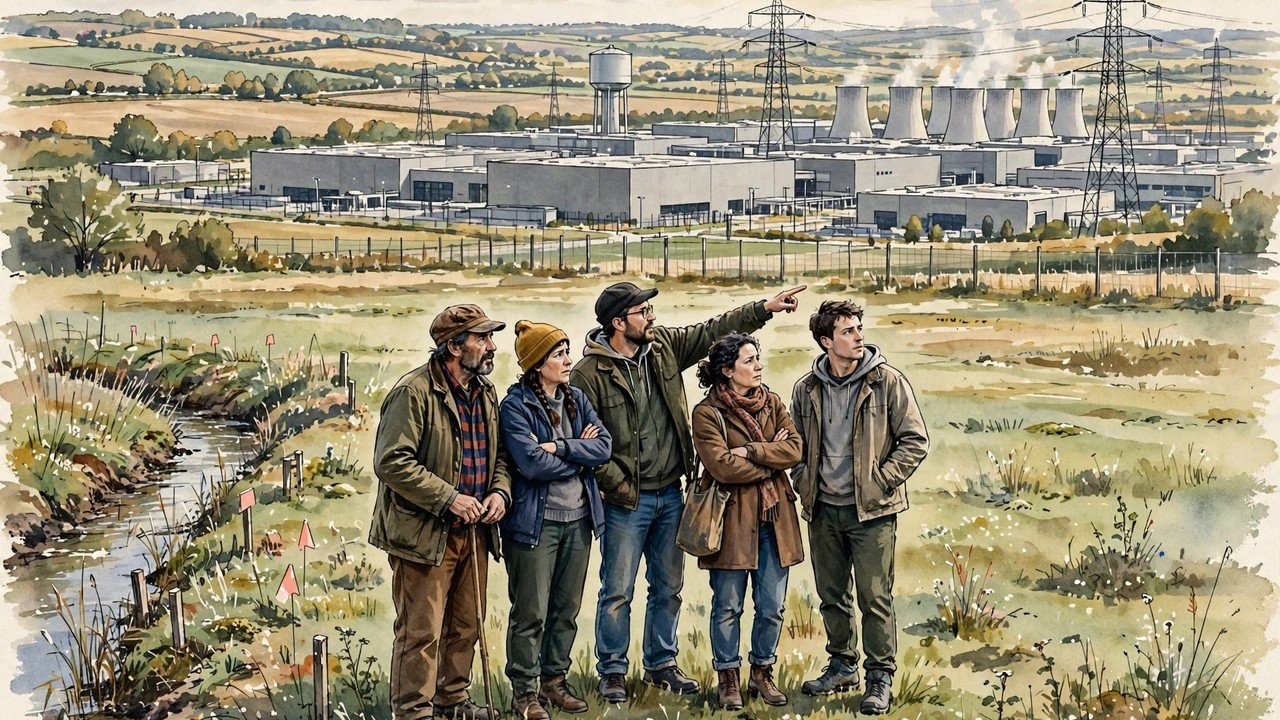
Everything described so far in this post — the circular investments, the debt, the talent auction, the chips — eventually has to stand somewhere. A frontier training run is not an abstraction. It is a set of buildings on a specific piece of ground, in a named county or parish, drawing a contracted quantity of electricity and rejecting a contracted quantity of heat. The spend becomes physical at this point, and physical things have addresses, planning histories and neighbours. They also have sizes that stopped being measured in the units of the property business some time ago. Campuses are no longer described by their floor area. They are described by their power.
The change of unit tells the story. A large data centre of the last decade was a 30 or 50 megawatt building. The campuses of this build-out are specified in gigawatts. Stargate’s first site, at Abilene, Texas, is a 1.2 gigawatt campus of eight buildings, built by a joint venture of Crusoe, Blue Owl Capital and Primary Digital Infrastructure on land held by Lancium, operated by Oracle on its cloud and used by OpenAI.64 Meta’s Hyperion, in Richland Parish, Louisiana, is planned to scale over time to several gigawatts.4 A campus in New Mexico leased to Oracle, known in its financing documents as Project Jupiter, is reported at 2.5 gigawatts.75 The planned campus in Ohio developed by SB Energy to host OpenAI’s compute is about 4.25 gigawatts.31 And the largest single announcement of all is not in the United States: Stargate UAE, announced on 22 May 2025 by G42, OpenAI, Oracle, Nvidia, SoftBank and Cisco, is a 1 gigawatt cluster — its first 200 megawatts due in 2026 — inside a 5 gigawatt UAE–US AI campus in Abu Dhabi covering ten square miles, described by its builders as the largest such deployment outside the United States.76 A gigawatt is roughly the output of a large power station. Each of these sites therefore has to be thought of as two projects, not one: a power project the size of a utility, and a computer building attached to it.
Abilene shows how the two projects are financed together, because its money is documented in unusual detail. The joint venture’s first phase, agreed in October 2024, was $3.4bn for two buildings and 206 megawatts, leased long-term — a fifteen-year lease, with the tenant unnamed in the release and reported to be Oracle. The second phase, on 21 May 2025, added $11.6bn of debt and equity, including a $7.1bn construction loan led by JPMorgan; across both phases JPMorgan’s debt came to $9.6bn and the sponsors’ equity to about $5bn, for a $15bn venture in total.64 The first phase went live on Oracle’s cloud on 30 September 2025 at more than 200 megawatts, and the full campus was due in mid-2026.64 Financial Times reporting in May 2025 put Oracle’s purchase of Nvidia GB200 chips for the site at about $40bn — that is, the chips cost more than twice the documented cost of the venture that houses them, a ratio worth holding in mind whenever the price of a campus is quoted as if it were the price of the capability.64
The xAI campuses in Tennessee and Mississippi show the same physical programme built at junk prices, and then changing hands. xAI’s June 2025 debt package was raised through two subsidiaries identified in the documents by their places — Memphis and Southaven — as $3bn of senior secured notes at 12.5 per cent and two $1bn term loans, for the Colossus build-out.87 Colossus 2 was financed through a vehicle of about $20bn, up to $7.5bn of equity and $12.5bn of debt, which buys Nvidia GPUs and leases them to an xAI subsidiary over five years.87 Then, in May 2026, SpaceX — which had absorbed xAI three months earlier — leased Colossus 1, a site of more than 300 megawatts holding more than 220,000 Nvidia GPUs, to Anthropic, after xAI had migrated its training to Colossus 2.59 A campus built by one laboratory, at 12.5 per cent money, ended up rented to its rival. The buildings and the power contracts are becoming a market of their own, separable from the companies that commissioned them, and a site’s second tenant may be its first tenant’s competitor.
Hyperion, the Louisiana campus, is documented differently — through the structure examined in Part Three — but its physical facts are plain. Meta contributed the land and the construction in progress to the joint venture with Blue Owl’s funds, and the venture’s total development costs are about $27bn, a figure that covers not only the buildings but the long-lived power, cooling and connectivity infrastructure attached to them.69 That composition matters. A substantial share of what a modern campus costs is not the hall the servers sit in; it is the substations, the cooling plant and the network that make the hall usable, bought for a working life far longer than the servers inside it. Meta leases the finished campus back, on initial four-year terms renewable out to twenty years, and guarantees its residual value up to a threshold that filing summaries put at about $28bn over the first sixteen years.69 The same pattern was then repeated by its own author at El Paso, Texas, where a campus of about a gigawatt — reported at 960 megawatts — was financed in July 2026 through a vehicle held 80 per cent by BlackRock-managed funds, with $12.5bn of notes serviced by twenty years of Meta rent.74
Oracle’s campuses show the same physical programme at a weaker credit. The campuses being built for it by Vantage Data Centers in Shackelford County, Texas, and Port Washington, Wisconsin, are supported by about $38bn of bank construction loans — reported in October 2025 as roughly $23bn for Texas and $15bn for Wisconsin, and in October 2026 as $23.25bn and $14.75bn respectively, at about two and a half points over SOFR with a four-year maturity.75 Project Jupiter in New Mexico carries a loan package of about $18bn from a bank group including SMBC, MUFG, BNP Paribas and Goldman Sachs.75 These are not loans to buy computers. They are construction loans, of the kind once raised against motorways and power stations, and they are secured in the end by one thing: the lease payments of the tenant whose name stands behind the site.
The list of named sites lengthens quickly once the second tier is included, and the pattern repeats at every scale. In Childress, Texas, Microsoft contracted with IREN for 200 megawatts of Nvidia GB300 capacity across four buildings known as Horizon 1 to 4, in a $9.7bn five-year agreement signed at the end of October 2025 that included a prepayment of about a fifth of the contract value.64 In West Virginia, Anthropic’s agreements with Nscale cover 460 megawatts at a campus called Monarch.64 In Texas again, a campus for Anthropic being developed by Nexus Data Centers was reported in 2026 with a financing package of about $15bn — and, significantly for this chapter, its own 1.6 gigawatt gas plant attached to the site, with the borrowing backstopped by Google.29 In Nevada, Switch’s securitised pool added a Reno campus of more than 52 megawatts to a master trust holding eleven data centres in five markets.140 And the largest portfolio transaction of the period was not a new build at all: the AI Infrastructure Partnership — BlackRock’s Global Infrastructure Partners, MGX, Microsoft, Nvidia, xAI, the Kuwait Investment Authority and Temasek — acquired Aligned Data Centers in a deal announced on 15 October 2025 at an enterprise value of about $40bn, for fifty-odd campuses totalling between five and six and a half gigawatts of operational and planned capacity.31 Land and power, assembled by somebody else, had become an asset class that could be bought whole.
It had also become collateral. Switch, the Las Vegas operator, had raised about $4.2bn across five asset-backed securitisations since 2024; its April 2026 issue, of $768m, added the Reno campus to a master trust whose eleven data centres in five markets serve more than 550 customers, with about 84 per cent of trust revenue coming from investment-grade customers — the credit quality of the tenants, not the buildings, being what the bond buyer is asked to price.140 Vantage, the developer behind Oracle’s Texas and Wisconsin campuses, appears in the research for this article in three separate lanes at once: as a securitiser, with the tenth issue since 2018 including Europe’s first data-centre asset-backed deal; as a borrower under a $2.75bn credit facility taken in June 2025; and as the project borrower on the $38bn of Oracle construction loans.140 Nscale’s August 2026 borrowing was likewise raised through borrower vehicles tied to named places — $1.85bn against Ward County, Texas, and $1.2bn against North Carolina.64 The geography of the build-out is written into its debt: each campus is a separate credit, in a separate vehicle, in a named county, and the map of the sites and the map of the loans are the same map.
What the buyers are buying, underneath the buildings, is a position in three queues at once: for land that can take the load, for a grid connection that can supply it, and for the water and cooling capacity to run it. The land itself is the simplest of the three, and even it is not simple. A campus site needs to be large, flat and cheap, but it also needs to sit within reach of high-voltage transmission, of fibre, and of a substation that either has spare capacity or can be expanded. That combination is why the same kinds of places recur — former industrial land in Texas, parish land in Louisiana, sites in the Ohio corridor — and why the counterparties in the documents are so often counties and parishes rather than companies: Shackelford County, Richland Parish, Port Washington, Childress.697564 Nvidia, in its January 2026 investment in CoreWeave, undertook among other things to help the company procure land, power and shell — the chip supplier acting as property scout for its customer, because land and power had become part of what a chip contract has to deliver.79
Power is the binding term, and the builders’ own arithmetic says so. The International Energy Agency projects global data-centre electricity consumption rising from about 485 terawatt-hours in 2025 to about 950 terawatt-hours in 2030 — a doubling in five years — and judges that about a fifth of planned data-centre projects are at risk of delay from grid constraints.67 The response, visible at the Nexus site in Texas, is to stop waiting for the grid and build the power station inside the fence: a 1.6 gigawatt gas plant developed as part of the campus package itself.29 Meta’s Prometheus cluster in Ohio and Hyperion in Louisiana were announced in July 2025, in Zuckerberg’s words, as the first of a series of multi-gigawatt clusters, with spending of “hundreds of billions” behind them.4 The next chapter examines what happens when every builder reaches the electrical supply chain at the same time; the point here is simpler. The campuses are sized by the power that can be contracted for them, not by the demand for computing in the year they open. They are built, like Prometheus itself on Meta’s own account, for the programme after next.
Power is also billed, and who pays for the build-out is now a documented fight with figures on both sides. In PJM, the capacity price — what customers pay generators to be available — cleared at $28.92 per MW-day for 2024/25, then $269.92 for 2025/26, costing $14.7 billion against $2.2 billion the year before, and then hit the federally approved cap in both following auctions — $329.17 for 2026/27, $333.44 for 2027/28 — the latter failing for the first time to procure PJM’s reliability requirement.234 PJM’s Independent Market Monitor, re-running the auctions without data-centre load, attributes $9.33 billion of the 2025/26 capacity cost to that load — about 63 per cent of the auction — with $7.27 billion, $6.50 billion and $6.27 billion in the three following auctions: $29.4 billion across four auctions, 46 per cent of the $63.6 billion total.235 The caveats belong with the numbers: these are wholesale capacity costs from a counterfactual model, not metered household bills, and most of the 2027/28 figure is load not yet built — households paying for forecast demand, 42 per cent of which had already been cancelled or delayed when the monitor told FERC so in September 2026.235 A Federal Reserve Bank of Dallas working paper estimates data centres raised wholesale electricity prices by 6.9 per cent nationally by 2025 — 15.4 per cent in the Northwest, 15.0 per cent in northern Virginia — reaching 12.3 per cent by 2028 in its preferred scenario.236
The other side deserves its full strength. A Lawrence Berkeley National Laboratory and Brattle Group study found United States retail prices roughly flat in real terms over 2019–2024, with the highest load-growth states generally recording real falls — over 1¢ per kWh in the highest-growth states — as fixed system costs spread over more units sold; it attributes recent increases mainly to distribution capital spending, fuel and storm costs, not load growth.237 Its own caveat: the window ends in 2024, before the PJM capacity shock reached bills, and PJM is where the pattern breaks.237 An Electric Power Research Institute working paper estimates data centres caused average retail rates to fall modestly over 2015–2024 — about 6 per cent lower at average growth — while cautioning that future supply constraints could reverse the effect.238 The literature splits along a visible line: studies ending in 2024 find flat-to-lower average rates; the post-2024 wholesale and capacity evidence finds sharp increases where the load is. Regulators have begun rewriting who pays — Oregon’s POWER Act of 2025 created a separate rate class for data centres, with minimum ten-year contracts and operators covering 90 per cent of contracted demand whether or not it materialises.239
Behind the named sites stands a stated appetite larger than all of them. In a post on 6 November 2025, Sam Altman put OpenAI’s commitments at “about $1.4 trillion over the next 8 years”, against an annualised revenue run-rate he put at above $20bn by the end of 2025.29 Commitments are not campuses, and Chapter 37 returns to what happens if they cannot be met; but a commitment of that stated size is a claim on land, connections and cooling that does not yet exist, made in advance of the revenue that is supposed to justify it. It explains the land-banking visible throughout this chapter — sites optioned, shells built, portfolios bought whole — better than any single campus does. The builders are not only housing the machines they have. They are reserving the ground for machines they have promised to want.
Water enters the accounts more quietly than power: at Hyperion the cooling sits inside the $27bn development budget as plant, alongside the buildings and the substations.69 But the metered record now exists, in vintages that must not be merged. The International Energy Agency’s estimate, in April 2025, put global data-centre water consumption at about 560 billion litres a year.240 Its World Energy Outlook 2026 put consumption in 2025 at 885 billion litres — of which only 240 billion litres, 27 per cent, was consumed at the data centres themselves, nearly 40 per cent was linked to power generation, and the rest to chip manufacturing and primary energy supply.241 Successive vintages of the same series, not separate quantities — and the second carries the finding that matters: most of the water is off-site, embedded in the electricity. Lawrence Berkeley National Laboratory found the same shape in the United States — about 66 billion litres on site in 2023 against nearly 800 billion litres indirectly through electricity — and projected the average site’s water efficiency worsening by 2028.242
Google, the largest disclosed user, withdrew 13,562 million gallons and consumed 10,523 million gallons at its data centres in 2025.243 Council Bluffs, Iowa consumed 1,346 million gallons in 2025 — about 3.7 million gallons a day — while Google’s air-cooled Dublin site consumed 0.1 million gallons all year: a difference of four orders of magnitude set by climate and cooling design.243 Meta consumed 753 million gallons in 2025, and is the only operator to disclose the water embedded in its purchased electricity — 72,207 megalitres in 2024, about 24 times its direct consumption.243 The industry’s rebuttal figure is honestly derived — a median Gemini prompt uses 0.26 ml of water — but a prompt is not the unit at which a county experiences a campus drawing 3.7 million gallons a day.244243
The fullest documented case is The Dalles, Oregon, a town of about 16,000, where learning the figure took a lawsuit. In September 2021 The Oregonian asked the city for Google’s historical water records; the city refused on trade-secret grounds, the county district attorney ordered release, and the city then sued the newspaper to keep its own records secret, with Google funding the city’s case.245 In December 2022 the city settled, releasing a decade of records; Google covered the city’s $106,000 legal costs and $53,000 owed to the newspaper’s lawyers.245 The figures exist in two versions, and must not be mixed. The city-metered series put Google at 355.1 million gallons in 2021 — roughly 29 per cent of all water used in the city, and nearly triple its 2017 use of 124.2 million gallons.246 Google’s own series: 358.3 million gallons withdrawn that year, 274.5 million consumed.246 For 2025 the unreconciled series diverge further: Google reports 654.3 million gallons withdrawn and 469.0 million consumed; a city-metered figure of about 550 million also circulates.246 Google committed $28.5 million to the city’s water infrastructure, having received more than $240 million in tax breaks there over fifteen years.246
Elsewhere the dispute was settled before the building opened, by changing what the building was. Google’s $200 million Cerrillos data centre in Santiago was approved in 2020 on a filing putting maximum draw at 169 litres per second of fresh drinking water — about 14.6 million litres a day — in a capital in a megadrought running since 2010.247 Residents organised as MOSACAT, won a referendum against the project in December 2019, and challenged the permit; in February 2024 Chile’s environmental court partially annulled the authorisation, requiring the aquifer effects to be assessed and the cooling reconsidered; Google withdrew the water-cooled design for air cooling.247 In Canelones, Uruguay, Google’s planned campus was designed to draw 7.6 million litres of potable water a day from the public system — a figure that became public through court proceedings — in 2023, the year drought left Montevideo’s main reservoir at about 2.4 per cent of capacity; the project as approved in July 2024 is air-cooled and a third of its original size.248 In Middenmeer, Microsoft and the municipality had told residents the campus would use 12 to 20 million litres of drinking water a year; the regional newspaper established that actual use in 2021 was 84 million litres, 75 million of it for cooling — four to seven times the stated figure.249 Microsoft’s response, which belongs with the figure, is that the total included substantial construction water and that the mostly air-cooled site uses water cooling only above 25 °C — six days in 2021; all North Holland data centres together used 550 million litres, about 0.5 per cent of provincial supply.249
What the record does not contain should be stated as plainly as what it does. A six-case review, and this post’s own research, found no documented case of a river or aquifer dried up by a data centre.248 The honest claim is narrower: a single campus can take between a quarter and two fifths of a small city’s water, can be permitted on drinking water in a drought capital, and can have its use understated to the residents around it by a factor of four to seven.248
Local politics, in the documents, rarely looks like a protest. It looks like a date. The clearest case in the research for this article is British. Nscale’s amended prospectus disclosed that a statement of work from Microsoft worth $3.22bn was terminated after the UK power provider withdrew the connection date for its Loughton site.64 No campaign, no court case, no ministerial decision: a grid operator moved a date, and a contract worth more than three billion dollars ceased to exist. The same company’s documents show the other end of the dependence — agreements with Microsoft for payments of up to $43.8bn through 2033 and with Anthropic for up to $44.6bn, against total active and contracted value of $103.4bn of which only $2.6bn was active when the prospectus was filed.64 Between the contract and the campus stands the connection, and the connection is granted by institutions that do not move at the speed of the money.
The Loughton case is the quiet end of a spectrum; at the other end, opposition has become organised and increasingly successful. Data Center Watch counted $64 billion of United States projects blocked ($18 billion) or delayed ($46 billion) amid opposition between May 2024 and March 2025, with 142 activist groups across 24 states.250 Later windows grew larger still, but they overlap and use differing definitions, so they are never summed here.250
The largest delayed project in that first report, the $24.7 billion Prince William Digital Gateway in Virginia, lost its zoning on procedure: on 31 March 2026 the Court of Appeals of Virginia held that the Board of Supervisors’ hearing advertising had violated Virginia Code § 15.2-2204(A), rendering the rezonings void from the start.250251 In Loudoun County — the world’s largest data-centre market — the Board ended by-right approval in March 2025, voted 7-1-1 in September 2026 to pause new applications, and formalised a twelve-month pause in November while it rewrites its standards: the centre of the industry pausing itself.251 In Tucson, Arizona, the mayor and council voted unanimously on 6 August 2025 not to consider Project Blue, a 290-acre campus whose end customer, revealed by a mistaken county document release, was Amazon Web Services; refusing annexation denied it city water but did not stop it — construction continued in the county.252 In Maine, LD 307 passed both chambers — the first statewide moratorium to clear a legislature — and would have frozen approvals for data centres over 20 MW until 1 November 2027; Governor Janet Mills vetoed it on 24 April 2026 while stating in her veto letter that “a moratorium is appropriate given the impacts of massive data centers in other states”, solely because it lacked an exemption for a $550 million project at the former Androscoggin Mill in Jay that had strong local support.253
Britain’s version runs the other way: the local decision is unmade in London. Three Rivers District Council refused a 96 MW campus on Green Belt land at Abbots Langley unanimously in January 2024; the Secretary of State allowed the appeal on 12 May 2025, on the ground that it would supply about 3 per cent of forecast London capacity growth and that refusal risked investment going abroad — and as of October 2026 no reserved-matters application had been filed, so the permission exists and the campus does not.254 At Woodlands Park in Iver, Buckinghamshire, refused twice by the council, approval was granted by the Secretary of State on 9 July 2025 for a scaled-back 72,000 m², 90 MW scheme; when Foxglove and Global Action Plan challenged the absence of a lawful Environmental Impact Assessment, the Government Legal Department conceded the case on 19 January 2026, four days before the High Court hearing, and agreed the approval should be quashed and redetermined.255
Against the billions stand the jobs, and here too an official audit has taken the headline apart. JLARC, Virginia’s legislative auditor, reported in December 2024 that the industry contributes 74,000 jobs and $9.1 billion of GDP a year to the state hosting the most capacity — and that 59,000 of those 74,000 jobs are construction-phase, with operations accounting for 15,000, of which only 4,400 are direct data-centre employees.256 JLARC found that a typical 250,000 square foot data centre employs about 50 full-time workers, roughly half of them contractors, while construction employs up to about 1,500 workers at peak.256 The economic case for a campus is therefore overwhelmingly a case about its construction, and it expires when the construction does. On tax, Virginia’s sales-tax exemption saved the industry $928.6 million in FY23 — by far the state’s largest incentive, the next closest worth $74 million.257 Auditors dividing what came back by what was given up found returns of 48 cents per dollar abated — and 22 cents in JLARC’s November 2026 follow-up.258 Georgia’s audit evaluation found the exemption there cost $474.2 million in forgone revenue in FY2025 against roughly $41 million in direct state tax revenue, and that only about 30 per cent of the construction was caused by the exemption — 70 per cent would have happened anyway.258
At this chapter’s own largest site the arithmetic is starkest. Hyperion was announced on 4 December 2024 with 500 or more promised jobs, against development costs Part Three puts at about $27 billion — roughly $54 million of development cost per promised permanent job; the Louisiana statute behind its twenty-year tax rebates requires a minimum of only 50 jobs per facility.259 After the July 2026 expansion the state’s figures rose to 1,000 or more direct jobs against an investment of $50 billion-plus — the jobs figure doubling while the investment quintupled.259 The watchdog Good Jobs First calculates that taxpayer costs can exceed $1 million per permanent job.260 The counterweight is real: data-centre revenue reaches 31 per cent of total local revenue in Virginia’s mature markets — in Loudoun the industry is the tax base of the very county that paused approvals in 2026.256 No state publishes an audited count of permanent jobs actually delivered against the promises; the delivery is unverified, which is not the same as saying the jobs did not arrive.261
Delay, accordingly, is not an accident of the programme but one of its regular features. JLL’s figures for 2025 record that 57 per cent of data-centre projects suffered a construction delay of three months or more; a typical 50 megawatt facility took about eighteen months to build, and orders for some materials were being placed up to twenty-four months ahead of need.65 Set that against the sizes in this chapter — twenty 50 megawatt facilities to make a single gigawatt — and the schedule of a campus like Hyperion or Abilene is a chain of hundreds of such orders, any of which can slip. The money, by contrast, does not slip. The loans are drawn, the leases are signed and the guarantees are live from the dates in the documents, whether or not the power is. That gap — between financial commitments that run from a signature and physical capacity that arrives when the transformers do — is where the next chapter begins.
27. The electrical bottleneck
The chips get the headlines, but the dates are decided by transformers. A graphics processor can be manufactured in months and air-freighted anywhere on earth. A large power transformer is built to order, by hand, in one of a small number of factories, weighs as much as a house, travels by rail and heavy-haul road under escort, and cannot be substituted by another maker’s unit at short notice because each is specified for its site. When every hyperscaler, every neocloud and every utility on three continents reaches for these machines in the same five years, the result is not a price negotiation. It is a queue, measured in years, and it now sets the real timetable of the build-out described in the last chapter.
The reference dataset is Wood Mackenzie’s survey series, and its figures deserve to be set out plainly. In the second quarter of 2025 the average lead time for a power transformer was 128 weeks — against a pre-pandemic norm of twelve to sixteen weeks. Generator step-up transformers, the units that connect a power station to the grid, averaged 143 to 144 weeks in the same survey, and by the first quarter of 2026 were over 160 weeks. The United States Department of Energy, reporting to Congress in July 2024, put the lead time for the largest transformers at commonly 36 months and up to 60. Medium-voltage switchgear averaged about 44 weeks, and high-voltage circuit breakers reached 125 weeks in the second half of 2025, up from 77 weeks in 2023.65 In Europe the position is worse: a benchmark published for the CWIEME exhibition in March 2026 put lead times for large power transformers at 48 to 60 months, against twelve to fourteen months before the pandemic, and advised that a large transformer ordered from a major maker in the fourth quarter of 2026 should be planned for delivery in 2030 or 2031.65
Prices have followed the queue. Power transformer prices were up 77 per cent on 2019; generator step-up prices up about 80 per cent over five years; medium-voltage switchgear up 50 per cent since 2021.65 The demand behind those numbers is not the data centres alone, and the chapter should not pretend otherwise: Wood Mackenzie attributes it to AI data centres, industrial electrification and the replacement of an ageing transformer fleet arriving together — demand for generator step-up units up 274 per cent since 2019 and for power transformers up 119 per cent.65 The same survey work put the supply shortfall at about 30 per cent for power transformers and about 10 per cent for distribution transformers against 2025 demand, with no meaningful relief projected before 2028.65 A shortage of a third, in the component without which no campus can be energised, is not a friction at the margin of the programme. It is a ration, and the ration is allocated by whoever ordered first and paid the deposit.
Behind the transformer queue stands a material queue, documented by the United States Department of Energy itself. Grain-oriented electrical steel — GOES — is about a quarter of a large power transformer’s cost and is used in about 95 per cent of American transformer cores.262 Since ATI left GOES production in 2016, one company has made it in the United States: Cleveland-Cliffs, melting and rolling at Butler Works in Pennsylvania and finishing at Zanesville, Ohio. It meets only 12 to 20 per cent of domestic large-transformer GOES demand. The highest-performance grade, permanent domain-refined GOES, is not manufactured in the United States at all; Nippon Steel is the sole qualified supplier for wound large-transformer cores.262 American transformer factories imported 88 per cent of their pre-cut GOES laminations, 80 per cent of pre-assembled stacked cores and 100 per cent of wound large-transformer cores, on Commerce Department figures carried in the DOE’s July 2024 report to Congress; the Congressional Research Service puts imported content at 50 to 75 per cent of the cores in American-assembled distribution transformers, and Metglas in South Carolina is likewise the sole American producer of the amorphous ribbon used in high-efficiency distribution units.262 GOES prices roughly doubled between 2020 and 2024. The steelmaker’s response, such as it is, runs forward into the product its steel constrains: in July 2024 Cleveland-Cliffs announced a $150 million distribution-transformer plant at Weirton, West Virginia, consuming Butler’s output and producing from the first half of 2026.262 A transformer ordered in America is thus, in its core, mostly an imported object assembled domestically — and the queue for the finished machine begins in a steel queue almost nobody outside the industry can see.
Gas turbines — the machines behind the build-your-own-power response described in the last chapter — are rationed the same way. Wood Mackenzie counted about 110 gigawatts of heavy-duty gas turbine orders by the end of 2025 against an industry able to build 60 to 70 gigawatts a year; a turbine ordered now delivers around 2031, and turbine prices were up 195 per cent on 2019 and heading towards about $600 per kilowatt.65 The makers’ order books confirm the position from the other side. Siemens Energy reported an order backlog of €136bn at the third quarter of its 2025 financial year, a record, and €138bn at the year end; its chief executive, Christian Bruch, said that about 60 per cent of the 14 gigawatts of gas-turbine orders taken so far that year were linked to United States data centres.66 The third quarter alone brought Siemens Energy €16.6bn of orders, up 64.6 per cent on a comparable basis, a book-to-bill ratio of 1.70 — for every euro of equipment shipped, €1.70 of new orders arrived to replace it in the queue.66 The bottleneck industry, in other words, can see exactly who is filling its books.
GE Vernova’s figures need care, because the company’s position moved fast and its 2025 and 2026 numbers describe different worlds; they are kept separate here, as they must be. In early 2025 GE Vernova had about 29 gigawatts of gas-turbine backlog and about 21 gigawatts of slot reservation agreements; by the third quarter of 2025 those had risen to about 33 gigawatts and about 29 gigawatts. A slot was not free: management told a Bernstein conference in May 2025 that the company required about 20 per cent of the contract price as a deposit before granting a slot reservation. At its investor day on 10 December 2025 the company said all its gas-turbine production slots were sold out through 2028, with output running at about 20 gigawatts a year annualised by mid-2026 and rising to 24 gigawatts in 2028, and total backlog expected to grow from $135bn towards about $200bn by 2028, with the electrification order book expected to double to $60bn.66 By the third quarter of 2026 — a different and later position — the total backlog stood at $197bn, with 64 gigawatts of firm gas-equipment backlog and 58 gigawatts of reservations, 122 gigawatts under contract in all, an electrification equipment backlog of $42.2bn, and slots being sold in the quarter for delivery in 2032.66 A buyer who signed in late 2026 was contracting for a machine to be delivered six years later, to power a campus whose computers, on the depreciation schedules examined in Part Seven, would be written down over a shorter life than the wait for their power supply.
Hitachi’s energy business tells the same story in a third currency: a backlog of $66.4bn, ¥10.5tn, at the end of September 2026, with quarterly orders up 47 per cent year on year.66 The makers are building capacity, but the capacity is itself queued. Hitachi Energy broke ground on 29 June 2026 on a $457m large-transformer plant at South Boston, Virginia, with volume output ramping towards 2028, as part of more than $1bn of United States grid manufacturing investment announced in September 2025; its Mississippi plant produces from 2029; Siemens Energy’s Indian expansion adds 30,000 MVA of capacity during 2030 to 2032.66 Most new transformer capacity arrives between 2028 and 2032 — the factories built to relieve the queue are standing in a queue of their own. Summing the five largest publicly reporting grid and switchgear suppliers’ disclosures from October and November 2026 gives more than $130bn of combined unfilled electrical backlogs; the figure is a measure of scale, not a league table, because the makers’ backlogs are not directly comparable — they differ in scope, currency and definition.66
The makers’ wider answer can now be dated, and every date in it falls after the campuses currently being built need their machines. Hitachi Energy announced $1.5 billion to ramp global transformer production in April 2024, then a further $4.5 billion by 2027 that June — double its investment of the previous three years — including about $330 million in Sweden, where the Ludvika flagship is being expanded for large transformers and HVDC. In September 2026 it announced a $528 million factory at Gallman, Mississippi, its largest single American investment, making the 10 to 160 MVA mid-range units data centres use at more than double the capacity of its existing Crystal Springs plant, producing from 2029 and completing an American manufacturing programme of about $1.5 billion.263 Siemens Energy finalised a $1 billion United States programme on 3 February 2026, adding more than 1,500 jobs: at Charlotte, North Carolina, it resumes large power transformer production and restarts gas-turbine manufacturing at a plant Siemens shut in 2020 when demand dipped, with turbines to ship again in the next two or three years; the programme adds turbine parts at Winston-Salem, blades and vanes at Tampa, generator components at Fort Payne, Alabama, and a new high-voltage switchgear plant in Mississippi.264 GE Vernova announced nearly $600 million of American factory investment on 29 January 2026 — $160 million of it expanding Greenville, South Carolina — as the first tranche of a $9 billion global capex and research plan through 2028, supporting up to eighty heavy-duty gas turbines a year against an average of about fifty-one a year in 2021–2025. In October 2026 it agreed to acquire Trench Group for $9.0 billion: the maker of the high-voltage bushings, instrument transformers and coils its own machines wait for, supplying more than eight hundred utilities and hyperscalers from eleven plants. The turbine maker is buying its own component bottleneck.265 Industrial Info Resources counts more than $3 billion of current and planned construction at American transformer factories alone, up from $1.85 billion in September 2025, with HD Hyundai Electric’s $200 million plant for extra-high-voltage units at Montgomery, Alabama, opening around mid-2027 among them.266 The shortage has become an investment cycle. The cycle’s output dates are 2027 to 2029.
Beyond the factory gate stands the second queue, and here precision matters, because there are two different queues and they are routinely confused. The best-documented one — Lawrence Berkeley National Laboratory’s Queued Up series — is the queue of generators and storage seeking permission to connect to the United States grid and supply it. It is a supply queue, not the queue of data centres seeking to draw power, and every figure that follows belongs to the supply side. That queue held about 2,600 gigawatts actively seeking interconnection at the end of 2023, against about 1,300 gigawatts of installed United States capacity; it fell to about 2,290 gigawatts at the end of 2024, its first decline in a decade, and to 2,061 gigawatts at the end of 2025 — 1,312 gigawatts of generation and 749 gigawatts of storage.67 Its history is a warning about what a queue entry is worth: the median project that reached operation in 2025 had taken 61 months from interconnection request to commercial operation, against 36 months in 2015 and 22 months in 2008, and only about 13 per cent of the capacity that queued between 2000 and 2020 had ever been built; more than 750 gigawatts withdrew in 2025 alone.67 The queue is also changing fuel under the pressure of the load: queued natural-gas capacity rose 86 per cent to 253 gigawatts by the end of 2025, while the solar, storage and wind queues all fell — to 773 gigawatts of solar, 749 gigawatts of storage and 220 gigawatts of wind in the 2025 position.67
Britain’s supply queue reached the point of institutional failure first. It peaked at 738 to 739 gigawatts — roughly three times the 200 to 225 gigawatts of clean generation Britain is judged to need by 2030 — and on 29 January 2025 the system operator, NESO, paused new applications altogether. An estimated 60 to 70 per cent of the projects in the queue were never expected to be built, and some connection offers under the old system carried dates ten to fifteen years out, into the 2040s.67 The reform, Ofgem’s approval of NESO’s TMO4+ package in April 2025 under the principle of “first ready and needed, first connected”, produced a reformed queue on 8 December 2025 giving 283 gigawatts of generation and storage firm Gate 2 places — 132 gigawatts for 2030 and 151 gigawatts for 2035 — and cut the queue by nearly two-thirds.67 And then the second queue announced itself: British demand-connection applications — the load side, the queue the data centres actually stand in — surged from about 41 gigawatts to about 125 gigawatts in roughly a year, on Ofgem figures reported in July 2026.67 Britain reformed the queue to supply power just as the binding constraint moved to the queue to consume it.
Europe’s supply queues are of the same order: about 1,700 gigawatts of renewable projects waiting in grid connection queues across sixteen countries, more than three times the additional capacity needed for the continent’s 2030 climate targets, with €7.2bn of clean power curtailed in 2024 because the networks could not absorb it.67 The International Energy Agency’s global count, in its September 2026 report on modernising grids, put at least 1,700 gigawatts of advanced-stage renewables and 600 gigawatts of grid-scale batteries waiting to connect as of 2025, put the cost of grid congestion at about $12bn in the United States and €4.3bn in the European Union in 2024, and judged that grid-enhancing technologies could unlock up to 330 gigawatts on existing networks.67 None of these figures is a data-centre figure, and this chapter does not present them as such. They are the state of the system into which the campuses of the last chapter must be connected: a system already holding years of unbuilt supply, in which a new gigawatt-scale load does not join the end of an orderly line but competes, with money and with deposits, for a place near the front of it.
Copper runs through all of it, and its arithmetic does not reconcile — which is itself the finding, so the figures travel here as a range and not a number. The IEA’s Global Critical Minerals Outlook 2025 puts refined copper demand rising from about 27 million tonnes in 2024 to about 33 million tonnes by 2035, while mined supply from existing and announced projects peaks in the late 2020s at a little over 24 million tonnes and falls below 19 million tonnes by 2035 — a shortfall of about 30 per cent — and a new copper mine takes about seventeen years from discovery to production.267 How much of that demand belongs to a data centre depends on whose intensity figure is used, and the figures war. An 80-megawatt Microsoft facility in Chicago used 2,100 tonnes of copper, about 26 tonnes per megawatt. S&P Global puts AI facilities at 27 to 33 tonnes per megawatt inside the fence, rising to 100 to 150 tonnes per megawatt once the grid connection is counted, and data-centre copper demand reaching 2.5 million tonnes a year by 2040. The Copper Development Association’s “up to 50,000 tonnes for a hyperscale facility”, repeated in financial coverage, implies several hundred tonnes per megawatt and reconciles with neither; it stands as the industry’s own outlier claim.267 The IEA’s Energy and AI report adds that data centres’ gallium demand alone could exceed 10 per cent of today’s global gallium supply by 2030.267 The honest statement is a range spanning an order of magnitude, drawn around metals whose supply lines are measured in decades.
Nor is the constraint only metal. The Associated Builders and Contractors calculates that American construction needed to attract 439,000 additional workers in 2025, puts the 2026 requirement at 349,000 net new workers and 2027’s at 456,000 — the gap persisting even as construction outside data centres cools.268 The Bureau of Labor Statistics counts 818,700 electricians employed nationally, about 81,000 openings a year, and employment projected to grow 9 per cent between 2024 and 2034, at a median wage of $62,350. The IBEW puts electrical work at 45 to 70 per cent of a data centre’s total construction cost, and the AI build-out’s requirement at more than 300,000 additional electricians over the decade; Brookings’ Darrell West, in the same reporting, called the shortage “quite dire” and “a leading barrier to data center construction”.268 The demand side said it out loud at Davos on 21 January 2026, when Nvidia’s Jensen Huang told BlackRock’s Larry Fink the build-out would need “plumbers and electricians and construction and steel workers and network technicians” — at six-figure salaries.268 The bottleneck, at this layer, is not manufactured at all. It is trained, over apprenticeships that take years, in numbers the industry’s own bodies say are not arriving.
What the queue does to a named project can be followed at Abilene, the first Stargate campus. Bloomberg reported on 6 March 2026 that Oracle and OpenAI had scrapped the planned expansion lease of about 600 megawatts after negotiations dragged over financing and OpenAI’s changing needs; The Information reported the harder fact underneath — power at the expansion site would not be ready for roughly a year, and by the time it arrived Nvidia’s Vera Rubin generation would be shipping, leaving the expansion built for the previous one.269 Oracle’s version, stated publicly on 9 March 2026, was that the coverage was false, the existing 1.2-gigawatt campus unaffected and the wider 4.5-gigawatt agreement on track.269 Three weeks later, on 27 March 2026, Crusoe announced a 900-megawatt expansion of the same campus for Microsoft, with behind-the-meter power generation of its own.269 Both versions of the dispute stand. The sequence is not in dispute: an expansion died, power readiness was reported as its cause, and its replacement brought its own power. Field research records the mechanism at project level. LATO’s interviews with twenty-nine data-centre practitioners in November 2026 include a hyperscaler campus in Northern California that broke ground after the utility estimated the transformers needed to connect it would be available in twenty-four months — an estimate that, once work started, became “10 years, if at all”, leaving the customer to order gas engines at roughly three times the unit cost of the diesel backup sets originally specified.270 Of the twenty-six interviewees who reported delays on their own projects, fourteen cited grid power, twelve permitting, nine late electrical equipment and three labour — electrical equipment the third-ranked cause in practitioners’ own accounting.270 One limit must be stated plainly, because this chapter will not borrow a name it does not have: no named, on-the-record admission by any hyperscaler ties a specific campus delay solely to transformer delivery. The documented named cases attribute delay to grid power readiness; the transformer-specific case is anonymised by its source. That is the state of the evidence, and it is stated here rather than filled in.271
That competition is the bottleneck’s real effect on the argument of this post. The electrical stack cannot be scaled by spending alone, because its supply is set by factory capacity that takes half a decade to add and by connection processes run by public institutions on public timescales. What money can buy is priority — the deposit that reserves the turbine slot, the order placed twenty-four months before the building needs it, the campus bought whole with its connections already granted.6566 The spend therefore does not abolish the queue. It decides who waits in it, and the waiting is increasingly done by everyone who cannot pay to jump it: the housing development, the factory extension and the town whose substation upgrade sits behind a data centre’s 160-week transformer in the same factory’s order book.6567
28. China spends differently
The American build-out described in the earlier parts of this post runs on three kinds of money: the profit pools of the hyperscalers, the circular investments by which suppliers finance their own customers, and the passive flows of index savers whose pension contributions buy the largest companies in proportion to their size. China’s build-out runs on a different machine. Its parts were assembled over twenty years, for other industries first, and artificial intelligence is only the latest load placed on them. The machine is the state, acting not mainly through grants or procurement, but through equity — through funds that buy stakes, municipal governments that behave like venture capitalists, and, since January 2026, a Hong Kong stock market willing to list laboratories that have never made a profit and may not make one for years.51272
The distinction matters because it decides who carries the risk when the spending fails to pay. In the American system, as the earlier chapters showed, the risk is spread across shareholders, bondholders, private-credit funds and anyone whose retirement savings track an index. In the Chinese system the risk is concentrated where the money starts: on the balance sheets of the state, its banks and its local governments, and increasingly on the Hong Kong public investors who have been invited to take a share of it. Both systems socialise the cost of the build-out. They differ in who does the socialising, and in how much of the process an outsider can see. The American version, for all its circularity, leaves a trail of SEC filings. The Chinese version leaves registry entries, fund charters and the occasional prospectus, and a great deal has to be reconstructed from those.272
The basic instrument is the government guidance fund. The legal framework dates from an NDRC measure in 2005 and a State Council decision in 2008, and it changed character after the 2014 Budget Law pushed the state away from direct grants and towards equity investment: instead of giving a chosen company money, a government fund takes a stake in a private fund, or in the company itself, and expects the stake to steer private capital in the direction the state wants.51 By 2024 the accumulated capital of these guidance funds was estimated at about ¥13tn, roughly $1.78tn — a figure that describes the size of the machinery rather than the amount spent on any one sector, and which should be read as an analyst’s synthesis of Chinese sources rather than an official total.51 Within that machinery, one research estimate holds that between 2000 and 2023 nearly a quarter of guidance-fund capital flowed to firms connected with artificial intelligence.51
Above the general machinery sits a set of named national funds, built for semiconductors first and then pointed at AI. The National Integrated Circuit Industry Investment Fund — the Big Fund — raised ¥138.7bn in its first phase in 2014 and ¥204bn in its second phase in 2019, and in May 2024 it registered a third phase with ¥344bn, about $47.5bn, of registered capital, with the Ministry of Finance as its largest holder at ¥60bn and six of the big state banks among its shareholders.51 The caution that applies to every Chinese fund figure applies here in full: registered capital is not paid-in capital, and paid-in capital is not money disbursed to companies. The number records an intention backed by the state’s balance sheet, which is not nothing — in the Chinese system it is close to a guarantee of direction — but it is not a bank transfer, and this chapter will not treat it as one.51
In January 2025, days after the United States tightened its chip export controls again, a dedicated vehicle appeared: the National AI Industry Investment Fund, with ¥60.06bn, about $8.2bn, committed, backed mainly by the Big Fund’s third phase and managed by Guozhi Investment in Shanghai.51 Its stated targets run across the whole chain — compute, algorithms, data, applications and embodied intelligence — with an emphasis on early-stage companies, the stage at which American venture capital was, by then, retreating from China.51 In December 2025 a further instrument was announced, a National Venture Capital Guidance Fund seeded with ¥100bn of central money and designed to mobilise ¥1tn, with a twenty-year life, at least 70 per cent of it directed to seed and early-stage investment, organised through more than 600 sub-funds across three regions.51 A twenty-year fund life is itself a statement. No American venture fund, and no hyperscaler’s capital budget, is set on a twenty-year horizon by design; the Chinese state is telling its own system that it does not need the money back inside a political or commercial cycle.51
The most distinctive part of the machine, though, is not in Beijing. It is in the cities. The city of Hefei, capital of Anhui province, became the model that other local governments study, through a run of bets that began long before AI: an investment in the display maker BOE in 2008, a founding stake in the memory-chip maker CXMT in 2016, and a rescue of the electric-vehicle maker Nio in 2020 at about $1bn, when the company was close to collapse.273 The CXMT bet completed its arc in the summer of 2026, when the company listed on Shanghai’s Star Market in an IPO reported to have raised more than $8.5bn; the municipal state-asset vehicle that holds Hefei’s stake, Hefei Industry Investment Holding, was upgraded by Fitch in June, citing the valuation gains from that listing.273 A city government had behaved like a venture firm, held its position for a decade, and been rewarded in the currency its own rating agency understands.273
Hefei is a model because it worked, and the Chinese debate is honest about the fact that the model does not always work. Local government financing vehicles, the LGFVs through which Chinese cities borrowed for property and infrastructure, are being pushed towards technology equity at exactly the moment when Beijing is trying to clean up what the IMF estimates as ¥71.4tn, about $10.5tn, of LGFV debt — the “hidden debt” of the property era.273 The risk has a name in Chinese discussion: “involution”, the pattern by which dozens of local governments back the same fashionable sector, duplicate one another’s bets, and crush prices and returns for everyone, including themselves.273 A system that directs capital politically will sometimes direct too much of it to the same place. That is not a Western critic’s discovery; it is an argument conducted inside China about China’s own machine.273
The machine’s growing weight can be measured in the funding rounds themselves. Government-affiliated investors appeared in about 16 per cent of Chinese startup rounds in the first quarter of 2025, against less than 5 per cent a decade earlier, while the foreign dollar funding that once supplied about half of Chinese startup capital in 2018 had fallen to about a tenth by January to August 2025.273 Government-linked investors backed more than 140 Chinese AI deals in 2025, against fewer than ten a year before 2018.272 The retreat of the American dollar and the advance of the state are the same event seen from two sides: as United States restrictions and political risk made China uninvestable for many Western funds, the state did not merely replace the missing money — it changed the terms on which money was available, from a commercial return within a fund’s life to a strategic return within a plan’s horizon.273272
How the money reaches an actual laboratory can be seen by taking the funding of a Chinese lab apart into its four sources, as one filing-based synthesis does. The first is founder money, of which DeepSeek is the extreme case and the subject of the next chapter: a laboratory run for years on the profits of a quantitative hedge fund, with no outside investors at all. The second is the strategic corporate — Tencent, Alibaba, Baidu and industrial champions such as the battery maker CATL and the carmaker Geely buying positions in laboratories whose models they will use, a Chinese version of the patronage that Chapter 7 described in America, with the difference that the patrons here act inside a system the state supervises. The third is the state funds themselves, investing through funds rather than by grant. The fourth, and since January 2026 the largest single source for the laboratories that have reached it, is the Hong Kong public market.274
DeepSeek’s first outside round, when it finally came in June 2026, showed all four sources arriving at once, and on terms that no American laboratory has accepted. The round was reported at more than ¥50bn in total, with about ¥20bn from Liang Wenfeng himself, ¥10bn from Tencent and ¥5bn from CATL; the outside investors bought into a limited partnership managed by Liang, took no votes, and accepted a five-year lock-up — while the National AI Industry Investment Fund, alone among the investors, bought in directly and took a vote.274 Read that structure carefully, because it is the Chinese model in miniature. Private and corporate money was welcome, but it was not given control. State money was a minority of the round, but it was the only money that came with a seat inside the room. The founder kept the laboratory; the state kept its hand on the laboratory; and the price of both arrangements was paid by investors who accepted them because access to DeepSeek was worth more than governance rights.274
The Hong Kong turn is the newest part of the machine, and the most revealing. On 8 January 2026 Zhipu AI became the first Chinese large-language-model laboratory to list, raising HK$4.35bn, roughly $552–560m, in Hong Kong at a valuation of about $6.6bn; its register already contained Beijing and Shanghai municipal funds and Alibaba, its lead manager was the partly state-owned CICC, and it had been placed on the United States Entity List in January 2025, cited for military modernisation — a listing that closed American capital to it and made the Hong Kong route a necessity rather than a preference.272 The next day MiniMax listed, raising HK$4.82bn, about $619–620m, at HK$165 a share and a valuation of about $6.5bn; its shares rose 109 per cent on the first day, against Zhipu’s 13 per cent, its retail tranche was oversubscribed 1,240 times, and its cornerstone investors included Alibaba, Abu Dhabi’s ADIA, Boyu and Mirae.272
What those listings disclosed is as important as what they raised. Zhipu’s prospectus showed a net loss of ¥2.4bn in the first half of 2025 on revenue of ¥190m, research and development spending of $228m in that half-year — more than eight times its revenue — and a monthly burn of ¥327m that gave it about two years of runway before the IPO and about three years after it.272 MiniMax’s accounts showed revenue of $53.4m in the first nine months of 2025 against a net loss of about $512m, with about 90 per cent of its IPO proceeds assigned to research and development.272 These are companies that, in the words of Reuters Breakingviews, would once have been considered too early in their development for public markets at all. They listed because the private and foreign capital that used to carry laboratories at this stage had dried up under the pressure of the United States–China conflict, and Hong Kong’s Chapter 18C route for pre-profit specialist technology companies was open.272 Across the first three quarters of 2026, that route carried HK$36.2bn across nineteen deals.272
Nor did the listings end the raising. Within months Zhipu placed new H shares for about HK$31.4bn, roughly $4bn — more than seven times what its IPO had raised — and MiniMax raised a further HK$9.54bn in a placement and HK$6.50bn in convertible bonds, more than three times its IPO proceeds.272 The pattern is worth setting beside the American one. An American laboratory raises private rounds at rising valuations from a small circle of patrons and suppliers, and treats a public listing as a distant event to be postponed while losses are large. A Chinese laboratory now lists early, discloses losses that would frighten a private patron, and then returns to the public market repeatedly, because the public market — encouraged by the state’s visible sponsorship — is willing to keep paying.272 The median Chinese AI deal in May 2026 was only $7.4m; the money concentrates, as it does in America, in a handful of leaders, with Moonshot reported at a private valuation of about $50bn and a Hong Kong listing of up to $5bn planned for the first quarter of 2027.272
Below the leaders, the next channel is private credit. The research for this chapter records the direction plainly — Asia-Pacific private credit is projected as the coming source of finance for the tier of Chinese laboratories below the listed leaders — but the specific figure retrieved for it was incomplete, and it is not quoted here, because a number that cannot be carried whole should not be carried at all.272 The direction itself, though, completes the parallel with America. In the United States, the spending began on hyperscaler balance sheets and migrated downwards and outwards into bonds, private credit and off-balance-sheet vehicles, as Parts Two and Three described. In China it began in state funds and is migrating downwards and outwards into public equity and private credit. The two systems started at opposite ends — private profit in one, state equity in the other — and are arriving at the same place: a structure in which the cost of building artificial intelligence is distributed across the whole financial system, and in which a failure of the technology to pay would therefore not be a private event for the companies that built it.272
One analyst formulation of the Chinese system deserves to be carried in its own terms, because it reverses the usual Western reading. ChinaTalk’s argument is that in China the bubble is also industrial policy: that overinvestment, which a commercial system records as waste, is in the Chinese system partly a feature, buying capacity, trained engineers, supply chains and learning that remain in the country even when the individual company that received the money fails.51 The Hefei record gives that argument its evidence — a city can lose on individual bets and still end with a display industry, a memory-chip maker and an electric-vehicle industry inside its boundaries.273 The American system has its own version of the same defence, made for it by the Bank for International Settlements’ historians rather than by its government: the railways and the fibre networks were overbuilt too, and the country used them for a century. Chapter 36 takes up that argument directly. What can be said here, at the end of the financing comparison, is narrower. China spends differently because China is organised differently: the state is the patient investor, the cities are its venture arm, the public market has been opened early to loss-making laboratories, and the whole structure is designed to keep building through a downturn that would stop a commercial system — at the price of carrying the losses, when they come, on the state’s own books and on the books of the local governments least able to bear them.51273272
To see why the guidance-fund form matters, consider what it replaced and what it avoids. A grant is spent and gone; it creates no asset, no discipline and no return, and after the 2014 Budget Law it also created accounting problems the Chinese state wanted to escape. A state bank loan creates a debt that must be serviced whether or not the borrower succeeds — the mechanism that loaded the LGFVs with the hidden debt now being cleaned up. Equity sits between the two. A guidance fund that takes a stake in a company, or a limited-partner stake in a private fund that then invests, shares the loss if the company fails and shares the gain if it succeeds, and its presence is itself the signal: private investors who might not have examined a sector, or a city, follow the state’s money because the state’s money announces that the sector will be protected, supplied with land, power and permissions, and not regulated out of existence next year.51273 That signalling function is why the sums in the fund charters, even discounted for the gap between registered and disbursed capital, move real money many times their size — and why the ¥100bn venture guidance fund announced in December 2025 was designed, in its own terms, to mobilise ten times its seed.51
The same form explains the system’s characteristic failure. When the signal is national — semiconductors after 2014, artificial intelligence after 2023 — every province and city hears it at once, and each local government, judged by its own officials on the industries it lands, has a reason to build its own version of what its neighbour is building. The result is the duplication the Chinese debate calls involution: too many guidance funds chasing the same small set of credible laboratories and chip designers, bidding up their valuations, while second-tier cities fund second-tier copies of the same projects.273 The American system has a mirror-image failure: too many private patrons chasing the same two or three laboratories, as Chapter 7 showed, with valuations set by what a supplier will pay to keep a customer. Neither system allocates its capital calmly. They allocate it competitively, one through ministries and municipalities, the other through markets — and in both cases the competition is precisely why so much is spent.273272
The semiconductor funds also supply the cautionary precedent that hangs over the AI funds, and an honest account of the Chinese model has to include it in general terms: money directed at this scale, through this many layers of funds and local vehicles, is hard to audit, and the distance between a fund’s charter in Beijing and a disbursement in a provincial city is measured in intermediaries, each with its own incentives.51 What can be verified from the research assembled for this article is the structure and the totals, not the probity of every disbursement, and this chapter makes no claim either way about individual funds. What the structure guarantees is opacity of a particular kind. An American reader who wants to know what the AI build-out costs can begin, however imperfectly, from audited filings: capex lines, lease commitments, bond prospectuses, a draft IPO document from Anthropic that put $518bn of future commitments in print.1 A reader of the Chinese build-out works from fund registrations, state-media announcements and the prospectuses of the minority of companies that list. The two systems are both spending sums that strain comprehension; only one of them is required, by its own rules, to show its working.51272
That is why the Hong Kong listings matter beyond the money they raised. A prospectus is a disclosure machine. When Zhipu and MiniMax listed in January 2026, the Chinese model produced, for the first time, documents in which a frontier Chinese laboratory’s losses, burn rate and runway were stated in figures an outsider could check: Zhipu losing ¥2.4bn in six months on ¥190m of revenue, MiniMax losing about $512m in nine months on $53.4m.272 The numbers were, by American standards, small — the entire Zhipu IPO raised roughly what Meta spends on its AI programme in a few days — but their existence changes the argument about China’s spending. It is no longer necessary to guess whether Chinese laboratories burn money like American ones. On their own published figures, they burn it faster relative to their revenue: Zhipu’s research spending in a single half-year was more than eight times everything it sold.272 The Chinese difference is not efficiency of spending. It is the identity of the spender standing behind the loss, and the length of time that spender is willing to wait.272
There is a final feature of the Chinese system that the financing figures alone do not capture, and it connects this chapter to the next. Because the state is the standing investor, a Chinese laboratory’s scarcest resource is not money. Chinese founders and officials say, in different words, the same thing that Liang Wenfeng of DeepSeek said in his interviews: the binding constraint on Chinese AI is chips, not money.275 Tencent’s president made the corporate version of the same admission when he explained that his company’s 2025 capital spending had been suppressed by the supply of graphics processors, and that Tencent would have spent more if more accelerators had been available.276 A system in which money is abundant and compute is rationed spends its money differently from a system in which compute is abundant and money must be justified. It stockpiles. It builds domestic substitutes at whatever cost in efficiency. It trains on the chips it can get and engineers around their weaknesses. And it gives the resulting models away, because the return it needs from them is not a margin on tokens but a position in the world’s technical order. That is the subject of the next chapter, and it is the largest single fact in this part of the post: the enormous Chinese effort is not a smaller copy of the American one. It is a different answer to the same question — what a country, and not just a company, is willing to spend to avoid being left out of the technology on which the next era’s power may rest.275276
The chronology is worth holding in one view, because the speed of the machine’s assembly is part of the story. In 2014 the Big Fund’s first phase and the Budget Law’s turn to equity set the form. In 2019 the Big Fund’s second phase, at ¥204bn, extended it. In May 2024 the third phase registered ¥344bn — the largest of the three, raised at the moment when American export controls had made domestic semiconductor capacity a matter of national urgency rather than industrial preference.51 In January 2025 the National AI Industry Investment Fund was established with ¥60.06bn, days after a further tightening of those controls.51 Through 2025 government-linked investors appeared in more than 140 AI deals.272 In December 2025 the venture guidance fund added a ¥100bn seed designed to mobilise ¥1tn over a twenty-year life.51 In January 2026 the first two laboratories listed in Hong Kong, and within months both had returned to the market for sums several times their IPO proceeds.272 In June 2026 the state’s AI fund took its direct, voting stake in DeepSeek.274 Each step followed the logic of the one before: as foreign capital withdrew and American restrictions tightened, another part of the Chinese state’s financial machinery was pointed at the gap. Whatever else is said about the system, it does not hesitate. The interval between a channel closing and a state channel opening in its place has repeatedly been measured in months.51272
Set against the American figures in this post, the Chinese state funds are not, in themselves, the larger sums. The Big Fund’s third phase, at about $47.5bn of registered capital, is smaller than a single year of capital expenditure at Microsoft or Alphabet, and the National AI Fund’s $8.2bn would not cover Meta’s spending for a month at its 2026 rate.51 Their importance is not their size but their position: they sit at the base of the pyramid, absorbing the earliest and riskiest stage of investment, certifying sectors and companies for the municipal funds, the strategic corporates and now the Hong Kong market that build on top of them.51274 The American pyramid is inverted. Its base is the broadest money of all — the index savings of millions of households, committed automatically — and its risk concentrates at the top, in a handful of companies whose valuations carry the whole structure, as Chapter 35 describes.19 China’s risk concentrates at the bottom, in the state funds and city vehicles that seed everything else, where losses can be carried quietly for a long time and where, equally, they can accumulate unseen. An American failure would be loud: share prices, bond spreads and index values would announce it the day it happened. A Chinese failure could be silent for years, and then arrive as a fiscal fact — another tranche of local-government debt for Beijing to refinance, in a system already carrying an estimated ¥71.4tn of it.273 Which failure mode is safer is a question this post will not pretend to settle. That the two systems have chosen opposite ones is a fact, and it is the deepest sense in which China spends differently.273272
One more comparison completes the financing picture, and it concerns what each system asks of the companies it funds. The American patrons of Parts Two and Three ask for position: cloud consumption, chip orders, a stake in the laboratory whose models will draw the world’s users, a place in the index that the passive money must buy. Their return is expected, in the end, in money, and the reckoning — as the losses in Chapter 32 show — is postponed rather than cancelled. The Chinese state asks for something else first: that the industry exist, inside China, under Chinese control, with its supply chains and its standards and its trained people on Chinese soil.51 A laboratory that achieves that has delivered the return its largest backer most values, whether or not its own accounts ever balance — which is why Zhipu could list in Hong Kong carrying losses of more than twelve times its half-year revenue, why the state’s fund could take its DeepSeek stake on terms that gave private investors no vote and itself the only one, and why the “bubble is also industrial policy” argument is not a rationalisation invented after the fact but a description of the machine’s design from 2014 onwards.27227451 It also means the Chinese effort has a floor under it that the American effort does not. If the models disappoint commercially, the American system must eventually stop, because its money is other people’s savings entrusted for return. The Chinese system can continue at a reduced level almost indefinitely, because its money is the state’s, and the state has decided the capability itself is the return. That difference — not any single fund, listing or laboratory — is what the rest of the world is competing against, and it is why the next chapter’s subject, the sheer scale of the effort and the free models it produces, has to be understood as the output of this financing machine rather than as a separate surprise.51272
For the reader who wants the whole contrast in one place, it is this. American AI is financed from the top of the world’s richest companies downwards: profits first, then supplier credit dressed as investment, then bonds, then private credit and off-balance-sheet vehicles, with the savings of the index-tracking public underneath everything, committed without a decision ever being taken by the saver.19 Chinese AI is financed from the bottom of the world’s most organised state upwards: guidance funds and national funds first, municipal venture vehicles and strategic corporates on top of them, and a public market opened early — before profit, before maturity, in Zhipu’s case while on an American blacklist — to carry the final stage.51272 In America the state appears at the edges of the story: as customer, as licensor of chips, as the regulator warning about the risks, as Chapter 30 will show. In China the state is the story’s first mover and its investor of last resort. Both arrangements have produced, in under four years, spending programmes among the largest in industrial history. Both have produced laboratories that lose money at a rate their revenues cannot yet justify. And both rest on a belief that the cost of being left behind exceeds the cost of the build-out — a belief that, in China’s case, does not have to survive a quarterly earnings call, a shareholder vote or an election fought on the subject, which may in the end be the most consequential difference of all.51272
29. China’s enormous effort and the open-weights weapon

The financing machine described in the last chapter would matter little if the effort it funded were small. It is not small. It is the second-largest programme of AI construction on earth, pursued by a country that is barred from buying the best tools for the job, and it has produced the one development that the American spenders did not plan for and cannot buy their way past: a stream of frontier-class models, given away free, at a pace of roughly one significant release every few weeks, which now account for a rising share of all the AI actually used in the world. This chapter sets out the scale of that effort — the platform companies’ capital spending, the data centres, the laboratory at its centre, the release cadence and the adoption figures — and then examines the giveaway itself as what it is: not generosity, and not carelessness, but a weapon aimed with some precision at the business model on which the entire American build-out depends.276277278
Begin with the platform companies, because in China, as in America, the largest spenders are the incumbent giants. On 24 February 2025 Alibaba announced that it would spend RMB380bn, about $53bn, over three years on AI and cloud infrastructure — the largest capital commitment in the company’s history, exceeding its total capital expenditure of the previous decade.276 The promise was kept at a pace that surprised even its own framing: actual capex for the financial year ending March 2025 was RMB85.97bn, up 168 per cent year on year; the following year’s figure reached RMB126.94bn; about RMB190bn of the three-year plan was reported spent by the end of June 2026; and in the September 2026 quarter alone Alibaba spent RMB50.5bn, up 60 per cent year on year.276 In May 2026 Reuters reported that Alibaba would exceed the RMB380bn plan, with margin explicitly secondary to the build-out — the same subordination of profit to position that the American hyperscalers had announced, in almost the same words, two years earlier.276 Eddie Wu set the direction in September 2025: Alibaba Cloud’s global data-centre capacity is to pass 20 gigawatts by 2032.276
Tencent’s numbers tell a more revealing story, because Tencent admitted what limited them. Its capital expenditure for 2025 was RMB79.2bn, up only 3 per cent on 2024’s RMB76.8bn, on revenue of RMB751.8bn — a modest rise that its president, Liu Chiping, explained on the results call: spending had been suppressed by the supply of graphics processors, and Tencent would invest more in 2026 if more accelerators were available.276 The constraint was chips, not money, not will. Then, as supply loosened — through domestic production, stockpiles and the channels Chapter 25 described — the spending broke loose: RMB31.9bn in the first quarter of 2026, RMB52.8bn in the second, RMB81.4bn in the third, that last figure equal to 39 per cent of the quarter’s revenue and a headline rise of 527 per cent year on year; across nine months of 2026 Tencent spent RMB166.2bn, more than double its entire 2025 total, moving its balance sheet from net cash towards net debt and accumulating large compute prepayments.276 A company does not prepay for compute it does not intend to use. Tencent’s balance sheet in 2026 is the record of a buyer who had been kept waiting at the chip counter and, when the queue moved, bought everything in reach.276
ByteDance, the owner of TikTok and the largest of the unlisted spenders, must be handled differently, because its figures are disputed and the dispute is on the record. Reuters reported exclusively on 23 January 2025, citing sources, that ByteDance planned more than RMB150bn, about $20.6bn, of capital expenditure for 2025, mostly for AI, with roughly half to be spent abroad, and named Huawei, Cambricon and Nvidia among the beneficiaries.276 ByteDance’s own response was a denial: “the anonymously sourced information about our spending is incorrect.”276 The Financial Times’ rival figure for the same plan was about $12bn on AI infrastructure — some 70 per cent below the Reuters figure, with neither number confirmed by the company.276 Later reporting put ByteDance’s actual 2025 capex above RMB150bn, of which about RMB90bn was AI compute, with a 2026 plan of about RMB160bn including some RMB85bn of AI chips.276 This chapter carries the denial alongside the numbers, as the numbers deserve: what is certain is that ByteDance is one of the largest AI buyers in China, that its Doubao models compete at prices discussed below, and that the true size of its programme is known precisely only inside the company — a small, perfect example of the disclosure gap between the two systems that Chapter 28 described.276
Baidu, the oldest of China’s search companies and the earliest of its AI investors, shows the scale at the smaller end. Its capital expenditure for 2025 was RMB12.06bn, up 48.6 per cent, with research and development of RMB20.4bn; by the second quarter of 2026 it spent RMB11.39bn in a single quarter — roughly a whole prior year in three months — with free cash flow deeply negative and the gap funded by borrowing, while its GPU cloud revenue rose 283 per cent year on year.276 The scale note from the research for this article deserves to be quoted in substance, because it disciplines everything in this chapter: Baidu’s entire 2025 capital expenditure is about one month of one American hyperscaler’s.276 The Chinese platform totals are large in absolute terms and an order of magnitude below the American five. The enormous effort is enormous in organisation, in people and in output — not yet in dollars, which is itself one of the facts the American spenders find hardest to price.276
Underneath the corporate spending sits the physical build. Rystad Energy estimates China’s installed data-centre capacity at 32 gigawatts at the end of 2025, rising to 40 gigawatts at the end of 2026 and more than 60 gigawatts by 2030, with data-centre power demand reaching 289 terawatt-hours by 2030 — 2.3 per cent of national demand, growing at 19 per cent a year.279 Citi’s figures differ in scope and should not be blended with Rystad’s: Citi puts Chinese AI infrastructure investment at RMB508bn in 2025 rising to RMB1.048tn in 2026, and operational capacity at 34.3 gigawatts in 2025 rising to 55.2 gigawatts in 2028.279 A reported NDRC-led plan goes further: about ¥2tn, roughly $295bn, over five years for a national AI data-centre network, run largely by China Mobile and China Telecom, with at least 80 per cent domestic technology mandated, and a possible ¥5tn once grid upgrades are counted — a reported plan, not an enacted budget line, and carried here as such.279 The National Data Administration records more than 13.73 million standard racks in use at the end of 2025, and notes that the East Data West Computing hubs — the state’s project to site compute inland, near cheap power and cool air — took more than 80 per cent of the new compute added in 2025.279 The contrast with America is structural. The American build-out is a scramble by competing companies for grid connections, land and turbines, fought county by county, as Chapters 26 and 27 described. The Chinese build-out is steered: capacity is directed inland by policy to where the power is, the way freight was once directed by rail plans. Each system has the failure mode of its virtues — America’s is local blockage and speculative duplication by rivals; China’s is building where the plan says rather than where the demand is — but only one of them can decide, centrally, that a fifth of a continent’s new compute will stand in its western deserts, and make it so.279
At the centre of the effort stands a laboratory that does not fit any of the categories this post has used so far. DeepSeek is not a hyperscaler’s internal lab, not a venture-backed startup, not a state institute. It is wholly a creature of High-Flyer, the quantitative hedge fund co-founded by Liang Wenfeng, and for its first years it was funded entirely by that fund — no outside fundraising, and, at the time Liang gave his interviews, no plans to raise any.275 Its parent made its money by using machine intelligence to trade Chinese markets; the laboratory was, in effect, a trading firm’s research department that walked out of the building and began publishing. The consequences run through everything DeepSeek has done since. A laboratory funded from trading profits has no venture investors requiring an exit, no patrons requiring cloud consumption in return for their cheques, no revenue target and no share price. It can pursue a research goal across years of silence. And it can give its models away, because nothing in its funding requires the models to be sold.275
Liang Wenfeng’s stated positions, given in interviews with 36Kr and Waves in 2023 and 2024, are the clearest account any frontier laboratory leader has given of the open-weights philosophy, and they deserve to be set out as he put them. The goal is AGI, not applications revenue. Open source is “more of a cultural act than a commercial one”. A closed-source moat is not sustainable. And the binding constraint on Chinese AI is chips, not money.275 Each claim is also a strategic position, and Liang is too careful a man for that to be accident — the cultural framing disarms the question of how a hedge fund’s laboratory serves any national purpose, while the moat argument tells every developer listening that the American labs’ closed products are a temporary condition, not a permanent order.275 But the positions have been borne out by conduct, which is more than can be said for most laboratory leaders’ interviews. DeepSeek did commit to open-sourcing all its models, and, as the release record below shows, it did so, at a cadence no Western laboratory has matched.275277
Even DeepSeek’s hardware is disputed ground, and the two versions frame the whole argument about Chinese efficiency. The company publicly acknowledged a fleet of about 10,000 A100 processors in its early period. SemiAnalysis, in Dylan Patel’s estimate, put the true figure at upwards of 50,000 Hopper-generation processors once H800 and H100 stockpiling is counted.275 If the smaller figure were the whole story, DeepSeek’s results would imply an efficiency advantage so large as to change the economics of the entire industry. If the larger figure is right, DeepSeek is a well-stocked laboratory that engineered brilliantly under constraint — formidable, but not magic. Chapter 33 returns to the training-cost version of this dispute, where the same two numbers appear again in dollar form. What neither version disputes is the output: from a standing start in 2023, a hedge fund’s laboratory in Hangzhou produced, within two years, models that the world’s largest companies now use, fear and copy.275
The state arrived late to DeepSeek, and the timing is the point Chapter 28 made with its funding structure. For five years the laboratory needed nothing from Beijing. Only in June 2026, after the strategic value was proven to the entire world, did outside money come in — more than ¥50bn of it, with the National AI Industry Investment Fund taking its direct stake with a vote while Tencent, CATL and the rest accepted a founder-managed partnership without one.275274 The Chinese system is often described in the West as the state picking winners in advance. The DeepSeek case shows the other mode, and it may be the more effective one: the state lets a hundred private efforts run, watches which of them the world validates, and then arrives with money, protection and a seat at the table for the winner — late enough not to have smothered it, early enough to bind it to the national project before anyone else does.274275
DeepSeek is the famous case, but the effort’s depth is in the field behind it. Alibaba’s Qwen team, Moonshot AI, Zhipu, MiniMax, Baidu and ByteDance’s Seed organisation all run frontier programmes, and their combined release record is the most striking artefact of the Chinese effort. One dated timeline, traced to primary sources, counts 67 Chinese open-weight releases; DeepSeek alone accounts for about thirty tracked releases between November 2023 and October 2026, twenty-nine of the thirty with downloadable weights, averaging one release every thirty-seven days.277 No organisation in the history of software has published significant work at that pace for three years. The cadence is itself the strategy made visible: by the time the world has finished evaluating one model, the next is out, and the conversation — the benchmarks argued over, the fine-tunes begun, the defaults set in a thousand codebases — never has a chance to settle on anyone else’s terms.277
The DeepSeek line runs like a drumbeat. November 2023: the first DeepSeek LLM and Coder releases. 6 May 2024: V2, a 236-billion-parameter model with 21 billion active, whose pricing started the token price war that Chapter 33 examines. 26 December 2024: V3, at 671 billion parameters. 20 January 2025: R1, the first open reasoning model to rival OpenAI’s o1, released under the MIT licence — the release that moved markets on the other side of the world. March 2025 brought V3-0324, with the licence moved to MIT; May brought R1-0528, with distillation explicitly permitted — an invitation, in writing, for anyone to train smaller models on the reasoning of DeepSeek’s largest. August 2025: V3.1, the first single model to combine thinking and non-thinking modes. September and December 2025: the V3.2 line, with DeepSeek Sparse Attention. Through 2026: the V4 family, up to a V4 Pro preview of 1.6 trillion parameters, again under MIT.277 Read the licences in that sequence again. At each step where the company might have tightened its terms — as its models became valuable, as American rivals restricted theirs — it loosened them or held them open. That is not the behaviour of a company that has failed to think about monetisation. It is the behaviour of a company that has thought about something else.277
Alibaba’s Qwen pursued the same strategy by flood rather than by drumbeat. In September 2024 the Qwen2.5 family arrived in dozens of sizes at once, a size for every device and budget. In April 2025 Qwen3 followed, from 0.6 billion to 235 billion parameters, under Apache 2.0, with hybrid thinking modes. July 2025 brought Qwen3-Coder, a 480-billion-parameter coding model. September 2025 brought three families in a single month — Qwen3-Next, Qwen3-Omni and Qwen3-VL — while Qwen3-Max, passing a trillion parameters, appeared API-first, the exception that marks the boundary: Alibaba’s very largest model was not open at launch.277 By August 2026 Qwen3.8, at 2.4 trillion parameters, appeared under a custom Qwen licence rather than Apache 2.0 — the first sign, at the very top of the range, of the same drift towards bespoke terms that the next sections trace at Mistral.277 The flood had a purpose the drumbeat did not need: Qwen was not only a model family but Alibaba Cloud’s shop window, and every size released was another door through which a developer might walk into Alibaba’s ecosystem and, eventually, its cloud.277280
The depth of the field showed itself most clearly in a single month. Within seventeen days in the summer of 2025, four Chinese laboratories shipped frontier-class open models. MiniMax came first in the sequence with M1 on 16 June 2025 — 456 billion parameters, a million-token context, a hybrid “lightning” attention design, and a company-publicised figure of about $535,000 for the reinforcement-learning stage of its training, a claim of the same family as DeepSeek’s famous training-cost figure and to be read with the same caution: it is a stage cost, not a total cost.277 On 11 July Moonshot released Kimi K2: 1.04 trillion parameters, 32 billion active, trained on 15.5 trillion tokens with its MuonClip optimiser, under a modified MIT licence whose only condition bites at more than a hundred million monthly users or large revenue — openness for everyone except a giant.277 On 28 July Zhipu released GLM-4.5, 355 billion parameters, under plain MIT. Then the cadence continued without a pause: GLM-4.6 in September, MiniMax-M2 in October aimed at coding agents, Kimi K2 Thinking in November with its long chains of tool calls, GLM-4.7 and MiniMax-M2.1 in December, GLM-5 in February 2026 — 744 billion parameters, MIT, the first frontier-tier open model from a listed Chinese laboratory — and Kimi K3 in July 2026 at 2.8 trillion parameters, the largest open-weight model released to that date, though under a bespoke Kimi licence rather than a standard one.277 GLM’s version cadence across that period ran at roughly one major release every two months.277 Four laboratories, then six, then more, releasing in rotation: the effect is that “the Chinese model” stopped being a single rival that American laboratories could benchmark against and became a weather system they operate inside.277
The licences deserve a paragraph of their own, because they are where the strategy is written down in law. A Hugging Face survey of Chinese releases larger than twenty billion parameters found, across 178 of them, 59 per cent under Apache 2.0 and 22 per cent under MIT — the two most permissive standard licences in general use, allowing commercial use, modification and redistribution.277 That clustering is not an accident of drafting. It is a choice, made repeatedly, by laboratories that could have chosen restrictive terms and mostly did not. The qualifications appear only at the extreme top end — Kimi K3’s bespoke licence, Qwen3.8’s custom licence — at the trillion-parameter frontier where a model becomes a strategic asset in its own right.277 Chapter 31 will show a small French laboratory travelling the same road in the opposite direction and arriving, by October 2026, at a bespoke licence of its own at the same parameter line. The pattern is general, and worth naming here: openness in this industry is a weapon of the challenger, flourished while catching up, and reconsidered — in Hangzhou, in Beijing and in Paris alike — at the moment the challenger’s largest model becomes worth fencing.277
Did it work? The adoption evidence says yes, on a scale that surprised the analysts who compiled it. Hugging Face’s “State of Open Models” report, published in August 2026, counted 2.045 billion downloads of Qwen models in a single year — 54 per cent of all tracked open-model downloads between October 2025 and September 2026 — with eight of the ten most-downloaded repositories belonging to Qwen.278 The derivative count, the truest measure of an ecosystem, comes in two versions that must be carried together: Hugging Face counted 151,448 Qwen derivative repositories, while Alibaba itself claims more than 300,000 derivatives and over three billion cross-platform downloads; across all model families the total of derivative repositories was about 470,289, nearly half of them Qwen.278 Chinese models took 41 per cent of all Hugging Face downloads over the year, overtaking American models.278 China’s Ministry of Industry and Information Technology, cited through the press, puts cumulative global downloads of Chinese open-source models above ten billion.278 Downloads can be inflated and derivatives can be trivial; the harder measure is usage, and it points the same way. On OpenRouter, the marketplace through which much of the world’s independent AI traffic passes, Chinese open models were 1.2 per cent of tokens in late 2024, about 30 per cent by late 2025 on the evidence of its hundred-trillion-token study, and about 46.4 per cent by the middle of 2026, against 35.7 per cent for American models — with Chinese models ranked first in weekly token usage for twenty-nine consecutive weeks on the MIIT-cited figures.278
What those numbers mean needs to be stated plainly, because it is the hinge of this chapter. The American laboratories’ product is tokens, sold at a margin, and the margin is what is supposed to repay the largest capital programme in industrial history. The Chinese laboratories made the weights — the thing itself, not a metered service — free. So the ecosystem compounds in their favour along every dimension except the cash register: the fine-tunes are Qwen fine-tunes, the tooling assumes DeepSeek’s formats, the defaults inside frameworks and products are Chinese models, the engineers graduating this year learned their craft on Chinese weights.278 An American laboratory can win the benchmark argument and lose the installation argument, and the installation argument is the one that decides what the world’s software is built on for the next decade. Airbnb’s chief executive told Bloomberg in October 2025 that his company “relies heavily” on Alibaba’s Qwen for its customer-service agent — “very good, fast and cheap” — in a system of about thirteen models in which OpenAI’s were, in his words, typically not that much in production, because there were faster and cheaper models.281 When the defectors are named, they are not hobbyists. They are the chief executives of American platform companies, choosing Chinese weights on the merits, in public.281278
Why give it away? The research for this article assembles the argument in five strands, from the analysts who have studied it most closely — CSIS, the Takshashila Institution and the US-China Economic and Security Review Commission among them — and each strand should be weighed separately, because they are not all equally proven.280 The first is standards and dependence: whoever’s weights the world builds on sets the de facto technical standards of the field, and collects the ecosystem rents later, in cloud contracts, in tooling, in the hiring market, in the simple fact that the next generation of engineers reaches for your formats first.280 The second is prestige and talent: an open release is the cheapest global advertisement a laboratory can buy, a demonstration of capability that no marketing budget could purchase, read by exactly the researchers the laboratory most wants to hire.280 The third is price destruction, and it is the strand aimed most directly at the subject of this post. Free near-frontier weights cap the price American laboratories can charge for tokens. Every capability that a free Chinese model makes good enough is a capability for which OpenAI and Anthropic cannot charge a frontier margin — and the margin is the entire repayment plan for the spending described in Parts Two and Three. The giveaway is aimed at the American business model, not merely at market share.280 Chapter 33 sets out the price record in full; the sequence that began with DeepSeek’s V2 pricing in May 2024 is cross-referenced there and not repeated here.282
The fourth strand is the sanctions workaround, and it has a logic that export policy created by accident. Weights cross borders that chips cannot. A downloaded model needs no export licence; American export controls govern the training loop — the chips, the fabs, the clouds — but not the deployment loop, as the USCC’s analysis puts it.280 A country that cannot freely buy the means of training can still ship the products of training everywhere on earth, instantly, at no marginal cost, in a form no customs regime currently intercepts. The controls, designed to slow China’s advance, thus push its laboratories towards the one distribution strategy that maximises their global influence per trained model. The fifth strand is the financing fact from Chapter 28: where the state funds the research base, the private return on giving models away does not have to clear a commercial hurdle.28051 Alibaba’s version of the logic is the most commercial and the most explicit in analyst readings of its statements: free Qwen weights sell Alibaba Cloud compute — the model is the loss-leader, the cloud is the till.280 Between DeepSeek’s cultural act, Alibaba’s loss-leader and the state’s standards strategy, the giveaway is overdetermined. Any one of the five strands would justify it. All five operate at once.280
Two cautions belong in the record. The first is Takshashila’s: the giveaway may not be permanent. As the largest Chinese models become strategically sensitive in their own right, graduated restrictions on them are plausible from about late 2028 — the bespoke licences already appearing on Kimi K3 and Qwen3.8 may be the first, mildest form of a general tightening.280277 The second caution concerns the Huawei side of the effort, which Chapter 25 covered in detail and which is only summarised here: the open-weights campaign runs on top of a domestic hardware campaign — Huawei’s Ascend processors and CloudMatrix systems, SMIC’s constrained production, a national effort to build a complete substitute stack under sanctions.279 The two campaigns are one strategy with a software front and a hardware rear. The software front is winning in the open, on downloads and tokens, in full view. The hardware rear is grinding forward under constraint, at yields and volumes that remain genuinely uncertain, with high-bandwidth memory — as Chapter 24 showed — the binding constraint on the whole Chinese programme.279 An assessment that celebrates the first and ignores the second would be as wrong as one that does the reverse.280
The people complete the picture, and here too the direction has reversed within the period of this post. Carnegie’s Global AI Talent Tracker, revived in September 2026, found that in the 2025 NeurIPS elite-researcher cohort, 40.6 per cent worked in China against 34.2 per cent in the United States; in 2022 the figures had been China 27.1 per cent, United States 46.4 per cent — the crossover happened inside three years.212 Researchers of Chinese origin are 57 per cent of the elite sample, and the share of them working in China rose from 57 to 69 per cent; Peking University was the first institution in the 2025 cohort; migration of Chinese-origin researchers to the United States is down 89 per cent since 2017.212 Both facts must be carried, not one: the net flow of researchers still favours the United States, which gained a net 2,145 against China’s net loss of 1,729 across the tracked population — the same figures Chapter 20 carries from the other side.212 China now produces the cohort and increasingly keeps it; America still nets the world’s researchers overall. But a country that trains the majority of the elite, keeps a rising share of its own, and gives its laboratories’ work away to everyone else’s engineers has arranged the talent system to compound in its favour, exactly as it arranged the weights system. The enormous effort is enormous in this sense above all: it is not one programme but the alignment of finance, hardware, publication and people behind a single strategic judgement — that in a technology defined by cumulative ecosystems, being built upon is worth more than being paid.212280
The field behind DeepSeek repays a closer look, laboratory by laboratory, because each embodies a different part of the Chinese system. Moonshot AI, maker of the Kimi models, is the venture-scale contender: a private valuation reported at about $50bn, a Hong Kong listing of up to $5bn planned for the first quarter of 2027, and a release programme — K2 in July 2025, K2 Thinking that November, K3 in July 2026 at 2.8 trillion parameters — that kept a company a fraction of Alibaba’s size at the frontier of open releases for two years.272277 Zhipu, which trades as Z.ai, is the state-and-university line made flesh: spun from Tsinghua’s research ecosystem, backed by Beijing and Shanghai municipal funds before it ever listed, placed on the American Entity List in January 2025, and then, a year later, the first of the laboratories to take Hong Kong’s money, with the GLM line running at a two-month cadence through its listing and beyond.272277 MiniMax is the consumer-and-overseas bet, the laboratory whose models and products reached Western users earliest, whose Hong Kong debut doubled its share price in a day, and whose M1 and M2 releases were aimed squarely at the coding-agent market the American labs regard as their most defensible revenue.272277 ByteDance’s Seed organisation is the platform internal: Doubao serves one of the world’s largest consumer surfaces, its prices in the May 2024 war were set at 99.3 per cent below the industry average, and its spending — whatever the true figure inside the disputed range — is underwritten by the advertising and commerce profits of TikTok and Douyin, the closest Chinese analogue to Meta’s arrangement in Chapter 11.276282 Baidu is the elder: first into AI among the platforms, owner of the Ernie line, and by 2026 spending at a quarterly rate that would have been a year’s budget two years earlier, borrowing to do it.276 Five different funding logics — venture, state-university, consumer startup, platform internal, incumbent transformation — producing one convergent behaviour: train at the frontier, release the weights, cut the price. Convergence on that scale is not imitation. It is what a system looks like when its incentives, set by the financing machine of Chapter 28 and the chip constraint of Chapter 25, all point the same way.276277272
The single most consequential release of the entire period deserves its own passage, because it was the moment the Chinese effort stopped being a projection and became a market fact. On 20 January 2025 DeepSeek released R1, its reasoning model, under the MIT licence.277 Eight days later the V3 cost claim attached to its predecessor — $5.576m for the official training run, a figure whose own technical report states that it excludes prior research and experiments — had spread through the world’s markets, and on 27 January 2025 Nvidia lost about 17 per cent of its value, some $589bn in a day, the largest one-day loss in American market history to that date.37 The counter-estimate arrived within weeks: SemiAnalysis reckoned DeepSeek’s access at about 50,000 Hopper-generation processors and its server spending at about $1.6bn — a marginal final-run cost, in other words, sitting on an installed base of a billion dollars and more.37 Both numbers can be true at once, and the chapter insists on the conjunction because the panic of January 2025 came from reading the first as if it were the whole account. But notice what survived the correction. Even on the sceptics’ figures, a laboratory with a billion-dollar hardware base and a hedge fund’s patience had matched, in reasoning performance, models trained inside the largest spending programme in the industry — and then given the match away, free, under the most permissive licence in use, with distillation into smaller models expressly invited five months later.37277 The American spenders’ problem was never that the $5.576m figure was accurate. It was that it did not need to be accurate to do its work: it repriced, in a single week, what the world believed a frontier model ought to cost to make.37
The giveaway has a cost, and the cost is carried where Chapter 28 said it would be: on the accounts of the laboratories and the patience of their backers. Zhipu’s research spending ran at more than eight times its revenue in the first half of 2025; MiniMax lost about $512m in nine months on $53.4m of sales; both listed early precisely because the losses required a deeper pool of capital than private patrons would supply.272 The open-weights strategy deepens those losses by design. A laboratory that gives its models away forgoes the API margin on every deployment it wins; its return comes, if it comes, in cloud consumption, in enterprise contracts for deployment and support, in the state’s continued favour and in the ecosystem position whose value is real but unbankable. For Alibaba, with a cloud to fill, the exchange is arithmetic. For the independent laboratories it is a wager that position now converts to revenue later, made under the eye of a state that has reasons of its own to keep the wager funded.280272 Nor should the domestic price war’s casualties be hidden: by 2026 more than two hundred Chinese models were in the token price war, the big platforms were selling tokens at near-free levels, and startups reported that they could not compete on price at all — the “war of a hundred models” in which the platforms’ free tiers crush the independents the state’s funds are simultaneously trying to raise.282 The Chinese system, like the American one, eats its young. The difference is that in China the crushing is done in the open, by price, within a single national market, and the state watches it as a selection mechanism rather than a market failure.282273
There is also a limit on the strategy from the American side, and honesty requires it in this chapter rather than in the reckoning chapters where it would be more comfortable for the argument. The price of the frontier itself has not fallen. Across three generations the flagship launch price held at about $60 per million output tokens, peaked at $150 with GPT-4.5 in 2025, and sat at about $40 in late 2026; what collapses, at rates measured between nine and nine hundred times a year depending on the benchmark, is the price of yesterday’s frontier.42 The American case rests on buyers continuing to climb to the newest, expensive tier faster than the free tier absorbs them from below. For two years that case held: the frontier kept moving, and each movement re-established the gap the open models then spent months closing. The open-weights weapon does not make the American spend irrational. It makes it perishable — a lead that must be re-bought with fresh spending every year, which is, of course, precisely the dynamic this entire post exists to explain. The Chinese effort and the American effort are not two separate races. Each is the other’s reason for running.42281
And the traffic is no longer one-way at the level of the individual engineer’s choice, which is where ecosystems are actually decided. OpenRouter’s figures — Chinese open models at about 46.4 per cent of tokens by mid-2026, ahead of American models at 35.7 per cent — measure a marketplace of independent developers and companies routing real workloads, not downloads hoarded or benchmarks gamed.278 The share of tokens routed by American companies to Chinese models passed 30 per cent in weekly figures from February 2026, up from a twelve-month average of 11 per cent, with the performance gap between the two countries’ models estimated by Brookings and the Center for AI Standards and Innovation analysts at six to nine months.281 Six to nine months is the whole strategic equation in one number. A six-month-old capability, free, against the current capability at frontier prices: for most of the world’s applications, most of the time, that is not a hard choice, and the world is making it in the proportions OpenRouter records.281278 The American laboratories know this, which is why Anthropic’s Haiku 5.5 in October 2026 cut short-request pricing to a tenth of its predecessor’s — an American frontier laboratory descending, at last, to fight on the price ground the Chinese labs had held for two years, and moving MiniMax’s and Zhipu’s Hong Kong share prices down 10 and 5.6 per cent in a morning by doing so.281 Both readings of that event belong in the record: the source that celebrated it argued the Chinese “kill line” was broken; the same record shows the line had held for two years and was matched only by an American laboratory spending engineering effort on cost rather than capability — effort that is also, in the end, spending.281
The physical scale bears one more examination, because the gigawatt figures can pass too easily as abstractions. Thirteen and three-quarter million standard racks in use at the end of 2025 is the National Data Administration’s count — racks, not renderings: steel, power distribution, cooling and fibre, installed and running.279 The East Data West Computing project, which took more than four-fifths of 2025’s new compute, is the deliberate placement of that mass in the country’s interior, where land is cheap, air is cold and power — much of it renewable, much of the rest coal — does not compete with the coastal cities’ demand.279 The reported national network plan’s condition that at least 80 per cent of the technology be domestic is the clause that turns a construction programme into an industrial one: every rack in the state network becomes an order for Chinese servers, Chinese accelerators where they can be had, Chinese networking and Chinese cooling, whether or not those are yet the best available.279 America’s build-out, for all its size, contains no equivalent clause and no equivalent steering; its domestic-content pressure arrives indirectly, through export controls on the other side and subsidy conditions at home. The Chinese state is not merely financing capacity. It is using the construction of capacity as the demand engine for the substitute supply chain that sanctions made necessary — the build-out and the workaround are the same expenditure, counted once.27951
What “being built upon” means in practice is worth slowing down for, because it is the return the whole open-weights strategy is buying, and it does not appear in any revenue line. A model’s weights, once published, are taken up by an ecology of strangers: researchers fine-tune them for medicine, law, languages the laboratory never targeted; engineers quantise them to run on a single card in a bedroom or a factory; frameworks adopt their formats as defaults; startups build products on them because the price of experimentation is the price of electricity. Hugging Face’s count of 151,448 Qwen derivative repositories is the visible part of that ecology; Alibaba’s own claim of more than 300,000 derivatives, against total derivatives across all families of about 470,289, would make Qwen the ancestor of the majority of the world’s derived models — and the truth, somewhere between the platform’s count and the company’s claim, is large enough that the difference does not change the conclusion.278 Each derivative is a small act of allegiance that costs the allegiant nothing and pays the originator in the only currency the strategy seeks: the next project also starts from Qwen, because the tooling, the tutorials, the pretrained adapters and the team’s own experience are already there. Switching costs in software are rarely contractual. They are habitual, educational and communal — and they are exactly what a decade of American platform companies taught the world to build. The Chinese laboratories learned the platform lesson from the Americans and are applying it, with free weights, against the Americans’ own laboratories.278280
The strategy’s audience is not only American. A finance ministry in Jakarta, a university in Lagos, a startup in São Paulo or a defence establishment in the Gulf faces the same arithmetic as Airbnb, with smaller budgets: a free model six to nine months behind the frontier, downloadable today, hostable on their own soil, immune to any future American licence decision or price rise, against a metered American service that a change of administration in Washington could restrict overnight.280281 The USCC’s formulation — that export controls govern the training loop but not the deployment loop — understates the point from the buyer’s side: the deployment loop is where sovereignty lives, and China is the only frontier supplier offering it unconditionally.280 This is the sense in which the open-weights campaign is a foreign policy conducted by laboratories. Every country that builds its public services, its banks or its armies on Chinese weights acquires a reason to resist American pressure to exclude Chinese technology; every cohort of engineers trained on Qwen and DeepSeek is a constituency for the ecosystem that trained them. The American laboratories, bound to a business model that must charge, cannot answer in kind without destroying the revenue on which their own spending depends — the trap the strategy was designed, across five separate logics, to set.280
Set the effort’s totals once more, carefully, with their sources named and their scopes kept apart, because this chapter has ranged across estimates that do not measure the same thing. Citi: Chinese AI infrastructure investment of RMB508bn in 2025 rising to RMB1.048tn in 2026 — the larger figure roughly $150bn, in one year, in one country, under sanctions.279 Rystad: capacity of 32 gigawatts rising past 60 by 2030.279 The platforms: Alibaba committed to RMB380bn over three years and running ahead of the promise; Tencent doubling its annual spend inside nine months of 2026; ByteDance somewhere inside a disputed range whose top end exceeds RMB150bn a year; Baidu borrowing to multiply its quarterly rate.276 The state: ¥344bn registered in the Big Fund’s third phase, ¥60.06bn in the dedicated AI fund, a ¥100bn venture seed aimed at mobilising ten times itself, and the municipal machines beneath.51 The laboratories: thirty DeepSeek releases in three years, sixty-seven counted Chinese open releases in one timeline, 41 per cent of the world’s open-model downloads, approaching half the world’s routed tokens.277278 None of these measures is the American measure — none approaches the hyperscalers’ combined capital budgets — and together they describe an effort that is second in money and first in diffusion. That is the shape of the Chinese challenge as this post goes to press: not a bigger spender, but a spender whose money buys a different thing — presence, everywhere, at zero price — while the American spend buys capability, at the frontier, at a margin that presence is designed to erode.279276278
Behind the release cadence sits an engineering story that the sanctions themselves wrote, and it should be recorded because it qualifies the word “catching up”. DeepSeek’s V3 activates only 37 billion of its 671 billion parameters for each token — a sparse mixture-of-experts design that buys capability without paying to run the whole machine on every word. It was trained in FP8 mixed precision, squeezing arithmetic into fewer bits, and it uses multi-head latent attention to cut the memory cost of holding a conversation’s context.37 These are not decorations. They are the designs of a laboratory working on H800 processors — export-compliant variants of the H100 with their interconnect bandwidth cut to 400 gigabytes per second — for which the standard American recipes, written for machines that can talk to each other at full speed, waste exactly the resource that is scarcest.37 Constraint produced a distinctive school of engineering, as it did in every earlier technology race in which one side was denied the best tools. And because the weights and the papers are open, that school’s lessons are now taught everywhere: the efficiency techniques forced on Hangzhou by Washington’s controls are run today, profitably, on Nvidia’s best hardware in Virginia and Dublin, lowering the serving costs of the very laboratories the controls were meant to protect.37277 Open weights then complete the circuit: once a model is downloadable, any hoster on earth can compete to serve it, so the price of using it is set by hoster competition rather than by its maker’s price list — which is why the token prices of Chapter 33 fell fastest exactly where the open models were strongest.37
The limits of the effort are as real as its achievements, and this chapter has tried to keep them in view; gathered in one place, they are these. The money is an order of magnitude smaller: the largest Chinese platform programme is a fraction of the American five’s combined budgets, and Baidu’s annual capex is a month of one hyperscaler’s.276 The hardware rear is unproven at scale: domestic accelerators exist and improve, but high-bandwidth memory remains the binding constraint on the whole programme, and the stockpiled American fleets that SemiAnalysis counts are a wasting asset under a blockade that has barred Blackwell from China entirely and licensed only downgraded parts to approved users since the controls of October 2022.27550 The frontier itself is still American by six to nine months on the analysts’ estimate — the open models chase a lead that keeps moving, and the frontier’s price, as the counter-curve shows, has not fallen.28142 The openness itself is drifting at the top end, into bespoke licences on the largest models, and may tighten further as those models become strategic assets.277280 And the laboratories’ own accounts, where they can be read at all, show losses relative to revenue worse than the American labs’ — the effort is sustainable only because the system behind it has decided, at the level of the state, that sustainability is not the test.272 A reader who holds both columns at once — the diffusion triumph and the structural deficits — has the measure of the thing. It is neither the mirage its detractors describe nor the juggernaut of its admirers’ warnings. It is a large, organised, state-backed programme, working under a blockade, that has found in openness the one strategy the blockade cannot interdict and the American business model cannot answer without self-harm.28050
One consequence of the effort reaches back into the American chapters and should be stated before this chapter closes, because it explains a part of the American spending that the American chapters, taken alone, leave mysterious. Washington’s control regime treats the advanced chip as a strategic weapon: Blackwell has never been licensed for China, allocation decisions for approved buyers abroad are made under security conditions, and the chipmaker’s order book has become, in effect, an instrument of foreign policy.50 Every tightening of that regime raises the value, to Beijing, of the substitute stack and of the open-weights campaign that needs no one’s licence — and every success of that campaign is then cited in Washington as evidence that the frontier must be defended with still more spending, public and private, lest the lead narrow further. The two efforts are coupled, each supplying the other’s justification, in the same circular pattern this post found inside the American financing system, now operating between governments. When American executives tell their shareholders that they must spend because China is coming, they are telling the truth as far as it goes. When Chinese planners tell their funds that they must spend because America is blockading, they are also telling the truth as far as it goes. The race nobody can leave, in Chapter 3, turns out to have a second, geopolitical circuit, and it is the circuit least likely to be switched off by anything as small as a bad quarter, a falling share price or a laboratory’s losses — which is why the next chapter’s question, whether these companies have become too big to fail, has to be asked of states as well as of markets.50280
The scale race inside the open camp itself shows no sign of the effort tiring. The largest open models of 2026 are Chinese, and they are larger than anything any laboratory, anywhere, had released openly before: Kimi K3 at 2.8 trillion parameters in July, Qwen3.8 at 2.4 trillion in August, DeepSeek’s V4 Pro preview at 1.6 trillion — each of them an order of magnitude beyond the models whose release, three years earlier, had seemed to define the practical limit of the form.277 Parameter counts are a crude measure, and this post has treated vendors’ numbers with care throughout; but as evidence of intent they are unambiguous. A laboratory does not train a 2.8-trillion-parameter model, at whatever true cost in scarce processors, in order to retreat from the frontier. It trains it to occupy the frontier in public — to make the statement, in the only language the field fully trusts, that the open camp can build at the same scale as the closed one, and then to hand the result to anyone who wants it.277 The bespoke licences attached to K3 and Qwen3.8 qualify the gift without retracting it: the weights are out, the world can run them, and only the largest commercial exploitations are fenced. Even the qualification teaches the same lesson as Mistral’s parallel journey in the next-but-one chapter — that openness, at the trillion-parameter line, has become a negotiated instrument rather than a principle, in every capital where it is practised.277
The people figures, finally, deserve their caveat and their weight in equal measure. The NeurIPS cohort that Carnegie tracks is a sample of elite researchers — the authors of the field’s most visible conference papers — not a census of the industry, and percentages of it should be read as the direction of the frontier’s workforce, not of employment as a whole.212 Read that way, the direction is stark: a cohort that in 2022 worked 46.4 per cent in America and 27.1 per cent in China had, by 2025, become 40.6 per cent Chinese-based against 34.2 per cent American-based; the first institution in the cohort was Peking University; and the flow that built America’s laboratories for a generation — Chinese-origin researchers migrating west, down 89 per cent since 2017 — has slowed to a fraction of itself, while the share of Chinese-origin researchers choosing to work in China rose from 57 to 69 per cent.212 America’s net gain of 2,145 researchers across the tracked population remains the counterweight, and this chapter has carried it; the American system still attracts the world, including much of China’s diaspora.212 But the Chinese effort no longer depends on the diaspora’s return. It trains its own, at a scale the cohort figures only begin to suggest, inside the universities the state funds, for the laboratories the state backs, on the models the state’s strategy gives away. The enormous effort, in the end, is a system for producing more of itself — money producing compute, compute producing models, models producing allegiance, allegiance and prestige producing people, and people producing the next models. Systems of that kind do not stop because a quarter is bad. They stop, if they stop, when the state that underwrites them changes its mind — and nothing in the record assembled in these two chapters suggests that this state, on this subject, is anywhere near changing its mind.21251
One engine of the effort is easy to overlook from outside, because it does not announce itself in model releases at all: the platforms’ own demand. Alibaba’s free Qwen weights are a loss-leader for a cloud whose capacity its chief executive intends to take past twenty gigawatts by 2032 — every developer the giveaway recruits is a prospective tenant of the largest infrastructure programme in Chinese corporate history.276280 Baidu’s GPU cloud revenue rising 283 per cent year on year in the second quarter of 2026 is the same circuit in another company: the models draw the workloads, the workloads rent the machines, the machines justify the capex that Tencent’s president said was limited only by the supply of chips.276 ByteDance’s Doubao, priced in May 2024 at a level its maker advertised as 99.3 per cent below the industry average, sits inside consumer surfaces of a scale no Western laboratory commands, generating the usage data and the serving volume that drive its maker’s chip orders — disputed in total, undisputed in direction.282276 The Chinese platforms, like the American ones, are building demand and supply in the same motion and calling the motion a market. The difference is the price at the centre of the circle: where the American circle is designed to return a margin, the Chinese circle is designed to return volume — volume of users, of tokens, of developers, of countries — on the theory, stated in the analyst strands above, that volume today is the standards, the data and the allegiance of tomorrow.280
So the enormous effort, assembled whole, is this: a state financing machine that treats overinvestment as policy; platform companies spending at rates that doubled inside a year once chips allowed; a physical build steered inland by plan and bound by an 80-per-cent-domestic rule to lift a substitute supply chain behind it; a hedge fund’s laboratory that proved a frontier model could be made under blockade and given away; five rival laboratories converging on the same open strategy from five different funding logics; a release cadence that never lets the world’s attention settle; adoption figures that show the gift taken up on every continent; and a talent system that now produces the field’s largest national cohort and keeps most of it at home.51276279275277278212 Against it stand the deficits this chapter has not hidden: a tenth of the money, a constrained and ageing stockpile of foreign chips, a memory bottleneck, a six-to-nine-month lag at the frontier, laboratories losing money faster than their American rivals relative to sales, and an openness that is already being fenced at the very top.276275281272277 The American spenders who cite China as their reason for spending are not inventing the threat. They are, if anything, understating its organisation while overstating its wealth. And the Chinese effort poses, in its purest form, the question that the rest of this post asks of every spender in it: not whether the spending can be repaid in money — on present figures, in China as in America, it cannot — but what else, besides money, the spending is for, and whether the people paying for it have honestly named that thing to themselves. China has named it: position, standards, sovereignty, survival under blockade. The naming does not make the sums smaller. It makes them harder to argue with, and harder still to outbid with a business plan.28051
A word, before the reckoning chapters take over, about how any of this is known — because the adoption claims in this chapter are the kind that propaganda, on both sides, finds easiest to manufacture, and the reader is entitled to the measures’ weaknesses as well as their results. Downloads are the weakest measure: they can be automated, mirrored and hoarded, and a downloaded model may never run. The MIIT-cited figure of more than ten billion cumulative downloads of Chinese open models should be read as a ministry’s claim about a real phenomenon, not as a count of users.278 Derivatives are stronger: a derivative repository represents work — someone fine-tuned, adapted or rebuilt the model — and the gap between Hugging Face’s count of 151,448 Qwen derivatives and Alibaba’s claim of 300,000 or more is best understood as a counting difference (what counts as a derivative, and across how many platforms) rather than a contradiction, with the platform’s lower figure the safer one to build on.278 Tokens are the strongest measure of all, because they record machines actually doing work for people who chose the model at the moment of use. OpenRouter’s study of a hundred trillion tokens is a sample of the world’s routed traffic, not the whole of it — direct API contracts and self-hosted deployments escape it in both directions — and within that sample the movement is beyond argument: from 1.2 per cent Chinese in late 2024 to about thirty per cent by late 2025 and about 46.4 per cent by the middle of 2026, ahead of American models, with the MIIT-cited weekly series putting Chinese models first for twenty-nine consecutive weeks across 119.1 trillion tokens.278 Three measures, of increasing strength, pointing the same way over two years, compiled by a French-American platform company, an American router and a Chinese ministry that agree on little else: that is as close to a verified fact as this contested field produces, and it is the fact with which any honest account of the spending — American, Chinese or, as the next chapters turn to, European — now has to reckon.278
The effort’s next tests are already dated, and they will show whether the system described in these two chapters can renew itself. Moonshot’s planned Hong Kong listing, at up to $5bn in the first quarter of 2027, will test the public market’s appetite for a third great Chinese laboratory, and will put a third set of frontier accounts into public view.272 The release cadence will test the hardware rear: each new generation at the two-to-three-trillion-parameter scale consumes more of the stockpiled and domestic compute whose limits Chapter 25 examined, and the bespoke licences on Kimi K3 and Qwen3.8 suggest the laboratories themselves are beginning to husband their largest assets as the strategic property Takshashila expects Beijing to fence more formally from about late 2028.277280 And the American counter-move — Haiku 5.5’s descent to Chinese price levels in October 2026 — will test whether the price weapon can be answered by engineering, or only by the frontier moving again.281 What none of the tests will decide is the effort’s existence. A programme carried by state funds on twenty-year horizons, by platforms whose spending doubled inside a year, by a public market that queued 1,240 times over for MiniMax’s shares and by a laboratory culture that measures itself in releases per month is not waiting for a verdict from any single quarter.51276272277 It is, in the full sense of Daniel’s original question, the other half of the reason the world’s AI companies spend what they spend: each side’s colossal effort is the other side’s colossal justification, and the machine, once coupled, does not need either side to be making money in order to keep turning.280
There is a second edge to the weapon, quieter than price, and it sits in the serving costs. A model given away is not only free to acquire; the Chinese laboratories have competed, release by release, to make it cheap to run. DeepSeek’s V3.2 line introduced its Sparse Attention mechanism in the autumn of 2025, cutting the cost of attending over long contexts — the operation that dominates the bill when a model reads a long document or holds a long conversation.277 Qwen3’s hybrid thinking modes, and V3.1’s combination of thinking and non-thinking modes in a single model, attack the same bill from the other side: a system that can choose not to reason at length about a simple question spends a fraction of the compute on the traffic that does not need it.277 Each such technique, published openly with the weights, lowers the serving cost of the entire open ecosystem at once — every hoster, every fine-tuner, every startup built on the model inherits the saving the week it ships. The closed laboratories’ efficiency gains, by contrast, are private: they lower one company’s cost of serving its own customers, and reach the market only as that company chooses to pass them on in price. Openness thus compounds in costs as well as in adoption, and the compounding is the strategy’s deepest layer: the Chinese effort is not merely giving away models. It is giving away, continuously, the means of making models cheaper — and each gift makes the American margin, the number on which the largest spending programme in history depends for its eventual justification, a little harder to defend.27737
30. Too big to fail
The phrase that titles this chapter is used constantly about the AI companies, and it is used, almost always, by the wrong people. No central bank has said it. No finance ministry has adopted it. No regulator has published a framework under which OpenAI, Anthropic, Nvidia or any hyperscaler would be rescued, and no official body, in any document in the research for this article, applies the words “too big to fail” to a single AI firm.283 The explicit claim — that the spending continues because the spenders believe they will be granted an oligopoly too big to fail — belongs to one named man, the short seller Michael Burry, who wrote it on 6 October 2026 while holding positions against the companies concerned.283 This chapter will carry Burry’s claim in full, because it is the sharpest version of the popular argument and because parts of the structure he points at are real. But it will keep his claim separate from what the officials actually say, because what the officials actually say is narrower, better evidenced, and in its way more disturbing: not that these firms would be rescued, but that a sharp repricing of them would now transmit through the entire financial system whether anyone rescued them or not.1928438
Start with the Bank of England, in its own words, from the Financial Stability Report of December 2025. “Many risky asset valuations remain materially stretched, particularly for technology companies focused on AI. Equity valuations in the US are close to the most stretched they have been since the dot-com bubble, and in the UK since the global financial crisis. This heightens the risk of a sharp correction.”19 The Bank recorded that AI infrastructure spending “could exceed $5 trillion” over five years on industry estimates, and that “approximately half is expected to be financed externally, mostly through debt”.19 And it named the mechanism that converts a technology disappointment into a financial event: “Deeper links between AI firms and credit markets, and increasing interconnections between those firms, mean that, should an asset price correction occur, losses on lending could increase financial stability risks.”19 Prices, the Bank concluded, are “exposed to a sharp correction if the prospects for AI development, or for the companies to monetise and generate profits from the use of AI, are revised”.19 Note what the Bank did not say. It did not say bubble, as a verdict. It did not say bailout. In the same report it judged British banks well capitalised and resilient under stress. Its claim is about transmission: stretched prices, half the build financed with debt, and a web of interconnections dense enough to carry a repricing from the equity market into the lending market.19
The Bank’s position hardened through 2026 along a dated path that the research for this article traces: an October 2025 Financial Policy Committee record noting the top five companies’ share of the S&P 500 at about 30 per cent, the highest in fifty years; a July 2026 stability report scenario in which a 45 per cent fall in American equities over six quarters cuts British GDP growth by 2.2 percentage points; a September 2026 committee statement that the “risk of a sharper correction persists”, recording AI debt issuance of about $450bn on Morgan Stanley’s estimate, double the prior year; and Andrew Bailey, writing as chair of the Financial Stability Board to the G20, treating frontier AI as a systemic risk.19 The International Monetary Fund walked the same road in parallel. Its October 2025 Global Financial Stability Report, launched by Tobias Adrian, warned that changed investor expectations about AI “could trigger asset valuations to reprice”, and identified the three vulnerabilities — stretched prices, sovereign debt, and the interconnection of banks and non-banks — that “could compound one another”.284 The Fund’s chief economist, Pierre-Olivier Gourinchas, supplied the counterweight at the same vintage: the parallels with the dot-com episode were real, but AI investment was then financed largely by cash-rich firms rather than debt, at under 0.4 per cent of GDP since 2022 against the dot-com build’s 1.2 percentage points, making a systemic bust less likely.284 By October 2026 the Fund’s tone had moved with the facts: an AI correction was named one of three “salient risks” and a plausible near-term catalyst for a sharp tightening of financial conditions, overseas exposure to American and AI assets was the highest it had ever been, and the Fund had counted the circular web itself — about $300bn of equity and $650bn of debt against $1.4tn of future revenue commitments across the interconnected deals since 2023.284 The Fund’s own summary named the accelerant in the Fund’s words: a correction “exacerbated by rising leverage, concentrated exposures, and circular financing arrangements”.147 And the Fund gave the mechanism a name of its own — “wrong-way risk”: “Equity and debt investments in the firms depreciate in value precisely when future revenue streams tied to them are impaired.”147 Nearly half of the debt in the Fund’s count, about $320bn of the $650bn, sat with the investee firms themselves, including debt backed by investor guarantees and other off-balance-sheet debt.147 The Federal Reserve’s November 2025 stability report likewise recorded a turn in AI sentiment among the risks most cited by its market contacts.284
The Bank for International Settlements, the central banks’ own bank, went furthest of the officials, and it went there by way of history. Its Annual Economic Report of 28 June 2026 drew the parallel itself: canal mania in the 1830s, railway mania, the electrification boom of the 1920s, the dot-com build — each a genuine breakthrough, each financed beyond its returns, each ending in an investment reversal and a recession.38 On the BIS’s account, the five largest hyperscalers would spend more than $1tn on AI capital expenditure across 2025 and 2026, with commitments outpacing earnings and free cash flow — consensus free cash flow for the five falling from about $395bn in 2024 to about $50bn in 2026 — while the funding shifted from cash flow to debt, private credit and off-balance-sheet structures.38 It named the circular financing this post documented in Part Two — chipmakers and cloud firms taking equity in laboratories that commit to buy their chips and compute — and observed that demand in such a system is “partly endogenous”: manufactured inside the web rather than arriving from outside it.38 It recorded that direct-lending funds’ exposure to AI and IT had quadrupled in five years to about 15 per cent of portfolios, and that the credit spreads of several AI-linked firms had been widening since early 2025 even as their equities priced in growth. Its Asia-Pacific representative, Zhang Tao, warned that dependence on non-bank finance could make a downturn “more abrupt and severe” than a banking crisis.38 A BIS working paper of July 2026 added the theoretical core: in a contest with winner-take-all dynamics, each firm rationally over-invests, and sector investment could exceed the efficient level by about half — the race of Chapter 3, formalised by the institution least given to exaggeration in the world financial system.38 The European Central Bank’s November 2026 stability review completed the official picture: cumulative major American technology capex reaching about $5.5tn by 2030, with most American hyperscalers in negative free cash flow in 2026.38
Why would a repricing transmit so far? The officials’ answer has a demand side, and it is the machinery of modern saving. The Bank of England recorded that the “Magnificent 7” constitute over one-third of the S&P 500 and that index investors face a “high level of pass through” from any AI correction; the IMF put the seven at about 33 per cent of the index and the IT sector at 35 per cent, similar to the dot-com peak; the BIS’s September 2025 review put the top ten American stocks at about 40 per cent of the index’s capitalisation, the highest in five decades, a level later data providers measured at 37.3 per cent on 30 October 2026, with Nvidia alone the largest single stock at 7.7 per cent.19 Underneath the percentages sits a mechanical fact: the three largest S&P 500 exchange-traded funds hold about $2.6tn between them, the first ETF has passed $1tn, and every passive inflow — every month’s pension contribution, every default allocation in every retirement account that holds the index — buys the largest names in proportion to their market value, so that rising weight attracts the buying that raises the weight further.19 The counterweight is real and the chapter carries it: the top ten also produce about 40 per cent of the index’s earnings, so the concentration is earnings-backed in a way the concentration of 2000 was not, and forward multiples on technology, at about thirty times, stand well below the fifty of the dot-com peak.19 But earnings-backing answers the valuation question, not the transmission question. A saver in Ohio, Osaka or Oslo who has never heard a laboratory’s name holds the build-out in her pension, in proportion set by the spenders’ own market value, and no decision of hers — no decision of anyone’s, taken one saver at a time — can reduce that exposure before a repricing. The spender, meanwhile, does not need to persuade an active investor each quarter. The index buys regardless. That automatic demand is the quiet half of “too big to fail”: not a promise of rescue, but a guarantee of funding, renewed monthly, at whatever valuation the market happens to print.19
The state’s half of the entanglement is more visible and, in dollar terms, surprisingly small — which is exactly why it matters. In July 2025 the Pentagon’s Chief Digital and AI Office awarded contracts to OpenAI, Anthropic, Google and xAI, each with a ceiling of $200m, $800m of headline in total.49 The reality, established by the Modern War Journal at West Point, is that only about $8m had actually been funded at the time of writing, each contract funded to its $2m floor: the ceiling is a press figure, the floor is the money.49 By May 2026 the entanglement had deepened in kind rather than in cash. The Pentagon reached agreements with seven companies — SpaceX and xAI, OpenAI, Google, Nvidia, Reflection, Microsoft and AWS — for deployment on classified networks at the IL6 and IL7 levels, while Anthropic was excluded and designated a supply-chain risk after a dispute over the guardrails on military use, a designation it is contesting in court.49 The Pentagon’s GenAI.mil platform, meanwhile, counted more than 1.3 million personnel users after five months.49 The point made in the research for this article is the right one, and this chapter adopts it: the dollars are trivial against the capex figures of this post, but the significance is political. A laboratory embedded in classified warfighting and enterprise systems acquires a state interest in its own survival — and, as Anthropic learned in the same transaction, the state can also designate it a risk and reach for another supplier. Entanglement is not a guarantee. It is a relationship, with obligations on both sides and a termination clause.49
Sovereign money supplies the larger cheques, and it is price-insensitive in a way pension money is not, because it is buying position rather than return. Abu Dhabi’s MGX, launched in 2024 by Mubadala and G42 with a target of about $100bn of AI assets, was an initial equity funder of Stargate, reportedly committing about $7bn of the $52bn of committed equity alongside SoftBank’s and OpenAI’s $19bn each and Oracle’s $7bn; it co-founded the Global AI Infrastructure Investment Partnership with BlackRock, Microsoft and GIP in September 2024 with a $30bn equity mobilisation target; it appears in the investor list of xAI’s $20bn Series E of January 2026; and its first fund was reported closed at $49bn in July 2026, a figure flagged in the research for this article for verification against MGX’s own release.57 Saudi Arabia’s HUMAIN, launched on 12 May 2025 by Crown Prince Mohammed bin Salman, who chairs it, arrived with launch-week partnerships that read as a roll-call of the American build-out: Nvidia, with 18,000 GB300 processors initially and several hundred thousand over five years up to 500 megawatts; AMD, a $10bn collaboration; AWS, an AI Zone above $5bn; Qualcomm and Cisco besides.57 Qatar’s QIA, a fund of about $580bn, announced a $20bn AI infrastructure joint venture with Brookfield and also stands in xAI’s Series E list.57 Combined Gulf mobilisation is claimed above $130bn — a headline of announced and planned sums, not spent ones, and this chapter keeps that distinction as firmly as the research for this article insists on it.57 In May 2025 the sovereign and the strategic fused in a single project: Stargate UAE, a one-gigawatt cluster, its first 200 megawatts due in 2026, inside a five-gigawatt UAE–US AI campus in Abu Dhabi, built by G42 and operated by OpenAI and Oracle, with the UAE investing in American Stargate infrastructure in parallel.76 And in November 2025 the United States Commerce Department approved up to 35,000 Nvidia Blackwell GB300 chips each for G42 and HUMAIN under strict security and reporting conditions — the point at which a chip allocation became, openly, an act of alliance policy.50
Europe’s sovereign efforts, and Britain’s, belong in this chapter as the control group: sovereignty purchased at three very different price points. The European Union’s InvestAI, launched by Ursula von der Leyen at the Paris AI Action Summit on 11 February 2025, promised to mobilise €200bn, including a €20bn fund for AI gigafactories of about a hundred thousand latest-generation chips each — but the composition matters more than the headline: €150bn was pledged by a private coalition of European AI champions and €50bn was the EU’s top-up, making the €200bn a mobilisation target rather than an appropriation, “a CERN for AI” financed largely by hoping the private sector arrives.58 Britain’s AI Opportunities Action Plan of 13 January 2025 accepted fifty recommendations under the slogan “AI maker, not AI taker”, and the June 2025 Spending Review put more than £2bn behind the plan to 2029/30, including up to £500m for a Sovereign AI Unit and £750m for an Edinburgh supercomputer; a year on, thirty-eight of the fifty actions were recorded as met, and the Unit’s first investments included an £8m seed for the OpenBind data consortium.58 Set the three side by side — a £500m British unit, a €200bn European mobilisation of other people’s money, Gulf commitments in the tens of billions of state cash — and the geography of the too-big-to-fail question redraws itself. The firms that could plausibly be rescued, funded through a downturn or carried as national champions are American and Gulf-backed, because those are the treasuries with the depth and the declared intent. Europe’s sovereignty, as the next chapter’s little challenger shows, is being attempted at a discount.5857
Now Burry, in full, because his is the claim the chapter title quotes and it should be met at its strongest. Michael Burry — the investor of “The Big Short”, holding put options against Nvidia and Palantir on his third-quarter 2025 filing, with later positions against Micron, Nebius and the semiconductor index disclosed in his own posts — wrote on X on 6 October 2026: “The only reason the CEOs of these tech monopolies are spending wildly on data centers like they are is because they assume they will be granted an oligopoly that is too big too fail.”283 In his Substack, “Short Thoughts: The AI Cloud Oligopoly”, the following day, he argued that OpenAI, Anthropic and Oracle seek to join that oligopoly, that “much of what is being spent will be just so much sunk cost”, and that the market is in the “denial” phase it occupied in 2000 and 2008; he added that a crash blocking the laboratories’ IPOs would “benefit humanity”.283 His depreciation attack — that the hyperscalers understate depreciation by some $176bn across 2026 to 2028 by extending server lives — is carried in Chapter 32 with its grade: his figure, from his own analysis, which CNBC could not independently confirm.283 The counter-argument is on the same record, and it is not a weak one. Ed Zitron replied that the spending is not oligopoly strategy at all, but the behaviour of hyperscalers with “no hypergrowth ideas left”, chasing demand that is concentrated in just two laboratories, OpenAI and Anthropic.283 Jim Chanos, the other great short seller of the era, aimed at a different joint in the structure: the circular vendor financing, which he compared to Lucent’s in 1999 to 2001, and the layered credit built on it, which he called “the real Achilles heel”.283 Three sceptics, three different mechanisms — expected rescue, exhausted incumbents, vendor credit — and the differences matter, because the remedies, and the failure modes, differ with the mechanism. A reader who lumps them together as “the bears” will misread whichever failure, if any, arrives.283
Where does that leave the title? With a distinction this chapter has maintained throughout and now states as its conclusion. There is no evidence in the official record that any AI company has been promised rescue, designated systemically important, or brought inside a bailout framework; the one man who asserts the expectation of rescue holds positions that profit if the market believes him, and his assertion is graded here, as opinion.283 What the official record does establish — in the Bank of England’s, the IMF’s, the BIS’s and the ECB’s own words — is a transmission structure: valuations at dot-com levels of stretch, half a five-trillion-dollar build to be debt-financed, circular commitments counted by the Fund at $300bn of equity and $650bn of debt against $1.4tn of future revenue, direct-lending funds’ exposure quadrupled, the top ten stocks at forty per cent of the index through which the world’s pensions save, and the spenders simultaneously embedded in classified defence networks, sovereign-fund portfolios and a chip-allocation regime administered as foreign policy.1928438194950 A company does not need a promise of rescue to be too big to fail in the only sense that will matter on the day. It needs to be so woven into the savings, the credit, the defence and the diplomacy of its country that its failure is no longer a private event. By that test — the test of entanglement, not of promises — the largest of these companies are already most of the way there, and they got there not by asking for protection but by accepting investment, contracts and index weight from everyone, including the reader. Whether that entanglement would actually produce a rescue is a question no one can answer before the day it is tested. The officials, to their credit, have not claimed otherwise. They have merely written down, in four institutions’ reports across thirteen months, exactly how much of the world’s financial system would be standing in the room when it was.1928438
The boundary of the protected zone is visible at the industry’s edge, in the companies that hold the same assets with none of the protections. The neoclouds of Chapter 16 — CoreWeave, Nebius, Nscale and their peers — own the same processors and powered shells as the hyperscalers, financed with the same instruments, but they have no profit pool behind them, no index weight compelling the world’s pensions to hold them, no sovereign partner and no defence entanglement; their debt is junk-rated and GPU-backed, and in November 2026 the sector repriced in weeks, CoreWeave down about thirty per cent and Nebius about fifty in a single month, while one widely followed analysis put the market-implied five-year default probability for CoreWeave, whose quarterly interest bill of $846m stood against operating income of $207m, at 68 per cent.285 Nscale, the British standard-bearer, froze office hiring that month while its amended prospectus showed nine-month revenue of $307.5m against a net loss of $1.69bn and debt risen from $78.9m to $5.52bn inside a year.286287 Gartner expects eighty per cent of neocloud providers to cease independent operations by 2030.285 This is what the absence of too-big-to-fail looks like, and it is instructive precisely because the assets are identical. The market is not protecting a technology. It is protecting a position — in the index, in the state’s systems, in the sovereign portfolios — and the companies that hold the position without the protection are being priced, already, as ordinary speculative borrowers. Elon Musk, an interested party running xAI and graded here as opinion, put the sector’s prospects in his own idiom: debt markets “almost entirely shut” for firms without non-AI revenue, and “guppy-level death and consolidation” for the two hundred or more neoclouds.285 The little fish are expendable. The chapter’s question is whether the whales know they are not — and Burry’s answer, that their spending is the behaviour of managements who believe exactly that, remains, on the evidence assembled here, an interpretation laid over the structure rather than a fact found inside it.283285
The chip regime completes the state’s side of the web. Since the controls of October 2022, advanced AI chips have been barred from China; Blackwell has never been licensed there; only downgraded Hopper-class parts reach approved end-users; and allocations to the Gulf’s champions are granted in counted thousands — 35,000 GB300s each for G42 and HUMAIN — under security and reporting conditions, with a reported July 2026 move to licence-free access for approved entities in the UAE whose authorisations run to April 2027, a detail flagged in the research for this article for verification against Commerce’s own publications.50 When a company’s product can be sold only by government permission, in quantities governments set, to buyers governments approve, the company has ceased to be a purely commercial actor whatever its share register says. Nvidia’s allocation decisions are state decisions in effect; TSMC’s capacity is a strategic asset of two governments at once. This is the deepest layer of the too-big-to-fail structure, and the least discussed, because it operates in peacetime and by consent: the state does not need to rescue a chipmaker it cannot afford to lose to an adversary. It needs only to keep licensing, keep approving, and keep treating the firm’s order book as an instrument of policy — support that never appears in any budget, and is worth more than most subsidies precisely because it is exercised continuously rather than in a crisis.50
One further peculiarity separates these firms from the banks of 2008, and it cuts against the rescue expectation in a way neither the officials nor Burry quite states. A bank’s assets are contracts, and a state can guarantee contracts. A frontier laboratory’s decisive asset is a few hundred people who can walk out of the building — the same people whose auction Part Four priced — together with weights, code and a stockpile of depreciating processors. There is, moreover, no published profit-and-loss account for any incumbent’s laboratory against which a rescuer could even measure the hole: DeepMind sits in Alphabet’s unallocated corporate costs, Superintelligence Labs inside Meta’s Family of Apps, and Microsoft and Amazon offer run-rate claims with no cost or margin attached, while the two independent laboratories’ accounts exist in public only because one set leaked and the other was drafted for an IPO — OpenAI’s operating loss of $20.92bn on $13.07bn of booked revenue in 2025, Anthropic’s operating loss of $8.06bn against $518bn of future commitments.1 A rescue of a bank restores a balance sheet. A rescue of a laboratory would have to restore confidence in people who are free to leave, using accounts that in most cases do not exist. That is a further reason to doubt that the spenders are spending in expectation of a bailout of the 2008 kind: the instrument does not fit the asset. What the entanglement of this chapter would produce in a crisis is likelier to be messier and more political — pressure on pension trustees, emergency credit lines, procurement accelerated, export licences adjusted, a sovereign fund’s cheque enlarged — the state acting through the dozen channels by which it is already involved, rather than through a single dramatic guarantee. The officials’ warnings are written for exactly that world: not a rescue they have planned, but a transmission they cannot switch off.11938
Oracle’s two years supply the nearest thing to a controlled experiment in how far position, without hyperscaler protection, actually carries a company. In September 2025 Oracle reported remaining performance obligations of $455bn, up 359 per cent year on year, on four multi-billion-dollar contracts with three customers; its shares rose 36 per cent in a day, their best since 1992, adding some $240bn of market value in a session, on a quarter whose underlying revenue and earnings had missed.44 The reward was for backlog — for position in the build-out — not for profit. By the middle of 2026 the shares stood about 64 per cent below that peak; S&P had downgraded the company in July 2026 naming OpenAI a key credit risk, with OpenAI estimated at about half of Oracle’s $638bn of fiscal-2026 obligations; and by November 2026, with its credit-default swaps at record wides, Oracle announced a $20bn raise, half equity and half debt at coupons to 8.65 per cent, declared itself “fully funded” for the OpenAI contract, and was rewarded with a rise of twelve to thirteen per cent for the reassurance alone.44 Oracle is not a neocloud; it is a fifty-year-old pillar of enterprise computing, and the state is not its guarantor. Its experience marks the current boundary of the protected zone with unusual precision: position in the build-out buys a company one enormous repricing upwards, and thereafter it is a credit like any other, funded at whatever spread its customers’ promises are worth. The hyperscalers inside the zone have not yet been tested as Oracle has. That they have not been tested is, in the end, the only proposition in this chapter that bulls and bears and central banks all assert with equal confidence — and the one on which the largest amount of the world’s money is now riding.44
31. Mistral, the little challenger

Every spender in this post so far has commanded one of three treasuries: a hyperscaler’s profit pool, a superpower’s state funds, or the index savings of the developed world. This chapter is about a company that has none of them. Mistral AI, of Paris, is a frontier laboratory — by common consent the only one Europe has produced — whose entire lifetime funding, about €5.7–5.8bn of equity and roughly $7.5bn including debt, amounts to approximately one quarter of one year of Meta’s capital expenditure guidance.288 Its staff numbered a few hundred through 2025 and around a thousand by the middle of 2026, against the tens of thousands the American giants deploy on AI — though, as this chapter will show, even its headcount is a matter of conflicting sources, and the conflict itself is part of the story of a company the world insists on measuring with instruments built for giants.289 It owns, until very recently, no data centres. It has never published a revenue figure. And yet its models are run by European banks, carmakers, ministries and armies; its largest shareholder is the Dutch company without which no advanced chip on earth can be made; Microsoft, which began as its distributor and landlord, now rents capacity in its data centres; and the Presidents of France treat its survival as a matter of state. Mistral is the control experiment of the entire spending race: what can be done, in the age of the colossal spenders, by a laboratory that cannot spend colossally — and what cannot.288290291
The company was incorporated in Paris on 28 April 2023, by three men in their late twenties and early thirties who had all passed through the two laboratories that then defined the field. Arthur Mensch, the chief executive, came from Google DeepMind, where he had contributed to the Chinchilla scaling-laws work and to Flamingo and Retro. Guillaume Lample, the chief scientist, came from Meta’s FAIR laboratory in Paris, where he had co-authored LLaMA. Timothée Lacroix, the chief technology officer, was also FAIR, and had worked on LLaMA’s training and optimisation. All three had studied at the École Polytechnique.292 The pedigrees are not decoration; they are the company’s founding technology and its founding argument in one. Chinchilla is the paper that showed the industry it was training its models wrongly — that capability was a function of the balance between parameters and data, and that smaller models, properly fed, could match giants. LLaMA is the model that proved a laboratory could give its weights away and gain, rather than lose, by it. Mistral was founded by the men of both papers, and its thesis was their union: that the industry’s rush to closed, ever-larger models was dangerous and commercially ripe for disruption, and that a European laboratory releasing efficient open weights could take the ecosystem while selling enterprise deployment and premium models on top.292 Efficiency per parameter and per euro, not raw scale, was to be the weapon — the same weapon, arrived at from a Paris seminar room rather than from sanctions, that Chapter 29 watched the Chinese laboratories take up at a hundred times the size.292277
The timing gave the thesis a second edge. Mistral was founded in the middle of the final negotiations of the European Union’s AI Act, and it lobbied on the Act from the month of its birth; the company and the regulation grew up together, a fact its critics in the sovereignty debate have never allowed it to forget, and to which this chapter returns.292 But in the spring of 2023 the more immediate fact was simpler. Europe had watched the frontier of the defining technology of the age consolidate inside five American companies and a state-backed Chinese field, and it had no laboratory at all. Three researchers with the right two papers on their records were, in that market, not merely a startup. They were a strategic asset looking for a balance sheet — and the price the market put on them, before they had a product, a customer or a model, is the first number in the company’s history and one of the most instructive in this entire post.292288
The raises, in order, are the company’s biography told in money. In June 2023, weeks after incorporation and before any product existed, Mistral raised a seed round of €105m led by Lightspeed, at a valuation of about €240m — a European record seed at the time, paid, as the research for this article puts it, on the founders’ names alone: the talent market’s price for three specific researchers, which ties this chapter back to Part Four’s auction as directly as any fact in it.288 In December 2023, with two open models released and a reputation compounding, came a Series A of €385m led by Andreessen Horowitz, at about €2bn. In February 2024 Microsoft took its small, famous stake: €15m, $16.3m, converting at the next round, under one per cent of the company — a sum trivial to Microsoft and, as the next sections show, consequential out of all proportion to its size.288 In June 2024 the Series B raised €600m — €468m of equity and €132m of debt — led by General Catalyst at a valuation of €5.8bn, with Nvidia, Samsung Ventures, IBM and Cisco among the investors: strategic money, from its chip supplier and its prospective customers alike, the circular pattern of Part Two in miniature and at a fiftieth of the scale.288 In September 2025 came the round that changed the company’s nature: a Series C of €1.7bn led by ASML, which contributed €1.3bn of it, taking about eleven per cent of Mistral fully diluted, becoming its largest shareholder, and placing its chief financial officer, Roger Dassen, in an advisory seat on Mistral’s strategic committee, with a partnership that puts Mistral’s models across ASML’s own portfolio, engineering and research.288 What ASML is must be stated for the weight of that transaction to land. ASML, of Veldhoven in the Netherlands, holds a monopoly of the extreme-ultraviolet lithography machines without which no advanced processor — not Nvidia’s, not Huawei’s, not anyone’s — can be manufactured. It is the single European firm through which the entire American–Chinese chip war of Chapter 25 must pass. Its money did not merely fund Mistral. It reclassified it: from a promising French startup into a chip-war asset, a piece on the board of the only game in technology that governments now treat as existential.288
The last two entries complete the arc. In March 2026 Mistral raised $830m of debt from a syndicate of seven banks — BNP Paribas, Crédit Agricole, HSBC, MUFG and Bpifrance among them — earmarked for its Essonne data centre: debt raised against infrastructure, the neocloud instrument of Part Three, at roughly a thirtieth of the neoclouds’ scale and with a profitable customer book behind it.288 And on 8 September 2026 came a Series D of €3bn led by Samsung Electronics, co-led by the Scaleup Europe Fund and PSG Equity, at a post-money valuation above €21bn, about $24bn — described as Europe’s largest technology equity round. Reuters reported, at that announcement, more than 125 enterprise customers in twenty countries, and a detail worth pausing on: Microsoft, which two months earlier had agreed to spend billions renting capacity in Mistral’s European data centres, did not take equity in the round.288290 Cumulative funding stands at about €5.7–5.8bn of equity and some $7.5bn including debt, the totals varying by what is counted and carried here as a range.288 Now set the whole biography against the post’s main subject. Mistral has raised, in three and a half years, from a record seed to Europe’s largest round, a sum equal to about a quarter of what Meta alone budgets for a single year. Everything the company has done — the models, the customers, the data centres, the seat at the sovereignty table — was done inside that constraint. The constraint is not the context of the Mistral story. It is the story.288
Even the company’s size resists the tidy figure a reader expects, and the disagreement should be reported as it stands, because it illustrates how thin the public record on this company remains. Mistral itself marked its hundredth employee on 30 September 2024.289 PitchBook put it at more than two hundred employees in September 2025; reporting derived from the Financial Times put it at about 250 in the middle of 2025, with the commercial team expanding fastest; a LinkedIn-derived series runs from 220 on 1 January 2025 to 708 on 1 January 2026; Revelio Labs’ workforce data runs from 307 at the end of 2024 to 832 at the end of 2025 and 1,277 by June 2026; and the company’s own careers page in 2026 said “900+”.289 One circulating series — fifty staff in June 2023 rising to five hundred by March 2024 — is uncorroborated and flatly contradicted by the company’s own hundredth-employee date, and is not used.289 The honest summary of the research for this article is: a few hundred people in 2025, around a thousand by the middle of 2026 — two orders of magnitude below the AI headcounts of the American laboratories, a single Paris office building’s worth of people, holding a frontier position against organisations that employ more people in a single division than Mistral employs on earth.289 That ratio — roughly a hundred to one in people, roughly a hundred to one in money, and a gap in capability measured by most independent reckonings in months rather than in kind — is the most efficient fact in this chapter, and the founders’ Chinchilla inheritance is written all over it.292289
The company’s hiring leaves one more public trail, in a place no press release reaches: the United States Department of Labor’s labour-condition application files, in which an employer sponsoring a worker from abroad must state the job, the place of work and the wage offered. Compiled from those disclosure files, Mistral’s certified applications rose from four in the 2024 financial year to fifteen in 2025 and forty-seven in 2026; “AI Scientist” was the dominant title across the last two years, and the work locations were overwhelmingly in California — the little challenger recruiting, in growing dozens, inside its rivals’ home market.220 The median base wage offered in the 2026 filings was $280,000; the median had been $340,000 in the small 2024 cohort and $260,000 in 2025 — the wage pattern of a laboratory hiring steadily at the market’s professional rate, not at its auction rate.220 That is a frontier salary by any ordinary standard, and it is also a number of a wholly different kind from the auction prices of Part Four: a base wage, declared on a government form, with no equity, no signing bonus and no four-year package attached to it.220 Beside the filings stands a negative, and it should be stated as plainly as the research states it: no named senior hire into Mistral from an American frontier laboratory appears anywhere in the record for 2025 or 2026, and no Mistral pay package, of any size, has ever been reported.220 Mistral does not appear in the talent auction’s price record at all. In that market the Paris laboratory figures as a source — its own people are among those the spenders have bought — and not as a bidder; its buying is done at filed wages, in ones and twos and, by 2026, in forties, against competitors who were signing individuals for reported sums larger than Mistral’s entire record seed round. The asymmetry of the auction is the asymmetry of this whole chapter, stated in people rather than in euros.220
The models, and the fight over their licences, are where Mistral’s strategy was fought in public, release by release, and the record is long enough to show a mind changing under pressure — twice. The licence story has three phases in the analysts’ telling: Apache 2.0 at the founding; a drift to restricted and API-only terms through 2024; a public return to Apache 2.0 for general-purpose models in January 2025, crowned by a fully open flagship that December; and then, at the trillion-parameter line in October 2026, a new bespoke licence again.293 It begins in theatre. On 27 September 2023 Mistral released its first model, Mistral 7B, 7.3 billion parameters, under Apache 2.0, beating Meta’s Llama 2 13B on the company’s benchmarks — and released it through a magnet link posted on X, a deliberate piece of open-source theatre that announced, in form as well as in licence, that this laboratory intended to be the open camp’s Western champion.293 On 11 December 2023 came Mixtral 8x7B, 46.7 billion parameters in total with 12.9 billion active, also Apache 2.0, the first open mixture-of-experts model of its class, and by early 2024 the most downloaded model on Hugging Face.293 For one season, the position the Chinese laboratories would later take by flood, Mistral held nearly alone: the frontier’s open flag flew from Paris.293
Then the drift. On 26 February 2024 Mistral Large, the company’s flagship, launched API-only, with no weights at all, alongside the Microsoft Azure deal — and the “retreat from open” criticism begins at exactly that date, with developers reading the flagship’s closure as the classic pattern of the industry: open while small, closed when it matters.293 April brought Mixtral 8x22B under Apache 2.0, but May brought Codestral, its 22-billion-parameter code model, under a bespoke Mistral Non-Production Licence — evaluation permitted, commercial deployment forbidden — a second front in the licence fight.293 July 2024 brought the low point of the open story: Mistral Large 2, 123 billion parameters, its weights released but under a Mistral Research Licence that barred commercial self-hosting without a paid licence — downloadable, but not open, a distinction the community does not forgive because it cannot build on what it cannot sell.293 Through the autumn the pattern repeated in miniature — Pixtral under Apache, the Ministral small models under mixed terms, Pixtral Large under the research licence — a company running two strategies at once, open at the sizes that built its name, fenced at the sizes that carried its revenue hopes.293 Mensch’s defence, given to TIME in 2024, should be carried in his own words alongside the critics’: “We always had the intention to have leading models in the open source world, but also have some premium features that could only be accessed through monetized services.”293 It is a reasonable position. It is also, word for word, the position of every laboratory that has ever drifted closed, which is why the community’s suspicion was not paranoia but pattern recognition.293
The return, when it came, was explicit enough to quote. On 30 January 2025 Mistral Small 3 was announced in terms that “renew our commitment” to Apache 2.0 for general-purpose models, moving away from the research licence.293 The year that followed reads as a company demonstrating the commitment at increasing cost to itself: Magistral, its first reasoning family, in June 2025, with the Small version under Apache and the Medium API-only — the whole strategy in a single release, as the research for this article notes; and then, on 2 December 2025, the Mistral 3 family, crowned by Mistral Large 3: 675 billion parameters in total, 41 billion active, multimodal, a 256,000-token context, trained on 3,000 Nvidia H200 processors, and released under Apache 2.0 — the first fully, commercially open Mistral flagship, the promise of September 2023 kept at ninety times the size.293 The Ministral 3 small models and Devstral 2 followed under Apache and modified MIT terms; Mistral Small 4 in the spring of 2026 was Apache; Mistral Medium 3.5 came under a modified MIT that is Apache-equivalent except above $20m of monthly revenue — the same device, biting only at giant scale, that Moonshot had built into Kimi K2’s licence.293277 And then, in October 2026, Mistral Large 4 — about a trillion parameters, some fifty billion active, previewed on 6 October and weighted on the twenty-ninth — appeared under a new “Mistral Ecosystem Open-Weight License”, requiring a separate commercial agreement from anyone running a model-as-a-service business on it.293 The licence debate therefore does not end with Large 3, and this chapter will not pretend it does. At the trillion-parameter line Mistral did exactly what Kimi did in the same season: opened the weights, and fenced the largest commercial use. The two chapters are the same chapter, written in Paris and in Beijing, about the price of openness when the model itself becomes the most valuable object the laboratory owns.293277
The critics’ word for the whole arc is “open-washing”, and their case, assembled by the analyst teardown of the company, deserves its sentence: that Mistral built its brand on open weights while its best models sat behind proprietary licences through 2024 and 2025, and that the Chinese laboratories now out-download and undercut it roughly tenfold on the very ground it chose.293278 The download figures of Chapter 29 give that charge its sting — Qwen’s two billion downloads in a year were taken on Mistral’s home field, with Mistral’s own founding playbook, by laboratories with a state behind them. The defence is the record of 2025 and 2026 itself: a flagship opened at 675 billion parameters is not washing, and a modified-MIT fence that bites only above $20m a month is not closure. What the record actually shows is neither purity nor fraud but a small company negotiating, release by release and in public, the exact boundary that every open laboratory in this post has had to negotiate — how much of the crown jewels can be given away before the giving away consumes the laboratory. The giants negotiate that boundary in private, with lawyers. Mistral, having made openness its name, has had to negotiate it in front of its own community, and the bruises are part of its history now.293
Of the company’s money coming in, as opposed to its money raised, one fact must lead: Mistral has never published an official revenue figure. Not once, in any filing or release, in three and a half years. Everything that follows is press-reported or executive-stated, with definitions — revenue, annual recurring revenue, annualised run-rate — differing between items, and this chapter flags that in its text rather than in a footnote because the difference between a laboratory that must publish its losses, like Anthropic in its prospectus, and one that need publish nothing, is part of what “little” means in practice.294 The series, as reported: about $30m of revenue in 2024, on press estimates; about €300m of ARR by September 2025, reported by CNBC; more than $400m annualised by January or February 2026, on the chief executive’s word to the Financial Times; at Davos in January 2026, Mensch set a target to cross €1bn of revenue by the end of 2026, with chip and infrastructure spending “of a similar order”, about €1bn; and in September 2026 the chief financial officer told Reuters the company was on track for $1bn of annualised revenue by year-end, alongside those 125 enterprise customers in twenty countries.294 Growth into early 2026 was reported at about twenty times year on year.294 Read the series as its grades require: a company growing very fast from a very small base, describing itself in the run-rate language every laboratory in this post uses, with the honest caveat that no auditor has yet been asked to agree with any of it in public.2941
The customers, though, are named, and names can be checked in a way run-rates cannot. Mistral’s first enterprise customer, in 2023, was BNP Paribas, running its models on-premises, with an internal platform reported at about 65,000 users.294 In April 2025 came the largest known single contract at its signing: CMA CGM, the Marseille shipping group, a €100m five-year partnership, with a dedicated “Mistral AI Factory” and an AI media laboratory, rolling out across some 155,000 employees.294 Stellantis expanded its work in February 2025, from an in-car assistant into engineering and manufacturing. Airbus signed a licensing agreement covering the full product suite in June 2026. HSBC took a strategic partnership for global banking AI in December 2025. BMW and EDF were the first clients of “Mistral for Industrial Engineering” at its launch in May 2026, with CMA CGM beside them. AXA, Veolia, Capgemini, Sopra Steria, Cisco and NTT DATA stand on the customer and partner rosters; Accenture signed a multi-year strategic partnership in February 2026 and became a customer itself — the same integrator OpenAI and Anthropic had signed, which is to say Mistral reached channel parity with the giants; SAP’s multiyear partnership of November 2025 put Mistral’s models inside SAP’s platform and inside a Franco-German sovereign programme for the public sector; and the Singapore Ministry of Defence stands on the roster as a sovereign customer outside Europe altogether.294 Reporting derived from the Financial Times in the middle of 2025 described several commercial contracts of at least $100m each over three-to-five-year terms, secured or near-secured — the CMA CGM template, repeated.294 The pattern in the names is the strategy in commercial form: banks, insurers, shipowners, carmakers, aircraft builders, energy utilities — regulated, European, data-sensitive incumbents, buying from the one frontier laboratory that will install its models inside their own walls and leave the weights where their lawyers can read the licence. That is not the consolation segment of the market. In Europe, it is close to being the market.294291
The compute problem was, for the company’s first two years, absolute: Mistral owned no data centres at all. Its training ran on rented capacity — Microsoft’s Azure, Scaleway, FluidStack — which is to say that a frontier laboratory conducted its most sensitive work as a tenant of its competitors’ landlords, on machines whose allocation, in a shortage, would never favour the tenant over the owner.290 Every other spender in this post began from the opposite position. The escape from tenancy is the second half of Mistral’s biography, and it begins on a stage. On 11 June 2025, at VivaTech in Paris, with President Macron and Nvidia’s Jensen Huang sharing it, Mistral Compute was launched with Nvidia: an end-to-end European cloud, 18,000 Grace Blackwell processors in its first phase, at a site in Essonne, south of Paris, of about forty megawatts — against the backdrop of France’s €109bn AI infrastructure programme.290 In March 2026 the $830m bank debt followed, funding 13,800 Nvidia GB300 processors at a 44-megawatt site at Bruyères-le-Châtel, built by Eclairion in Essonne and targeted for operation in the second quarter of 2026.290 In February 2026 the company announced a €1.2bn EcoDataCenter site at Borlänge in Sweden — its first infrastructure outside France, with Vera Rubin processors, aimed at 2027. A Paris-region AI campus, backed by Bpifrance, MGX, Nvidia and Mistral together, is planned at 1.4 gigawatts, with operations targeted around 2028.290 And in July 2026 the tenancy relationship completed its inversion: Microsoft agreed to spend billions renting capacity in Mistral’s European data centres, for regulated-industry and sovereign workloads — Brad Smith’s formulation was American software on European-controlled hardware — with, explicitly, no new Microsoft equity.290 The tenant had become the landlord, to the very company that had housed it. Of all the transactions in this chapter, that is the one that proves the compute build worked: the scarcest asset in Europe, sovereign-controlled frontier capacity, turned out to be something the largest software company on earth needed to rent.290
The company’s stated targets, given between August and November 2026, are 200 megawatts of capacity by the end of 2027 and up to a gigawatt by the end of 2030, financed substantially by multi-year take-or-pay customer commitments and revenue commitments rather than by heavy debt leverage — a contrast Mensch draws explicitly with the leveraged neoclouds of Chapter 16, CoreWeave and Nebius.290 Large 4 was trained on 3,800 Grace Blackwell processors in Mistral’s own European data centres.290 The gap, stated without varnish, remains the gap: even the 2030 target of a gigawatt is roughly one large American campus, of the kind Chapter 4 priced and Chapter 26 queued for transformers. Mistral’s answer is the founders’ inheritance — efficiency, the Chinchilla discipline of capability per euro — plus a pricing insight the giants cannot copy: scarce sovereign capacity, sold at a premium to customers for whom sovereignty is not a preference but a legal obligation.290292 Whether efficiency and premium niches can hold a frontier position against a hundredfold spending advantage is the open question of the company’s life, and this chapter will not close it. What can be said is that, three and a half years in, the position is held.290
Spain requires a paragraph of its own, precisely because the accurate story is not the one a casual account would invent. There is no Mistral data centre in Spain, and this chapter will not write one into existence. The Spanish footprint is threefold. First, an office: Madrid, opened with about fourteen staff and growing past twenty, with Iberian public-sector enterprise hiring under way in November 2026.290 Second, a partnership that captures, in one contract, what Spain is actually buying: Indra, the Spanish defence group, twenty-eight per cent state-owned, has partnered with Mistral — and with Canada’s Cohere — for its IndraMind sovereign-AI platform, explicitly not using Chinese models.290 Third, capacity at one remove: a May 2026 agreement with Digital Realty, which itself opened a Barcelona data centre that month — Digital Realty’s building, not Mistral’s.290 The accurate line, on the research for this article, is: Spain buys Mistral’s sovereignty product rather than hosting its furnaces. A Spanish defence champion, partly owned by the Spanish state, chose a French laboratory’s models to keep Spanish defence intelligence out of American and Chinese hands alike. That is a smaller fact than a gigawatt campus, and in the politics of European AI it may be the more telling one: sovereignty, it turns out, is a product that can be exported by a company of a thousand people, and bought by countries that will never build a frontier laboratory of their own.290291
The partnerships and the state deals complete the record, and they show a company being woven, thread by thread, into the position Chapter 30 described for the giants — entanglement as protection — at a hundredth of the scale. The Microsoft relationship came first and cuts both ways through the whole story: the €15m investment and Azure distribution of February 2024 put Mistral Large in front of the world’s enterprise customers in the company’s first year, and within days the European Commission announced it would analyse the deal inside its scrutiny of big-tech and generative-AI arrangements, while members of the European Parliament attacked the sequence in public — the AI Act had just been softened in ways that helped Mistral, and the beneficiary had immediately taken American money and American distribution.291 In February 2025 Mistral partnered with Helsing, the European defence-technology company, on vision-language-action models for European defence systems. In March 2025 it signed a cooperation pact with the French Ministry of the Armed Forces, and on 8 January 2026 a framework agreement through AMIAD covering the armed forces, the CEA, ONERA and SHOM, to be deployed only on French state infrastructure; the armed forces’ sovereign platform, GenIAl, is reported at about nineteen million queries a year.291 The ASML partnership of September 2025 put its models across the lithography monopolist’s own portfolio and research. Nvidia made it a founding member of the Nemotron Coalition in March 2026, beside the Mistral Compute partnership. AFP licenses its content to Le Chat; Google Cloud’s Vertex AI and Amazon’s Bedrock both distribute its models; IBM’s watsonx carries them on-premises; and in February 2026 the company made its first acquisition, Koyeb, a serverless deployment firm — a little challenger beginning, modestly, to buy rather than only to be courted.291 Read the list again for what it is: a distribution web through every channel its rivals own, a defence relationship with its own state on sovereign infrastructure, a shareholder who is the chip war’s indispensable man, and a landlord’s contract from Microsoft. If entanglement is the modern form of too big to fail, Mistral has been acquiring it, deliberately and at discount, since its first year.29149
The sovereignty pitch itself should be given in the company’s own terms before it is cross-examined. Mistral sells “AI that keeps data, intelligence, compute, and operations under the customer’s control”: on-premises and private deployment through its Forge offering, European data residency, and — the clause no American laboratory can match — downloadable weights that cannot be withdrawn, repriced or silently changed underneath a deployment.291 Mensch’s public argument, made through the autumn of 2026, is that leaving frontier models to America and China puts Europe in a dependence “without equivalent in the history of civilizations”; that the owner of a closed model can raise prices, restrict uses or withdraw versions at will; and that Europe’s binding constraints are capital and computing capacity, to be answered by strategy set at European, not national, level.291 The case for the pitch, in the analysts’ reading, is that the dependency is real: American cloud law reaches data held by American companies wherever they hold it, foreign compulsion is not a hypothetical, model withdrawal has happened, and open weights on European machines under European law is a substantive product answer, not branding — with the banking, insurance and defence contracts of this chapter as evidence that regulated buyers pay for exactly that.291 The case against is assembled with equal care in the research for this article, and it has four counts. Ownership: the largest outside shareholder is Dutch ASML at about eleven per cent, the Series D was led by Korean Samsung, and American funds — Andreessen Horowitz, Lightspeed, General Catalyst — with Microsoft itself hold stakes from the earliest rounds; the champion of European sovereignty is, in part, American and Korean property.291 Hardware: every self-built Mistral data centre runs on Nvidia processors, so the sovereignty stops at the chip, a distinction between operational control and hardware independence that Mensch himself concedes.291 Regulation: Mistral lobbied through the AI Act’s final negotiations, and Corporate Europe Observatory accused the frontier developers, Mistral among them, in March 2024 of helping to weaken the law’s treatment of the most advanced systems — the champion helped shape its own rulebook, then took the Microsoft deal weeks later.291 And openness: the open-washing charge of the licence fight.291293 Both readings are true in their parts, which is why the debate is a debate. The balanced analyst verdict the research for this article preserves is the one this chapter adopts as its own: the evidence supports “a durable European enterprise franchise” in the sovereign niche more strongly than it supports frontier parity with the American laboratories — a company squeezed between the American labs above it, with ten times the funding, and the Chinese open weights below it, at a tenth of the price.291278
Two episodes in the company’s short life repay slower treatment, because each contains the whole sovereignty argument in miniature. The first is the Microsoft deal, and it begins with how small it was. Fifteen million euros, $16.3m, under one per cent of the company, converting at the next round — in the ledger of Part Two’s circular deals, where single commitments run to tens of billions, it would not survive rounding.291288 What Microsoft bought was not equity in any meaningful sense. It bought distribution rights to Mistral Large on Azure, announced on 26 February 2024, the same day the flagship appeared API-only — and what Mistral bought was the world’s largest enterprise salesforce, in its tenth month of existence, for a sum that cost it almost nothing in ownership.293291 The reaction in Brussels is the measure of what the deal signified. Within days the European Commission, through its spokesperson Lea Zuber, said it would analyse the transaction inside its examination of big tech’s generative-AI arrangements; members of the European Parliament attacked the sequence openly, because the AI Act’s final text had, weeks earlier, been softened in its treatment of the most powerful models in ways Mistral had lobbied for — and the first use the champion made of its freedom was to take an American giant’s money and shelf space.291 Every element of the later sovereignty debate is present in that fortnight: a European champion genuinely strengthened by American distribution; a regulator genuinely uncertain whether to applaud or intervene; a law whose drafting the champion had influenced; and a question — whose company is it, once the giants hold pieces of it? — that the share register assembled in the last section answers only in part. Mistral’s own conduct since suggests it learned the lesson the episode taught: the July 2026 capacity agreement with Microsoft was structured, pointedly, as rent rather than equity, and the September 2026 round was led from Korea and Europe with Microsoft absent from the cap table’s new names.290288 The little challenger still takes the giants’ money. It has learned to take it in forms that expire.291
The second episode is the regulation itself. Mistral was founded in April 2023, in the middle of the AI Act’s final negotiations, and it lobbied on the Act from birth — a startup of, at first, a few dozen people, arguing in Brussels about the obligations that should fall on the class of models it had not yet built.292 Corporate Europe Observatory’s accusation of March 2024 was that the frontier developers, Mistral among them, had helped weaken the law’s treatment of the most advanced systems.291 The company’s defenders answer that a European law written without reference to Europe’s only frontier laboratory would have regulated the continent out of the industry entirely, and that open weights — which the Act’s final shape treats more lightly than closed systems — are a public good the law was right to protect.291 Both accounts agree on the underlying fact, which is the one this post cares about: in Europe, uniquely, the challenger is inside the room where its constraints are written, because the state needs the challenger to exist. France’s €109bn AI infrastructure programme formed the backdrop to Mistral Compute’s launch; Bpifrance, the state’s own investment bank, stands in the debt syndicate of March 2026 and among the backers of the 1.4-gigawatt Paris campus; the armed forces’ framework agreement confines the company’s defence deployment to French state infrastructure, making the state simultaneously Mistral’s customer, its creditor’s partner and its rule-maker.290291288 Chapter 28 described a Chinese system in which the state is the first investor. France’s version is recognisably the same instinct at a fiftieth of the budget: not ownership, but embrace — the state holding its champion close enough that the champion’s survival becomes a matter of national prestige, which is a form of capital no balance sheet records and no rival can raise.290291
The economics of the niche deserve a passage of arithmetic, because they are the opposite of the economics that govern the rest of this post, and the opposition is deliberate. The neocloud model of Part Three borrows against processors, signs capacity ahead of demand, and services the debt from whatever the market will pay for compute in the future; its purest case, CoreWeave, paid $846m of interest in a single quarter of 2026 against operating income of $207m, and carried a market-implied five-year default probability of 68 per cent.285 Mistral’s model inverts the sequence. Its capacity targets — 200 megawatts by the end of 2027, up to a gigawatt by 2030 — are to be financed substantially by multi-year take-or-pay customer commitments and revenue commitments: the customers sign first, the borrowing follows the signatures, and the debt is serviced by contracted revenue rather than by hope.290 The $830m bank facility of March 2026 was earmarked against a named site and a named processor count, 13,800 GB300s at Bruyères-le-Châtel, in a structure a syndicate of seven relationship banks could diligence line by line.288290 Mensch draws the contrast with the leveraged neoclouds himself, in interviews, as a point of doctrine.290 Doctrine it may be; it is also necessity wearing doctrine’s clothes. A company that has raised $7.5bn in its life cannot borrow like a company carrying a hyperscaler’s guarantee, and a company whose largest shareholder is a lithography monopolist and whose state treats it as a champion cannot afford a default that would be read, instantly and everywhere, as Europe’s failure. The little challenger finances like a utility because it is priced, politically, like one.290288
What Mistral cannot do is as instructive, and this chapter has promised the list. It cannot train at the giants’ scale: its open flagship, Large 3, was trained on 3,000 H200 processors, in a world where the American programmes of Chapter 4 are counted in hundreds of thousands of processors and gigawatts.293 It cannot bid in Part Four’s talent auction at the top of the market — its founding was itself an artefact of that auction, three men whose price was a record seed round, and its growth to a thousand people was achieved in a market where single American packages for single researchers exceeded its entire seed.288289 It cannot give its models away at the Chinese scale, because the Chinese giveaway rests on foundations it does not have: Alibaba’s cloud till, the platforms’ consumer surfaces, and a state research base that absorbs the cost of the gift.280 Mistral’s openness must pay its own way, enterprise contract by enterprise contract, which is why its licences keep renegotiating themselves at the frontier and why its revenue — unreported, run-rated, but anchored in named contracts with named incumbents — matters to its survival in a way that DeepSeek’s does not.293294 And it cannot escape the chip: every machine in its own data centres is Nvidia’s, its founding infrastructure partner is Nvidia, its place in Nvidia’s Nemotron Coalition is a privilege of the supplier’s diplomacy — the sovereignty it sells is real at the level of law, data and operations, and stops, by its chief executive’s own concession, at the silicon.290291 A challenger that cannot train largest, pay most, give freely or fab its own chips has exactly one asset left, and Mistral’s whole history is the exploitation of it: it is the only frontier laboratory whose interests are identical to its customers’ fear. Europe’s banks, ministries, carmakers and armies are afraid — of American law, of Chinese dependence, of closed models withdrawn or repriced — and Mistral is the fear, incorporated, productised and, since September 2026, valued at more than €21bn.291288
Why Paris could produce these three men is a question with an institutional answer, and it reflects well on nobody’s planning. Meta had placed its FAIR laboratory in Paris years earlier, drawn by the French mathematical schools; Google DeepMind’s research culture reached across the Channel; and the École Polytechnique and its sister institutions had been training, for two centuries, exactly the kind of mathematician the transformer era suddenly priced like footballers.292 Lample and Lacroix learned the large-model trade inside Meta’s Paris lab, working on the LLaMA programme whose open release, in 2023, demonstrated the strategy their own company would adopt; Mensch learned his at DeepMind, on the scaling-laws work that told the industry how to spend its compute efficiently.292 The giants, in other words, trained their own challenger, in Europe, at European salaries, inside laboratories they had built to tap Europe’s schools — and then, in the spring of 2023, watched the three most placeable products of that system walk out and incorporate a competitor for a seed round that cost its backers less than a single quarter of one giant’s talent budget.292288 Part Four described the auction for researchers as a force that concentrates talent in the richest laboratories. The founding of Mistral is the auction’s other face: at a certain level, the researchers are the laboratory, and three of them, in the right city, with the right two papers, can constitute a frontier programme before they have rented an office. Everything since — the billions raised, the data centres, the defence frameworks — is the world paying to build, around three people, the institution their knowledge requires. That is the most hopeful fact in this post for anyone who believes the spending race must have exceptions, and the founders’ subsequent history is the measure of how much institution a frontier position now demands: a thousand colleagues, a bank syndicate, a lithography monopolist and a president, and still the position is held by months.292289290
The small end of the model range, easily passed over in a chapter about billions, is where the efficiency doctrine becomes product. Alongside the flagships, Mistral shipped Ministral at three and eight billion parameters, Pixtral for vision, Codestral and its Mamba variant and Devstral for code, Mathstral for mathematics, and NeMo, a twelve-billion-parameter model built with Nvidia in July 2024 under Apache 2.0.293 These are not consolation releases. A three-billion-parameter model that a bank can run inside its own walls, on its own hardware, under its own jurisdiction, is the sovereignty product in its most literal form — the form in which it actually enters the ministries and utilities of the customer list — and it is a form the giants, whose economics require the customer to come to the cloud, serve badly and the Chinese, whose gift is real but whose jurisdiction frightens European regulators, cannot serve at all in the rooms where Mistral sells.293294291 The flagship exists, in commercial terms, to certify the small models: to prove, at 675 billion parameters and then at a trillion, that the laboratory offering a ministry a three-billion-parameter box is a frontier laboratory choosing to be small at that layer, not a small laboratory unable to be large. Read in that light, even the licence fight changes colour. The flagship’s licence is where the money and the principle collide; the small models, Apache-licensed almost throughout, are where the strategy simply works, unobserved, in production, inside the walls of Europe’s incumbents.293
The valuation deserves the same scepticism this post has applied to every other spender’s numbers. A company that has never published revenue, whose best current figure is a chief financial officer’s statement that it is on track for $1bn of annualised revenue by the end of 2026, was priced in September 2026 at more than €21bn.294288 The ratio, on those figures, is richer than the ratios of most of the American giants, and it is not explained by the contracts, impressive as the customer list is. It is explained by the scarcity of the asset. Mistral is, for a European state, a European pension fund or a European industrial champion that has decided it must own a piece of the frontier, the only piece for sale. ASML’s €1.3bn was not a venture investment in any ordinary sense; it was the purchase, by the one European company the whole industry depends on, of a guaranteed seat beside the one European laboratory its own customers and governments will need — with Mistral’s models simultaneously going to work inside ASML’s portfolio and research, so that the chip war’s indispensable supplier becomes, itself, a distribution channel for European models.288 Samsung’s leadership of the Series D extends the logic eastward: a Korean champion, squeezed between American platforms and Chinese prices in its own markets, buying the same insurance in the same company.288 Scarcity pricing is not fraud, and this chapter does not suggest it. But it should be named, because it is the little challenger’s version of the phenomenon the whole post describes: when an asset is strategic, its price detaches from its accounts, and the detachment is paid, willingly, by buyers who are purchasing position in a future they fear more than they fear overpaying. Meta pays it in capex, China pays it in state funds, and Europe pays it in the valuation of a thousand-person company in Paris.288294
Set Mistral, finally, beside the post’s other challengers, because the comparison is the chapter’s reason for existing at the length Daniel required of it. The Chinese laboratories challenge the giants with a state behind them and a gift in their hands: scale without margin, diffusion without revenue, patience without a quarterly reckoning.28051 The neoclouds challenge with leverage: the giants’ own assets, bought with other people’s money, at spreads that assume the music never stops.285 Mistral challenges with a niche and a doctrine: efficiency learned from the scaling laws themselves, openness negotiated release by release, sovereignty sold as a product to the continent that invented the word’s modern legal meaning, and a state’s embrace accepted in place of a state’s treasury.292293291 Of the three challenges, Mistral’s is the only one that must pay its own way in the open market, quarter by quarter, contract by contract — and therefore the only one whose survival, if it survives, would prove something the other two cannot: that in the age of the colossal spenders, a frontier position can still be held by judgement about where not to spend. Its failure, if it fails, would prove the opposite with equal clarity: that the minimum efficient scale of the frontier has risen past the reach of a merely excellent company, and that the future belongs, as the spenders’ own logic insists, to treasuries — corporate, sovereign or both. Either way, the little challenger is the experiment whose result the rest of the industry, and the rest of this post, is waiting for. The reckoning chapters that follow are written in its shadow as much as in the giants’.290291
The business, as it now stands, has three layers, and the layering is the founders’ answer to the question every open laboratory must answer: what, exactly, is sold, if the models are given away? The first layer is the models themselves, sold as premium services where they are not open — the API-only Medium line, the fenced flagship terms, the enterprise licences — the monetised surface Mensch described to TIME in 2024.293291 The second layer is deployment: Forge, the on-premises and private offering that installs Mistral inside a customer’s own walls, under the customer’s control, with the downloadable weights that cannot be withdrawn or repriced beneath the installation — the sovereignty product proper, and the layer the BNP Paribas platform, at a reported 65,000 internal users, exemplifies.291294 The third layer, newest and most surprising, is infrastructure: Mistral Compute, the European cloud launched with Nvidia in June 2025, in which the laboratory sells not models but the sovereign capacity itself — to customers including, since July 2026, Microsoft.290 Around the three layers sit the consumer and content surfaces: Le Chat, the company’s assistant, fed in part by AFP’s licensed content — a French national champion’s news archive inside a French laboratory’s product, a small fact that captures the national-project texture of the whole enterprise better than any speech.291 Each layer answers a different failure of the layer beneath it. Open models alone earn allegiance but not money; deployment earns money but depends on the customer’s machines; infrastructure earns rent but demands capital the company does not have — which is why the third layer is financed by take-or-pay commitments and a state-backed campus partnership rather than by the balance sheet, and why its targets, 200 megawatts then a gigawatt, are written in the language of a utility prospectus rather than a startup’s.290291 It is a coherent machine. It is also, in every layer, an order of magnitude smaller than the corresponding American machine, and the coherence is purchased by accepting that smallness as the strategy’s premise rather than its temporary embarrassment.290
The Essonne build, where the third layer is becoming concrete, shows the machine’s working parts at ground level. The first Mistral Compute phase placed 18,000 Grace Blackwell processors at a site of about forty megawatts south of Paris; the March 2026 debt funded a second, 13,800 GB300s at 44 megawatts at Bruyères-le-Châtel, on the Eclairion site, targeted for operation in the second quarter of 2026, with the earlier FluidStack and Eclairion arrangements overlapping at the same build — a palimpsest of tenancy, partnership and ownership on one campus, recording in property form the company’s passage from renting other people’s machines to owning its own.290 Behind the campus stands the French state’s €109bn AI infrastructure programme, and behind the company’s expansion stands the Paris-region campus backed by Bpifrance, MGX, Nvidia and Mistral at 1.4 gigawatts — a project in which, the reader should note, the Gulf sovereign money of Chapter 30 appears again, this time as a partner in Europe’s sovereignty build, a fact that belongs in any honest account of what European sovereignty currently costs and who is paying for it.29057 Europe’s own InvestAI, with its €200bn mobilisation target and its gigafactory fund, supplies the policy weather in which all of this is financed: not appropriations, in the main, but the organised expectation that private and sovereign money will arrive where the Union points.58 Mistral is the principal private instrument through which that expectation is currently being made good. When its CFO tells Reuters it is on track for a billion dollars of annualised revenue, and its chief executive tells Davos that infrastructure spending of a similar order is planned to match, the two statements together describe a company intending to remain, by the standards of this post, little — and to make littleness, backed by a continent’s policy weather, sufficient.294290
What would settle the sovereignty debate, in either direction, is worth stating, because debates of this kind otherwise run on indefinitely on the same exhibits. The critics’ strongest count is hardware: sovereignty that stops at an American chip is operational, not structural, and Mensch’s own concession of the distinction is the honest core of their case.291 But the count proves more than its makers intend. On that standard, no laboratory on earth is sovereign: the American giants fab at TSMC, the Chinese stack is built under blockade precisely because its hardware independence is incomplete, and the chip itself depends on a Dutch monopolist’s machines containing components from three continents.29150 Hardware independence, pursued to the bottom, is a property of the planet’s supply chain as a whole, not of any company or bloc within it — which is why the serious version of Mistral’s claim was never autarky. It is jurisdiction: whose law governs the data, whose courts compel disclosure, whose executive can order a model withdrawn, whose parliament the supplier must answer to. On that standard the product is real, and the defence contracts, the banking installations and the French armed forces’ confinement of the system to state infrastructure are its verification.291 The ownership count is the one that will not dissolve so easily. A company eleven per cent owned by a Dutch champion, led in its latest round by a Korean one, and held in part by the American funds of its first years is a European company the way the modern European economy is European — which is to say, genuinely, and not exclusively. Whether that is a betrayal of the sovereignty pitch or simply its price is a political question, and this chapter leaves it where the evidence leaves it: the pitch survives as jurisdiction and dies as purity, and the customers who pay for it — ministries, banks, a Spanish defence group that chose Paris over both Washington and Beijing — appear to be buying the jurisdiction, with their eyes open.291290
The company’s growth, where the conflicting counts at least agree on direction, has a shape that tells its own story. The hundredth employee arrived in September 2024; through 2025 the commercial team expanded fastest, on the Financial Times-derived reporting; the workforce series, for all their disagreements, converge on a company passing five hundred during 2025 and approaching or passing a thousand in the course of 2026; the Madrid office opened with about fourteen people and grew past twenty with Iberian public-sector hiring under way; and in February 2026 the company made its first acquisition, of the serverless deployment firm Koyeb — buying, rather than building, a piece of the deployment layer its strategy depends on.289290291 A research laboratory hires researchers first and salespeople when it must; the order in Mistral’s growth — the commercial expansion leading, the offices following the customers, the acquisition bought for deployment rather than for science — is the order of a company converting a research reputation into an enterprise franchise as fast as the reputation allows, before the window the giants’ distraction and China’s frightfulness have opened can close. The teardown’s verdict, quoted earlier, that the evidence supports a durable European enterprise franchise more strongly than frontier parity, is on this reading not a diminution of the company. It is a description of what the company, on its own hiring pattern, is actually building — with the frontier models maintained, at real and rising cost, as the franchise’s certificate of rank.291289290
The tests ahead are dated, as the Chinese effort’s were. The €1bn revenue target for the end of 2026, set by the chief executive at Davos and echoed by his finance chief’s billion-dollar formulation in September, will be the first of the company’s numbers the outside world can eventually check against something harder than an interview — and the checking, when it comes, will matter beyond Mistral, because every laboratory in this post speaks the run-rate language and Mistral is the one whose smallness makes the language easiest to audit.294 The 200-megawatt capacity target for the end of 2027 will test the take-or-pay doctrine against the construction realities of Chapter 27 — transformers, turbines and grid queues do not shorten their lead times for champions.290 The trillion-parameter licence of October 2026 will test whether the community that made the company’s name accepts the fence at the top of the range, or whether the open camp’s centre of gravity, already shifted to China by the download figures, shifts further.293278 And somewhere behind those tests stands the largest: whether a company financed at €21bn on scarcity value can grow into its price on enterprise revenue alone, in a market where the Americans can outspend it a hundredfold and the Chinese can underprice it tenfold, indefinitely.288291 This post has described, across thirty chapters, a world reorganised by spending — money going round in circles, debt climbing off balance sheets, people auctioned, chips hoarded, states entangled. The little challenger of Paris is the one actor in it whose strategy consists of refusing the reorganisation: spend where it counts, give away what builds allegiance, sell what the frightened will pay for, borrow only against signatures, and let the giants’ colossal machine be, for once, somebody else’s problem. If the reckoning that follows finds the giants’ model broken, Mistral’s survival will be part of the explanation of what replaced it. If it finds the giants vindicated, Mistral’s absorption or eclipse will be among the reckoning’s first exhibits. Either way, the experiment is running, a thousand people strong, in a city that has buried larger certainties than this one.290291
It is worth pausing, at the end of this part of the post, to set the three frontier fundings of the age side by side, because Mistral’s is the only one of the three that resembles a business. DeepSeek’s funding, for its first five years, was a hedge fund’s profits: no investors, no rounds, no valuation, no revenue requirement — a laboratory as a rich man’s research institute, until the state arrived with a voting stake once the work was proven.275274 The American independents’ funding is the patronage web of Part Two: tens of billions from suppliers who are repaid in cloud consumption and chip orders, at valuations set in private rooms, against losses that — on the leaked and drafted accounts — run to $20.92bn of operating loss in a single year at OpenAI and $8.06bn at Anthropic.1 Mistral’s funding is eleven rounds and facilities of ordinary, if escalating, venture and bank finance — a record seed, four priced rounds, a strategic cornerstone, a bank syndicate, a Korean-led Series D — each raised in sequence against demonstrated position, each small enough to be diligenced, the whole summing to less than the American independents have raised in single rounds.288 None of the three models is a fraud, and none is sustainable by the test an ordinary business would apply. But they fail, if they fail, in different currencies: DeepSeek’s in the patience of a founder and a state, the Americans’ in the tolerance of patrons and public markets yet to be tested by a prospectus, Mistral’s in the oldest currency of all — whether the customers’ cheques, summed across BNP Paribas and CMA CGM and the French armed forces and a hundred and twenty-five other enterprises, arrive faster than the frontier moves away.2882941 Of the three, Mistral’s is the only funding model whose failure would be announced by its customers leaving rather than by its backers tiring. That is not safety. It is merely a different, and arguably more honest, exposure.294
And the challenger’s nationality, on inspection, is the last of its instructive complications. It is a French company — Parisian founders, a French state embrace, French banks in its syndicate, a French news agency in its chatbot, the French armed forces as its anchor sovereign customer.292288291 But its largest shareholder is Dutch, its latest round was led from Korea, its campus is part-financed from Abu Dhabi, its second infrastructure home is Sweden, its defence beachhead outside France is a Spanish champion’s platform, its sovereign customers include Singapore’s defence ministry, and its chief executive argues, in print, that the strategy must be set at European rather than national level because no single European state — France included — commands the capital or the compute the contest requires.288290291 Mistral is less a French champion than a coalition that happens to be headquartered in Paris: the one form in which Europe, a continent of rich states none of which can spend like America or organise like China, has so far managed to field a frontier laboratory at all.291 That may be its fragility — coalitions dissolve — or its deepest strength, since a company owned by the continent’s indispensable monopolist, banked by its largest state’s banks, rented by America’s largest software firm and deployed by its ministries has acquired, piece by piece and at a hundredth of the giants’ cost, the same entanglement that Chapter 30 identified as the true substance of too big to fail. Europe could not afford to make Mistral colossal. It has settled, characteristically, for making it connected — and in the world this post has described, where the money goes round in circles and the circles are the protection, connection may yet prove to be the cheaper and the more durable of the two.29129057
The chronology, gathered in one view, is the fastest way to feel the pace at which a little challenger must move. April 2023, incorporation; June, the record seed; September, the first model, released by magnet link; December, the Series A and Mixtral.292288293 February 2024, the Microsoft deal and the closed flagship; June, the Series B; September, the hundredth employee.291288289 January 2025, the public return to Apache; February, Helsing and Stellantis; March, the armed-forces pact; April, CMA CGM’s €100m; June, Mistral Compute launched on a stage shared with a president and Jensen Huang; September, ASML’s €1.3bn; November, SAP; December, the open flagship at 675 billion parameters and HSBC.293291294290288 January 2026, the defence framework on state infrastructure; February, Sweden, Accenture and the first acquisition; March, the $830m bank debt and the Nemotron Coalition; May, the industrial-engineering launch and the Digital Realty capacity agreement; June, Airbus; July, Microsoft renting its data centres; September, the €3bn Series D at more than €21bn; October, the trillion-parameter flagship under its new licence.291290288293 Forty-two months from incorporation to that October — a priced round or a state-grade partnership in almost every quarter, a model family in almost every season, and not one quarter in which the company could afford to stand still. The giants of this post spend to keep a lead. The little challenger spends its scarcest asset, its founders’ and its thousand people’s time, to keep existing in the same league at all — and the league, so far, has let it.288289
Part Seven – The Reckoning
32. Never profitable, so far
Start with the simplest fact in this post, and the one most often argued past. The two largest independent laboratories have never made a profit, and the gap between what they take in and what they spend is not closing at the speed their revenues are growing. OpenAI booked $3.7bn of revenue in 2024 and $13.07bn in 2025, a rise most industries would call extraordinary. Its operating loss over the same two years rose from $8.78bn to $20.92bn. In other words, for every extra dollar of revenue OpenAI added in 2025, it added roughly a dollar and a third of operating loss. Those figures come from audited accounts that reached the public through a leak, and were independently verified by the Financial Times; they are not a short seller’s reconstruction.131
Anthropic’s shape is the same, one size smaller. Its booked revenue rose from about $0.4bn in 2024 to nearly $4.6bn in 2025, while its operating loss rose from $2.98bn to $8.06bn, on operating expenses of $12.65bn of which $7.33bn was compute and infrastructure alone. Those numbers come from the draft prospectus prepared for its stock-market listing, seen by Reuters in September 2026. The same document records $518bn of future cloud, compute and infrastructure commitments — promises to spend, made by a company whose entire 2025 revenue would cover less than one hundredth of them.141
The headline net losses are larger than either of those operating figures, and the honest chapter has to explain why before it uses them. OpenAI’s attributable net loss for 2025 was $38.53bn, and Anthropic’s was about $42bn, but in both cases the bulk of the difference is a non-cash accounting charge created when the companies converted their financing structures — about $41.55bn at OpenAI and about $34bn at Anthropic. Paper charges of that kind do not consume cash, and a critic who quotes the net loss as money burned is misleading his readers. The operating loss is the figure that describes the business: money in from customers, money out on compute, staff and research, and a large negative number left over. That number is bad enough without decoration.1314
xAI presents the opposite problem: figures that are dramatic, widely repeated, and disputed by the man who owns the company. Bloomberg reported in June 2025, from internal documents, that xAI was burning about $1bn a month, expected roughly $13bn of levered cash burn across 2025, and expected standalone revenue of only about $500m in the same year — about $26 burned for every $1 earned, the worst ratio in this post. Elon Musk publicly called the reporting nonsense. Both the figures and the denial belong in the record, and neither cancels the other: the documents Bloomberg described have never been published, and Musk has never published accounts of his own to set against them.115
For the laboratories inside the giants, there is not even a loss to argue about, because there is no account. No parent company publishes a profit-and-loss statement for its frontier laboratory. Alphabet carries Google DeepMind inside unallocated corporate costs. Meta carries Superintelligence Labs inside Family of Apps. Microsoft and Amazon publish artificial-intelligence revenue run-rates with no cost and no margin attached. The only standalone DeepMind accounts that exist, filed at Companies House in London, show turnover of about £1.33bn in 2024 that is almost entirely fees charged to other Alphabet companies — a measure of what the parent chose to spend on the laboratory, not of anything the laboratory sold. When a Microsoft or Meta executive says his AI operation is succeeding, the claim cannot be checked against a published account, because the account does not exist.6451
What funds the losses, at the two companies that do report, is other people’s profit. Meta’s Family of Apps produced $102.469bn of operating income in 2025, against total company operating income of $83.276bn, the difference being largely Reality Labs, which lost $19.193bn in the year and has now lost more than $80bn since 2020. Meta’s shareholders have therefore already funded one decade-long, loss-making technology programme at a cumulative cost greater than the entire 2025 revenue of OpenAI and Anthropic combined, and the company responded to that experience by starting a second, larger one. Alphabet’s position is stronger still: $112.39bn of operating income in 2024. The losses of the internal laboratories are, for now, a rounding decision taken inside the most profitable businesses ever recorded. That is precisely why the spending can continue without a profit ever appearing — and why “never profitable” is a description of the laboratories, not yet a threat to the parents.46
The independent laboratories have no such shelter, which is why their accounts matter more. Bain & Company, in its sixth annual Global Technology Report on 23 September 2025, calculated that the industry would need $2tn of annual revenue by 2030 to fund profitably the compute required to meet anticipated demand, and that even after counting AI-related savings inside customer companies, the world was $800bn short of that figure. Bain is a consultancy that sells advice to the companies doing the spending; it has no short position to defend. Its arithmetic simply sets the size of the climb: from OpenAI’s $13.07bn and Anthropic’s $4.6bn of booked 2025 revenue, the two leaders would have to multiply their takings many times over, and the rest of the industry with them, before the system as a whole pays for its own machines.211
Both laboratories answer that the climb is already happening, and on the revenue line they have evidence. Anthropic told prospective listing investors that it took $11.6bn of revenue in the second quarter of 2026 and $16.8bn in the third, and was profitable in the third quarter on an adjusted basis. OpenAI’s chief financial officer, Sarah Friar, wrote in January 2026 that annualised revenue had passed $20bn at the end of 2025, against $2bn in 2023 and $6bn in 2024. Neither claim should be dismissed. Neither should be mistaken for what it is not. An annualised run-rate is a single strong month multiplied by twelve, not a year’s booked revenue — OpenAI’s booked 2025 revenue was $13.07bn against that $20bn-plus run-rate. And an adjusted profit, of the kind Anthropic reported for one quarter of 2026, is a profit after the adjustments the company itself chooses to make. The audited operating losses in the last full-year accounts of both companies are the figures a reader should hold in his hand while he listens to the newer claims.13141
Underneath the revenue argument sits an accounting argument, and it is the sharpest technical dispute in the whole subject. A graphics processor bought for a training cluster does its most valuable work early, when it is the fastest chip available. Every hyperscaler must nonetheless choose a number of years over which to spread its cost in the accounts, and in the early 2020s the largest buyers lengthened that number. Microsoft moved servers and network equipment from four years to six from its 2023 financial year, a change it disclosed was worth $3.7bn of operating income in that year alone. Alphabet moved servers from four to six years in January 2023, reducing its 2023 depreciation by $3.9bn. Meta moved most of its servers and network assets to five and a half years from 1 January 2025, reducing 2025 depreciation by $2.92bn and raising net income by $2.59bn. Each change was disclosed in filings, each was defended on the ground that software and maintenance genuinely keep machines useful for longer, and each one made reported profit larger in the year it was made.295
Those three are only the largest steps of a staircase the whole industry has been climbing for six years. Counted from the companies’ own annual reports, there have been twelve such extensions since 2020. Microsoft lengthened servers from three years to four, and network equipment from two to four, in July 2020, worth $2.7bn of operating income in its first year. Alphabet moved servers from three years to four in January 2021, cutting that year’s depreciation by $2.6bn. Amazon lengthened in three separate steps — three years to four in 2020, four to five in 2022, five to six in 2024 — worth $2.7bn, $3.6bn and $3.2bn respectively as compiled from its filings. Meta extended twice inside 2022 alone, from four years to four and a half and then to five, cutting 2022 depreciation by $860m. Oracle extended in its 2023 and 2025 financial years, worth $434m and $733m. Summed, the first-year effects of the twelve extensions come to about $27.4bn of lower depreciation or higher operating income — every dollar of it taken from the companies’ own disclosures, none of it involving a single machine lasting a single day longer than it would have anyway. The habit has since spread down the industry and off the servers entirely. CoreWeave, the largest of the neoclouds, moved its computing equipment from five years to six from January 2023 — the identical extension that was worth $2.92bn at Meta was worth about $20m at CoreWeave, a neat measure of the difference in their fleets. Nebius moved its servers from four years to five in January 2026, after the accusation described below had been made in public, adding about $83m a year to its pre-tax income and nothing to its cash. And Microsoft has announced that from its 2027 financial year its data-centre buildings — the shells, not the machines — will be depreciated over 25 years instead of 15. The counterfactual is computable from the same filings: had the old lives been kept, depreciation across Microsoft, Alphabet, Amazon, Meta and Oracle in the latest year would have been roughly $32bn higher, about 7 per cent of their combined operating profit. The extensions are not a scandal in themselves; each was disclosed, and auditors signed them. But $27.4bn of reported profit across six years rests on a judgement about how long a graphics processor stays useful, and that judgement has moved in only one direction, at every company that has revisited it except one.296
The counter-example matters, because it shows the choice was a choice. Amazon, from the same 1 January 2025, shortened the life of a subset of its servers and network equipment from six years to five, saying in its filing that the increased pace of technology development, particularly in artificial intelligence and machine learning, required it. The change was expected to cost Amazon about $700m of 2025 operating income, on top of $920m of accelerated depreciation taken in late 2024 for machines retired early. The expectation, it turned out, was optimistic. Amazon’s own accounts for 2025, filed in its FY2025 annual report, put the actual effect of the shortening at a $1.4bn increase in depreciation expense and a $1.0bn reduction in net income for the year, falling primarily in AWS — roughly double the cost the company had forecast when it announced the change. Both figures are Amazon’s; they are a year apart, and the second one is the one that happened. A company shortening the life of its machines because artificial intelligence is making them obsolete faster found, in the event, that they were becoming obsolete faster than even its own correction had assumed.296 One of the five largest buyers of these machines therefore told its shareholders, in a signed filing, that AI was making its equipment obsolete faster, at the same moment three of the others were telling theirs that their equipment would last longer.295
Michael Burry, the investor who shorted the American housing market before 2008, turned that discrepancy into an accusation on 10 November 2025. Extending useful life to understate depreciation, he wrote, was “one of the more common frauds of the modern era”, and he estimated $176bn of understated depreciation across the industry in 2026 to 2028, with 2028 earnings overstated by 26.9 per cent at Oracle and 20.8 per cent at Meta. Two facts about Burry must travel with his number. He held put options against Nvidia and Palantir at the time, and later said he had shorted Oracle, so he stood to gain from the fall he was predicting. And CNBC, reporting his claim on 11 November 2025, stated that it could not independently confirm the practice he described. His $176bn is an estimate by an interested party, not a finding. What is not an estimate is the disclosed fact underneath it: the extensions happened, they were worth billions of reported profit, and Amazon moved the other way.2951
Nvidia answered Burry directly, in a seven-page memorandum sent to Wall Street analysts and reported on 25 November 2025. Its customers, the company said, depreciate graphics processors over four to six years based on real-world longevity and utilisation, and its A100 chips, shipped in 2020, retained meaningful economic value. Its chief financial officer, Colette Kress, told the earnings call on 19 November 2025 that A100s shipped six years earlier were “still running at full utilization today”. CoreWeave’s finance chief pointed to a contract to lease A100 capacity through 2029. The strongest version of this defence is the cascade: a chip spends its first years on frontier training, then moves to high-value inference, then to batch work, earning less each year but earning something for most of a decade. The weakness in it is visible on the spot market, where an A100 rents for about $0.72 an hour against an original cost of $10,000 to $15,000. A machine can be fully utilised and nearly worthless at the same time, because utilisation measures whether it is switched on, not what anyone will pay for its output. Burry made exactly that point in his reply on 19 November. No auditor or regulator has published a rival depreciation figure for the industry, so the dispute stands unresolved between a disclosed accounting choice and an interested critic — with Amazon’s filing sitting quietly on the critic’s side of the table.295
Since Burry wrote, the argument has acquired named voices and harder evidence on both sides, and the honest chapter should set them out rather than leave the dispute as one short seller against one chip maker. On the sceptical side, Mihir Kshirsagar of Princeton’s Center for Information Technology Policy published the academic version of the charge in October 2025, under the title “Lifespan of AI Chips: The $300 Billion Question”: the chips, he argued, have “a useful lifespan of one to three years”, yet companies depreciate them over five or six. The market evidence assembled by Dilikoglu Research in October 2026 gives that claim a price series to stand on: H100 rental prices fell about 21 per cent a year on one-year contracts and about 34 per cent a year on a composite index between late 2023 and October 2025, and cross-sectional prices in late October 2026 implied that each generation of age knocked 33 to 45 per cent off a chip’s rental value. On a simplified three-year contract model, the same research calculates that a six-year book life only just breaks even — residual cash flow covers book value if market prices decline by less than about 28 per cent a year, against about 31 per cent for a five-year life and 37 per cent for four. The observed decline rate sits almost exactly on the six-year break-even. The accounts, in other words, are balanced on the edge of the rental market’s own arithmetic. On the other side stands physical evidence rather than financial modelling. Sprout, a company that resells retired data-centre hardware and therefore sees the machines at the end of their service, reports that Microsoft ran its K80, P100 and P40 fleets for between 6.9 and 8.8 years before retirement, and its V100 fleet for 8.4 years — against a six-year book life. The older generations of AI chips were, in the metal, longer-lived than the accounts assumed. CoreWeave adds a commercial data point from the current generation: its first large H100 renewal, it says, came within 5 per cent of the original contract price. The market’s own five-year rental curve is less generous, implying re-rentals at about half the first price for H100 and Blackwell machines and about a third for H200 — and both figures belong in the record, because a customer renewing a whole cluster at once and a spot market pricing a single card are measuring different things. A second sceptic total now stands against Burry’s: TON618 Capital’s “Depreciation Reckoning” series of July 2026 models roughly $221bn deferred out of 2026 to 2028 earnings on a three-year clock, against Burry’s $176bn, and about $38bn deferred at Meta alone, on which basis it re-marks Meta’s 2025 earnings per share from $23.49 to $21.56. Two interested critics, two different totals: the pair should be read as a range of critics’ models, not as a finding. What the range establishes is only that the question is now being asked with spreadsheets by people on both sides of it.297
There is a harder version of the depreciation question waiting behind it, and it should be stated with its present answer, which is: nothing has happened yet. Depreciation spreads a cost; impairment admits the asset is not worth what the books say. Gartner, in October 2026, forecast that more than $3.5tn of AI infrastructure spending could face impairment by the end of 2030 — a further formulation of the same work puts over $4tn of asset value at write-down risk through 2032 — and that over 80 per cent of neocloud providers will have ceased to operate independently by 2030. Those are forecasts by an analyst firm, and they sit in the record as forecasts. Against them stands the realised column, and it is blank in the place that matters: no hyperscaler has disclosed an impairment or write-down of AI servers or graphics processors as such in its 2025 or 2026 filings, in any source searched for this post. The one large AI-infrastructure loss actually recognised so far is not a hardware impairment at all. It is a procurement loss. SoftBank disclosed on 10 November 2026 that it had recognised a loss of ¥597.2bn — about $3.73bn — for the six months to September 2026, after its subsidiary SB7 revised the procurement of power-generation equipment for American data-centre projects: ¥457bn of the loss was advance payments that will not be refunded, and ¥140.2bn was the cost of modifying and settling the contracts, out of cumulative payments of about $9.48bn across the related programme. The first great write-down of the build-out, when it came, was not a chip that had stopped earning. It was equipment ordered for power that the projects, as re-planned, no longer needed on the terms agreed. The impairment debate is therefore, so far, a $3.5tn forecast on one side and a single procurement charge on the other — and a reader deciding which side to believe should notice that the forecasters are describing 2030 and the accountants are describing a column that is still empty.298
There is one more reason the laboratories’ losses understate the commitment, and it is the commitments themselves. Anthropic’s $518bn of future cloud and compute promises were recorded in a draft prospectus when its booked annual revenue was $4.6bn. OpenAI’s position, reconstructed in the circular-money chapters of this post, involves purchase commitments of a comparable order, many of them to the same companies that invest in it. A laboratory that has promised to buy half a trillion dollars of compute has decided its cost base for a decade in advance, whatever its revenue does. If the revenue arrives, the commitments look like foresight. If it does not, they are the mechanism by which a laboratory’s losses become its suppliers’ problem — which is where the reckoning in the last chapters of this part begins.114
None of this makes the spending irrational, and the chapter should end by refusing the easy conclusion. A young industry with revenues doubling yearly is supposed to lose money; Amazon lost money for years while building the warehouses that later made it formidable, and the comparison is made often because it is partly true. The difference is one of scale and of clock speed. Amazon’s early losses were measured in hundreds of millions against assets — warehouses, vans, shelving — that depreciated over decades and could be sold or repurposed if the bet failed. The laboratories’ losses are measured in tens of billions a year against chips that each new generation makes less valuable, bought with commitments measured in hundreds of billions. The question the rest of this part takes up is not whether the spenders are foolish. It is what, exactly, has to happen — to prices, to customers, to funders, and to the machines themselves — for the arithmetic ever to close.21295
The internal shape of OpenAI’s 2025 accounts shows where the money goes, and it is not where a casual reader expects. Of $34.0bn of total costs, research and development took $19.18bn and the direct cost of revenue $7.5bn. And $17.2bn of the year’s expenses were payments to a single counterparty — Microsoft — of which $10.59bn was classified as research and development and $6.047bn as cost of revenue, with $3.64bn still owed to Microsoft at the year’s end. The largest laboratory in the world is, on its own audited figures, a business that pays half its costs to its largest investor, which is also its landlord and its chip supplier. Its losses cannot be understood apart from that circle, which the circular-money chapters of this post mapped in full; what matters here is the consequence. Even a laboratory that owned nothing and employed no one would lose money at these purchase prices. One that also spends $19.18bn a year on research loses it at the rate the accounts record.13
Where the compute money goes inside that total is genuinely disputed, and both versions belong in the record because the dispute is about the business model itself. Epoch AI, analysing OpenAI’s investor documents, estimated about $5bn of research-and-development compute and about $2bn of inference compute in 2024, and found that most of the research compute went on experimental and unreleased runs rather than final training. The leaked-documents analysis put the charge for inference on Microsoft’s Azure alone at $3.76bn in 2024 and $5.02bn in the first half of 2025 — roughly double Epoch’s figure for 2024, and, for that half-year, more than the company’s entire revenue of $4.3bn. The definitions differ — gross charges against net cost — and the two cannot simply be averaged. But on the higher version, the largest laboratory spent more serving its existing customers in six months than those customers paid it, before a single researcher was hired or a single experiment run. Anthropic’s earlier history rhymes: its 2024 gross margin, on the internal-forecast reporting, was minus 94 per cent — about two dollars of compute for every dollar of revenue. These are the economics of a product being given away at scale in the hope that scale itself becomes the asset.1314299
The consumer business shows the same shape in miniature. OpenAI reported about 800 million weekly users in October 2025 and more than 900 million by February 2026, with paying consumer subscribers reaching about 50 million in that month — a conversion rate that stayed between 4 and 5.6 per cent of weekly users across every disclosure the company made. The free users are not waste; they are the distribution, the training signal and the political fact of the product’s importance. But they are served at a cost, on infrastructure bought with borrowed and invested money, and nine out of ten of them pay nothing. A subscription business with a twentieth of its users paying can be a fine business at software margins. At inference margins of 33 per cent and falling, it is a furnace with a famous name.13299
The laboratories’ own forecasts, made before the present scale of spending, concede the point in writing. OpenAI’s internal projections, reported from investor documents of October 2024, expected a loss of about $14bn in 2026, cumulative losses of about $44bn through 2028, and a first profit in 2029. Later reporting on the company’s plans put cumulative cash burn through 2029 far higher, at about $115bn — a different measure from a later vintage, and the two should not be merged. What neither vintage contains is a year, before the end of the decade, in which the largest laboratory expects to keep as much as it spends. The men and women raising the money have never told their investors otherwise. The promise was never early profit. It was that the losses were buying a position whose eventual value would dwarf them — which returns the argument, again, to whether the position can be monetised at the prices the next chapter examines.131
The margin figures show why monetisation keeps slipping. OpenAI’s adjusted gross margin — what remains of each revenue dollar after the direct cost of serving it — fell to 33 per cent in 2025 from 40 per cent in 2024, against an internal forecast of 46 per cent, as inference costs rose roughly fourfold to about $8.4bn. Anthropic cut its own 2025 gross-margin forecast from 50 per cent to 40 per cent as the cost of reasoning models came in above plan. Both figures are press-reported from internal documents, not company-published, and both point the same way: the product’s direct costs are growing faster than its prices, in a market where the sellers are simultaneously cutting those prices. A business can outgrow that arithmetic if volume rises fast enough. Neither laboratory, in its last full-year accounts, had done so.299
33. The token price war

Every figure in the previous chapter describes money coming in too slowly. This chapter describes why the price of the product keeps falling faster than the volume can rise. The product is the token — a fragment of text, roughly three-quarters of a word, bought and sold by the million — and its price history is the most violent deflation recorded in any major industry. Three separate measurements, made by three separate organisations using three different yardsticks, agree on the direction and roughly on the scale, and the chapter will name the yardstick every time it quotes a multiple, because the multiples are not interchangeable.42
Andreessen Horowitz, the venture firm, published its “LLMflation” calculation in November 2024. The cost of a model scoring about 42 on the MMLU knowledge benchmark fell from $60 per million tokens in November 2021, when OpenAI’s GPT-3 set the price, to $0.06 in November 2024, when Meta’s small Llama 3.2 model was served by a discount hoster — a thousandfold fall in three years, about tenfold a year for the same measured capability. At the higher bar of GPT-4-class performance, the same firm measured a fall of about 62 times from March 2023. Stanford’s AI Index, an academic measurement with no models to sell, found the cost of querying a system at GPT-3.5 level fell from $20.00 per million tokens in November 2022 to $0.07 in October 2024, more than 280 times in eighteen months. Epoch AI, the third measurer, put the median decline at about 50 times a year across benchmark tasks, while warning that some of the apparent gain may be models tuned to the benchmarks themselves. A thousandfold, 280-fold, fiftyfold a year: pick whichever measurer you distrust least, and the conclusion is the same. Yesterday’s intelligence becomes nearly free on a schedule of months.42
The list prices tell the same story in the sellers’ own numbers. GPT-4 launched in March 2023 at $30 per million input tokens and $60 per million output tokens. GPT-4 Turbo cut that to $10 and $30 in November 2023. GPT-4o halved it again in May 2024, to $5 and $15, and was cut by a further half within months. GPT-4o mini, launched in July 2024 at $0.15 in and $0.60 out, scored above the original GPT-4 on standard benchmarks — which is to say that sixteen months after GPT-4 set the frontier price, better-than-GPT-4 output cost about one two-hundredth as much. OpenAI made each of those cuts itself, voluntarily, while losing money on every one of the earlier prices. It cut because its rivals were cutting, and because a developer who can get the same quality elsewhere for a tenth of the price does not stay out of loyalty.42299
Then there is the counter-curve, and the whole case for the spending rests on it. The price of the frontier itself did not fall. The top-tier launch price for output held at about $60 per million tokens across three generations — GPT-3’s best model in 2021, GPT-4 in 2023, the o1 reasoning model in 2024 — peaked at $150 with GPT-4.5 in 2025, and sat at about $40 in late 2026. What collapses is the price of last year’s frontier. The newest, most capable model is introduced at roughly the old anchor price, and the customer is invited to climb. The hyperscalers’ arithmetic requires two things to remain true at once: that volume grows as prices fall, and that buyers keep migrating upward to the newest expensive tier instead of settling, satisfied, on the nearly free one. The first is happening. The second is what the open-weights releases are designed to break.42
The price war was started, as a matter of dated record, in China in May 2024, and it was started deliberately. On 6 May 2024 DeepSeek released its V2 model — 236bn parameters, of which only 21bn are active for any given token — at one yuan per million input tokens, about $0.14, roughly one-hundredth of GPT-4 Turbo’s price and about 120 times cheaper than Baidu’s comparable Wenxin model inside China itself. Five days later Zhipu cut the price of its entry-level model by 80 per cent. On 15 May ByteDance launched its Doubao Pro model at 0.8 yuan per million input tokens, announced as 99.3 per cent below the industry average. On 21 May Alibaba Cloud cut its Qwen-Long input price by 97 per cent. Baidu responded by making two of its Ernie tiers free. Tencent followed. In eighteen days the Chinese market’s price structure had been dismantled by its own largest companies, each cutting not because its costs had fallen in those eighteen days, but because a rival had moved first.282
By December 2024 ByteDance had cut its vision model’s price to a level about 85 per cent below the industry average, and Alibaba matched it within a fortnight. By 2026 more than 200 Chinese language models were in the war, the big platforms were selling tokens at close to free, and Chinese start-ups were telling reporters they could not compete on price at all. A Seoul newspaper’s account of the domestic end-state called it a war of a hundred models. This is the part of the Chinese effort that the financing chapters cannot show: a state-tolerated, platform-funded destruction of the price of the product, carried out by companies whose cloud divisions can absorb the loss, against an American industry whose entire spending case depends on the product holding its price.282
DeepSeek then exported the war. Its V3 technical report, published on 26 December 2024, stated that the model’s full training run had taken 2.788 million hours on Nvidia H800 chips, which at an assumed rental price of $2 an hour came to $5.576m. The report stated, in its own text, that this figure covered only the official training run and excluded all prior research and experiments. That exclusion was widely dropped as the number travelled, and $5.576m was repeated around the world as the total cost of building a frontier model — against American training programmes costed in the hundreds of millions. The claim, even in its correct form, landed on the one question the American spending could not afford to have asked in public: if a Chinese laboratory can reach the frontier for the price of a final training run on a modest cluster, what exactly are the hundreds of billions buying?37299
The market answered on 27 January 2025. After DeepSeek’s R1 reasoning model spread the V3 cost claim worldwide, Nvidia lost about 17 per cent of its value in a single day — roughly $589bn, the largest one-day loss of market value by any company to that date. The loss was not a judgement that DeepSeek’s figure was literally true. It was a judgement that if efficiency could substitute for scale even in part, the demand curve underneath the entire build-out — the assumption that frontier capability requires ever more chips — had a crack in it.37
The counter-estimate deserves the same space as the claim, because both can be true at once and the chapter that prints only one of them is cheating. SemiAnalysis, the semiconductor research firm, estimated in early 2025 that DeepSeek had access to about 50,000 Hopper-generation chips and had spent about $1.6bn on servers in total. On that account, $5.576m is the marginal cost of the last run, sitting on an installed base that cost more than a billion dollars — the same accounting shape, in miniature, as an American laboratory quoting the cost of a single training run out of a data centre that cost twenty times as much. What DeepSeek genuinely demonstrated was not that frontier models are cheap. It was that the engineering is real: V3 activates only 37bn of its 671bn parameters for each token, trains in eight-bit arithmetic, and was designed under export controls that cut the interconnect speed of its H800 chips to a fraction of the unrestricted part. Constraint produced efficiency, and efficiency, released as open weights, produced a price weapon no American laboratory could answer without cutting its own prices.37
That last mechanism is the one that matters most, and it is structural rather than anecdotal. A closed model has one seller, who sets its price. An open-weights model has as many sellers as there are hosting companies willing to serve it, and they compete the serving price down towards the cost of electricity and chip time. Once DeepSeek or Alibaba publishes the weights, the price of that capability is no longer set by a price list in San Francisco or Beijing; it is set by the cheapest competent hoster on earth. By 2025 and 2026 the measurable consequences had accumulated. Analysts put Chinese open-weight models at 60 to 90 per cent cheaper per token than the leading American closed models. OpenRouter, the routing marketplace through which many American companies buy their tokens, recorded the share of tokens from American companies going to Chinese models passing 30 per cent in some weeks from February 2026, against a twelve-month average of 11 per cent. Analysts at Brookings and at the federal Center for AI Standards and Innovation put the capability gap at six to nine months — close enough that for most commercial work, the cheaper model is not a compromise but a substitute.281
The defection that named the mechanism was Airbnb’s. Its chief executive, Brian Chesky, told Bloomberg in October 2025 that the company “relies heavily” on Alibaba’s Qwen models for its customer-service agent, calling them very good, fast and cheap; that the agent uses about thirteen models; and that OpenAI’s models are “typically not that much in production because there are faster and cheaper models”. Airbnb reported that its agent cut average resolution time from about three hours to about six seconds and reduced the need for human support by 15 per cent. The clearest named-customer success story in the enterprise record — examined again in the next chapter — was achieved on the cheapest tokens available, bought from a Chinese open-weights model, by a company large enough to have bought anything.281300
The American laboratories eventually answered in kind, which is itself the evidence that the war is real. In October 2026 Anthropic released Haiku 5.5 with short-request pricing of $0.10 per million input tokens and $0.50 per million output — a tenth of its predecessor’s price — and took the low-price position on the Artificial Analysis charts back from the Chinese models. Hong Kong markets marked MiniMax down 10 per cent and Zhipu down 5.6 per cent the same morning. Two readings of that event are both on the record, and both belong here. The first is that the Chinese price line was broken: the American laboratory matched the price and kept the customers. The second is that the Chinese vendors held that line for two years, and the American laboratory matched it only by spending engineering effort on cost reduction — effort, and margin, that the spending model had assumed would not be necessary. A price war is not won by the side that cuts last. It is won by the side that can afford to keep cutting, and on the evidence of May 2024 onwards, that contest is between American laboratories funded by advertising and cloud profits, and Chinese platforms funded the same way, with the Chinese side having shown it will cut first.281
The bulls’ reply has a name and a long pedigree: Jevons paradox. When steam engines became more efficient, coal consumption rose, because cheaper power created uses that had not existed at the old price. Applied here, every fall in the price of a token expands the total number of tokens the world wants — agents that re-read whole codebases, services that reason at length about every customer message, applications that were absurd at $60 a million and obvious at six cents. The year after the DeepSeek shock supports the reply in the aggregate: Nvidia’s revenue rose 62 per cent in the year following January 2025 and TSMC’s rose 36 per cent, as efficiency increased total compute consumption rather than reducing it. But Jevons rescues the chip sellers and the cloud owners, whose revenue is volume. It does not by itself rescue the laboratories, whose revenue is price times volume on a product whose price falls tenfold a year, and whose costs — the commitments in the previous chapter — are fixed in advance. The token price war is therefore not an argument that the spending stops. It is an argument about who, in the end, gets paid for it.281299
Two qualifications keep the deflation honest. The first is that per-token prices are not per-task prices. Reasoning models — the systems that now command the frontier tier — work by generating large volumes of internal tokens that the customer pays for but never sees, and agent systems resend whole contexts again and again as they work. A task that cost a dollar in 2023 may cost ten cents in tokens and still cost fifty cents by the time the reasoning is done. The sellers know this, and part of the frontier’s pricing power lies precisely in selling a unit whose consumption per job keeps rising. The second qualification is the frontier’s own launch behaviour: GPT-4.5 arrived in February 2025 at $75 per million input tokens and $150 per million output, the highest anchor ever set, before the frontier settled back towards $40. The laboratories are not passive victims of the price war. They fight it with product design — longer reasoning, deeper agents, more tokens per answer — even as they lose it on the price of any fixed unit of capability.29942
DeepSeek’s R1, released on 20 January 2025, showed how completely the open-weights mechanism escapes its maker’s control. R1 claimed performance comparable to OpenAI’s o1 reasoning model at API prices about twenty-seven times cheaper, and its weights were published for anyone to host. Within days, hosters who had never spoken to DeepSeek were selling R1 inference in competition with each other and with the closed original. OpenAI could not have recalled that capability at any price. Every future release from any laboratory now enters a world in which a six-month-old frontier, or a good imitation of one, is available at serving cost. That, more than any single price cut, is what the spending has to overcome: not a rival’s price list, but a ratchet.299
One more measurement frames the war’s stakes. Bain’s September 2025 report calculated that demand for compute was growing at more than twice the rate of Moore’s law — the cadence at which chips themselves improve — straining grids that had added little capacity for decades. If demand grows faster than the hardware improves, then even a tenfold annual fall in the price of a fixed capability does not reduce the total bill; it raises it, because the work expands to use the new capacity and then asks for more. That is the arithmetic the spenders are relying on, and the token war is the contest between that arithmetic and the open-weights ratchet. Both forces are real, both are measured in this chapter, and they pull in opposite directions on the same revenue line. The side that wins decides whether the laboratories are toll roads or public utilities that forgot to charge.30142
34. What the customers got
Somewhere underneath the commitments, the bond issues and the price war there is supposed to be a customer: a company that pays for this product and becomes more profitable for having paid. This chapter asks what the customers themselves report, and it begins with the most quoted statistic in the whole debate, because handling it honestly is a test of everything else in this post. The statistic is “95 per cent of AI pilots fail”. It is quoted by ministers, short sellers and conference speakers. It is not what the study it comes from measured.302303
The study is “The GenAI Divide: State of AI in Business 2025”, produced by Project NANDA at MIT and published in the summer of 2025. Its authors label their own work preliminary findings. It is not peer-reviewed. The report itself calls its figures “directionally accurate rather than official”, and its evidence base is 52 structured interviews, 153 survey responses gathered at four industry conferences, and a review of some 300 public deployments. What it measured, in its own definition, was whether organisations reported measurable profit-and-loss impact six months after a pilot — self-reported, by the organisations themselves. On that measure, 95 per cent reported zero return. The report then attaches its 95-and-5 split to four different units in four different places — organisations, integrated pilots, custom tools reaching production, and enterprise solutions generally — which is reason enough to treat the single number with care. Used correctly, the study says something narrower and still uncomfortable: six months after pilots, measurable financial return, as reported by the buyers themselves, was rare. Used as it is usually used, it says something its authors did not establish.302303
The larger surveys, with samples in the thousands, tell a story that is less dramatic and more useful. McKinsey’s State of AI survey for 2025, fielded in June and July 2025 among 1,993 participants in 105 countries, found that 88 per cent of organisations now use AI regularly in at least one business function, and 79 per cent use generative AI. Adoption, in other words, is close to universal. Attributed profit is not. Only 39 per cent of respondents attributed any enterprise-level earnings impact to AI at all, most of those put it at under 5 per cent of earnings, only about a third of organisations had begun scaling AI across the enterprise, only 7 per cent described themselves as fully scaled, and only about 6 per cent qualified as McKinsey’s “high performers” — at least 5 per cent of earnings attributable to AI, with significant value reported. The high performers were about three times more likely than the rest to have redesigned their workflows around the technology rather than bolting it onto the old ones. Every figure in that survey is self-reported by individuals and none is audited, a limitation McKinsey’s method shares with NANDA’s. The difference is scale and candour about what is being counted.304
S&P Global Market Intelligence’s 2025 enterprise survey, covering 1,006 technology and business professionals in North America and Europe, measured the other side of the same behaviour: abandonment. It found that 42 per cent of companies had abandoned most of their AI initiatives before production, up from 17 per cent in the same survey a year earlier, and that the average company scrapped 46 per cent of its proofs of concept between the pilot stage and broad adoption. The obstacles named most often were cost, data privacy and security. Abandonment is not the same as failure — killing a bad project early is what competent management is for — but a doubling of the abandonment rate in a single year, in a survey of the buyers, is not the signature of a product selling itself. The Boston Consulting Group, in September 2025, put the share of companies that had built the capability to move beyond proofs of concept to material value at 26 per cent. Gartner’s widely quoted figure — that at least 30 per cent of generative AI projects would be abandoned after proof of concept by the end of 2025 — is a forecast, made in advance, and should never be quoted as a measurement; Gartner later forecast, in June 2025, that over 40 per cent of agentic AI projects would be cancelled by the end of 2027. Forecasts of failure are opinions with dates on them. The surveys of buyers are evidence, and the evidence says: nearly everyone is using it, somewhere between an eighth and two-fifths report clear financial value depending on the definition used, and a small minority — around 6 per cent on McKinsey’s measure — are getting a great deal.304303
Two further surveys, both published in October 2026 and both larger than anything in the set above, sharpen the same picture rather than overturning it. The strongest is the fourth annual study from Wharton Human-AI Research and GBK Collective, “The Adaptive Advantage”, fielded in July 2026 among 1,416 leaders and employees at American firms of a thousand staff or more. Eighty per cent of leaders reported positive returns on their AI spending — but only 28 per cent reported strongly positive returns, and only 7 per cent of organisations cleared all three of the study’s success markers: proving value, transforming workflows and aligning the organisation. What separated the winners was measurable. Departments that tracked at least one growth measure, rather than efficiency alone, reported strong returns at 35 per cent against 13 per cent. Organisations that had appointed a dedicated chief AI officer reported strong returns at 58 per cent, against 24 per cent where the role was bolted onto an existing executive and 8 per cent where there was none. Companies standardised on one approved platform reported 50 per cent, against 9 per cent for those still experimenting. Two-thirds of firms now use agents in some form; only 17 per cent let an agent finish a task without a human approving each step. The study is self-reported and cross-sectional, and its authors note that part of the effect of tracking returns may be conviction rather than cause — the firms that measure hardest may simply be the firms that believed most. Read with that caution, it is the best evidence yet that the returns are real, conditional, and concentrated in the minority that reorganised.305
Deloitte’s State of AI in the Enterprise appeared twice in 2026, and the two editions must be kept separate, because their samples and country mixes differ and their categories may not be defined identically. The January 2026 edition, drawn from 3,235 leaders in 24 countries, found 66 per cent reporting productivity and efficiency gains, 53 per cent better insights, 40 per cent cost reduction — and only 20 per cent revenue growth, against 74 per cent who had hoped AI would grow their revenue. Eighty-four per cent were increasing their AI budgets anyway; only a quarter had moved 40 per cent or more of their pilots into production. The October 2026 edition, drawn from 3,500 leaders in 25 countries, found 81 per cent reporting faster decision-making, and the share reporting revenue gains risen to 28 per cent — Deloitte’s own comparison between its editions, carried here with the caveat that the two surveys are not the same instrument. Only a quarter of the October respondents said they used AI to deeply transform the business. A secondary summary of McKinsey’s 2026 wave, meanwhile, puts “any earnings impact” at 37 per cent, against 39 per cent in the 2025 wave used above — a single secondary chain, reported here as reported rather than as McKinsey-verified. The direction across all three is consistent: the value is spreading, slowly, from a small base, while the budgets rise at full speed.305
Against those surveys stands the counter-survey, and fairness requires it to be given its weight and its warning label together. Google Cloud commissioned a study from the National Research Group, surveying 3,466 senior leaders in 24 countries in the spring of 2025, which found 74 per cent reporting a return on investment within the first year, rising to 88 per cent among early adopters of agentic AI, with most of those reporting revenue growth putting it at 6 to 10 per cent. The sample consists entirely of enterprises already deploying generative AI, and the study was paid for by a company that sells it. It does not refute the buyer surveys; it describes the experience of the committed minority inside them. Bain, in the same September 2025 report that produced the $2tn revenue requirement, recorded that leading companies scaling AI across core workflows reported earnings gains of 10 to 25 per cent over two years, while most companies remained in experimentation. The pattern across every source in this chapter, friendly and hostile, is the same pattern: a minority of buyers, who reorganised work around the product, report large gains; the majority, who bought licences and pilots, report small ones or none. The argument is about the size of the minority, not about whether it exists.30621
Now set what the buyers spend against what the sellers build. Menlo Ventures, in its State of Generative AI in the Enterprise report of 9 December 2025, estimated enterprise spending on generative AI at $1.7bn in 2023, $11.5bn in 2024 and $37bn in 2025 — a tripling in the last year, with applications taking $19bn of it. Two warnings travel with that number. Menlo is an investor in Anthropic, and its market shares are estimates: it credits Anthropic with about 40 per cent of enterprise language-model spending, OpenAI with about 27 per cent, down from 50 per cent in 2023, and Google with about 21 per cent. And its $37bn deliberately excludes chips, model serving and AI features bundled into existing software, so it understates the buyers’ total outlay. Even with both warnings, the comparison is the factual spine of this chapter. The demand that can be measured today — tens of billions a year, growing fast — is an order of magnitude smaller than the supply-side commitments recorded in the earlier parts of this post: Anthropic’s $518bn of promised compute purchases alone is fourteen times the entire measured enterprise market for 2025. The spending is not justified by the demand that exists. It is justified by the demand that is expected, and the expectation is doing work that no survey in this chapter can yet verify.307
The named-customer evidence, which ought to be the strongest kind, is the thinnest. Vendors publish case studies by the hundred, but they are marketing documents, written by the seller, about customers the seller chose. The clearest independently examinable case in the research for this post remains Airbnb’s: a customer-service agent built on about thirteen models, relying heavily on Alibaba’s open-weights Qwen, which by the company’s own shareholder reporting resolved about 45 per cent of the issues it handled without a human agent by the second quarter of 2026 and reduced support cost per booking by about 16 per cent year on year. It is a real, quantified, company-reported result. It was achieved on the cheapest adequate tokens on the market, from a supplier that gives its models away — which makes it simultaneously the best evidence that the product works and the best evidence that the most expensive version of the product is not the one the value depends on.300281
The fullest named-customer record of all belongs to Klarna, the Swedish payments company, because Klarna listed on the stock market in 2025 and its claims can therefore be checked against its own filings. The launch claim, in February 2024, was spectacular: its OpenAI-powered assistant handled 2.3 million conversations in its first month — two-thirds of all customer chats — did “the work of 700 full-time agents”, cut resolution times from eleven minutes to under two, and was projected to improve 2024 profit by about $40m. The filing version, when it came, was close to the claim: Klarna’s listing documents put the assistant’s delivered cost savings for 2024 at about $39m, and its final prospectus recorded 69 per cent of chats handled by the system in the twelve months to June 2025 and 25.3 million conversations since launch. Then came the correction, in the chief executive’s own words. In May 2025 Sebastian Siemiatkowski told Bloomberg that cost had been “a too predominant evaluation factor” and that “what you end up having is lower quality”; Klarna began recruiting human agents again, in a flexible pool, promising customers that a human would always be reachable. What did not happen matters as much as what did. The assistant was not switched off. It kept handling roughly two-thirds of inquiries, and by late 2025 Klarna said it was doing the work of 853 agents with about $60m of cumulative savings. What reversed was the ambition to make the automation total — and the cost of restoring quality is visible in the accounts, in both of the versions the record offers: customer service and operations expense in the third quarter of 2025 rose year on year from $42m to $50m on one reading of the results, or from $44m to $53m on another; the line definitions differ, the direction and its cause do not. The headcount frame needs the same care: Klarna’s staff fell from 5,527 at the end of 2022 to 3,422 by December 2024, a fall of about 38 per cent achieved by a hiring freeze and attrition, not by an AI layoff round — the 700-person layoff of 2022 predated the assistant entirely. Klarna is the canonical case because it contains the whole cycle in one company’s filings: a real saving, honestly reported; an overreach, admitted by the man who ordered it; and a settlement in which the machine kept most of the work and the humans were rehired to hold the quality the machine alone had let slip.308
A second bank supplied the reversal with an apology attached, on the record. In July 2025 the Commonwealth Bank of Australia announced that 45 customer-service roles would go as its AI voice bot rolled out, telling the Finance Sector Union that the bot was cutting call volumes by about 2,000 a week. The union replied that volumes were in fact rising, that overtime was being offered and team leaders pulled onto the phones, and the dispute went to the Fair Work Commission. On 21 August 2025 the bank reversed the redundancies and apologised, in its own words: its initial assessment “did not adequately consider all relevant business considerations and this error meant the roles were not redundant”. The 45 were offered their jobs back, redeployment, or an exit. At the annual meeting on 15 October 2025 the chairman, Paul O’Malley, was questioned by one of the 45 — a 25-year employee who had spent years training the bank’s chatbot — and answered: “We made a mistake.” No dollar cost of the episode has been published, and none will be invented here. What the episode documents is narrower and more valuable than a cost: a very large, very competent bank measured its own bot’s effect on its own call volumes, got the measurement wrong in the direction of its hopes, and had to unsay a redundancy round in public.309
The flagship success claim of the enterprise record comes from the same industry, and its history is the cleanest demonstration of the evidence problem this chapter describes. JPMorgan Chase, the most credible buyer in the world, put AI’s annual benefit at about $2bn in October 2025 — roughly matching the bank’s AI spending, in Jamie Dimon’s phrase already paid for itself — with more than 600 use cases in production valued at $1.5bn to $2bn a year and its internal LLM Suite used weekly by about 150,000 employees. Through 2026 the claim grew: almost 1,000 use cases by July, about 50 of them “really important”, some discrete units’ headcount cut by 30 to 40 per cent, weekly users up to about 200,000 by October, and about $2bn of AI spending reclassified into core infrastructure inside a technology budget of roughly $19.8bn. Then, on 13 October 2026, the bank’s chief financial officer, Jeremy Barnum, walked the precision back. The AI-specific expense, he said, had run at something like $700m a year when the $2bn benefit was cited; the $2bn figure was stale; AI spending was now too diffused across the bank to ring-fence; and he was moving away from a dollar figure because the benefits are not observable in quarterly earnings. Dimon himself had already cautioned in April 2026 that expecting AI to improve the bank’s efficiency ratio was “a bad idea”, because rivals deploy it too. Nothing in the walk-back retracts the programme — the bank is spending more, not less. What it retracts is the number. The most sophisticated customer in the market announced a precise benefit, defended it for a year, and then withdrew the precision while keeping the spending: which is, in one institution’s conduct, the entire state of the enterprise evidence.310
One gap in the evidence should be stated as plainly as the findings, because a less careful post would fill it with a plausible number. No audited, large-sample study of renewal and churn — how many enterprise customers, having paid for a year of AI services, pay for a second year at the same or greater level — exists in public sources. Renewal evidence is anecdotal and supplied by vendors, who report the renewals that flatter them. The single most decision-relevant number in the whole customer question is therefore not published, by anyone, and any writer who gives you a churn figure for enterprise AI is inventing it or repeating someone who did. What can be said is what the surveys say: adoption is near-universal, attributed profit is uncommon but real, abandonment is rising, and the measured demand is a fraction of the committed supply. The customers, so far, have bought a promising tool at pilot scale. The spenders have built for a transformation at civilisational scale. Both cannot be sized correctly, and the difference between the two sizes is the risk the rest of this part distributes.311304
That gap in the evidence can now be dated, and what 2026 added to it recorded, because the year supplied everything except the number itself. Seat counts climbed steeply: Microsoft reported paid Microsoft 365 Copilot seats of 15 million in its December 2025 quarter, over 20 million in the March 2026 quarter and over 30 million in the June quarter — “Microsoft 365 Copilot reached over 30 million paid seats”, in Satya Nadella’s words in the July 2026 results. In October 2026 Microsoft declined to update the figure. Seats, however, are not renewals: a seat sold is a contract signed, not a contract kept, and the named deployments behind the totals are commitments and rollouts rather than measured use — HSBC committed to 200,000 seats, NHS England is rolling the product out to 505,000 staff on the strength of a trial that found about 43 minutes a day saved, Accenture has taken over 740,000 seats and KPMG is expanding across more than 276,000 professionals. Set against the denominator, the penetration remains shallow: roughly 450 million commercial Microsoft 365 seats imply a Copilot attach rate of about 3 to 4 per cent after three years, and activation inside most customer tenants is reported to stall in the mid-30 per cent range. The first independent evaluations of consequence also arrived: British public-sector evaluations covering about 26,500 licences across three departments found realised adoption near 80 per cent, with time savings well below the vendor-commissioned model. But the audited renewal or churn rate — the figure that would settle whether the customers, having paid once, judge the product worth paying for again — remains, as of late November 2026, unpublished by any major vendor. The sentence above can therefore be given its date: it was true when this post’s research began, and a year of bigger seat counts, government evaluations and one vendor ceasing to update its number has left it true.312
Inside the NANDA report, underneath the headline its authors could not control, sits the finding its evidence best supports, and it is about buying rather than building. Pilots bought from vendors reached deployment about 67 per cent of the time, against about a third — some methodological audits of the same report say nearer a fifth — for tools built in-house. The cause the report names is not model quality. It is what it calls the learning gap: tools that do not retain context, do not learn from feedback, and arrive in organisations whose own processes were never redesigned to receive them. That finding aligns with McKinsey’s, from the opposite end of the sample scale: the high performers were distinguished less by which model they bought than by the fact that they had rebuilt the work around it. The customer evidence, taken whole, does not say the product fails. It says the product succeeds roughly in proportion to the organisational effort spent on it — which is a slower, more expensive kind of demand than the sellers’ spending assumes, because organisational effort cannot be manufactured in a chip plant.302304
The forward-looking warnings should be labelled as what they are and then given their due. Gartner forecast in June 2025 that over 40 per cent of agentic AI projects would be cancelled by the end of 2027, on escalating costs, unclear value and inadequate risk controls, and coined the term “agent washing” for the thousands of vendors claiming agentic products of which, by its count, only about 130 were genuinely agentic. A forecast is not evidence about the present. But the direction of the measured surveys — abandonment doubling in a year in S&P Global’s buyer sample — is the same direction the forecasters are pointing, and a seller planning capacity for 2028 has to decide which of the two signals, the tripling of enterprise spend or the doubling of abandonment, describes his market. Both are true at once, which is exactly what a market looks like in the year before it sorts its winners from its casualties.303304
Even the sellers’ flagship enterprise product illustrates how much of the customer record is assertion rather than account. Microsoft announced in January 2025 that its “AI business” had passed an annual revenue run-rate of $13bn, and did not update the figure until April 2026, when it put it at $37bn. The basket the phrase covers — Azure AI services, the Copilots, GitHub’s tools — has never been defined in a filing, no booked revenue for it has ever been published, and neither Copilot’s revenue nor its paid seat count has ever appeared in an earnings release. Microsoft is the most financially transparent of the spenders, and this is the best it offers on the product at the centre of its spending. Amazon’s formulation is the same shape: its chief executive has said since October 2024 that the AWS AI business is a multi-billion-dollar run-rate growing at triple digits, without a figure for revenue, cost or margin ever being filed. When the two largest sellers of enterprise AI will not state what the enterprise business earns, the customer chapter of this story cannot be written from accounts. It has to be written from surveys — which is itself a finding about who is being asked to take the demand on trust.52
35. The quiet funders
Nobody voted for the AI build-out, and almost everybody is paying for a share of it. This chapter follows the money that arrives without a decision — the retirement savings, insurance premiums and index funds that fund the spending automatically, in proportion to size, whether or not the saver has an opinion about artificial intelligence. The spenders do not have to persuade these funders. The mechanism persuades itself.31319
The mechanism is concentration. A decade ago the seven largest American technology companies — the group the market calls the Magnificent Seven — made up about 12 per cent of the S&P 500 index. By late 2023 they were about 28 per cent. By January 2026 S&P Dow Jones Indices put them at 34.9 per cent, and readings through 2026 kept the top ten stocks at roughly two-fifths of the whole index — the October 2025 peak reading was 41.7 per cent, and trackers differ by method, float-adjusted or full market value, so the honest form of the figure is “roughly two-fifths”. The Bank of England’s Financial Stability Report of December 2025 recorded the same concentration from the official side: the Magnificent Seven at over a third of the index, American equity valuations close to their most stretched since the dot-com bubble, and index investors facing, in the Bank’s words, a high level of pass-through from any AI correction. The International Monetary Fund’s October 2025 stability report put the seven at about a third of the index and the technology sector at 35 per cent, a share it noted was similar to the dot-com peak. The Bank for International Settlements put the top ten at about 40 per cent, the highest in five decades.3131919284
The series can be brought current, and its latest movement is worth recording precisely because it cuts against the simpler version of the story. State Street’s holdings file for the largest S&P 500 fund, dated 9 November 2026, puts the top ten companies at 38.9 per cent of the fund and the top five at 29.4 per cent, with Apple the largest single name at 7.86 per cent. The Magnificent Seven stood at 33.7 per cent of the index in November 2026. The record, on the trackers’ readings, was set at the end of 2025, when the top ten reached roughly 40.7 to 41 per cent; J.P. Morgan Asset Management put the top ten at 40.8 per cent as late as May 2026, against 26.6 per cent at the dot-com peak. Concentration has therefore eased slightly from its peak — about 39 per cent against about 41 — while remaining far above anything in the index’s history before this decade. The pass-through the Bank of England warned about is also no longer a hypothetical about a future correction. On 5 November 2026 the seven companies lost over $1tn of market value in a single session, Nvidia alone over $440bn — a trillion dollars of the public’s indexed savings repriced in a day, on no collapse, no default and no news worse than doubt. The pipe works. It has been tested at partial pressure.314
Set that against the last great concentration. In 1929 the largest company in America, AT&T, was about 3 per cent of the market, the top ten were about 16 per cent, and the entire New York Stock Exchange was worth about 86 per cent of the country’s output. By the middle of August 2026 the American market was worth about $79tn against output of about $32.5tn — roughly 240 per cent — and Nvidia alone, at about $5.4tn, was worth some 16 to 17 per cent of American GDP. The comparison is not offered as a prediction; the earnings underneath today’s concentration are real in a way that 1929’s often were not, a point the fairness chapter will make properly. It is offered as a measure of exposure. A saver in 1929 who owned the market owned a diversified slice of an economy. A saver in 2026 who owns the market owns, to the extent of two-fifths, a bet on a handful of companies whose defining activity is the spending this post describes.31319
The saver rarely chose the bet. Vanguard’s data show that 84 per cent of American 401(k) participants invest some or all of their savings in target-date funds — the default option, the fund you are put in when you make no choice at all. The three largest S&P 500 exchange-traded funds hold about $2.6tn between them, and every inflow to any index product buys the largest companies in proportion to their market value. This creates the loop the earlier parts of this post relied on without naming: a company’s weight in the index rises, passive inflows buy more of it in proportion, its price is supported by buying that does not depend on its valuation, its cost of capital falls, and the spending that the valuation was supposed to discipline becomes easier to fund. The spender does not need to convince an active investor each quarter. The index buys regardless. When the Bank of England warns of pass-through, this loop is the pipe the losses would travel down — from a repricing of a dozen companies into the retirement accounts of people who never made a decision about AI in their lives.31319
The most transparent quiet funder in the world is Norway’s, because Norway publishes everything. The Government Pension Fund Global was worth 21.27 trillion kroner, about $2.2tn, at the end of 2025. Its largest single holding was Nvidia, at 612bn kroner, followed by Apple, Alphabet, Microsoft, TSMC and Amazon; it owns roughly 1.3 per cent of Nvidia, holds stakes in about 7,200 companies, and owns about 1.5 per cent of every listed share in the world. Its 2025 return was 15.1 per cent, a profit of 2.36 trillion kroner, and its chief executive, Nicolai Tangen, attributed the result mainly to the largest American technology companies, with technology at 28.5 per cent of the portfolio. The oil fund is, by design, the savings of a nation of 5.6 million people for the day the oil runs out. In 2025 the day was paid for, in large part, by the appreciation of the companies building AI data centres. If those companies reprice, the fund does not face ruin — it is diversified across everything — but a measurable share of a nation’s retirement from oil is now a position in the build-out, taken not by a decision about AI but by the arithmetic of owning the world market.315
Canada’s pension fund supplies the sharper version of the same point, because it tried not to take the position and was punished for it. CPP Investments, with C$793.3bn of net assets in March 2026, returned 7.8 per cent against 13.2 per cent for its own benchmark portfolios, and said itself that the gap was explained by benchmark returns driven by “large-cap technology and communication services companies largely tied to artificial intelligence”. A pension fund that deliberately diversifies away from the AI trade now underperforms the index it is measured against, and its managers must explain the shortfall to the public whose pensions they hold. The incentive structure reaches all the way down: the fund manager who doubts the spending and acts on the doubt risks his results, his bonus and his job, in a way the manager who simply holds the index never does. Quiet funding is not only automatic. For the professionals inside it, it is close to compulsory.315
And then, in 2026, the same fund stopped being only a benchmark victim and became a direct owner of the buildings. In February 2026 CPP Investments agreed with Equinix to buy atNorth, the Nordic data-centre operator, from Partners Group. The announced version — the one most coverage still carries — put the enterprise value at $4.0bn, with CPP investing about $1.6bn for roughly 60 per cent. By completion in September 2026 the terms had moved: Partners Group reinvested for 10 per cent, and CPP closed with about 51 per cent for $1.3bn, Equinix about 34 per cent for $895m, on a financing package of $4.1bn. Both versions are the fund’s own releases, seven months apart, and both belong in the record. In June 2026 CPP committed up to a billion Canadian dollars to CtrlS Datacenters in India — an 8.2 per cent stake, plus a joint venture, 48 per cent CPP-owned, to build hyperscale campuses. The fund that explained its underperformance by its refusal to chase the AI trade is now a controlling owner of data-centre platforms on two continents. The quiet money is no longer only passive money arriving through an index. Some of the largest pension funds in the world are now buying the assets outright, with their members’ savings, at the prices the build-out sets.316
Ontario Teachers’ Pension Plan arrived earlier and has begun, unusually, to talk about the risk in public. Brookfield Infrastructure and Ontario Teachers’ agreed in June 2023 to acquire Compass Datacenters — the parties did not disclose the price; Reuters put the deal at about $5.5bn — and Teachers’ had first invested in Compass as long ago as 2017. In November 2026 its chief executive, Jo Taylor, told Bloomberg that a prolonged build-out of AI infrastructure could drive up costs and make it harder for investors to earn their target returns, with outcomes depending on entry valuation and the type of exposure; he described Compass’s facilities as less technology-intensive than GPU-dense sites. Teachers’ also took part in Anthropic’s 2025 funding round at a $183bn valuation. A pension fund that owns the assets, holds the laboratory equity, and warns on the record that the pace of building is now itself a returns risk is not a silent funder. It is something the build-out has not previously had to deal with: an owner, inside the structure, pricing the structure’s own momentum as a hazard.317
Australia’s superannuation funds supply the named ledger in its fullest form. AustralianSuper put €1.5bn into Vantage Data Centers’ European business in September 2023, for a significant minority stake alongside DigitalBridge. Its DataBank investment of October 2024 carries a warning this chapter will observe: AustralianSuper’s own release is headlined in Australian dollars — an agreement to invest $2.2bn — while the transaction itself was a US$2.0bn equity raise led by AustralianSuper’s US$1.5bn. Same money, two currencies; the figure must never be printed as US$2.2bn. In total AustralianSuper has put about A$4.7bn into data-centre businesses, and the peer funds follow behind it: Aware Super with roughly US$642m identified, including $500m into Switch and $300m into a Vantage joint venture in Asia-Pacific; IFM Investors about US$970m; Cbus about US$418m. Singapore’s GIC and Abu Dhabi’s ADIA, sovereign rather than pension money, committed $1.6bn to Vantage’s Asia-Pacific expansion, including a campus of over 300 megawatts in Johor. The pattern is no longer a handful of adventurous funds. It is the retirement systems of Canada, Australia and half a dozen other countries, plus the sovereign funds of the Gulf and Singapore, holding direct equity in the buildings — which means the savers behind them hold it too, whether or not any of them could name a single campus.318
The debt side of the quiet money is less visible and, in the end, may matter more. When Meta financed its Hyperion data centre in Louisiana in October 2025, it did not borrow the money itself. A joint venture owned 80 per cent by funds managed by Blue Owl Capital and 20 per cent by Meta took on development costs of about $27bn, and Meta leased the campus back. The transaction was reported as the largest private-credit deal ever done. Reporting on who supplied the debt puts PIMCO — an asset manager owned by the insurer Allianz, which runs annuity and insurance money — behind roughly $26bn of it in the first accounts, and at about $18bn of $27bn of vehicle debt, rated A+ and yielding 6.58 per cent, in a later detailed account; both figures are on the record and the discrepancy is a matter of what was counted, so both are carried here. What is not in dispute is the shape: debt secured on an AI data centre, maturing in 2049, held on insurer-linked balance sheets. New York and Pennsylvania state pension plans are reported investors in Blue Owl’s digital-infrastructure fund — public-sector retirement money inside the vehicle that owns four-fifths of the campus. The saver whose pension is in that fund owns a slice of a Louisiana data centre financed off Meta’s balance sheet, and almost certainly does not know it.69
The same alchemy runs through the chip debt. In August 2023 Magnetar and Blackstone funds lent CoreWeave $2.3bn secured directly on Nvidia H100 chips. In May 2024 a Blackstone-led group provided a $7.5bn facility on the same principle. In March 2026 CoreWeave closed an $8.5bn delayed-draw loan anchored by Blackstone’s credit and insurance arm and rated A3 by Moody’s, described as the first investment-grade loan for high-performance computing infrastructure. In three years, a loan secured on graphics processors travelled from private credit to an investment-grade rating. A Chicago Booth researcher, describing the financing platform announced around Nvidia in August 2026 — non-binding agreements with Apollo, BlackRock, Blackstone, Brookfield, Goldman Sachs and KKR to mobilise more than $500bn of third-party capital for Nvidia’s customers — identified where the capital enters: from insurance general accounts, because Apollo owns the annuity writer Athene, KKR owns Global Atlantic, and Brookfield has a large insurance arm, arriving at borrowers, in his phrase, “relabelled as investment-grade fixed income”. Nvidia itself committed no capital in that structure, retaining only an option to backstop up to $125bn. The estimates of the total stock of this debt should be handled with care — a figure of nearly $500bn of AI-related debt issuance in 2026, attributed to Goldman Sachs research, and an estimate of about $520bn of hyperscaler bonds held by bond funds, insurers and pension funds, both rest on single chains of secondary reporting, and are given here as attributed estimates, not established totals. The direction they point is corroborated by the dated deals above it.69
The securitisation layer — the machinery that packages data-centre loans into bonds for exactly those long-duration buyers — now has something close to an official census. The second edition of the Commercial Real Estate Finance Council’s Data Center Primer, published in November 2026 with data to the end of October, records Barclays’ count of $116bn of secured project bonds outstanding, alongside $44.2bn of data-centre asset-backed securities and $22.4bn of commercial mortgage-backed securities on completed, operating assets. Issuance of American data-centre ABS and CMBS in 2026 reached $21.9bn by the end of October, up 7 per cent on the year — but the last three months of that period ran 20.2 per cent below the same months of 2025. Bloomberg’s wider count, which includes fibre securitisations, puts 2026 issuance at $28.6bn against $27.7bn for the whole of 2025: a different perimeter, the same direction. The price of the quiet money is also rising, measurably. All-in funding costs for data-centre ABS are up over a full percentage point since the start of 2026 on Morgan Stanley’s figures, and spreads on five-year single-A data-centre paper averaged 2.57 percentage points in the three months to early November, against 1.95 points in the first quarter. Who buys is stated plainly by the sellers: “pension funds and insurance companies seeking long-duration assets have been among the most active buyers”, in the words of DataBank’s chief financial officer, Kevin Ooley. And the machine is being formally accommodated even as its price rises: a Securities and Exchange Commission staff letter of 29 July 2026 concluded that certain data-centre ABS transactions fall outside the 5 per cent risk-retention requirement that normally forces issuers to keep a share of their own risk. The same census season produced the layer’s first visible crack. ING’s auction of roughly $500m of data-centre loans failed to attract the interest needed to clear; bids for the slice tied to Project Jupiter, the New Mexico Stargate campus, came in too low, and HSBC had already sold $300m of the same project’s construction debt at a discount. The loans were not defaulted. They were simply, at the offered price, unwanted — the first time in the build-out that the quiet money has been seen declining to be quiet.319
There is even a paper trail in Parliament. Written evidence submitted to a House of Commons inquiry by the Loan Market Association recorded the 2025-vintage scale of the shift: Apollo’s £4.5bn debt facility to EDF in June 2025, and Meta in talks with private-credit firms over about $29bn for AI data centres — a dated marker of the moment private credit, and behind it insurance and pension money, became the marginal funder of the build-out. The evidence was filed because legislators had begun to ask who, exactly, was lending. It is a good question, and its answer is the subject of this chapter: the lending is being done, increasingly, by the institutions that hold the public’s long-term savings, through vehicles the public has never heard of, at maturities — 2049, in the Hyperion case — that assume the AI data centre is as durable an asset as a toll road. The spenders found the one pool of money in the world that is patient by law and inattentive by design. Whether that patience is wisdom or exposure is the question the next two chapters approach from opposite ends of history.6919
One part of the concentration has a defence that must be recorded before the history chapter uses the concentration against the spenders, because the defence is factual. The top ten companies also produce roughly 40 per cent of the index’s earnings: the weight in the index is matched, approximately, by weight in actual profits, which was not true in 2000, when the largest technology valuations rested on companies with small or negative earnings and forward multiples around 50 times, against roughly 30 times for technology today. The quiet funders are not, in the main, holding empty claims. They are holding the most profitable companies in the world, whose other businesses — search, retail, software, advertising, telephones — would be valuable if the AI spending stopped tomorrow. What they cannot escape is correlation: the same half-dozen balance sheets carry both the safe earnings and the speculative build-out, so there is no version of the index that keeps the first and refuses the second. An academic working paper of February 2026 made the distributional version of this point as an explicit argument, labelled as such: when corrections in such a structure come, their costs fall disproportionately on retirement accounts, regional economies and displaced workers — the constituencies with the least influence over the decisions that created the exposure. That is an opinion about incidence, not a measurement. The structure it describes, however, is measured, and it is the structure this chapter has described.19313
The appetite on the other side of these issues is not in doubt, and it should be recorded, because a market in which long-term lenders refuse the paper would look very different. Meta’s $30bn bond deal drew an order book of about $125bn — four times the paper on offer — from buyers whose defining need is long-duration assets against long-duration promises: pension funds matching pensions due in the 2050s, insurers matching annuities. To such a buyer, a thirty-year bond from a company with $102bn of annual operating income in its applications business is not a speculation on artificial intelligence. It is a utility-grade instrument with a technology coupon. That reasoning is coherent on its own terms, and it explains why even ultra-long AI-linked paper clears. What it cannot do is diversify the buyer away from the risk, because the same buyer’s equity book, bond book and private-credit allocations now all lean, in different wrappers, on the same half-dozen companies’ capacity to keep growing. The IMF’s October 2026 report added the international leg of the same exposure: overseas holdings of American and AI-linked assets, it found, were the highest they had ever been. The quiet funders are not only American savers. They are everyone, everywhere, who owns a world index or a pension — which is to say, the build-out has arranged for its own failure, if it fails, to be a general event rather than a sectoral one.69284
36. Earlier build-outs

Three times before, a rich country has financed a transformative network far beyond the returns anyone could demonstrate at the time: the railways in the 1840s, electricity in the 1920s, and optical fibre in the 1990s. Each episode is used loosely in the AI debate, usually as a one-word argument — “railways” from the bulls, “fibre” from the bears. Used precisely, with the figures attached, the three episodes say something more specific and more useful: the technology was real every time, the investors lost heavily two times out of three, and the losses were decided less by the technology than by the financial structure built on top of it.320321322
The railway mania of the 1840s is the best measured of the three, thanks largely to the work of Andrew Odlyzko at the University of Minnesota. About £150m of private capital was actually invested during the mania — a sum Odlyzko compares, relative to the size of the economy, to about £600bn in the Britain of 2018. Spending peaked in 1847 at £43.9m in a single year. Parliament authorised roughly 10,000 miles of new line during the mania years — 805 miles in 1844, about 2,700 in 1845, a record 4,538 in 1846 — of which only about 5,000 miles were built. Had the rest been built, Odlyzko notes, investor losses would have been far larger: the incompleteness of the mania was a mercy. The business cases were thin on their face. Prospectuses promised profits of about 6.5 per cent on invested capital at a time when the public expected about 10, and even those promises rested on costs that were then underestimated and revenues that were then overestimated. The share index peaked in July 1845 and fell about 64 per cent by October 1849, through a Bank of England tightening and the commercial panic of 1847. At the centre of the collapse stood George Hudson, the Railway King, who had paid his shareholders’ dividends out of capital — the era’s emblematic abuse, and the reason the mania left behind not only railways but company law.320
The academic record since Odlyzko adds a layer his aggregates do not show: how the mania’s investors were levered, and how well they actually judged. Gareth Campbell of Queen’s University Belfast, working from daily prices for every London-listed railway security between 1843 and 1850, established that the leverage was built into the instrument itself. Mania shares were sold partly paid — a small deposit at purchase, the balance due in later “calls” — so that each share behaved as a leveraged futures contract: little capital required at the outset, gains multiplied in the boom, losses multiplied in the downturn, and then the call schedule forced holders to find cash, or sell, at the worst moment of the fall. The deleveraging was not a decision investors made in the panic. It was a timetable they had signed in the boom — the direct ancestor, in structure, of buying a build-out on instalments. Campbell’s second finding is fairer to the investors than the word “mania” suggests. His cross-section of dividend payments shows that share prices incorporated forecasts of short-term dividend changes well: once expected future growth is allowed for, the railways’ apparent overpricing against other shares shrinks from 68 weeks of dividends to four. What investors could not do was predict dividend changes over the longer term. The market priced the next dividend accurately and missed the decade. And Campbell and Turner, in Business History in 2015, corrected the cast list: most of the mania’s expansion was carried out not by new promotions but by established, previously successful railway companies, building defensively to protect their positions against rival routes — and even so it left their shareholders “an enduring legacy of low returns on capital, and meagre dividends”. Their counterfactual deserves the weight the fairness chapter gives the modern version: not expanding might have left the incumbents worse placed still. A later Business History paper, in 2022, disputes the acquittal of the managers, using the York and North Midland as its case — the dispute is carried here because it is the same dispute, conducted over 1840s evidence, as the argument of this post’s first part about a race nobody can leave.323
The contrast case sits inside the same industry a decade earlier, and it is the bulls’ best historical evidence, so it should be stated in its strongest form. In the smaller mania of the 1830s, about £70m was spent and about 2,000 miles were working by 1844. Construction costs overran by nearly two times, just as they would in the 1840s — but the revenue forecasts proved accurate, and investors who stayed the course earned above-market returns. Odlyzko calls it the one large mania that succeeded. The difference between the two railway manias was not the technology, the engineering, or the honesty of the promoters. It was the relationship between what was promised and what the traffic turned out to be. In the 1830s the traffic was real. In the 1840s a decade of traffic was built for in five years, at prices the traffic could not service. More than 6,000 miles of the lines authorised in 1844 to 1846 were eventually built, and Britain kept the network. The investors who paid for it, in large part, did not keep the returns.320
Electricity supplies the second episode, and the one with the closest structural resemblance to the present — not in its technology but in its corporate architecture. By September 1929 utility stocks made up an estimated 18 per cent of the New York Stock Exchange, and about 80 per cent of America’s electricity supply was owned by a handful of holding companies stacked in pyramids above the operating utilities. The largest pyramid was Samuel Insull’s. His companies served more than four million customers across 32 states, generated about an eighth of the nation’s electricity, and carried a market value above $3bn in 1929. Insull had financed the structure by selling shares and bonds to his own customers and employees: the number of Illinois holders of his securities rose from about 50,000 in 1919 to almost 500,000 in 1921 — the public funding its own infrastructure build-out, ninety years before the index fund did it automatically. The Dow Jones Utilities Average fell from 144 in 1929 to 17 by 1934. In April 1932, banks acting on J.P. Morgan’s instruction called a $10m note, and Insull’s empire went into receivership within the month. Losses approached $800m on one business-history account; the count of ruined savers is given as 600,000 shareholders and 500,000 bondholders by that account, and more cautiously as “hundreds of thousands of shareholders” by Yale’s energy historians — the range is the honest figure. Insull personally owed $16m more than he was worth. He was tried three times and acquitted three times: what destroyed his investors was leverage, not proven fraud. The political consequence was the Public Utility Holding Company Act of 1935, which broke the pyramids up by law.321
The split inside the Insull collapse is the detail the AI debate most needs from it. The operating utilities — Commonwealth Edison, Peoples Gas — did not fail. They kept generating, kept billing, and survived the receivership of everything above them. What died was the leveraged holding-company superstructure: layers of debt and cross-held shares whose value depended on the layers beneath them continuing to rise. Electricity demand was real, growing, and never went away. The losses fell precisely on the financial engineering, and spared precisely the physical network. A reader of the debt chapters of this post — the special-purpose vehicles, the leasebacks, the guarantees stacked on guarantees — will recognise the shape of the question that structure poses for AI, even though the amounts and the industry differ.32169
What the holding-company investors actually recovered can be given a contemporary figure, provided it is labelled as what it is. Electrical World, the industry’s trade paper, reported on 5 November 1932 — while the receivership was still new — that a preliminary audit conducted for the noteholders of Middle West Utilities, Insull’s largest holding company, indicated “between 14 and 20 cents on the dollar for some investors”. The receivership audit listed $308.5m of assets for that company; a later legal-academic account notes that its books had shown a $2.9m surplus that was in reality a $177.7m deficit. Fourteen to twenty cents is a preliminary estimate, made in the worst month of the Depression, for one class of noteholders in one company of the pyramid — and no audited final recovery percentage for Insull holding-company investors as a class has been found in the sources for this post, so none will be stated. Creditors of the operating companies, the Commonwealth Edison layer, fared far better, which is the split already described. But the contemporary estimate is the honest order of magnitude for the people who held the paper at the top of the structure: the savers who had bought the pyramid recovered, on the first careful count, something under a fifth of their money.324
Fibre is the closest completed cycle, and the numbers are correspondingly larger. American carriers’ capital spending rose from about $30bn in 1996 to between $110bn and $120bn at the 2000 peak, roughly 1 per cent of GDP; more than $500bn was spent across 1996 to 2000, of which about $90bn was fibre itself, leaving more than 80 million miles of it in the American ground. A second compilation, drawn from a sample of 116 firms, puts cumulative spending above $444bn for 1996 to 2001 and industry debt peaking at about $306bn in 2000; the samples differ, the order of magnitude does not. The build-out was justified by a demand claim that turned out to be false: WorldCom’s network arm had popularised the assertion that internet traffic was doubling every 100 days, when in fact it was doubling about once a year. The United States Department of Commerce repeated the claim in 1998. On the strength of a growth rate overstated roughly fourfold, an industry borrowed and spent as if capacity built today would be scarce tomorrow.322
Fibre also contains the direct ancestor of the financial structures at the centre of this post. In 2000, Lucent lent its customers $7.5bn to buy Lucent equipment, and Nortel lent $5.2bn to buy Nortel’s; Lucent’s loan commitments had already reached $7bn in 1999. Vendor financing — the supplier lending the customer the money with which to become a customer — was not invented by Nvidia, or by the cloud companies that invest in laboratories which then buy their compute. It was perfected in 1999 and 2000 by two equipment makers whose shares subsequently fell 97 and 99.4 per cent. Jim Chanos, the short seller, made exactly this comparison about the present build-out, naming the layered credit structure as the real weakness; Chanos is an interested party, as short sellers are, but the Lucent and Nortel figures he points to are not his figures — they are the companies’ own.322303
The bust, when it came, followed the railway pattern at fibre speed. By early 2002 an estimated 95 per cent of the fibre laid in America lay dark; TeleGeography’s widely cited estimate put only about 2.7 per cent of installed fibre in use — different survey, same substance. Wholesale bandwidth prices fell about 90 per cent from the peak, and the price of a New York to Los Angeles circuit fell from $1.8m a year to under $150,000. More than $2tn of telecom market value evaporated. WorldCom filed for bankruptcy in July 2002 listing $107bn of assets and $41bn of debt, the largest American bankruptcy to that date, with an accounting fraud over line costs at its centre. The Nasdaq Composite fell from 5,048.62 on 10 March 2000 to 1,114.11 on 9 October 2002, a fall of 78 per cent. And the assets — this is the part the bears omit — did not vanish. They were sold. Control of Global Crossing, which had declared $22.4bn of assets and had been valued at its peak at somewhere between $39bn and $50bn depending on the account, passed for a $250m cash infusion to a consortium including a Singapore government-owned company; its shareholders were wiped out. A transatlantic cable built by 360networks for $850m sold for $18m, on a single analyst’s account. Level 3, itself down 97 per cent, bought the wreckage company by company — Genuity in 2003, Global Crossing in 2011 — and the dark fibre, bought for cents on the dollar, went on to carry search, video and the cloud for fifteen years. The builders lost. The users of the cheap asset won. The infrastructure turned out to be worth building; it was worth building at about a tenth of the price its builders paid.322
One fibre company’s record, documented in bankruptcy filings rather than in retrospect, shows the whole pattern inside a single balance sheet. FLAG Telecom owned the Fibre-optic Loop Around the Globe, a submarine cable system circling the earth. It filed for Chapter 11 protection on 12 April 2002 carrying pre-filing assets of $5,739m — against annual sales of $132m. Under its confirmed plan that September, the holders of its 11⅝ per cent senior notes received $245m in cash, a $45m promissory note and 5 per cent of the reorganised company’s stock: a partial recovery in cash and paper, the rest written off. The network itself then changed hands entire. Reliance acquired FLAG in 2003 for about $207m — some reports say $211m, and both figures are carried here — which is to say that a global fibre system whose holding company had carried $5.7bn of assets eighteen months earlier was bought, whole, for roughly the price of a single modern AI data-centre building. The asset, of course, kept working: FLAG’s cables carried traffic for their new owner for two decades. The loss sat entirely in the 2002 capital structure. Asset immortal, investors not — the fibre pattern in one company, at filing grade.325
The disanalogy must be stated as firmly as the analogy, because it is the strongest single point in the spenders’ favour and the fairness chapter will build on it. The central builders of the fibre bubble were cash-flow-negative carriers financed with junk bonds; the core of the AI build-out is financed from the operating cash flow of the most cash-generative companies in history, companies that could stop tomorrow without missing a debt payment. Meta, Alphabet, Microsoft and Amazon are not WorldCom. But the same analysis that draws the parallel also identifies the respect in which AI’s stranded-asset risk is worse than fibre’s. A mile of dark fibre was a multi-decade asset whose demand eventually arrived; glass does not become obsolete. A graphics processor depreciates on an obsolescence curve of two to six years, argued over in the depreciation chapter, and a data centre full of superseded chips cannot wait fifteen years for its demand to grow into it. The railways kept their rails, the fibre owners kept their glass, and in both cases time healed the overbuild. Time is the one remedy the AI build-out’s core asset does not accept. That asymmetry — sounder funders, faster-rotting assets — is the honest summary of what history offers this argument: not a verdict, but the location of the risk.322295
The equipment makers’ fate completes the fibre record, because it shows where in a build-out the losses concentrate when the buyers stop buying. Nortel fell 99.4 per cent from its peak and Lucent 97 per cent; Cisco, which survived and prospered in the next era, still fell 89 per cent; Corning and JDS Uniphase, the fibre and component specialists, fell about 99 per cent. At least 537 internet companies closed in 2001 alone, on the Webmergers count. The pattern generalises across all three episodes in this chapter and should be stated once, plainly: in a build-out bust, the asset owners lose money, the users gain a cheap asset, and the suppliers of the specialised equipment — the firms whose entire order book was the build-out — lose nearly everything. Translated to the present, that ordering puts the chip and equipment chain, and the single-product neoclouds behind it, in the position Lucent’s shareholders occupied in 2000, and it puts the diversified buyers of the wreckage — whoever they turn out to be — in the position of Level 3. The spenders at the centre of this post know this history. Several of them lived through it as young companies. It has not stopped them spending, which is either the strongest evidence that this time the demand is real, or proof that the lesson of a bust is never learned by the generation that profited from surviving the last one.322
Global Crossing deserves one further sentence, because its record contains the exact shape of the fear now attached to the laboratories’ order books. It never had a profitable year. Not one, in its entire existence as a public company — it built, borrowed, expanded and filed, and the profitable year that each prospectus implied was always the next one. Its declared assets at bankruptcy were $22.4bn against $12.4bn of debt, and the difference between those figures and the $250m for which control was sold is the measure of what build-out assets are worth when the revenue that was supposed to justify them does not arrive on schedule: not their cost, not their book value, but whatever the one buyer who can use them chooses to pay. The OECD’s figures for the sector complete the picture of the turn: telecommunications investment across its members was about $230bn in 2000 and about $194bn in 2001, and falling — the spending did not glide down as the evidence worsened. It fell off a cliff in a single year, because it had been financed as if the cliff did not exist.322
37. If the music stops
A correction, when it comes, does not fall evenly. It falls in an order, and the order can be read in advance from the structures the earlier parts of this post described: the weakest balance sheets first, then the credit built on them, then the valuations, then — through the index — everyone. This chapter follows that order, naming the holders at each level and, where responsibility belongs with identifiable people for identifiable decisions, saying so with the dates attached.28519
It lands first on the neoclouds, because they hold the same assets as the giants with none of the giants’ protections: no advertising or retail profit pool, no index weight of consequence, no sovereign partner, and debt secured on the chips themselves. Nscale is the documented case. Its amended listing prospectus of 12 November 2026 recorded revenue of $307.5m and a net loss of $1.69bn for the nine months to September 2026, debt risen from $78.9m at the end of 2025 to $5.52bn, a signed contract book of $103.4bn of which only $2.6bn was active, and two customers — Microsoft and Anthropic — accounting for about 85 per cent of that book. The prospectus itself warned that further financing would be needed to meet 2027 obligations and that some of the company’s capital commitments could not be deferred or cancelled. Nine days after that prospectus, on 21 November 2026, the Telegraph reported that Nscale had paused office hiring and cut discretionary spending, on the word of an internal email from its chief operating officer; the company had grown from 300 to about 1,100 staff during 2026. A hiring pause after hypergrowth can be ordinary discipline, and the reporting said so. What cannot be read as ordinary is the structure the pause sat on: a company with $307.5m of revenue carrying $103.4bn of signed promises, the largest of them a $44.6bn contract for Anthropic in West Virginia with no binding financing in place and $9 to $9.5bn still to spend on the first building alone. The men who signed those promises knew the revenue figure when they signed. If the music stops, Nscale’s shareholders and lenders are the first in the room to hear it, and a reported $3.2bn Microsoft contract in Britain, lost after grid-connection delays, shows how little of the book needs to slip for the arithmetic to fail.286287
CoreWeave shows the same exposure at larger scale. In its third quarter of 2026 it reported operating income of $207m against net interest of $846m — the interest bill was four times the operating profit of the business it was charged on — and a net loss of $709m. Its 2031 bonds yielded about 18 per cent, and S&P’s market-intelligence arm put its five-year default probability at 68 per cent. Across the sector, by 18 November 2026, IREN had fallen 79 per cent from its high, CoreWeave 74 per cent and Nebius 63 per cent, in a period when CoreWeave’s quarterly revenue had reached $3.66bn and its backlog about $132.5bn. Growth was not the problem. The cost of the money was the problem. Gartner forecasts that 80 per cent of neocloud providers will have ceased independent operations by 2030. Elon Musk, who runs a competitor and is therefore an interested party, put it more coarsely: debt markets were almost entirely shut, he said, for firms without non-AI revenue, and most of the two hundred-odd neoclouds faced “guppy-level death and consolidation”. Strip out the interest and the forecast underneath is the analysts’ own.285
The second level is the credit the giants themselves have begun to carry, and Oracle is its demonstration. On 9 September 2025 Oracle announced remaining performance obligations of $455bn, up 359 per cent in a year, without naming the customer the market immediately identified as OpenAI. The next day its shares rose 36 per cent, its best day since 1992, adding roughly $240bn of market value in a session; its chairman was briefly the richest man in the world. By the middle of 2026 the shares stood about 64 per cent below that peak, and in July 2026 S&P downgraded the company, naming OpenAI — a loss-making private laboratory — as a key credit risk, with OpenAI estimated at about half of Oracle’s $638bn of obligations. By November 2026 Oracle’s credit-default swaps stood at record widths, and the company felt it necessary to announce that it was “fully funded” for the OpenAI contract after a $20bn raising, half equity and half debt at coupons up to 8.65 per cent; the shares rose 12 to 13 per cent on the reassurance alone. The decisions that produced that sequence were taken by named people on dated occasions: a backlog presented to the market in September 2025 without its counterparty named, against a single customer whose audited operating loss that year was $20.92bn. The market that rewarded it bears its share. But the presentation was a choice, and the downgrade was its price.441
By November 2026 the second level had acquired something it previously lacked: market prices for the change of mood, dated at both ends. Spreads on five-year single-A data-centre asset-backed paper averaged 1.95 percentage points in the first quarter of 2026 and 2.57 points in the three months to early November — the cost of insuring the build-out’s credit against itself up by nearly two-thirds of a point in a year of record issuance. And in the loan market the music produced its first audible missed note. ING’s auction of roughly $500m of data-centre loans failed to attract the interest needed to clear, with bids for the slice tied to Project Jupiter, the New Mexico Stargate campus, coming in too low; HSBC had already sold $300m of the same project’s construction debt at a discount. These are the first documented instances of AI construction debt failing to clear at par — not a default, not a downgrade, but a room of professional lenders declining a named project’s paper at the price offered. Corrections in credit rarely begin with a collapse. They begin with an auction that does not clear.319
Above the companies sits the guarantee layer, and it is where a laboratory’s failure becomes a landlord’s and a lender’s loss. Meta’s Hyperion structure of October 2025 — a $27bn campus owned four-fifths by Blue Owl funds, leased back to Meta, with insurer-linked debt maturing in 2049 — was designed so that the asset and its debt sit off Meta’s balance sheet while Meta’s business occupies the building. Pension plans from New York and Pennsylvania are reported inside the owning fund. If AI demand holds, that structure is unremarkable project finance. If it does not, the loss does not fall on the company that decided the campus should exist; it falls on the fundholders who own the campus, while the hyperscaler’s own exposure is bounded by a lease it negotiated. The same shape repeats in the chip debt: loans secured on graphics processors, originated by private-credit funds and increasingly held, through insurance general accounts, by annuity holders who were promised investment-grade fixed income. A repricing of AI would therefore arrive, as the Bank of England put it in December 2025, through “deeper links between AI firms and credit markets, and increasing interconnections between those firms”, such that “losses on lending could increase financial stability risks”. The Bank chose those words carefully, and the chapter will not improve on them.6919
The official warnings escalated through 2026, and their escalation is itself evidence, because central banks do not raise their voices for entertainment. In October 2025 the Bank of England’s Financial Policy Committee recorded the top five American shares at about 30 per cent of the index, the highest in fifty years. By July 2026 its stability report was modelling a 45 per cent fall in American equities over six quarters, taking 2.2 percentage points off British GDP. By 30 September 2026 the Committee was recording AI debt issuance of about $450bn on Morgan Stanley’s estimate, double the prior year, and warning that the risk of a sharper correction persisted; its governor, writing as chair of the Financial Stability Board to the G20, named frontier AI a systemic risk. The IMF’s October 2026 stability report counted the circular web directly: about $300bn of equity and $650bn of debt standing against $1.4tn of future revenue commitments across the interconnected deals since 2023, and named an AI correction one of three salient risks to global financial stability. The Bank for International Settlements, in June 2026, reached for the same historical shelf as this post’s previous chapter — canals, railways, 1920s electrification, the dot-com build-out — and noted that each genuine breakthrough had been financed beyond its returns, and that funding for this one was shifting from cash flow towards debt, private credit and off-balance-sheet structures, with one of its senior officials warning that dependence on non-bank lenders could make a downturn “more abrupt and severe” than a banking crisis.1928438
Against that record, one claim must be kept separate, because the integrity of this post depends on the separation. No official body — not the Bank of England, not the IMF, not the BIS, not the Federal Reserve — has called these companies “too big to fail”, and none has proposed that any of them would be rescued. The explicit claim exists in one place: in the writing of Michael Burry, who on 6 October 2026 argued that the chief executives of the technology monopolies spend as they do “because they assume they will be granted an oligopoly that is too big to fail”. Burry held short positions when he wrote it, and his claim is an opinion about other men’s motives, which cannot be verified from outside their boardrooms. The official claim is narrower, and stronger for being narrower. It does not require a bailout, an oligopoly, or bad faith. It requires only what is already documented: concentration at half-century highs, half a trillion dollars a year of new debt, circular commitments between a small number of firms, and a passive investment system that transmits any repricing of those firms into the savings of the general public within a day. A system does not have to rescue its giants for their fall to be everyone’s problem. It only has to own them, lend to them, and house its pensions in their buildings — all of which, on the evidence of the previous chapter, it already does.28319313
What physically remains, if the music stops, is worth enumerating, because it decides how bad the ending is. The buildings remain: powered shells in Louisiana, Texas, Ohio and Abu Dhabi are convertible to ordinary cloud use, at a discount, by whoever buys them from the vehicles that own them. The grid connections remain, and in a world of 128-week transformer queues a consented, connected gigawatt is an asset in its own right. The chips remain, but on the fibre precedent’s terms inverted: glass waited fifteen years and lost nothing, while a superseded accelerator loses value every quarter it waits, so the chip stock is the layer where the loss concentrates and the layer least likely to be recovered by patience. The trained people remain — the researchers whose auction Part Four described do not become worthless because one employer fails; in the fibre bust the engineers of the bankrupt carriers built the next industry, and the same redistribution is the likeliest fate of the laboratories’ staff. And the models remain, many of them open-weighted and therefore un-repossessable: a bankrupt laboratory’s weights, once published, belong to everyone forever, which is a sentence that could not have been written about any previous build-out. The wreckage of this one, if it comes, will be unusually useful. That is a comfort to the world. It is not a comfort to the people who paid full price for the parts.32265295
The concentration runs through the whole chain, in both directions, and it is worth pausing on the symmetry because it decides how a stop propagates. Nscale’s book is 85 per cent two customers. Anthropic’s own prospectus record shows about a quarter of its 2025 revenue coming from two customers. The laboratories depend on a handful of cloud buyers and investors; the neoclouds depend on a handful of laboratory tenants; the chip loans depend on the neoclouds’ contracts; the insurance accounts hold the chip loans. A failure at any single joint — one laboratory slowing its purchases, one hyperscaler declining to renew — does not stay at that joint. It reprices every layer beneath it within a quarter, because every layer borrowed against the layer above. This is not a prediction that a joint will fail. It is a description of a structure in which the failure of any part is, by construction, a failure of the financing of all the parts — the precise property the Bank of England’s phrase “increasing interconnections” was chosen to name.285119
The Federal Reserve’s November 2025 Financial Stability Report recorded that a turn in AI sentiment was already among the risks most cited by its market contacts — a year before the IMF counted the circular web in dollars. And the BIS, in the same June 2026 report, noted a divergence that belongs in any honest account of the present position: the credit-default swap spreads of several AI-linked companies had been widening since early 2025 even as their share prices priced uninterrupted growth. Equity and credit are looking at the same companies and reporting different weather. One of them is wrong. The credit market’s version costs less to hold — a widened spread is a price, not a collapse — but the divergence itself, sustained over two years, is the market’s own statement that the ending of this story is genuinely uncertain, priced as certain by one class of holder and as hazardous by another.28438
38. The case for the spend, stated fairly

The spenders are not fools, and a post that has spent seven parts on the weaknesses of their position owes them their argument in its strongest form — not the version a critic would choose for them, but the version their own evidence best supports. It has six parts. Each of them is true, or honestly arguable, on the record assembled in this post. The disagreement is about whether they are true enough, together, to carry half a trillion dollars a year.306
First: the demand is real, and it is growing at a speed no previous technology market has matched. OpenAI’s booked revenue rose from $3.7bn in 2024 to $13.07bn in 2025. Anthropic’s rose twelvefold in the same year, and by the third quarter of 2026 it was reporting $16.8bn of revenue in a single quarter, profitably on an adjusted basis. Menlo Ventures measured enterprise generative-AI spending tripling in a year to $37bn in 2025, with at least ten products above $1bn of annual recurring revenue and more than fifty above $100m. These are not projections. Whatever else is contested in this post, the proposition that nobody wants the product is not available to the critics. People and companies are paying for it, in rising amounts, at prices the sellers keep cutting — and buying more, not less, as the price falls.1314307
Second: the efficiency objection has already been tested, and the market for compute passed the test. When DeepSeek’s cost claims hit in January 2025, the prediction made in real time was that cheaper training meant fewer chips. What happened over the following year was the opposite: Nvidia’s revenue rose 62 per cent and TSMC’s 36 per cent in the year after the shock, as cheaper capability created new demand faster than it destroyed old demand. The Jevons pattern — efficiency expanding total consumption — is not a slogan in this industry; it is the observed behaviour of its largest market over its largest shock. Every fall in the price of a token so far has been followed by a rise in the total spent on tokens. If that pattern holds, the price war of the previous chapters is not the spenders’ enemy. It is their demand engine.299281
Third: the sellers of the machines can see orders the critics cannot. Nvidia told its November 2025 earnings call that it had visibility to about $500bn of revenue from its Blackwell and Rubin generations across 2025 and 2026, and estimated $3 to $4tn of annual AI infrastructure spending by 2030 — a company estimate from an interested party, to be weighed as such, but from the one company whose order book is the industry’s best instrument. Microsoft’s Satya Nadella told his October 2025 call that the company would raise its AI capacity by over 80 per cent in a year and roughly double its data-centre footprint in two, “reflecting the demand signals we see”, with commercial remaining performance obligations up over 50 per cent to nearly $400bn. His finance chief, Amy Hood, has made the flexibility argument in its precise form across two years of calls: roughly half of capital spending goes into long-lived assets — land and buildings — that retain value under any scenario, and equipment spending can be scaled with demand. The build-out, on this account, is not a single irreversible bet. It is a staircase, most of whose lower steps are real estate.306
Fourth: where the product is properly deployed, the returns the buyers report are large, and they come from the buyers’ own side of the table. Bain — the same firm whose $2tn requirement anchors the sceptics’ arithmetic — recorded in the same report that leading companies scaling AI across core workflows reported earnings gains of 10 to 25 per cent over two years. McKinsey’s high performers, the 6 per cent who reorganised work around the technology, attribute at least 5 per cent of their entire earnings to it. The Google-commissioned survey of committed deployers found three-quarters reporting a return within a year. The spenders’ reading of the enterprise evidence is therefore not that the surveys are wrong, but that they are early: that the gap between the 6 per cent and the 88 per cent is a deployment gap, which closes as the practice of the leaders spreads — and that when it closes, the demand for compute rises by an order of magnitude without a single new laboratory being founded. On the evidence in the customers chapter, that reading is at least as well supported as the sceptics’.21304306
Fifth: the core of the build-out is funded in the soundest way any build-out has ever been funded. The railway mania was funded by the savings of a thin investing class on false prospectuses; the fibre bubble by junk bonds issued by companies with no profits; Insull’s pyramid by his own customers’ savings stacked in leveraged layers. The AI build-out’s core is funded from the operating cash flow of companies that earned, between them, hundreds of billions of dollars in the year they spent it — Alphabet alone reported $112.39bn of operating income in 2024, Meta’s applications business $102.469bn in 2025. These companies can stop. That they choose not to is a judgement their shareholders can reverse at any annual meeting, and the debt and off-balance-sheet structures that qualify this point — real, and documented at length in this post — sit at the edges of the system, around Oracle, the neoclouds and the laboratories, not at its cash-generative centre. A correction would wound the centre. On present balance sheets it would not bankrupt it, and a build-out whose core can survive its own failure is a different historical object from 2000.32264
Sixth: the alternative to spending is not safety. It is second place, in a technology that every major state now treats as strategic, against a Chinese system — documented in Part Six — that funds its laboratories through state equity, municipal venture capital and early public listings, prices its models to destroy the American price structure, and publishes its weights to set the world’s defaults. The American spenders’ argument, made in earnings calls and in Washington, is that the cost of overbuilding is a write-down, while the cost of underbuilding is dependence: on foreign models, foreign chips policy, and standards set elsewhere. Governments have accepted a version of this argument with money — defence contracts, sovereign funds, gigafactory programmes — because states understand the asymmetry even when markets price it badly. A private company that stops spending while its rivals, foreign and domestic, continue, does not conserve its shareholders’ position. It liquidates it, slowly. The race structure described in Part One is not an excuse the spenders invented after the fact. It is the actual shape of the game they are in, and every participant’s private calculation — spend, because the others will — is, from inside that participant’s boardroom, correct.27249282
The spenders restated that case in the autumn of 2026, in the October and November earnings season, with a year of public scepticism behind them and the sceptics’ questions put to them directly — and their answers, in their own words, are the freshest evidence for every part of it. Microsoft’s finance chief, Amy Hood, told the October call: “we still have demand that exceeds supply.” The company had spent $45.2bn on capital equipment in a single quarter, guided to over $50bn for the next, and to about $170bn for calendar 2026, with roughly three-quarters of it going to short-lived assets — the chips and servers whose lives the depreciation chapter argues about. Its commercial order book stood at $677bn of remaining performance obligations, up 73 per cent; Azure’s revenue rose 48 per cent; and the same disclosure recorded $364.6bn of signed data-centre leases not yet commenced, running from 2027 to 2034 — a figure that is a bull fact and a bear fact in the same line, committed demand and committed cost at once. Hood expects the company to remain free-cash-flow positive through its 2027 financial year. Amazon’s Andy Jassy, the following day, made the demand claim at its most expansive: “we believe that AWS can grow north of 40% in each of 2027 and in 2028 and be a trillion-dollar revenue business in the next five to 10 years. We’re in the very early days of this inflection.” AWS had taken $46.0bn in the quarter, up 39.3 per cent at a 38.7 per cent operating margin; its backlog had reached $578bn, from $244bn at the end of 2025; the company is, in Jassy’s phrase, “installing an AI accelerator roughly every 14 seconds, and customers snap them up almost as quickly as we install the capacity”, with customers reserving hundreds of megawatts, sometimes a gigawatt, years ahead; and its cash capital spending for 2026 runs at about $220bn, mostly for AWS.326327
Alphabet’s finance chief, Anat Ashkenazi, answered the returns question in terms a sceptic could not call evasive: “Across the entire investment cycle, we expect to generate attractive returns on invested capital, significantly above our cost of capital, and we expect to generate strong operating cash flow.” Management added that Google Cloud has generated tens of billions of dollars of AI revenue in 2026 to date, and Sundar Pichai framed the strategy by analogy — “just as we shifted to mobile a decade ago, we are focused on building the best search user experience first, and then monetizing it” — with AI features driving the fastest growth in search queries in five years. Alphabet held its 2026 capital-spending guidance at $195–205bn and warned that 2027’s would “increase significantly”. The fair statement of their case must also carry what the same quarter contained: Alphabet’s free cash flow was negative $9.1bn, for a second consecutive quarter. Meta’s was worse, and Meta is where the spenders’ case stands most exposed, because the same week held both halves of it. Meta narrowed its 2026 capital-spending guidance upward, to $135–145bn; spent $34.9bn in the quarter against $32.8bn of operating cash flow, leaving free cash flow negative $2.1bn against positive $10.6bn a year earlier; and declined to give 2027 guidance at all, leaving the field to estimates such as Wedbush’s $249bn. Its finance chief, Susan Li, made the defence in efficiency terms — Muse’s “compute intensity means that expanding its user base will require significant investment”, set against an expected improvement of more than tenfold in compute cost efficiency over the next year — and Mark Zuckerberg reported Muse at 10 million downloads. A new non-voting share class was announced in the same week, which Li described as prudent framework-building for the financing ahead. The defence and the cost, stated by the same management in the same week: efficiency gains and product traction on one side, negative free cash flow and guidance refused on the other.328329
Against those statements stands the sharpest analyst test yet published, and fairness requires it in the same chapter, because both sides now cite it. Gartner calculates that providers will spend about $1tn on infrastructure in 2026 and a further $6tn across 2027 to 2030, and that to cover the announced spending plus its financing costs at a 12 per cent return on invested capital, the industry would need cumulative AI revenue of roughly $8.5tn through 2030 — against a forecast of no more than $3.6tn, a shortfall of at least $4.9tn. It is Bain’s $2tn-a-year test restated cumulatively, by a second firm, with the required return named. The bulls’ reading is that the forecast counts model and services revenue and excludes much hardware value and the internal-use value of the platforms’ own products; the bears’ reading is that the gap is 2.4 times the forecast, and no reading changes the arithmetic. Gartner’s own scale check belongs beside it: across the largest hyperscalers, about $122.9bn of depreciation ran against roughly $464.5bn of capital spending in the latest financial year — the depreciation wave the extensions defer is, on those figures, only about a quarter loaded. The spenders’ case, restated in their own words in the autumn of 2026, is that demand exceeds supply, order books are at records, and returns will clear the cost of capital across the cycle. The test their critics have now formalised is that the revenue must reach $8.5tn in five years. Both statements are on the record. The figures of the next three years will arbitrate between them, which is the subject of the final chapter.298
That is the case. It deserves to be felt at full weight before the final chapter weighs it: real and rapidly growing demand; an efficiency shock that increased rather than reduced total consumption; order books visible to the sellers and not to the critics; documented returns, at the leaders, of a size that would justify large spending if they generalised; the soundest funding base any technology build-out has had; and a strategic contest in which abstention has its own severe price. The critics’ case, made across this part, does not deny any of it. It denies the conjunction — that all six remain true at once, at the required scale, for the required decade, while prices fall tenfold a year and the commitments already signed come due. The final chapter therefore does the only useful thing left to do with two strong cases: it states, as testable conditions, what would have to be true for the spenders to be right.30621
Seventh in order, though the spenders would put it first: their framework for the whole question was set out by one of their own side’s analysts before the largest cheques were written, and it has the merit of being arithmetic rather than prophecy. David Cahn of Sequoia — a venture firm invested in the industry’s success — posed it in September 2023 as the $200bn question and updated it in June 2024 to the $600bn question: take Nvidia’s implied data-centre revenue, double it for the total cost of the data centres the chips sit in, and double it again for the gross margin the end seller must earn, and the result is the annual end-user revenue the build-out must generate to pay for itself — $600bn, on 2024 numbers, restated by Cahn himself at about $840bn by the summer of 2025. Cahn’s stance was long-term bullish; his question was whether the customer’s customer was healthy. It remains the cleanest statement of the spenders’ own test, set by a friend of the enterprise, and every figure in the customers chapter can be marked against it. On Menlo’s measurement, the end-user revenue stood at $37bn of enterprise spending in 2025, growing at a tripling pace. The gap between $37bn and $840bn is the whole argument, expressed as a single subtraction.306307
Finally, the deepest disagreement in the record is not between bulls and bears at all, but between two credentialed estimates of the same quantity, and the spenders are entitled to have it stated. Daron Acemoglu, in a 2024 National Bureau of Economic Research paper, calculated from task exposure and automation costs a total productivity gain of no more than 0.66 per cent over ten years. Goldman Sachs’ own economists, in the same period, estimated about 9 per cent productivity growth and 6.1 per cent of GDP from the same technology — a disagreement of more than tenfold between serious measurers looking at the same economy. Goldman’s equity researchers, in the bank’s June 2024 “Too Much Spend, Too Little Benefit?” report, were simultaneously asking whether over $1tn of spending would show anything for itself, with its head of global equity research arguing that the technology, eighteen months after ChatGPT, had produced “not one truly transformative — let alone cost-effective — application”. A single bank thus published, in one document, the strongest version of both cases. The spenders’ position, stated fairly, is that when the honest range of expert estimates spans a factor of ten, the decision cannot be made by estimate at all. It can only be made by position: by being the company that owns the capacity if the high estimate is right. That is not a refutation of the sceptics. It is the reason the sceptics’ arithmetic, however sound, has not stopped a single quarter’s spending.303
The incumbents’ own trading figures, where they can be separated at all, point the same way. Alphabet’s cloud division took $15.16bn of revenue in the third quarter of 2025, up 34 per cent, with a backlog of $155bn, while its Gemini systems processed seven billion tokens a minute through its programming interface and its consumer application passed 650 million monthly users — figures filed by the company, though with no AI dollar amount separated out. Amazon reported AWS sales of $128.7bn for 2025, up 20 per cent, a fourth-quarter backlog of $244bn, customer spending on its Bedrock model platform up 60 per cent in a single quarter, and its custom-silicon business at an annualised run-rate above $10bn. Microsoft’s cloud revenue grew 26 per cent in the quarter it promised to double its footprint. These are the results of the divisions carrying the spending, and they are growing at rates no mature business of their size has sustained before. The spenders’ case, at its strongest, is simply this table read aloud: the platforms are not building into a void. They are building into the fastest-growing demand any of them has ever recorded, and the argument is only about whether the demand belongs to AI or merely passes through it.62306
39. What would have to be true
The argument of this post cannot be settled today, because it is an argument about numbers that have not happened yet. It can, however, be made falsifiable. What follows are the conditions under which the spending is vindicated, each stated with the figure that would prove it and the reading that figure carries today. A reader in 2028 will not need this post’s opinion. He will need this list.21
Revenue would have to reach the requirement. Bain’s calculation of September 2025 sets the bar: $2tn of annual industry revenue by 2030 to fund the compute profitably, with an $800bn shortfall even after customer-side savings. Against that bar, the measured starting points are OpenAI’s $13.07bn of booked revenue in 2025, Anthropic’s $4.6bn, and $37bn of total enterprise generative-AI spending in the same year on Menlo Ventures’ scope. The condition is not growth — growth is certain, and the quarterly figures since, including Anthropic’s $16.8bn third quarter of 2026, show it compounding. The condition is growth of roughly two orders of magnitude across the industry within five years, sustained, in a market whose prices fall every year. No software market in history has done this. The spenders’ reply is that no software market has been the general-purpose kind before, and the reply is honestly made. It is a claim about the future, and it will be settled by revenue figures, not by argument.2130714
Buyers would have to keep climbing to the expensive tier. The price of a fixed capability falls by roughly tenfold a year on the venture measure, 280-fold in eighteen months on Stanford’s, and about fiftyfold a year on Epoch’s median; the frontier holds its price only because each new model re-anchors it. The spending case therefore requires customers to keep migrating to the newest, full-price capability faster than the nearly free tier becomes good enough for their work. Today’s readings point both ways: OpenRouter’s data show American companies routing over 30 per cent of their tokens to cheaper Chinese open-weight models in some weeks of 2026, and Airbnb built its flagship agent on the cheapest adequate tokens it could buy — while Anthropic’s October 2026 price cut showed an American laboratory could win the low tier back when it chose to spend the engineering effort. The condition is testable in a single number that the industry could publish and does not: the share of token volume, year by year, served at frontier prices. If that share holds while volume explodes, the spenders are right. If it slides towards the free tier, the revenue condition above cannot be met at any volume.42281
The accounting would have to be honest in fact, not only in disclosure. The depreciation extensions at Microsoft, Alphabet and Meta were each disclosed, and each was worth billions of reported profit; Amazon shortened its lives in the same season, citing the pace of AI itself. The condition for vindication is that the extended lives prove real — that six-year-old accelerators are still earning economic value commensurate with the small annual charge left against them, as Nvidia’s utilisation evidence claims — rather than merely running, at spot prices like the A100’s $0.72 an hour, that no longer cover the electricity and the rack. This condition will be settled without anyone announcing it: in the write-downs, or their absence, in the accounts of 2027 to 2029. A wave of accelerated depreciation and early-retirement charges, of the kind Amazon took voluntarily in 2024, would be the signature of the critics being right. Its absence, across five companies and three audit cycles, would be the strongest evidence the spenders could produce.295
The customers would have to convert. Today, on the largest buyer survey, 88 per cent of organisations use the product and 39 per cent attribute any earnings impact to it, with about 6 per cent reporting the large gains of the high performers, and 42 per cent report having abandoned most of their initiatives before production. The condition is that the high performers’ share rises from 6 per cent towards a majority — that the deployment practices of the leaders generalise across the economy — before the patience of the buyers’ finance departments runs out. This is the condition over which the spenders have least control and the laboratories talk about most confidently. It will be visible in the same surveys, run again: if McKinsey’s 39 per cent becomes 70, and its 6 per cent becomes 30, the demand side of the spending case is proven. If the abandonment rate rises a second year running, the opposite is being proven, in the buyers’ own words.304
The money would have to stay patient. The build-out’s centre is funded from cash flow, but its edges — the laboratories’ commitments, Oracle’s contracts, the neoclouds’ fleets, the campuses in their special-purpose vehicles — are funded by credit that must be refinanced in markets that have already begun to discriminate: 18 per cent yields on a neocloud’s 2031 bonds, a 68 per cent modelled default probability for its largest peer, record credit-default swap widths on Oracle in November 2026, and central banks from London to Basel writing the exposure into their stability reports. The condition is that refinancing remains available at tolerable prices through the years when the commitments peak — which is to say, the credit market must keep believing, because the structure now requires its belief as an input. The historical chapters show what the alternative looks like: not a gradual slowing, but a called note in April 1932, a bankruptcy filing in July 2002. Credit does not taper. It stops.2854438321
And the grid would have to arrive. Behind every figure in this post stands a physical condition that no financing can repeal: the power must exist. The International Energy Agency puts data-centre demand at about 485 terawatt-hours in 2025 on its updated path, rising to about 950 by 2030; transformer lead times stand at 128 weeks against a pre-pandemic norm of twelve to sixteen; the makers’ turbine slots are sold out years ahead; and about a fifth of planned data-centre projects are already assessed at risk of delay from grid constraints. The condition is that generation, transmission and equipment manufacturing expand at the speed of the spending rather than the speed of the planning system. If they do not, the build-out throttles itself — which would resolve the argument in the strangest way available, with the spenders proved neither right nor wrong about demand, but simply unable to spend as fast as they promised, and the commitments repriced accordingly.3016566
The states would have to stay in. Part Six documented the entanglement: defence contracts that put the laboratories inside classified systems, sovereign funds whose money is price-insensitive because it buys strategic position rather than return, gigafactory programmes in Europe, and an export-control regime that has made two companies’ products an instrument of state policy. None of that guarantees a rescue, and this post has been careful to keep the officials’ narrower warning separate from the one explicit too-big-to-fail claim, which belongs to a short seller. But the spending case quietly assumes the political floor holds — that governments continue to treat the build-out as strategic infrastructure, fund their shares of it, and refrain from the kind of intervention, tax or breakup that would change the arithmetic mid-decade. The condition is testable in budgets and contract awards rather than speeches: sovereign commitments converted into spent money, at the pace the announcements promised. On today’s record, most Gulf and European figures remain announcements rather than expenditure, and the conversion rate is the number to watch.5758283
One further condition sits underneath the revenue condition and is the spenders’ founding belief, stated in Part One and testable like the rest. OpenAI’s finance chief set out the lockstep in January 2026: compute rising from 0.2 gigawatts in 2023 to 0.6 in 2024 to 1.9 in 2025, with annualised revenue rising in the same years from $2bn to $6bn to over $20bn — capacity and income, scaling together, presented by the company as a single curve. The condition is that the curve holds at fifty and a hundred gigawatts as it held at two: that each new tranche of capacity finds buyers at prices that cover it, rather than arriving into a market already served more cheaply by the last tranche’s machines. Everything else in this chapter — the prices, the margins, the conversion of customers — is a component of that one relationship. If compute and revenue scale together for three more doublings, the spending was the best-documented bargain in business history. If they separate, the gigawatts become the largest stranded asset ever built, and they become it quickly, because the machines depreciate while the debt does not.13295
Seven conditions: revenue at two orders of magnitude above today’s, buyers who keep paying frontier prices for a product whose old versions approach free, machine lives that prove as long as the accounts assume, customers who convert pilots into profit at several times today’s rate, credit that stays open, and a grid that arrives on time. None of them is absurd. Several are, individually, more likely than not. The spending requires all of them at once, sustained for the rest of the decade, and that conjunction — not foolishness, not fraud, not mania in the simple sense — is what half a trillion dollars a year is actually buying. The men and women who signed the commitments knew the conditions when they signed; the documents in this post show them signing anyway, with other people’s savings increasingly standing behind the signature. History’s verdict on the railways was that the country was right to want the network and the investors were wrong about its price, and both halves of that verdict were delivered by the same events. The evidence assembled here suggests the same double verdict is the likeliest one available to this build-out — magnificent infrastructure, honestly transformative, bought at a price its first owners will not recover. The figures of the next three years will say whether even that judgement was too kind, or not kind enough.32032221
Timeline
24 February 2023 — Meta announces Llama, the open-weights line the later spending strategy is built on (Chapter 11)
18 July 2023 — Llama 2 released, the first version intended for commercial use (Chapter 11)
25 January 2024 — Abbots Langley data-centre application refused unanimously by the local council (later overturned by ministers) (Chapter 26)
19 March 2024 — Microsoft–Inflection reverse acquihire, about $650m for roughly 70 people (Chapter 19)
6 May 2024 — DeepSeek cuts V2 prices and opens China's token price war (Chapter 33)
21 May 2024 — Alibaba's Qwen-Long cuts prices 97 per cent as the Chinese price war spreads (Chapter 33)
23 July 2024 — Llama 3.1 released, including the 405-billion-parameter model (Chapter 11)
4 September 2024 — UK CMA decides Microsoft/Inflection is a merger situation, then clears it at phase 1 (Chapter 19)
18 September 2024 — European Commission states Microsoft/Inflection is a concentration under EU merger law, but takes no decision (Chapter 19)
29 November 2024 — Germany's Bundeskartellamt calls Microsoft/Inflection "a de facto takeover" but declines jurisdiction (Chapter 19)
17 January 2025 — FTC publishes its Khan-era staff report on AI partnerships and talent access (Chapter 19)
20 January 2025 — DeepSeek releases R1, the open-weights reasoning model (Chapter 29)
21 January 2025 — Stargate announced at the White House, with a stated intent to invest $500bn over four years (Chapter 9)
27 January 2025 — Nvidia loses $589bn of market value in one session after the DeepSeek shock (Chapter 33)
3 February 2025 — SoftBank and OpenAI announce Cristal, a $3bn-a-year enterprise contract (Chapter 12)
11 February 2025 — The EU launches InvestAI, a €200bn mobilisation target for AI (Chapter 30)
24 February 2025 — Alibaba commits RMB380bn over three years to AI and cloud infrastructure (Chapter 29)
1 April 2025 — Joelle Pineau announces her departure from Meta's AI research leadership (Chapter 11)
5 April 2025 — Llama 4 Scout and Maverick released, with Behemoth still in training (Chapter 11)
10 June 2025 — Bloomberg reports Zuckerberg is personally recruiting a roughly 50-person superintelligence team (Chapter 17)
12 June 2025 — Scale AI announces Meta's investment at a valuation above $29bn; Alexandr Wang to join Meta (Chapter 17)
20 June 2025 — Meta's Bosworth rebuts the $100m signing-bonus claim internally; Lucas Beyer denies it publicly (Chapter 17)
27 June 2025 — SoftBank AGM: Son declares himself "all in on OpenAI" (Chapter 12)
29 June 2025 — Daniel Gross leaves SSI for Meta (Chapter 17)
30 June 2025 — Meta Superintelligence Labs announced, under Alexandr Wang (Chapter 11)
11 July 2025 — OpenAI's $3bn Windsurf deal collapses; Google takes Windsurf's founders and technology in a $2.4bn licence-and-hire the same day (Chapter 19)
15 July 2025 — Thinking Machines Lab closes a $2bn seed round at a $12bn valuation (Chapter 17)
25 July 2025 — Shengjia Zhao named chief scientist of Meta Superintelligence Labs (Chapter 11)
30 July 2025 — Zuckerberg publishes the "Personal Superintelligence" letter (Chapter 11)
31 July 2025 — The New York Times reports Matt Deitke's roughly $250m four-year Meta package (Chapter 17)
6 August 2025 — Tucson's city council votes unanimously against Project Blue (Chapter 26)
9 September 2025 — Oracle reports $455bn of remaining performance obligations; its shares jump 36 per cent in a session (Chapter 9)
23 September 2025 — OpenAI's Stargate expansion announcement describes the Oracle partnership as exceeding $300bn (Chapter 9)
6 October 2025 — AMD–OpenAI deal signed: 6 GW of GPUs and a warrant for up to 160m AMD shares at $0.01 (Chapter 23)
13 October 2025 — OpenAI–Broadcom 10 GW custom-chip arrangement announced as a term sheet (Chapter 22)
14 October 2025 — IMF publishes the October 2025 Global Financial Stability Report, warning on AI valuations and leverage (Chapter 30)
21 October 2025 — Meta and Blue Owl announce the Hyperion joint venture in Louisiana, the template off-balance-sheet campus deal (Chapter 14)
22 October 2025 — Meta cuts about 600 jobs in Superintelligence Labs, sparing the frontier team (Chapter 11)
23 October 2025 — Anthropic's deal for up to a million Google TPUs and over a gigawatt of capacity is announced (Chapter 7)
29 October 2025 — Meta's Q3 2025 results are punished by the market as capex guidance rises (Chapter 11)
18 November 2025 — Microsoft and Nvidia commit up to $5bn and $10bn respectively to Anthropic, alongside Anthropic's cloud commitments (Chapter 7)
1 December 2025 — DeepSeek releases V3.2 (Chapter 29)
2 December 2025 — Bank of England Financial Stability Report puts five-year AI infrastructure spending at about $5tn, roughly half debt-financed (Chapter 30)
24 December 2025 — Nvidia and Groq announce a licensing deal and the hire of Groq's founders, the largest reverse acquihire of the cycle (Chapter 19)
14 January 2026 — Barret Zoph and two co-founders leave Thinking Machines Lab for OpenAI (Chapter 17)
16 January 2026 — FTC Chair Ferguson puts acquihires under Hart-Scott-Rodino examination (Chapter 19)
26 January 2026 — Nvidia invests a further $2bn in CoreWeave (Chapter 8)
28 January 2026 — Meta guides 2026 capex at $115–135bn, aimed at Superintelligence Labs, data centres and custom chips (Chapter 11)
12 February 2026 — SoftBank's finance briefing itemises the borrowing stack behind its OpenAI commitment (Chapter 12)
24 February 2026 — AMD–Meta deal: 6 GW and a second 160m-share warrant at $0.01 (Chapter 23)
26 February 2026 — Reuters reports Ruoming Pang, Meta's roughly $200m Apple hire, has left for OpenAI after seven months (Chapter 17)
27 February 2026 — OpenAI closes its $110bn funding round (Chapter 5)
31 March 2026 — Virginia's Court of Appeals voids the Prince William Digital Gateway rezonings on a notice defect (Chapter 26)
8 April 2026 — Muse Spark released, Meta Superintelligence Labs' first model, with closed weights (Chapter 11)
24 April 2026 — Maine's governor vetoes LD 307, the first statewide data-centre moratorium passed by a legislature (Chapter 26)
19 May 2026 — Andrej Karpathy joins Anthropic's pre-training team (Chapter 20)
19 June 2026 — Nobel laureate John Jumper announces he is joining Anthropic (Chapter 20)
28 June 2026 — BIS Annual Economic Report warns on AI financing and circularity (Chapter 30)
17 August 2026 — Nvidia's current report discloses $105bn of residual-value guaranties to SB Energy for OpenAI's Ohio campus (Chapter 15)
8 September 2026 — Mistral closes its €3bn Series D, led by Samsung Electronics, at a valuation above €21bn (Chapter 31)
18 September 2026 — Nscale files its S-1 (Chapter 16)
30 September 2026 — SoftBank cancels the undrawn $10bn of its OpenAI bridge facility, the drawn balance already termed out into new debt (Chapter 12)
26 October 2026 — Anthropic's S-1 is filed publicly, naming compute commitments that secondary readings sum at $637bn (Chapter 15)
28 October 2026 — Microsoft's earnings call: the Copilot seat series, last given at over 30m, is not disclosed, and the CFO declines to resume it (Chapter 10)
9 November 2026 — Rest of World publishes its investigation of Chinese labs recruiting in Silicon Valley (Chapter 20)
10 November 2026 — Anthropic files S-1 Amendment No. 2, lifting the commitment aggregate to roughly $895–901bn (Chapter 15)
12 November 2026 — Nscale's amended prospectus puts its contracted book at $105.8bn, of which $6.4bn is active (Chapter 16)
21 November 2026 — The Telegraph reports Nscale's hiring halt and IPO-valuation questions (Chapter 16)
References
- THE LOSS RECORD — brief summary. https://www.wheresyoured.at/exclusive-openai-financials/ *
- Amazon — AGI, Bedrock and AWS — Amazon reports North America, International and AWS only. The AGI organisation (formed Dec 2024 around the Nova models, under Rohit Prasad) has no segment, revenue or cost line; no dollar figure for AGI, Nova or Bedrock revenue appeared in any filing in this period. *
- Reuters, Hyperscaler corporate bond wave — the visible layer. https://www.reuters.com/business/retail-consumer/alphabet-bonds-lack-guardrails-highlights-investor-confidence-2026-02-13/ *
- Meta — Superintelligence Labs and the advertising machine — Meta reports two segments only: Family of Apps and Reality Labs. Meta Superintelligence Labs (formed 30 June 2025, Alexandr Wang as Chief AI Officer) has no segment, revenue or cost line; its costs sit inside Family of Apps R&D and company capex. Meta AI is free and di. *
- Microsoft — the only incumbent AI revenue claim — Microsoft FY2025 Q2 release (29 Jan 2025): “our AI business has surpassed an annual revenue run rate of $13 billion, up 175% year over year” (Nadella). The “AI business” basket (Azure AI, Copilot, GitHub Copilot etc.) has never been defined, and no booked AI revenue, c. *
- Google DeepMind and Alphabet — Alphabet Q1 2023 release: from Q1 2023 DeepMind is reported within Alphabet's unallocated corporate costs, not Other Bets; from Q2 2023 the merged Google DeepMind (DeepMind + Google Research's Brain team, announced 20 Apr 2023) likewise. Alphabet's only segments are Go. *
- The combined picture. https://chartedfacts.com/charts/big-tech-capital-expenditure *
- What the baseline proves (writer's synthesis, all from K1.1–K1.5) — In 2019, the last pre-pandemic, pre-AI year, the four parents' combined cash capex was $69.4bn — less than Alphabet alone spent in 2025. – The four-company total for the five years 2019–23 was ~$578bn; for 2024–25 alone, ~$575bn on the same cash basis. Five years of spending, r. *
- Alphabet — the cleanest series. https://stockdividendscreener.com/information-technology/alphabet/alphabet-capital-expenditure/ *
- US Securities and Exchange Commission (SEC EDGAR), Amazon — three numbers in one filing, all of them "capex". https://www.sec.gov/Archives/edgar/data/0001018724/000101872423000004/amzn-20221231.htm *
- Meta — two numbers, and the difference is a definition Meta chose. https://marketontology.com/evidence/META/capital-expenditure *
- Microsoft — cash, leases, and the ~$88.7bn question. https://businessquant.com/metrics/msft/capital-expenditures-annual *
- OpenAI. https://kelofm.com/2024/09/27/openai-sees-11-6-billion-revenue-next-year-offers-thrive-chance-to-invest-again-in-2025/ *
- Anthropic. https://www.anthropic.com/news/anthropic-raises-series-f-at-usd183b-post-money-valuation *
- XAI and Grok — all figures press-reported, and disputed. https://www.tomshardware.com/tech-industry/artificial-intelligence/elon-musks-xai-is-projected-to-lose-usd13-billion-in-2025-ai-project-burns-usd1-billion-a-month-in-expenditures *
- TechCrunch, OpenAI–Oracle, and Stargate. https://techcrunch.com/2025/09/10/openai-and-oracle-reportedly-ink-historic-cloud-computing-deal/ *
- OpenAI, Nvidia–OpenAI. https://openai.com/index/openai-nvidia-systems-partnership/ *
- Microsoft–OpenAI. https://blogs.microsoft.com/blog/2023/01/23/microsoftandopenaiextendpartnership/ *
- Bank of England. https://www.bankofengland.co.uk/-/media/boe/files/financial-stability-report/2025/financial-stability-report-december-2025 *
- The financing gap and the lease overhang (system-level numbers). https://medium.com/@macroread.com/how-the-ai-data-center-buildout-is-financed-8df388932b5f *
- Part 3 — Profitability mechanics (part-level marker). https://valueaddvc.com/ai-buildout-tracker *
- Bank of England, Regulators and official bodies (in date order). https://www.bankofengland.co.uk/financial-policy-committee-record/2025/october-2025 *
- How to read this file — evidence grades and three traps (base-file preamble). https://kelofm.com/2024/09/27/openai-sees-11-6-billion-revenue-next-year-offers-thr *
- GlobeNewswire, Financial scale. https://www.globenewswire.com/news-release/2025/11/19/3191444/0/en/NVIDIA-Announces-Financial-Results-for-Third-Quarter-Fiscal-2026.html *
- Unit pricing — Nvidia publishes NO list price; all figures are estimates. https://siliconanalysts.com/analysis/nvidia-b200-blackwell-cost-breakdown *
- Allocation power — the structural point. https://siliconanalysts.com/analysis/foundry-allocation-status-q1-2026 *
- The two named mega-packages. https://www.deeplearning.ai/the-batch/metas-hiring-spree-pushes-up-salaries-for-ai-engineers-across-the-industry *
- Counter-offers and defensive spending (OpenAI, Google, Anthropic, SSI). *
- OpenAI, The labs borrow too: bank facilities and supplier-held notes. https://openai.com/index/new-credit-facility-enhances-financial-flexibility/?_bhlid=75b11aaa3e44ae305c25546d45a1ff0dac117e29 *
- Data Center Dynamics, Analysts, rating agencies and market voices. https://www.datacenterdynamics.com/en/news/moodys-hyperscalers-understating-risks-of-short-term-ai-dc-lease-agreements-leaving-investors-in-the-dark/ *
- US Securities and Exchange Commission (SEC EDGAR), Nvidia's wider investment web (beyond OpenAI/Anthropic/CoreWeave in the base + A2). https://www.sec.gov/Archives/edgar/data/50863/000005086325000155/a09152025form8-kex991.htm *
- GitHub, Kaplan et al. (2020), Hoffmann et al. (2022) and the 2024 reconciliation of the two scaling-law fits, arXiv:2406.12907. https://github.com/gal-tab/agent_knowledgebase/blob/HEAD/examples/research-papers/raw/scaling-laws-survey.md *
- Chinchilla's numbers, and the audit of Chinchilla. https://gen-ai.fyi/papers/chinchilla-compute-optimal *
- Epoch AI, “Training compute of frontier AI models grows by 4–5x per year” (2024). https://epoch.ai/publications/training-compute-of-frontier-ai-models-grows-by-4-5x-per-year *
- Data Center Dynamics, The Anthropic deal — the TPU goes external at scale. https://www.datacenterdynamics.com/en/news/google-and-anthropic-confirm-massive-1gw-cloud-deal-with-up-to-one-million-google-tpus/ *
- ANTHROPIC'S MULTI-CHIP STRATEGY (the lab that buys from everyone). https://andrew.ooo/answers/micron-q3-fy2026-earnings-41-billion-revenue-june-2026/ *
- ArXiv, DeepSeek's cost claim — and the dispute that must travel with it. https://arxiv.org/pdf/2412.19437?categoryid=2826672?categoryid=2826672?categoryid *
- BIS. https://www.indexbox.io/blog/bis-warns-ai-spending-spree-creates-financial-vulnerabilities/ *
- The data wall, quantified by the same people who measured the climb. https://mailchi.mp/epochai/the-epoch-brief-june *
- ArXiv, The data-constrained answer: repetition works — up to a point. https://arxiv.org/abs/2305.16264?context=cs.LG *
- The labs' own verdict: compute-optimal is not deployment-optimal. https://postgame.news/learn/training-compute-and-flop *
- The measured collapse in the price of a fixed capability. https://a16z.com/llmflation-llm-inference-cost/ *
- The second axis: test-time compute. https://www.computerworld.com/article/3520391/decoding-openais-o1-family-of-large-language-models.html *
- The cleanest single episode: Oracle, 9–10 Sep 2025. https://www.oracle.com/news/announcement/q1fy26-earnings-release-2025-09-09/ *
- The punishment asymmetry (spend = rewarded, hesitation = punished — with one big exception) — Meta Q3 2025 (29–30 Oct 2025): revenue beat (+26%, $51.242bn) but shares −~11%, steepest since Oct 2022, on tax-distorted EPS miss AND raised capex signal together — do NOT attribute to capex alone (see sources.md 2.7). – General pattern to state carefully [Analy. *
- Reuters, Meta–Scale AI, Meta capex and the talent market. https://www.reuters.com/business/meta-expects-annual-capital-expenditures-rise-superintelligence-push-2026-01-28/ *
- Internal funding — the parent pays, no external round, no P&L. https://microsoft.ai/news/towards-humanist-superintelligence/ *
- Reuters, Google–Anthropic. https://www.reuters.com/technology/anthropics-path-ai-startup-industry-defining-ipo-2026-11-19/ *
- Data Center Dynamics, US defence — the labs become defence contractors. https://www.datacenterdynamics.com/en/news/google-wins-200m-contract-with-us-department-of-defense/ *
- Export controls make Nvidia/TSMC strategic assets. https://kurums.com/gulf-data-center-investment-saudi-uae-qatar/ *
- The fund architecture. https://crossingriver.substack.com/p/a-look-at-the-governments-increasing *
- The disputed centrepiece — Meta's reported $100m+ offers (June 2025). *
- OpenAI — the Mark Chen memo. https://winbuzzer.com/2025/07/07/openai-ramps-up-stock-pay-to-combat-metas-costly-talent-raids-xcxwbn/ *
- OpenAI — the August 2025 retention bonuses. https://www.windowsreport.com/openai-to-reportedly-reward-1000-research-engineering-employees-totalling-1-5-billion-in-bonuses/ *
- Google DeepMind — the non-compete / garden-leave weapon. https://tech.slashdot.org/story/25/04/09/1717210/google-deepmind-has-a-weapon-in-the-ai-talent-wars-aggressive-noncompete-rules *
- SSI's defensive packages. https://decrypt.co/325739/meta-openai-staff-100m-signing-bonuses-altman *
- Sovereign AI funds — UAE / Saudi / Qatar. https://www.universalassetowners.com/mgx-abu-dhabi-ai-fund/ *
- UK / EU sovereign AI. https://digital-strategy.ec.europa.eu/en/news/eu-launches-investai-initiative-mobilise-eu200-billion-investment-artificial-intelligence *
- Sacra, Smaller 2026 loops worth a paragraph each. https://sacra.com/c/xai/ *
- CROSS-CUTTING SYNTHESIS FOR THE WRITER. https://www.techtimes.com/articles/317225/20260526/custom-ai-chips-outpace-nvidia-gpu-growth-2026-asic-shipments-set-triple-gpu-rate.htm *
- OpenAI–Broadcom (13 Oct 2025) — circularity's limit case (a purchase commitment, not financing). https://openai.com/index/openai-and-broadcom-announce-strategic-collaboration/ *
- US Securities and Exchange Commission (SEC EDGAR), AMD–OpenAI (6 Oct 2025) — the warrant structure. https://www.sec.gov/Archives/edgar/data/2488/000119312525230895/d28189d8k.htm *
- US Securities and Exchange Commission (SEC EDGAR), AMD–Meta (24 Feb 2026) — the structure repeats. https://www.sec.gov/Archives/edgar/data/2488/000000248826000045/amd-20260223.htm *
- Data Center Dynamics, Deal-by-deal additions. https://www.datacenterdynamics.com/en/news/oracle-to-spend-40bn-on-nvidia-chips-for-openai-texas-data-center/ *
- Lead times and prices (Wood Mackenzie survey series — the reference dataset). https://safeguard.sh/resources/blog/data-center-transformers-switchgear-lead-times-prices-suppliers *
- The makers' order books. https://files.quartr.com/reports/3819b-2025-08-06-05-11-03.pdf?ref=cXVhcnRyLXB1YmxpYy13ZWI%3D *
- Grid connection queues. https://gcn.com/battery-storage-queue-backlog-gigawatts/23076/ *
- Ironwood (TPU v7). https://customsiliconlist.com/google-tpu-v7-ironwood/ *
- Meta, The template deal — Meta / Blue Owl, Hyperion (Louisiana). https://about.fb.com/news/2025/10/meta-blue-owl-capital-develop-hyperion-data-center/ *
- AMD — the second source. https://whatledto.com/events/amd-instinct-ai-gpus *
- Why HBM eats the wafer supply. https://qntum.substack.com/p/the-floor-that-locks-the-peak *
- TradingView, Sold-out claims, maker by maker. https://www.tradingview.com/news/reuters.com,2025:newsml_L1N3W91N2:0-nvidia-supplier-sk-hynix-bets-on-chip-super-cycle-after-booking-record-profit/ *
- Price consequences. https://www.trendforce.com/presscenter/news/20260105-12860.html *
- The copycat SPVs (2026). https://cms.llms.blog/the-data-centers-are-real-the-debt-is-somewhere-else/ *
- US Securities and Exchange Commission (SEC EDGAR), Oracle — the most leveraged hyperscaler story. https://www.sec.gov/Archives/edgar/data/1341439/000119312525220445/d31817d8k.htm?code=unknown&aff_unique2=unknown *
- SoftBank Group, Stargate UAE — where sovereign AI meets export control. https://group.softbank/en/news/press/20250522 *
- Amazon–Anthropic. https://www.aboutamazon.com/news/aws/amazon-invests-additional-4-billion-anthropic-ai *
- CoreWeave–Nvidia and CoreWeave–OpenAI. https://files.sec2pdf.com/CoreWeave%2C%20Inc.%20(CRWV *
- TechCrunch, Nvidia → CoreWeave, second helping (26 Jan 2026). https://techcrunch.com/2026/01/26/nvidia-invests-2b-to-help-debt-ridden-coreweave-add-5gw-of-ai-compute/ *
- Axis Intelligence, CoreWeave — GPU-collateralised borrowing as a business model. https://axis-intelligence.com/neocloud-statistics/ *
- Anthropic, Microsoft + Nvidia → Anthropic (18 Nov 2025). https://www.anthropic.com/news/microsoft-nvidia-anthropic-announce-strategic-partnerships *
- Reuters, OpenAI's $110bn round (27 Feb 2026) — the LOI becomes a round/. https://www.reuters.com/business/retail-consumer/openais-110-billion-funding-round-draws-investment-amazon-nvidia-softbank-2026-02-27/ *
- Reuters, What the patrons take out — Anthropic's marketplace economics, from its own filing. https://www.reuters.com/world/anthropic-ipo-prospectus-lays-bare-deep-dependence-big-tech-partners-2026-09-29/ *
- GitHub, Bedrock's scale — analyst estimates, and the company's silence. https://github.com/hczhu/stock-research/blob/HEAD/memos/2026-05-27-aws-bedrock-anthropic-hyperscaler-margins.md *
- GOOGLE TPU — generations, Ironwood, external sales. *
- AMAZON — Trainium / Inferentia (Annapurna Labs). *
- Other neocloud borrowing. https://r40.io/news/nbis-converts-accretion-effective-rate/ *
- FourWeekMBA, Guarantees and backstops: the contingent layer (new synthesis section). https://fourweekmba.com/ai-data-center-off-balance-sheet-financing/ *
- Nvidia's small stakes, from its own 13F — the filed spine of chapter 8. https://www.nasdaq.com/articles/small-ai-companies-soar-after-chip-giant-reveals-stake *
- Behind the 13F — the 10-Q aggregates and the cost-basis customer stakes. https://aistockwire.com/blog/nvidia-nvda-investment-map-90-billion-equity-book-august-2026 *
- TechCrunch, The Musk group — Tesla, SpaceX, xAI. https://techcrunch.com/2025/07/13/elon-musks-spacex-might-invest-2-billion-in-musks-xai/ *
- NVIDIA — volumes, pricing, margins, allocation power. *
- Oracle before Stargate — the decade chapter 9 currently skips. https://www.julien.org/blog/industry-perspectives/2026-03-11_cloud-vs-clout/ *
- SoftBank: the leveraged single borrower behind OpenAI and Stargate. https://www.workoptional.ai/p/one-borrower-ai-buildout-ewd-261125 *
- Census totals (use as the chapter's map, then deal by deal below). https://ai-industry-reviews.com/research/ai-data-center-debt-financing-statistics-2026/ *
- SI-profitability research base, preamble — no parent company discloses a standalone P&L for its frontier lab: Alphabet puts Google DeepMind in unallocated corporate costs, Meta puts Superintelligence Labs inside Family of Apps, and Microsoft and Amazon give AI run-rate claims with no cost or margin attached (synthesis note over the Part 1 items of that research file). *
- DeepMind Technologies Ltd — the filed accounts in full, and a correction to chapter 10. https://www.spark-intel.co.uk/bright-sparks/deep-dives/google-deepmind/ *
- Alphabet — what Google Cloud actually discloses about AI revenue. https://drops.mts.now/ai-capex/wiki/ *
- The Motley Fool, Microsoft — the Copilot seat series, its arithmetic, and its withdrawal; and the Inflection documents. https://WWW.FOOL.COM/investing/2026/11/15/microsoft-ignite-starts-nov-17-will-microsoft-update-its-paid-copilot-seat-count/ *
- Amazon — the split is never disclosed, but the retail side produced one hard number. https://www.semiboard.com/ticker/AMZN/2025-10-30.html *
- Apple — the family member that rents the laboratory. https://www.iclarified.com/98925/apple-details-hybrid-ai-strategy-sidesteps-massive-spending-war-with-rivals *
- Amazon, Q4 2025 earnings call, 5 February 2026 — the $10bn+ annualised run rate covered the combined custom-silicon business, Trainium (AI) plus Graviton (CPU), not Trainium alone. https://www.zacks.com/stock/news/3021456/zacks-investment-ideas-feature-highlights-amazon *
- Formation. https://vrarnews.com/details/zuckerberg-is-reportedly-assembling-a-superintelligence-group-for-meta-ai-68486116f056aa1200e1a349 *
- The confirmed deal (highest-grade facts in this batch). https://scale.com/blog/scale-ai-announces-next-phase-of-company-evolution *
- Why this belongs in the talent chapter (the analytical point, sourced) — The structure is the point: Meta did not acquire Scale (no control, no votes, no board seat reported) — it bought the FOUNDER's services plus a commercial data relationship, in a form that avoided a full merger review. Wang became Meta's first Chief AI Officer and head of MSL;. *
- ArXiv, reference 13 of the Meta Superintelligence Labs project's list (sections/partA-refs.html). Mark Zuckerberg, “Open Source AI Is the Path Forward”, Meta, July 2024; Meta, “Introducing Llama 3.1”, 23 July 2024; Abhimanyu Dubey and others, “The Llama 3 Herd of Models” (2024). https://arxiv.org/abs/2407.21783 *
- Reference 16 of the Meta Superintelligence Labs project's list (sections/partA-refs.html). Meta, Llama download and adoption reporting, 2024 to 2025; Reuters, reporting on Llama adoption and downloads, 2025 No URL printed in the source list. *
- The earlier Meta Superintelligence Labs project (meta-superintelligence), whose references form one continuous numbered list (refs 1–115 across its sections/partA-refs.html to partD-refs.html). MSL-A is that project's Part A key (Llama and the open-weights programme, refs 1–25), used in chapter 11 as a part-level marker; the claims at its six occurrences are carried by these entries in that list: Regulators passage (Llama as the standing example of the open alternative): ref 13 (Zuckerberg, “Open Source AI Is the Path Forward”, Meta, July 2024;. *
- Meta AI, reference 17 of the Meta Superintelligence Labs project's list (sections/partA-refs.html). Meta AI, “Introducing Llama 4 Scout and Llama 4 Maverick”, Meta AI Blog, 5 April 2025. https://ai.meta.com/blog/llama-4-multimodal-intelligence/ *
- Reference 18 of the Meta Superintelligence Labs project's list (sections/partA-refs.html). LMArena, statement and updated policies on the Llama 4 Maverick arena submission, April 2025 No URL printed in the source list. *
- FourWeekMBA, Named hires (all-reported unless noted; individual pay NOT disclosed except where stated). https://fourweekmba.com/the-meta-superintelligence-labs-explained/ *
- Reference 21 of the Meta Superintelligence Labs project's list (sections/partA-refs.html). Meta, *Frontier AI Framework*, February 2025 No URL printed in the source list (the document is listed again at ref 94, also without a URL). *
- MSL-B is the MSL project's Part B key (the Scale transaction, the laboratory's structure and leadership, refs 26–55), used in chapter 11 as a part-level marker at 14 occurrences; the claims are carried by these entries in that list: The August 2025 division into four groups: ref 38 (Bloomberg, reporting on Alexandr Wang's memo restructuring Meta Superintelligence Labs into four groups, August 2025); ref 39 (TechCrunch, “Meta restructures its AI division into four groups, including TBD Lab”, 19 August 2025);. *
- TechCrunch, The reversal — MSL cuts and exits (essential balance for the chapter). https://techcrunch.com/2025/10/22/meta-cuts-600-ai-jobs-amid-ongoing-reorganization/ *
- Altman's claim (the origin of the number). https://news.bloomberglaw.com/tech-and-telecom-law/altman-says-meta-offered-openai-staffers-100-million-bonuses *
- The Wired version — bigger, and structured differently. https://www.pon.harvard.edu/daily/business-negotiations/employment-negotiations-to-poach-or-not-to-poach/ *
- Meta's denial / reframing (the other version — must run alongside 1.1–1.2). https://info.deeplearning.ai/grok-raises-questions-meta-poaches-talent-california-reframes-ai-regulations-multi-agent-systems-get-stronger *
- The unlettered key is reference 23 of the Meta Superintelligence Labs project's list (sections/partA-refs.html) — the only ref 23 in that continuous list, and its contents match the sentence (the stack rebuild and Muse Spark's arrival). Reuters and TechCrunch, reporting on Llama 4 Behemoth delays and on Meta's rebuilding of its AI stack, 2025 to 2026; Meta AI, “Introducing Muse Spark”, 8 April 2026 No URL printed in the source list for this entry (the Muse Spark post's URL is printed at refs 67/86: https://ai.meta.com/blog/introducing-muse-spark-msl/). *
- MSL-C is the MSL project's Part C key (compute, Muse Spark and the campuses, refs 56–85), used in chapter 11 as a part-level marker at 7 occurrences; the claims are carried by these entries in that list: Muse Spark announced 8 April 2026 as MSL's first, natively multimodal model: ref 67 (Meta, “Introducing Muse Spark — MSL's First Model”, Meta AI Blog, 8 April 2026 — https://ai.meta.com/blog/introducing-muse-spark-msl/); the same post is listed again at ref 86. *
- Anthropic — winning on retention, not on headline pay. https://www.pin.com/blog/ai-lab-talent-flow-report-2026/ *
- Meta AI, META MTIA. https://ai.meta.com/blog/meta-mtia-scale-ai-chips-for-billions/?ref=huntscreens.com *
- Reuters, The bond wave, company by company (additions to A1.6). https://www.reuters.com/business/retail-consumer/analysts-revise-ai-hyperscaler-debt-forecasts-after-amazon-bond-sale-2026-03-17/ *
- SoftBank Group, How the OpenAI commitment was funded — the step-by-step sequence from SoftBank's own presentations. https://group.softbank/media/Project/sbg/sbg/pdf/ir/presentations/2025/investor-accounting_q4fy2025_01_en.pdf *
- The Vision Fund record — the AI bet is the second time Son has run this machine. https://aiwiki.ai/wiki/vision_fund *
- SoftBank: the bridge loan and the OpenAI position// — Primary sources: SoftBank Group IR — Q1 FY2026 earnings call Q&A (6 Aug 2026); "Early Repayment of Bridge Loans" releases (9 Sep and 1 Oct 2026); Q2 FY2026 Finance deck (10 Nov 2026); 24 Sep 2026 notes issuance release; Q2 FY2026 results. No Q3 FY2026 materials exist yet. *
- Arm — the collateral is itself an AI company, and SoftBank has now grouped its chip assets around it. https://brandsownedby.com/companies/arm-holdings/ *
- Son's rationale, in his own words. https://srnnews.com/softbank-aims-to-become-leading-artificial-super-intelligence-platform-provider/ *
- US Securities and Exchange Commission (SEC EDGAR), Anthropic S-1. https://www.sec.gov/Archives/edgar/data/2130357/000162828026067168/anthropicpbc-sx1.htm *
- Bank for International Settlements, BIS primary texts. https://www.bis.org/publications/bulletin-120-financing-ai-boom-cash-flows-debt.pdf *
- Nvidia filings and the Ohio guarantee — Primary sources: Nvidia 10-Q for the quarter ended 26 Jul 2026 (filed 26 Aug 2026, accession 0001045810-26-000075), Note 9 (Debt), Note 10 (Commitments and Contingencies), Notes 5–6, MD&A; 8-K of 17 Aug 2026 (Item 1.01); 8-K of 18 Jun 2026 (Item 8.01). CIK 0001045810. Note: no Q3. *
- Dryburgh, Beignet lease mechanics NEW details from S&P Research Update 23 Oct 2025 (via Dryburgh worksheet citing S&P as Grade A). https://Dryburgh.com/preview/vol1/hyperion *
- US Securities and Exchange Commission (SEC EDGAR), The remarketing-rights argument is NOT in Meta's public filing — NOT FOUND in 10-K text. https://www.sec.gov/Archives/edgar/data/1326801/000162828026003942/meta-20251231.htm *
- Beignet entity stack and collateral: notes are secured on the venture interest, NOT a mortgage on the campus. https://evidinvest.com/blog/hyperscaler-shadow-debt-spv-map-2026-08-22 *
- Dryburgh, Blue Owl side filing: ORENT's 63% indirect stake and $1.533bn commitment — the equity is mostly a non-traded REIT's money. https://Dryburgh.com/preview/vol1/filings/blue-owl-10q-q3-2025 *
- SEC private letter to Meta: reported, but text NOT FOUND / not public. https://nextepinvestimentos.com.br/wp-content/uploads/2025/10/The-Creative-Dealmaking-Behind-Metas-30-Billion-Data-Center-Financing-—-The-Information.pdf *
- IFR, S&P's exact RVG non-adjustment wording for Beignet, and its quarterly-review promise. https://www.ifre.com/bonds/2390941/moodys-opinion-threatens-to-derail-off-balance-sheet-data-centre-deals *
- Analyst quantification of the agency split's consequence (JPMorgan Cembalest counter-argument). https://thenewrecord.substack.com/p/if-you-build-it-they-will-lend *
- Dryburgh, S&P outlook linkage: Beignet outlook follows Meta's, mechanically. https://Dryburgh.com/preview/vol1/notes/chapter-14 *
- Accounting-mechanics quantification: XBRL invisibility of uncommenced leases (why screens miss them). https://dev.to/eqvero/why-sec-companyfacts-drops-off-balance-sheet-data-center-leases-parsing-dimensional-xbrl-in-python-22gm *
- CREFC, Securitisation — the debt reaches bond-market retail plumbing. https://www.crefc.org/cre/content/News/Items/Research_and_Data/2026/CREFC_CMBS_ACMBS_and_Data_Center_New_Issue_Weekly_11_9_26.aspx *
- Rating-methodology chronology: every data-centre ABS framework is newer than most deals it rates. https://fleminganalytic.com/datacenters/financing/ *
- Linklaters handbook chapter: agency-by-agency mechanics that differ (EUL, vacancy, forward leases, caps). https://edge.sitecorecloud.io/linklaterslbf57-linklatersx7ccc-linklatersxf9f5-394d/media/digital-marketing-image-library/files/06_ckp/2025/october/ssfh-2026-linklaters.pdf *
- Named deal: QTS Thunder (KBRA, project-finance method, NOT KBRA's ABS method) — and a DSCR discrepancy to preserve. https://www.kbra.com/publications/kRbJnxVX/kbra-assigns-a-preliminary-rating-to-qts-thunder-managing-issuer-llc-s-up-to-3-6-billion-senior-secured-debt?format=web *
- Named deals: Aligned 2026-1, STACK 2025-1, Sabey 2025-1/2025-2 — filed coupons, triggers, ARDs. https://aligneddc.com/press-release/aligned-data-centers-completes-1-18-billion-securitization-financing/ *
- Morningstar, Named deals: Compass (DBRS AAA + a postponed deal), Vantage Cardiff surveillance, DataBank COLO 2026-1. http://dbrs.morningstar.com/research/493648/morningstar-dbrs-assigns-provisional-credit-ratings-to-compass-datacenters-issuer-ii-llc-series-2026-1 *
- Nscale prospectus — Primary sources: Nscale Global Holdings — Form S-1 filed 18 Sep 2026 (File No. 333-299011; CIK 0002110365; accession 0001193125-26-395475) and Amendment No. 1 (S-1/A) filed 12 Nov 2026 (accession 0001193125-26-458722), after a confidential DRS phase from 17 Feb 2026. NYSE: NSCL. *
- International Monetary Fund, IMF Global Financial Stability Report, October 2026. https://www.imf.org/en/publications/gfsr/issues/2026/10/13/global-financial-stability-report-october-2026 *
- NEOCLOUD FRAGILITY — Nscale as the case study. *
- Debt maturity / principal schedule at 30 Sep 2026 (NEW — supersedes mid-2026 totals already used) via compilation — Total debt carrying amount $46.9bn at 30 Sep 2026 (recourse $41.6bn + non-recourse $5.273bn per balance sheet notes), against $21.4bn at 31 Dec 2025. Principal $47.5bn. – Maturity concentration: $2.43bn of principal falls due in the remainder of 2026 and $10.97bn in 2027 [Analy. *
- CoreWeave's wall, from its own Q3 2026 10-Q: $47.505bn scheduled principal, $10.974bn of it in 2027. https://www.pagetwentyone.com/post/is-coreweave-going-bankrupt *
- Leases and off-balance-sheet scale the debt total does not capture — Operating lease liabilities $18,697m (ROU assets $18,922m); total undiscounted operating lease payments $32,954m, of which $22,080m is "thereafter" (after 2030); weighted-average operating lease discount rate 10%, remaining term 12 years. – Leases NOT yet commenced: "aggregate. *
- Customer concentration, exactly as filed in Note 2 (supersedes the Q2 picture already used) — Q3 2026 (three months to 30 Sep 2026): Customer A 24%, Customer B 30%, Customers C and D each (below 10%). Q3 2025 comparator in same table: Customer A 67%, all others below 10%. – Nine months to 30 Sep 2026: Customer A 33%, Customer B 26%. Nine months to 30 Sep 2025: Customer. *
- Verbatim risk-factor language on concentration, naming OpenAI and Meta order forms — Heading, verbatim: "A substantial portion of our revenue is driven by a limited number of our customers, and the loss of, or a significant reduction in, spending from one or a few of our top customers would adversely affect our business, operating results, financial condition, an. *
- NEW: $1.9bn of deferred revenue became cancellable in Q3 2026 — Verbatim (Note 2, Contract Balances): deferred revenue (current + non-current) was $10.0bn at 30 Sep 2026, $8.2bn at 31 Dec 2025, $4.1bn at 31 Dec 2024; and "as of September 30, 2026, $1.9 billion of the deferred revenue balance from the beginning of the period was reclassified f. *
- TradingView, Fitch first-time CoreWeave IDR BB- / Positive, with full published rationale (Dec 2025). https://www.tradingview.com/news/reuters.com,2025-12-10:newsml_FIT5GwTjz:0-fitch-rates-coreweave-s-new-senior-unsecured-convertible-notes-bb-rr4/ *
- US Securities and Exchange Commission (SEC EDGAR), The one real covenant event: CoreWeave's DDTL 3.0 First Amendment, 31 Dec 2025 (filed 2 Jan 2026). https://www.sec.gov/Archives/edgar/data/1769628/000176962826000003/crwv-20251231.htm *
- FINDING: no default by any AI-era neocloud on a GPU-backed loan, on the public record to Nov 2026 — and who has looked. https://rillor.com/insights/mining-loan-defaults-gpu-lenders *
- The rated-GPU-debt ladder: facility ratings split by offtaker, not by borrower (2026). https://www.infracompute.co.uk/insights/rated-gpu-debt *
- The 2026 facilities in the filing's own terms (beyond the already-used ladder) — From Note 10 / MD&A of Q3 2026 10-Q: – DDTL 4.0 Facility (Mar 2026, CCAC VIII, MUFG as agent): $8.5bn capacity; at 30 Sep 2026 only $2.2bn floating-rate + $2.4bn fixed-rate drawn. Floating = SOFR + 2.25% (or ABR + 1.25%); fixed = Treasury + 2.00%. Matures March 2032; monthly prin. *
- NEW secured debt layer the convertible narrative misses: MUFG $775m + Citi $3.5bn bridge — First senior secured facility (6-K, 17 Jul 2026; agreement dated 10 Jul 2026): approx. $775m senior secured term loan; borrowers Nebius Compute II LLC (US) and Nebius Compute II Oy (Finland); MUFG Bank London Branch as MLA/underwriter/sole bookrunner/structuring agent; Kroll as. *
- Nebius: the sector's sharpest single refinancing date — a $3.5bn 364-day bridge taken instead of a bond (Oct 2026). https://06.ai/wire/w060/ *
- Meta contracts: three distinct deals, do not conflate — Meta deal 1 (2025): agreement dated 1 Nov 2025, dedicated clusters over five years, delivered Nov 2025 and Feb 2026; value approx. $2.9bn in the 20-F (press at signing said approx. $3bn). – Meta deal 2 (2026): signed 13 Mar 2026 (6-K, 16 Mar 2026) — five-year orders, de. *
- US Securities and Exchange Commission (SEC EDGAR), Nvidia's $2bn pre-funded warrant — Nebius's mirror of the CoreWeave deal. https://www.sec.gov/Archives/edgar/data/1513845/000110465926026163/tm268532d1_6k.htm *
- Q3 2026 interim filing: concentration worsens, one-off revenue, prepayment funding model — 6-K interim report, 12 Nov 2026: – Revenue Q3 2026 $980.8m (AI cloud $973.8m); operating income $50.4m — first operating profit in the seven quarters shown. – Concentration: three unnamed customers at 33%, 22% and 15% of Q3 revenue (70% combined); nine-month figures 21% / 21% / 2. *
- FY2026 was funded by issuing paper: $11.0bn in twelve months — FY26 10-K cash-flow statement: proceeds from issuance of ordinary shares $4,742.8m; proceeds from convertible notes $6,299.6m; net cash from financing $9,680.1m. Operating cash flow $2.1bn was 88% customer prepayments (increase in deferred revenue $1,841.7m); operating cash flow. *
- Filing-status change and FY2026 shape — IREN (Australian-incorporated, Nasdaq) filed 20-F under IFRS to FY2024, then switched to domestic forms (10-K, US GAAP) from FY2025. FY2026 (year to 30 Jun 2026) 10-K: total revenue $707.0m, of which bitcoin mining $578.2m (82%) and AI cloud $128.8m; net loss $702.6m driven by $6. *
- 10-K lease portfolio table: $36.2bn, two tenants = approx. 72% — 10-K for year ended 31 May 2026 (filed 29 Jul 2026): five campuses, all leases 15-year base term, "take-or-pay" and non-cancellable as filed, totals exclude renewals: – Polaris Forge 1 (Ellendale, ND) — CoreWeave, 400 MW, approx. $11.0bn (30.4% of contracted value; approx. $1.83m. *
- CoreWeave warrants and credit support inside APLD's filings — 10-Q to 31 Aug 2026: in connection with the CoreWeave leases APLD issued warrants for 13,062,521 shares at $7.19 and 8,393,611 shares at $10.75; 21,455,832 warrant shares remained outstanding at 31 Aug 2026 — i.e. the tenant holds equity upside in its landlord. – 10-K: after a. *
- APLD debt stack at 31 Aug 2026: $6.72bn principal, project notes itemised — 10-Q debt note: principal $6.72bn = $2.35bn 9.25% senior secured notes due 2030 + $2.15bn 6.75% notes due 2031 + $1.59bn 7.00% notes due 2031 (each issued at a project company) + $450m convertible notes + $82m revolver drawn + $99m other debt. Long-term debt (net) $6.26bn; cash $. *
- Google backstop mechanics — commencement-gated, and it expires — Google credit support for Fluidstack leases: approx. $3.2bn at WULF Compute; support becomes effective lease-by-lease at commencement (delivery of CB-3 unlocked $600m of it); if Fluidstack defaults/insolvent, Google may pay the termination fee or step into the lease. – Anthropi. *
- Galaxy's project debt prices THROUGH its tenant: 9.875% secured — 28 Jul 2026: Galaxy Helios Data Centers II LLC issued $3.5bn of 9.875% Senior Secured Notes due 2031 at 99.500, to finance "two buildings containing eight data halls, with a combined 400 megawatts of utility capacity and 260 MW of critical IT capacity" (Phase II; estimated buil. *
- Helios/CoreWeave lease as filed, with the first audited rent-per-MW — 10-Q for quarter ended 30 Sep 2026 (filed 9 Nov 2026): Helios (Dickens County, West Texas) — CoreWeave has leased 526 MW of critical IT across three phases under a 15-year lease entered into Apr 2025, plus two 5-year options; Phase I 133 MW critical IT (approx. 200 MW gross power. *
- Equity rounds — Series D (closed Dec 2024): $600m at $2.8bn valuation, led by Founders Fund, with Nvidia, Fidelity, Mubadala, Ribbit, Valor among participants. – Series E (initial closing 24 Oct 2025): anticipated $1.375bn at >$10bn valuation, co-led by Valor Equity Partners and Mubadala Capit. *
- Corporate credit facilities (separate from Abilene project debt) — Upper90 (closed 27 Mar 2025): approx. $225m credit facility, syndicated with BCI, FS Investments, King Street, Liberty Mutual and ORIX USA; restricted to buying Nvidia GPUs and cloud infrastructure for Crusoe Cloud. – Brookfield (Jun 2025): $750m credit facility from Brookfield. *
- The 2026 debt stack: three approx.-$1bn facilities in five months — May 2026 (announced 7 May): $1bn syndicated senior secured credit facility led by J.P. Morgan — an UPSIZING of a $275m facility originated Aug 2025 (so $1bn total, not $1bn new). – Aug 2026 (closed 27 Aug, priced 12 Aug): $926m senior secured Term Loan B via an SPV; Morgan Stan. *
- The one Lambda item that IS in a filing: Anthropic's S-1/A — Anthropic's Form S-1/A discloses its Lambda agreements (signed May, Jun and Aug 2026) totalling approx. $41.3bn of commitments into 2034, of which the Aug 2026 agreement is approx. $34.9bn for GPU cloud services intended to deliver approx. 350 MW of Nvidia GPU capacity at Hut 8's. *
- Dilikoglu Research, "What Is an Old GPU Worth?" (29 Oct 2026): the break-even decline rates. https://dilikogluresearch.com/reports/old-gpu-worth-2026-10-29/pdf?download=1 *
- ComputeLabs term-sheet evidence (Sep–Oct 2026): lenders underwrite residual value at ~zero — 9% insured floor vs 40–50% book value. https://www.computelabs.ai/research/where-the-gpu-credit-crunch-actually-is *
- Chronology (talent auction only) — 2023–early 2024 — Post-ChatGPT hiring inflation sets in; OpenAI/Anthropic/DeepMind bidding for the same researcher pool; Noam Brown's 2023 job search (lunch with Sergey Brin, poker at Altman's, private-jet investor visit — Reuters anecdote) shows the courtship style predates th. *
- Safe Superintelligence (SSI — Ilya Sutskever). https://www.pedrumshokouhi.com/investing/private/safe-superintelligence *
- NYT — the Deitke package (31 July 2025). https://edition.pagesuite.com/popovers/dynamic_article_popover.aspx?guid=18066895-82f9-4a4b-9c7d-2b03a990c6c0&appcode=SAN252&eguid=0d931500-0a1b-43c3-b1df-8e0a5971d841&pnum=3 *
- The Scale investment in Meta's own filing words. https://postgame.news/stories/filings-0001628280-25-036791 *
- Apple — the clearest loser. https://www.macrumors.com/2025/08/07/apples-ai-problem-not-just-siri-talent-leaving/ *
- TradingView, xAI — the founding team walks out (Jan–Mar 2026). https://it.tradingview.com/news/stocktwits:83f16f817094b:0-spacex-faces-talent-drain-as-50-xai-staff-reportedly-exit-for-meta-thinking-machines/ *
- XAI — the rebuild imports Mistral and Cursor (2026). https://tesorb.com/xai-engineering-rebuild-grok-5-leadership-2026/ *
- Bloomberg — the Pang package (9 July 2025). https://www.macrumors.com/guide/artificial-intelligence/ *
- Reuters, The Pang reversal — the $200m hire lasts seven months. https://www.reuters.com/technology/openai-hires-meta-ai-researcher-who-previously-led-apples-models-team-2026-02-26/ *
- Why people cost that much — the size of the pool. https://content.techgig.com/career-advice/unlocking-opportunities-in-the-elite-world-of-ai-talent/articleshow/123467946.cms *
- MSL headcount — NO filing disclosure exists. https://edition.pagesuite.com/tribune/article_popover.aspx?guid=15c4a84f-3249-4b9c-a168-429144bc7fb7 *
- FourWeekMBA, Anthropic — the S-1 makes lab stock pay a filing fact for the first time. https://fourweekmba.com/ai-stock-pay-is-about-70-of-anthropics-3-2b-personnel-bill/ *
- OpenAI — the Form 990 proves a negative. https://talk-to-athena.app/compensation-insights/openai *
- Retention — the disclosure that does not exist — NOT FOUND: any lab disclosing retention or attrition rates in a filing. SignalFire and Pin remain the only sources, both. The S-1's RSU liquidity-event structure (§5.1) is the closest filing-grade retention evidence available: Anthropic's own prospectus. *
- Thinking Machines Lab (Mira Murati). https://tractionwire.com/what-is-an-ai-neolab *
- The pattern — SSI ($1bn at ~10 staff) and Thinking Machines ($2bn seed, pre-product) show capital being priced on PEOPLE, not products: the raise IS the hiring budget, and the valuation is a bet that a named handful of researchers can reproduce a frontier lab. When those people leave (§6.4,. *
- The Wall Street Journal, The Tulloch offer — the largest reported individual package, and its strange ending. https://www.wsj.com/tech/ai/star-ai-researcher-is-leaving-meta-8906e4aa *
- Thinking Machines — the founders walk back out (Jan 2026). https://www.ciol.com/news/openai-draws-founders-back-as-murati-lab-struggles-to-hold-talent-11000567 *
- Reverse acquihires — buying the team instead of the company (2024–2025). https://www.educationtimes.com/learning/who-is-varun-mohan-the-indian-origin-engineer-who-rejected-rs-25794-crore-openai-deal-for-googles-rs-20633-crore-ai-investment-know-his-educational-qualification-career-and-more/articleshow/135360233.cms *
- Adept price conflict: Consilium law-firm analysis (Feb 2026, ~$25m licence fee) vs ~$300m+ secondary compilations; neither confirmed — 1. Adept's price: a February 2026 law-firm analysis (Consilium) states Amazon paid "a licensing fee of about $25 million" and hired roughly two-thirds of Adept's staff including CEO David Luan, and that the deal is "reportedly under regulatory investigation". This conflicts with. *
- Reuters, Nvidia / Groq — the largest reverse acquihire, and a new named deal for chapter 19. https://www.reuters.com/business/nvidia-buy-ai-chip-startup-groq-about-20-billion-cnbc-reports-2025-12-24/ *
- UK CMA — Microsoft / Inflection: the full decision. https://www.gov.uk/cma-cases/microsoft-slash-inflection-ai-inquiry *
- European Commission — Microsoft / Inflection is a "concentration", but no EU decision. https://www.bundeskartellamt.de/SharedDocs/Meldung/EN/Pressemitteilungen/2024/29_11_2024_Microsoft.html?nn=49376 *
- EU — Google / Windsurf: notified under the DMA; NO investigation opened. https://www.globalbankingandfinance.com/EU-ANTITRUST-M-A-d9325c76-3d3d-4d49-919e-bfecc584fe85/ *
- US FTC — the Khan-era staff report on AI partnerships (17 January 2025). https://archive.org/download/gov.uscourts.cand.433688/gov.uscourts.cand.433688.98.2.pdf *
- US DOJ — inquiry into Google / Character.AI (May 2025). https://ktwb.com/2025/05/22/google-faces-doj-probe-over-deal-for-ai-tech-bloomberg-law-reports/ *
- US FTC 2026 — Chair Ferguson puts acquihires under HSR examination. https://www.wilmerhale.com/api/sitecore/module/pdfgeneration?itemurl=%2Fen%2finsights%2fclient-alerts%2f20260129-ftc-eyeing-acquihire-transactions-in-tech-industry&itemid=%7b113ee0b5-2c5c-4b26-a805-9769153cda7a%7d *
- US Senate letters — the political record. https://www.warren.senate.gov/wp-content/uploads/media/doc/final_-_warren_wyden_blumenthal_letter_to_the_department_of_justice_and_the_federal_trade_commission_on_big_tech_reverse_acqui-hires.pdf *
- The Drive-lead claim, finally closed — NOT VERIFIED item stands, now with a fuller negative: across the CMA, Commission, Bundeskartellamt, FTC and DOJ records above, NO authority has opened any proceeding into Meta's 2025 researcher raid as such, and no regulator document links the raid to a monopoly/a. *
- Academic drain. https://hai.stanford.edu/policy/expanding-academias-role-in-public-sector-ai *
- The historical baseline — faculty attrition was already measurable in 2018. https://systems-analysis.info/eng/The_2019_AI_Index_Report *
- The drain partially reversed at the entry point — AI Index 2026. https://aiadoption.org/data/new-ai-phds-share-academia-industry/ *
- China courting Silicon Valley (Drive lead — public original found). https://www.europesays.com/ai/233721/ *
- Talent return flows (cross-ref ). https://carnegieendowment.org/features/whos-ahead-in-the-global-ai-talent-race *
- The China Initiative effect, measured — Xie et al., PNAS 2023. https://pmc.ncbi.nlm.nih.gov/articles/PMC10318999/ *
- The flow since 2024 — Princeton-tracked counts and the marquee names. https://english.ckgsb.edu.cn/knowledge/article/us-china-science-talent-shift/ *
- Qiming — the successor programme, with two price tags that must not be merged. https://wtocenter.vn/chuyen-de/22605-insight-china-quietly-recruits-overseas-chip-talent-as-us-tightens-curbs *
- The K visa — what the regulation actually grants. https://www.jobtourchina.com/insights/residence-without-employer/ *
- Genius Youth — China's flagship pay ladder, and its own leak. https://www.songshunlp.com/en/bigtech-talent-plans.html *
- TechCrunch, Anthropic's 2026 harvest from DeepMind. https://techcrunch.com/2026/05/19/openai-co-founder-andrej-karpathy-joins-anthropics-pre-training-team/ *
- The half-drain — Physical Intelligence and the faculty who did not quite leave. https://aimagazine.com/news/physical-intelligence-what-are-robot-foundation-models *
- Mistral — what the sweep found, and what it did not. https://attentionhead.ai/companies/mistral-ai *
- Europe bids — Choose Europe for Science, and the missing outcome data. https://www.timeshighereducation.com/opinion/von-der-leyen-and-macrons-words-science-must-be-followed-action *
- Nvidia — sovereign AI, disclosed as a segment story. https://slidedeck.co/library/nvidia-investor-update-2025/ *
- Generation line. https://intuitionlabs.ai/articles/google-tpu-architecture-gemini-3 *
- TradingView, Generations and deployment. https://www.tradingview.com/chart/AMZN/pAmzAgNh-AMZN-Q4-2025-The-Infrastructure-Pivot/ *
- Amazon, Project Rainier — the anchor deployment. https://www.aboutamazon.com/news/aws/aws-project-rainier-ai-trainium-chips-compute-cluster *
- MICROSOFT MAIA. https://www.storagereview.com/news/maia-200-signals-microsofts-push-toward-custom-silicon-for-ai-inference *
- FourWeekMBA, The deal. https://fourweekmba.com/ai-openais-own-chip-plan-is-10-gw-1-7x-its-amd-gpu-deal/ *
- Broadcom's XPU business — the numbers behind every ASIC in this batch. https://news.alphastreet.com/broadcom-inc-avgo-q4-2025-earnings-call-transcript/ *
- SK hynix — what it discloses, and what it does not. https://moatexplorer.com/sk-hynix/the-moat/the-hbm-lead/the-lead-is-measurably-narrower/ *
- Micron — the one memory maker that talks in dollars. https://www.alphaspread.com/security/nasdaq/mu/earnings-calls/q1-2025 *
- TSMC — concentration, in its own filing. https://safeguard.sh/resources/blog/taiwan-semiconductor-supply-chain-what-tsmc-filings-say-2026 *
- Axis Intelligence, ASML — the monopoly's own accounts. https://axis-intelligence.com/asml-revenue-statistics/ *
- HUAWEI ASCEND AND CHINA DOMESTIC SILICON. https://uc-105.stratiqx.com/ *
- PJM Base Residual Auction results, 2024–2026 (PJM Interconnection). https://whopaysfordatacenters.com/capacity-auctions/ *
- Monitoring Analytics (PJM’s Independent Market Monitor), auction analyses to October 2026. https://www.monitoringanalytics.com/reports/Reports/2026/IMM_Analysis_of_the_20282029_RPM_Base_Residual_Auction_Part_A_20261030.pdf *
- Federal Reserve Bank of Dallas, Working Paper 2606, “Processing Power” (Kay, Reaser & Taylor; revised October 2026). https://www.dallasfed.org/research/papers/2026/wp2606 *
- The other side, stated at full strength — LBNL & Brattle Group, “Factors influencing recent trends in retail electricity prices in the United States” (Wiser et al., 2025; The Electricity Journal, December 2025). https://ippsr.msu.edu/sites/default/files/policy/presentations/wiser1225.pdf *
- ArXiv, EPRI working paper (Watten, Bistline & Blanford, 2026). https://arxiv.org/pdf/2606.19777 *
- The regulatory response — large-load tariffs and Oregon’s POWER Act (2025). https://www.columbiariverkeeper.org/2025/implementing-oregons-power-act/ *
- IEA, Energy and AI, 10 April 2025. https://www.iea.org/reports/energy-and-ai *
- IEA, World Energy Outlook 2026, Box 1.10 (November 2026 vintage). https://www.usefenn.com/blog/how-much-water-does-ai-really-use *
- Axis Intelligence, LBNL, 2024 United States Data Center Energy Usage Report (December 2024, for the US Department of Energy). https://axis-intelligence.com/ai-data-center-water-usage-statistics/ *
- Google, 2026 Environmental Report (covering 2025). https://suedatacenters.org/guides/how-much-water-does-a-data-center-use *
- Google, Gemini per-prompt methodology paper, August 2025 — Gemini text prompt consumes 0.26 ml of water (“about five drops”), calculated from fleetwide WUE. This is the industry’s standard rebuttal figure and it is honestly derived — but it is a median text prompt on an efficient fleet, and it answers a question about prompts, not about. *
- The Dalles, Oregon — Google; records fight September 2021 to December 2022. https://www.waterledger.org/mi/learn *
- The Dalles — the figures, in both versions. https://the-dalles.cloudsontherange.com/ *
- Data Center Dynamics, Chile — Cerrillos, Santiago; Google; permit partially annulled February 2024. https://www.datacenterdynamics.com/en/news/chile-partially-reverses-google-data-center-permit-over-water-use-concerns/ *
- Uruguay — Canelones; Google; 2023–24. https://projetcelsius.com/en/ai/analyses/can-data-centres-dry-up-a-region/ *
- Data Center Dynamics, Netherlands — Middenmeer, Hollands Kroon; Microsoft; figures published August 2022. https://www.datacenterdynamics.com/en/news/drought-stricken-holland-discovers-microsoft-data-center-slurped-84m-liters-of-drinking-water-last-year/ *
- Data Center Watch (10a Labs), first report, research window May 2024 – March 2025. https://www.datacenterwatch.org/report *
- Prince William County, Virginia — Court of Appeals of Virginia, 31 March 2026. https://evidinvest.com/blog/community-benefit-agreements-and-moratoria-a-2026-map-with-sources-2026-11-26 *
- Tucson, Arizona — Project Blue; unanimous council vote, 6 August 2025. https://www.govtech.com/policy/tough-reception-for-controversial-tucson-ariz-data-center *
- Reuters, Maine — the first statewide moratorium passed a legislature, and was vetoed; 24 April 2026. https://www.reuters.com/legal/litigation/maine-governor-rejects-first-us-state-freeze-new-data-centers-2026-04-24/ *
- United Kingdom — Abbots Langley, Hertfordshire; refusal 25 January 2024, ministerial approval 12 May 2025. https://moderngov.threerivers.gov.uk/mgAi.aspx?ID=4743 *
- United Kingdom — Woodlands Park, Iver, Buckinghamshire; approval 9 July 2025, conceded for quashing January 2026. https://www.leighday.co.uk/news/news/2025-news/legal-challenge-launched-over-government-approval-of-buckinghamshire-hyperscale-data-centre/ *
- JLARC (Virginia’s legislative auditor), Data Centers in Virginia, Report 598, 9 December 2024. https://rga.lis.virginia.gov/Published/2025/RD206 *
- JLARC on bills and the exemption, same report. https://jlarc.virginia.gov/pdfs/reports/Rpt598-2.pdf *
- The return-on-incentive audits. https://www.rilegislature.gov/senators/SenateComDocs/Commerce/S0921%20Good%20Jobs%20First.pdf *
- The jobs claims at the chapter’s own sites — Hyperion. https://www.opportunitylouisiana.gov/digital-factories/meta *
- The per-job arithmetic, attributed. https://goodjobsfirst.org/cloudy-with-a-loss-of-spending-control-how-data-centers-are-endangering-state-budgets/ *
- NOT FOUND — verified permanent-jobs delivery — publishes an audited count of permanent data-centre jobs actually delivered against the numbers promised at announcement; states count commitments or modelled estimates. The chapter can say the delivery is unverified; it cannot say the jobs did not arrive. — – The drafted chapt. *
- The steel inside the transformer — GOES, from the DOE's own report. https://energy-solutions.co/supply-chain/grid-equipment/goes-electrical-steel-transformer-core-supply *
- Hitachi Energy — the response, itemised. https://aap.com.au/aapreleases/globenewswire9150425/ *
- Siemens Energy — $1 billion in the United States, including a resurrection. https://www.industrialinfo.com/iirenergy/industry-news/article.jsp?newsitemID=352984 *
- GE Vernova — $600 million now, $9 billion planned, and a $9 billion acquisition of a component maker. https://www.sourcebyspec.com/news/industry-digest-power-transformer-20261028.html *
- The wider factory wave — $3 billion tracked in the US alone. https://www.datamintelligence.com/blogs/us-transformer-manufacturing-investment-capacity-expansion *
- Copper — the IEA's arithmetic and the warring intensity figures. https://www.metalsintel.com/report-document *
- The labour bottleneck, quantified by the industry itself. https://www.metaintro.com/blog/ai-boom-data-center-construction-jobs-worker-shortage-2026 *
- A named delay with the power date at its centre — Abilene's expansion (also serves ch. 9). https://omny.fm/shows/bloomberg-businessweek/oracle-and-openai-end-plans-to-expand-flagship-data-center *
- The anonymous case that names the mechanism. https://www.latolabs.io/studies/ear-to-the-ground *
- NOT FOUND — chapter 27 — No named, on-the-record hyperscaler admission ties a specific campus delay solely to transformer delivery. Project-level attribution is not published by utilities or makers; the documented named cases attribute delay to grid power readiness (N2.8), and the transformer-specific. *
- Reuters, The IPO / private-credit turn (the Drive PDF's thesis, publicly verified). https://www.reuters.com/world/asia-pacific/chinese-ai-firm-minimax-targets-up-539-million-hong-kong-ipo-2025-12-30/ *
- The Hefei model — local governments as VCs. https://kr-asia.com/hefeis-cxmt-jackpot-fuels-china-local-governments-tech-bets *
- How a Chinese lab is actually funded — four kinds of money. https://aireachoutinstitute.com/asia/how-china-ai-labs-are-funded/ *
- DeepSeek and High-Flyer, in depth. https://www.chinatalk.media/p/deepseek-ceo-interview-with-chinas *
- Chinese platform AI capex, by company and year. *
- The open-weights release cadence (the depth ch.29 needs). https://notebookfield.com/posts/chinese-open-weights-timeline/ *
- Adoption evidence — the giveaway worked — Hugging Face "State of Open Models" (Aug 2026): Qwen took 2.045bn downloads in the year (2,061M across all repos) — 54% of all tracked open-model downloads Oct 2025–Sep 2026; 8 of the 10 most-downloaded repos were Qwen. – Derivatives — BOTH VERSI. *
- China data-centre build-out scale — Rystad Energy: installed DC capacity 32 GW end-2025 → 40 GW end-2026 → >60 GW by 2030; DC power demand 289 TWh by 2030 (2.3% of national demand), 19% CAGR. – Citi: China AI infrastructure investment RMB508bn (2025) → RMB1.048tn (2026); operational DC capacit. *
- Why give it away — official statements and the analyst argument. https://www.csis.org/analysis/what-know-about-chinese-ai-models *
- Where the war stands, 2025–2026. https://www.fathom.news/chinese-ai-models-run-90-percent/ *
- China starts the war: May 2024. https://kr-europe.medium.com/llm-prices-hit-rock-bottom-in-china-as-alibaba-cloud-enters-the-fray-2fa4bd48c434 *
- Named analysts / sceptics — OPINION, grade and attribute, note positions. https://stocktwits.com/news-articles/markets/equity/michael-burry-says-big-tech-ce-os-are-betting-on-too-big-to-fail-ai-oligopoly-skeptic-says-they-have-no-hypergrowth-ideas-left/cZDHzK7RBlH *
- International Monetary Fund, IMF (Official — GFSR Oct 2025, "Shifting Ground Beneath the Calm", 14 Oct 2025). https://mediacenter.imf.org/news/imf—october-2025-global-financial-stability-report/s/bb7569b7-92fe-4fc1-bc59-bd96e8e2da5f *
- The Motley Fool, The sector around Nscale. https://WWW.FOOL.COM/investing/2026/11/18/iren-coreweave-and-nebius-stock-prices-have-plunged-more-than-60-here-s-what-it-means-for-ai-investors/ *
- Nscale — the hiring halt (Drive lead: Telegraph original, publicly verified). https://www.telegraph.co.uk/business/2026/11/21/british-ai-giant-nscale-halts-hiring-in-cost-cutting-drive/ *
- Nscale — the numbers behind the IPO question. https://data-central.co.uk/nscale-restricts-hiring-ahead-of-proposed-ipo/ *
- Mistral — every raise, in order. https://tech.eu/2025/09/09/mistral-bags-1-7bn-funding-round-as-asml-takes-significant-stake/ *
- Mistral — headcount (SOURCES CONFLICT — carry the range) — Company milestone: 100th employee, 30 Sep 2024. – PitchBook, Sep 2025: "more than 200 employees". – Dubai Times/FT-derived reporting, mid-2025: ~250 staff, commercial team expanding fastest. – LinkedIn-derived series : 220 (1. *
- Nvidia, Mistral — the compute problem and the data-centre build. https://blogs.nvidia.com/blog/france-sovereign-ai-infrastructure/ *
- TechCrunch, Mistral — partnerships, defence, and the sovereignty debate. https://techcrunch.com/2024/02/27/microsoft-made-a-16-million-investment-in-mistral-ai/ *
- Mistral — founding and founders, in detail. https://benched.ai/companies/mistral *
- GitHub, Mistral — models and the licence fight, release by release. https://github.com/patrickwiloak/genai-research-papers-summarized/blob/HEAD/explainers/model-families/mistral.md *
- Mistral — revenue and named customers — REVENUE — Mistral has NEVER published an official revenue figure. Everything below is press-reported or executive-stated; definitions (revenue vs ARR vs annualised run-rate) and currencies differ between items. Flag this in the chapter text itself. – ~$30m revenue, 2024. [Press e. *
- US Securities and Exchange Commission (SEC EDGAR), GPU depreciation — the accounting fight. https://www.sec.gov/Archives/edgar/data/1326801/000162828026003942/R10.htm *
- US Securities and Exchange Commission (SEC EDGAR), The full staircase — twelve extensions, $27.4bn of first-year profit effect, all from the companies' own 10-Ks. https://www.sec.gov/Archives/edgar/data/789019/000156459021039151/R8.htm *
- The residual-value debate, named voices on both sides (new names only). https://www.vistaresearch.ai/notes/coreweave-gpu-depreciation-economic-life.html *
- Impairment — what has actually been written down, and what has not. https://wgaadvisors.com/2026/11/05/ai-capex-depreciation-distorts-2027-earnings/ *
- Inference margins and the price war — a16z “LLMflation” (Nov 2024): the cost of a fixed capability level fell ~10× a year; GPT-3-class quality fell from $60 to $0.06 per million tokens, late 2021 to late 2024 (~1,000×). Epoch AI (Mar 2025): inference prices for fixed performance fell 9×–900× a year depend. *
- Named-customer evidence (use sparingly; each is company-reported). https://theinference.org/article/airbnb-s-35-5-margin-guide-runs-on-qwen-and-intel-s-ceo-just-priced-that-trade *
- Energy as a constraint. https://www.iea.org/topics/artificial-intelligence *
- MIT NANDA "95%" — graded carefully, as instructed. https://bardak.ai/posts/mit-95-percent-ai-pilots-fail *
- The sceptics — each tagged, none neutral by default. https://elements.visualcapitalist.com/wp-content/uploads/2024/07/1719926432649.pdf *
- The larger surveys — adoption is near-universal, attributed profit is not. https://tatvic.com/wp-content/uploads/2026/04/the-state-of-ai-in-2025-vf.pdf *
- The two new large-sample surveys. https://www.businesswire.com/news/home/20261013596222/en/ *
- The bull cases — Sequoia's “$600bn question” . David Cahn, “AI's $200B Question” (Sep 2023), updated to “AI's $600B Question” (20 June 2024): Nvidia's implied run-rate data-centre revenue ($150bn) ×2 for total data-centre cost (GPUs are about half) ×2 again for. *
- What buyers actually pay — the demand-side totals. https://menlo1stg.wpenginepowered.com/perspective/2025-the-state-of-generative-ai-in-the-enterprise/ *
- Named companies — the full Klarna arc, now with filing-grade numbers. https://www.resolutionindex.com/blog/klarna-ai-customer-service-case-study *
- Named companies — a reversal with an apology on the record. https://gizmodo.com/bank-fires-workers-in-favor-of-ai-chatbot-rehires-them-after-chatbot-is-terrible-at-the-job-2000646573 *
- Named companies — the flagship success claim, and its own CFO walking it back. https://imagine.ai/research/jpmorgan-chase *
- Gaps in this batch (state in the chapter's notes, do not fill by invention) — No audited, large-sample study of enterprise AI contract RENEWAL/churn rates was found in public sources at research time; renewal evidence is anecdotal and vendor-supplied. The post should say renewal data is not published, rather than imply a churn figure. – Enterprise per-se. *
- Renewal and seat evidence — what 2026 added, and the gap that remains. https://ecorpit.com/microsoft-365-copilot-30m-seats-renewal-math-2026/ *
- Index/passive concentration: retirement money is long the spend by default. https://www.eqmf.org/blog/concentration-risk-and-the-ai-infrastructure-bet-how-today-compares-to-1929?categoryId=235111 *
- Concentration — UPDATE bringing series current. https://uxs.nz/indices/how-much-of-the-sp-500-is-in-the-top-10-stocks/ *
- Sovereign wealth — the most transparent case is Norway. https://sovereignwealthfunds.com/funds/norway-government-pension-fund-global/ *
- CPP Investments — from benchmark victim to direct owner (two 2026 deals). https://www.cppinvestments.com/wp-content/uploads/attachments/CPP-Investments-and-Equinix-to-Acquire-atNorth-for-US4-Billion-27.02.26-FINAL-1.pdf *
- Ontario Teachers' — co-owner of Compass, and a public warning from its own CEO. https://www.stockwatch.com/News/Item/Z-C!BIP-3423956/C/BIP *
- Australian superannuation — the named-fund ledger. https://www.digitalbridge.com/news/2023-09-11-australiansuper-backs-vantage-data-centers-with-15-billion-investment-and-joins-digitalbridge-as-key-shareholder *
- CREFC, The securitisation layer, measured by its own trade body (CREFC, Nov 2026). https://www.crefc.org/common/uploaded%20files/Research/CREFC_Data_Center_Primer_Second%20Edition_Nov2026.pdf *
- Railway Mania, Britain, 1844–1849. https://www-users.cse.umn.edu/~odlyzko/doc/mania15.pdf *
- Electricity and the utility holding companies, US, 1920s–1935. https://businessdailymedia.com/business-news/45635-today’s-ai-hype-has-echoes-of-a-devastating-technology-boom-and-bust-100-years-ago *
- Fibre and telecom, 1996–2002 — the closest completed cycle. https://beehiiv-publication-files.s3.amazonaws.com/uploads/downloadables/1cf8fa39-cfc4-4688-8d80-aa9c08c8b2e4/325524bc-013f-47f3-a9de-74b318e2ad03/Telecom_Bubble_vs_AI_Report_PDF.pdf?X-Amz-Algorithm=AWS4-HMAC-SHA256&X-Amz-Credential= *
- Railway Mania — the investor-outcome layer (Campbell; Campbell & Turner). https://mpra.ub.uni-muenchen.de/21822/1/MPRA_paper_21822.pdf;urn=RePEc:pra:mprapa:21822 *
- Insull — a recovery rate, from the contemporary record. https://dn720805.ca.archive.org/0/items/sim_electrical-world_1932-11-05_100_19/sim_electrical-world_1932-11-05_100_19_djvu.txt *
- Fibre — a second worked resale example, at filing grade (FLAG Telecom). https://lopucki.law.ufl.edu/companyinfo.php?name=FLAG+Telecom+Holdings,+Ltd *
- The Motley Fool, Microsoft — Q1 FY2027 call, 28 Oct 2026. https://www.fool.com/earnings/call-transcripts/2026/10/29/microsoft-msft-q1-2027-earnings-call-transcript/ *
- The Motley Fool, Amazon — Q3 2026 call, 29 Oct 2026. https://www.fool.com/earnings/takeaways/2026/10/31/amazon-3-key-takeaways-for-long-term-investors/ *
- Alphabet — Q3 2026 call, 28 Oct 2026. https://www.itiger.com/news/1159488446 *
- Meta — Q3 2026, 21 Oct 2026 (the case and its price, same week). https://www.investors.com/news/technology/meta-stock-q3-2026-earnings/ *


